Discover the Spiritual Gifts of Sufism: 7 Practices to Experience More Divine Love & Compassion

By Susan Audrey, Shift Team Writer (theshiftnetwork.com)

Have you ever encountered a stranger who radiated such love and acceptance that you were magnetically drawn to them?  

I once sat across from a man at a spiritual retreat who had a way about him I immediately wanted to emulate….

He was grounded and sure of himself –– in a humble way. He was compassionate, and there was a lightness about him, in his personality and even his appearance. It’s as if his beautiful presence was emanating an actual visible luminosity.

When the two of us completed the exercise we were doing with the group, I asked him what his secret was…

Did he spend a year in an ashram?

Did he meditate six hours a day?

Was he a mystic?

Some sort of Guru?

“I’m no longer afraid of death,” he answered. “I’m not afraid to die.”

Wow, I thought. Wouldn’t that be nice.

My further inquiries revealed this man had no terminal illness; in other words, he had no reason to hurry up the acceptance of the inevitable.

I was in awe and have thought of his graceful acceptance often.

Then…

Years later, I heard a friend, a Sufi, mention the Sufi practice of “dying before you die.”

She explained that in this tradition, this powerful phrase means to reconnect with the light within or one’s higher self or soul, while still alive, not waiting for this connection, (also considered a reconnection with the Beloved or Divine) to occur only at life’s end.

I found both perspectives –– the acceptance of physical death and the reconnection with the Beloved while still living –– intriguing and inspiring, as they each appeared to carve a path toward a more peaceful, sacred and fulfilling experience of life.

(And below I’m sharing 7 Sufi practices which can help you along on this powerful path.)

If you’re unfamiliar with it, Sufism is the mystical belief and practice which many believe originated in Islam (others believe it comes from the early Christian mystics of Syria and Egypt)  in which practitioners seek to find the truth of divine love and knowledge through direct personal experience of the Beloved.

And renowned mystic-scholar Andrew Harvey has taught about the rapturous, though at times difficult, path of the Sufi for decades.

In his younger years, he undertook a 10-year-long exploration and explication of Rumi and Sufi mysticism in Paris with a group of French Sufis under the guidance of Eva De Vitray-Meyerovitch, the translator of Rumi into French.

Andrew has been known to claim that one cannot define the mystical Islamic belief and practice of Sufism.

Yet, in the spirit of its experiential nature, he assures us that we can know it for ourselves in our own broken heart, our passion for the Divine, our cries for transformation, and our hunger for a world renewed in the divine light.

And, as Andrew has passionately shared, “It is a way to the heart of hearts, to the utmost direct intense experience of one’s sacred identity.”

Yet, how can we –– whether a practicing Sufi or not –– enliven and enrich our experience of the Divine, and our spirituality, by tapping into this heart of hearts and experiencing our own sacred identity (or die before dying)?

Here are 7 Sufi-inspired practices that can draw you closer to your inner light for a more fulfilling and embodied experience of the sacred self we all hold within us:

1.  Remember your connection with the Divine in the breath.

When you sit in meditation, with each breath, invite the remembrance that the Divine is present in all things.

2.  Imagine a place in your heart for the Divine.

Sufi tradition believes that the innermost chamber of the heart belongs to the Divine and is representative of our oneness with the Divine. Invite yourself to focus on this place of unity within your own heart as you meditate or light a candle to honor this sacred place within.

3.  When you are depressed, return to the Divine.

Many traditions, including Sufism, see our depression as a cutting ourselves off from our nurturing inner life, our connection to the Divine. We have only to return to this connection –– let the Divine essence back in –– through meditation or prayer, to help lift the clouds of our darkness.

4.  Look to your nighttime dreams for wisdom and share your dreams with others.

Traditionally, Sufi’s look to their nighttime dreams for wisdom and guidance to help them along their spiritual path. There is also an emphasis on the value of sharing dreams with others –– versus self-interpretation. And, it is part of tradition to seek a final, “perfect” interpretation for a dream throughout one’s lifetime.

To gain important insights into your waking life and spiritual evolution, share your nighttime dreams with others (who you feel will safely and compassionately hold them). Looking to your dreams for guidance in this way can provide a portal to your inner life and help deepen your connection to the Divine.

5.  Open to love without expectation.

It has been said that “Sufi love” is the highest form of human love. A Sufi’s devotion to the Divine includes a love that has no conditions or expectations. In the spirit of this unconditional love, one sees the “face of God” or the Divine in oneself and in everyone.

If we, as laymen, were to embrace and express this form of love, what would it be like? Invite yourself to approach a day, even an hour, in which you look for the light, the spark of the Divine, in those you encounter, and take note of the feelings that arise in your heart.

6.  Honor the Divine Feminine within yourself and the greater world.

Honoring the sacredness of the Divine Feminine (the innate feminine qualities that belong to both men and women and hold our spiritual power and potential) is central to Sufism, according to Andrew Harvey.

As we remember and honor the birth, life, death attributes of the feminine, we open to the natural transformations that occur within ourselves, nature and all of life and are better able to see the sacredness in our existence. As many traditions teach, seeing this sacredness in life can not only nourish our spiritual life and enrich our daily existence but can inspire in us a greater care for others and the Earth.

  1.  Read the poetry of Rumi.Rumi is the supreme Sufi, according to Andrew. “Through his poetry, we have the most gorgeous and intense explosion of Sufi passion, love and knowledge that the world has been given.” (You can listen to Andrew read Rumi’s poetry and tell stories illuminating the way of the Sufi in the video below.)The way of the Sufi is a sacred devotional path from which we can discover many perspectives and practices to deepen and enliven our spiritual life, whether we are a practicing Sufi or not.I now wonder, though I didn’t ask, if the man with the incredibly luminous presence at the spiritual retreat might have discovered the beauty in connecting with the light of the Divine before death –– like the Sufi practice of dying before death –– to come to terms with his own impermanence.

    In the video below, Andrew will show you that the treasure of the mystic knowledge of our sacred divine energy is for all of us. Each of us is the divine keeper of the treasure and has access to it.

    We need only find our own way to it… and we can, if we try, weep, love and dare enough.


Mystic-Scholar Andrew Harvey on Rumi

PS – Inspired by the words and video above? If so, I invite you to download mystic-scholar Andrew Harvey’s free hour-long audio, Discovering the Sufi Way of the Beloved:

Two related questions of the week from Valeria Maltoni (Conversation Agent)

1. Is it a yes, or is it a no?

“The worst enemy of creativity is self-doubt,” said Sylvia Plath. There’s a way to access our wisdom… through our gut. Asking a simple binary question solves most creative decisions.

2.  When is it enough?

“Growth for the sake of growth is the ideology of the cancer cell,” says Edward Abbey. When we’re called to make decisions of consequence, more creates confusion, it buries signal under a mountain of noise, where options become a distraction and a delaying tactic that prevents us from making clarity around why and what should be our course of action.

(ConversationAgent@gmail.com)

Are We on the Verge of a New Golden Age?

A long-wave theory of technological and economic change suggests the financial malaise that began in 2007 may be about to end.

August 28, 2017 (strategy-business.com)

History doesn’t exactly repeat itself, but it does run in cycles. One of the most robust theories of such cycles was articulated by economic historian Carlota Perez, in her influential book Technological Revolutions and Financial Capital: The Dynamics of Bubbles and Golden Ages (Edward Elgar, 2002). It suggests that humanity can get through the current period of upheaval and economic malaise and enter a new “golden age” of broad economic growth, if the world’s key decision makers act in concert to help foster one.

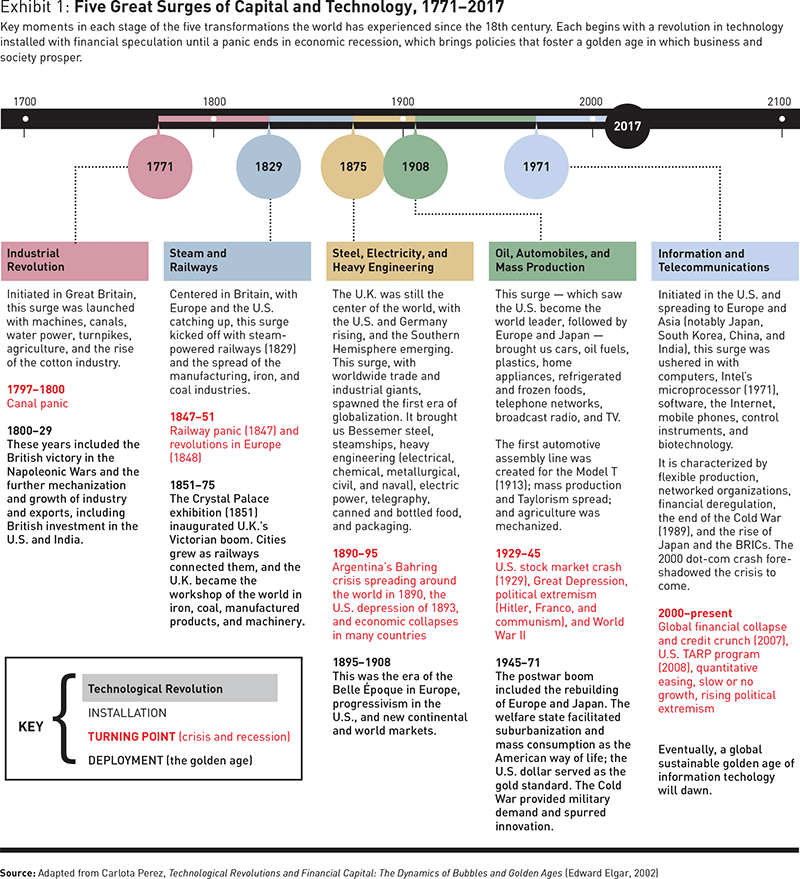
This may seem far-fetched, but it’s happened four times before. We are in the midst of the fifth great surge (as Perez calls them) of technological and economic change since the Industrial Revolution. The last one, the age of oil, automobiles, and mass production, lasted most of the 20th century and still shapes many people’s attitudes. Our current surge started around 1970 and has rolled out information and communications technology around the world: It is the age of the computer and the Internet (see Exhibit 1).

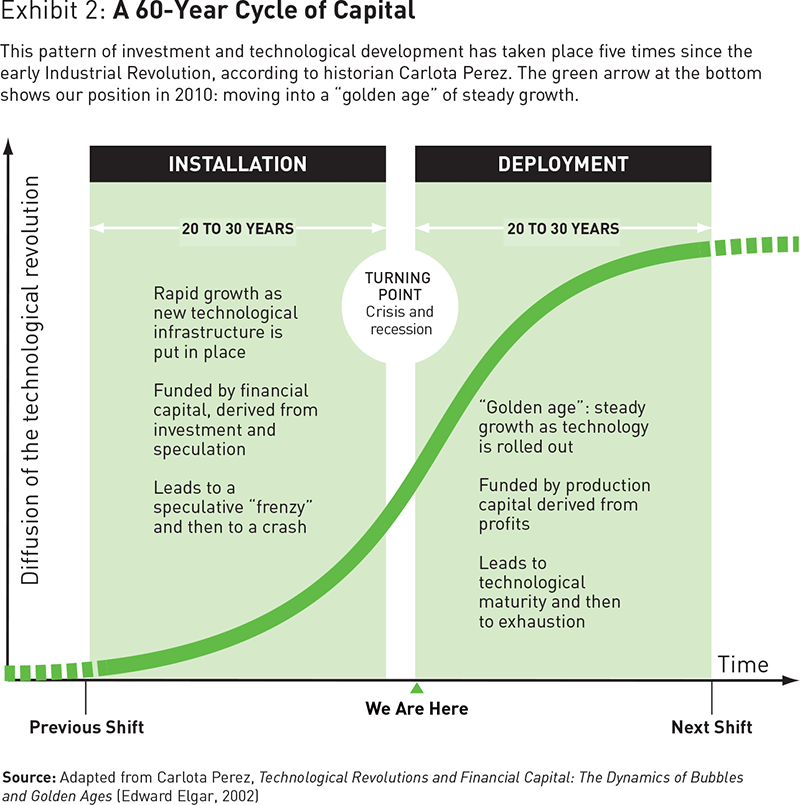
Each of these surges follows the same broad pattern. First, there is a wave of major new technologies, leading to dramatic changes in industrial production and daily life. For about 20 to 30 years, in a period that Perez calls installation, these technologies are funded largely by speculative investment chasing rapid returns. This age of widening wealth disparity leads to a bubble, which bursts in spectacular fashion, and is followed by a crisis period that Perez calls the turning point. This phase of economic and social turbulence has varied in length from two years to 17. Many efforts to get back to normal are made, usually involving the regulation of financial excesses or the stimulation of production and employment. When the crisis ends, the third part of the cycle begins; it consists of 30 years or so of stable economic growth, with a high level of genuine return on investment, and an economy funded by production capital, not speculation. Perez calls this period deployment. It is experienced as a golden age: a wave of prosperity, lifting everyone’s fortunes, including those who felt left behind just a few years before. Eventually, the technological opportunities reach exhaustion, markets become saturated, and the cycle starts all over again (see Exhibit 2).

Of course, these are broad observations, and nothing guarantees that the pattern will continue. But its overall logic is compelling. To Perez, the dramatically powerful technologies of Wall Street, Silicon Valley, and Industry 4.0 have provoked, in effect, a worldwide economic revolution, starting in the 1970s, challenging the equally powerful technologies of the fourth surge: oil, automobiles, and mass production. To turn the corner from crisis to golden age would require a major economic and political consensus: an intelligent global policy framework giving a convergent direction to investment and innovation, ensuring the growth of profitability and jobs around the world, including most major national economies. Not an easy task!

The participants in this roundtable were three longtime observers of the Perez hypothesis — including Carlota Perez. We met recently to consider this question: Given today’s political turbulence, after at least 10 years of being in the crisis phase, what would have to happen for a new golden age to begin?

—Art Kleiner

Causes of the Current Crisis

KLEINER: Carlota, according to your theory, we’re now about 45 years into a surge that began in the early 1970s. That’s the longest such cycle we’ve seen — and the longest period of crisis.
PEREZ: It’s probably also the deepest transformation of everyday life, and the one that has gone the furthest globally. Also, given our longer life span, the older generation has taken longer to hand over power — in this case, to younger digital natives. Even after 40 years, the information and communications technology (ICT) revolution is far from complete. It hasn’t fully changed our way of life, as previous technological revolutions had done. And it has brought a dangerous political shift, the separation of the interests of major global corporations from interests of the national societies where they are based.

To turn the corner from crisis to golden age would require a major economic and political consensus.

During the golden age of mass production, in the 1950s and early 1960s, the interests of business and society converged. With the welfare state and suburbanization, working-class people in many Western countries could become homeowners and consumers. Therefore, when companies paid high salaries and high taxes, it all contributed to increasing domestic demand. Government support for education and health services freed up discretionary cash for people to spend on consumer products. High demand for these products created conditions for growth and profit. It was a robust positive-sum game, a super win-win between business and the majority of the population, resulting in good profits and decent livelihoods.

Then, in the 1970s, the mass production revolution hit a maturity ceiling. New products were less viable; productivity fell; markets were saturated. The welfare state became unsustainable, and national solidarity broke down. Since then, many businesses have seen their cost advantage and their customer demand migrate abroad, away from their home countries. Low salaries no longer harm business as in the past, so living standards have been declining for decades. This, together with unemployment from offshoring, goes far in explaining the Brexit referendum and the fervor of the U.S. elections in 2016.

JOHNSON: A factor that may intensify those tensions is the nature of today’s technology. We have an amazing arsenal of innovations on the threshold of realization: synthetic biology, quantum computing, blockchain, drones, autonomous vehicles, and private-citizen space travel. Potential breakthroughs are dangled before us.

But as Kentaro Toyama, the former Microsoft research director, says: “Technology is not the answer…. In project after project…information technology amplified the intent and capacity of human and institutional stakeholders, but it didn’t substitute for their deficiencies.”

The key question is the intent with which we deploy this new arsenal of technologies. And in a capitalist economy, there are two critical issues. Does an endeavor aim to increase productivity, and thus create wealth? And does it then aim to distribute that wealth among the many, rather than concentrate it among the few?

PEREZ: Those two things — wealth creation and distribution — must be combined. The new technology giants, like Google, Facebook, and Apple, along with others developing robotics and similar technologies, will comprise the highest-productivity sectors. That’s understood. But they won’t lead us to a more decent society unless they encourage distribution. Otherwise, they are unacceptable monopolies. It’s not just redistributing income that’s needed, but also fostering multiple novel job-creating activities, which historically have been associated with changes in lifestyles. (In the fourth surge, suburban living led to new jobs in retail and many other services.)

JOHNSON: I think the choice facing society is between closed economies, highly concentrated and unequal, and open economies, with decentralized ownership. But how willing are governments and large commercial institutions to break through their institutional lock-in to address these problems?

Continue reading Are We on the Verge of a New Golden Age?

The Danger of Knowing You’re on the ‘Right Side of History’” by Andrew Sullivan

Many Democrats found ways to defend the indefensible because the cause demanded it. Photo: New York Daily News Archive/NY Daily News via Getty Images


November 17, 2017 (NYMag.com)

I have to say I was deeply moved by the New York Times op-ed yesterday by an evangelical law professor from Alabama. The piece, by the wonderfully named William S. Brewbaker III, moved me because it was the first genuinely Christian thing I’ve heard an evangelical say about the Roy Moore scandal. It did more than renounce the tribalism that has led so many alleged Christians to back Moore; it presented Christianity, properly understood, as the core alternative to tribalism, as one way out of tribalism’s dead end. Brewbaker’s critical and deeply evangelical point:

To begin with, sin is a problem from which no one is exempt. If God’s love required the suffering and death of the Son of God in order to redeem us, we should not underestimate the consequences of sin in our own lives. The world is not divided into “good people” and “bad people”; to quote St. Paul, “all have sinned and fall short of the glory of God.” Or, as the Russian novelist Aleksandr Solzhenitsyn wrote, “the line separating good and evil passes not through states, nor between classes, nor between political parties either, but right through every human heart, and through all human hearts.”

It is thus wrong to attack one’s critics, as Mr. Moore did recently on Twitter, as “the forces of evil” and attribute their questions about serious allegations to “a spiritual battle.”

This is not just an evangelical truth. It is deeply embedded in all of Christianity. No party, no cause, no struggle, however worthy, is ever free from evil. No earthly cause is entirely good. And to believe with absolute certainty that you are on “the right side of history,” or on the right side of a battle between “good and evil,” is a dangerous and seductive form of idolatry. It flatters yourself. And it will lead you inevitably to lose your moral bearings because soon, you will find yourself doing and justifying things that are evil solely because they advance the cause of the “good.” These compromises can start as minor and forgivable trade-offs; but they compound over time. In the Catholic church, the conviction that the institution could do no wrong, that its reputation must endure because it represented the right side in the struggle against evil … led to the mass rape of children and teens.

The religious right’s embrace of Trump is of a similar trope. It is not some kind of aberration in the transformation of a faith into a worldly and political cause, it is its logical consequence. The Christian right’s support for a sociopathic, cruel, and vulgar pagan was inevitable, in other words, from the moment the Moral Majority was born. If politics is fused with religion, and if your opponents are deemed evil, then almost anything can be justified to defeat them. Sooner or later, you’l find yourself defending the molestation of a minor. Which is why I have long refused to call this political movement Christian, but Christianist. It is not about faith; it is about power.

But evangelical Republicans are not, of course, the only group susceptible to such corruption. Democrats are human as well, as we have so abundantly discovered. Many of them have also made their political struggle into a secular form of religion, and found myriad ways to defend the indefensible because the cause demanded it. I vividly remember Gloria Steinem’s op-ed defending Bill Clinton’s sex abuse at the time (she still refuses to disown it). I remember how many wanted to conflate sexual abuse with private consensual sex. I also recall a bizarre very-Washington lunch in that period when, for some reason, I was seated next to Barbra Streisand (my first and thankfully last encounter with the singer). I mentioned Paula Jones’s lawsuit — which I’d just defended in the pages of The New Republic — just to see what she’d say. Streisand’s lip curled. “Ugh,” she scoffed. “She’s a little kurva.” I later discovered that this means “whore,” “bitch,” or “slut.” And that was by no means an unusual Democratic response of the time.

And so the other op-ed I was impressed by this week was Michelle Goldberg’s beginning of a reckoning with the toxic legacy of the Clintons. In the age of Weinstein and Trump, Spacey and Moore, it has suddenly dawned on many that Bill Clinton’s history is, well, “problematic.” Goldberg is particularly troubled (and rightly so) by the case of Juanita Broaddrick. Broaddrick claims she was callously raped by Bill Clinton many moons ago, and her story was at first repressed by NBC (until after the Senate vote to acquit Clinton) and then dismissed or forgotten by the mainstream media. Eighteen years later, Goldberg now believes Broaddrick’s core story. Here’s the nub of the encounter in a hotel room. First he kisses her and is rebuffed; then:

“[H]e tries to kiss me again. And the second time he tries to kiss me he starts biting my lip … He starts to, um, bite on my top lip and I tried to pull away from him. And then he forces me down on the bed. And I just was very frightened, and I tried to get away from him and I told him ‘No,’ that I didn’t want this to happen but he wouldn’t listen to me. … It was a real panicky, panicky situation. I was even to the point where I was getting very noisy, you know, yelling to ‘Please stop.’ And that’s when he pressed down on my right shoulder and he would bite my lip. … When everything was over with, he got up and straightened himself, and I was crying at the moment and he walks to the door, and calmly puts on his sunglasses. And before he goes out the door he says ‘You better get some ice on that.’ And he turned and went out the door.”

Hard to get that phrase out of your mind once you’ve heard it, isn’t it?

Three weeks later, Broaddrick attended a small fundraiser for the Clintons. She said she was too ashamed to grapple with what happened, and felt guilty for letting Clinton meet her in her hotel room in the first place — classic patterns of a sexual victim. A friend of hers had picked up the Clintons at the airport and Hillary Clinton had asked her friend if Broaddrick would be at the event. Broaddrick recounted that, at the fundraiser, Hillary sought her out, took her hand and said, “I just want you to know how much Bill and I appreciate what you do for him.” When Broaddrick removed her hand, Clinton held on to it, looked her right in the face, and reiterated: “Do you understand? Everything that you do.” Broaddrick had no doubt in her mind what Hillary was conveying to her. She was thanking her for staying silent.

I believe Broaddrick on this part of the story as well. Goldberg, tellingly, doesn’t. As soon as Broaddrick’s story starts to impose on today’s tribal loyalties, and possibly impugn Hillary, it loses credibility. Suddenly, Broaddrick’s account is “wildly unlikely.” Broaddrick was obviously misreading Hillary’s remark, Goldberg speculates. “Most reporting about the Clinton marriage shows Bill going to great lengths to hide his betrayals.” On the question of Bill Clinton’s decades-long history of sexual abuse, Goldberg implies, Hillary Clinton had absolutely no idea what was going on.

And yet this is what Goldberg also believes about Hillary Clinton: that she’s an intelligent, shrewd political operator; a woman who pioneered the notion of a First Lady as co-president; someone intimately involved in every aspect of her husband’s career and campaigns; supremely attuned to what her enemies could use against her; a wife whose televised defense of her husband’s account of his sexual past in the primary season saved his career; a master of detail and strategy; worldly because she had to be. And yet at the same time, Goldberg believes that Hillary knew nothing about her political partner’s history of abusing, harassing, and exploiting women, was for decades a staggering naïf, and not an equal partner, was kept out of the information loop all along, and shocked, shocked, every time one of these bizarre accusations emerged. Well, I guess that’s possible. Just “wildly unlikely.”

There’s another thing we know about Hillary Clinton. She believed her whole life that she was on the side of the good, that her cause was just, that politics had to be dirty at times, but that advancing legislation to support women, and becoming the first woman president would make it all worthwhile. She was always for women, remember, for their dignity and equality. She was a feminist pioneer. She sacrificed so much for women and children, faced down such constant misogyny, and yet persisted through sexist hell. Her devoted followers believe all of that. It was the core message of her campaign last year. But the “line between good and evil passes not through states, nor between classes, nor between political parties either, but right through every human heart.” Even your idol’s. Perhaps especially your idol’s.

There is a moment here. No party is immune from evil; no tribe has a monopoly of good. If these bipartisan sex-abuse revelations can begin to undermine the tribalism that so poisons our public life, to reveal that beneath the tribes, we are all flawed and human, they may not only be a long-overdue turning point for women. They may be a watershed for all of us.

Rethinking Civilization

I’ve been reading one of those rare books that really changes your worldview — or somehow crystallizes where your mind has been trending. It’s called Against the Grain, an account of the emergence of the earliest states in human civilization, around 6,000 years ago. James C. Scott, of Yale, summarizes and synthesizes much of what we have discovered in the past 20 years about this period, as humans slowly transitioned from our hunter-gatherer tribes into the earliest agricultural settlements.

The usual narrative is that this was progress, the use of intelligence to finally better our lot, leading to writing and culture and politics and what we call civilization. But that drastically misreads much of the evidence. It’s increasingly clear that the shift toward “sedentism,” settling down in one place to grow crops and fence off animals, was a disaster for human beings. Our health declined sharply; our average height diminished; our diet worsened. The immense variety of the meat and berries and vegetation that had long provided us with a healthy diet became suddenly constrained to far fewer wheats and grains. A less diverse source of food made us more vulnerable to famines, when harvests failed; and the first devastating epidemics emerged, caused by the crowding of humans and animals into spaces they had not evolved to live in, and a mixing of populations once kept apart.

And the evidence shows that most humans at the time were understandably unimpressed. The persistence of hunter-gatherer communities throughout the early state era — and their healthier, more leisurely, and just as intelligent lives — made many suspicious of the new way of life. They weren’t starving; their hunting techniques required sophisticated skills, planning, and coordination; they had far more time to goof off than their successors, who found themselves pressed into monotonous drudgery on the same strips of land.

But for a few, the new order gave them extraordinary power. Control the territory and you control a lot. And so civilization begins with exploitation, hierarchy, and control. The relative egalitarianism and intergenerational communities of human society for over 190,000 years slowly attenuated. Slavery soon emerged as a way to maximize labor and power. Walls were built around these settlements not to keep “barbarians” out but to keep the enslaved or controlled inside. The deeper you read into the book, and mull its research, the harder it is to ignore the possibility that modern civilization has, in one respect, been a gigantic, species-level mistake, a bid for power and mastery over nature and other human beings that has led to stunning achievements, but also untold misery and suffering.

Continue reading The Danger of Knowing You’re on the ‘Right Side of History’” by Andrew Sullivan

“Our Children’s Children?” by Robert McEwen, H.W., M.

Will there be a planet for them?  It is up to us.
Human Survival on the Planet is at a tipping point of becoming extinct. Sagittarius Nature Alert…  The Natural World that human beings must have to be and remain human is vanishing rapidly.

Please give your translations, hope and energy to this place at which time you connect to it and receive the magic and endless possibility of infinity.  Share your concern and bring this up in conversation with friends and your actions.  It is up to this generation to make the difference of there being a planet that humans can live and thrive on for our children, and our children’s children.”

“Thank you for this moment of consideration of this serious matter of human survival, the animals, and the planet.”

R.W. McEwen, H.W., M.

SUNDAY NIGHT TRANSLATION GROUP — NOVEMBER 19, 2017

To quote Mike Zonta, H.W., M., “Translation is ‘magical thinking’  based on self-evident axioms and syllogistic reasoning (which is so say that Translation is not magical thinking at all).”  And to quote Heather Williams, H.W., M., “Translation is the creative process of re-engineering the outdated software of your mind.” Translation  is a 5-step process using words and their meanings and histories to transform the testimony of the senses and uncover  the underlying timeless reality of the Universe.

Sense testimony:

The Lives of Helen Schucman & William Thetford

The Lives of Helen Schucman & William Thetford

Full Title: A Course In Miracles: The Lives Of Helen Schucman & William Thetford

“This is the story of how two unlikely persons, both Ph.D. research psychologists at Colombia University, produced a channeled spiritual teaching which was unlike any of the professional psychological work upon which they built their academic careers. Neither of them felt completely comfortable with their role, and neither fully understood how it was that they became engaged in this unlikely endeavor.” From the Preface.

Neal Vahle has vast experience writing biographies of noted spiritual founders. He is also the author ofOpen At The Top: The Life of Ernest HolmesTorch-Bearer to Light the Way: The Life of Myrtle Fillmore; and The Spiritual Journey of Charles Fillmore. He served as editor of New Realities and Unity Magazineand holds a doctorate in American History from Georgetown University. He brings all of this experience to this excellent and thorough biography of Helen Schucman and William Thetford.

I thoroughly enjoyed reading Neal Vahle’s biography of Helen Schucman and Bill Thetford, which describes their collaboration in producing A Course in Miracles. Though I knew Helen and Bill, and much of the story, this book fills in many of the missing pieces. — Rev. Jon Mundy Ph.D., The Institute for Personal Religion

Although I have heard stories about Helen and Bill, this book reveals them to be both complex and inspiring. The author presents a fascinating story of their acceptance of this extraordinary teaching, and the effect the Course had on their lives. The last pages of this book are an inspiration to us all. — Linda Carpenter, student and teacher of A Course in Miracles.

Neal Vahle’s stimulating account of the struggles of two academics to bridge the realities of their professional lives and their new found revelations makes fascinating reading. This book will be of great interest to students of the Course and the general reading public. — Joseph T. Schultz, Director of the Center for Religious Studies, Emeritus, University of Missouri, Kansas City.

I was intrigued when asked to review the manuscript of this book by Neal Vahle, and very satisfied when I finished reading it. At last we have the kind of objective information we would expect from a professional historian! — Charles T. Tart, Professor of Psychology, Emeritus, University of California, Davis.

By Neal Vahle

Rising inequality charted across millennia

Hunter-gatherer societies typically had low wealth disparities. Their mobility would make it hard to accumulate wealth. (stock image)
Credit: © Rafal Cichawa / Fotolia

Findings have profound implications for contemporary society

November 15, 2017 (Washington State University)

Researchers at Washington State University and 13 other institutions have found that the arc of prehistory bends towards economic inequality. In the largest study of its kind, the researchers saw disparities in wealth mount with the rise of agriculture, specifically the domestication of plants and large animals, and increased social organization.

Their findings, published this week in the journal Nature, have profound implications for contemporary society, as inequality repeatedly leads to social disruption, even collapse, said Tim Kohler, lead author and Regents professor of archaeology and evolutionary anthropology at Washington State University. The United States, he noted, currently has one of the highest levels of inequality in the history of the world.

“Inequality has a lot of subtle and potentially pernicious effects on societies,” Kohler said.

The study gathered data from 63 archaeological sites or groups of sites. Comparing house sizes within each site, researchers assigned Gini coefficients, common measures of inequality developed more than a century ago by the Italian statistician and sociologist Corrado Gini. In theory, a country with complete wealth equality would have a Gini coefficient of 0, while a country with all the wealth concentrated in one household would get a 1.

The researchers found that hunter-gatherer societies typically had low wealth disparities, with a median Gini of .17. Their mobility would make it hard to accumulate wealth, let alone pass it on to subsequent generations. Horticulturalists — small-scale, low-intensity farmers — had a median Gini of .27. Larger scale agricultural societies had a media Gini of .35.

To the researchers’ surprise, inequality kept rising in the Old World while it hit a plateau in the New World, said Kohler. The researchers attribute this to the ability of Old World societies “to literally harness big domesticated mammals like cattle and eventually horse and water buffalo,” Kohler said.

Draft animals, which were not available in the New World, let richer farmers till more land and expand into new areas. This increased their wealth while ultimately creating a class of landless peasants.

“These processes increased inequality by operating on both ends of the wealth distribution, increasing the holdings of the rich while decreasing the holdings of the poor,” the researchers write.

The Old World also saw the arrival of bronze metallurgy and a mounted warrior elite that increased Ginis through large houses and territorial conquests.

The researchers’ models put the highest Ginis in the ancient Old World at .59, close to that of contemporary Greece’s .56 and Spain’s .58. It is well short of China’s .73 and the United States .80, a 2000 figure cited in the Nature paper. The 2016 Allianz Global Wealth Report puts the U.S. Gini at .81 and Kohler has seen the U.S. Gini pegged at .85, “which is probably the highest wealth inequality for any developed country right now.”

This worries him for several reasons.

Societies with high inequality have low social mobility. Kohler pointed to a Science paper from earlier this year that found rates of mobility have fallen from 90 percent for U.S. children born in 1940 to 50 percent for children born in the 1980s. The results, wrote the researchers, “imply that reviving the ‘American dream’ of high rates of absolute mobility would require economic growth that is shared more broadly across the income distribution.”

Other studies have found that unequal societies tend to have poorer health, while more equal societies have higher life expectancies, trust and a willingness to help others, said Kohler.

“People need to be aware that inequality can have deleterious effects on health outcomes, on mobility, on degree of trust, on social solidarity — all these things,” he said. “We’re not helping ourselves by being so unequal.”

Decreasing inequality is extremely difficult and usually comes about through plague, revolution, mass warfare or state collapse, according to The Great Leveler, a new book by Stanford University’s Walter Scheidel. Kohler himself has documented four periods of mounting inequality among the ancient Pueblo people of the American Southwest, with each ending in violence and greater equality. The last one coincided with the complete depopulating of the Mesa Verde area.

“In each case, you see not just this decline in Gini scores, but we also see an increase in violence that accompanies that decline,” Kohler said. “We could be concerned in the United States, that if Ginis get too high, we could be inviting revolution, or we could be inviting state collapse. There’s only a few things that are going to decrease our Ginis dramatically.”

Story Source:

Materials provided by Washington State University. Original written by Eric Sorensen. Note: Content may be edited for style and length.