Zombie Protesters Descend On Hamburg Germany G20 Meetings To Protest Public Apathy


Hundreds of demonstrators staged a protest in Hamburg’s city center ahead of the G20 summit on Wednesday. The protest was organized by the artistic group ‘1000 GESTALTEN’ (1000 Figures) in order to show ‘a symbol for our society and a symbol that they feel excluded from the political process only look out for themselves, only consume and don’t stand for each other.’ The figures represented a dog-eat-dog society in which belief in solidarity has been lost. The performers called for more humanity and individual responsibility.

(Courtesy of Bob of Occupy.)

“What is the Translation?” by Robert McEwen, H.W., M.

     When all is seen through the eyes of the  detached universal intelligence,  life looks very different.  There is no report to mind of good or bad, or sense testimony of any kind.  All is neutral.  You are 100% indifferent to the conclusion mind reaches.  In that crystal clarity you experience cosmic consciousness for a split second.
 
     This is an intervention from error.  An interventions of our  mind process takes place in a nano second.  No time to stop the conclusions.  It is an instant call.  To intervene one has to impinge the Truth upon conscious and unconscious processes by being proactive.  It is a preventative to prejudice through asking about conclusions first.   It is a kind of intervention to avoid erroneous premises and conclusions.
 
    So, what do I ask?  I ask myself what evidence do I have to prove that lack of anything is true?  I found lots.  And I found many with more than enough, so not much lack in that crowd.  In any event, any person, place or thing can be translated from the sense report back into consciousness.
 
     Look at the sense reports, and what that evidence screams at consciousness.  Then, compare that sense report to the absolute truth principles.  This is the process of what we call Translation.  
 
     Translation is straight thinking in the abstract.  
 
     I have found this awareness technology gets outstanding and surprising results.  It is a kind of miraculous but ontological pragmatic conscious tool.  Some call it scientific prayer.  I find it wonderful because it works. 
 
     To learn it just let The Prosperos or the Bathtub Bulletin know you want to know where and when it is being taught.  We can accommodate interested seekers for Truth.
 
Robert McEwen
503 706-0396 (text)

The “hard problem” of consciousness

Philosopher David Chalmers on consciousness, the hard problem and the nature of reality

Posted yesterday at 9:25pm

Fittingly for someone dedicated to pondering the puzzle posed by consciousness, philosopher David Chalmers possesses an unusual and fascinating mind.

For a start, he excelled at maths when he was young, earning a bronze medal at the fiendishly cryptic International Mathematical Olympiad.

“I had a very strong interest in the sciences in general, but maths was number one,” he said. “Philosophy — I don’t think I really knew what it was at that point.”

As a boy he also had synaesthesia, meaning that music produced strong colour sensations in his mind.

An MRI scan of a man's brain

“A lot of things were just kind of boring greens and browns but every now and then something would be bright red. I remember Here, There and Everywhere by The Beatles was bright red.”

Professor Chalmers, who was born in Sydney and brought up in Adelaide, today works out of New York University and is one of the world’s pre-eminent philosophers of mind, best known for breathing new life into an old conundrum.

He calls it the hard problem of consciousness.

Simply put, the hard problem asks the following question: how can the machinery of the brain (the neurons and synapses) produce consciousness — the colours that we see, for example, or the sounds that we hear?

Look at a brain scan and you will see nothing resembling consciousness. Brains, in fact, do not appear particularly remarkable — which makes the fact that they are even more exceptional.

“The really hard problem of consciousness is the problem of experience,” Professor Chalmers wrote in a landmark 1995 paper. “When we think and perceive, there is a whir of information-processing, but there is also a subjective aspect.”

“It is widely agreed that experience arises from a physical basis, but we have no good explanation of why and how it so arises. Why should physical processing give rise to a rich inner life at all? It seems objectively unreasonable that it should, and yet it does.”

In short, why should moving parts produce perception and sensation? And why should only brains (as far as we know) be responsible for consciousness?

Car engines are sophisticated systems, albeit far less complicated than brains, yet not one has ever shown the vaguest inclination of wanting to drive.

To claim that pain is nothing more than a configuration of molecules in our heads seems to ignore the fact that pain actually hurts.

In the 1950s, philosophers at the University of Adelaide were at the forefront of attempts to tackle such problems. A later generation of so-called eliminative materialists (most notably Patricia and Paul Churchland) were more radical.

Eliminativists claim that brain states do not merely generate conscious experiences, but literally are them. Daniel Dennett, who debated Professor Chalmers in a now notorious showdown in the Arctic Circle funded by a Russian entrepreneur, has even claimed that consciousness itself is an illusion.

The reality of experience, however, tends to refute this idea.

It seems that there is a hole in our scientific picture of the world, what philosopher Joseph Levine called an “explanatory gap”.

When I spoke to Professor Chalmers ahead of his recent talk at the Australasian Association of Philosophy, he went so far as to call the hard problem “the number one unanswered scientific challenge of our time”.

Sci-fi and the path to philosophy

Professor Chalmers grew up in a house filled with books. An avid reader, he was drawn to the science fiction of Asimov, Heinlein and Arthur C. Clarke.

Those authors posed deep questions about the world, about reality, and about the relationship between human beings and machines.

“The problem of consciousness certainly comes up from thinking about robots,” Professor Chalmers said.

David Chalmers

“Could a robot be conscious in the way that a human being is, or do you need a special biology to be conscious? I was always on the side of the robots. That’s not to say there’s no mystery about consciousness.”

Professor Chalmers went to Unley High School where he was a few years behind former prime minister Julia Gillard. At university, he studied mathematics — first in Adelaide, then at Oxford.

An encounter with Douglas Hofstadter’s classic book Godel, Escher, Bach deepened his burgeoning passion for philosophy, and he decided to switch fields.

“I had zero demonstrated talent at philosophy so there was no particular reason to think I’d be any good at it. It was a bit of a leap of faith.”

He recalls a conversation he had with his father, who was a professor of medicine at Flinders University, as he was making the transition.

“He was a bit worried about the whole philosophy thing,” Professor Chalmers said. “He’s a scientist … and then for me to be wanting to be veering off into philosophy.

“He told me ‘don’t tell me you’re going to spend your life looking for the soul!'”

Panpsychism and the fundamental laws of consciousness

Professor Chalmers believes one possible answer to the hard problem is a view known as panpsychism. It sounds spiritual, but it isn’t.

According to panpsychism, consciousness may be a fundamental property of reality in the same way as space and time.

“We’re not going to reduce consciousness to something physical … it’s a primitive component of the universe,” he said.

“But that frees us up to search for the fundamental principles that govern it. In physics, we don’t try and explain space and time in terms of more fundamental things. We just find the laws that govern them.”

Professor Chalmers retains a love of science, despite the hostility sometimes shown by scientists towards his own discipline. In recent years, theoretical physicists have been especially critical of philosophy. Lawrence Krauss is one. Stephen Hawking is another.

“You get a few people with strongly expressed opinions about this,” he said. “Often they don’t know so much about philosophy. Certainly Stephen Hawking doesn’t.

“A lot of the great philosophers of the 20th century have actually been scientists. Einstein was a great philosopher in his way, as well as people like Heisenberg and Schrodinger. Some of the best philosophical conversations I’ve had have been with scientists.”

Neuroscientist Giulio Tononi is among those to have piqued Professor Chalmers’ interest. Dr Tononi has developed what has come to be known as Integrated Information Theory, which attempts to measure consciousness using maths.

Professor Chalmers does not believe Dr Tononi has solved the hard problem, but thinks he may be closing in on significant new insights about the connections between mind and matter.

“He takes the attitude of presupposing the existence of consciousness as basically a fundamental component of reality, as I do, and [tries to] find the fundamental laws that link it to physical processing,” Professor Chalmers said.

“For him, these principles that connect integrated information and consciousness are kind of like fundamental laws of physics, and that’s roughly the view that I think you have to take too.”

Lately, Professor Chalmers has been thinking about technology and virtual reality, and whether we are all living in some kind of simulation.

He is far from alone in flirting with the idea — technologist Elon Musk, nuclear physicist Zohreh Davoudi, philosopher Nick Bostrom, futurist Ray Kurzweil and cosmologist Alan Guth are all enthusiasts.

Unsurprisingly, Professor Chalmers invokes The Matrix. But it is a train of thought that has taken him into the realm of current affairs.

Professor Chalmers has speculated that recent seismic political events may be evidence of the mischief, or cruelty, of whoever has programmed our universe.

“I started joking around saying ‘various things have been happening lately — Donald Trump, Brexit’,” he said.

“[Maybe] the simulators are just messing with us. Maybe someone thought at one point ‘let’s just run a simulation on the counterfactual hypothesis — what if Donald Trump had been elected?'”

During my interview with Professor Chalmers, I suggested that incessantly thinking about the mind, the brain and the nature of reality was enough to drive anyone mad. But as we were getting up to leave, I asked him more seriously whether there would come a point in his life when he would accept he would never answer the hard problem. Could he simply let it go?

“I’m an optimist so I would like the problem to be solved,” he replied.

“It could be decades. It could be centuries. At the end of the day, it’s possible we’ll never have a satisfactory solution but I don’t think we’re yet in a position to say that.

“Maybe once we develop amazing artificial intelligences they’ll be better than us at everything, including philosophy. Maybe they’ll be the ones that come up with a solution.”

“In Neanderthal DNA, Signs of a Mysterious Human Migration” by Carl Zimmer Carl Zimmer

Part of a femur, or thigh bone, from a Neanderthal that was discovered in the Hohlenstein-Stadel cave in Germany. CreditOleg Kuchar/Museum Ulm

July 4, 2017 (nytimes.com)

With fossils and DNA, scientists are piecing together a picture of humanity’s beginnings, an origin story with more twists than anything you would find at the movie theater.

The expert consensus now is that Homo sapiens evolved at least 300,000 years ago in Africa. Only much later — roughly 70,000 years ago — did a small group of Africans establish themselves on other continents, giving rise to other populations of people today.

To Johannes Krause, the director of the Max Planck Institute for Human History in Germany, that gap seems peculiar. “Why did people not leave Africa before?” he asked in an interview. After all, he observed, the continent is physically linked to the Near East. “You could have just walked out.”

In a study published Tuesday in Nature Communications, Dr. Krause and his colleagues report that Africans did indeed walk out — over 270,000 years ago.

Then the ancient African migrants disappeared. But some of their DNA endured in later generations of Neanderthals.

“This is now a comprehensive picture,” Dr. Krause said. “It brings everything together.”

Since the 1800s, paleontologists have struggled to understand how Neanderthals are related to us. Fossils show that they were anatomically distinct, with a heavy brow, a stout body and a number of subtler features that we lack.

The oldest bones of Neanderthal-like individuals, found in a Spanish cave called Sima de los Huesos, date back 430,000 years. More recent Neanderthal remains, dating to about 100,000 years ago, can be found across Europe and all the way to southern Siberia.

Then, 40,000 years ago, Neanderthals vanish from the fossil record.

As a graduate student in the mid-2000s, Dr. Krause traveled to museums to drill bits of bone from Neanderthal fossils. In some of them, he and his colleagues managed to find fragments of DNA that they could study.

Photo

Excavations at the entrance of the Hohlenstein-Stadel cave in 1937, the year when the Neanderthal femur was found. CreditMuseum Ulm

Scientists who study ancient genes search for two kinds of genetic material. The vast majority of our genes are in a pouch in each cell called the nucleus. We inherit so-called nuclear DNA from both parents.

But we also carry a small amount of DNA in the fuel-generating factories of our cells, called mitochondria. We inherit mitochondrial DNA only from our mothers, because a father’s sperm destroys its own mitochondrial DNA during fertilization.

Years ago, Dr. Krause and his colleagues started their search for ancient Neanderthal genes in a fossil by looking for mitochondrial DNA. After discovering mitochondrial DNA in some fossils, they later managed to find nuclear DNA.

The genes held some surprises. For example, bits of DNA in living people of non-African ancestry come from Neanderthals. When modern humans expanded out of Africa, they seem to have interbred several times with Neanderthals.

Those children became part of human society, passing on their genes.

But a finger bone and a tooth from a Siberian cave called Denisova left Dr. Krause and his colleagues with a baffling puzzle.

Inside those fossils, the scientists found sequences of mitochondrial DNA that were not human or Neanderthal, but something else — a distant branch of the family tree. The Neanderthal mitochondrial DNA was much closer to our own.

Later, the researchers managed to recover the nuclear DNA from the Denisovan finger bone, which showed Denisovans and Neanderthals were more closely related to each other.

As scientists found ancient DNA in more fossils, our history has come into sharper focus. Scientists now estimate that the common ancestor of modern humans, Neanderthals and Denisovans, lived between 765,000 and 550,000 years ago.

About 445,000 to 473,000 years ago, that common ancestor’s descendants split into two lineages. One eventually led to modern humans, while the other led to Neanderthals and Denisovans.

After years of investigation, however, Dr. Krause still did not understand why the nuclear DNA and mitochondrial DNA of Neanderthals seemed to have different histories. The former pointed to a link with Denisovans, the latter to humans.

Photo

The entrance to the Hohlenstein-Stadel cave seen recently. In 2013, a researcher examined a Neanderthal fossil from the cave and was able to reconstruct all of its mitochondrial DNA.CreditWolfgang Adler/Museum Ulm

The mystery only deepened in 2013. Another team of researchers retrieved mitochondrial DNA from a Neanderthal-like fossil at Sima de los Huesos, dating back 430,000 years.

The researchers had expected the DNA to resemble that of later Neanderthals in Europe. Instead, the mitochondrial DNA looked like it belonged to Denisovans — even though the Denisova cave was 4,000 miles away in Siberia.

Last year, the researchers announced they had gathered a small fraction of the nuclear DNA from the same Sima de los Huesos fossil. That genetic material looked like it belonged to a Neanderthal, not a Denisovan.

Dr. Krause and his colleagues have now discovered new Neanderthal DNA that they believe can solve the mystery of this genetic mismatch.

In 2013, one of Dr. Krause’s graduate students, Cosimo Posth, examined a Neanderthal fossil from a German cave called Hohlenstein-Stadel. He was able to reconstruct all of its mitochondrial DNA.

Dr. Posth estimated that the Neanderthal fossil was 120,000 years old and, more important, that it belonged to a branch of the Neanderthal family tree with a long history. He and his colleagues determined that all known Neanderthals inherited their mitochondrial DNA from an ancestor who lived 270,000 years ago.

All the data pointed to a sequence of events that could solve the puzzle that had bedeviled Dr. Krause for so long.

The common ancestors of Neanderthals and Denisovans spread across Europe and Asia over half a million years ago. Gradually the eastern and western populations parted ways, genetically speaking.

In the east, they became Denisovans. In the west, they became Neanderthals. The 430,000-year-old fossils at Sima de los Huesos — Neanderthals with Denisovanlike genes — capture the early stage of that split.

At some point before 270,000 years ago, African humans closely related to us moved into Europe and interbred with Neanderthals. Their DNA entered the Neanderthal gene pool.

Over many generations, most of that new DNA disappeared. But the mitochondrial DNA survived, passed down from mothers to their children. In fact, eventually all the Neanderthals inherited it, for some reason discarding the mitochondrial DNA that the species once had.

Dr. Posth said it was possible that early members of our own species moved from North Africa into Europe. Supporting this idea was the discovery reported last month of fossils of Homo sapiens in Morocco dating back 300,000 years.

But Dr. Posth said it was too soon to rule out another possibility: that these migrants belonged to another species in Africa closely related to us that scientists have yet to document.

“I feel uncomfortable to give a name to these humans,” Dr. Posth said.

Adam C. Siepel, a geneticist at Cold Spring Harbor Laboratory on Long Island who was not involved in the new study, said the hypothesis fit the evidence. “I think that’s absolutely possible,” he said.

The new study raises a host of tantalizing implications about human history.

It is not possible to know just how many times these early Africans interbred with Neanderthals. But somewhere in prehistory, at least one female human from Africa must have carried the child of a male Neanderthal.

“Now you have this hybrid child, which is probably pretty unusual-looking,” Dr. Siepel said. “One way or another, this hybrid individual was absorbed into Neanderthal society.”

Dr. Siepel warned that the hypothesis hinges on the new DNA found in the Hohlenstein-Stadel fossil. Dr. Krause and his colleagues are now trying to retrieve nuclear DNA from the fossil.

The research at Sima de los Huesos shows just how far back in time scientists can now search for genes. The most revealing DNA might come from the mountains of Morocco.

There, scientists may be able to find genes from the earliest Homo sapiens, which they can then compare to Neanderthals’.

“These are things that I never thought possible five years ago,” Dr. Krause said.

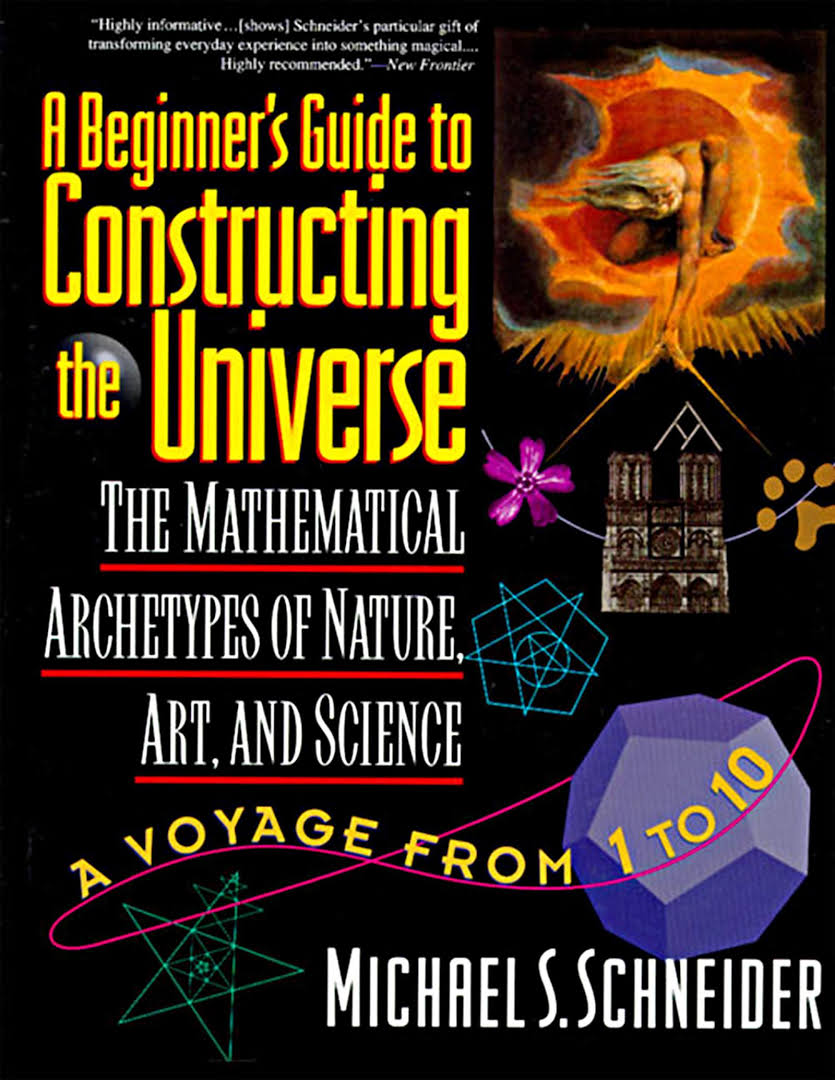
Book recommendation: “A beginner’s guide to constructing the universe: the mathematical archetypes of nature, art, and science” by Michael S. Schneider

HarperCollinsNov 10, 1994 – Mathematics – 351 pages
An imaginative tour of the numbers one through ten that illustrates how they consistently recur in everything from nature, technology, art, and science to mythology and the unconscious in archetypal patterns and principles. Richly illustrated with computer graphics and classical art.
(Google Books)
(Recommended by Robert McEwen, H.W., M.)

Spinoza’s “Ethics”

Ethics, Demonstrated in Geometrical Order (LatinEthica, ordine geometrico demonstrata), usually known as the Ethics, is a philosophical treatise written by Benedict de Spinoza. It was written between 1664 and 1665 and was first published in 1677.

The book is perhaps the most ambitious attempt to apply the method of Euclid in philosophy. Spinoza puts forward a small number of definitions and axioms from which he attempts to derive hundreds of propositions and corollaries, such as “When the Mind imagines its own lack of power, it is saddened by it”, “A free man thinks of nothing less than of death”, and “The human Mind cannot be absolutely destroyed with the Body, but something of it remains which is eternal.”

Summary

The first part of the book addresses the relationship between God and the universeTradition held that God exists outside of the universe, created it for a reason, and could have created a different universe if he so chose. Spinoza denies each point. According to Spinoza, God is the natural world. As with many of Spinoza’s claims, what this means is a matter of dispute. Spinoza claims that the things that make up the universe, including human beings, are God’s “modes”. This means that we and everything else are, in some sense, dependent upon God. The nature of this dependence is disputed. Some scholars say that the modes are properties of God in the traditional sense. Others say that modes are effects of God. Either way, the modes are also logically dependent on God’s essence, in this sense: everything that happens follows from the nature of God, just like how (as Spinoza puts it) it follows from the nature of a triangle that its angles are equal to two right angles. Since God had to exist with the nature he happens to have, nothing that has happened could have been avoided, and if a particular fate for a particular mode is fixed by God, there is no escaping it, or as Spinoza puts it, “A thing which has been determined by God to produce an effect cannot render itself undetermined.” God’s creation of the universe is not a decision, much less one motivated by a purpose.

Logical structure of the first six propositions of Spinoza’s Ethics

The second part of the Ethics focuses on the human mind and body. Spinoza attacks several Cartesian positions: (1) that the mind and body are distinct substances that can affect one another; (2) that we know our minds better than we know our bodies; (3) that our senses may be trusted; (4) that despite being created by God we can make mistakes, namely, when we affirm, of our own free will, an idea that is not clear and distinct. Spinoza denies each of Descartes’s points. Regarding (1), Spinoza argues that the mind and the body are a single thing that is being thought of in two different ways. The whole of nature can be fully described in terms of thoughts or in terms of bodies. However, we cannot mix these two ways of describing things, as Descartes does, and say that the mind affects the body or vice versa. Moreover, the mind’s self-knowledge is not fundamental: it cannot know its own thoughts better than it knows the ways in which its body is acted upon by other bodies. Further, there is no difference between contemplating an idea and thinking that it is true, and there is no freedom of the will at all. Sensory perception, which Spinoza calls “knowledge of the first kind”, is entirely inaccurate, since it reflects how our own bodies work more than how things really are. We can also have a kind of accurate knowledge called “knowledge of the second kind”, or “reason”. This encompasses knowledge of the features common to all things, and includes principles of physics and geometry. We can also have “knowledge of the third kind”, or “intuitive knowledge“. This is a sort of knowledge that, somehow, relates particular things to the nature of God.

In the third part of the Ethics, Spinoza argues that all things, including human beings, strive to persevere in their being. This is usually taken to mean that things try to last for as long as they can. Spinoza explains how this striving (“conatus“) underlies our emotions (love, hate, joy, sadness and so on). Our mind is in certain cases active, and in certain cases passive. In so far as it has adequate ideas it is necessarily active, and in so far as it has inadequate ideas, it is necessarily passive.

The fourth part, “Of Human Bondage,” analyzes human passions, which Spinoza sees as aspects of the mind that direct us outwards to seek what gives pleasure and shun what gives pain. The “bondage” he refers to is domination by these passions or “affects” as he calls them. Spinoza considers how the affects, ungoverned, can torment people and make it impossible for mankind to live in harmony with one another.

The fifth part, “Of Human Freedom,” argues that reason can govern the affects in the pursuit of virtue, which for Spinoza is self-preservation: only with the aid of reason can humans distinguish the passions that truly aid virtue from those that are ultimately harmful. By reason, we can see things as they truly are, sub specie aeternitatis, “under the aspect of eternity,” and because Spinoza treats God and nature as indistinguishable, by knowing things as they are we improve our knowledge of God. Seeing that all things are determined by nature to be as they are, we can achieve the rational tranquility that best promotes our happiness, and liberate ourselves from being driven by our passions.


Structure of reality

Spinoza’s original text of Ethica, Part 1

God or Nature consists of Attributes. God, as the complete system of Attributes, is absolutely infinite or complete; each Attribute is only infinite in its kind. By Attribute Spinoza means an ultimate or irreducible quality or energy. He names two such attributes, namely, Extension and Thought, but he allows for the possibility of an infinity of Attributes. The attributes do not belong to, but are identical with, Substance. Reality, moreover, is essentially dynamic, not static — to be is to be doing. Thus the Attribute Extension is really the whole of material energy, and the Attribute Thought is the whole of mind-energy. All material things and events are changing modes or states of Extension; and all mental events or experiences are similarly modifications or states of Thought. Each Attribute exhausts its kind of reality, in an ultimate character, activity or “world-line” of Nature, and gives rise to its entire series of objects and events in accordance with its own laws. These finite objects and events are real enough while they last, but as finite modes they change and pass; not, however, into mere nothingness, for the attribute, of which they are states, abides. The cosmic process never stops.

More at:  https://en.wikipedia.org/wiki/Ethics_(Spinoza)

“Thumbprints” by Suzanne Deakins, H.W., M.

As individual as our thumbprints so are our stories. In a sense our stories are karmic. Meaning they relate our past and consequences of our actions and sometimes our inactions. Since the election we have been crossing the desert of existential void. We each have formed and identity connected to each other. It does not matter if we have loved each other or disliked the other. An identity, a description of ourselves, is formed with each meeting. One of the most painful happenings in our lives is when part of our identity is taken away with death or departure of someone we know or an ideal we subscribe to tossed out.

I am a fan of Vicktro Frankl. His book “Man’s Search For Meaning,” has given me insight into my own grief and loss. Frankl lost his wife, his parents and writing during the holocaust. As a psychiatrist he began helping those in the concentration camp. He found what I have come to know is my strength. He found those who survive do because they found meaning and purpose in their life. Those who survived have a passionate love for a person or idea. He did not quantify this as having to be a kind of love, simply the ability to love and give their life meaning.

I don’t believe there is a punishing supreme being that penalizes and directs the course of my life. I don’t believe the universe is chaotic and without meaning or patterns of life. It is my experience that we give our life meaning by our very existence and our willingness to embrace our being as more than a frenzied second in the annuals of time.

With all loss and passing comes a sense of void. A dark place that is not familiar to us, a void. Somehow we are connected to this void and we inherently know this is an existential experience. In all religious texts, all stories written by great authors there is a sense of having to cross the sands of the existential void. The night of darkness where we cry out take me from this pain, and give me an answer why. In Christianity and many other religions this is seen as the 40 years in the desert spent by mosses, the 40 days spent by Jesus.  In each case the metaphors/archetypes bring the protagonist to a point of self-realization. Realizing that they alone can give meaning and love to their life.

In ontological terms this is the time when, we as individuals realize we alone are responsible for our life. How we react to life and accept our actions and reactions. Where we realize that like Job in the Bible we find we are indeed existential in nature connected to all life and therefore our brother’s keeper. Meaning we are responsible for all that appears in our consciousness and our reactions to it.

Like Joseph, of the many-colored coat, we arise above the land of blaming others or needing a supreme being and realize we control our destiny by our actions and reactions to the world around us.

Each of us handles grief and the leavings in life differently. There is no correct way, no happy way. Grief is a natural part of life. It can teach us compassion, love, and give us a hint of our very being. Like birth, death must be given a witness in our life in our consciousness. To give witness to death and birth is to acknowledge our very existential being, our connection to all life. It teaches us we are capable of great love and that each moment of life is ours to give meaning and purpose.

Suzanne Deakins is a High Watch Mentor, her books may be found on amazon.com She is also the publisher of One Spirit Press and The Q Press. She may be reached via email at suzannedeakins@gmail.com

Suzanne Deakins, Ph.D., H.W.M.

suzannedeak@gmail.com
503-954-0012

Blogs:  www.sacredpractices.com

Gene Luen Yang on coding

photography by Albert Law : www.porkbellystudio.com

“Coding is not about training students how to type into a computer.  That’s the least of it.  Coding is actually really about training students to think in a certain way.  It’s about training students to take a large and complex problems and break them up into small pieces. It’s about teaching students to take things that are vague, that are difficult to wrap your mind around, and putting them into concrete sequential steps.  And that sort of thinking, that sort of mental skill, is applicable no matter what you do in life.”

Graphic Novelist

“Has Science Conquered Metaphysics, and All of Philosophy?” by ANA SANDOIU

A visitor checks an art installation entitled ‘Mirror Room (Pumpkin)’ by Japanese artist Yayoi Kusama, part of the In Infinity art exhibition at the Moderna Museet, the Museum of Modern Art on August 31, 2016, Stockholm. (JONATHAN NACKSTRAND/A

July 4, 2017 (bigthink.com)

In the 1930s, a group of scientists and philosophers set out to destroy metaphysics. The so-called Vienna Circle accused metaphysics of being made of “pseudo-statements,” that is, a string of words that looks like a statement at first glance, but turns out to be completely bogus after more careful scrutiny.

Yet almost 90 years after the Vienna Circle—and over 2,000 years after Aristotle wrote the Metaphysics—the field doesn’t seem to be going anywhere. Some of its “pseudo-statements” may have been refuted by science in the meantime, but there are still many profoundly metaphysical questions that remain unanswered: What is consciousness? Do we have free will? Why is there good and evil? Until we’ve answered them, metaphysics can make a legitimate claim to the pantheon of human knowledge.

The literal meaning of the word “metaphysics” is “the ones after the physical ones.” This is what an editor of Aristotle’s work called the books which followed what we now call Aristotle’s Physics. The Stanford Encyclopedia of Philosophy notes that the title was probably meant to warn students of Aristotle’s work that they should read the Metaphysics only after they’ve grappled with the Physics.

Plato (left) and Aristotle (right) walking and discussing in Raphael’s Renaissance masterpiece, The Athens Schools located in the Apostolic Palace, Vatican City. (Wikimedia Commons)

But Aristotle himself did not see Metaphysics as coming second—if anything, for him it was at the beginning of everything. While Aristotle himself never used the term “metaphysics,” he referred to it the “first philosophy” or “first science.” Metaphysics came before everything else because it dealt with the first and most fundamental principles of life.  

But if metaphysics comes before physics, does that mean that the role of metaphysics is to inspire questions that we can later test in the physical world?

Some scientists (and philosophers) have claimed that science either already holds all the answers to metaphysical questions—or will soon do so—and that science, therefore, renders metaphysics useless. It’s not just the old Vienna Circle that deemed metaphysics pointless, but more recent public figures, such as Stephen Hawking or Neil deGrasse Tyson, seem to treat metaphysics with similar disregard.

In A Big Think video, Bill Nye, our favorite science guy, refers to some of the fundamental questions about consciousness when he quips “Drop a hammer on your foot and see if you don’t notice it.”

But questions such as “What is consciousness?” and its corollaries referenced by Nye (“How do we know that we know? Are we aware that we are aware? Is reality real?”) have not yet been fully answered by science. Even if we do agree that everything will ultimately be explained by science—a view some might deem scientist—we might still benefit from the intellectual freedom that metaphysics has to offer.

Of course, science has come up with beautiful explanations for many of the fundamental questions of metaphysics. Neuroscience can help us locate where in the brain occurs what is philosophically known as “the theory of mind.” Experiments using brain imaging techniques suggest that our decisions are made for us long before we think we made a choice, and the concept of “free will” is severely challenged.1 A scientific look at our fellow primates explains how morality may have come about, helping us decide if humans are fundamentally good, bad, or a combination of the two.

But, as any good scientist will know, answers only breed more questions.While science is helping us get closer to an answer, metaphysics helps us question that very answer once we have it.1

The deepest problems of metaphysics are still relevant, at least until science will have come up with a complete “theory of everything.” Until we have managed to reconcile quantum mechanics with relativity, we cannot say that we have the one and only accurate description of reality. Until we are able to integrate the hard problem of consciousness into our explanation of reality, we are not justified to mock those who wonder what is real. And until we have answered these questions, we are free to ask: what is reality?

Metaphysics provides a safe space for intellectual exploration, a blank canvas where human curiosity can freely express itself. At the beginning of each scientific process there is a fundamental question, which is usually metaphysical in nature. As some have put it, “science presupposes non-scientific knowledge,” and it is the role of the “first philosophy” to investigate these non-scientific presuppositions.