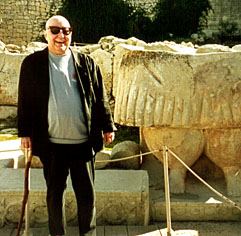
Biography: Marcia Herndon, H.W., M.

Herndon photo
Malta field trip, December 1996

Marcia Herndon died peacefully in the early hours of May 19, 1997. She struggled courageously with lupus and– more recently, with breast cancer– inspiring students and colleagues with her optimism and determination to heal. On Saturday, May 24, past and current graduate students met in Marcia’s home with Carolina Robertson and Billye Talmadge, Marcia’s life partner.The many “Marcia stories” narrated that day attested to the ways in which she impacted those around her. [Editor’s note: If you have a story about Marcia, please email it.]

A public memorial service will be held in the University of Maryland Chapel on September 30, 1997, the day before Marcia’s 56th birthday.Marcia was born in Canton, North Carolina, near the Cherokee community of her grandparents. After a career in organ and voice performance she pursued a Ph.D. in Anthropology/Ethnomusicology at Tulane University. She taught at the University of Texas at Austin and at the University of California at Berkeley. Before joining the University of Maryland faculty in 1990, she directed the Music Research Institute in the San Francisco Bay Area.

Her scholarship helped shape the field of ethnomusicology, especially in the areas of performance ethnography, gender issues, and Native American studies. Marcia was also the Metropolitan (head bishop) of the Ecumenical Catholic Church of America, and was especially dedicated to ordaining gay and lesbian priests.

She will be grieved and sorely missed in many communities.

“Mikhail Itkin: Tales of a Bishopric” by Ian Young (glreview.org)

“WHAT IS an Itkin anyway?” The rhetorical question was put to me as I was sitting in a Manhattan leather bar one summer night in the mid-1970’s. My companion that evening was apparently a pretty boy in full leather, actually an attractive young woman by the name of Dusty Verity, a former circus performer who had written me a fan letter the previous week and had now turned up at the Eagle’s Nest in very becoming drag. We were discussing mutual acquaintances and soon discovered that we both knew the notorious anarchist bishop, Mikhail Itkin. I was one of many names on his mailing list while Dusty was part of his small coterie of gay libbers and radical Christian activists.

Mikhail ItkinIt is often forgotten now that the rise of radical gay activism in the 70’s accompanied an upsurge of queer spirituality. The Metropolitan Community Church was founded in the late 60’s by Rev. Troy Perry (a pastor always more politically radical than most of his flock) and soon enjoyed a steady period of growth. Robert B. Clement’s Church of the Beloved Disciple established a flamboyant presence in New York City. The well-known civil rights activist and “coffee-house priest,” Father Malcolm Boyd, author of the best-selling Are You Running with Me, Jesus? (1965), came out of the closet with a bang. And the Rev. Billy Hudson, author of Christian Homosexuality (1970), founded something called the “American Association of Religious Crusaders: A National Interfaith Homophile Association,” though that seems to have vanished without a trace.

Adding a uniquely anarchic presence to this heady mix was a diminutive leatherguy called Mikhail Francis Augustine Itkin, a Christian anarcho-pacifist, Independent Bishop, and general, all-purpose shit-disturber. Itkin was born Michael Lewis Itkin in New York City on February 7, 1936, of Jewish parents who exposed him to left-wing politics early through former Vice President Henry Wallace’s Progressive Party. At the age of sixteen, Itkin was ordained a minister by the social activist People’s Institute of Applied Religion. Two years later, he was baptized in the Episcopal Church and discovered the Homophile Movement, becoming one of the founders of The League, Inc., which later became the New York Mattachine Society. In 1957, he was ordained into the Eucharistic Catholic Church, the first Christian body in the U.S. to open its ministry to gay people.

Over the years, Itkin founded, or revived, various small groups attempting to develop an egalitarian theology centered on “the androgynous spirit of the universal and indwelling Christ,” emphasizing sexual openness, revolutionary pacifism, and universal human rights, and conducting Old Catholic and Eastern Rite services. Itkin made notable contributions to ecclesiastical history in his writings about the influence of the Jewish Temple on early Christian worship. At various times he was linked with Sufis and radical Mennonites. In the late 60’s, he became one of the first Old Catholic bishops to ordain women, a move that led to a major split in his denomination and the loss of most of its property.

“From the early Fifties,” wrote Toby Marotta in The Politics of Homosexuality (1981), “Itkin had riled homophile leaders on both coasts with talk about radicalism, religion, and the importance of expressing homosexual feelings openly.” In 1969, he was present at the Stonewall riots in Greenwich Village. He wrote and presented the Resolution on Homosexual Rights adopted by the American Sociological Association, the first such resolution adopted by an American scholarly or professional society. The following year, he and others in the San Francisco Gay Liberation Front famously disrupted the American Psychiatric Convention held in that city. In their book Out for Good: The Struggle to Build a Gay Rights Movement in America, Dudley Clendenin and Adam Nagourney chronicled the event: “One of the most despised and infuriating figures in all of American psychiatry, as far as homosexual activists were then concerned—the author of a 1962 study that suggested that homosexual men were the products of weak fathers and smothering mothers—was scheduled to be on a panel at the [1970] American Psychiatric Convention. Dr. Irving Bieber … was a magnet for protesters, and the Gay Liberation Front decided to be there too. … Konstantin Berlandt wore a bright red dress and a full beard, and he, Gary Alinder and Michael Itkin, among others, haunted the APA sessions, disrupting them with displays of guerilla theater and angry protests form the floor.”

An avid reader of Walt Whitman and his radical English disciple Edward Carpenter, Itkin believed Gay Lib had the potential to fulfill Whitman’s prophetic dream for America. “Gay Liberation,” he wrote in his polemical 1972 essay The Radical Jesus and Gay Consciousness, is not an organized or monolithic thing. Arising in response to long-felt needs, it consists of many individuals and small groups … cutting across many class and political lines … to whom the life thus far forced upon them is far more to be feared than the penalties to be faced by being open about homosexuality. … We are a minority people struggling to create our own subculture. … The immediate issue is that we must continue to intensify the struggle for Gay freedom now and thus create a new Gay Consciousness.

“Take a moment,” he advised his readers, “to talk to adolescent runaways, youth without homes, street people, Black people, Latin and Indian Americans, the aged, the handicapped, draft resisters, demonstrators for peace, and revolutionaries who rightly feel that the institutional church has betrayed the revolutionary message of the Gospel … which is an outrageous shout of Love and Joy!” For Itkin, Gay Liberation entailed the overcoming of evil by the power of love, and the peaceful creation of a new co-operative community that would be an active force for good in the world.

These ideas place Itkin as part of a radical stream of Gay Liberation that saw itself as spiritual as well as political, and that was influenced by anarchist and libertarian thought as well as by esoteric spirituality. For example, in the early 70’s, the important East Coast newsmagazine Gay was edited by lovers Lige Clarke and Jack Nichols. Nichols had studied in the Baha’i movement and was strongly influenced by Whitman and Carpenter; Clarke was a yoga instructor. Another Carpenterian was scholar/activist John Lauritsen, co-author of The Early Homosexual Rights Movement (1864-1935); Lauritsen’s Pagan Press published an edition of Carpenter’s Iolaus: An Anthology of Friendship in 1982.

Based on New York’s Upper West Side, the radio broadcaster Bob “Flash” Storm and his partner, artist Ralph Hall, a lanky, sweet-natured hippie with a perverse sense of humor, issued Gay Post, Faggots on Faggotry and Ain’t It Da Truth, brightly colored “gayzines” which they sold or gave away on the street. These proto-zines ran poetry by Allen Ginsberg and Robert Burdick, and covered news and events that other media ignored. The group helped prisoners on Riker’s Island and in the notorious “Tombs” and sponsored the Gaywalk, an alternative to the official Christopher Street Parades. Another anarchist group, the Gay Clone Collective, operated out of Eleanor Roosevelt House at Hunter College.

In Boston, the anarchist-oriented Fag Rag collective published its radical gay paper as well as books such as Arthur Evans’ Witchcraft and the Gay Counterculture (1978) and the “Good Gay Poets” series (its name a play on the “Good Gray Poet,” Whitman). Fag Rag’s most prominent figure, Charley Shively, a poet and professor of American Literature, later published two books on Whitman and his lovers and was one of the first to discuss Abraham Lincoln’s bisexuality.

On the West Coast, the Cockettes and the Angels of Light furthered the anarchic tradition of street theater, and Mattachine founder Harry Hay, an initiate into American Indian spirituality, mentored the Radical Faeries. Itkin often acted as the spark connecting all these disparate groups and individuals, the artists and the activists, the old homophiles and the young gay radicals, the spiritual and the political.

I first met Mikhail Itkin through his friend Dusty Verity, in New York City, in the mid-70’s. His reputation had preceded him: he was remembered for his amazing multiple orgasms and his tendency not to return borrowed books. On our first encounter, he was hurrying to a conference and we shared a five minute cab ride, during which he propositioned me, suggesting that we could probably find a convenient corner somewhere for a quickie, presumably during a break in the proceedings. The offer didn’t interest me and when he alighted I continued my ride. He seemed unbothered by my demurral and whenever our paths crossed, he was always talkative and friendly.

Independent bishops have traditionally been known as “itinerant bishops,” but Itkin seemed more of a rushing or whirling variety. A small man of high energy and high spirits, he skittered about like a tiny whirlwind, stirring up controversy. His keen mind seemed overloaded, jumpy, as though some isolated malfunction kept overloading, or jamming, the circuits. His mood swings and uncertain attention span were apparently awarded a medical diagnosis, one which allowed him to draw a small pension as virtually his only source of income (unless one credits the tales of his selling ordinations to nervous clergymen unconvinced of the validity of their offices).

Itkin could provoke people to action without necessarily staying around for the inevitable follow-up. His friend Wayne Dynes commented on his “lack of personal charisma.” This was emphasized by a tendency to scowl unattractively. And he could inspire visceral distaste. In his bitterly funny memoir Dropping Names (2004), novelist Daniel Curzon reviled him as “a self-anointed little bloated toad,” speculating that he probably pissed out of windows.

I once caught a glimpse of the peripatetic bishop as I was walking through the East Village. A street demonstration was in progress—a local protest about housing conditions and squatter evictions. A motley crowd of peaceful protesters faced an armed phalanx of New York’s Finest. In the gap between them was Ralph Hall. Affecting a Groucho Marx crouch, he was approaching the police line, lips pursed, hands outstretched, cooing “Here piggie piggie piggie!” The cops were getting blue-faced and restless. Itkin might well have worried that the whole thing could quickly turn nasty. “You’re a provocateur, Ralph!” he shouted, grinning. “A provocateur!”

In the late 70’s, Itkin moved away from New York permanently and resumed his mission in California. In 1980 he ordained the novelist Marion Zimmer Bradley and her husband, numismatist Walter Breen, the pseudonymous author of Greek Love. Other colleagues included his successor Marcia Herndon, filmmaker Fred Halsted, and journalist Jim Kepner, who preserved some of Itkin’s papers.

Published cheaply by a small, co-operative press, The Radical Jesus and Gay Consciousness is both a political document very much of its time and a spiritual record valid for any time. It is Itkin’s account of his struggle to reconcile the complexities of Christian theology with the spiritual, social, and sexual needs of his own people. A “tough little Jewish kid from the Bronx,” he never ceased trying to reconcile cosmic theology with the pressing necessities of day-to-day life on the street, a leather-jacketed dervish whirling his sacred mission through the bemused crowd.

Bishop Itkin died August 1, 1989, of complications from AIDS. His ashes were scattered in the garden of the Episcopal Church of St. John the Evangelist in San Francisco. In 2002, the Moorish Orthodox Church elevated him to its pantheon of saints.

Ian Young is the author of The Stonewall experiment: A gay psychohistory (Cassell Books, 1995).

(Bishop Itkin was also a long time student of The Prosperos.)

Sunday Night Translation Group — March 12, 2017

To quote Heather Williams, H.W., M., “Translation is the creative process of re-engineering the outdated software of your mind.” Translation is a 5-step process using syllogistic reasoning to transform apparent man and the universe back into its essential whole, complete and perfect nature.  Through the process of Translation, reality is uncovered and thus revealed. Through word tracking, getting to the essence of the words we use to express our current view of reality, we are uncovering the underlying timeless reality of the Universe.

Sense testimony:

I don’t always trust principle, power, authority to be supportive.

Conclusions:

  1. I trust myself to support myself, to be the true, faithful, confident, all-powerful principle which I am.
  2. The Truth I am is calling bearing all wholly and well.
  3. I AM THAT I AM, a supportive principle and authority, in the Trust of Reality Truth.

“Call Me Troy”


Troy Deroy Perry Jr (born july 27, 1940) is the founder of the Metropolitan Community Church, a Christian denomination with a special affirming ministry with the lesbian, gay, bisexual, and transgender communities, in Los Angeles on October 6, 1968. Wikipedia

(Contributed by Robert McEwen, H.W., M.  Around 27 minutes in, notice the Rev. Mikhail Itkin marching with Troy Perry.  Prospero David Miles at about minute 34?)

“Pearl District’s 12-story timber tower moves forward, gets more ‘affordable'” by Jon Bell (bizjournals.com)

It’s not out of the ground yet, but a proposed 12-story high rise in the Pearl District made out of Cross-Laminated Timber is moving forward into its next phase of design, development and testing.

A project from Portland-based LEVER Architecture and project^, Framework would rise from the corner of Northwest 10th Avenue and Glisan Street on a quarter block that is currently home to Albina Community Bank.

The property owner is Beneficial State Bancorp, which acquired 90 percent of Albina’s stock in 2013. Also part of the project is Home Forward, a Portland-based affordable housing investor and developer.

The building will be home to 60 units of workforce housing and office space for socially minded businesses. When the building is completed, it will include ground-level retail — likely including space for Albina Bank — five floors of office space for B Corp businesses and social enterprises and five floors of workforce housing, which slides in somewhere between affordable and market rate housing.

According to information from the project leaders, the initial phase of the project included research and design development into using CLT in a high-rise mass timber building, something that’s not been done much in the U.S. Last September, the teams won a $1.5 million prize in the Tall Wood Building Prize Competition, money that was put toward that initial research.

The project now moves into a second phase of research, which will focus on seismic and fire testing that could pave the way for the city and the state to issue building permits. The testing is expected to wrap up by October, which had initially been a tentative groundbreaking for the project.

Texas-based Southwest Research Institute will conduct the fire testing and Portland State University and Oregon State University will conduct the seismic tests.

The latest designs have also incorporated features designed to help the building better withstand a seismic event.

In addition, Framework’s residential units were initially geared toward households earning up to 80 percent of the annual median income. That benchmark has been adjusted to 60 percent, which could make the units more accessible to more residents.

“This adjustment further demonstrates the project’s commitment to being an innovative contribution to the promotion of social equity while contributing to the vitality of rural and urban economies,” the project team wrote in a statement.

Other consultants who have joined the team include landscape architects 2.ink Studio, TCC & Associates Civil Engineers and StructureCraft Builders, the latter of which is working on constructability, value engineering and sourcing of the wood for the project.

The hope is that at least 50 percent of the wood in the project will come from Oregon.

Click through the gallery for a look at the latest renderings of Framework.

Jon covers real estate for the Portland Business Journal. Sign up for his daily newsletter to hear about new projects and get behind-the-scenes looks at Portland’s rapidly changing built environment.

Virgo Full Moon, March 12th, at 7:54 am PDT at 23 degrees

Virgo is the sign of service as well as seeking perfection and attention to detail. This is the perfect time to move forward and work on your desires and know that everything comes together when we keep moving toward our goals with an understanding that mastery comes by doing. Don’t allow a need for perfection to inhibit putting yourself forward. Don’t be shy, your personal gifts are needed now more than ever.

It is wise to use these Virgo energies to assist you in taking good care of yourself. Stay away from toxins, whether environmental or the food you eat. Work on eating organic and non GMO. Get organized and clean out the clutter in your environment and any toxic thoughts within.

This Full Moon is a time where Virgo logic can opposePisces intuition and it may seem difficult to make sense of the resulting mental chaos. However, both of these qualities, (logic and intuition) are greatly needed now in our chaotic world. This chaos is created by the Uranussquare Pluto aspects that have been ripening for the past several years. These two planets have been laying the foundation, through their shakeup, breakup energies, for the exposure of corruption, and the dark secretes of those in power around the globe. All is being leaked and exposed. There are no more secrets. The witnessing of the truth can cause great emotional turmoil as it shakes the foundations of the illusions we have been taught and have always held dear. People are waking up in what appears to be light speed where denial and ignorance are seen for the unconscious states that they are. Upon awakening, there is a period of adjustment and integration that follows, which can include depression, confusion, and a feeling of being scattered with one foot nailed to the floor.

Opposite this Full Moon is a grouping of planets in Pisces. This lineup includes the Sun, Mercury, Chiron and NeptuneThese energies stimulate us to be more sensitive and compassionate and they thin the veil between our present understanding of reality and our connection to the Divine. Listen to what Spirit is communicating to you. This is what is meant by being in the moment. Listen and follow in the present.

Meditation or just being still for a few moments can help with confusion and a feeling of being scattered and out of balance. How do you truly feel at this time of confusion and global unrest? Where can you help and do the most good? For many that simply means keeping a strong clear inner light that shines for those who are struggling to find their way. Not everyone needs to be on the front lines. Soft and gentle feelings of love and compassion are as powerful. Find inner peace with your choices. Despite the challenges, we, as beings of light, have what it takes to overcome these tumultuous forces. The Moon is aspecting Uranus which inspires ingenious solutions, if we can get out of our own way.

In addition to the Full Moon, there are two challenging T-Squares. The first involves the Sun, Mercury & Chiron in Pisces, the Moon in Virgo and Saturn in Sagittarius. This energy illuminates our inner unresolved emotions and the hidden agendas in others. This is a time for transformation, the clearing out of all that is not in harmony with our higher Truth.

The second T-Square includes Jupiter in Libra, Uranus in Aries,  and Pluto in Capricorn. This represents radical changes, upsets, and breakdowns of political, governmental, corporate and institutional structures in the world and our personal lives. Inconsistent weather patterns and earth changes will continue as a result.

Written by Wendy Cicchetti

A Full Moon symbolizes the fulfillment of the seeds planted at a previous New Moon or some earlier cycle. Each Full Moon reminds us of the seeds that may be coming to maturity, to their fullness, to fruition, to the place where the fruits or gifts are received. It may seem that fulfillment of our goals takes a long time. Some intentions may manifest within the two week phase prior to the next New or Full Moon. Some however, depending on their complexity, may take a much longer time. Just remember that our thoughts and emotions set Universal Action in motion and much work takes place behind the scenes as everything is orchestrated for fulfillment. Keep visualizing your goals as though you have already attained them and they will eventually manifest. Do not concern yourself with current conditions or worry about controlling it. The universe takes care of those details. Just keep seeing what you want, and move in that direction with your actions, and give no energy to what you don’t want. Patience is required.

Observing and confronting your Psychological Default Mode? (from Robert McEwen, H.W., M.)


   “Most all of us go into kind of a default mode when we are stressed or over whelmed mentally or emotionally.  It is where we go for relief and a feeling of safety.  It is a habit that is familiar to us.   It could be an addiction such as food, electronic gadgets, alcohol, prescriptions, or maybe video games or TV.  Those are default escape mechanisms the mind uses to cope with anxiety.  If we confront our feeling or mental state with ontological understanding:

Prosperos TRANSLATION method,  we can avoid the default coping device and move “through” the issue, finding a new paradigm.  New vistas outside the mechanical reactions to what appears in our life are then available… self observation of this “default mode” is the first step. This awareness creates a portal to break through it! ”

TRANSLATION is taught by Prosperos Mentors.  Please inquire when and where this classes and counseling  is available.

Robert McEwen, H.W., M.
(503) 706-0396

Carl Orff: Carmina Burana


(Visit: http://www.uctv.tv) Carl Orff’s Carmina Burana is one of the most popular pieces of the classical music repertoire. Here the UC Davis Symphony Orchestra, the University Chorus and Alumni Chorus, and the Pacific Boychoir perform at the Mondavi Center at UC Davis. Series: “Mondavi Center Presents” [6/2007]

Carmina Burana (Latin for “Songs from Beuern”; “Beuern” is short for Benediktbeuern) is the name given to a manuscript of 254[1] poems and dramatic texts mostly from the 11th or 12th century, although some are from the 13th century. The pieces are mostly bawdy, irreverent, and satirical. They were written principally in Medieval Latin; a few in Middle High German, and some with traces of Old French or Provençal. Some are macaronic, a mixture of Latin and German or French vernacular.

They were written by students and clergy when the Latin idiom was the lingua franca across Italy and western Europe for travelling scholars, universities and theologians. Most of the poems and songs appear to be the work of Goliards, clergy (mostly students) who satirized the Catholic Church. The collection preserves the works of a number of poets, including Peter of Blois, Walter of Châtillon, and an anonymous poet, referred to as the Archpoet.

The collection was found in 1803 in the Benedictine monastery of Benediktbeuern, Bavaria, and is now housed in the Bavarian State Library in Munich. Along with the Carmina Cantabrigiensia, the Carmina Burana is considered to be the most important collection of Goliard and vagabond songs.

The manuscripts reflect an international European movement, with songs originating from Occitania, France, England, Scotland, Aragon, Castile and the Holy Roman Empire.[2]

Twenty-four poems in Carmina Burana were set to music by Carl Orff in 1936. Orff’s composition quickly became popular and a staple piece of the classical music repertoire. The opening and closing movement, “O Fortuna”, has been used in numerous films.

More at: https://en.wikipedia.org/wiki/Carmina_Burana