
German Chancellor Olaf Scholz has called for a “Marshall Plan” to rebuild war-scarred Ukraine. What does he mean by that?
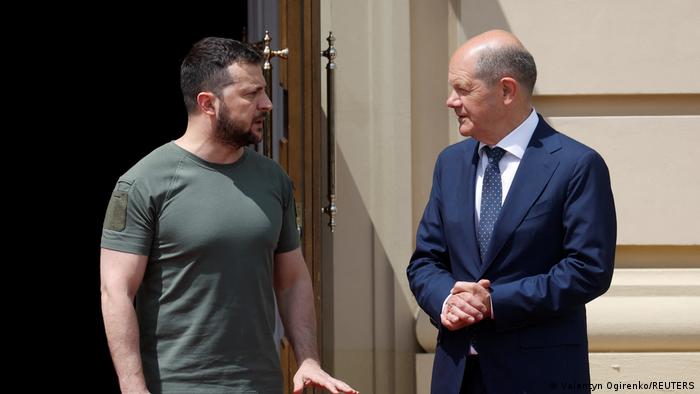
Ukrainian President Volodymyr Zelenskyy (left) met with German Chancellor Olaf Scholz in Kyiv on June 16
June 25, 2022 (dw.com)
Faced with great challenges, politicians commonly advocate for equally substantial remedies. One often reached-for comparison is the US Marshall Plan, which helped rebuild Western Europe after World War II. Decision-makers have launched subsequent programs modeled on the Marshall Plan to support pandemic-stricken economies, protect the environment, and much else.
Ahead of the G7 summit, German Chancellor Olaf Scholz has called for a Marshall Plan to rebuild Ukraine. His idea will be discussed among world leaders in Elmau, Germany, this weekend.
In a government address, Scholz said his recent visit to Ukraine had reminded him of the widespread destruction that had characterized many German cities after World War II.
“Just like war-scarred Europe then, Ukraine today needs a Marshal plan to rebuild,” he said. This, he added, was a job for the coming generation.
What was the Marshall Plan?
In 1947, then-US Secretary of State George C. Marshall suggested setting up the European Recovery Program (ERP) to help rebuild much of Europe, which had been destroyed in the war. Today, this scheme is commonly known as the Marshall Plan.
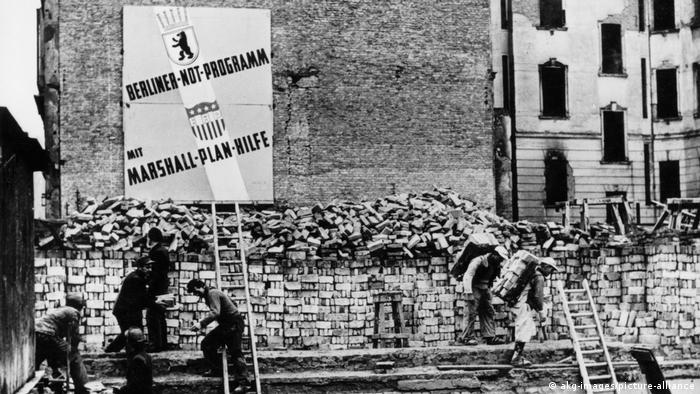
The Marshall Plan was devised to help postwar Europe get back on its feet
The program entailed the US providing loans to finance European reconstruction efforts, as well as importing goods, raw materials and foodstuffs to Europe. More than $12 billion (approximately $150 billion in today’s dollars; €142 billion) were provided to 16 different countries — among them West Germany, Italy, France and Great Britain — between 1948 and 1952. West Germany received roughly $1.5 billion. The cash infusion not only kick-started Europe’s economic recovery, but also opened up new markets for the United States.
The Marshall Plan had a political dimension, too. Not all European countries received US money. While the US was keen to limit Soviet influence in Eastern Europe, the Soviet Union barred Hungary, Czechoslovakia and Poland from joining the Marshall Plan, fearing US control over the region.
 UKRAINE: SCENES OF DESTRUCTION AND DESPAIR The longer the war the greater the povertyAn old woman in her damaged home in Kyiv: The serious consequences of the war are already being felt by the people of Ukraine. According to UN estimates, around 90% of the country’s population could be hit by poverty if the invasion lasts 12 months. This could set the country back economically by almost two decades.
In Germany and the rest of Europe, the Marshall Plan is largely remembered as a successful program that helped rebuild the continent. It sparked economic recovery but also helped democratic structures entrench themselves in Europe. That is why, after various wars and crises in the world, many have pointed to the Marshall Plan as a good example for postwar reconstruction.
A Marshall Plan for Ukraine?
Scholz expects the war in Ukraine will not end anytime soon. Just like the original Marshall Plan was geared toward long-term reconstruction, he said so too must the West expect that rebuilding Ukraine will take time.
“We will need many more billions of euro and dollar for reconstruction purposes — for years to come,” Scholz told the German parliament. He added that he wants to see Ukraine continue to receive broad European support in financial, economic, humanitarian and political terms, as well as “arms deliveries.”
Werner Hoyer, who heads the European Investment Bank, expects billions in financial aid for Ukraine. He said there is a need for a program targeting “a global audience, rather just EU taxpayers.”
The EU has suggested reconstruction efforts should be coordinated by Ukraine in conjunction with EU, G7 and G20 states, as well as international financial institutions and organizations.
This article was originally written in German