
Or: how to get people to change their minds, without hating you
Published in Bicerin
Aug 4, 2023 (Medium.com)
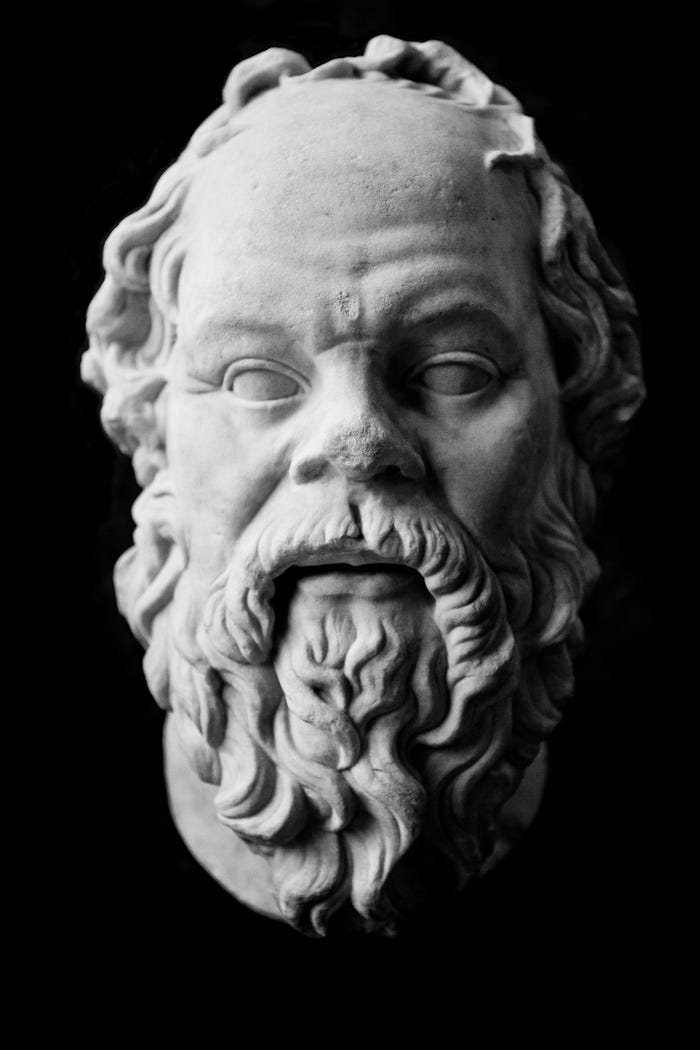
There’s a lot of talk in educational circles about ‘the Socratic method’. But the Socratic method or ‘refutation’, elenchus, is a strange beast. Socrates claimed to never teach anyone anything. He also famously claimed that whatever small wisdom he had involved knowing the limits of what he knew.
In Plato’s Theaetetus, he calls himself a midwife, but of the mind, who is barren of his own intellectual children: independent ideas of his own about the world. Instead, he assists others to bring forth their ideas, and assess whether they are viable, or else ‘wind eggs’.
In Plato’s Meno, his exasperated interlocutor compares Socrates’ questioning to a sting delivered by a stingray which numbs a person. Socrates himself rejoins in the Apology that he is like a gadfly, sent to nip at the sides of Athens, depicted as a lazy horse who wants to swat him with its tail.
This is all very diverting, and fascinating. It appeals to the young’s desire for the rebellious, and the rebel, at least in the safety of our imaginations. And Socrates was a genuinely courageous man, not simply someone who wrote about courage, ready to abandon his post at the first sign that someone might oppose his career ambitions, etc.
But ‘diverting’ and ‘fascinating’ doesn’t get us far in understanding who Socrates was, and what he was up to, and the arguable genius of his way of doing philosophy, which so profoundly changed Western intellectual history.
Knowledge of ignorance, versus redoubled ignorance
Where do we begin? The Apology is almost always the most suggestive guide. In Plato’s Apology, Socrates claims to be distinguished from the people whom he had questioned, who fancied themselves as experts, because (we said it before) he was aware of what he did not know. It’s a lovely paradox. But it has a serious meaning.
Socrates was soon to be heroized by the ancient academic sceptics, amongst nearly every other philosophical school. What he seems to share with the sceptics is the sense that people have a great tendency to imagine that we know more than we do.
So, we are actually ignorant of some subject or subjects: history, politics, economics, whatever. But many of us nevertheless suppose that we can opine with the best of them. Everyone, indeed, has a right to what the Greeks called a doxa. We don’t however have an epistemic right to assume that whatever we believe is actually true.
(You don’t need to know that ‘to each their own’ was a slogan on the gates of Buchenwald concentration camp to wonder about whether infinite subjective relativism doesn’t have some puzzling implications that people seem to have missed, at times. How funny culture can be, and how short cultural memory!)
But if we both don’t know something, and think or claim that we do, we suffer from a kind of double ignorance. Ignorant about the subject, we misunderstand or don’t know how we stand in relation to it, and in relation to people who might actually understand better than we do.
But we suppose we know.
Then, add natural pride …
And then, we express our knowledge, in conversation, in writing, on social media, wherever. And by doing so, we lay claim to recognition by others. No one wants to seem daft or dumb or weird or crazy or ignorant, even when we are being those things.
So, on top of the ‘double amathia’, our epistemic egos very soon get involved: in the old days, they called this ‘pride’. We claim to know something, and we claim recognition as a smart person, someone who knows that thing.
At this point, changing our opinions comes with psychological difficulties and costs. We worry about losing face. Our sense of our self and our worth is implicated in our opinions, and their expression.
It can sometimes seem that the worst thing in the world for a person, or a company or corporation, would be to be shown to be ignorant of something they have claimed to know.
The response to being called out on our mistakes and failings is then often some form of aggression. By challenging my opinion, you are challenging my identity or sense of self. That makes me feel very internally distressed. So, one must swat the gadfly that has caused the discomfort, if need be, with maximum prejudice.
Cue online arguments and mutual recriminations, amongst other things.
How to challenge epistemic egoism, and its double ignorance?
Well, old Socrates (some sources tell) would sometimes even get struck by those with whom he conducted his method. Many Platonic dialogues end with one or more characters getting very angry at him, and telling him to go away, or else playing along (‘whatever you say, Socrates’) in order to get the thing over with.
Alcibiades tells us frankly in the Symposium that, even though he does feel himself improving when he is with Socrates, reverts to his old patterns as soon as he leaves his company.
So, how can we change people’s minds, without provoking a threatened egoistic response, and the usual forms of ego defence long ago identified by psychologists: projection, deflection, misrepresentation of the other and their motivations, abuse, open aggression?
1. the person must say what they genuinely mean
Well, the Socratic method insists that the person engaged speaks sincerely on the subject under discussion. We must try to say what we mean, and mean what we say.
2. the person must answer, even when the answers show their holding onto contradictory beliefs
Then, Socrates shows that within the set of our beliefs about some subject — that is, within what we already are willing to say in public, in front at least of Socrates — we ourselves were already harbouring contradictory beliefs.
The psychological acuity of the process
Why does that matter? Well, Socrates tells people frequently when they get angry at him, rightly, that all he has done is get them to express their own beliefs on some subject. He’s not attacking them, from the outside. He’s exactly giving birth, through questioning, to ideas they already harbored in their own minds.
Do you see the difference?
I can either be refuted by someone who provides new information from outside of me, which in many cases is a good thing. Or, I can be refuted by someone who asks me to speak, from my own mouth, ideas that don’t make sense, when placed side by side.
Either I think temperance is modesty, or I do not think that’s right in some cases, but not both; either I think it is proceeding slowly in all cases, or I do not, but not both at the same time…
Or else, I hold both ideas, but just hadn’t realised I was internally, cognitively, a bit of a mess on this subject who could benefit from thinking things through, out loud, with somebody to ask questions and pose different examples to get me rethinking.
This is the force of what I think is a golden passage (230b-e) in Plato’s Sophist, amongst a series of definitions of the “sophist”, wise person or claimed ‘wise guy’. All of a sudden, we learn from the Stranger in that text, usually taken now to be Plato’s ‘spokesman’, of someone who sounds very like Socrates:
A> [visitor]: They cross-examine (διερωτῶσιν) someone when he thinks he’s saying something though he’s saying nothing. Then, since his opinions will vary inconsistently, these people will easily scrutinize them. They collect his opinions together during the discussion, put them side by side, and show that they conflict with each other at the same time on the same subjects in relation to the same things and in the same respects. (τιθέντες δὲ ἐπιδεικνύουσιν αὐτὰς αὑταῖς ἅμα περὶ τῶναὐτῶν πρὸς τὰ αὐτὰ κατὰ ταὐτὰ ἐναντίας). <B>
It’s what happens at this point that is most psychologically revealing, and telling. This is the moment of crisis, in dramatic terms.
It’s at this point that people who just ‘feel’ that they know it all will turn on Socrates, or like Euthyphro, flee the scene, taking with them a kind of persecutory sense of Socratic dialogue: it’s about showing people up, and proving how smart Socrates is, etc.
But then there are others, like the young Theaetetus or Nicias, who realise the meaning of the Socratic method at this time: it’s not about Socrates, it’s about self-examination, facilitated by a questioner. The passage in the Sophist continues, and described such figures, whose anger is not directed at blaming Socrates or everyone else, but themselves:
The people who are being examined see this, get angry at themselves (ἑαυτοῖς μὲν χαλεπαίνουσι), and become calmer toward others. They lose their inflated and rigid beliefs about themselves that way, and no loss is pleasanter to hear or has a more lasting effect on them.
At that point, reexamining their ideas becomes possible. No one can learn who thinks they already know everything. Socrates challenges us to be brave enough to be proven, not wrong, but inconsistent, so we can continue the process of learning and growing.
·Writer for Bicerin
Articles on philosophy, psychology & classical thought (notably Stoic), aimed at renewing, spreading, and applying these ideas today.