By Erin Allday, Staff Writer Aug 23, 2026
Gift Article (SFChronicle.com)
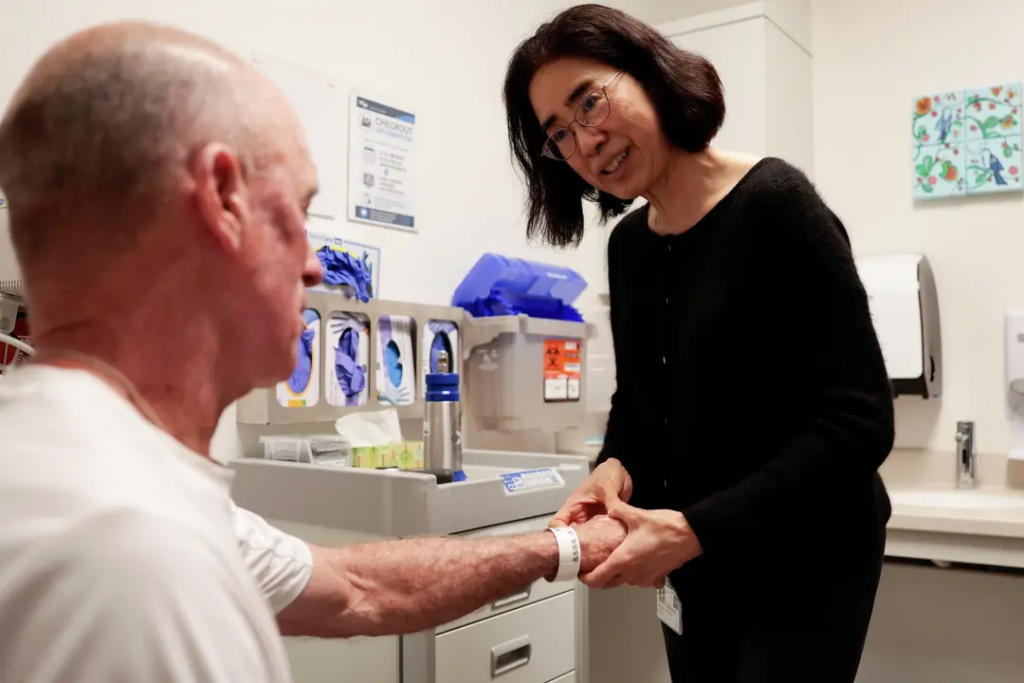
Mark Orwig is examined by Dr. Maria Wei during a follow-up visit at UCSF in San Francisco. Orwig participated in a potentially groundbreaking trial for a novel mRNA cancer vaccine that is reporting exciting outcomes for preventing skin cancer recurrences.Heather Diehl/For the S.F. Chronicle
Mark Orwig, 73, grew up in an era before parents slathered their children with sunscreen and enjoyed a career playing and coaching tennis, spending hours in the sun every day of his adult life.
It wasn’t a surprise, then, when the Moraga resident was diagnosed with a melanoma on his face in 2023. On the surface it was small, about half the size of an eraser head, but potentially deadly. To remove it and make sure they got all of the affected area, surgeons had to carve out a 4-inch chunk of his cheek. And melanomas are notoriously tricky — he still had to contend with the risk that the cancer would recur.
- Read more: UCSF cannabis study finds unexpected heart rhythm results
- ‘I would never do this’: What scientists want you to know about peptide injections
- Related: S.F. is embracing saunas and cold plunges. Are they actually good for you?
But UCSF, where he was being cared for, had several clinical trials running for melanoma, including one for a cutting-edge treatment involving an mRNA vaccine that Orwig joined. His oncologist, Dr. Adil Daud, was the lead investigator for that trial at UCSF, which was the first site in the United States to test the cancer vaccine technology, developed by pharmaceutical giants Merck and Moderna.
For the first time, a vaccine that harnesses a patient’s own immune system to fight cancer appears to be working. Doctors say the therapy should be applicable to other types of cancer, with clinical trials already underway.
“This could be an entirely new strategy, both for melanoma but really other cancers as well,” said Dr. Allison Betof, director of the melanoma program at Stanford, who was not involved in the vaccine trial. “There’s a lot of excitement around having a new platform, a totally new approach to treating cancer.”
Daud cautioned that he can’t say for sure whether Orwig benefited from the vaccine. Orwig may have received a placebo, and even if he got the vaccine, it may not have helped him; Daud said the data he’s seen so far is too vague to determine who benefited and how much. And other melanoma treatments that Orwig received have improved dramatically in the time Daud has been an oncologist, even before the mRNA vaccine.
Twenty years ago, he said, life expectancy for someone with Orwig’s diagnosis would have been nine months. Today it’s six years, owing mostly to the development of immunotherapy drugs. Orwig is now three years past his diagnosis, and his most recent scans were all clear.
Skin cancers are the most common type of cancer in the United States. Melanomas make up only about 1% of all skin cancers, but they’re the deadliest. About 100,000 cases are diagnosed in the United States and about 8,500 deaths occur each year, according to the American Cancer Society.
The new therapy uses the same technology that allowed for the rapid production of the COVID-19 mRNA vaccines, which were invented to be used against cancer in the first place. Messenger RNA carries genetic instructions that can train the immune system to recognize and attack a specific target. Scientists have been attempting for decades to make a vaccine that would stop cancer, but have been met with repeated failures to the point that doctors such as Daud were beginning to think it wasn’t possible.
Now, he and others believe that the missing link was the personalization that mRNA vaccines allow. Because the vaccines can be made quickly — within roughly six weeks — they can be developed for patients to better fight their specific cancer. “Technologically it wasn’t possible to do this” until recently, Daud said.
“We’ve been working with cancer vaccines for years and years, and even when there was promising data it fell apart,” Daud said. “This trial required a leap of faith, because a lot of people, including me, thought vaccines would never work. But it was also a leap of technology.”
The latest trial involved about 1,000 patients, all of whom had undergone surgery to remove a melanoma. All participants received the immunotherapy drug Keytruda, and some also received the vaccine, called intismeran. The double-blinded trial compared the Keytruda-only group against those who also got the vaccine.
For patients receiving the vaccine, tumor sequencing data was run through a computer program that identified key attack points. A vaccine was then developed for that patient to teach his or her immune system to fight those targets. Patients received up to nine doses of vaccine over several months.
Merck and Moderna last week announced only broad results from their trial and expect to release more details at a meeting in October. But the top-line results are exciting, oncologists said: Patients who received the vaccine had lower risk of recurrence and spread of their cancer than patients who received Keytruda alone.
“The big caveat is none of us have seen the data yet,” Betof said. But scientists saw promising results from earlier, smaller studies, and “hopefully this is a confirmation” of those results, she said.
Side effects from the vaccine could be intense but did not appear to be any more dangerous than immunotherapy alone, according to Daud and the companies.
The therapy was tough at times, Orwig said. After each dose he suffered terrible headaches, dizziness, chills and “pretty severe lethargy.” At one point in the winter, he was so fed up being tired and inside that he would set himself up on a lounge chair, no matter how cold, and wrap himself in blankets just for the fresh air.
Daud took that as a positive sign, though, Orwig said. “A placebo is not going to have that kind of reaction, so there’s a good chance you’re not getting the placebo” vaccine, Daud told him.
Orwig said he tries not to dwell on the possibility of a recurrence, and knowing that he did everything in his power to fight the cancer —perhaps most importantly, joining a clinical trial — helps keep the anxiety away.
“I don’t worry about things. I prioritize things. And so with the melanoma it was my priority and I did everything I possibly could, and now it’s out of my hands,” he said. “And I think I gave myself the best chance.”
Aug 23, 2026
Staff Writer
Erin Allday covers gender and sexuality for the Chronicle. Previously, she was a longtime health writer with a focus on covering infectious diseases, including HIV/AIDS and the COVID pandemic. A Southern California native, Erin has lived in the Bay Area since graduating UC Berkeley. She joined the Chronicle in 2006.