
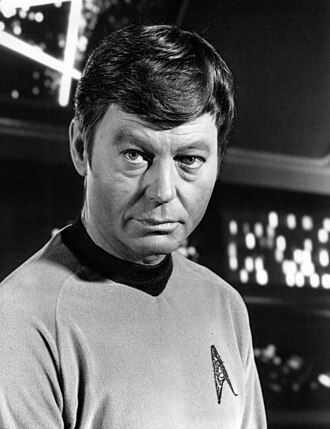
DeForest Kelley, who played Dr McCoy in Star Trek, wanted to become a doctor, but couldn’t afford medical school. He regularly received letters from fans who went into medicine because of him and said “to influence the youth of the country … is an award that is not handed out by the industry”
From Wikipedia, the free encyclopedia
“Dr. McCoy” redirects here. For the Marvel Comics character Dr. Hank McCoy, see Beast (comics).
| Leonard McCoy | |
|---|---|
| Star Trek character | |
| DeForest Kelley as Leonard McCoy in a publicity photograph for the original Star Trek series | |
| First appearance | “The Man Trap” (1966) (The Original Series) |
| Last appearance | Star Trek Beyond (2016) |
| Created by | Gene Roddenberry |
| Portrayed by | DeForest Kelley (1966–1991) Karl Urban (2009–2016) |
| In-universe information | |
| Full name | Leonard Horatio McCoy |
| Nickname | Bones |
| Species | Human |
| Gender | Male |
| Title | Doctor |
| Affiliation | United Federation of PlanetsStarfleet |
| Family | David McCoy (father) |
| Spouse | Unnamed wife (divorced) Natira (separated) |
| Children | Joanna McCoy (daughter) |

Dr. Leonard H. McCoy, known as “Bones“, is a character in the American science-fiction franchise Star Trek.[1] McCoy was played by actor DeForest Kelley in the original Star Trek series from 1966 to 1969, and he also appears in the animated Star Trek series, in six Star Trek films, in the pilot episode of Star Trek: The Next Generation, and in numerous books, comics, and video games.[2] A decade after Kelley’s death, Karl Urban assumed the role of McCoy in the Star Trek reboot film in 2009.[3]
Depiction
McCoy was born in Atlanta, Georgia, in 2227.[4] The son of David McCoy,[5]: 257–258 he attended the University of Mississippi[2] and is a divorcé.[6] McCoy later married Natira, the priestess of Yonada, characterized in the episode, “For the World Is Hollow and I Have Touched the Sky“. In 2266, McCoy was posted as chief medical officer of the USS Enterprise under Captain James T. Kirk, who often calls him “Bones”.[2] McCoy and Kirk are good friends, even “brotherly”.[5]: 146 The passionate, sometimes cantankerous McCoy frequently argues with Kirk’s other confidant, science officer Spock,[1] and occasionally is prejudiced against Spock’s Vulcan heritage.[7] McCoy often plays the role of Kirk’s conscience, offering a counterpoint to Spock’s logic.[1] McCoy is suspicious of technology,[8] especially the transporter.[2] As a physician, he prefers less intrusive treatment and believes in the body’s innate recuperative powers.[1] The nickname “Bones” – chosen before the character was named – is a play on sawbones, a 19th century epithet for a surgeon.[9][10][11] In the 2009 Star Trek film reboot, when McCoy first meets Kirk, he complains that his ex-wife took all their shared assets following their divorce: “All I got left is my bones”, implying this was the origin of the nickname.[12]
When Kirk orders McCoy’s commission reactivated in Star Trek: The Motion Picture (1979);[2] a resentful McCoy complains of being “drafted“.[13] Spock transfers his katra—his knowledge and experience—into McCoy before dying in Star Trek II: The Wrath of Khan (1982).[2] This causes mental anguish for McCoy, who in Star Trek III: The Search for Spock (1984) helps restore Spock’s katra to his reanimated body.[2] McCoy continues to serve on Kirk’s crew aboard the captured Klingon ship in Star Trek IV: The Voyage Home (1986).[2] In Star Trek V: The Final Frontier (1989), McCoy (through the intervention of Spock’s half-brother Sybok) reveals that he helped his father commit suicide to relieve him of his pain. Shortly after the suicide, a cure was found for his father’s disease, and McCoy had carried the guilt about it with him until Sybok’s intervention.
In Star Trek VI: The Undiscovered Country (1991), McCoy and Kirk escape from a Klingon prison world, and the Enterprise crew stops a plot to prevent peace between the United Federation of Planets and the Klingon Empire.[2] Kelley reprised the role for the “Encounter at Farpoint” pilot episode of Star Trek: The Next Generation (1987), insisting upon no more than the minimum Screen Actors Guild payment for his appearance.[14] McCoy had attained the rank of admiral in the Trek timeline when this episode was aired, and he is stated to be 137 years of age. He went on to become chief of Starfleet Medical, with a special rank known as branch admiral. The fictional book Comparative Alien Physiology was written by McCoy, and was required reading at the Starfleet Medical Academy through the 2370s.
In the 1973 Star Trek: The Animated Series episode “The Survivor“, McCoy mentions he has a daughter, Joanna. Although Chekov‘s friend Irina in the original series episode “The Way to Eden” was originally written as McCoy’s daughter, it was changed before the episode was shot.[15]
Reboot film series
.JPG)
In the 2009 Star Trek film, which takes place in an alternate, parallel reality,[16] McCoy and Kirk become friends at Starfleet Academy, which McCoy joins after a divorce that he says, “left [him] nothing but [his] bones.” This line, improvised by Urban,[12] explains how McCoy earned the nickname Bones. McCoy later helps get Kirk posted aboard the USS Enterprise. He later becomes the chief medical officer after Doctor Puri is killed during an attack by Nero. McCoy remains aboard to see the Enterprise defeat Nero and his crew, with Kirk becoming the commanding officer of the ship.
The Guardian called Urban’s portrayal of McCoy in the 2009 film an “unqualified success”,[17] and The New York Times called the character “wild-eyed and funny”.[18] Slate said Urban came closer than the other actors to impersonating a character’s original depiction.[19]
Development
Kelley had worked with Star Trek creator Gene Roddenberry on previous television pilots,[20] and he was Roddenberry’s first choice to play the doctor aboard the USS Enterprise.[21] However, for the rejected pilot “The Cage” (1964), Roddenberry went with director Robert Butler‘s choice of John Hoyt to play Dr. Philip Boyce.[22] For the second pilot, “Where No Man Has Gone Before” (1966), Roddenberry accepted director James Goldstone‘s decision to have Paul Fix play Dr. Mark Piper.[23] Although Roddenberry wanted Kelley to play the character of ship’s doctor, he did not put Kelley’s name forward to NBC; the network never “rejected” the actor, as Roddenberry sometimes suggested.[21]
Kelley’s first broadcast appearance as Doctor Leonard McCoy was in “The Man Trap” (1966). Despite his character’s prominence, Kelley’s contract granted him only a “featuring” credit; he was not given “starring” credit until the second season, at the urging of producer Robert Justman.[24] Kelley was apprehensive about Star Trek‘s future, telling Roddenberry that the show was “going to be the biggest hit or the biggest miss God ever made”.[5]: 146 Kelley portrayed McCoy throughout the original Star Trek series, and voiced the character in the animated Star Trek.[1]
Kelley, who in his youth wanted to become a doctor like his uncle, but whose family could not pay for a medical education,[25] in part drew upon his real-life experiences in creating McCoy, a doctor’s “matter-of-fact” delivery of news of Kelley’s mother’s terminal cancer was the “abrasive sand” Kelley used in creating McCoy’s demeanor.[5]: 145 Star Trek writer D. C. Fontana said that while Roddenberry created the series, Kelley essentially created McCoy; everything done with the character was done with Kelley’s input.[5]: 156
“Exquisite chemistry” among Kelley, William Shatner, and Leonard Nimoy manifested itself in their performances as McCoy, Captain James T. Kirk, and Science Officer Spock, respectively. Nichelle Nichols, who played Uhura, referred to Kelley as her “sassy gentleman friend”; the friendship between the African-American Nichols and Southern Kelley was a real-life demonstration of the message Roddenberry hoped to convey through Star Trek.[5]: 154
For the 2009 Star Trek film, writers Roberto Orci and Alex Kurtzman saw McCoy as an “arbiter” in Kirk and Spock’s relationship. While Spock represented “extreme logic, extreme science” and Kirk symbolized “extreme emotion and intuition”, McCoy’s role as “a very colorful doctor, essentially a very humanistic scientist”, represented the “two extremes that often served as the glue that held the trio together”. They chose to reveal that McCoy befriended Kirk first, explaining the “bias” in their friendship and why he would often be a “little dismissive” of Spock.[26] Urban said the script was “very faithful” to the original character, including the “great compassion for humanity and that sense of irascibility” with which Kelley imbued the character. New Zealand-born Urban trained with a dialect coach to create McCoy’s accent[27] and reprised the role in its sequels Star Trek Into Darkness[28] and Star Trek Beyond.
Cultural impact
McCoy is someone to whom Kirk unburdens himself, but is a foil to Spock.[24] He is Kirk’s “friend, personal bartender, confidant, counselor, and priest”.[29] Spock and McCoy’s bickering became so popular that Roddenberry wrote in a 1968 memo “we simply didn’t realize … how much the fans loved the bickering between our Arrowsmith and our Alien”.[30] Urban said McCoy has a “sense of irascibility with real passion for life and doing the right thing”, and that “Spock’s logic and McCoy’s moral standing gave Kirk the benefit of having three brains instead of just one.”[31]
Kelley said that his greatest thrill at Star Trek conventions was the number of people who told him they entered the medical profession because of the McCoy character.[32] He received two or three letters a month from others reporting similar experiences. A friend observed that despite not becoming a doctor as he had hoped, Kelley’s portrayal of McCoy had helped create many doctors. According to Kelley, “You can win awards and that sort of thing, but to influence the youth of the country … is an award that is not handed out by the industry”.[5]: 273
More at: https://en.wikipedia.org/wiki/Leonard_McCoy#Development