By Maria Popova (themarginalian.org)

You wouldn’t have bet on it, the frail famous poet teaching at Harvard as a visiting professor and the athletic secretary of the campus residence half her age. But every great love exists against probability, belongs to that region of the universe where the wildest bet may be the winning bet.
When she met Alice Methfessel, Elizabeth Bishop had served as Poet Laureate of the United States, had won the National Book Award and the Pulitzer Prize, had spent the better part of her youth in solitude and the better part of her middle age in South America with the woman she loved for seventeen years, who had taken her own life three years earlier.
Across their stations, across their age difference, across the abyss of possibility between their era’s parameters of permission, Elizabeth and Alice fell deeply and enduringly in love — a love that comes abloom on the pages of Megan Marshall’s delicious biography Elizabeth Bishop: A Miracle for Breakfast (public library).
Soon, they were beginning each day with a ritual refrain: “Good-morning I love you.” The “blue blue blue” of Alice’s eyes became the sky of a new world shimmering with new life. More poems poured out in a spring than had in a decade. They swam together in the Galápagos, admiring the flamboyance of flamingos, and in the Greek Isles, admiring the poppies and their thousand shades of red. Whenever they were separated by Elizabeth’s itinerant life as a public poet, she sent Alice “love — housefulls, churchfulls, airportsfull” and carried her photograph in her breast pocket. She revised her will to leave everything except her books to Alice.
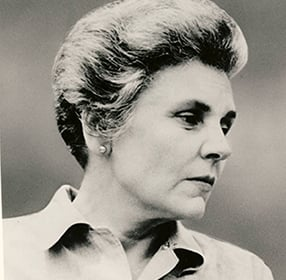
Elizabeth Bishop
After five years together — years of extraordinary creative vitality for the poet, but also years of savage struggle with alcohol — Alice, exhausted by Elizabeth’s increasingly out-of-control drinking to the point of collapse, met a young man who soon proposed.
“I want you to be happy and good and loved,” Elizabeth told her in a touching reminder that the deepest measure of love is wanting the best possible life for the other person. But she was heartbroken.
She coped the way all artists do.
What began as mostly prose became, seventeen drafts and several titles later — “How to Lose Things,” “The Gift of Losing Things,” “The Art of Losing Things” — one of the greatest poems ever written:
ONE ART
by Elizabeth BishopThe art of losing isn’t hard to master;
so many things seem filled with the intent
to be lost that their loss is no disaster.Lose something every day. Accept the fluster
of lost door keys, the hour badly spent.
The art of losing isn’t hard to master.Then practice losing farther, losing faster:
places, and names, and where it was you meant
to travel. None of these will bring disaster.I lost my mother’s watch. And look! my last, or
next-to-last, of three loved houses went.
The art of losing isn’t hard to master.I lost two cities, lovely ones. And, vaster,
some realms I owned, two rivers, a continent.
I miss them, but it wasn’t a disaster.—Even losing you (the joking voice, a gesture
I love) I shan’t have lied. It’s evident
the art of losing’s not too hard to master
though it may look like (Write it!) like disaster.
When she learned that Alice had decided to accept the proposal, Elizabeth was devastated. With the helpless vulnerability of love laid bare, which neither pride nor prejudice can touch, she wrote to her:
And then she sent her the poem.
Elizabeth Bishop (Archives & Special Collections, Vassar College Libraries)
Nobody knows what beckoned Alice back — the poem, the way a badly sprained ankle signaled Elizabeth’s fragility and made Alice shudder at the thought of losing her, or simply the inexplicable gravitational pull of love that eludes, always eludes, theory.
“I like being with you more than anyone else in the world,” Alice wrote to Elizabeth that summer.
They remained together until death did them part — one awful October evening, a cerebral aneurysm left Elizabeth’s body for Alice to find on their bedroom floor.
Years earlier, in her most intimate poem that she never published, Elizabeth had looked to death as dreadful only for separating her from Alice:
by Elizabeth BishopMy love, my saving grace,
your eyes are awfully blue.
I kiss your funny face,
your coffee-flavored mouth.
Last night I slept with you.
Today I love you so
how can I bear to go
(as soon I must, I know)
to bed with ugly death
in that cold filthy place
to sleep there without you,
without the easy breath
and nightlong, limblong warmth
I’ve grown accustomed to?
— Nobody wants to die;
tell me it is a lie!
But no, I know it’s true.
It’s just the common case;
there’s nothing one can do.
My love, my saving grace,
your eyes are awfully blue
early and instant blue.
Inside the tragedy, a triumph: It is miracle enough to have found blue.