A large tabular iceberg with visible blue ice layers floats in Antarctic waters under a cloudy sky, December 22, 2025. Photo credit: Srishti Sethi / Wikimedia (CC BY-SA 4.0)
“The temperatures here went very high so everything outside melted,” said one scientist.
Climate scientists are sounding the alarm after an unprecedented heatwave hit Antarctica this month and delivered temperatures 20 degrees Celsius (36 degrees Fahrenheit) higher than normal.
According to a Friday report in The Guardian, temperatures at Antarctica’s Trinity Peninsula this month hit peaks of over 15 C (59 F), even though it is the start of winter when ice typically expands on the continent. The prior record June temperature at the peninsula, 13.3 C (55.9 F), was set in 1998.
After weeks of above-average temperatures, scientists noticed that an area of sea ice that typically forms in the region — one roughly the size of France — was missing.
“It’s depressing,” Will Hobbs, an Antarctic sea ice expert at the University of Tasmania, told The Guardian. “It is remarkable that we are in June and there is no sea ice there.”
Hobbs also predicted that the loss of sea ice is likely permanent at this point given the trajectory of global temperature changes.
Peter Fretwell, a scientist at the British Antarctic Survey, explained to the newspaper that the loss of sea ice poses a serious threat to penguin populations.
“Sea ice is forming too late and breaking up too early,” Fretwell explained. “It leads to reduced breeding success and longer trips to moulting grounds.”
In a separate interview with The Guardian earlier this month, Raúl Cordero, a climate professor at the University of Groningen, expressed astonishment at the record-breaking Antarctic heat.
“This is absolutely crazy,” Cordero said. “That is a huge anomaly.”
Luis Muñoz, a Chilean glaciologist, told the newspaper he was shocked to step outside at King George’s Island, located just north of Trinity Peninsula, and see the ground uncovered by snow.
“The temperatures here went very high so everything outside melted,” Muñoz explained. “Usually there is 20 centimeters (7.8 inches) of snow and a lot of ice on the ground at this time.”
Taking stock of the bigger picture, the newspaper reported that scientists are now fearful that some of the biggest glaciers in the region of the peninsula have now “past a tipping point” that could “push up global sea levels by four meters.”
Such a rise in global sea levels would be unprecedented. Scientists estimate that global sea levels have risen by between 21 and 24 centimeters (8.2 and 9.4 inches) since 1880.
This story by Brad Reedwas originally published by Common Dreams and is part of Covering Climate Now, a global journalism collaboration strengthening coverage of the climate story. WhoWhatWhy has been a partner in Covering Climate Now since its inception in 2019.
Avoiding the worst ravages of climate breakdown is still possible, and there are “multiple, feasible and effective options” for doing so, the Intergovernmental Panel on Climate Change has said.
Hoesung Lee, chair of the body, which is made up of the world’s leading climate scientists, made clear that – despite the widespread damage already being caused by extreme weather, and the looming threat of potentially catastrophic changes – the future was still humanity’s to shape.
“[The IPCC reports] clearly show that humanity has the knowhow and the technology to tackle human-induced climate change. But not only that. They show that we have the capacity to build a much more prosperous, inclusive and equitable society in this process.
“Tackling climate change is a hard, complex and enduring challenge for generations. We, the scientific community, spell out the facts of disheartening reality, but we also point to the prospects of hope through concerted, genuine and global transformational change.”
Finance would be key, he said. The shift to a low-carbon economy would take between three and six times the amounts of funding currently devoted to green investment, according to the final section of the IPCC’s comprehensive sixth assessment report (AR6) of human knowledge of the climate.
Climate justice would also be vital, the IPCC said, because the people being hit hardest by the impacts of the crisis were the poorest and most vulnerable who have done least to cause the problem.
Aditi Mukherji, one of the 93 authors of the “synthesis report”, the final section that draws together the key findings, said: “Almost half the world’s population lives in regions that are highly vulnerable to climate change. In the last decade, deaths from floods, droughts and storms were 15 times higher in highly vulnerable regions.”
Chris Jones, of the Met Office Hadley Centre, a member of the report’s core writing team, pointed out that emissions fell by 6% in 2020 owing to the Covid-19 lockdowns, and a similar fall would be needed each year for the next decade. “The scale of the challenge is massive,” he said. “If we keep emitting at the current rate, the carbon budget for 1.5C will be exhausted by 2030.”
Monday’s publication may be the last this decade from the IPCC, which was set up in 1988 to assess global knowledge of the climate and advise on how human actions have been changing it. The IPCC AR6 report, which was delayed slightly owing to the Covid-19 pandemic, was published in three main sections from August 2021 to April 2022. The first three sections covered the underlying science of the climate system, the impacts of climate breakdown and the ways of tackling or reducing the problem, followed by Monday’s synthesis chapter drawing the previous three together.
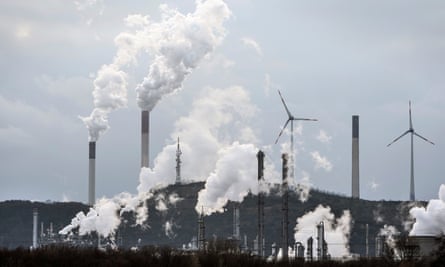
A BP refinery and a Uniper coal-fired power plant in Gelsenkirchen, Germany. Photograph: Martin Meissner/AP
IPCC scientists and climate experts emphasised that this decade would be crucial, as decisions made now would affect the future of the planet for hundreds and perhaps thousands of years.
Simon Stiell, the UN’s top climate official, said: “We are in a critical decade for climate action. Global emissions need to be reduced by nearly 43% by 2030 for the world to achieve the Paris agreement’s goal to limit global temperature rise to 2C and pursuing efforts to limit the temperature increase to 1.5C. The synthesis report highlights just how far off-track we are.”
But he added: “It’s not too late. The IPCC clearly demonstrates that it is possible to limit global warming to 1.5C with rapid and deep emissions reductions across all sectors of the global economy. It has given us many feasible, effective and low-cost mitigation and adaptation options to scale up across sectors and countries.”
The message of action, rather than despair, was also taken up by the UN secretary-general, António Guterres. He called for countries to adopt an “acceleration agenda” involving all of the G20, the world’s biggest developed and developing countries.
Developed countries must bring forward their commitments on reaching net zero greenhouse gas emissions, from 2050 to “as close as possible to 2040”, said Guterres.
Emerging economies, many of which have set net zero targets for the second half of this century, must also bring them forward, to “as close as possible” to 2050, he urged. This would require a major revision by some of the world’s biggest emitters: China currently has a target of before 2060, and India of 2070.
Guterres also called for developed countries to phase out coal by 2030, and all others by 2040. He called for no new licensing or funding of oil and gas projects, based on the findings of the International Energy Agency that all new oil and gas development must cease for the world to limit global heating to 1.5C above pre-industrial levels.
Ed Miliband, the shadow secretary for climate change in the UK, said: “António Guterres is right to say that we need to rapidly increase the pace and urgency of the fight against the climate crisis.
“In Britain, we have a Conservative government whose net zero strategy is so bad that it has been declared unlawful. The tragedy is that the Conservatives are holding us back from reaping the benefits of the green transition – lower energy bills, millions of good jobs, and a livable future for our children and grandchildren.
“Labour will make Britain world leader in tackling the climate crisis, with our plan to make Britain a clean energy superpower by 2030, and by leading a clean power alliance across the world to create cleaner, greener energy.”
Consciousness, spirituality, biography, sexuality, androgyny, futurism, space, the arts, science, astrology, democracy, humor, books, movies and more