Tag Archives: C.S. Lewis

The Thing Itself: C.S. Lewis on What We Long for in Our Existential Longing

By Maria Popova (themarginalian.org

Nothing kidnaps our capacity for presence more cruelly than longing. And yet longing is also the most powerful creative force we know: Out of our longing for meaning came all of art; out of our longing for truth all of science; out of our longing for love the very fact of life. We may give this undertone of being different names — Susan Cain calls it “the bittersweet” and Portuguese has the lovely word saudade: the vague, constant longing for something or someone beyond the horizon of reality — but we recognize it in our marrow, in the strata of the soul beyond the reach of words.

No one has explored the paradoxical nature of longing more sensitively than the philosopher, storyteller, beloved Narnia creator, and modern mystic C.S. Lewis (November 29, 1898–November 22, 1963) in a sermon he delivered on June 8, 1941, which later lent its title to his 1949 collection of addresses The Weight of Glory (public library).

Illustration by Margaret C. Cook for a rare 1913 edition of Walt Whitman’s Leaves of Grass. (Available as a print.)

Lewis — who thought deeply about the significance of suffering and the secret of happiness — writes:

This desire for our own far off country [is] the secret which hurts so much that you take your revenge on it by calling it names like Nostalgia and Romanticism and Adolescence; the secret also which pierces with such sweetness that when, in very intimate conversation, the mention of it becomes imminent, we grow awkward and affect to laugh at ourselves; the secret we cannot hide and cannot tell, though we desire to do both. We cannot tell it because it is a desire for something that has never actually appeared in our experience. We cannot hide it because our experience is constantly suggesting it, and we betray ourselves like lovers at the mention of a name. Our commonest expedient is to call it beauty and behave as if that had settled the matter. Wordsworth’s expedient was to identify it with certain moments in his own past. But all this is a cheat. If Wordsworth had gone back to those moments in the past, he would not have found the thing itself, but only the reminder of it; what he remembered would turn out to be itself a remembering.

As Lewis considers the illusory nature of these shorthands for our longing, we are left with the radiant intimation that “the thing itself” is not something we reach for, something beyond us, but something we are:

The books or the music in which we thought the beauty was located will betray us if we trust to them; it was not in them, it only came through them, and what came through them was longing. These things — the beauty, the memory of our own past — are good images of what we really desire; but if they are mistaken for the thing itself they turn into dumb idols, breaking the hearts of their worshipers. For they are not the thing itself; they are only the scent of a flower we have not found, the echo of a tune we have not heard, news from a country we have never visited.

For Lewis, who was religious, this notion of “the thing itself” — the ultimate object of longing — was anchored in his understanding of God. For me, it calls to mind Virginia Woolf’s exquisite epiphany about the meaning of art and life, found while strolling through her flower-garden:
Behind the cotton wool is hidden a pattern… the whole world is a work of art… there is no Shakespeare… no Beethoven… no God; we are the words; we are the music; we are the thing itself.

The Life and Work of C. S. Lewis with James Tunney

New Thinking Allo • Apr 11, 2023 James Tunney, LLM, is an Irish barrister who has lectured on legal matters throughout the world. He is a poet, artist, scholar, and author of The Mystery of the Trapped Light: Mystical Thoughts in the Dark Age of Scientism plus The Mystical Accord: Sutras to Suit Our Times, Lines for Spiritual Evolution; also Empire of Scientism: The Dispiriting Conspiracy and Inevitable Tyranny of Scientocracy, TechBondAge: Slavery of the Human Spirit, and Human Entrance to Transhumanism: Machine Merger and the End of Humanity. His most recent book is Plantation of the Automatons. His website is https://www.jamestunney.com/ Here he describes a crucible of consciousness at Oxford in the early twentieth century when a group of writers converged around C. S. Lewis and J. R. R. Tolkien at the Eagle and Child pub. They were known as the Inklings. 00:00:00 Introduction 00:02:18 C. S. Lewis & Tunney 00:06:37 Lewis’ religion 00:20:47 Reinchantment 00:28:49 Scientocracy 00:41:36 The afterlife 00:49:47 Amputated spirit 00:56:19 Eudaemon 01:05:46 Conclusion Edited subtitles for this video are available in Russian, Portuguese, Italian, German, French, and Spanish. New Thinking Allowed host, Jeffrey Mishlove, PhD, is author of The Roots of Consciousness, Psi Development Systems, and The PK Man. Between 1986 and 2002 he hosted and co-produced the original Thinking Allowed public television series. He is the recipient of the only doctoral diploma in “parapsychology” ever awarded by an accredited university (University of California, Berkeley, 1980). He is also the Grand Prize winner of the 2021 Bigelow Institute essay competition regarding the best evidence for survival of human consciousness after permanent bodily death. (Recorded on March 28, 2023)

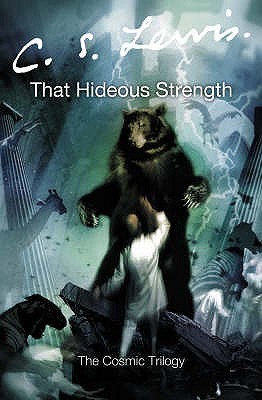
Book: “That Hideous Strength”

The Space Trilogy #3

That Hideous Strength

C.S. Lewis

The third novel in the science-fiction trilogy by C.S. Lewis. This final story is set on Earth, and tells of a terrifying conspiracy against humanity.

The story surrounds Mark and Jane Studdock, a newly married couple. Mark is a Sociologist who is enticed to join an organisation called N.I.C.E. which aims to control all human life. His wife, meanwhile, has bizarre prophetic dreams about a decapitated scientist, Alcasan. As Mark is drawn inextricably into the sinister organisation, he discovers the truth of his wife’s dreams when he meets the literal head of Alcasan which is being kept alive by infusions of blood.

Jane seeks help concerning her dreams at a community called St Anne’s, where she meets their leader – Dr Ransom (the main character of the previous two titles in the trilogy). The story ends in a final spectacular scene at the N.I.C.E. headquarters where Merlin appears to confront the powers of Hell.

(Goodreads.com)