

Saints Sergius and Bacchus were third-century Roman soldiers, Christian martyrs and men who loved each other. Their story is told here in words and images for their feast day on Oct. 7.
The close bond between Sergius and Bacchus has been emphasized since the earliest accounts, and recent scholarship has revealed their homosexuality. The oldest record of their martyrdom describes them as erastai (Greek for “lovers”). Scholars believe that they may have been united in the rite of adelphopoiesis (brother-making), a kind of early Christian same-sex marriage.
From ancient times until today these “gay saints” have inspired some of the most beautiful art depicting the holiness of same-sex couples, sometimes in a homoerotic way. A classic example of paired saints, Sergius and Bacchus were high-ranking young officers in the Roman army. Sergius was primicerius (commander) and Bacchus was secundarius (subaltern officer). They were tortured to death around 303 in present-day Syria after they refused to attend sacrifices to Zeus, thus revealing their secret Christianity.


The men were arrested and paraded through the streets in women’s clothing in an unsuccessful effort to humiliate them. Early accounts say that they responded by chanting that they were dressed as brides of Christ. They told their captors that women’s dress never stopped women from worshiping Christ, so it wouldn’t stop them, either. Then Sergius and Bacchus were separated and beaten so severely that Bacchus died.
According to the early manuscripts, Bacchus appeared to Sergius that night with a face as radiant as an angel’s, dressed once again as a soldier. He urged Sergius not to give up because they would be reunited in heaven as lovers. His statement is unique in the history of martyrs. Usually the promised reward is union with God, not with a lover. Over the next days Sergius was tortured and eventually beheaded.
Sergius’ tomb became a famous shrine, and for nearly 1,000 years the couple was revered as the official patrons of the Byzantine army. Many early churches were named after Sergius, sometimes with Bacchus. They have been recognized as martyrs by the Catholic, Eastern Orthodox and Oriental Orthodox churches. The pair was venerated through the Mediterranean, the Middle East, Latin America and among the Slavs.
Yale history professor John Boswell names Sergius and Bacchus as one of the three primary pairs of same-sex lovers in the early church in his book “Same Sex Unions in Pre-Modern Europe
The Roman Catholic Church stripped Sergius and Bacchus from its liturgical calendar in 1969 — the same year that New York’s Stonewall riots launched the modern gay liberation movement. Supposedly they were “de-canonized” due to lack of historical evidence, but some see it as an anti-gay action since they clearly had churches dedicated to them long before medieval times. Sergius and Bacchus continue to be popular saints with Christian Arabs and now among LGBTQ Christians and allies.
Sergius and Bacchus are celebrated in art
In a striking 2013 painting at the top of this post, Alessio Ciani of Italy shows young Sergius and Bacchus embracing in their red-and-white military uniforms. He has done a wide variety of LGBT illustrations and gay homoerotic art. His work has been exhibited in Milan and Perugia.

“Saints Sergius and Bacchus” by Robert Lentz is part of Scott Sella’s sacred art collection in Akron, Ohio. Photo by Scott Sella.
“Saints Sergius and Bacchus” by Robert Lentz is probably the best-known icon of the pair in the LGBTQ community. It was painted by Brother Robert Lentz, a Franciscan friar and world-class iconographer known for his innovative icons. The icon of the loving pair was commissioned by the Living Circle, an interfaith LGBTQ spirituality center founded by Dennis O’Neill. It was first displayed in June 1994 when they carried it in Chicago’s Gay Pride Parade for the first time. “Saints Sergius and Bacchus” is one of 10 Lentz icons that sparked major controversy since 2005. Critics accused Lentz of glorifying sin and creating propaganda for a progressive sociopolitical agenda. They caused such a stir that in order to keep the peace between his Franciscan province and the Archbishop of Santa Fe, New Mexico, Lentz temporarily gave away the copyright for the 10 controversial images to his distributor, Trinity Stores. Lentz’ own moving spiritual journey and some of his icons are included in the book Art That Dares: Gay Jesus, Woman Christ, and More

“Saint Sergius and Saint Bacchus” from Cristianas y Cristianos de Madrid LGTB+H (CRISMHOM)
One of the newest icons of Sergius and Bacchus was painted by a member of the Cristianas y Cristianos de Madrid LGTB+H (CRISMHOM), an LGBTQ Christian community in Madrid, Spain. The artist is serving as a missionary in Mozambique. He portrays Christ inside a rainbow medallion uniting Sergius and Bacchus as they join hands and gaze into each other’s eyes. Sacred flames burn in their hearts.

Another new image of third-century gay saints Sergius and Bacchus is a stained glass window donated in 2011 to an Illinois church by its LGBT parishioners. The new Sergius and Bacchus window (above) was dedicated in September 2011 at St. Martha’s Church in Morton Grove, Illinois, as a gift from its LGBT members. Rev. Dennis O’Neill, pastor, believes it is the first window dedicated to Sergius and Bacchus in any church in the United States. O’Neill is the author of Passionate Holiness: Marginalized Christian Devotions for Distinctive People
The Sergius and Bacchus window is part of a project in which members of St. Martha’s diverse congregation were selecting and paying for a set of 20 windows of saints from their various homelands. LGBT members contributed the “friendship window” depicting Sergius and Bacchus. It is a companion to the “marriage window” which shows St. Elizabeth of Hungary and her husband, Blessed Ludwig of Thuringia.
Artist Plamen Petrov worked with Daprato Rigali Studios to design and create the stained glass windows. He was born in Sevlievo, Bulgaria in 1966 and currently lives in Chicago. He graduated from University St. Cyril and St Methodius University of Veliko Tarnovo, Bulgaria’s Faculty of Fine Art in 1995, with an M.F.A. in graphic art – printmaking and pedagogy of figurative arts. For more than a dozen years he specialized mostly in stained glass, but his creativity takes many forms, since he also works in mosaics, murals, oil, acrylic, photography and graphic design. His artwork may be seen across Chicago and Illinois, and in many countries all over the world.

Massachusetts artist Brandon Buehring included Sergius and Bacchus in his “Legendary Love: A Queer History Project.” He uses pencil sketches and essays “to remind queer people and our allies of our sacred birthright as healers, educators, truth-tellers, spiritual leaders, warriors and artists.” The project features 20 sketches of queer historical and mythological figures from many cultures around the world. He has a M.Ed. degree in counseling with an LGBT emphasis from North Carolina State University in Raleigh. He works in higher education administration as well as being a freelance illustrator based in Northampton, Massachusetts.
The painting below is by California gay artist Rick Herold. “I over the years as a painter have been interested in the idea of the spirit and the flesh as one — began by Tantric art influences and then using my Catholic background,” he told the Jesus in Love Blog. He paints with enamel on the reverse side of clear plexiglas.
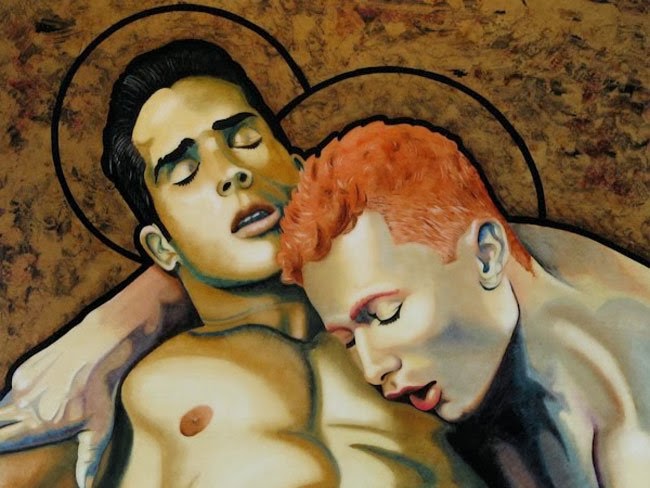
Herold has a bachelor of arts degree in art and theology from the Benedictine Monastic University of St. John in Minnesota and a master of fine arts degree from Otis Institute of Art in Los Angeles. His religious artwork included a Stations of the Cross commissioned by Bob Hope for a church in Ohio before a conflict over modern art with the Los Angeles cardinal led to disillusionment with the church. Herold came out as gay and turned to painting male nudes.

A banner saying “patrons of same sex couples” hangs above Bacchus and Sergius in a colorful icon by Maria Cristina, an artist based in Las Cruces, New Mexico.
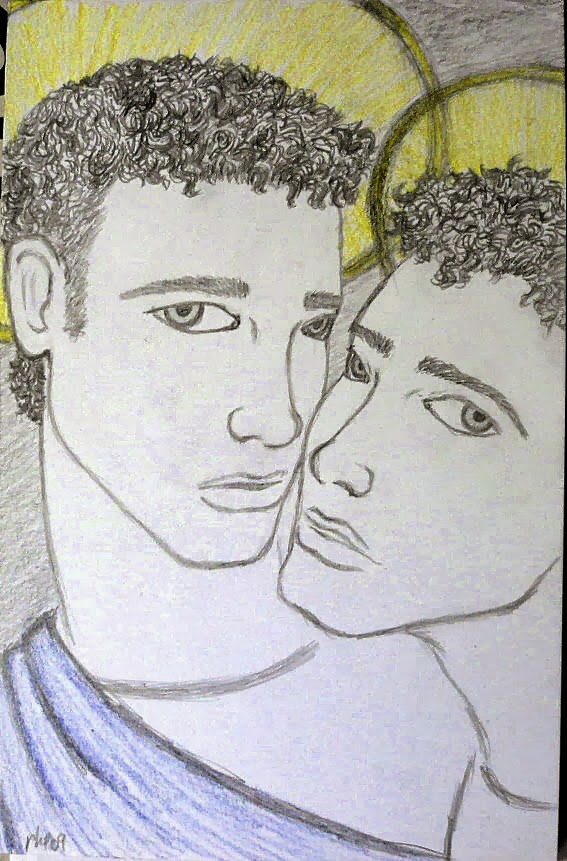
On the day that California artist Ray Avito first heard the story of Sergius and Bacchus, he sketched a delightfully unpretentious portrait of the pair (pictured above). He said it was based on “the suspicion that they may have been more than just comrades in arms.”


Sergius and Bacchus are among the many saints painted by Georgia artist Tony de Carlo. Raised Catholic, he started painting saints to counteract the church’s demonization of LGBT people. For more info, see my article Tony De Carlo: Artist affirms gay love with saints, Adam and Steve, and marriage equality paintings.

Historical men who loved men, including Sergius and Bacchus, are painted by American artist Ryan Grant Long in his “Fairy Tales” series. Sergius and Bacchus are usually portrayed as static icons, side by side staring straight at the viewer. But Long catches them gazing into each other’s eyes during a private moment in their prison cell. For more info, see my article Artist paints history’s gay couples: Interview with Ryan Grant Long.

Noted British photographer Anthony Gayton does stylized homoerotic photos based on the history of gay culture. He shows Sergius and Bacchus stripped and bound as prisoners in two separate photos. The images are intended to be shown together, but by design they can also be separated.
Appropriate Bible quotes are on banners above them. For Bacchus: “But I will not take my love from him, nor will I ever betray my faithfulness.” (Psalm 89:33). For Sergius: “All thy commandments are faithful, they persecute me wrongly; help thou me.” (Psalm 119: 86)
His Sergius and Bacchus photos belong to the series “Five Saints.” In addition to exploring saints, Gayton’s work uses historical themes inspired by such diverse sources as mythology, Renaissance and Baroque painting and early photography. Gayton’s work is published in his book Sinners and Saints


 Early Christian saints Sergius and Bacchus appear as “patrons of homosexuality” on handsome handmade cufflinks from artist Shoushan of Artisan Courtyard. Saints Sergius and Bacchus pendants are available as cufflinks, pendants, lockets and bracelets through her My Altar shop. The same icon is also available on shirts at Shoushan’s Etsy shop.
 Sergius and Bacchus religious medals show the couple together with the words, “Pray for us.”
The relationship of Sergius and Bacchus was reimagined in dance by Elastic Theatre in 2009 and is available on video. The description states, “Some have come to believe that they were lovers, and their ambiguous relationship has raised fascinating and inevitably controversial issues of gender and sexuality in early Christianity. With an original vocal score devised collaboratively by the company and choreography by Lola Maury, the piece premiered at the Arcola Theatre in July 2009 and was subsequently presented as part of the Borderline Opera season at London Metropolitan University.”
How good, or how pleasent is the brotherly knowledge of Your Martyrs, O God.For they did not know natural brothers in the flesh,but for the faith were considered brothers who struggled until death.Through their prayers, O God, have mercy on us.
Two new hymns to Sergius and Bacchus was written by George Staelens, the blogger at “Blogue de Georges.” The hymns can be heard in performance at this link from the Old-Catholic chapel of Saint Servais. Here is one stanza, which can be sung to many tunes such as “Old 100th.”
Stronger than death, the love has won ;
Sergius and Bacchus are but one ;
After their passion, they’re in heav’n ;
Together they shall rise again.
Top image credit:
“Sergius and Bacchus” by Alessio Ciani
Qspirit.net presents the Jesus in Love Blog on LGBTQ spirituality.
