Two men are getting attention online for kissing at the moment that it was announced that a new pope had been chosen at the Vatican.
The short video being shared online shows the crowd at St. Peter’s Square cheering when it was announced that a new pope had been elected. Two young men can be seen kissing quickly as the camera turns to them.
“Judging whether life is or is not worth living amounts to answering the fundamental question of philosophy,” Albert Camus wrote in one of the most sobering opening pages in literature. So here you are, having answered affirmatively, consciously or not, now facing the second fundamental question that ripples out of the first: How shall you live?
Perhaps the sharpest, most recurrent shock of being alive is the realization that no one can give you a ready-made answer — not your parents or your teachers, not scripture or Stoicism, not psychotherapy or psilocybin, not the old dharma teacher or the new pope. Only life itself. Only what Seamus Heaney called “your own secret knowledge,” which you may spend your life learning, but which is always whispering to you if you get still enough and quiet enough to discern its voice through the clangor of confusion and the din of shoulds.
In this sense, Nietzsche was right to caution that “no one can build you the bridge on which you, and only you, must cross the river of life.” In another, he was wrong in depicting life as a river you stand on the banks watching and waiting to cross without getting wet. No: You are the water. You are a molecule afloat among all the other molecules of everything else alive, the flow of life living itself through you, an answer complete unto itself.
This is why I’ll take, over all the world’s philosophy combined, Marie Howe’s spare and stunning poem “The Maples,” found in her New and Selected Poems (public library) — that benediction of a book that won her the Pulitzer Prize — read here by sapling-poet Rose Hanzlik to the sound of Debussy:
THE MAPLES by Marie Howe
I asked the stand of maples behind the house, How should I live my life?
They said, shhh shhh shhh…
How should I live, I asked, and the leaves seemed to ripple and gleam.
A bird called from a branch in its own tongue, And from a branch, across the yard, another bird answered.
A squirrel scrambled up a trunk then along the length of a branch.
Stand still, I thought, See how long you can bear that.
Try to stand still, if only for a few moments, drinking light breathing
Few things in life are more devastating than to give something your all and still fail. Not the “fail better” of startup culture, not the “fail forward” of self-help, not the failure that is childhood’s fulcrum of learning, not the inspired mistakes that propel creative risk, but simply that helpless and harrowing moment when you face the abyss between your will and your powers, your values and your choices, your ideal self and your real self. It is without redemption, such failure. But it need not be without reward. Admitting failure, especially moral failure, is hard enough — to others, where the temptation to displace blame and make excuses seduces most, but most of all to oneself. Accepting it is even harder — but it is on the other side of acceptance that the true reward of failure is to be found.
That is what the great Czech playwright, essayist, and poet Václav Havel (October 5, 1936–December 18, 2011) explores in an extraordinary feat of soul-searching and reckoning with the human condition, found in his Letters to Olga (public library), one of the most moving books I have ever read — the living record of his imprisonment after being found guilty on charges of “subversion” for his plays criticizing the communist regime and his human rights work defending the unjustly persecuted.
Václav Havel
In the summer of his forty-sixth year, Havel recounts a moment of moral failure that shaped the course of his life:
Dear Olga,
Five years ago something happened tome that in many regards had a key significance in my subsequent life. It began rather inconspicuously: I was in detention for the firs time and one evening, after interrogation, I wrote out a request to the Public Prosecutor for my release. Prisoners in detention are always writing such requests, and I too treated it as something routine and unimportant, more in the nature of mental hygiene: I knew, of course, that my eventual release or nonrelease would be decided by factors having nothing to do with whether I wrote the appropriate request or not. Still, the interrogations weren’t going anywhere and it seemed proper to use the opportunity to let myself be heard. I wrote my request in a way that at the time seemed extremely tactical and cunning: while saying nothing I did not believe or that wasn’t true, I simply “overlooked” the fact that truth lies not only in what is said, but also in who says it, and to whom, why, how and under what circumstances it is expressed. Thanks to this minor “oversight” (more precisely, this minor self-deception) what I said came dangerously close — by chance, as it were — to what the authorities wanted to hear. What was particularly absurd was the fact that my motive — at least my conscious and admitted motive — was not the hope that it would produce results, but merely a kind of professionally intellectualistic and somewhat perverse delight in my won — or so I thought — “honorable cleverness.” (I should add, to complete the picture, that when I read it some years later, the honor in that cleverness made my hair stand on end.) I sent the request off the following day and because no one responded to it and my detention was prolonged again, I assumed it had ended up where such requests usually end up, and I more or less forgot about it.
Havel was shocked to be told one day that he was most likely going to be released and “political use” would be made of his petition. He recounts:
Of course I knew right away what that meant: (1) that with appropriate “recasting,” “additions” and widespread publicity, the impression would be created that I had not held out, that I had given in to pressure and backed down from my positions, opinions and all my previous work; in short, that I had betrayed my cause, all for a trivial reason — to get myself out of jail; (2) no denial or correction on my part would alter that impression because I had undeniably written something that “met them halfway” and anything I could add would, quite rightly, seem like an attempt to worm my way out of it; (3) that the approaching catastrophe was unavoidable; (4) that the blot it would leave me on and everything I had taken part in would haunt me for years to come, that it would cause me measureless inner suffering, and that I would probably try to erase it with several years in prison (which in fact happened), but that not even that would rid me entirely of the stigma; (5) that I had no one but myself to blame: I was neither forced to do it, nor offered a bribe; I was not, in fact, in a dilemma and it was only because I’d unforgivably let down my moral guard that I’d given the other side — voluntarily and quite pointlessly — a weapon that amounted to a heaven-sent gift.
The haunting price of self-knowledge is that you always know, or some part of you always knows, exactly what your own moral failures would cost you. All Havel feared would happen is exactly what happened:
I came out of prison discredited, to confront a world that seemed to me one enormous, supremely justified rebuke. No one knows what I went through in that darkest period of my life… weeks, months, years in fact, of silent desperation, self-castigation, shame, inner humiliation, reproach and uncomprehending questioning. For a while I escaped from a world I felt too embarrassed to face into gloomy isolation, taking masochistic delight in endless orgies of self-blame. And then for a while I fled this inner hell into frantic activity through which I tried to drown out my anguish and at the same time, to “rehabilitate” myself somehow.
His only relative reprieve came when he was thrown into prison again. But it took him years to fully accept his moral failure and wrest from it something larger, something the dream of blamelessness and the performance of perfection could ever secure for the life of the soul. In a testament to the indivisible yin-yang of fortune and misfortune illustrated by the ancient parable of the Chinese farmer, he writes:
I’ve only now begun fully to realize that the experience wasn’t just — from my point of view, at least — an comprehensible lapse that caused me a lot of pointless suffering; it had a deeply positive and purgative significance, for which I ought to thank my fate instead of cursing it. It thrust me into a drastic but, for that very reason, crucial confrontation with myself; it shook, as it were, my entire “I,” shook out of it a deeper insight into itself, a more serious acceptance and understanding of my situation… my horizons, and led me, ultimately, to a new and more coherent consideration of the problem of human responsibility.
[…]
It is not hard to stand behind one’s successes. But to accept responsibility for one’s failures, to accept them unreservedly as failures that are truly one’s own, that cannot be shifted somewhere else or onto something else, and actively to accept — without regard for any worldly interests, no matter how well disguised, or for well-meant advice — the price that has to be paid for it: that is devilishly hard! But only thence does the road lead — as my experience, I hope, has persuaded me — to the renewal of sovereignty over my own affairs, to a radically new insight into the mysterious gravity of my existence as an uncertain enterprise, and to its transcendental meaning. And only this kind of inner understanding can ultimately lead to what might be called true “peace of mind,” to that highest delight, to genuine meaningfulness, to that “joy of Being.” If one manages to achieve that, then all one’s worldly privations cease to be privations, and become what Christians call grace.
In the years he spent in prison, Havel learned what it takes to turn suffering into strength and discovered the deepest meaning of hope. Upon his release, he threw himself with redoubled devotion into his political work. Not even a decade into his freedom, the Federal Assembly unanimously elected him president — the last president — of Czechoslovakia, after the dissolution of which a free people elected him the first president of the Czech Republic. Many survivors of communist dictatorships (myself included) lament that he was never awarded the Nobel Peace Prize. But the writing he left behind in his Letters to Olga is an eternal triumph of peacekeeping for the war within, the war we each wage against ourselves and in which there are no victors unless we arrive at the kind of peace of mind Havel found on the other side of facing, truly facing, his failure.
Walking through the white-walled gallery at the graduation show of one of New York’s most esteemed art schools, between beautiful young people with Instagram faces, I was struck to see project after project take up as its subject the least durable, most illusory aspect of human existence: the self. Where was the Iris Murdoch in these dawning artists’ lives to remind them that art, at its best, is “an occasion for unselfing”? And yet who could fault them: Not just their generation, but our entire culture seems to have forgotten that identities and opinions are the least interesting parts of people — ripples on the surface of the ocean of the soul, shimmering but shallow, pervious to every windsweep, irrelevant to the depths.
I was suddenly reminded of an essay by Annie Dillard from her 1974 masterpiece Pilgrim at Tinker Creek (public library), which won her the Pulitzer Prize and which I revisit frequently as basic irrigation for the soul. Its subject is Dillard’s experience of “stalking” a muskrat at Tinker Creek. Its object — like that of every Annie Dillard essay, of any great essay — is what it means to be alive.
Muskrat (Photograph: Tom Koerner/USFWS)
An epoch before it was imaginable that any fragment of the self could instantly face a worldwide mirror of millions, that any experience could be photographed and instantly become not only “a commemoration of itself” (as Italo Calvino so presciently put it) but a commodification of an inner world traded for likes, Dillard writes:
In the forty minutes I watched [the muskrat], he never saw me, smelled me, or heard me at all.
[…]
I never knew I was there, either. For that forty minutes last night I was as purely sensitive and mute as a photographic plate; I received impressions, but I did not print out captions. My own self-awareness had disappeared; it seems now almost as though, had I been wired with electrodes, my EEG would have been flat. I have done this sort of thing so often that I have lost self-consciousness about moving slowly and halting suddenly; it is second nature to me now. And I have often noticed that even a few minutes of this self-forgetfulness is tremendously invigorating. I wonder if we do not waste most of our energy just by spending every waking minute saying hello to ourselves.
After some passages bridging Heraclitus and Heisenberg in the virtuosic way that makes a piece of writing a symphony of thought and feeling, Dillard goes on to quote Martin Buber quoting an old Kabbalah teacher:
When you walk across the fields with your mind pure and holy, then from all the stones, and all growing things, and all animals, the sparks of their soul come out and cling to you, and then they are purified and become a holy fire in you.
A decade later, speaking at Portland’s wonderful Literary Arts, she would hold up this passage as her favorite in her entire book. But I find her own words just as clarifying, just as sanctifying:
It is astonishing how many people cannot, or will not, hold still. I could not, or would not, hold still for thirty minutes inside, but at the creek I slow down, center down, empty.
Long before neuroscience revealed how such moments quiet the activity of the brain’s Default Mode Network and put us in a salutary state termed “soft fascination,” Dillard describes that state from the inside:
I am not excited; my breathing is slow and regular. In my brain I am not saying, Muskrat! Muskrat! There! I am saying nothing. If I must hold a position, I do not “freeze.” If I freeze, locking my muscles, I will tire and break. Instead of going rigid, I go calm. I center down wherever I am; I find a balance and repose. I retreat — not inside myself, but outside myself, so that I am a tissue of senses. Whatever I see is plenty, abundance. I am the skin of water the wind plays over; I am petal, feather, stone.
This, perhaps, is what Willa Cather meant in her perfect definition of happiness as being “dissolved into something complete and great” that “comes as naturally as sleep” — a dissolution of the self into the totality of Being, or what Transcendentalist queen Margaret Fuller called “the All” in her own exquisite account of one such experience a century and a half earlier. This, too, is the pulsating truth at the heart of Dillard’s own oft-quoted insight — an indictment, today — that “how we spend our days is, of course, how we spend our lives.”
PBS Space Time • Apr 3, 2025 Check Out All PBS Earth Episodes: • Earth Month from PBS Planet Earth is the jewel of the solar system—the shimmery blue oceans, the verdant green forests, the wispy whimsical cloud formations. Saturn is the only competitor for most gorgeous planet with that giant ring system. Hmm… what if we could put the jewel of the Earth in its own ring? Then no contest. Well, there’s an extremely good chance that Earth once DID have a ring system. At least, that’s the proposal by a recent study that has evidence that a mysterious burst in meteor activity nearly half a billion years ago was actually caused by that ancient ring system collapsing onto the Earth. And, you know, if we had a ring once maybe we can have one again. Check Out Joe Scott’s: What Would Happen If The Earth Had Rings?
Nellie McClung statue unveiled at the Manitoba Legislature in Winnipeg on Friday June 18, 2010. Honored for her role in getting women the right to vote, she was also a supporter of eugenics. (THE CANADIAN PRESS/Winnipeg Free Press-Ken Gigliotti)
Sunday Edition4:25The allure and the dangers of “presentism”
Five years ago, after many heated arguments, a statue of Nellie McClung was unveiled on the grounds of the Manitoba legislature. She was being honoured and recognized for her pioneering work on behalf of equal rights for women. It was largely because of her efforts that Manitoba became the first province to grant women the vote. At the time, a prominent Winnipeg civil rights lawyer argued against the erection of any statue to McClung because of her belief in the practice of eugenics.
Wildly popular and morally repugnant, eugenics was the nutty theory that the human race could be mightily improved by sterilizing the disabled, the mentally ill, the developmentally delayed, all the lesser breeds among us. A young Tommy Douglas was an early believer.
Fast forward five years. The controversial statue issue has again come up, this time at Wilfrid Laurier University in Waterloo, Ontario. The university had plans to erect statues of Canada’s 22 prime ministers as part of the country’s 150th birthday celebrations next year.
Canada’s first prime minister, Sir John A. Macdonald. (THE CANADIAN PRESS/National Archive of Canada)
A petition signed by a number of representatives of native organizations condemned the idea of any statue honoring Canada’s first prime minister John A. Macdonald. The petitioners’ objections? MacDonald was a racist in his treatment of aboriginal people. It didn’t matter that without MacDonald, there would be no Canada.
In England, Oxford students are furious that their university has decided to keep in place a statue of Cecil Rhodes, the man who colonized much of southern Africa and gave his name and fortune to the Rhodes Scholarships. Keeping the statue, say the students, is proof positive that Oxford doesn’t care about black people.
All of the argument about who should be honored and who should be condemned is an example of the philosophical notion of presentism. Presentism is the practice of judging historical figures by the moral and ethical standards of the present day. For example, T.S. Eliot and Evelyn Waugh both reflected the casual antisemitism of the Twenties and Thirties. Should we then condemn the poetry of Eliot or the novels of Waugh because we now realize that any form of antisemitism is pernicious and downright dangerous?
How do you condemn one action or series of actions by one person, and exculpate others? In the Waterloo case, if you reject the MacDonald statue would you not have to reject the statue of the man for whom the university is named? After all, Laurier imposed and increased the notoriously racist head tax on Chinese immigrants. Thanks to social media, we live in an era of harsh, instantaneous judgement. People, especially well known people, are condemned on the slightest evidence without any reference to the context or complexity of the time.
In this age of identity politics, political careers are quickly smothered with the discovery of a long ago remark which may offend some group or other. What might be considered at one time as a high school prank, can blight a hard-won reputation. Let’s face it, we have all done or said many really stupid things in our lives. As might be expected, historians are caught in the middle.
The American Historical Association has condemned what it calls “the tendency to interpret the past in presentist terms.” It argues that “presentism encourages a kind of moral complacency and self-congratulation. Interpreting the past in terms of present concerns usually leads us to find ourselves morally superior.”
It is vital that we come to terms with our history. But before we rush to condemn, we should work harder to understand.
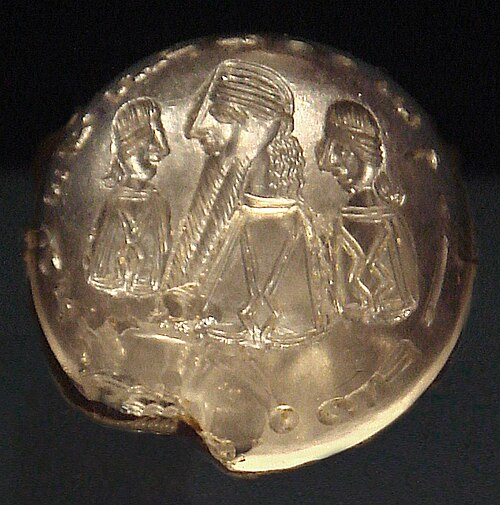
Sealstone of Mani, rock crystal, possibly 3rd century CE, Iraq. Cabinet des Médailles, Paris.[1][2] The seal reads “Mani, messenger of the messiah”, and may have been used by Mani himself to sign his epistles.[3][1]
Manichaeism was quickly successful and spread far through Aramaic-speaking regions.[15] It thrived between the third and seventh centuries, and at its height was one of the most widespread religions in the world. Manichaean churches and scriptures existed as far east as China and as far west as the Roman Empire.[16] Before the spread of Islam, it was briefly the main rival to early Christianity in the competition to replace classical polytheism. Under the Roman Dominate, Manichaeism was persecuted by the Roman state and was eventually stamped out in the Roman Empire.[5]
Manichaeism survived longer in the east than it did in the west. The religion was present in West Asia into the Abbasid Caliphate period in the 10th century. It was also present in China despite increasingly strict proscriptions under the Tang dynasty and was the official religion of the Uyghur Khaganate until its collapse in 830. It experienced a resurgence under the Mongol Yuan dynasty during the 13th and 14th centuries but was subsequently banned by the Chinese emperors, and Manichaeism there became subsumed into Buddhism and Taoism.[17] Some historic Manichaean sites still exist in China, including the temple of Cao’an in Jinjiang, Fujian, and the religion may have influenced later movements in Europe, including Paulicianism, Bogomilism, and Catharism.
While most of Manichaeism’s original writings have been lost, numerous translations and fragmentary texts have survived.[18]
An adherent of Manichaeism is called a Manichaean, Manichean, or Manichee.[19]
Manichaean priests, writing at their desks. Eighth or ninth century manuscript from Gaochang, Tarim Basin, China.Yuan Chinese silk painting Mani’s Birth
Mani composed seven works, six of which were written in the late-AramaicSyriac language. The seventh, the Shabuhragan,[24] was written by Mani in Middle Persian and presented by him to Sasanian emperorShapur I. Although there is no proof Shapur I was a Manichaean, he tolerated the spread of Manichaeism and refrained from persecuting it within his empire’s boundaries.[25]
A 14th-century illustration of the execution of Mani
While Manichaeism was spreading, existing religions such as Zoroastrianism were still prevalent, and Christianity was gaining social and political influence. Although having fewer adherents, Manichaeism won the support of many high-ranking political figures. With the assistance of the Sasanian Empire, Mani began missionary expeditions. After failing to win the favour of the next generation of Persian royalty and incurring the disapproval of the Zoroastrian clergy, Mani is reported to have died in prison awaiting execution by the Persian emperor Bahram I. The date of his death is estimated at 276–277 CE.
Mani believed that the teachings of Buddha, Zoroaster,[28] and Jesus were incomplete, and that his revelations were for the entire world, calling his teachings the “Religion of Light”. Manichaean writings indicate that Mani received revelations when he was twelve years old and again when he was 24, and over this period, he grew dissatisfied with the Elcesaites, the Jewish ChristianGnostic sect he was born into.[29] Some researchers also point to an important Jain influence on Mani as extreme degrees of asceticism and some specific features of Jain doctrine made the influence of Mahāvīra’s religious community more plausible than even the Buddha.[30] Fynes (1996) argues that various Jain influences, particularly ideas on the existence of plant souls, were transmitted from Western Kshatrapa territories to Mesopotamia and then integrated into Manichaean beliefs.[31]
Mani wore colorful clothing abnormal for the time that reminded some Romans of a stereotypical Persian magus or warlord, earning him ire from the Greco-Roman world because of it.[32]
Mani taught how the soul of a righteous individual returns to Paradise upon dying, but “the soul of the person who persisted in things of the flesh – fornication, procreation, possessions, cultivation, harvesting, eating of meat, drinking of wine – is condemned to rebirth in a succession of bodies.”[33]
Mani began preaching at an early age and was possibly influenced by contemporary Babylonian-Aramaic movements such as Mandaeism, Aramaic translations of Jewish apocalyptic works similar to those found at Qumran (e.g., the Book of Enoch literature), and by the Syriac dualist-Gnostic writer Bardaisan (who lived a generation before Mani). With the discovery of the Mani-Codex, it also became clear that he was raised in the Jewish Christian sect of the Elcasaites and possibly influenced by their writings.[citation needed]
According to biographies preserved by ibn al-Nadim and the Persian polymathal-Biruni, Mani received a revelation as a youth from a spirit, whom he would later call his “Twin” (Imperial Aramaic: תאומא tɑʔwmɑ, from which is also derived the Greek name of Thomas the Apostle, Didymus; the “twin”), Syzygos (Koinē Greek: σύζυγος “spouse, partner”, in the Cologne Mani-Codex), “Double,” “Protective Angel,” or “Divine Self.” This spirit taught him wisdom that he then developed into a religion. It was his “Twin” who brought Mani to self-realization. Mani claimed to be the Paraclete of the Truth promised by Jesus in the New Testament.[34]
Manichaean Painting of the Buddha Jesus depicts Jesus Christ as a Manichaean prophet. The figure can be identified as a representation of Jesus Christ by the small gold cross that sits on the red lotus throne in His left hand.
Jesus in Manichaeism possessed three separate identities: (1) Jesus the Luminous, (2) Jesus the Messiah and (3) Jesus patibilis (the suffering Jesus).
(1) As Jesus the Luminous … his primary role was as supreme revealer and guide and it was he who woke Adam from his slumber and revealed to him the divine origins of his soul and its painful captivity by the body and mixture with matter.
(2) Jesus the Messiah was an historical being who was the prophet of the Jews and the forerunner of Mani. However, the Manichaeans believed he was wholly divine, and that he never experienced human birth, as the physical realities surrounding the notions of his conception and his birth filled the Manichaeans with horror. However, the Christian doctrine of virgin birth was also regarded as obscene. Since Jesus the Messiah was the light of the world, where was this light, they reasoned, when Jesus was in the womb of the Virgin? Jesus the Messiah, they believed, was truly born only at his baptism, as it was on that occasion that the Father openly acknowledged his sonship. The suffering, death and resurrection of this Jesus were in appearance only as they had no salvific value but were an exemplum of the suffering and eventual deliverance of the human soul and a prefiguration of Mani’s own martyrdom.
(3) The pain suffered by the imprisoned Light-Particles in the whole of the visible universe, on the other hand, was real and immanent. This was symbolized by the mystic placing of the Cross whereby the wounds of the passion of our souls are set forth. On this mystical Cross of Light was suspended the Suffering Jesus (Jesus patibilis) who was the life and salvation of Man. This mystica crucifixio was present in every tree, herb, fruit, vegetable and even stones and the soil. This constant and universal suffering of the captive soul is exquisitely expressed in one of the Coptic Manichaean psalms.[35]
Augustine of Hippo also noted that Mani declared himself to be an “apostle of Jesus Christ”.[36] Manichaean tradition is also noted to have claimed that Mani was the reincarnation of religious figures from previous eras such as the Buddha, Krishna, and Zoroaster in addition to Jesus himself.
Academics note that much of what is known about Manichaeism comes from later 10th- and 11th-century Muslim historians like al-Biruni and ibn al-Nadim in his al-Fihrist; the latter “ascribed to Mani the claim to be the Seal of the Prophets.”[37] However, given the Islamic milieu of Arabia and Persia at the time, it stands to reason that Manichaens would regularly assert in their evangelism that Mani, not Muhammad, was the “Seal of the Prophets”.[38] In reality, for Mani the metaphorical expression “Seal of Prophets” is not a reference to his finality in a long succession of prophets as it is used in Islam, but rather as final to his followers (who testify or attest to his message as a “seal”).[39][40]
10th century Manichaean Electae in Gaochang (Khocho), China
Other sources of Mani’s scripture were the Aramaic originals of the Book of Enoch, 2 Enoch, and an otherwise unknown section of the Book of Enoch entitled The Book of Giants. Mani quoted the latter directly and expanded upon it, becoming one of the six original Syriac writings of the Manichaean Church. Besides short references by non-Manichaean authors through the centuries, no original sources of The Book of Giants (which is actually part six of the Book of Enoch) were available until the 20th century.[41]
Scattered fragments of both the original Aramaic Book of Giants (which were analyzed and published by Józef Milik in 1976)[42] and the Manichaean version of the same name (analyzed and published by Walter Bruno Henning in 1943)[43] were discovered along with the Dead Sea Scrolls in the Judaean desert in the 20th century and the Manichaean writings of the Uyghur Manichaean kingdom in Turpan. Henning wrote in his analysis of them:
It is noteworthy that Mani, who was brought up and spent most of his life in a province of the Persian empire, and whose mother belonged to a famous Parthian family, did not make any use of the Iranian mythological tradition. There can no longer be any doubt that the Iranian names of Sām, Narīmān, etc., that appear in the Persian and Sogdian versions of the Book of the Giants, did not figure in the original edition, written by Mani in the Syriac language.[43]
By comparing the cosmology of the books of Enoch to the Book of Giants, as well as the description of the Manichaean myth, scholars have observed that the Manichaean cosmology can be described as being based, in part, on the description of the cosmology developed in detail within the Enochic literature.[44] This literature describes the being that the prophets saw in their ascent to Heaven as a king who sits on a throne at the highest of the heavens. In the Manichaean description, this being, the “Great King of Honor”, becomes a deity who guards the entrance to the World of Light placed at the seventh of ten heavens.[45] In the Aramaic Book of Enoch, the Qumran writings, overall, and in the original Syriac section of Manichaean scriptures quoted by Theodore bar Konai,[46] he is called malkā rabbā d-iqārā (“the Great King of Honor”).[citation needed]
Mani was also influenced by writings of the gnostic Bardaisan (154–222 CE), who, like Mani, wrote in Syriac and presented a dualistic interpretation of the world in terms of light and darkness in combination with elements from Christianity.[47]
Mani was heavily inspired by Iranian Zoroastrian theology.[28]
Akshobhya in the abhirati with the Cross of Light, a symbol of Manichaeism
Noting Mani’s travels to the Kushan Empire (several religious paintings in Bamyan are attributed to him) at the beginning of his proselytizing career, Richard Foltz postulates Buddhist influences in Manichaeism:
Buddhist influences were significant in the formation of Mani’s religious thought. The transmigration of souls became a Manichaean belief, and the quadripartite structure of the Manichaean community, divided between male and female monks (the “elect”) and lay followers (the “hearers”) who supported them, appears to be based on that of the Buddhist sangha.[48]
The Kushan monk Lokakṣema began translating Pure Land Buddhist texts into Chinese in the century prior to Mani arriving there. The Chinese texts of Manichaeism are full of uniquely Buddhist terms taken directly from these Chinese Pure Land scriptures, including the term “pure land” (Chinese: 淨土; pinyin: jìngtǔ) itself.[49] However, the central object of veneration in Pure Land Buddhism, Amitābha, the Buddha of Infinite Light, does not appear in Chinese Manichaeism and seems to have been replaced by another deity.[50]
Spread
Roman Empire
A map of the spread of Manichaeism (300–500). World History Atlas, Dorling Kindersly.
Manichaeism reached Rome through the apostle Psattiq in 280, who was also in Egypt in 244 and 251. It flourished in the Faiyum in 290.
Manichaean monasteries existed in Rome in 312 during the time of Pope Miltiades.[51]
In 291, persecution arose in the Sasanian Empire with the murder of the apostle Sisin by Emperor Bahram II and the slaughter of many Manichaeans. Then, in 302, the first official reaction and legislation against Manichaeism from the Roman state was issued under Diocletian. In an official edict called the De Maleficiis et Manichaeis compiled in the Collatio Legum Mosaicarum et Romanarum and addressed to the proconsul of Africa, Diocletian wrote:
We have heard that the Manichaeans […] have set up new and hitherto unheard-of sects in opposition to the older creeds so that they might cast out the doctrines vouchsafed to us in the past by the divine favour for the benefit of their own depraved doctrine. They have sprung forth very recently like new and unexpected monstrosities among the race of the Persians – a nation still hostile to us – and have made their way into our empire, where they are committing many outrages, disturbing the tranquility of our people and even inflicting grave damage to the civic communities. We have cause to fear that with the passage of time they will endeavour, as usually happens, to infect the modest and tranquil of an innocent nature with the damnable customs and perverse laws of the Persians as with the poison of a malignant (serpent) … We order that the authors and leaders of these sects be subjected to severe punishment, and, together with their abominable writings, burnt in the flames. We direct their followers, if they continue recalcitrant, shall suffer capital punishment, and their goods be forfeited to the imperial treasury. And if those who have gone over to that hitherto unheard-of, scandalous and wholly infamous creed, or to that of the Persians, are persons who hold public office, or are of any rank or of superior social status, you will see to it that their estates are confiscated and the offenders sent to the (quarry) at Phaeno or the mines at Proconnesus. And in order that this plague of iniquity shall be completely extirpated from this our most happy age, let your devotion hasten to carry out our orders and commands.[52]
By 354, Hilary of Poitiers wrote that Manichaeism was a significant force in Roman Gaul. In 381, Christians requested Theodosius I to strip Manichaeans of their civil rights. Starting in 382, the emperor issued a series of edicts to suppress Manichaeism and punish its followers.[53]
Augustine of Hippo (354–430) converted to Christianity from Manichaeism in the year 387. This was shortly after the Roman emperor Theodosius I issued a decree of death for all Manichaean monks in 382 and shortly before he declared Christianity the only legitimate religion for the Roman Empire in 391. Due to the heavy persecution, the religion almost disappeared from Western Europe in the fifth century and from the eastern portion of the empire in the sixth century.[54]
According to his Confessions, after nine or ten years of adhering to the Manichaean faith as a member of the group of “hearers”, Augustine of Hippo became a Christian and potent adversary of Manichaeism (which he expressed in writing against his Manichaean opponent Faustus of Mileve), seeing their beliefs that knowledge was the key to salvation as too passive and unable to affect any change in one’s life.[55]
I still thought that it is not we who sin but some other nature that sins within us. It flattered my pride to think that I incurred no guilt and, when I did wrong, not to confess it … I preferred to excuse myself and blame this unknown thing which was in me but was not part of me. The truth, of course, was that it was all my own self, and my own impiety had divided me against myself. My sin was all the more incurable because I did not think myself a sinner.[56]
Some modern scholars have suggested that Manichaean ways of thinking influenced the development of some of Augustine’s ideas, such as the nature of good and evil, the idea of hell, the separation of groups into elect, hearers, and sinners, and the hostility to the flesh and sexual activity, and his dualistic theology.[57]
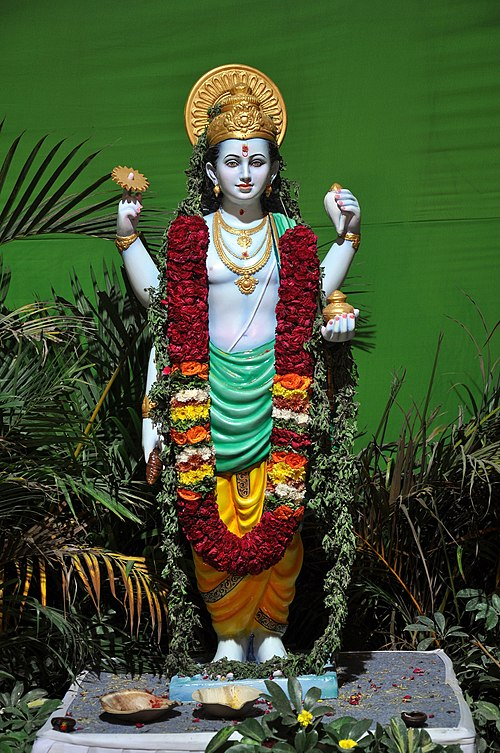
Dhanvantari, an avatar of Vishnu, is the Hindu god associated with ayurveda.
Ayurveda (/ˌɑːjʊərˈveɪdə, -ˈviː-/; IAST: āyurveda[1]) is an alternative medicine system with historical roots in the Indian subcontinent.[2] It is heavily practised throughout India and Nepal, where as much as 80% of the population report using ayurveda.[3][4][5][6] The theory and practice of ayurveda is pseudoscientific and toxic metals including lead and mercury are used as ingredients in many ayurvedic medicines.[7][8][9][10]
Ayurveda therapies have varied and evolved over more than two millennia.[2] Therapies include herbal medicines, special diets, meditation, yoga, massage, laxatives, enemas, and medical oils.[11][12] Ayurvedic preparations are typically based on complex herbal compounds, minerals, and metal substances (perhaps under the influence of early Indian alchemy or rasashastra). Ancient ayurveda texts also taught surgical techniques, including rhinoplasty, lithotomy, sutures, cataract surgery, and the extraction of foreign objects.[13][14]
Historical evidence for ayurvedic texts, terminology and concepts appears from the middle of the first millennium BCE onwards.[15] The main classical ayurveda texts begin with accounts of the transmission of medical knowledge from the gods to sages, and then to human physicians.[16] Printed editions of the Sushruta Samhita (Sushruta’s Compendium), frame the work as the teachings of Dhanvantari, the Hindu deity of ayurveda, incarnated as King Divodāsa of Varanasi, to a group of physicians, including Sushruta.[17][18] The oldest manuscripts of the work, however, omit this frame, ascribing the work directly to King Divodāsa.[19]
In ayurveda texts, dosha balance is emphasised, and suppressing natural urges is considered unhealthy and claimed to lead to illness.[20] Ayurveda treatises describe three elemental doshas: vāta, pitta and kapha, and state that balance (Skt.sāmyatva) of the doshas results in health, while imbalance (viṣamatva) results in disease. Ayurveda treatises divide medicine into eight canonical components. Ayurveda practitioners had developed various medicinal preparations and surgical procedures from at least the beginning of the common era.[21]
Although some Ayurvedic treatments can help relieve some symptoms of cancer, there is no good evidence that the disease can be treated or cured through ayurveda.[12]
Several ayurvedic preparations have been found to contain lead, mercury, and arsenic,[11][23] substances known to be harmful to humans. A 2008 study found the three substances in close to 21% of US and Indian-manufactured patent ayurvedic medicines sold through the Internet.[24] The public health implications of such metallic contaminants in India are unknown.[24]
Etymology
The term āyurveda (Sanskrit: आयुर्वेद) is composed of two words, āyus, आयुस्, “life” or “longevity”, and veda, वेद, “knowledge”, translated as “knowledge of longevity”[25][26] or “knowledge of life and longevity”.[27]
Eight components
Nagarjuna, known for the Madhyamaka (middle path), wrote the medical works The Hundred Prescriptions and The Precious Collection.[28]
The earliest classical Sanskrit works on ayurveda describe medicine as being divided into eight components (Skt. aṅga).[29][30] This characterization of the physician’s art, “the medicine that has eight components” (Sanskrit: चिकित्सायामष्टाङ्गायाम्, romanized: cikitsāyām aṣṭāṅgāyāṃ), is first found in the Sanskrit epic the Mahābhārata, c. 4th century BCE.[31] The components are:[32][27][33]
Kāyachikitsā: general medicine, medicine of the body
Kaumāra-bhṛtya (Pediatrics): Discussions about prenatal and postnatal care of baby and mother; methods of conception; choosing the child’s sex, intelligence, and constitution; childhood diseases; and midwifery[34]
Śhālākyatantra: treatment of ailments affecting openings or cavities in the upper body: ears, eyes, nose, mouth, etc.
Bhūtavidyā: pacification of possessing spirits, and the people whose minds are affected by such possession
Agadatantra/Vishagara-vairodh Tantra (Toxicology): includes epidemics; toxins in animals, vegetables and minerals; and keys for recognizing those anomalies and their antidotes
Rasāyantantra: rejuvenation and tonics for increasing lifespan, intellect and strength
Vājīkaraṇatantra: aphrodisiacs; treatments for increasing the volume and viability of semen and sexual pleasure; infertility problems; and spiritual development (transmutation of sexual energy into spiritual energy)
The central theoretical ideas of ayurveda show parallels with Samkhya and Vaisheshika philosophies, as well as with Buddhism and Jainism.[35][36] Balance is emphasized, and suppressing natural urges is considered unhealthy and claimed to lead to illness.[20] For example, to suppress sneezing is said to potentially give rise to shoulder pain.[37] However, people are also cautioned to stay within the limits of reasonable balance and measure when following nature’s urges.[20] For example, emphasis is placed on moderation of food intake,[38] sleep, and sexual intercourse.[20]
The three doshas and the five elements from which they are composed
According to ayurveda, the human body is composed of tissues (dhatus), waste (malas), and humeral biomaterials (doshas).[39] The seven dhatus are chyle (rasa), blood (rakta), muscles (māmsa), fat (meda), bone (asthi), marrow (majja), and semen (shukra). Like the medicine of classical antiquity, the classic treatises of ayurveda divided bodily substances into five classical elements (panchamahabhuta) viz. earth, water, fire, air and ether.[40] There are also twenty gunas (qualities or characteristics) which are considered to be inherent in all matter. These are organized in ten pairs: heavy/light, cold/hot, unctuous/dry, dull/sharp, stable/mobile, soft/hard, non-slimy/slimy, smooth/coarse, minute/gross, and viscous/liquid.[41]
The three postulated elemental bodily humours, the doshas or tridosha, are vata (air, which some modern authors equate with the nervous system), pitta (bile, fire, equated by some with enzymes), and kapha (phlegm, or earth and water, equated by some with mucus). Contemporary critics assert that doshas are not real, but are a fictional concept.[42] The humours (doshas) may also affect mental health. Each dosha has particular attributes and roles within the body and mind; the natural predominance of one or more doshas thus explains a person’s physical constitution (prakriti) and personality.[39][43][44] Ayurvedic tradition holds that imbalance among the bodily and mental doshas is a major etiologic component of disease. One ayurvedic view is that the doshas are balanced when they are equal to each other, while another view is that each human possesses a unique combination of the doshas which define this person’s temperament and characteristics. In either case, it says that each person should modulate their behavior or environment to increase or decrease the doshas and maintain their natural state. Practitioners of ayurveda must determine an individual’s bodily and mental dosha makeup, as certain prakriti are said to predispose one to particular diseases.[45][39] For example, a person who is thin, shy, excitable, has a pronounced Adam’s apple, and enjoys esoteric knowledge is likely vata prakriti and therefore more susceptible to conditions such as flatulence, stuttering, and rheumatism.[39][46] Deranged vata is also associated with certain mental disorders due to excited or excess vayu (gas), although the ayurvedic text Charaka Samhita also attributes “insanity” (unmada) to cold food and possession by the ghost of a sinful Brahman (brahmarakshasa).[39][45][47][48]
Ama (a Sanskrit word meaning “uncooked” or “undigested”) is used to refer to the concept of anything that exists in a state of incomplete transformation. With regards to oral hygiene, it is claimed to be a toxic byproduct generated by improper or incomplete digestion.[49][50][51] The concept has no equivalent in standard medicine.
In medieval taxonomies of the Sanskrit knowledge systems, ayurveda is assigned a place as a subsidiary Veda (upaveda).[52] Some medicinal plant names from the Atharvaveda and other Vedas can be found in subsequent ayurveda literature.[53] Some other school of thoughts considers ‘ayurveda’ as the ‘Fifth Veda‘.[54] The earliest recorded theoretical statements about the canonical models of disease in ayurveda occur in the earliest Buddhist Canon.[55]
Practice
Physician taking pulse, Delhi, c. 1825
Ayurvedic practitioners regard physical existence, mental existence, and personality as three separate elements of a whole person with each element being able to influence the others.[56] This holistic approach used during diagnosis and healing is a fundamental aspect of ayurveda. Another part of ayurvedic treatment says that there are channels (srotas) which transport fluids, and that the channels can be opened up by massage treatment using oils and Swedana (fomentation). Unhealthy, or blocked, channels are thought to cause disease.[57]
Diagnosis
An ayurvedic practitioner applying oil using head massage
Ayurveda has eight ways to diagnose illness, called nadi (pulse), mootra (urine), mala (stool), jihva (tongue), shabda (speech), sparsha (touch), druk (vision), and aakruti (appearance).[58] Ayurvedic practitioners approach diagnosis by using the five senses.[59] For example, hearing is used to observe the condition of breathing and speech.[40] The study of vulnerable points, or marma, is particular to ayurvedic medicine.[41]
Treatment procedures
Treatment and prevention
Two of the eight branches of classical ayurveda deal with surgery (Śalya-cikitsā and Śālākya-tantra), but contemporary ayurveda tends to stress attaining vitality by building a healthy metabolic system and maintaining good digestion and excretion.[41] Ayurveda also focuses on exercise, yoga, and meditation.[60] One type of prescription is a Sattvic diet.
Ayurveda follows the concept of Dinacharya, which says that natural cycles (waking, sleeping, working, meditation etc.) are important for health. Hygiene, including regular bathing, cleaning of teeth, oil pulling, tongue scraping, skin care, and eye washing, is also a central practice.[40]
The arrival of non-human intelligence is a very big deal, says former Google CEO and chairman Eric Schmidt. In a wide-ranging interview with technologist Bilawal Sidhu, Schmidt makes the case that AI is wildly underhyped, as near-constant breakthroughs give rise to systems capable of doing even the most complex tasks on their own. He explores the staggering opportunities, sobering challenges and urgent risks of AI, showing why everyone will need to engage with this technology in order to remain relevant.
New Thinking Allowed with Jeffrey Mishlove • May 16, 2025 This video is a special release from the original Thinking Allowed series that ran on public television from 1986 until 2002. It was recorded in about 1988. It will remain public for only one week. Patricia L. Garfield was an American psychologist specializing in the study of dreams, specifically the cognitive processes underpinning them. She was the author of ten books covering a broad range of dream topics. These topics include: nightmares, children’s dreams, healing through dreams and dream-related art. She was a founder of the International Association for the Study of Dreams and a past-president of that organization. Here she describes the healing power of dreams of those who have departed. Now you can watch all of the programs from the original Thinking Allowed Video Collection, hosted by Jeffrey Mishlove. Subscribe to the new Streaming Channel (https://thinkingallowed.vhx.tv/) and watch more than 350 programs now, with more, previously unreleased titles added weekly. Free month of the classic Thinking Allowed streaming channel for New Thinking Allowed subscribers only. Use code THINKFREELY.
Consciousness, spirituality, biography, sexuality, androgyny, futurism, space, the arts, science, astrology, democracy, humor, books, movies and more


 THE MAPLES




.jpg)




._Seal_with_figure_of_Mani,_possibly_3rd_century_CE,_possibly_Irak._Cabinet_des_M%C3%A9dailles,_Paris.jpg)