

Tarot Card for May 19: The Fool
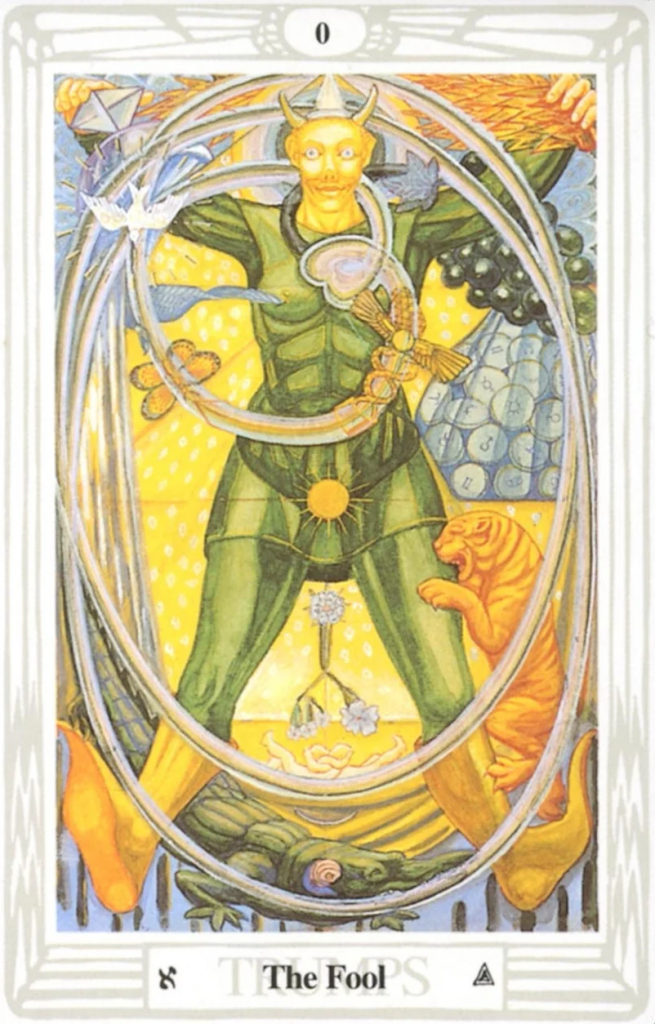
| The Fool The Fool is a joyous and exciting card – combining both perfect trust and self reliance.As the very first card in the Tarot deck, it marks the moment upon which we embark on a new phase in our spiritual journey.When we explore new terrain, we are bound sometimes to encounter danger or challenge. The Fool’s energy gives us the power and self-confidence to move through challenges with an open heart, to recognise friends and to gather experiences to us as the true treasures that they are.Innocence is a devalued quality these days. We forget that to approach life with eyes that are new each morning reveals to us more of life’s mystery than anything else. We cannot substitute the sheer growth permitted by trust and innocence with cynicism nor prior knowledge.So, on a day ruled by the Fool, we need to lift our hearts upwards and open them to the richness and beauty of life. We need to regard ourselves as travelling through a land of wonderment and joy. We need to encourage excitement and exhilaration, and to look constantly for that which is new and bright and hopeful in every step we take.We also need to trust to the life process, and to remember that, by and large, the gods have no need of our suffering, and every need of our joy, laughter and celebration. Affirmation: “I tread the path of life with joy in my heart and a smile on my lips.” |
(Angelpaths.com)
Elvis ’68 Comeback Special
Droning Around Feb 11, 2024 NBC STUDIO 1A
“After the first session, Elvis went backstage and quickly shed his now legendary black leather jumpsuit. He called over his costume designer Bill Belew, who had personally tailored his outfit. “We’ve got a problem,” Elvis told him. “It’s all wet inside.” He wasn’t talking about perspiration. Belew took the suit without a word and worked it with a few paper towels and a hair dryer. Elvis went out again without a word for the second act.”
–Whitmer, “The Inner Elvis” from “The Occult Elvis” by Miguel Conner
Time Travel with Eric Wargo
New Thinking Allowed with Jeffrey Mishlove • May 18, 2025 Eric Wargo, PhD, an anthropologist, is author of Time Loops, Precognitive Dreamwork and the Long Self: Interpreting Messages From Your Future, From Nowhere: Artists, Writers, and the Precognitive Imagination, Where Was It Before the Dream, and most recently Becoming Timefaring: Time Travel & the Human Future. His website is https://www.thenightshirt.com/ Here he points out the logical flaws in the arguments raised by both physicists and philosophers that time travel is a practical impossibility. He notes that “reverse causation” is coming to be seen as part of the natural world in theoretical physics. He adds that UFO experiences may well be examples of visitors from the future. He suggests we should prepare ourselves for a new era of time travel. 00:00 Introduction 03:14 The reluctance of scientists 07:18 UFOs and time travel 10:24 Fallacies of the critics 19:58 Time travel approaches 24:49 Meeting yourself 28:39 Being in multiple places at once 35:13 The universe as a time loop 40:26 Retrocausation research 55:15 Conclusion New Thinking Allowed host, Jeffrey Mishlove, PhD, is author of The Roots of Consciousness, Psi Development Systems, and The PK Man. Between 1986 and 2002 he hosted and co-produced the original Thinking Allowed public television series. He is the recipient of the only doctoral diploma in “parapsychology” ever awarded by an accredited university (University of California, Berkeley, 1980). He is also the Grand Prize winner of the 2021 Bigelow Institute essay competition regarding the best evidence for survival of human consciousness after permanent bodily death. He currently serves as Co-Director of Parapsychology Education at the California Institute for Human Science. (Recorded on April 28, 2024)
How We Can Resist Trump’s Reality TV Regime
Wajahat Ali • May 16, 2025 If it talks like a fascist, rules like a fascist, and follows a fascist playbook, then maybe it’s the Trump authoritarian regime that is openly coming after our freedoms, rights, and social services.

Strongmen: Mussolini to the Present
Ruth Ben-Ghiat
Ours is the age of authoritarian rulers: self-proclaimed saviors of the nation who evade accountability while robbing their people of resources and corroding or destroying democracy. Their mutual-admiration club also draws on models from the past. Vladimir Putin rehabilitates Soviet tyrant Joseph Stalin, Donald Trump praises Libyan despot Muammar Gaddafi, Jair Bolsonaro admires Chilean dictator Augusto Pinochet, and Recep Tayyip Erdogan invokes Adolf Hitler as the model of an efficient leader.
Ruth Ben-Ghiat covers a century of authoritarianism to explain why strongman rulers in Africa, Europe, and Latin America, drawing from a common playbook of machismo, propaganda, violence, and corruption, have found popular support even as they bring ruin to their countries. The fruit of decades of research, Strongmen gives readers insight into how such rulers think, who and what they depend on, and how they can be opposed.
About the author
Ruth Ben-Ghiat
Ruth Ben-Ghiat is an internationally acclaimed historian, speaker, and political commentator for the Atlantic, CNN, the Washington Post, and other publications. She is a professor of history and Italian studies at New York University and lives in New York City.
Book: “Cleansing the Doors of Perception: The Religious Significance of Entheogenic Plants and Chemicals”
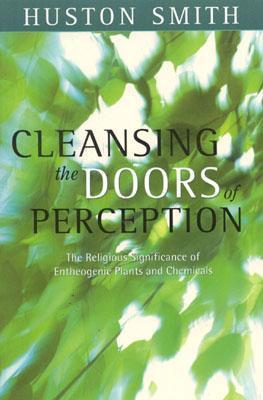
Cleansing the Doors of Perception: The Religious Significance of Entheogenic Plants and Chemicals
Huston Smith
This book takes a serious look at the use of psychedelic drugs as a means to achieve mystical union with the divine.
About the author
Huston Smith
Smith was born in Suzhou, China to Methodist missionaries and spent his first 17 years there. He taught at the Universities of Colorado and Denver from 1944–1947, moving to Washington University in St. Louis, Missouri for the next ten years, and then Professor of Philosophy at MIT from 1958–1973. While at MIT he participated in some of the experiments with entheogens that professor Timothy Leary conducted at Harvard University. He then moved to Syracuse University where he was Thomas J. Watson Professor of Religion and Distinguished Adjunct Professor of Philosophy until his retirement in 1983 and current emeritus status. He now lives in the Berkeley, CA area where he is Visiting Professor of Religious Studies at the University of California, Berkeley.
During his career, Smith not only studied, but practiced Vedanta Hinduism, Zen Buddhism (studying under Goto Zuigan), and Sufism for over ten years each. He is a notable autodidact.
As a young man, Smith, of his own volition, after suddenly turning to mysticism, set out to meet with then-famous author Gerald Heard. Heard responded to Smith’s letter, invited him to his Trabuco College (later donated as the Ramakrishna Monastery) in Southern California, and then sent him off to meet the legendary Aldous Huxley. So began Smith’s experimentation with meditation, and association with the Vedanta Society in Saint Louis under the auspices of Swami Satprakashananda of the Ramakrishna order.
Via the connection with Heard and Huxley, Smith eventually experimented with Timothy Leary and others at the Center for Personality Research, of which Leary was Research Professor. The experience and history of the era are captured somewhat in Smith’s book Cleansing the Doors of Perception. In this period, Smith joined in on the Harvard Project as well, an attempt to raise spiritual awareness through entheogenic plants.
He has been a friend of the XIVth Dalai Lama for more than forty years, and met and talked to some of the great figures of the century, from Eleanor Roosevelt to Thomas Merton.
He developed an interest in the Traditionalist School formulated by Rene Guenon and Ananda Coomaraswamy. This interest has become a continuing thread in all his writings.
In 1996, Bill Moyers devoted a 5-part PBS special to Smith’s life and work, “The Wisdom of Faith with Huston Smith.” Smith has produced three series for public television: “The Religions of Man,” “The Search for America,” and (with Arthur Compton) “Science and Human Responsibility.” His films on Hinduism, Tibetan Buddhism, and Sufism have all won awards at international film festivals.
His latest DVD release is The Roots of Fundamentalism – A Conversation with Huston Smith and Phil Cousineau.
Story: “Same Boat”
 Two men were out on the ocean in a boat.
 Pepe Mujica: My Generation Made a Naive Error
BY JOSÉ MUJICA
05.14.2025 (Jacobin.com)
The late Uruguayan statesman José “Pepe” Mujica argues that capitalism is not just property relations but a set of cultural values that the Left must confront with a culture of solidarity.

Our spring issue, “Progress,” was called by one commentator “quite readable.” Click here to see what all the fuss is about.
My generation made a naive error. We believed that social change was only a matter of challenging modes of production and distribution in society. We did not understand the immense role of culture. Capitalism is a culture, and we must respond to and resist capitalism with a different culture. Another way to put this: we are in a struggle between a culture of solidarity and a culture of selfishness.
I am not thinking of culture that is sold, like professional music or dance. All that is important, of course, but when I speak of culture I am referring to human relations, to the set of ideas that govern our relationships without us realizing it. It is a set of unspoken values that determine the way in which millions of anonymous people around the world relate to each other.
Consumerism is part of that culture. It is an ethic needed for capitalism in its struggle for infinite accumulation. The worst problem for capitalism would be for us to stop buying or to buy very little. And this has generated the consumerist culture that envelops us. But a capitalist social system is not only property relations; it is also a set of unspoken values common to the society. These values are stronger than any army and they are the main force maintaining capitalism today.
My generation believed it was going to change the world by trying to nationalize the media and distribution, but we failed to understand that at the center of this battle must be the construction of a different culture. You cannot build a socialist building with bricklayers who are capitalists. Why? Because they are going to steal the rebar, they are going to steal the cement, because they are only looking to solve their own problems, because that is how we are formed. My generation, rationalist with a programmatic vision of history, did not understand that humans often decide with their guts and then their conscience constructs arguments to justify their decisions. We choose with our hearts, and here culture becomes a vital issue because it tempers our irrationality.
For example, what happened to our left leaders? Left leaders are sick and immersed in that same culture, and that is why their way of life is not a message coherent with their struggle. Look, they said I was poor when I was president, but they didn’t understand a thing! I am not poor. Poor is the one who needs a lot. My goal is to be a stoic. And the fact is that if the world does not learn to live with a certain sobriety, not to squander, not to waste, if it does not learn this soon, our world will not survive.
The lust for money incites us to keep on buying new things, but sustaining the life of the planet means that we must learn to live with what is necessary and not to squander our resources. Now, as you can see, this struggle is a cultural epic. We, the Left, must construct a line of thought that is different from the one we have.
This means throwing out our connection to capitalism. We ran out of creativity in terms of ideas. We wanted to do the same as capitalism, but with more equality. And in the end, this all has to do with what we consider to be the good life, the values that we can cherish in life, the things that we can aspire to. It means having a sense of limits. Nothing too much, as the Greeks used to say.
The Left must be faithful to another set of values, and that is why I insist on the problem of culture, on the problem of commitment and on the problem of valuing certain areas of life that capitalism does not value. There is much sadness in our societies even though they are full of wealth. We are an overfed people with societies choked by the amount of garbage we create. We infest everything, we buy things we don’t need and then we live in despair paying bills. We must propose another way of living! For me, the Left has to be more revolutionary than ever.
It means to live as you think. Otherwise we end up thinking as we live. The struggle is for a self-managing society, to learn to be our own bosses and to lead our common projects. These things will have to be discussed by a new left. I believe in the permanent existence of the Left, but it will not be the Left as it was. What it was is gone, has passed! The Left will have to be different because time changes. The only permanent thing is change.
I’m not going to suggest obstacles to the creation of new revolutionary programs. On the contrary! But I don’t have a magic formula. It seems to me that creativity must be encouraged, because we are in a world with an old left that lives too much on nostalgia, a left that finds it hard to realize why it failed and has great difficulty in imagining new ways forward. I believe that this is a time of much rehearsal, a lot of experimentation and creativity. And for that there are some parameters we can follow, because, as I said, my generation did not place enough emphasis on culture. I am referring to the culture inherent in the common and ordinary relationships that people have, which, under capitalism, now uses the events of daily life only to ensure further accumulation.
The culture in which we are embedded, in which we are surrounded, is functional only for the multiplication of individual profit. And that culture is much stronger than armies and military power and everything else, because that culture is determining the permanent relationships of millions of ordinary people all over the world.
And that is much stronger than the atomic bomb! So, to change a system without facing the problem of a change in culture is useless. We must build a new system and, in parallel, a new culture, a new ethic, because, if not, what we saw with the Soviet Union will happen again, where a revolutionary movement made a perfect 360 degree turn to be in the same place — but much worse! We have to learn from that defeat, right?
Adapted from Surviving the 21st Century by Noam Chomsky and José Mujica, edited by Saúl Alvídrez, forthcoming from Verso in September 2025.
(Contributed by Gwyllm Llwydd)
Diamond Luminosity with Chris Bache Live Stream
New Thinking • Streamed live 104 minutes ago Chris Bache, PhD, is professor emeritus in the department of Philosophy and Religious Studies at Youngstown State University in Ohio where he taught for 33 years. He is also adjunct faculty at the California Institute of Integral Studies, Emeritus Fellow at the Institute of Noetic Sciences, and on the Advisory Council of Grof Legacy Training. Chris is the author of Lifecycles: Reincarnation and the Web of Life; Dark Night, Early Dawn; The Living Classroom: Teaching and Collective Consciousness; and LSD and the Mind of the Universe: Diamonds from Heaven. His website is chrisbache.com.

Lifecycles: Reincarnation and the Web of Life
Christopher M. Bache
Lifecycles combines the best scientific testimonies about reincarnation with philosophically sound yet accessible arguments about its implications. Lifecycles is the first book to both describe the dynamics of rebirth and explore the ramifications of adopting a reincarnationist perspective. The book begins with a masterful synthesis of recent findings from consciousness research and near-death studies. It includes the work of such eminent therapists and scholars as Stanislav Grof and Dr. Ian Stevenson, and critically surveys the most compelling evidence for rebirth. Lifecycles emphasizes the lessons for self-awareness and spiritual growth inherent in a reincarnationist world view, showing us how we can reconnect with the order, intelligence, and beauty of the universe around us.
About the author
Christopher M. Bache
Christopher Bache is professor emeritus in the department of Philosophy and Religious Studies at Youngstown State University, adjunct faculty at the California Institute of Integral Studies, Emeritus Fellow at the Institute of Noetic Sciences, and on the Advisory Council of Grof Legacy Training.
(Goodreads.com)
Book: “Realms of the Human Unconscious: Observations from LSD Research”
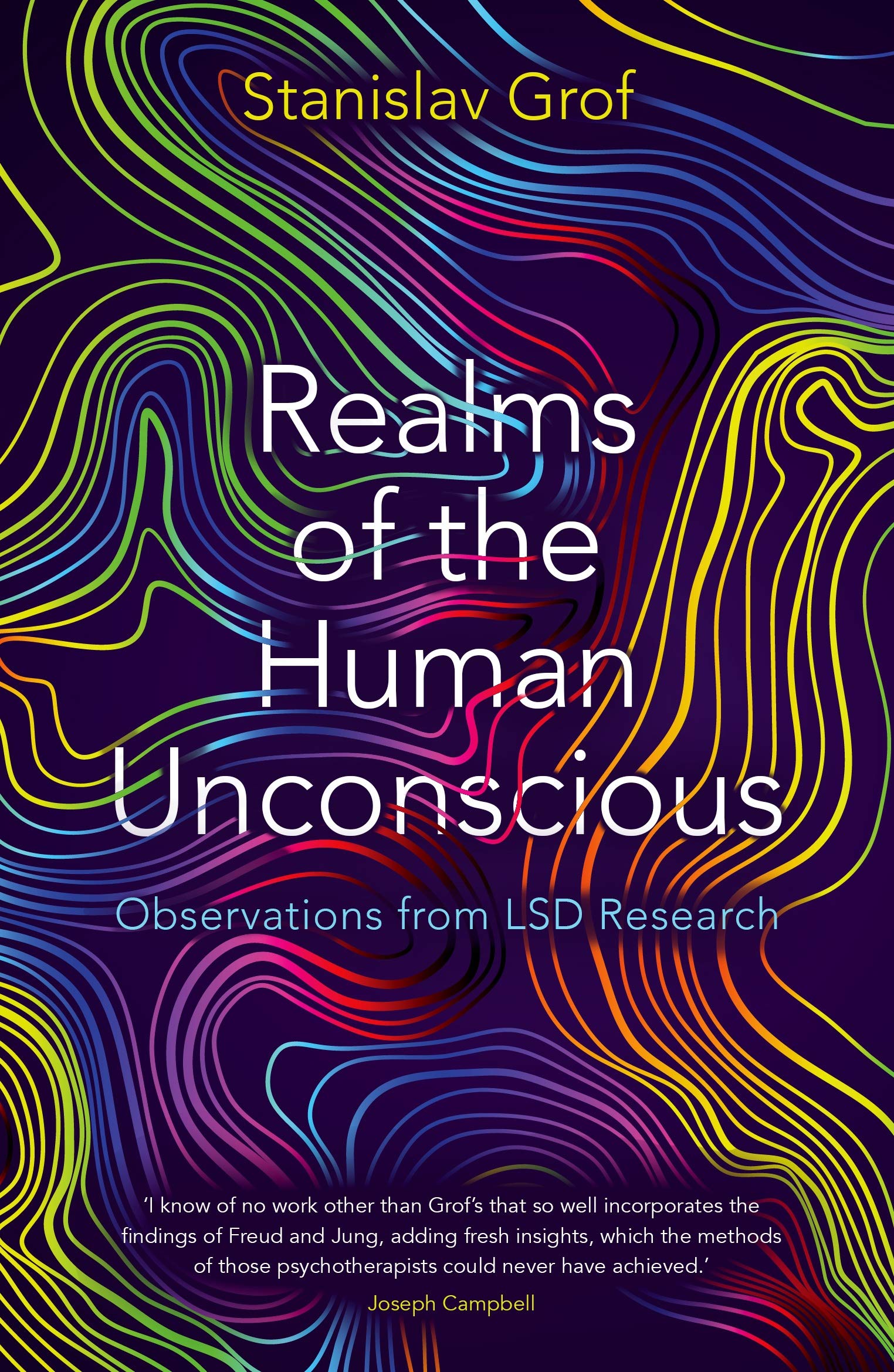
Realms of the Human Unconscious: Observations from LSD Research
Stanislav Grof
Stanislav Grof is one of the founding fathers of the modern consciousness movement and here is his pioneering work, Realms of the Human Unconscious , reissued for a new generation that has found Grof’s work to be increasingly important for their time. Dr Grof views LSD as an unspecific amplifier of the unconscious. He has developed an understanding of the domains of the unconscious (Freudian, Jungian and Rankian) which unfold under the LSD experience that forms the basis for his radical psychology. He explains a range of fundamental discoveries, previously mysterious, that change the way we think about human potential. LSD has the potential to be used in study of schizophrenia, psychiatry and psychotherapy; as well as its role in a deeper understanding of art, mythology and religion. Dr Grof’s extensive research has included experiential psychotherapy using psychedelics, alternative approaches to psychoses and the understanding of psychospiritual crises.
Realms of Human Unconscious is Stanislav Grof’s classic introduction to non-ordinary states of consciousness, and the foundation of his work on transpersonal psychology. It has proved to be a map to the inner transformation that we need and a revolutionary guide to living in the world with spiritual intelligence.
About the author
Stanislav Grof
Stanislav Grof is known for his early studies of LSD and its effects on the psyche—the field of psychedelic psychotherapy. Building on his observations while conducting LSD research and on Otto Rank’s theory of birth trauma, Grof constructed a theoretical framework for pre- and perinatal psychology and transpersonal psychology in which LSD trips and other powerfully emotional experiences were mapped onto one’s early fetal and neonatal experiences. Over time, this theory developed into an in-depth “cartography” of the deep human psyche.
Following the legal suppression of LSD use in the late 1960s, Grof went on to discover that many of these states of mind could be explored without drugs by using certain breathing techniques in a supportive environment. He continues this work today under the title “Holotropic Breathwork”.
Grof received his M.D. from Charles University in Prague in 1957, and then completed his Ph.D. in Medicine at the Czechoslovakian Academy of Sciences in 1965, training as a Freudian psychoanalyst at this time. In 1967, he was invited as an Assistant Professor of Psychiatry at Johns Hopkins University School of Medicine in Baltimore, United States, and went on to become Chief of Psychiatric Research at the Maryland Psychiatric Research Center where he worked with Walter Pahnke and Bill Richards among others. In 1973, Dr. Grof was invited to the Esalen Institute in Big Sur, California, and lived there until 1987 as a scholar-in-residence, developing his ideas.
Being the founding president of the International Transpersonal Association (founded in 1977), he went on to become distinguished adjunct faculty member of the Department of Philosophy, Cosmology, and Consciousness at the California Institute of Integral Studies, a position he remains in today.
Grof was featured in the film Entheogen: Awakening the Divine Within, a 2006 documentary about rediscovering an enchanted cosmos in the modern world.