Patricia Garfield offers nine elements that exemplify dreams about lost loved ones and explains how they can be used to help guide the dreamer through the process of grieving and healing.
Time travel is the most exciting technological development looming in our future. It is also the most misunderstood. Alleged paradoxes as well as strong cultural taboos have kept the subject mostly outside the realm of serious thinking and theorizing, and science-fiction writers have peddled numerous myths and misconceptions. It’s such a knotty subject that even physicists have stumbled and gone down blind alleys. This book attempts to clear up the misconceptions and bust the myths.
Carl Jung, the legendary Swiss psychiatrist best known for his groundbreaking concepts like the collective unconscious, archetype theory, and synchronicity, often took pains to avoid any explicit association with mysticism or the occult. Yet Jung lived a life rich in paranormal experiences-arguing for the existence of poltergeists in a debate with Sigmund Freud, participating in séances, incorporating astrology into his therapeutic work, reporting a near death experience, and interacting with the pioneering ESP researcher J. B. Rhine.
This image shows the Circinus West molecular cloud captured by the 570-megapixel Dark Energy Camera, one of the most powerful digital cameras in the world located in Chile. Dark nebulae like this are so dense and cold that atoms bond with each other to form molecules, and not the hotter plasma that we see throughout most of the universe. Circinus West is 180 light-years across and contains 250,000 times the mass of the Sun. It is 2,500 light years distant from Earth. (from New Thinking Allowed)
WASHINGTON—Sitting in the front row and snapping his fingers in time to the 1980 musical’s overture, President Donald Trump rehearsed his Cabinet for a Kennedy Center performance of Les Misérables amid an escalating boycott by the show’s usual cast, sources reported Friday. “Marco, I want you in there as Jean Valjean, and give us your full energy on ‘Look Down’—remember, chest voice, not head voice! You’re a prisoner, for goodness sake, not Patti LuPone,” said the visibly anxious president, who, after glancing at a list of Broadway actors who had departed from the production out of protest, turned to JD and Usha Vance, telling the vice president and second lady to don bicorne hats, scarves, and aprons for the roles of Madame and Monsieur Thénardier. “Relax, JD! ‘Master Of The House’ doesn’t need you to hit any high notes. Just keep up that bawdy energy of yours, and you’ll win over the audience. Now, places people! We’re going to nail the choreography on the barricade sequence if it kills me.” At press time, Trump was overheard ordering a weeping Attorney General Pam Bondi to take ‘I Dreamed A Dream’ from the top and to please stay in tune this time.
Wars Will No Longer Be Fought By Male Shannons, Terrys, Or Carmens
Published: May 15, 2025 (TheOnion.com)
WASHINGTON—In a move that significantly restricts the eligibility of thousands of American troops to fight for their country on the front lines, senior U.S. military officials announced Wednesday that all men with girl names would now be forbidden from serving in combat roles.
The ban, which goes into effect immediately, prohibits male personnel with clearly feminine names like Jamie, Sandy, and Alexis from serving in all artillery, infantry, and armored units. According to a Defense Department memo, the military is less effective as a fighting force when it deploys men named Francis, Sloan, Carol, or Loren in active conflict zones.
“For too long, we’ve sacrificed combat readiness in the name of inclusivity, ignoring the fact that there are innate differences between a Hank and a male Tracy,” said Gen. Doug H. Sandoval, who is a longtime opponent of men with girl names in the military and who worked with top appointed officials at the Pentagon to devise the new ban. “All these Shelleys and Dakotas are a liability. Imagine you’re in a heavy firefight, and your commander tells you to lay down cover fire for Casey. Your brain takes an extra moment to realize Casey is a man even though that’s a lady’s name, and in that plit second of hesitation, your entire squad is overrun by the enemy.”
“Or suppose your special forces team is parachuting into hostile territory,” he continued. “Can you really order someone named Ashley to jump out of a plane? It defies common sense.”
The Pentagon confirmed that servicemen with girl names would be reassigned to noncombat roles and that their pay would be lower as a result, an outcome officials justified by arguing that men named Allison should not be the primary breadwinners in their household anyway. Some hardliners have suggested these men should not be in the armed forces at all, and should instead stay home to father the Johns and Harolds needed to fight America’s wars.
Some exceptions will reportedly be made on the basis of spelling, with men named Nicky, for example, being eligible for combat deployment so long as their name ends with a y instead of an i. A military spokesperson told reporters tabs will be kept on once-masculine names that are starting to become girly, the way Charlie and Riley seem to have lately.
“America must project strength to keep our adversaries in check, and we can’t do that with men named Taylor on the battlefield,” said Navy Vice Adm. Scott Rigby, observing that the soft consonants of unisex names like Sasha and Avery never sat right with him. “China will never take us seriously so long as we’re sending Leslies to enforce our interests abroad. And if Russia ever learned we let men named Dana pilot our fighter jets? Forget it. When it comes to soldiers, we need big, strong Chets, Mikes, and Jakes out there, full stop.”
President Trump signaled his personal approval of the ban in a post on Truth Social, writing: “Bye bye, Bailey. He’s got to leave the fighting to GUS!!!”
The ban has been met with fierce condemnation from many effeminately named male veterans, including Aubrey Hart of the advocacy group Man Enough to Fight, which plans to mount a legal challenge on behalf of 24-year-old Army sniper Mandy Wright.
“Just because a man is named Stacy or Carey doesn’t mean he can’t fight like a Brock or an Axel,” Hart said. “Back when I served, there may have been a few snickers the first time I introduced myself, but once I set my fellow soldiers straight about Aubrey being a perfectly normal thing for a boy to be called, my name was never a distraction. To suggest otherwise is an insult to me and all the male Aubreys who have bled and died for their nation.”
While congressional Republicans appear to have fallen in line behind the Trump administration’s support for the ban, one GOP lawmaker was willing to speak on the record against it.
“This is the most egregiously unfair, bigoted, and discriminatory policy I have ever encountered,” said the senator and Air Force veteran Lindsey Graham. “I won’t stand for it.”
BOSTON and LOS ALTOS, Calif., May 15, 2025 /PRNewswire/ — Mendoza Impact, a Boston-based nonprofit, made a $250,000 investment into Prosperos, a fintech startup that is bringing financial access to the Latino market. Founded by Silicon Valley startup veterans Vinay Pai and Salvador Chavez (both formerly of Bill.com), Prósperos is revolutionizing capital inclusion by treating all American workers as firstclass customers with bank accounts and credit cards from day one. Mendoza Ventures joins FEBE Ventures, BAT VC, Tekton Ventures, and Courtyard Ventures in supporting Prósperos.
“We are so excited to support the Prosperos team. Financial access at all levels is the bedrock for a healthy economy, and Prosperos is already delivering on that promise in the early stage. Any family making a wage deserves financial inclusion, and real impact is getting all American workers the financial mobility to grow into our economy.” – Mendoza Impact founder Senofer Mendoza
Financial access at all levels is the bedrock for a healthy economy, and Prosperos is delivering on that promise.Post this
“With Prósperos, our customers have access to bank accounts with no minimum balances, no monthly fees, and no fees for depositing their paychecks or using their credit card for payments. With our financial platform, a family can save over $1000 each year in fees for banking services.” – Vinay Pai, CEO and Cofounder, Prósperos.
“As the son of immigrants, I saw firsthand how lack of financial access holds families back. My father had to pay over 10% of his wages just to cash his checks and send money home to our family in Mexico. With Prósperos, we have the opportunity to change that—to help Latinos save their hard-earned money, build credit, and take meaningful steps toward financial security and opportunity.” – Salvador Chavez, COO and Cofounder, Prósperos.
In a year known for sluggish capital deployments, this stands out as a break from the norm and a call to action for investors to stand up to support new founders. As the first check from the nonprofit born out of Mendoza Ventures’s best practices, this sets the tone for a strong impact framework for Mendoza Impact.
Prosperos
Prósperos leverages modern financial technology with a vision of delivering a simple, convenient mobile financial platform to the 400M Latinos in the Western hemisphere. Say goodbye to fees for cashing checks and sending money. And say hello to a platform that allows you to build a prosperous financial future for your family. Together, we will all prosper. Welcome to Prósperos!
Mendoza Impact
Mendoza Impact was started as the philanthropic arm of the Mendoza family. Having deployed over $30M to successful diverse founders through their VC fund Mendoza Ventures, they believe that the funding discrepancy isn’t a pipeline problem– it’s a capital commitment problem. As a result of this gap in commitments, in 2023 they founded Mendoza Impact to create opportunity for all Americans by empowering and funding the next generation of founders, funders, and fellows to impact their communities. Mendoza Impact is a registered 501(c)(3) Non-Profit.
Translation is a 5-step process of “straight thinking in the abstract” comparing and contrasting what seems to be truth with what you can syllogistically, axiomatically and mathematically (using word equations) prove is the truth. It is not an effort to change, alter or heal anything.
The claims in a Translation may seem outrageous, but they are always (or should always be) based on self-evident syllogistic reasoning. Here is one Translation from this week.
1) Truth is that which is so. That which is not truth is not so. Therefore truth is all that is. Truth being all is therefore total, therefore whole, therefore complete, therefore present, therefore here and now. I think therefore I am. Since I am and since Truth is all that is, therefore I, being, am Truth. Since I, being, am Truth, therefore I, being, have all the attributes of truth. Therefore I, being, am total, whole, complete, present, here and now. Since I am mind (self-evident) and since I (being) am Truth, therefore Truth is Mind. (Two things equal to a third thing are equal to each other.) Since Truth is Mind, therefore Mind has all the attributes of Truth. Therefore Mind is total, whole, complete, present, here and now.
2) Some students of Truth may lack physical courage.
Word-tracking: student: study, zeal, studio, to learn, to care, to be diligent learn: to find out, to come to know lack: to be without, languid, slack, relaxed physical: natural, physics, science science: to know verify: to show as true courage: cordial, heart heart: character, spirit, compassion, love
3) Truth being all is therefore without limit, therefore infinite, and Truth being mind, therefore Mind is infinite, without limit. Mind being without limit cannot be limited in knowing, therefore mind is all-knowing. Mind being all-knowing, cannot at the same time need to learn something which it doesn’t know, therefore there are no students in Truth/Mind. Since science means knowledge and since Truth/Mind is all-knowing, all-knowledge, therefore Truth is Science. And Science being the study of the physical, the tangible, the verifiable, therefore Science is the study of truth (that which can be verified, shown to be true). Truth being all that is, therefore Truth is all that can be verified, scientifically proven. Truth being one, therefore indivisible, therefore inseparable, therefore one throughout eternity, therefore wed throughout eternity, Therefore Truth is love. And love being heart being courage, therefore truth is courage. Truth being courage and truth being without limit, therefore the courage of Truth is without limit.
4) Mind is infinite, without limit. Mind is all-knowing. There are no students in Truth/Mind. Truth is Science. Science is the study of truth (that which can be verified). Truth is love. Truth is courage. Truth is all that can be verified, scientifically proven. The courage of Truth is without limit.
5) All that can be scientifically verified is the infinity of the courage (heart) of Truth.
Weekly Invitational Translation Group invites your participation. If you would like to submit a Translation on any subject, feel free to send your weekly Translation to zonta1111@aol.com and we will anonymously post it on the Bathtub Bulletin on Friday.
“When you wake up to the Divine Consciousness within you, you wake up simultaneously to the Divine Consciousness appearing as all other beings. And until you realize this, you do not know who or where you are.”
Andrew Harvey (b.1952) British Writer
AN OPPORTUNITY FOR DAILY REFLECTION BROUGHT TO YOU BY THE SCHOOL OF PRACTICAL PHILOSOPHY
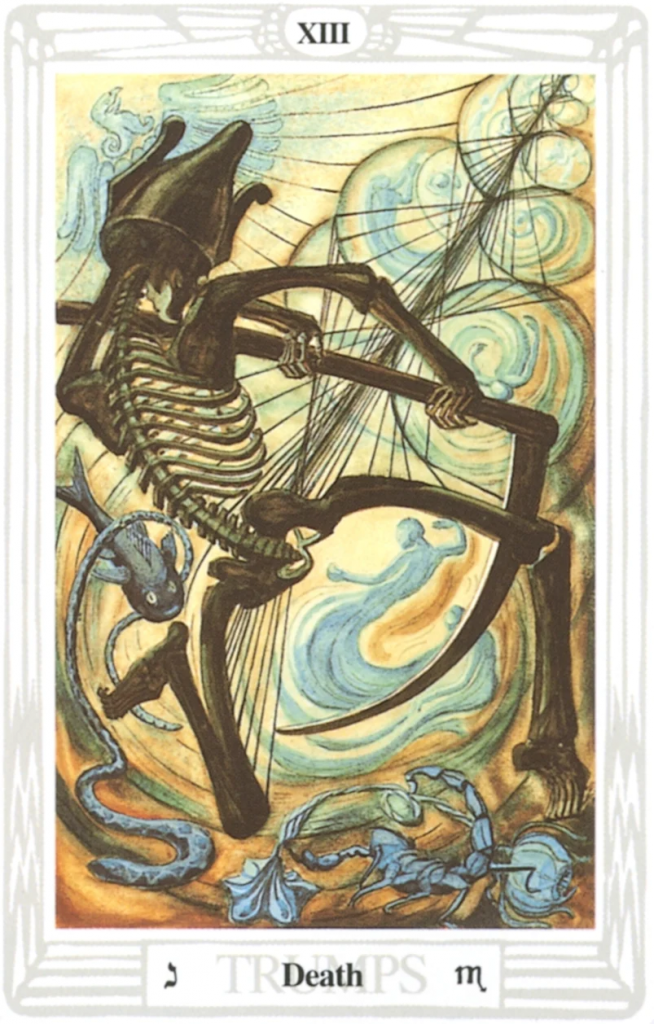
I wonder if there is a more-feared card in the Tarot deck? Yet Death is, in many ways, a hopeful and refreshing influence if only we will let it be. It is the major card for change and alteration in the entire deck. Since life itself changes constantly, in order to harmonise ourselves more completely with it, we too must be in a state of constant change – working toward our goals, attempting to fulfil our dreams and developing the quality of our spiritual understanding.When Death comes up as Card of the Day, the first question we need to ask ourselves is – what is it that needs to be changed or finished up? What situations have been lingering on well past their sell-by date? What should we have dealt with before, that this day challenges us to face and finish?Imagine, for a moment, that your life is a plot of land. If it is completely overgrown, covered with unwanted and untended undergrowth, you cannot plant something beautiful and fruitful in it can you?The Death card requires that we spend a bit of dedicated time cutting away the undergrowth, and clearing the debris so that our lives are clear and open, ready for fresh planting.Sometimes a Death card day won’t be one in which we need to do, so much as one in which we need to think. Most peoples’ lives are very busy indeed these days. So busy, in fact, that we often tend to put off thinking about the difficult or demanding issues in our lives. Yet often it is exactly this type of issue that causes emotional and mental deadwood to accumulate, if we allow it.If life is created by what we think, what we expect and how we feel about things, our deepest emotional urges, our wildest dreams, our highest ideals require a great deal of thinking about, don’t they? If not, we stagnate, never creating new channels through which to direct our energies, never determining when a habitual action has run its course, never assessing what is useful, and what is not.So, sometimes, a Death card day needs to be a day in which you re-evaluate the general patterns of your daily existence, and re-appraise your goals. You’ll know if it’s that kind of day by measuring how dissatisfied you currently feel. If you are largely happy and comfortable, then the Death card day is one for clearing the decks in a physical sense.
Affirmation: “I welcome change into my life, embracing it fearlessly and hopefully.”
Today is the day of my release, as I declare myself free of the bondage of the ego. I will do one thing, however small, to forge a path of greatness where I have formerly cowered in fear.
I need not repair every aspect of my wounded self today. I need only practice the thinking and behavior of a greater good. With this, I build new pathways in my brain and in my life.
Dear God, Please free me of the habits That keep me bound To a life I do not wish to live. Break the chains that keep me From claiming my greater good. I will try today. Please help me. Amen.
New Thinking Allowed with Jeffrey Mishlove • May 15, 2025 Miguel Conner is host of the Aeon Byte Gnostic Radio podcast. He has authored two books of interviews about gnosticism, Voices of Gnosticism and Other Voices of Gnosticism, and also four novels. His newest book is The Occult Elvis: The Mystical and Magical Life of the King. His website is https://www.miguelconner.com/ Here he explains the origins of Gnosticism in late antiquity. He describes how it impacted both the Christian, Greek, and Persian worlds. He discusses the influence of Gnosticism upon a range of modern thinkers and writers. And, he distinguishes Gnosticism from other similar movements including Neo-Platonism and Hermeticism. 00:00 Introduction 03:21 What is Gnosticism? 11:37 The struggle between good and evil 15:05 Persecution of the gnostics 19:43 Modern gnostics 22:40 Key gnostic texts 26:24 Gnosticism and other esoteric movements 34:44 Neo-Gnosticism 38:23 Gnosis 47:06 Conclusion New Thinking Allowed host, Jeffrey Mishlove, PhD, is author of The Roots of Consciousness, Psi Development Systems, and The PK Man. Between 1986 and 2002 he hosted and co-produced the original Thinking Allowed public television series. He is the recipient of the only doctoral diploma in “parapsychology” ever awarded by an accredited university (University of California, Berkeley, 1980). He is also the Grand Prize winner of the 2021 Bigelow Institute essay competition regarding the best evidence for survival of human consciousness after permanent bodily death. He is Co-Director of Parapsychology Education at the California Institute for Human Science. (Recorded on April 14, 2025)
Consciousness, spirituality, biography, sexuality, androgyny, futurism, space, the arts, science, astrology, democracy, humor, books, movies and more