
New Thinking Allowed with Jeffrey Mishlove Jul 18, 2025 This video is a special release from the original Thinking Allowed series that ran on public television from 1986 until 2002. It was recorded in about 1991. It will remain public for only one week. Jon Klimo, author of Channeling, proposes the intriguing view that we are all like cells of a larger organism and that we share in the consciousness of that organism. Thus, channeled “entities” such as Lazaris, Seth, Ramptha, Michael, Emmanuel, etc., may be seen as both part of our deeper mind and as larger than our individual consciousness. Now you can watch all of the programs from the original Thinking Allowed Video Collection, hosted by Jeffrey Mishlove. Subscribe to the new Streaming Channel (https://thinkingallowed.vhx.tv/) and watch more than 350 programs now, with more, previously unreleased titles added weekly. Free month of the classic Thinking Allowed streaming channel for New Thinking Allowed subscribers only. Use code THINKFREELY.
Elderly Woman Keeps Mind Active Justifying Trump’s Actions

Published: July 17, 2025 (TheOnion.com)
LEXINGTON, KY—Stressing the importance of regularly performing mental gymnastics to prevent cognitive decline, local 80-year-old Edna Connolly confirmed Thursday that she keeps her mind active by justifying President Donald Trump’s actions. “I try to break out of my routine and engage my mind by rationalizing what the president is doing, even when it’s completely against the promises he made to voters,” said Connolly, explaining that she spends at least 30 minutes a day improving her mental faculties and problem solving skills by making excuses for Trump’s constant attacks on civil liberties. “I’m developing new neural pathways each time I shrug off Trump’s clear violations of the Constitution and his total contempt for our system of checks and balances. You know, I have some friends who didn’t spend time rationalizing Trump’s actions, and they ended up in nursing homes.” At press time, Connolly was reportedly stimulating her creativity by justifying the president’s decision to reverse course on releasing the Epstein files.
Babies made using three people’s DNA are born free of hereditary disease
4 days ago (BBC.com)
James Gallagher
Health and science correspondent•@JamesTGallagher
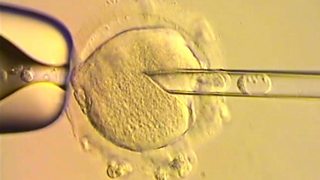
0:26Watch the moment DNA from a mum and dad is injected into the egg of another woman – the critical step in the creation of a baby made from three people
Eight babies have been born in the UK using genetic material from three people to prevent devastating and often fatal conditions, doctors say.
The method, pioneered by UK scientists, combines the egg and sperm from a mum and dad with a second egg from a donor woman.
The technique has been legal here for a decade but we now have the first proof it is leading to children born free of incurable mitochondrial disease.
These conditions are normally passed from mother to child, starving the body of energy.
This can cause severe disability and some babies die within days of being born. Couples know they are at risk if previous children, family members or the mother has been affected.
Children born through the three-person technique inherit most of their DNA, their genetic blueprint, from their parents, but also get a tiny amount, about 0.1%, from the second woman. This is a change that is passed down the generations.
None of the families who have been through the process are speaking publicly to protect their privacy, but have issued anonymous statements through the Newcastle Fertility Centre where the procedures took place.
‘Overwhelmed with gratitude’
“After years of uncertainty this treatment gave us hope – and then it gave us our baby,” said the mother of a baby girl.
“We look at them now, full of life and possibility, and we’re overwhelmed with gratitude.”
The mother of a baby boy added: “Thanks to this incredible advancement and the support we received, our little family is complete.
“The emotional burden of mitochondrial disease has been lifted, and in its place is hope, joy, and deep gratitude.”

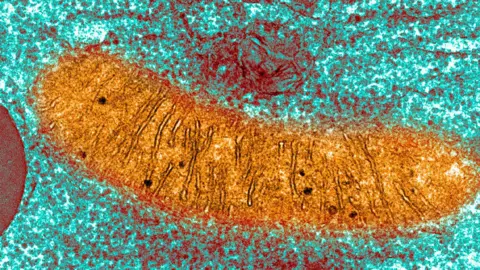
Mitochondria are tiny structures inside nearly every one of our cells. They are the reason we breathe as they use oxygen to convert food into the form of energy our bodies use as fuel.
Defective mitochondria can leave the body with insufficient energy to keep the heart beating as well as causing brain damage, seizures, blindness, muscle weakness and organ failure.
About one in 5,000 babies are born with mitochondrial disease. The team in Newcastle anticipate there is demand for 20 to 30 babies born through the three-person method each year.
Some parents have faced the agony of having multiple children die from these diseases.
Mitochondria are passed down only from mother to child. So this pioneering fertility technique uses both parents and a woman who donates her healthy mitochondria.
The science was developed more than a decade ago at Newcastle University and the Newcastle upon Tyne Hospitals NHS Foundation Trust and a specialist service opened within the NHS in 2017.
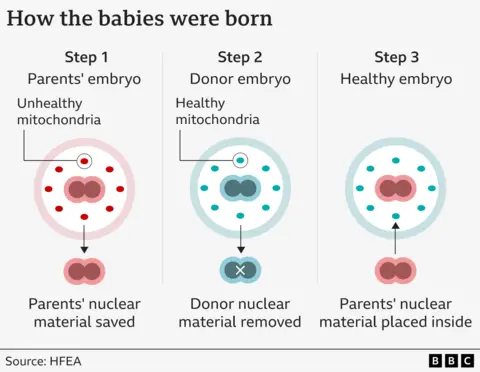
The eggs from both the mother and the donor are fertilised in the lab with the dad’s sperm.
The embryos develop until the DNA from the sperm and egg form a pair of structures called the pro-nuclei. These contain the blueprints for building the human body, such as hair colour and height.
The pro-nuclei are removed from both embryos and the parents’ DNA is put inside the embryo packed with healthy mitochondria.
The resulting child is genetically related to their parents, but should be free from mitochondrial disease.
Baby born from three people’s DNA in UK first
A pair of reports, in the New England Journal of Medicine, showed 22 families have gone through the process at the Newcastle Fertility Centre.
It led to four boys and four girls, including one pair of twins, and one ongoing pregnancy.
“To see the relief and joy in the faces of the parents of these babies after such a long wait and fear of consequences, it’s brilliant to be able to see these babies alive, thriving and developing normally,” Prof Bobby McFarland, the director of the NHS Highly Specialised Service for Rare Mitochondrial Disorders told the BBC.
All of the babies were born free of mitochondrial disease and met their expected developmental milestones.
There was a case of epilepsy, which cleared up by itself and one child has an abnormal heart rhythm which is being successfully treated.
These are not thought to be connected to defective mitochondria. It is not known whether this is part of the known risks of IVF, something specific to the three-person method or something that has been detected only because the health of all babies born through this technique is monitored intensely.
Another key question hanging over the approach has been whether defective mitochondria would be transferred into the healthy embryo and what the consequences could be.
The results show that in five cases the diseased mitochondria were undetectable. In the other three, between 5% and 20% of mitochondria were defective in blood and urine samples.
This is below the 80% level thought to cause disease. It will take further work to understand why this occurred and if it can be prevented.
Prof Mary Herbert, from Newcastle University and Monash University, said: “The findings give grounds for optimism. However, research to better understand the limitations of mitochondrial donation technologies, will be essential to further improve treatment outcomes.”
The breakthrough gives hope to the Kitto family.
Kat’s youngest daughter Poppy, 14, has the disease. Her eldest Lily, 16, may pass it onto her children.
Poppy is in a wheelchair, is non-verbal and is fed through a tube.
“It’s impacted a huge part of her life,” says Kat, “we have a lovely time as she is, but there are the moments where you realize how devastating mitochondrial disease is”.
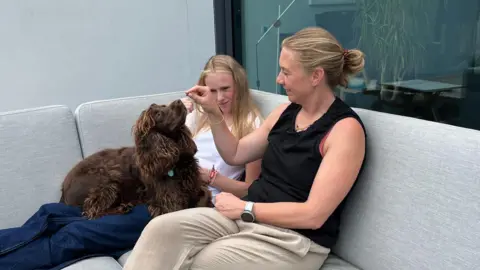
Despite decades of work there is still no cure for mitochondrial disease, but the chance to prevent it being passed on gives hope to Lily.
“It’s the future generations like myself, or my children, or my cousins, who can have that outlook of a normal life,” she says.
‘Only the UK could do this’
The UK not only developed the science of three-person babies, but it also became the first country in the world to introduce laws to allow their creation after a vote in Parliament in 2015.
There was controversy as mitochondria have DNA of their own, which controls how they function.
It means the children have inherited DNA from their parents and around 0.1% from the donor woman.
Any girls born through this technique would pass this onto their own children, so it is a permanent alteration of human genetic inheritance.
This was a step too far for some when the technology was debated, raising fears it would open the doors to genetically-modified “designer” babies.
Prof Sir Doug Turnbull, from Newcastle University, told me: “I think this is the only place in the world this could have happened, there’s been first class science to get us to where we are, there been legislation to allow it to move into clinical treatment, the NHS to help support it and now we’ve got eight children that seem to free of mitochondrial disease, what a wonderful result.”
Liz Curtis, the founder of the Lily Foundation charity said: “After years of waiting, we now know that eight babies have been born using this technique, all showing no signs of mito.
“For many affected families, it’s the first real hope of breaking the cycle of this inherited condition.”
Google AI on physical symptoms of an emerging repressed memory
Google AI Overview
Emerging repressed memories can manifest in various physical symptoms, often as a result of the body holding onto the physical sensations and responses associated with past trauma. These physical symptoms can be a way for the body to communicate emotional distress when it’s not being consciously processed.
Common physical symptoms associated with emerging repressed memories include:
- Headaches and Migraines:Repressed trauma can manifest as tension headaches or migraines, as the body holds onto stress and tension.
- Digestive Issues:Stomach problems, nausea, and other gastrointestinal issues can be linked to unresolved trauma and stress.
- Chronic Pain:Back pain, muscle aches, and other forms of chronic pain can be somatic manifestations of past trauma.
- Fatigue and Sleep Problems:Unexplained fatigue, insomnia, or nightmares can be a result of the body’s ongoing stress response to trauma.
- Muscle Tension and Pain:Chronic muscle tension, aches, and pains, especially in the neck, shoulders, and back, can be related to repressed trauma.
- Hypervigilance and Hyperarousal:A state of heightened alertness and reactivity to stimuli, as if constantly scanning for danger, can be a physical sign of unresolved trauma.
- Tremors or Shaking:Involuntary tremors or shaking can occur as the body releases stored energy associated with traumatic experiences.
- Tingling or Warmth:Sensations of tingling, warmth, or other unusual physical sensations can occur as the body processes and releases trauma.
- Heart Palpitations or Rapid Heartbeat:The physical symptoms of anxiety, such as a racing heart, can be a response to trauma.
- Shallow Breathing:Rapid and shallow breathing can be a physical manifestation of anxiety and stress related to trauma.
- Dissociation:In extreme cases, individuals may experience dissociation, which can manifest as feeling detached from their body or surroundings.
The connection between trauma and the body:
- Trauma can be stored in the body’s nervous system, causing it to remain in a state of high alert.
- This constant state of high alert can lead to physical symptoms as the body tries to protect itself from perceived threats.
- The brain’s emotional and memory centers are closely linked to physical sensations and responses.
- When a similar situation triggers the emotional and memory centers, it can also activate the body’s stress response, leading to physical symptoms.
Seeking professional help:
If you are experiencing these physical symptoms, it’s important to seek professional help from a therapist or healthcare provider. They can help you explore the root causes of your symptoms and develop coping strategies to manage them.
Featured Books from New Thinking Allowed
Klimo profiles recent channels and their sources, goes back to preliterate societies and the advent of monotheism and identifies as channels such figures as Moses, Solomon, Muhammad, Merlin, Nostradamus, Swedenborg and Edgar Cayce. He discusses the sorts of people who are channels, kinds of information channeled, sources of information channeled and varieties of channeling like clairvoyance and automatic writing.

Richly detailed with Joyce’s experiences studying shamanic healing in South East Asia and stories of the people she has assisted back to health, this book will allow readers to explore their own ability to heal at every level. They will discover current research and fascinating findings about the language of their cells and how these tiny constituents of the body communicate, connect, and touch. Alongside this biological backdrop, they’ll find fresh mind-body imagery, insights, and empowering healing techniques that will take them on a deep inner journey.

Solar flares
(from New Thinking Allowed)
Solar flares eject ions, electrons, and atoms into space which reach the Earth and cause auroras and may disrupt communication. Solar flares tend to emanate from dark areas on the Sun known as sun spots. Sun spot numbers cycle on an 11-year period known as the solar cycle. This image was captured by NASA’s Solar Dynamics Observatory, a satellite in geosynchronous orbit whose cameras are continuously pointed at the sun. An image of the earth has been added to reveal the enormity of the flare.

Credit: NASA Goddard Space Flight Center
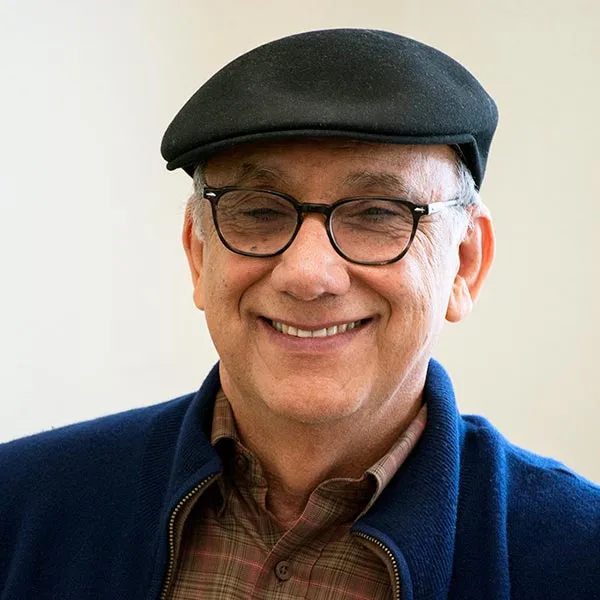
Almaas on owning yourself
(Image from shambhala.com)
“As long as you hold onto wanting something from the outside, you will be dissatisfied because there is a part of you that you are still not totally owning. How can you be complete and fulfilled if you believe that you cannot own this part [of yourself ] until somebody else does something? If it is conditional, it is not totally yours.”
~ Almaas
A. H. Almaas is the pen name of A. Hameed Ali (born 1944), an American writer and spiritual teacher who writes about and teaches an approach to spiritual development informed by modern psychology and therapy which he calls the Diamond Approach. “Almaas” is the Arabic word for “diamond”. Almaas is originally from Kuwait. Wikipedia
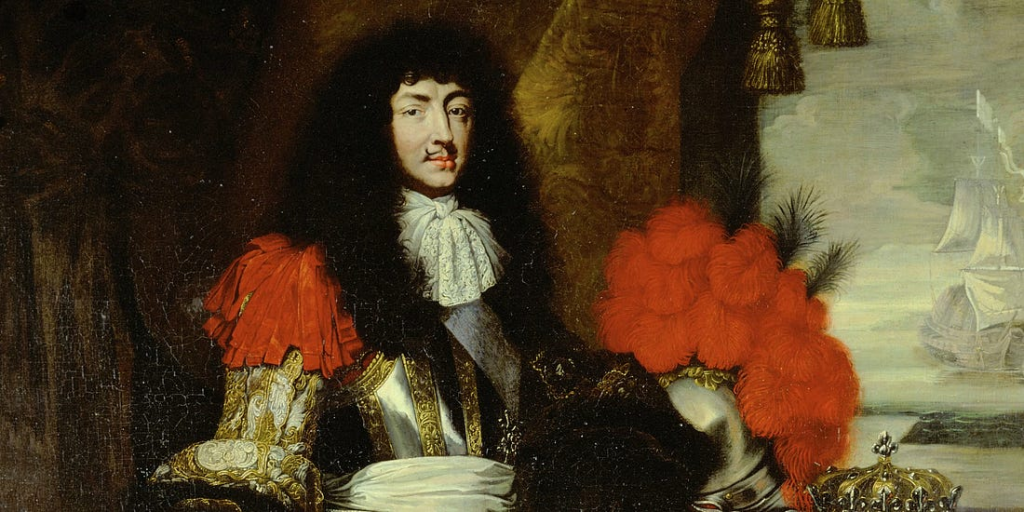
Louis XIV: “They’re kissing my ass.”
| JUL 18, 2025 |
The closest historic analogy to what’s happening in Trump’s Washington is the court of Louis XIV, which brimmed with competitive sycophancy and insider deals. As the Duke de Saint Simon noted in his memoir, written in the 1730s:
“His Ministers, generals, mistresses, and courtiers soon found out his weak point, namely, his love of hearing his own praises. There was nothing he liked so much as flattery, or, to put it more plainly, adulation; the coarser and clumsier it was, the more he relished it. That was the only way to approach him; if he ever took a liking to a man it was invariably due to some lucky stroke of flattery in the first instance, and to indefatigable perseverance in the same line afterwards.”
But flattery could go only so far. During the French Revolution, Louis XIV’s tomb was desecrated and his remains scattered.
Why good people become bad bosses
Jamie Woolf and Christopher Bell | TEDxSonomaCounty
• March 2025
You’ve probably had a bad boss, but you might not realize how easy it is to become one. Leadership experts Jamie Woolf and Christopher Bell unpack “power blindness” — how authority can warp your perspective — and share smart, practical ways to break the cycle of toxic bosses for good.
About the speakers
Jamie Woolf
French mural of Statue of Liberty covering her eyes in shame angers Trump supporters
FRANCE
A mural depicting the Statue of Liberty covering her eyes in the northern French city of Roubaix has sparked a flurry of comments on social media over its intended swipe at US President Donald Trump’s crackdown on migrants. Dutch artist Judith de Leeuw has described her work in Roubaix, which has a large immigrant community, as “a quiet reminder of what freedom should be”.
Issued on: 18/07/2025
By: FRANCE 24

As statements go, it’s a big one.
A towering mural in France of the Statue of Liberty covering her eyes is racking up millions of views online with its swipe at US President Donald Trump ‘s immigration and deportation policies.
Amsterdam-based street artist Judith de Leeuw described her giant work in the northern French town of Roubaix, which has a large immigrant community, as “a quiet reminder of what freedom should be.”
She said “freedom feels out of reach” for migrants and “those pushed to the margins, silenced, or unseen.”
“I painted her covering her eyes because the weight of the world has become too heavy to witness. What was once a shining symbol of liberty now carries the sorrow of lost meaning,” de Leeuw wrote in a July 4 post on Facebook, when Americans were celebrating Independence Day.
Her depiction of the Statue of Liberty, a gift from the French people in the late 1800s, has inspired some sharp criticism.
READ MOREFrench MEP demands the US ‘give us back the Statue of Liberty’
House representative Tim Burchett, a Republican lawmaker from Tennessee, wrote in an angry post on X that the work “disgusts me.” He said he had an uncle who fought and died in France, where US forces saw combat in both World War I and World War II.
In an interview with The Associated Press, de Leeuw was unapologetic.
“I’m not offended to be hated by the Donald Trump movement. I am not sorry. This is the right thing to do,” she said.
The town stood by the work, with its deputy mayor in charge of cultural affairs, Frédéric Lefebvre, telling broadcaster France 3 that “it’s a very strong and powerful political message.”
Since returning to the White House amid anti-immigration sentiment, Trump has launched an unprecedented campaign that has pushed the limits of executive power and clashed with federal judges trying to restrain him. People from various countries have been deported to remote and unrelated places like South Sudan and the small African nation of Eswatini.
WATCH MOREUS deports five migrants convicted of crimes to Eswatini
Polling by Gallup released last week showed an increasing number of Americans who said immigration is a “good thing” and decreasing support for the type of mass deportations Trump has championed since before he was elected.
The mural in Roubaix is part of an urban street culture festival backed by the town. Roubaix is one of the poorest towns in France. It was economically devastated by the collapse since the 1970s of its once-flourishing textile industry that used to attract migrant workers from elsewhere in Europe, north Africa and beyond.
(FRANCE 24 with AP)