“Your duty is to be and not to be this or that. ‘I am that I am’ sums up the whole truth. The method is summed up in the words ‘Be still’. What does stillness mean? It means destroy yourself. Because any form or shape is the cause for trouble. Give up the notion that ‘I am so and so’. All that is required to realize the Self is to be still. What can be easier than that?”
~ Ramana Maharshi
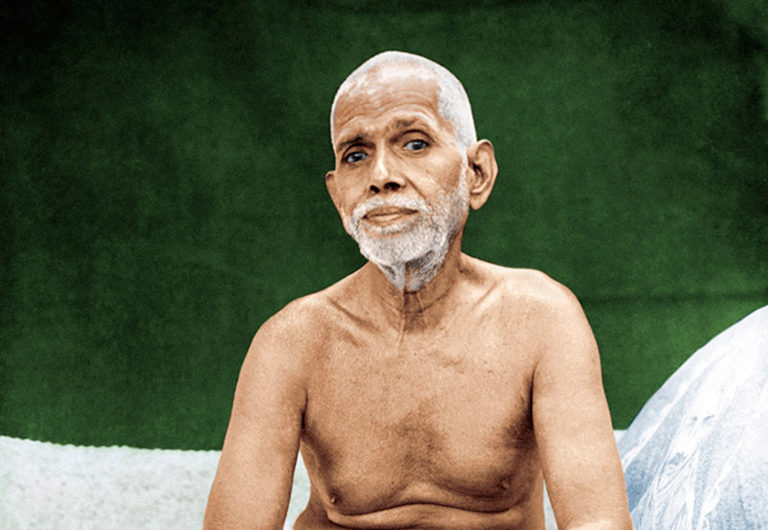
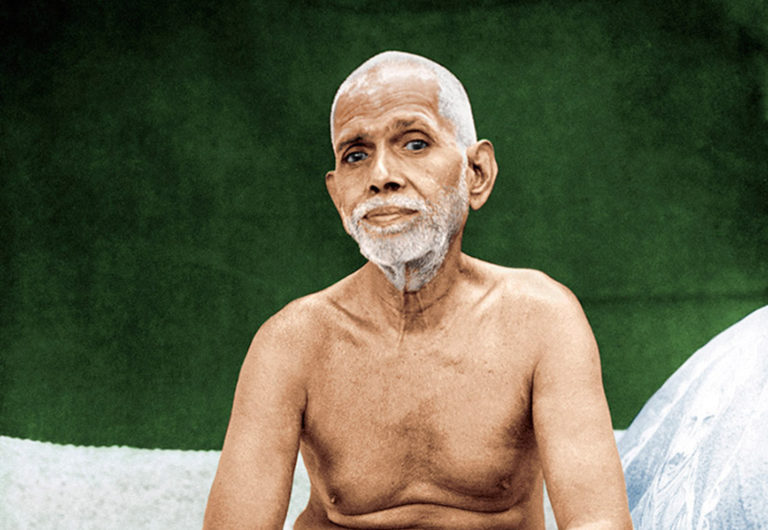
Ramana Maharshi (December30, 1879 – April 14, 1950) was an Indian Hindu sage and jivanmukta. He was born Venkataraman Iyer, but is mostly known by the name Bhagavan Sri Ramana Maharshi. He was born in Tiruchuli, Tamil Nadu, India in 1879. Wikipedia
What youthful philosophers and experimentalists we are! There is not one of my readers who has yet lived a whole human life.
Henry David Thoreau, Walden
Everyone who comes to Thoreau has a story. Mine begins in a neighborhood bookstore where I pulled a book off the shelf simply because it was small and green—like the little green book I’d been carrying around (filched from my father’s library) by a writer named Ralph Waldo Emerson. “There is one mind common to all individual men,” it opened. “Of the works of this mind history is the record.” To a restless, idealistic teenager, this was catnip. And here was a second green book! This one had a double title, Walden and Civil Disobedience: “I have lived some 30 years on this planet,” I read, “and I have yet to hear the first syllable of valuable or even earnest advice from my seniors.”
That made sense. Don’t trust anybody over 30, we were all saying, for the adult world was clearly mad. every afternoon I brought the newspaper in off the front porch and read the headlines: how many soldiers had died in Vietnam, where the latest riots were burning, which of my heroes had just been assassinated. “Here is life,” continued the new green voice, “an experiment to a great extent untried by me; but it does not avail me that they have tried it.” More catnip! I bought the book and brought it to school. Next time I was marched to the mandatory football rally, I split off at the door, sat on a grassy rise nearby, and opened my copy of Walden, holding it high so my teachers could see the title. They left me alone, and I’ve been stepping to the music of that different drummer ever since.
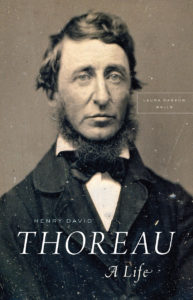
I began writing a biography of him to return to the figure who opened up that space for independent thinking, to learn how he had opened up that space for himself. “A man is a bundle of relations, a knot of roots, whose flower and fruitage is the world,” wrote Emerson. Thoreau’s roots were in Concord, Massachusetts, where he was born in 1817— far from the Seattle of 1970. Yet had Thoreau lived a normal life span, my grandmother could have shaken his hand; our world is that close, in many ways the flower and fruitage of his. Two hundred years ago, American democracy still felt raw, experimental, and uncertain, especially in Concord, where America was a family affair, earned by one generation and about to pass to the next. Thoreau felt the weight of that responsibility more than most, and when he returned home from college, he set about reexamining the roots of democracy for himself. For it was clear to him that the American Revolution was incomplete: inequality was rife, materialism was rampant, and the American economy was wholly dependent on slavery. Yet in a terrible irony, his elders seemed content to let this state of things, from which they all benefited, continue. No, they were not to be trusted; he must try the experiment for himself.
By the time Thoreau built his house on Walden Pond at the edge of town, he had come of age among a circle of radical intellectuals called “Transcendentalists,” for their belief in higher ideas that “transcended” daily life. Emerson was their leader; he had moved to Concord while Thoreau was at Harvard, class of ’37. Back home, Thoreau found his new neighbor declaring America’s intellectual independence, even as his own household had become a hotbed of antislavery activism. Thoreau joined the new revolution, but by 1844 he was less certain that Emerson, now his mentor, had all the answers. The dilemma that pressed upon him was how to live the American Revolution not as dead history but as a living experience that could overturn, and keep overturning, hidebound convention and comfortable habits.
Moving to Walden Pond thus had a double purpose: it offered a writer’s retreat, where Thoreau could follow his calling as spiritual seeker, philosopher, and poet; and it offered a public stage on which he could dramatize his one-person revolution in consciousness, making his protest a form of performance art. In writing Walden, Thoreau encouraged his readers to try the experiment of life for themselves, rather than inheriting its terms from others—including himself. When he returned from Walden and became, once again, a working member of a large family in town, he tried to bring into the heart of workaday America his belief in life as a quest toward higher truth. Thoreau is often said to have turned to “Nature,” but what he actually turned to was, more exactly, the “commons”—spaces that, back then, were still open to everyone: woods, fields and hilltops, ponds and blueberry thickets, rivers, meadows, trails up nearby mountains, the long open beaches on the Atlantic shore. Nearly all his writings use landforms and watersheds to explore the commons, expanding our shared natural and intellectual heritage until it touches the Cosmos itself. When Thoreau sailed on the Concord and Merrimack Rivers, he traveled the deep stream of time; when he walked the shore of Cape Cod, he dabbled his toes in a wild ocean stretching around the globe; when he stood on the shoulder of Mount Katahdin, he breathed the thin chill air of a planet in stellar space.
This viewpoint—deep time, planetary space—structured Thoreau’s thinking from his Harvard years onward. He read at least six languages; to him, literature was world literature, beginning with the written word itself—Homer, Virgil, the Bible, the ancient scriptures of India and China, Old English poetry—on through the latest in German philosophy and science, French histories of the New World, England’s most advanced Romantic poetry, and Scotland’s most vigorous prose. Thoreau filled dozens of notebooks with extracts from hundreds of volumes, creating his own working library: poetry, history, science, anthropology, travel, and exploration. His ferocious curiosity meant the least detail in his own backyard could speak to him of faraway times and places: farmers working their fields evoked Virgil’s Georgics; Arctic explorers helped him analyze winter in New England; Irish laborers showed him the Bhagavad Gita in the waters of Walden.
Through the 1840s and 50s, Thoreau’s commitment to social activism deepened as he linked the actions of his Northern neighbors to the perpetuation of slavery in the South, a connection that led to his famous acts of protest: his night in jail for nonpayment of taxes, his essay “Civil Disobedience,” his furious denunciation of “Slavery in Massachusetts,” his passionate support for John Brown’s attempted insurrection. When death stilled his voice just after the onset of the Civil War, Thoreau’s friends mourned not only him, but also the loss of all the work he had begun and never lived to complete.
When I began writing my biography, the term Anthropocene was a novelty: human beings, scientists were suggesting, had become a geological force changing the planet itself. As I worked, I realized that Thoreau’s life span, though short, had been long enough to witness and record the arrival of the Anthropocene epoch in America. He was born on a colonial-era farm into a subsistence economy based on agriculture, on land that had sustained a stable Anglo-American community for two centuries and, before that, Native American communities for 11,000 years. People had been shaping Thoreau’s landscape since the melting of the glaciers. By the time he died, in 1862, the Industrial Revolution had reshaped his world: the railroad transformed Concord from a local economy of small farms and artisanal industries to a suburban node on a global network of industrial farms and factories. His beloved woods had been cleared away, and the rural rivers he sailed in his youth powered cotton mills. In 1843, the railroad cut right across a corner of Walden Pond, but in 1845 Thoreau built his house there anyway, to confront the railroad as part of his reality.
By the time he left Walden, at least 20 passenger and freight trains screeched past his house daily. His response was to call on his neighbors to “simplify, simplify.” Instead of joining the rush to earn more money for the latest gadgets and goods from China, Europe, or the West Indies—feeding an economy that grew mindlessly, he wrote, like rank and noxious weeds—he called for mindful cultivation of one’s inner being and one’s greater community, a spiritual rather than material growth through education, art, music, and philosophy. When he wrote that “a man is rich in proportion to the number of things which he can afford to let alone,” he meant not an ascetic’s renunciation, but a redefinition of true wealth as inner rather than outer, aspiring to turn life itself, even the simplest acts of life, into a form of art. “There is Thoreau,” said one of his closest friends. “Give him sunshine, and a handful of nuts, and he has enough.”
Thoreau’s own family rose from penury to middle-class respectability after his father founded a small pencil factory. Thoreau was fond of machinery, and his inventions and improvements to the manufacturing process brought prosperity to his family. To pay his own expenses—including the bills for living in the family’s boardinghouse—he worked as a day laborer and eventually built up his own business as a land surveyor. When he wasn’t laying out property bounds, he was crossing those bounds in his own private enterprise as a walker and writer, earning just enough from publishing and lecturing to cover travel expenses.
The more closely Thoreau lived and worked in nature, the more he was drawn to science, for the workings of things always fascinated his engineer’s mind; his quest to understand nature’s “bundle of relations” made him a pioneer of ecological science well before the field existed. Yet the more deeply he understood natural science, the more intensely he longed for something beyond understanding—what he called “the wild.” In “Walking,” one of his most famous essays, Thoreau declared his credo: “In Wildness is the preservation of the world.” In later years, he kept a detailed journal to record his observations of nature (including human nature), noting the date each flower bloomed, the date the ice melted on Walden Pond, when leaves turned color, and the dates and depths of snowfalls. He bragged that from looking at the flowers, he could tell the day of the month within two days. Scientists are now using his meticulous records to track with precision the ever-earlier onset of spring and the lingering of fall, as year by year climate change shrinks winters and alters the composition of Walden’s plant communities.
But today, as those scientists have shown, Thoreau’s flower calendar is deranged, for the synchronies he documented are falling out of rhythm. His records thus help us measure the arrival of the Anthropocene epoch that threatens to overturn everything he believed. Thoreau could look to “Nature” as an eternal fountain of renewal and regeneration, a sacred force capable of healing even the deepest acts of human destruction, including slavery, war, and environmental devastation. He ended Walden with an ecstatic vision into the regenerative forces of the Cosmos, and late in life, when he took up Darwin’s Origin of Species, he saw in a flash that the theory of evolution meant nature was a “constant new creation,” a creative principle unceasingly at work, all around, every day. That the actions of human beings and the ancient fossil fuels they dug out of the ground to feed the engines of industry could fundamentally alter those natural processes—changing the chemistry of the atmosphere and of the encircling oceans, melting the poles, killing winter, killing life itself—was beyond Thoreau’s reckoning. Can his faith live on after nature, at least nature as he knew it, has ended?
I think it can and will. Thoreau could speculate that even a slight shift in natural processes—a little colder winter, a little higher flood—might put an end to humanity, so dependent are we on a wild nature that gives us no guarantees. Hence he emphasized living “deliberately”; that is, living so as to perceive and weigh the moral consequence of our choices. “Civil Disobedience” insists that the choices we make create our environment, both political and natural—all the choices, even the least and most seemingly trivial. The sum of those choices is weighed on the scales of the planet itself, a planet that is, like Walden Pond, sensitive and alive, quick to measure the least change and register it in sound and form. To Thoreau this was cause for tremendous optimism: as the village expanded and the old trees fell, he planted new ones and reveled in the young forest. If the English settlers had wiped out many of New England’s animals—beaver, wolf, bear and cougar, moose and deer, wild turkey—still there was much remaining, enough to assure him the wild was everywhere, ready to reseed and reclaim what it had lost. His last, unfinished works, Wild Fruits and The Dispersion of Seeds, emphasize how the smallest of seeds, let loose on the winds or carried by the least of beings, could transform the world. All humans need to do is learn to work with instead of against the vital currents of life.
The books Thoreau didn’t live to finish are about building a community of life, and he died in the faith that his words, like seeds, would take root and grow. Exactly insofar as we, today, share his belief in the future of life and act on it, will he continue to speak to us.
Pope Leo XIV greets the crowd as he leaves after presiding over a mass at San Pancrazio Cathedral at Albano Laziale on July 20, 2025 in Albano Laziale, Italy.
(Photo: Ernesto Ruscio/Getty Images)
Pope Leo XIV said the Israeli military’s deadly attack on Gaza’s sole Catholic Church was “just one of the continuous military attacks against the civilian population and places of worship” in the Palestinian enclave.
Pope Leo XIV on Sunday called for “immediate halt to the barbarity of the war” on the Gaza Strip as Israel’s military carried out fresh massacres of Palestinians seeking food aid.
The pontiff decried the Israeli military’s recent deadly bombing of Gaza’s sole Catholic Church and read aloud the names of the three victims—Saad Issa Kostandi Salameh, Foumia Issa Latif Ayyad, and Najwa Ibrahim Latif Abu Daoud.
But Pope Leo stressed that the attack was “just one of the continuous military attacks against the civilian population and places of worship in Gaza,” whose religious sites have been decimated by more than a year of Israeli bombings.
The pope went on to demand a “peaceful resolution to the conflict” and implored the international community to respect “the prohibition against collective punishment, indiscriminate use of force, and forced displacement of the population.”
Pope Leo’s remarks came as the Israeli military issued expanded evacuation orders in central Gaza and killed more than 80 people across the enclave as they sought to obtain food aid amid an increasingly dire hunger crisis fueled by Israel’s blockade.
The Associated Pressreported that “at least 79 Palestinians were killed while trying to reach aid entering through the Zikim crossing with Israel.”
“The U.N. World Food Program said 25 trucks with aid had entered for ‘starving communities’ when it encountered massive crowds that came under gunfire,” the outlet continued. “Nafiz Al-Najjar, who was injured, said tanks and drones targeted people ‘randomly’ and he saw his cousin and others shot dead.”
Meanwhile, the humanitarian group World Central Kitchen said in a statement Sunday that its teams in Gaza “have again run out of ingredients to cook warm meals” after serving 80,000 meals the previous day.
“Our field kitchens are prepped and ready to resume cooking the moment new supplies arrive. Every second counts. Families in Gaza rely on these hot meals,” the group said. “This is the second time lack of access to aid has forced our kitchen operations to pause. Cooking halted for 12 weeks while aid was not permitted to enter Gaza. We were able to resume work one month ago. Since then, our kitchen teams have worked nonstop to serve tens of thousands of meals daily.”
Our work is licensed under Creative Commons (CC BY-NC-ND 3.0). Feel free to republish and share widely.
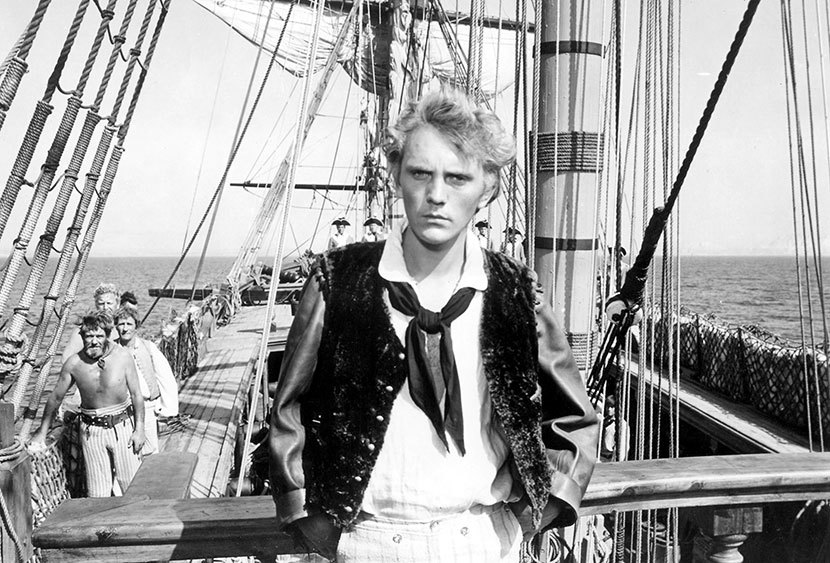
Terence Stamp in Billy Budd (dir. Peter Ustinov, 1962). (Allied Artists/Photofest)
In Herman Melville‘s “Billy Budd, Sailor,” truth is a complex and often ambiguous concept, intertwined with issues of innocence, corruption, and justice. The novella explores the clash between honest, straightforward truth and the manipulative lies used to conceal darker motives. Billy’s inherent innocence and inability to lie are contrasted with Claggart‘s calculated falsehoods and Captain Vere‘s adherence to naval law, even when it clashes with what might be considered true justice. The story suggests that “truth uncompromisingly told will always have its ragged edges,” highlighting the harsh realities and potential consequences of speaking one’s mind without regard for social or political implications.
Here’s a more detailed breakdown:
Billy’s Truth: Billy Budd is presented as inherently truthful, unable to comprehend or participate in deception. His stammer, a physical imperfection, is interpreted by some as a sign of original sin, yet he embodies a kind of innocent truthfulness. He is sincere in his words and actions, believing everything he says to be true.
Claggart’s Falsehoods: Claggart, the master-at-arms, is the embodiment of calculated evil and deception. He fabricates lies and uses them to manipulate situations and destroy others, specifically Billy. His ability to lie with such conviction and control highlights the corrupting influence of power and the potential for truth to be twisted.
Vere’s Dilemma: Captain Vere is caught between his sense of justice and the rigid laws of the navy. He recognizes Billy’s innocence and Claggart’s villainy, yet feels compelled to uphold the established order. This leads him to make a decision that, while legally sound, is arguably morally unjust. Vere, like Pilate in the biblical story, is seen as washing his hands of the situation, choosing to follow the letter of the law rather than the spirit of truth and justice.
The Narrator’s Perspective: The narrator acknowledges that the story is presented as “truth uncompromisingly told,” suggesting a commitment to realism and an attempt to present the events as they unfolded. However, the narrator also recognizes the inherent complexities of truth, acknowledging that “truth uncompromisingly told will always have its ragged edges”. This suggests that even when striving for honesty, the truth can be messy, imperfect, and potentially lead to difficult or even tragic consequences.
Themes of Truth and Justice: The story explores the tension between truth and justice, highlighting how the pursuit of one can sometimes undermine the other. It questions whether strict adherence to rules and laws can truly serve justice, especially when those laws are applied to individuals who may not fully understand them or who are caught in circumstances beyond their control. The story also explores the power of rumors and how they can distort the truth and lead to devastating consequences.
The more I think about reincarnation the less I like the idea. First of all, you’ve got to be disembodied for some time, I guess. Then you have to go through that whole getting born trauma again. Then all of babyhood and toddlerhood and childhood and adolescence when we are making all sorts of lifetime decisions using a brain which won’t be fully developed until about age 25 or so.
Then we have 60 or so years to learn the lessons we didn’t learn last time. Maybe having to deal with the same people we dealt with last time.
Releasing the Hidden Splendour (RHS)* teaches us that our real identity is Consciousness conscious of Itself as Consciousness.
Seems like an easier way to go.
Ontologically speaking, Consciousness does not evolve. Just like Truth does not evolve. It just is.
So more and more realizing that state of Consciousness is the goal. And if someone pokes through the ego universe to witness Consciousness and somebody else does not, why should the Universe care?
I don’t think Universal Mind came up with idea of reincarnation. I think reincarnation is a man-made idea which gives each of us a built-in excuse to postpone (perhaps indefinitely) realizing our true identity.
Poking through the ego-shell is the goal. And the more individuals who do that, the easier it becomes for everyone else to do it.
And for those who can’t or won’t break through, well, I don’t think we can rely on reincarnation to help us out. I don’t think the Universe is that interested in our life stories.
Democracy Now! Jul 10, 2025 Latest Shows Support our work: https://democracynow.org/donate/sm-de… Brazilian filmmaker Petra Costa’s latest documentary, Apocalypse in the Tropics_, explores the impact of evangelical Christianity on Brazil’s political landscape. Once a small minority, evangelicals now constitute about 30% of Brazil’s population and played a key role in the rise of former far-right President Jair Bolsonaro. “It’s one of the fastest-growing religious shifts in the history of mankind,” Costa tells _Democracy Now! She says right-wing evangelicalism in Brazil is largely a U.S. import, after Washington sought to undermine the influence of left-wing Catholic teachings during the Cold War. U.S. President Donald Trump on Wednesday threatened to impose 50% tariffs on Brazil, partly as retribution for what he calls the “witch hunt” against Bolsonaro, now facing trial in Brazil for an alleged coup attempt following his defeat in the 2022 presidential election to Luiz Inácio Lula da Silva. “Apocalypse in the Tropics” is available on Netflix starting July 14. Costa’s previous film, “The Edge of Democracy,” was nominated for an Academy Award for Best Documentary Feature. Democracy Now! is an independent global news hour that airs on over 1,500 TV and radio stations Monday through Friday. Watch our livestream at democracynow.org Mondays to Fridays 8-9 a.m. ET. Subscribe to our Daily Email Digest: https://democracynow.org/subscribe
I didn’t understand the machinery of autocratic power, the mechanisms of control, the unspoken rules of party discipline. Now I do. And I see it developing here
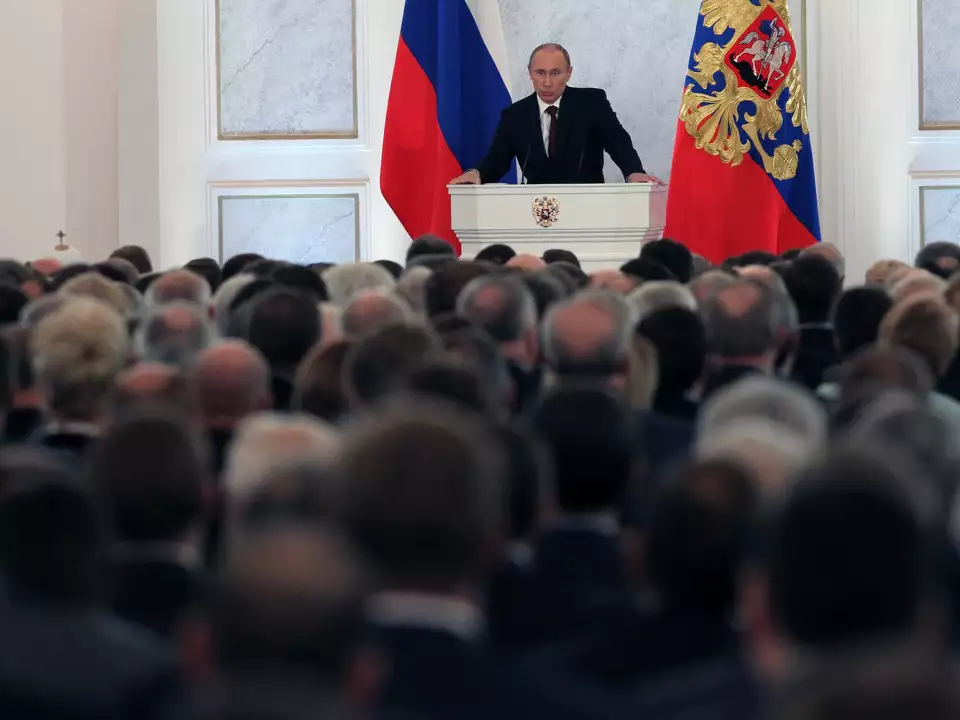
Russian President Vladimir Putin delivers a state-of-the-nation address to the Duma, Russia’s parliament, in 2012. What’s happening in the U.S. today is eerily similar to Russia’s slide to a dictatorship. Sasha Mordovets/Getty Images
By Oxana Pushkina
July 19, 2025 (SFChronicle.com)
When I tell my American friends that they’re closer to becoming Russia than they think, they laugh.
“We have a Constitution,” they say. “We have democracy.”
But everything we once said about Russia — “that could never happen” — has long been a reality. And what I see in America today feels eerily familiar.
I don’t say this as an outsider. I’m a former member of the Duma, Russia’s parliament.
I didn’t enter politics right away. For nearly 25 years, I hosted my own television show, where I told the stories no one else would — especially women’s stories. Domestic violence. Gender inequality. Discrimination. Loneliness. Despair. I tried to help — with words, with visibility, with human connection.
But eventually, I realized that storytelling wasn’t enough. You can’t protect a woman from abuse when there’s no law recognizing domestic violence. You can’t change a broken system just by exposing it.
So, in 2016, I ran for office. And I won. Even though I wasn’t a member of United Russia, President Vladimir Putin’s party, it officially nominated me. Under Russian electoral law, that’s possible: You can be an independent candidate with a party endorsement.
People often asked, “Why are you with them?”
And I always answered — and still do: Because I was pushing through legislation to protect women and children, and at that moment, I needed political power behind me.
I entered politics with one clear mission: to create fundamental, enforceable protections for women and children.
At first, the party didn’t take me seriously. It certainly didn’t see me as a threat. I was a TV journalist, yes, and popular. But convenient. Safe. Someone the party could use to bring in a huge female audience when needed.
Still, my public visibility gave me power — and I used it.
I had limited support in parliament, but strong backing from civil society. Human rights groups stood with me. So did ordinary people. At one point, 90% of Russian citizens supported a draft law on domestic violence. Still, it never passed.
Ultimately, I didn’t yet understand the full weight of what I had walked into — the machinery of autocratic power, the mechanisms of control, the unspoken rules of party discipline. I only began to understand it once I was truly inside.
By 2018, the conservative lobby tightened its grip — infiltrating every corner of public life. Reformers like me were edged out.
When I fought for a law on domestic violence prevention, I was called a “foreign agent.”
“If he hits you, it means he loves you.” As if that were part of the sacred “traditional values” of the Russian people.
They tried to humiliate me, to silence me, to break me.
They didn’t. But I left.
Now I read the news: The U.S. Supreme Court has granted the president the authority to fire federal employees and restructure entire agencies without congressional approval.
People tell me: “It’s just a temporary decision.”
Yes — formally, it is.
But in substance, this is a significant crack in the wall. This is how centralized, unchecked control begins.
In Russia, that moment came in 2004, when Putin abolished gubernatorial elections — also in the name of “efficiency.”
At the time, many accepted it. The country was exhausted — by instability, by economic hardship, by weak regional leadership. The official line was comforting: “We need unity. We need order. We need strong vertical control.” People wanted stability so badly, they let themselves believe it. Others were simply afraid to speak out. And some turned away — weary, cynical, numb. That’s how authoritarianism takes root; it’s not always with tanks in the streets, but through fatigue, fear and false promises.
In the U.S., the Supreme Court decision was issued per curiam, with no author named.
I’m told, “That’s normal. It’s standard practice.”
But I remember how this became a way to blur responsibility in Russia. It ended in complete judicial subordination.
At first, it was low-key. Judges who ruled against the state were quietly removed — reassigned, not reappointed or pressured into silence. Then came the warnings. Those who tried to uphold constitutional rights or challenge powerful officials were smeared in the press, disciplined or even prosecuted. Over time, loyalty replaced professionalism. Obedience became the price of survival. The message was unmistakable: independence was no longer welcome — it was dangerous.
Today, even ordinary judges make decisions with one eye on politics, afraid of crossing an invisible line. There are no independent courts left. Not at the local level. Not at the regional level. Not one.
America is not there yet. But I see the tilt toward a judiciary that acts, not as a neutral arbiter, but as a political actor.
They say, “The president still has to follow the law.”
But I know how that game is played.
In Russia, the government also “follows the law.” Because laws can be rewritten. Circumvented. Ignored.
That’s how elections were canceled. That’s how nongovernmental organizations were shut down. That’s how journalists were labeled “foreign agents.”
Trump’s executive order has no mechanism for congressional oversight.
“But Congress can still intervene,” some argue.
Can it?
In Russia, the parliament still exists — on paper. But it’s called the “mad printer” because it rubber-stamps whatever it is told. Independent political candidates have been effectively frozen out of elections.
No debate. No resistance. Just speed and silence.
America isn’t there. Not yet.
But if a president can bypass Congress — as Trump’s order suggests — the legislative branch ceases to properly balance power.
And there’s something else.
In the U.S., the word “democracy” is still spoken. But listen closely — it’s increasingly met with sarcasm, with cynicism.
In Russia, “democracy” became a dirty word. It’s been replaced by talk of “spiritual values,” “sovereignty” and “traditional norms.”
It didn’t happen overnight. It took decades of propaganda. But it happened.
In the U.S., I see the early signs.
You think this is far away? So did I.
I thought a modern country couldn’t be dragged backward by a regime built on fear, nostalgia and brute power. But in Russia, it didn’t take long.
Once, we had a free press. We had honest elections. We had independent courts. Now we have illusions.
America still has a choice. But the window is narrowing faster than you think. Absolute power doesn’t lie in executive orders. Or in purges. Or in fear. Real power lies in trust. In transparency. In the separation of powers.
If America wants to remain America, it will have to fight for it daily.
Oxana Pushkina is a former deputy in the Russian Duma. She now lives in San Francisco.
“Realisation is not acquisition of anything new nor is it a new faculty. It is only removal of all camouflage”
~ Ramana Maharshi
Ramana Maharshi (December 30, 1879 – April 14, 1950) was an Indian Hindu sage and jivanmukta. He was born Venkataraman Iyer, but is mostly known by the name Bhagavan Sri Ramana Maharshi. He was born in Tiruchuli, Tamil Nadu, India in 1879. Wikipedia
There’s no one way to become a man. If anything, the so-called online “manosphere” and current political culture of toxic masculinity have left many men and boys feeling angry, unfulfilled, and yearning for a stronger, more benevolent type of masculinity that feels more authentic and inclusive of different kinds of power.
Transgender men are giving us that. Assigned a different gender at birth, trans men are often socialized into girlhood and pressured into denying their masculine inclinations. While the seemingly contradictory or toxic rules and rituals of cis masculinity may feel like a daily hardship, the transition can also be a rapturous reclamation of the brotherhood they’ve long sought, mixed with a joyous queer-ing of what it means to be a man.
The July-August Issue of LGBTQ Nation explores what trans men teach us about masculinity. The stories, mostly written by trans men themselves, elevate trans male voices above the current conservative crusade that is crazed with policing trans women.
One of the men will discuss how his mind and behavior gradually moved from a female point of view to a male one, even while his body still reflected feminine aspects. Another will discuss how he happily retains different aspects of his femininity, even while becoming a visible public advocate for trans men.
We’ll hear from one writer about how the queer community’s understanding and acceptance of trans men has changed over his 30 years of activism, and two groundbreaking trans male athletes will share the challenges they’ve faced while excelling in competitive sports.
Another trans man will discuss how he joined the military to assert his manhood (and the problems and possibilities that created), and others will discuss why trans men are so often excluded both from male spaces and the larger political discourse around transgender rights.
In these ways, trans men aren’t just following traditional routes to masculinity – they’re redefining them, forging new paths for the current and future generations of men, both trans and cis.
Subscribe to the LGBTQ Nation newsletter and be the first to know about the latest headlines shaping LGBTQ+ communities worldwide.
Daniel Villarreal is a longtime, award-winning journalist and editor who has written for NBC News, Newsweek, Vox, Slate, Vice News, The Seattle Stranger, The Dallas Voice and numerous other LGBTQ+ publications. He has spoken at SXSW, Creating Change, Netroots Nation, GaymerX, and is a graduate of GLAAD’s Voices of Color program and of the Poynter Institute’s 2024 Power of Diverse Voices seminar. He is also the founder of QueerBomb Dallas, an annual non-corporate Pride event; CinéWilde, the nation’s longest running monthly LGBTQ film series. He is available for interviews and educational talks.
Blank on Blank Oct 22, 2013 “I even thought that I was gay. I thought that might be the solution to my problem.” – Kurt Cobain Interview by Jon Savage July 22, 1993. Cassette Tape Hear the full interview @ Rocksbackpages.com Kurt Cobain GIFs http://blankonblank.org/interviews/ku… Executive Producer: David Gerlach Animator: Patrick Smith
Consciousness, spirituality, biography, sexuality, androgyny, futurism, space, the arts, science, astrology, democracy, humor, books, movies and more



 Shutterstock