The Palmer Raids

From Wikipedia, the free encyclopedia

A. Mitchell Palmer

The Palmer Raids were a series of raids conducted in November 1919 and January 1920 by the United States Department of Justice under the administration of President Woodrow Wilson to capture and arrest suspected socialists, especially anarchists and communists, and deport them from the United States. The raids particularly targeted Italian immigrants and Eastern European Jewish immigrants with alleged leftist ties, with particular focus on Italian anarchists and immigrant leftist labor activists. The raids and arrests occurred under the leadership of United States Attorney General A. Mitchell Palmer, with 6,000 people arrested across 36 cities. Though 556 foreign citizens were deported, including a number of prominent leftist leaders, Palmer’s efforts were largely frustrated by officials at the U.S. Department of Labor, which had authority for deportations and objected to Palmer’s methods.

The Palmer Raids occurred in the larger context of the First Red Scare, a period of reactionary fear of communists in the U.S. in the years immediately following World War I and the successful Russian Revolution.[1] There were strikes that garnered national attention, and prompted race riots in more than 30 cities, as well as two sets of bombings in April and June 1919, including one bomb mailed to Palmer’s home in response to his policy of politically motivated mass arrests and deportations.[2]

Background

During the First World War there was a nationwide right-wing campaign in the United States against the real and imagined divided political loyalties of immigrants and ethnic groups, who were feared to have too much loyalty for their nations of origin. In 1915, President Wilson warned against hyphenated Americans who, he charged, had “poured the poison of disloyalty into the very arteries of our national life.” “Such creatures of passion, disloyalty and anarchy”, Wilson continued, “must be crushed out”.[3] The Russian Revolutions of 1917 added special force to fear of labor agitators and partisans of ideologies such as anarchism and communism. The general strike in Seattle in February 1919 represented a new development in labor unrest.[4]

The fears of Wilson and other government officials were confirmed when Galleanists—Italian immigrant followers of the anarchist Luigi Galleani—carried out a series of bombings in April and June 1919.[5] At the end of April, some 30 Galleanist letter bombs had been mailed to a host of individuals, mostly prominent government officials and businessmen, but also law enforcement officials.[5] Only a few reached their targets, and not all exploded when opened. Some people suffered injuries, including a housekeeper in Senator Thomas W. Hardwick‘s residence, who had her hands blown off.[5] On June 2, 1919, the second wave of bombings occurred, when several much larger package bombs were detonated by Galleanists in eight American cities, including one that damaged the home of Attorney General A. Mitchell Palmer in Washington, D.C.[5] At least one person was killed in this second attack, night watchman William Boehner, and fears were raised because it occurred in the capital.[5][6][7] Flyers declaring war on capitalists in the name of anarchist principles accompanied each bomb.[5]

Preparations

In June 1919, Attorney General Palmer told the House Appropriations Committee that all evidence promised that radicals would “on a certain day…rise up and destroy the government at one fell swoop.” He requested an increase in his budget to $2,000,000 from $1,500,000 to support his investigations of radicals, but Congress limited the increase to $100,000.[8][9]

An initial raid in July 1919 against an anarchist group in BuffaloNew York, achieved little when a federal judge tossed out Palmer’s case. He found in the case that the three arrested radicals, charged under a law dating from the Civil War, had proposed transforming the government by using their free speech rights and not by violence.[10] That taught Palmer that he needed to exploit the more powerful immigration statutes that authorized the deportation of alien anarchists, violent or not. To do that, he needed to enlist the cooperation of officials at the Department of Labor. Only the Secretary of Labor could issue warrants for the arrest of alien violators of the Immigration Acts, and only he could sign deportation orders following a hearing by an immigration inspector.[11]

On August 1, 1919, Palmer named 24-year-old J. Edgar Hoover to head a new division of the Justice Department‘s Bureau of Investigation, the General Intelligence Division (GID), with responsibility for investigating the programs of radical groups and identifying their members.[12] The Boston Police Strike in early September raised concerns about possible threats to political and social stability. On October 17, the Senate passed a unanimous resolution demanding Palmer explain what actions he had or had not taken against radical aliens and why.[13]

At 9 p.m. on November 7, 1919, a date chosen because it was the second anniversary of the Bolshevik revolution, agents of the Bureau of Investigation, together with local police, executed a series of well-publicized and violent raids against the Union of Russian Workers in 12 cities. Newspaper accounts reported some were “badly beaten” during the arrests. Many later swore they were threatened and beaten during questioning. Government agents cast a wide net, bringing in some American citizens, passers-by who admitted being Russian, some not members of the Russian Workers. Others were teachers conducting night school classes in space shared with the targeted radical group. Arrests far exceeded the number of warrants. Of 650 arrested in New York City, the government managed to deport just 43.[A]

When Palmer replied to the Senate’s questions of October 17, he reported that his department had amassed 60,000 names with great effort. Required by the statutes to work through the Department of Labor, they had arrested 250 dangerous radicals in the November 7 raids. He proposed a new Anti-Sedition Law to enhance his authority to prosecute anarchists.[16]

Raids and arrests in January 1920

Men arrested in raids awaiting deportation hearings on Ellis Island, January 13, 1920
Newspaper cartoon
Cartoon by Archibald B. Chapin on the South Bend News-Times – November 8, 1919

Inasmuch as Attorney General Palmer struggled with exhaustion and devoted all his energies to the United Mine Workers coal strike in November and December 1919,[17] Hoover organized the next raids. He successfully persuaded the Department of Labor to ease its insistence on promptly alerting those arrested of their right to an attorney. Instead, Labor issued instructions that its representatives could wait until after the case against the defendant was established, “in order to protect government interests.”[18] Less openly, Hoover decided to interpret Labor’s agreement to act against the Communist Party to include a different organization, the Communist Labor Party. Finally, despite the fact that Secretary of Labor William B. Wilson insisted that more than membership in an organization was required for a warrant, Hoover worked with more compliant Labor officials and overwhelmed Labor staff to get the warrants he wanted. Justice Department officials, including Palmer and Hoover, later claimed ignorance of such details.[19]

The Justice Department launched a series of raids on January 2, 1920, with follow up operations over the next few days. Smaller raids extended over the next 6 weeks. At least 3,000 were arrested, and many others were held for various lengths of time. The entire enterprise replicated the November action on a larger scale, including arrests and seizures without search warrants, as well as detention in overcrowded and unsanitary holding facilities. Hoover later admitted “clear cases of brutality.”[20] The raids covered more than 30 cities and towns in 23 states, but those west of the Mississippi and south of the Ohio were “publicity gestures” designed to make the effort appear nationwide in scope.[B] Because the raids targeted entire organizations, agents arrested everyone found in organization meeting halls, not only arresting non-radical organization members but also visitors who did not belong to a target organization, and sometimes American citizens not eligible for arrest and deportation.[C]

The Department of Justice at one point claimed to have taken possession of several bombs, but after a few iron balls were displayed to the press they were never mentioned again. All the raids netted a total of just four ordinary pistols.[23]

While most press coverage continued to be positive, with criticism only from leftist publications like The Nation and The New Republic, one attorney raised the first noteworthy protest. Francis Fisher Kane, the U.S. Attorney for the Eastern District of Pennsylvania, resigned in protest. In his letter of resignation to the President and the Attorney General he wrote: “It seems to me that the policy of raids against large numbers of individuals is generally unwise and very apt to result in injustice. People not really guilty are likely to be arrested and railroaded through their hearings… We appear to be attempting to repress a political party… By such methods, we drive underground and make dangerous what was not dangerous before.” Palmer replied that he could not use individual arrests to treat an “epidemic” and asserted his own fidelity to constitutional principles. He added: “The Government should encourage free political thinking and political action, but it certainly has the right for its own preservation to discourage and prevent the use of force and violence to accomplish that which ought to be accomplished, if at all, by parliamentary or political methods.”[24][25] The Washington Post endorsed Palmer’s claim for urgency over legal process: “There is no time to waste on hairsplitting over infringement of liberty.”[26]

Aftermath

In a few weeks, after changes in personnel at the Department of Labor, Palmer faced a new and very independent-minded Acting Secretary of Labor in Assistant Secretary of Labor Louis Freeland Post, who canceled more than 2,000 warrants as being illegal.[27] the 10,000 arrested, 3,500 were held by authorities in detention; 556 resident aliens were eventually deported under the Immigration Act of 1918.[28]

At a Cabinet meeting in April 1920, Palmer called on Secretary of Labor William B. Wilson to fire Post, but Wilson defended him. The President listened to his feuding department heads and offered no comment about Post, but he ended the meeting by telling Palmer that he should “not let this country see red.” Secretary of the Navy Josephus Daniels, who made notes of the conversation, thought the Attorney General had merited the President’s “admonition”, because Palmer “was seeing red behind every bush and every demand for an increase in wages.”[29]

Palmer’s supporters in Congress responded with an attempt to impeach Louis Post or, failing that, to censure him. The drive against Post began to lose energy when Attorney General Palmer’s forecast of an attempted radical uprising on May Day 1920 failed to occur. Then, in testimony before the House Rules Committee on May 7–8, Post proved “a convincing speaker with a caustic tongue”[27] and defended himself so successfully that Congressman Edward W. Pou, a Democrat presumed to be an enthusiastic supporter of Palmer, congratulated him: “I feel that you have followed your sense of duty absolutely.” [30]

On May 28, 1920, the nascent American Civil Liberties Union (ACLU), which was founded in response to the raids,[31] published its Report Upon the Illegal Practices of the United States Department of Justice,[32] which carefully documented unlawful activities in arresting suspected radicals, illegal entrapment by agents provocateur, and unlawful incommunicado detention. Such prominent lawyers and law professors as Felix FrankfurterRoscoe Pound and Ernst Freund signed it. Harvard Professor Zechariah Chafee criticized the raids and attempts at deportations and the lack of legal process in his 1920 volume Freedom of Speech. He wrote: “That a Quaker should employ prison and exile to counteract evil-thinking is one of the saddest ironies of our time.”[33]

The Rules Committee gave Palmer a hearing in June, where he attacked Post and other critics whose “tender solicitude for social revolution and perverted sympathy for the criminal anarchists…set at large among the people the very public enemies whom it was the desire and intention of the Congress to be rid of.” The press saw the dispute as evidence of the Wilson administration’s ineffectiveness and division as it approached its final months.[34]

In June 1920, a decision by Massachusetts District Court Judge George W. Anderson ordered the discharge of 17 arrested aliens and denounced the Department of Justice’s actions. He wrote that “a mob is a mob, whether made up of Government officials acting under instructions from the Department of Justice, or of criminals and loafers and the vicious classes.” His decision effectively prevented any renewal of the raids.[35] [36]

Palmer, once seen as a likely presidential candidate, lost his bid to win the Democratic nomination for president later in the year.[37] The anarchist bombing campaign, following the ideology of propaganda of the deed, continued intermittently in the US for another twelve years.[38][5]

Epilogue

The legal issues involved in the 1919 Palmer Raids during the Woodrow Wilson administration have been resurrected during the deportations during the second Trump administration.[39]

Current Trump administration policy has been compared to the Palmer Raids, and the “Repatriations” of the 1930s”:

Former President Donald Trump’s call for historic “mass deportations” of immigrants from the United States is forcing the nation to revisit past expulsions that left deep wounds still felt today. The big picture: From the Palmer Raids of Jewish and Italian immigrants of 1919 to the mass deportation of Mexican immigrants in the 1950s, previous deportation operations ignored civil liberties, heightened racial tensions and disrupted families of American citizens for generations.[40]

It has also been compared to the Irish Expulsion, the Palmer Raids and the “Soviet Ark”, the “Mexican Repatriation” during The Great Depression, “Operation Wetback” during the Dwight D. Eisenhower administration, and “The Deporter-in-Chief” during the Barack Obama administration.[41]

In the 105 years between 1892 and 1997, the United States deported 2.1 million people.[42] Between 2001 and 2008, during the Presidency of George W. Bush, about 2.0 million people were deported, while between 2009 and 2016, during the Presidency of Barack Obama, about 3.2 million people were deported.[43]

More at: https://en.wikipedia.org/wiki/Palmer_Raids

Why you should be able to vote on your phone

Bradley Tusk | TED2025

• April 2025

LikeRead transcript

The US political system is broken — and the solution might be in the palm of your hands, says political strategist Bradley Tusk. Drawing on his deep experience with government and technology, he makes the case for allowing Americans to vote on their phones, explaining how it can be done safely and securely. Learn why mobile voting could be the best way to increase voter turnout, reduce political extremism and save our broken democracy.

About the speaker

Venture capitalist, political strategist

Vacation and the Art of Presence: Anaïs Nin on How to Truly Unplug and Reconnect with Your Senses

By Maria Popova (themarginalian.org)

If leisure is the basis of culture, how can we harness its true rewards given our pathological addiction to productivity? That’s exactly what French-Cuban writer Anaïs Nin (February 21, 1903–January 14, 1977) — an enchantress of love and life, a woman of extraordinary cultural prescience, and one of the most dedicated diarists of all time — explores in a portion of The Diary of Anaïs Nin, Volume 5 (public library).

In the winter of 1947, drained by the bustle and constant striving that drives life in New York, Nin took a holiday in Acapulco, Mexico — still a mostly undeveloped patch of wilderness, on which the Hotel El Mirador had been built as twelve rooms on the edge of a cliff just a few years earlier. She was immediately struck by the world of difference between the local way of life and the obsessive living-making of the workaholic culture from which she had taken respite.

Three decades before Susan Sontag lamented the “aesthetic consumerism” of vacation photography, which commodifies the experience by prioritizing its record over its livingness, and more than half a century before we came to compulsively catalog every private moment on the social web, Nin writes:

I am lying on a hammock, on the terrace of my room at the Hotel Mirador, the diary open on my knees, the sun shining on the diary, and I have no desire to write. The sun, the leaves, the shade, the warmth, are so alive that they lull the senses, calm the imagination. This is perfection. There is no need to portray, to preserve. It is eternal, it overwhelms you, it is complete.

Nin had many friends of color in an era when that was rather uncommon for the average white person, and saw white Americans’ and Europeans’ way of life as a rote existence greatly inferior in its sensorial unimaginativeness compared to the cultures from which jazz, the art-form she most admired, sprang. Faced with the radically different disposition of the Mexican locals, she considers what they know about living with presence that the society from which she escaped does not:

The natives have not yet learned from the white man his inventions for traveling away from the present, his scientific capacity for analyzing warmth into a chemical substance, for abstracting human beings into symbols. The white man has invented glasses which make objects too near or too far, cameras, telescopes, spyglasses, objects which put glass between living and vision. It is the image he seeks to possess, not the texture, the living warmth, the human closeness.

Illustration from a rare first edition of Nin’s 1944 short-story collection Under a Glass Bell

Many decades before we became transfixed by the glowing screens of our devices, which came to interfere with the very basics of being a city life, Nin adds:

Here in Mexico they see only the present. This communion of eyes and smiles is elating. In New York people seem intent on not seeing each other. Only children look with such unashamed curiosity. Poor white man, wandering and lost in his proud possession of a dimension in which bodies become invisible to the naked eye, as if staring were an immodest act. Here I feel incarnated and in full possession of my own body.

Four years later, Nin returns to Acapulco and is once again enchanted by the aliveness that its invitation to presence awakens in the spirit:

To me Acapulco is the detoxicating cure for all the evils of the city: ambition, vanity, quest for success in money, the continuous contagious presence of power-driven, obsessed individuals who want to become known, to be in the limelight, noticed, as if life among millions gave you a desperate illness, a need of rising above the crowd, being noticed, existing individually, singled out from a mass of ants and sheep… Here, all this is nonsense. You exist by your smile and your presence. You exist for your joys and your relaxations. You exist in nature. You are part of the glittering sea, and part of the luscious, well-nourished plants, you are wedded to the sun, you are immersed in timelessness, only the present counts, and from the present you extract all the essences which can nourish the senses, and so the nerves are still, the mind is quiet, the nights are lullabies, the days are like gentle ovens in which infinitely wise sculptor’s hands re-form the lost contours, the lost sensations of the body… As you swim, you are washed of all the excrescences of so-called civilization, which includes the incapacity to be happy under any circumstances.

Complement The Diary of Anaïs Nin, full of wisdom just as electrifying and alive, with Nin on why emotional excess is essential for creativitythe elusive nature of joy, and what maturity really means, then revisit Josef Pieper, writing around the same time, on how to reclaim our human dignity by mastering leisure.

Free Will Astrology: Week of July 17, 2025

BY ROB BREZSNY | JULY 15, 2025

Photo: Rovin De Silva

ARIES (March 21-April 19): For the Dagara people of Burkina Faso, the element of fire has profound cultural meanings. It’s a symbol of innovation and inspiration. It’s a mediator between the physical and spiritual worlds and a conduit for communication with the ancestors. Through rituals, fire is a purifying and renewing force that helps people reconnect with their purpose, heal relationships and catalyze positive change in the community. In the coming weeks, Aries, I hope you will be deeply aligned with all these symbolic meanings. What are you ready to ignite for the sake of nurturing and care? What truths need light and heat? What future visions would benefit from surges of luminosity?

TAURUS (April 20-May 20): In the Nahuatl language spoken by Indigenous Mexicans, the word nepantla describes an in-between space. It’s a liminal threshold where a transition is in process. The old ways have fallen away, but the new ways are not yet fully formed. It’s unsettling and perhaps confusing, yet seeded with the potential for creative change. I suspect you are now in a state resembling nepantla, Taurus. Please understand that this isn’t a crisis. It’s a chrysalis. Any discomfort you feel is not a sign of failure, but a harbinger of the wisdom and power that will come by molting the identity you have outgrown. I hope you will honor the rawness and speak tenderly to yourself. You are not lost; you are mid-ritual.

GEMINI (May 21-June 20): The sea slug Elysia chlorotica is a small, unassuming creature that performs a remarkable feat: It eats algae and steals its chloroplasts, then incorporates them into its own body. For weeks afterward, the slug photosynthesizes sunlight like a plant. I believe, Gemini, that you are doing a metaphorical version of this biological borrowing. Some useful influence or presence you have absorbed from another is integrating into your deeper systems. You’re making it your own now. This isn’t theft, but creative borrowing. You’re not copying; you’re synthesizing and synergizing.

CANCER (June 21-July 22): Ancient beekeepers in Anatolia carved hives directly into rock faces, coaxing honey from the cliffs. This practice was designed to protect bees from harsh weather and predators while maximizing honey production. The bees adapted well to their unusual homes. I suspect, Cancerian, that in the coming weeks, your sweetness and bounty may also thrive in unlikely structures. It could take a minute or two for you to adjust, but that won’t be a problem. Your nectar-making instincts will guide you. So I advise you not to wait for the perfect container before beginning your work. Make honey in the best available setting.

LEO (July 23-Aug. 22): I laughed until I sobbed as you earnestly played the game of love even after the rules had changed. I sighed till I panted as you dredged up a new problem to avoid fixing an overripe hassle. I rolled my eyes until I got dizzy as you tried to figure out the differences between stifling self-control and emancipating self-control. But all that’s in the past, right, Leo? Now I’m preparing to cheer until my voice is raspy as you trade in a dried-up old obsession in favor of a sweet, fresh, productive passion—and outgrow all the fruitless nuisances.

VIRGO (Aug. 23-Sept. 22): The ancient scribes of Mesopotamia etched records onto clay tablets with styluses, pressing wedge-shaped marks into wet earth. Once baked, these tablets endured for thousands of years. Some are still readable today. In my astrological assessment, Virgo, you are undergoing a metaphorically comparable process. Messages and expressions that are forming within you are meant to last. They may not win you immediate attention and applause. But you already suspect how crucial they will be to both your own future and the destinies of those you care for. Be bold, decisive and precise as you choose your words.

LIBRA (Sept. 23-Oct. 22): Is there any aspect of your life or character that is still unripe even though it is critical to your life-long journey? Have you held on to your amateur status or remained a bit dilettantish beyond the time when you might have progressed to the next highest level? Are you still a casual dabbler in a field where you could ultimately become masterful? If you answered yes to these queries, now is a perfect moment to kick yourself in the butt and leap to the next level. Waiting around for fate to kick your butt would be a mistake.

SCORPIO (Oct. 23-Nov. 21): Many astrologers rightfully say that Virgo is the most detail-oriented, meticulous sign. I think you Scorpios may be the most methodical and thorough of all the signs, which means that you, too, can be meticulous and detail-oriented. A prime example is the Scorpio sculptor Auguste Rodin (1840–1917). Eventually, his work became world-renowned, but his career developed gradually because of his painstaking patience and scrupulous devotion to excellence. I propose we make him your role model for now. Inspired by him, resist pressure for immediate results. Trust in the slow, steady refinement process.

SAGITTARIUS (Nov. 22-Dec. 21): Here are half of your words of power for the coming days: windfallgodsend and boon. The other half are potionremedy and healing agent. If you’re lucky, and I think you will be, those terms will blend and overlap. The blessings that come your way will be in the form of cures and fixes. I’m being understated here so as to not sound too wildly excited about your immediate future. But I suspect you will wrangle at least one amazing victory over hardship. Your chances of a semi-miraculous visitation by a benevolent intervention are as high as they have ever been.

CAPRICORN (Dec. 22-Jan. 19): The ancient Chinese character for “listening” contains symbols for ears, eyes and heart. I interpret this to signify that it’s not enough to seek the truth with just one of your faculties. They must all be engaged and working together to get the full story. You are wise to survey the world with your whole being. Keep these meditations in mind during the coming weeks, Capricorn. Your natural inclination is to be practical, take action and get things done. But for now, your main superpower will be listening to everything. So my advice is to listen with your skin. Listen with your breath. Listen with your gut. Let your attention be so complete that the world softens and speaks to you about what you really need to know.

AQUARIUS (Jan. 20-Feb. 18): If you would like to glide into rapt alignment with astrological rhythms, give gifts to your two closest allies. These offerings should inspire their ambitions, not indulge their cravings to be comfortable. They shouldn’t be practical necessities or consumer fetishes, but rather provocative tools or adult toys. Ideally, they will be imaginative boons that your beloved companions have been shy about asking for or intriguing prods that will help beautify their self-image. Show them you love both the person they are now and the person they are becoming.

PISCES (Feb. 19-March 20): Piscean photographer Ansel Adams is so renowned that he’s in the International Photography Hall of Fame. We know the moment that his lifelong passion erupted. At age fourteen, his family gave him a simple camera and took him to Yosemite National Park in California. “The splendor of Yosemite burst upon us, and it was glorious,” he wrote later. “One wonder after another descended upon us. A new era began for me.” In the coming months, I foresee you encountering a comparable turning point, Pisces—a magical interlude awakening you to a marvel that will become an enduring presence in your life. Be alert for it. Better yet, declare your intention to shape events to ensure it happens and you’re ready for it.

Homework: Make amends to the person you were in the past. They’re still alive within you. Newsletter.FreeWillAstrology.com

Word-Built World: writing on the wall

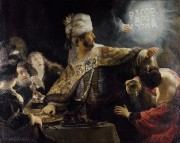
Belshazzar’s feast (Daniel 5:5), 1636. Art: Rembrandt

A.Word.A.Daywith Anu Garg

writing on the wall

PRONUNCIATION:

(RY-ting ahn thuh WAWL) 

MEANING:

noun: A clear sign of impending decline or disaster.

ETYMOLOGY:

From write, from Old English writan + wall, from Old English weall, from Latin vallum (rampart), from vallus (stake). Earliest documented use: 1663.

NOTES:

In the Biblical story told in Daniel 5, the haughty King Belshazzar throws a big party. While everyone is feasting, a disembodied hand appears and writes a warning on the wall. The term is also used in the form handwriting on the wall.
The moral of the story: At a party, read the room. Also, read the doom.

Spiritualism: An Insider’s View with Darryl Schoon

New Thinking Jul 14, 2025 Darryl Robert Schoon is a financial analyst famous for having predicted the 2008 market crash. His website is www.drschoon.com. He is author of Light in a Dark Place: The Prison Years. He has also written a novel titled You Can’t Always Get What You Want. He is a minister with the Temple of Universality in Tucson, Arizona. Here he describes how he encountered the spiritualist medium, Hoyt Robinette, who produced physical materializations of drawings and also convincing spirit communications. Additionally, he was introduced to spiritualist healings mediated by Bruno Gröning, a German healer who died in 1959. As a result of these encounters, he and his wife became spiritualist ministers at the Temple of Universality in Tucson, Arizona. New Thinking Allowed host, Jeffrey Mishlove, PhD, is author of The Roots of Consciousness, Psi Development Systems, and The PK Man. Between 1986 and 2002 he hosted and co-produced the original Thinking Allowed public television series. He is the recipient of the only doctoral diploma in “parapsychology” ever awarded by an accredited university (University of California, Berkeley, 1980). He is also the Grand Prize winner of the 2021 Bigelow Institute essay competition regarding the best evidence for survival of human consciousness after permanent bodily death. He is Co-Director of Parapsychology Education at the California Institute for Human Science. (Recorded on October 31, 2019)

Interview with Richard Tarnas: Navigating this Time of Crisis with Faith and Spiritual Awareness

Heather Ens Jul 14, 2025 In this interview, Richard Tarnas, Ph.D. shares his understanding of this time that we are in historically and in our evolution of consciousness as humanity. He describes this as a time in which we are facing a crisis of meaning and need to reclaim our remembrance that we are spiritual beings living in an ensouled Cosmos. Richard Tarnas, PhD is Professor Emeritus at the California Institute of Integral Studies, where he was the founding director of the Philosophy, Cosmology, and Consciousness department. During his thirty years there he taught courses in the history of ideas, depth psychology, archetypal cosmology, cultural history, and the evolution of consciousness. He has also frequently lectured on archetypal studies and depth psychology at Pacifica Graduate Institute, and was formerly the director of programs and education at Esalen Institute. He is the author of The Passion of the Western Mind, a narrative history of the Western world view from the ancient Greek to the postmodern that is widely used in universities. His second book, Cosmos and Psyche, received the Book of the Year Prize from the Scientific and Medical Network. He is a past president of the International Transpersonal Association and was a long-time member of the Board of Governors for the C. G. Jung Institute of San Francisco. His website: https://cosmosandpsyche.com/ Link for the Philosophy, Cosmology and Consciousness program at the California Institute of integral Studies: https://www.ciis.edu/academics/depart… Heather’s website: https://www.risingmoonhealingcenter.com/ To become a patron of Heather:   / heatherensworth  

Free Will and Determinism with Ruth Kastner

New Thinking Allowed with Jeffrey Mishlove Jul 16, 2025 Ruth Kastner, PhD, is a member of the Foundations of Physics group at the University of Maryland, College Park. She is author of The Transactional Interpretation of Quantum Mechanics: The Reality of Possibility, Understanding Our Unseen Reality: Solving Quantum Riddles, and Adventures in Quantumland: Exploring Our Unseen Reality. Here she maintains that quantum indeterminacy is not quite the same as “randomness” and that it does allow for the possibility of free will, which is otherwise incompatible with a completely deterministic universe. Physics, however, has nothing to say about consciousness — a term that is not defined precisely in any physical theory. However, it is interesting to note that the “iceberg” metaphor used by Freud to describe the human subconscious can be equally applied to the ontological realm of possibility or “Quantumland” as defined in the Transactional Interpretation. New Thinking Allowed host, Jeffrey Mishlove, PhD, is author of The Roots of Consciousness, Psi Development Systems, and The PK Man. Between 1986 and 2002 he hosted and co-produced the original Thinking Allowed public television series. He is the recipient of the only doctoral diploma in “parapsychology” ever awarded by an accredited university (University of California, Berkeley, 1980). He is also the Grand Prize winner of the 2021 Bigelow Institute essay competition regarding the best evidence for survival of human consciousness after permanent bodily death. He is Co-Director of Parapsychology Education at the California Institute for Human Science. (Recorded on October 21, 2019)

Improving Mental Health with Chinese Medicine with Nina Cheng

New Thinking Jul 15, 2025 Nina Cheng is the founder of the Chinese medicine company, The Eastern Philosophy, and serves as Communications Officer and board member of The International Association for the Study of Traditional Asian Medicine (IASTAM). She is a graduate student in History of Medicine at Johns Hopkins Graduate School of Medicine with a research focus on mental health in pre-modern China. She is author of Chinese Medicine for the Mind: A Science-Backed Guide to Improving Mental Health with Traditional Chinese Medicine with contributions from prominent clinicians and historians of Chinese medicine psychology from around the world. Her website is theeasternphilosophy.com. Nina shares principles of Traditional Chinese Medicine (TCM) and its holistic application to mental health. She discusses the concept of qi as a vital life force and the efficacy of herbal treatments, five element music therapy, and qigong, among other approaches, to harmonize the connection between emotional states and organ systems. Ultimately, she advocates for a shift from the pursuit of happiness to a focus on contentment. 00:00:00 Introduction 00:06:35 Holistic approach of Traditional Chinese Medicine (TCM) 00:09:37 Five Element theory 00:17:03 Qi – vital life force 00:21:14 Mental health conditions TCM can help 00:40:22 Stress and anxiety 00:54:58 Depression 00:59:22 Qigong, tai chi, and daoyin 01:04:14 ADHD 01:08:12 Emotions and consciousness 01:12:53 Heart – seat of awareness and governs the mind 01:14:18 Conclusion Edited subtitles for this video are available in Russian, Portuguese, Italian, German, French, and Spanish. New Thinking Allowed CoHost, Emmy Vadnais, OTR/L, is an intuitive healer and health coach based in St. Paul, Minnesota. She is the author of Intuitive Development: How to Trust Your Inner Knowing for Guidance With Relationships, Health, and Spirituality. Her website is https://emmyvadnais.com (Recorded on May 16, 2025)

Consciousness, spirituality, biography, sexuality, androgyny, futurism, space, the arts, science, astrology, democracy, humor, books, movies and more