
Democracy Now! Jul 10, 2025 Latest Shows Support our work: https://democracynow.org/donate/sm-de… Brazilian filmmaker Petra Costa’s latest documentary, Apocalypse in the Tropics_, explores the impact of evangelical Christianity on Brazil’s political landscape. Once a small minority, evangelicals now constitute about 30% of Brazil’s population and played a key role in the rise of former far-right President Jair Bolsonaro. “It’s one of the fastest-growing religious shifts in the history of mankind,” Costa tells _Democracy Now! She says right-wing evangelicalism in Brazil is largely a U.S. import, after Washington sought to undermine the influence of left-wing Catholic teachings during the Cold War. U.S. President Donald Trump on Wednesday threatened to impose 50% tariffs on Brazil, partly as retribution for what he calls the “witch hunt” against Bolsonaro, now facing trial in Brazil for an alleged coup attempt following his defeat in the 2022 presidential election to Luiz Inácio Lula da Silva. “Apocalypse in the Tropics” is available on Netflix starting July 14. Costa’s previous film, “The Edge of Democracy,” was nominated for an Academy Award for Best Documentary Feature. Democracy Now! is an independent global news hour that airs on over 1,500 TV and radio stations Monday through Friday. Watch our livestream at democracynow.org Mondays to Fridays 8-9 a.m. ET. Subscribe to our Daily Email Digest: https://democracynow.org/subscribe
I’m a former member of the Russian parliament. America is closer to Putin’s Russia than you know
I didn’t understand the machinery of autocratic power, the mechanisms of control, the unspoken rules of party discipline. Now I do. And I see it developing here

Russian President Vladimir Putin delivers a state-of-the-nation address to the Duma, Russia’s parliament, in 2012. What’s happening in the U.S. today is eerily similar to Russia’s slide to a dictatorship. Sasha Mordovets/Getty Images
By Oxana Pushkina
July 19, 2025 (SFChronicle.com)
When I tell my American friends that they’re closer to becoming Russia than they think, they laugh.
“We have a Constitution,” they say. “We have democracy.”
But everything we once said about Russia — “that could never happen” — has long been a reality. And what I see in America today feels eerily familiar.
I don’t say this as an outsider. I’m a former member of the Duma, Russia’s parliament.
I didn’t enter politics right away. For nearly 25 years, I hosted my own television show, where I told the stories no one else would — especially women’s stories. Domestic violence. Gender inequality. Discrimination. Loneliness. Despair. I tried to help — with words, with visibility, with human connection.
But eventually, I realized that storytelling wasn’t enough. You can’t protect a woman from abuse when there’s no law recognizing domestic violence. You can’t change a broken system just by exposing it.
So, in 2016, I ran for office. And I won. Even though I wasn’t a member of United Russia, President Vladimir Putin’s party, it officially nominated me. Under Russian electoral law, that’s possible: You can be an independent candidate with a party endorsement.
People often asked, “Why are you with them?”
And I always answered — and still do: Because I was pushing through legislation to protect women and children, and at that moment, I needed political power behind me.
I entered politics with one clear mission: to create fundamental, enforceable protections for women and children.
At first, the party didn’t take me seriously. It certainly didn’t see me as a threat. I was a TV journalist, yes, and popular. But convenient. Safe. Someone the party could use to bring in a huge female audience when needed.
Still, my public visibility gave me power — and I used it.
I had limited support in parliament, but strong backing from civil society. Human rights groups stood with me. So did ordinary people. At one point, 90% of Russian citizens supported a draft law on domestic violence. Still, it never passed.
Ultimately, I didn’t yet understand the full weight of what I had walked into — the machinery of autocratic power, the mechanisms of control, the unspoken rules of party discipline. I only began to understand it once I was truly inside.
By 2018, the conservative lobby tightened its grip — infiltrating every corner of public life. Reformers like me were edged out.
When I fought for a law on domestic violence prevention, I was called a “foreign agent.”
“If he hits you, it means he loves you.” As if that were part of the sacred “traditional values” of the Russian people.
They tried to humiliate me, to silence me, to break me.
They didn’t. But I left.
Now I read the news: The U.S. Supreme Court has granted the president the authority to fire federal employees and restructure entire agencies without congressional approval.
People tell me: “It’s just a temporary decision.”
Yes — formally, it is.
But in substance, this is a significant crack in the wall. This is how centralized, unchecked control begins.
In Russia, that moment came in 2004, when Putin abolished gubernatorial elections — also in the name of “efficiency.”
At the time, many accepted it. The country was exhausted — by instability, by economic hardship, by weak regional leadership. The official line was comforting: “We need unity. We need order. We need strong vertical control.” People wanted stability so badly, they let themselves believe it. Others were simply afraid to speak out. And some turned away — weary, cynical, numb. That’s how authoritarianism takes root; it’s not always with tanks in the streets, but through fatigue, fear and false promises.
In the U.S., the Supreme Court decision was issued per curiam, with no author named.
I’m told, “That’s normal. It’s standard practice.”
But I remember how this became a way to blur responsibility in Russia. It ended in complete judicial subordination.
At first, it was low-key. Judges who ruled against the state were quietly removed — reassigned, not reappointed or pressured into silence. Then came the warnings. Those who tried to uphold constitutional rights or challenge powerful officials were smeared in the press, disciplined or even prosecuted. Over time, loyalty replaced professionalism. Obedience became the price of survival. The message was unmistakable: independence was no longer welcome — it was dangerous.
Today, even ordinary judges make decisions with one eye on politics, afraid of crossing an invisible line. There are no independent courts left. Not at the local level. Not at the regional level. Not one.
America is not there yet. But I see the tilt toward a judiciary that acts, not as a neutral arbiter, but as a political actor.
They say, “The president still has to follow the law.”
But I know how that game is played.
In Russia, the government also “follows the law.” Because laws can be rewritten. Circumvented. Ignored.
That’s how elections were canceled. That’s how nongovernmental organizations were shut down. That’s how journalists were labeled “foreign agents.”
Trump’s executive order has no mechanism for congressional oversight.
“But Congress can still intervene,” some argue.
Can it?
In Russia, the parliament still exists — on paper. But it’s called the “mad printer” because it rubber-stamps whatever it is told. Independent political candidates have been effectively frozen out of elections.
No debate. No resistance. Just speed and silence.
America isn’t there. Not yet.
But if a president can bypass Congress — as Trump’s order suggests — the legislative branch ceases to properly balance power.
And there’s something else.
In the U.S., the word “democracy” is still spoken. But listen closely — it’s increasingly met with sarcasm, with cynicism.
In Russia, “democracy” became a dirty word. It’s been replaced by talk of “spiritual values,” “sovereignty” and “traditional norms.”
It didn’t happen overnight. It took decades of propaganda. But it happened.
In the U.S., I see the early signs.
You think this is far away? So did I.
I thought a modern country couldn’t be dragged backward by a regime built on fear, nostalgia and brute power. But in Russia, it didn’t take long.
Once, we had a free press. We had honest elections. We had independent courts. Now we have illusions.
America still has a choice. But the window is narrowing faster than you think. Absolute power doesn’t lie in executive orders. Or in purges. Or in fear. Real power lies in trust. In transparency. In the separation of powers.
If America wants to remain America, it will have to fight for it daily.
Oxana Pushkina is a former deputy in the Russian Duma. She now lives in San Francisco.
July 19, 2025
Oxana Pushkina
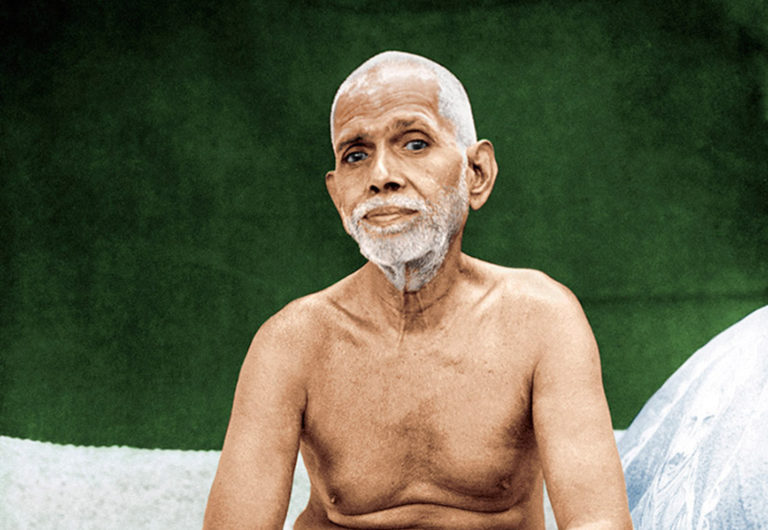
What is realisation?
(Image from innerspiritualawakening.com)
“Realisation is not acquisition of anything new nor is it a new faculty. It is only removal of all camouflage”
~ Ramana Maharshi
Ramana Maharshi (December 30, 1879 – April 14, 1950) was an Indian Hindu sage and jivanmukta. He was born Venkataraman Iyer, but is mostly known by the name Bhagavan Sri Ramana Maharshi. He was born in Tiruchuli, Tamil Nadu, India in 1879. Wikipedia
Toxic masculinity has warped our culture. Trans men are showing the path forward.
Trans men aren’t just following traditional routes to masculinity — they’re redefining them while forging new paths forward.
July 16, 2025 (lgbtqnation.com)
 Shutterstock
There’s no one way to become a man. If anything, the so-called online “manosphere” and current political culture of toxic masculinity have left many men and boys feeling angry, unfulfilled, and yearning for a stronger, more benevolent type of masculinity that feels more authentic and inclusive of different kinds of power.
Transgender men are giving us that. Assigned a different gender at birth, trans men are often socialized into girlhood and pressured into denying their masculine inclinations. While the seemingly contradictory or toxic rules and rituals of cis masculinity may feel like a daily hardship, the transition can also be a rapturous reclamation of the brotherhood they’ve long sought, mixed with a joyous queer-ing of what it means to be a man.
Related
“Little Women” author Louisa May Alcott was a transgender man
The July-August Issue of LGBTQ Nation explores what trans men teach us about masculinity. The stories, mostly written by trans men themselves, elevate trans male voices above the current conservative crusade that is crazed with policing trans women.
One of the men will discuss how his mind and behavior gradually moved from a female point of view to a male one, even while his body still reflected feminine aspects. Another will discuss how he happily retains different aspects of his femininity, even while becoming a visible public advocate for trans men.
We’ll hear from one writer about how the queer community’s understanding and acceptance of trans men has changed over his 30 years of activism, and two groundbreaking trans male athletes will share the challenges they’ve faced while excelling in competitive sports.
Another trans man will discuss how he joined the military to assert his manhood (and the problems and possibilities that created), and others will discuss why trans men are so often excluded both from male spaces and the larger political discourse around transgender rights.
In these ways, trans men aren’t just following traditional routes to masculinity – they’re redefining them, forging new paths for the current and future generations of men, both trans and cis.
Subscribe to the LGBTQ Nation newsletter and be the first to know about the latest headlines shaping LGBTQ+ communities worldwide.
Daniel Villarreal is a longtime, award-winning journalist and editor who has written for NBC News, Newsweek, Vox, Slate, Vice News, The Seattle Stranger, The Dallas Voice and numerous other LGBTQ+ publications. He has spoken at SXSW, Creating Change, Netroots Nation, GaymerX, and is a graduate of GLAAD’s Voices of Color program and of the Poynter Institute’s 2024 Power of Diverse Voices seminar. He is also the founder of QueerBomb Dallas, an annual non-corporate Pride event; CinéWilde, the nation’s longest running monthly LGBTQ film series. He is available for interviews and educational talks.
Kurt Cobain on Identity
Blank on Blank Oct 22, 2013 “I even thought that I was gay. I thought that might be the solution to my problem.” – Kurt Cobain Interview by Jon Savage July 22, 1993. Cassette Tape Hear the full interview @ Rocksbackpages.com Kurt Cobain GIFs http://blankonblank.org/interviews/ku… Executive Producer: David Gerlach Animator: Patrick Smith
Channeling and the Self with Jon Klimo
New Thinking Allowed with Jeffrey Mishlove Jul 18, 2025 This video is a special release from the original Thinking Allowed series that ran on public television from 1986 until 2002. It was recorded in about 1991. It will remain public for only one week. Jon Klimo, author of Channeling, proposes the intriguing view that we are all like cells of a larger organism and that we share in the consciousness of that organism. Thus, channeled “entities” such as Lazaris, Seth, Ramptha, Michael, Emmanuel, etc., may be seen as both part of our deeper mind and as larger than our individual consciousness. Now you can watch all of the programs from the original Thinking Allowed Video Collection, hosted by Jeffrey Mishlove. Subscribe to the new Streaming Channel (https://thinkingallowed.vhx.tv/) and watch more than 350 programs now, with more, previously unreleased titles added weekly. Free month of the classic Thinking Allowed streaming channel for New Thinking Allowed subscribers only. Use code THINKFREELY.
Elderly Woman Keeps Mind Active Justifying Trump’s Actions

Published: July 17, 2025 (TheOnion.com)
LEXINGTON, KY—Stressing the importance of regularly performing mental gymnastics to prevent cognitive decline, local 80-year-old Edna Connolly confirmed Thursday that she keeps her mind active by justifying President Donald Trump’s actions. “I try to break out of my routine and engage my mind by rationalizing what the president is doing, even when it’s completely against the promises he made to voters,” said Connolly, explaining that she spends at least 30 minutes a day improving her mental faculties and problem solving skills by making excuses for Trump’s constant attacks on civil liberties. “I’m developing new neural pathways each time I shrug off Trump’s clear violations of the Constitution and his total contempt for our system of checks and balances. You know, I have some friends who didn’t spend time rationalizing Trump’s actions, and they ended up in nursing homes.” At press time, Connolly was reportedly stimulating her creativity by justifying the president’s decision to reverse course on releasing the Epstein files.
Babies made using three people’s DNA are born free of hereditary disease
4 days ago (BBC.com)
James Gallagher
Health and science correspondent•@JamesTGallagher
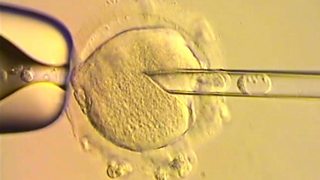
0:26Watch the moment DNA from a mum and dad is injected into the egg of another woman – the critical step in the creation of a baby made from three people
Eight babies have been born in the UK using genetic material from three people to prevent devastating and often fatal conditions, doctors say.
The method, pioneered by UK scientists, combines the egg and sperm from a mum and dad with a second egg from a donor woman.
The technique has been legal here for a decade but we now have the first proof it is leading to children born free of incurable mitochondrial disease.
These conditions are normally passed from mother to child, starving the body of energy.
This can cause severe disability and some babies die within days of being born. Couples know they are at risk if previous children, family members or the mother has been affected.
Children born through the three-person technique inherit most of their DNA, their genetic blueprint, from their parents, but also get a tiny amount, about 0.1%, from the second woman. This is a change that is passed down the generations.
None of the families who have been through the process are speaking publicly to protect their privacy, but have issued anonymous statements through the Newcastle Fertility Centre where the procedures took place.
‘Overwhelmed with gratitude’
“After years of uncertainty this treatment gave us hope – and then it gave us our baby,” said the mother of a baby girl.
“We look at them now, full of life and possibility, and we’re overwhelmed with gratitude.”
The mother of a baby boy added: “Thanks to this incredible advancement and the support we received, our little family is complete.
“The emotional burden of mitochondrial disease has been lifted, and in its place is hope, joy, and deep gratitude.”

Mitochondria are tiny structures inside nearly every one of our cells. They are the reason we breathe as they use oxygen to convert food into the form of energy our bodies use as fuel.
Defective mitochondria can leave the body with insufficient energy to keep the heart beating as well as causing brain damage, seizures, blindness, muscle weakness and organ failure.
About one in 5,000 babies are born with mitochondrial disease. The team in Newcastle anticipate there is demand for 20 to 30 babies born through the three-person method each year.
Some parents have faced the agony of having multiple children die from these diseases.
Mitochondria are passed down only from mother to child. So this pioneering fertility technique uses both parents and a woman who donates her healthy mitochondria.
The science was developed more than a decade ago at Newcastle University and the Newcastle upon Tyne Hospitals NHS Foundation Trust and a specialist service opened within the NHS in 2017.
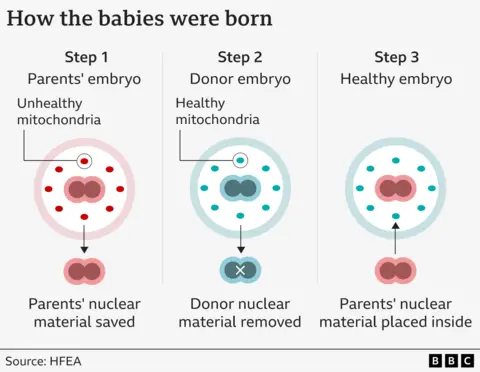
The eggs from both the mother and the donor are fertilised in the lab with the dad’s sperm.
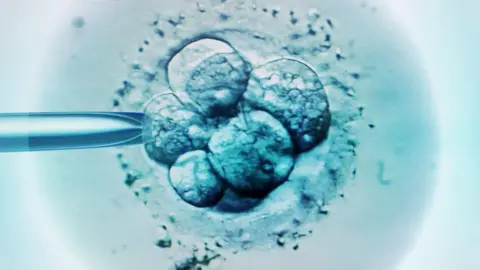
The embryos develop until the DNA from the sperm and egg form a pair of structures called the pro-nuclei. These contain the blueprints for building the human body, such as hair colour and height.
The pro-nuclei are removed from both embryos and the parents’ DNA is put inside the embryo packed with healthy mitochondria.
The resulting child is genetically related to their parents, but should be free from mitochondrial disease.
Baby born from three people’s DNA in UK first
A pair of reports, in the New England Journal of Medicine, showed 22 families have gone through the process at the Newcastle Fertility Centre.
It led to four boys and four girls, including one pair of twins, and one ongoing pregnancy.
“To see the relief and joy in the faces of the parents of these babies after such a long wait and fear of consequences, it’s brilliant to be able to see these babies alive, thriving and developing normally,” Prof Bobby McFarland, the director of the NHS Highly Specialised Service for Rare Mitochondrial Disorders told the BBC.
All of the babies were born free of mitochondrial disease and met their expected developmental milestones.
There was a case of epilepsy, which cleared up by itself and one child has an abnormal heart rhythm which is being successfully treated.
These are not thought to be connected to defective mitochondria. It is not known whether this is part of the known risks of IVF, something specific to the three-person method or something that has been detected only because the health of all babies born through this technique is monitored intensely.
Another key question hanging over the approach has been whether defective mitochondria would be transferred into the healthy embryo and what the consequences could be.
The results show that in five cases the diseased mitochondria were undetectable. In the other three, between 5% and 20% of mitochondria were defective in blood and urine samples.
This is below the 80% level thought to cause disease. It will take further work to understand why this occurred and if it can be prevented.
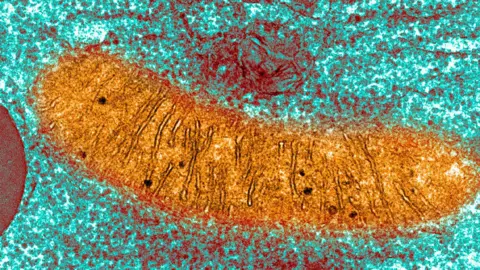
Prof Mary Herbert, from Newcastle University and Monash University, said: “The findings give grounds for optimism. However, research to better understand the limitations of mitochondrial donation technologies, will be essential to further improve treatment outcomes.”
The breakthrough gives hope to the Kitto family.
Kat’s youngest daughter Poppy, 14, has the disease. Her eldest Lily, 16, may pass it onto her children.
Poppy is in a wheelchair, is non-verbal and is fed through a tube.
“It’s impacted a huge part of her life,” says Kat, “we have a lovely time as she is, but there are the moments where you realize how devastating mitochondrial disease is”.
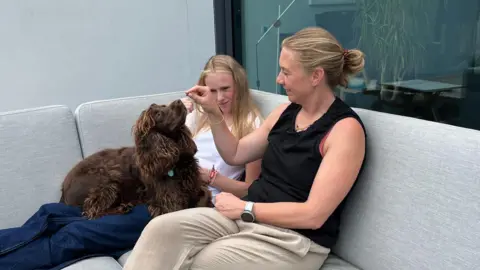
Despite decades of work there is still no cure for mitochondrial disease, but the chance to prevent it being passed on gives hope to Lily.
“It’s the future generations like myself, or my children, or my cousins, who can have that outlook of a normal life,” she says.
‘Only the UK could do this’
The UK not only developed the science of three-person babies, but it also became the first country in the world to introduce laws to allow their creation after a vote in Parliament in 2015.
There was controversy as mitochondria have DNA of their own, which controls how they function.
It means the children have inherited DNA from their parents and around 0.1% from the donor woman.
Any girls born through this technique would pass this onto their own children, so it is a permanent alteration of human genetic inheritance.
This was a step too far for some when the technology was debated, raising fears it would open the doors to genetically-modified “designer” babies.
Prof Sir Doug Turnbull, from Newcastle University, told me: “I think this is the only place in the world this could have happened, there’s been first class science to get us to where we are, there been legislation to allow it to move into clinical treatment, the NHS to help support it and now we’ve got eight children that seem to free of mitochondrial disease, what a wonderful result.”
Liz Curtis, the founder of the Lily Foundation charity said: “After years of waiting, we now know that eight babies have been born using this technique, all showing no signs of mito.
“For many affected families, it’s the first real hope of breaking the cycle of this inherited condition.”
Google AI on physical symptoms of an emerging repressed memory
Google AI Overview
Emerging repressed memories can manifest in various physical symptoms, often as a result of the body holding onto the physical sensations and responses associated with past trauma. These physical symptoms can be a way for the body to communicate emotional distress when it’s not being consciously processed.
Common physical symptoms associated with emerging repressed memories include:
- Headaches and Migraines:Repressed trauma can manifest as tension headaches or migraines, as the body holds onto stress and tension.
- Digestive Issues:Stomach problems, nausea, and other gastrointestinal issues can be linked to unresolved trauma and stress.
- Chronic Pain:Back pain, muscle aches, and other forms of chronic pain can be somatic manifestations of past trauma.
- Fatigue and Sleep Problems:Unexplained fatigue, insomnia, or nightmares can be a result of the body’s ongoing stress response to trauma.
- Muscle Tension and Pain:Chronic muscle tension, aches, and pains, especially in the neck, shoulders, and back, can be related to repressed trauma.
- Hypervigilance and Hyperarousal:A state of heightened alertness and reactivity to stimuli, as if constantly scanning for danger, can be a physical sign of unresolved trauma.
- Tremors or Shaking:Involuntary tremors or shaking can occur as the body releases stored energy associated with traumatic experiences.
- Tingling or Warmth:Sensations of tingling, warmth, or other unusual physical sensations can occur as the body processes and releases trauma.
- Heart Palpitations or Rapid Heartbeat:The physical symptoms of anxiety, such as a racing heart, can be a response to trauma.
- Shallow Breathing:Rapid and shallow breathing can be a physical manifestation of anxiety and stress related to trauma.
- Dissociation:In extreme cases, individuals may experience dissociation, which can manifest as feeling detached from their body or surroundings.
The connection between trauma and the body:
- Trauma can be stored in the body’s nervous system, causing it to remain in a state of high alert.
- This constant state of high alert can lead to physical symptoms as the body tries to protect itself from perceived threats.
- The brain’s emotional and memory centers are closely linked to physical sensations and responses.
- When a similar situation triggers the emotional and memory centers, it can also activate the body’s stress response, leading to physical symptoms.
Seeking professional help:
If you are experiencing these physical symptoms, it’s important to seek professional help from a therapist or healthcare provider. They can help you explore the root causes of your symptoms and develop coping strategies to manage them.
Featured Books from New Thinking Allowed
Klimo profiles recent channels and their sources, goes back to preliterate societies and the advent of monotheism and identifies as channels such figures as Moses, Solomon, Muhammad, Merlin, Nostradamus, Swedenborg and Edgar Cayce. He discusses the sorts of people who are channels, kinds of information channeled, sources of information channeled and varieties of channeling like clairvoyance and automatic writing.

Richly detailed with Joyce’s experiences studying shamanic healing in South East Asia and stories of the people she has assisted back to health, this book will allow readers to explore their own ability to heal at every level. They will discover current research and fascinating findings about the language of their cells and how these tiny constituents of the body communicate, connect, and touch. Alongside this biological backdrop, they’ll find fresh mind-body imagery, insights, and empowering healing techniques that will take them on a deep inner journey.
