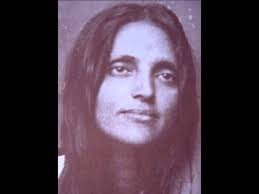
Biography: Sri Anandamayi Ma

Anandamayi Ma (April 30, 1896 – August 27, 1982) was an Indian spiritual leader.  Sivananda Saraswati of the Divine Life Society described her as “the most perfect flower the Indian soil has produced.”  —Wikipedia

Hinduism has given rise to many renowned female spiritual teachers over the millennia. Among the most famous of recent times was Sri Anandamayi Ma (1896-1982, “Blissful Mother”), a guru from Bengal who was born in a very pool orthodox brahmin family.  Often seen sitting in samadhi as a child, but nonetheless scrupulously carrying out all her domestic chores, she was married at a young age to a kind young man. Their marriage was never consummated for when he tried to approach her, he received a powerful electric shock.  When she was twenty years old, she began spontaneously adopting advanced yogic postures and reciting ancient Sanskrit texts and mantras that she had never learned from any human teacher.  She was suspected of being possessed, and exorcists were called, but they were unsuccessful in stopping her spiritual expressions; one exorcist even experienced severe pain until Ma healed him.  An inner voice told her that the power manifesting in her was “Your Shakti.  You are everything.”  Ma later explained, “I realized that the Universe was all my own manifestation.”  When she was twenty-two, she was guided to give herself mantra initiation, thus adopting the roles of both guru and disciple.  People began flocking to her for darshan, healing and spiritual counseling.  Detached from worldly concerns and thoughts, she ate very little and ultimately stopped feeding herself, so her devotes tried to hand-feed her.  Following only the inner guidance, in total disregard for cultural and religious mores–especially restrictions on women–she sometimes gave brilliant teachings in Vedanta philosophy (even though she was nearly illiterate), traveled unpredictably, attracted stray animals by her aura of love, and reportedly manifested siddhis (spiritual powers) such as appearing at several places at the same time,  changing her size, helping people at distant locations, multiplying food, and transforming people by her joyous and peaceful presence.  Ultimately millions of people became her followers, regarding her as the Goddess in human form, but she reportedly did not consider herself a guru, nor did she recognize anyone as her disciples–she saw only Herself everywhere.

–Mary Pat Fisher from Living Religions

“The Second Coming” by William Butler Yeats

Turning and turning in the widening gyre
The falcon cannot hear the falconer;
Things fall apart; the centre cannot hold;
Mere anarchy is loosed upon the world,
The blood-dimmed tide is loosed, and everywhere
The ceremony of innocence is drowned;
The best lack all conviction, while the worst
Are full of passionate intensity.
Surely some revelation is at hand;
Surely the Second Coming is at hand.
The Second Coming! Hardly are those words out
When a vast image out of Spiritus Mundi
Troubles my sight: somewhere in sands of the desert
A shape with lion body and the head of a man,
A gaze blank and pitiless as the sun,
Is moving its slow thighs, while all about it
Reel shadows of the indignant desert birds.
The darkness drops again; but now I know
That twenty centuries of stony sleep
Were vexed to nightmare by a rocking cradle,
And what rough beast, its hour come round at last,
Slouches towards Bethlehem to be born?

The Dalai Lama on meditating with a busy schedule

DalaiLamastory

Cognitive Dissonance

In the field of psychology, cognitive dissonance is the mental discomfort (psychological stress) experienced by a person who simultaneously holds two or more contradictory beliefsideas, or values. The occurrence of cognitive dissonance is a consequence of a person’s performing an action that contradicts personal beliefs, ideals, and values; and also occurs when confronted with new information that contradicts said beliefs, ideals, and values.[1][2]

In A Theory of Cognitive Dissonance (1957), Leon Festinger proposed that human beings strive for internal psychological consistency in order to mentally function in the real world. A person who experiences internal inconsistency tends to become psychologically uncomfortable and is motivated to reduce the cognitive dissonance. This is done by changing parts of the cognition to justify the stressful behavior, by adding new parts to the cognition that causes the psychological dissonance, or by actively avoiding social situations and contradictory information that are likely to increase the magnitude of the cognitive dissonance.[1]

More at:  https://en.wikipedia.org/wiki/Cognitive_dissonance

Sir Thomas Browne on the Transcendent Torture of Romantic Friendship

“United souls are not satisfied with embraces, but desire to be truly each other.”

(brainpickings.org)

Navigating the various types of platonic relationships can be challenging enough. But few things are more existentially disorienting than trying to moor oneself within a relationship that floats back and forth across the porous boundary between the platonic and the erotic — one rooted in a deep friendship but magnetized with undeniable romantic intensity, like the relationships between Johannes Brahms and Clara Schumann in the nineteenth century and Rachel Carson and Dorothy Freeman in the twentieth.

But as beautiful and vitalizing as such more-than-friendships can be, they tend to be inevitably dampened by an undercurrent of disappointment, a quiet undulating heartache that comes from the disconnect between the enormity one or both persons long for and the lesser-than reality permitted by the other person’s nature or the circumstances of one or both of their lives.

Four centuries ago, the English polymath Sir Thomas Browne (October 19, 1605–October 19, 1682) captured the divine heartbreak of romantic friendship with enduring insight in a passage from his first literary work, Religio Medici (The Religion of a Physician) (public library), penned the year of his thirtieth birthday.

Sir Thomas Browne by Jane Carlile

Browne, whose enchanting and lyrical writing inspired many of the Romantics, celebrates romantic friendship as a love that, in transcending regular friendship, approaches the divine:

I hope I do not break the fifth commandment, if I conceive I may love my friend before the nearest of my blood, even those to whom I owe the principles of life. I never yet cast a true affection on a woman; but I have loved my friend as I do virtue, my soul, my God. From hence, methinks, I do conceive how God loves man.

He then presents a taxonomy of the “three most mystical unions”:

1. two natures in one person; 2. three persons in one nature; 3. one soul in two bodies. For though indeed they be really divided, yet are they so united, as they seem but one, and make rather a duality in two distinct souls.

There are wonders in true affection; it is a body of enigmas, mysteries, and riddles, wherein two so become one, as they both become two.

But Browne’s most poignant insight deals with the paradoxical nature of such intense connections. When we seek for another to be our everything, he suggests, we doom ourselves to continual despair and disappointment, because the most anyone can ever give us is still less-than-everything, which to the heart that longs for everything — for a complete merging of natures — feels like a sorrowing incompleteness next to nothing. He writes:

I love my friend before myself, and yet methinks I do not love him enough: some few months hence my multiplied affection will make me believe I have not loved him at all. When I am [apart] from him, I am dead till I be with him; when I am with him, I am not satisfied but would still be nearer him. United souls are not satisfied with embraces, but desire to be truly each other; which being impossible, their desires are infinite, and must proceed without a possibility of satisfaction.

And yet the redemption of this perennial dissatisfaction, Browne argues, is that by so intensely throwing ourselves into a love that can never be fully requited, we master the difficult art of unselfish love — a love we can then direct at anyone, free of expectation of return, perhaps more akin to the Ancient Greek notion of agape, which inspired Dr. King’s “experiment in love.”Browne puts it simply:

He that can love his friend with this noble ardor will, in a competent degree, affect all.

Complement with Van Gogh on unrequited love as fuel for creative work and David Whyte on reclaiming heartbreak, then revisit the stunning epistolary record of Kahlil Gibran’s rich and nuanced relationship with Mary Haskell.

When You Try to Change People That’s Not Love, It’s Domination

Image by Mandel Ngan / Getty Images

PUBLIC THEOLOGY REIMAGINED

BY  (@BRODERICKGREER)COLUMNIST

Friday, October 27, 2017 (OnBeing.org)

In an interview conducted nearly thirty years ago, social visionary bell hooks had this to say about love and domination:

“I want there to be a place in the world where people can engage in one another.”

While hooks was discussing racial and gender representation in film, her statement can be broadly applied to relationships at home, in neighborhoods, in cities, and across whole societies.

To say “I want there to be a place in the world where people can engage in one another’s differences in a way that is redemptive” is to exercise one’s moral, social, and theological imagination. It is to pray and think expansively, imagining a world yet unborn into being. It is to recognize that difference need not be an occasion for brutality, but an occasion for mutual enhancement.

“I want there to be a place in the world” is the line poets, musicians, and storytellers utter before composing and what first-time parents pronounce while staring at their sleeping newborn: the desire to see one’s significant other or child or close friend given the space to flourish as themselves, not as someone else.

Qualifying “I love you” with “In order to love you, I must make you something else” is to use love as a pretext for domination, not as a springboard for generative companionship. To say, “In order to love you, I must make you something else” is to blur the good news that a loving God and community receive us as we are, not as we want to be or pretend to be. Much of Christian preaching and formation emphasizes the latter — the pretending — which feeds the pious-sounding quip:

“God loves you just the way you are, but too much to leave you that way.”

While well-meaning, that statement plays into the assumption that God will love us more as we become something or someone else.

Domination is the attempt to change others, recast them, remake them, possess them, control them. Domination is what took place in the Canadian residential schools. Masterminds of the schools thought they were being loving toward the indigenous people they enrolled, but they were actually practicing a logic of colonialist domination.

Domination is an uncreative, if convincing, imitation of love. Love says, “I receive you as you are and want to imagine a world in which you are received as you are,” exposing domination as a failure of imagination; love is imagination when it is given permission to meditate on endless possibility. Like planting a seed, watering it, and watching it become the tree you always knew it was. The seed isn’t being made into something else, but is living out its fullest potential, the way a sculptor discovers her subject in a block of stone. This is one way of seeing the life of love, or what the Rev. Marcus Halley calls “episodes of grace,” a series of moments in which we are awakened to the unique ways in which we are loved by God; not possessed, recast, or remade by God, but loved.

It is difficult for many of us to discern the difference between love and domination because so much of what we’ve been told was love throughout our lives was actually domination. This was apparent to me in a coffee shop conversation I had with a person who had recently disclosed to their closest family members that they are transgender. After two years of conversations with those family members, that person was given an ultimatum by a sibling:

“We will always love you, but either you allow us to refer to you by the pronouns and name we grew up using for you, or we will be forced to end our relationship with you.”

This friend went on to say that nothing hurt more in that conversation than their sibling’s “but.” “That single word negated every word that preceded it,” they said. The sigh of relief my friend needed to breathe would have come had they heard they are loved and received as they are, full stop. No caveats, fine print, or need to pretend that they are something that they aren’t.

When Christians celebrate and receive the presence of God in the bread and wine of Eucharist, we hear what my friend so desperately wanted to hear from their family. This doesn’t mean that my friend, or any of us, is looking to simply feel good about ourselves, but that we yearn to be fully known, seen, and loved.

Public theology is at its best when it creates the space necessary for people of various gender identities, religious affiliations and non-affiliations, ethnicities, and economic levels to be known as their full selves, not pushed into a mold not meant for them. It is being less concerned about finding surface-level common ground than about holding space for people’s unique experiences of divinity and humanity.

ASTRONOMERS HAVE DETECTED BLACK HOLE JETS THAT EMIT MORE ENERGY IN ONE SECOND THAN OUR SUN WILL PRODUCE IN ITS ENTIRE LIFETIME

Posted by Ben Gilberti on Sunday, November 5, 2017

Consciousness, spirituality, biography, sexuality, androgyny, futurism, space, the arts, science, astrology, democracy, humor, books, movies and more