“Karma means postponing energy, postponing experience, postponing life.”
“Integrated history is present. Unintegrated history is past.”
“Enlightenment is returning to the natural state.”
“When we reintegrate [RHS] our past, we are, In effect, changing not only our future, but our past as well. That’s what it means in Revelations when it says, “The dead will rise again.” That is, our dead past will come to life. –paraphrasing Thomas Hübl
“Countries (Germany, the United States, etc.) need to reintegrate our collective traumas (the Holocaust, slavery, the Native American genocide, etc.) as well as our personal traumas.” –paraphrasing Thomas Hübl
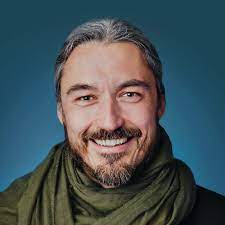
Thomas Huebl is an Austrian-born[1] contemporary spiritual teacher, author,[2] and founder of the Academy of Inner Science and a non-profit organization known as the Pocket Project.[3] Huebl completed approximately four years of medical school in his native Austria[2] before deciding to pursue a four-year independent meditation and spiritual retreat in Czechoslovakia.[1] Following his retreat, Huebl moved to Germany and was invited to teach meditation.[1] He then began working with Holocaust survivors to work through their respective experiences and historical trauma.[4] In 2008, Huebl founded the Academy of Inner Science, which studies the principles of human inner development and explores the core of humanity’s wisdom traditions.[5] In 2016, Huebl founded the Pocket Project, a non-profit organization dedicated to understanding collective and intergenerational trauma.[6] The organization brings together experts in various fields to explore healing trauma and expanding trauma research.[7] Among other initiatives, the Pocket Project offers online support group sessions for healthcare workers that have been impacted by the COVID-19 crisis.[8] Huebl is the author of The Power of We: Awakening in the Relational Field.[9] His second book, Healing Collective Trauma: A Process for Integrating Our Intergenerational and Cultural Wounds, is scheduled for publication in November of 2020.[3]
Showing the deep connection between our present ecological crisis and our lack of awareness of the sacred nature of creation, this series of essays from spiritual and environmental leaders around the world shows how humanity can transform its relationship with the Earth. Combining the thoughts and beliefs from a diverse range of essayists, this collection highlights the current ecological crisis and articulates a much-needed spiritual response to it. Perspectives from Buddhism, Sufism, Christianity, and Native American beliefs as well as physics, deep psychology, and other environmental disciplines, make this a well-rounded contribution. The complete list of contributors are Oren Lyons, Thomas Berry, Thich Nhat Hanh, Chief Tamale Bwoya, Joanna Macy, Sandra Ingerman, Richard Rohr, Wendell Berry, Mary Evelyn Tucker, Sister Miriam MacGillis, Satish Kumar, Vandana Shiva, Pir Zia Inayat-Kahn, Winona LaDuke, John Stanley, John Newall, Bill Plotkin, Geneen Marie Haugen, Jules Cashford, and Llewellyn Vaughan-Lee.
In this 40-minute talk, excerpted from one of Craig’s course modules, he explores the two life-altering realizations at the core of authentic spiritual awakening and why, once we discover these profound truths, we know without a doubt that we have come home.
“Envy those who see beauty in everything in the world,” artist Egon Schiele wrote in contemplating why visionaries tend to come from the minority. Artists are so often those whom society paints as other by some hue of identity and belonging, and yet they are also the ones who, in seeing how and what most people don’t see, teach us what it takes to be ourselves, what it feels like to be someone other than ourselves, and what it means to be a human being.
We make art with everything we are, the doom and the glory of it. We make art to know ourselves, to locate ourselves in the web of being, to make ourselves more alive. We make art that, at its best, helps other people locate themselves and live.
All artists know this and feel this, consciously or not, but few have contemplated that knowledge more deeply and articulated it more beautifully than Keith Haring (May 4, 1958–February 16, 1990), whose largehearted art has touched countless lives and helped generations of humans — this one included — live.
Haring explores this question with uncommon thoughtfulness and tenderness throughout his diary, posthumously published as Keith Haring Journals (public library) — the wondrous cathedral of creative vitality rising at the intersection of the intimate and the universal that gave us Haring’s impassioned insistence on the love of life even in the face of death.
In the early autumn of 1978, having just left Pittsburgh to begin his brave new life as an artist in New York City, the twenty-year-old Haring finds himself sitting in Washington Square Park — a microcosm of the city’s vibrant polyphony of life. He takes out his journal and begins composing a long stream-of-consciousness meditation on art and life, at the heart of which is the sentiment that would come to define his creative ethos:
No two human beings ever experience two sensations, experiences, feelings, or thoughts identically.
[…]
I am interested in making art to be experienced and explored by as many individuals as possible with as many different individual ideas about the given piece with no final meaning attached. The viewer creates the reality, the meaning, the conception of the piece. I am merely a middleman trying to bring ideas together.
Haring would devote the remainder of his short life to using art as a celebration of difference and an empathic bridge for coming as close as we can ever come to the way a consciousness other than our own is experiencing reality.
In an entry penned years later, not yet knowing his own consciousness is soon to meet its untimely end, he revisits the question of the ultimate function of art in human life — life inextricable from the larger web of life, the destructive unweaving of which had colored Haring’s childhood as the modern environmental movement was coming awake:
“Art”… is at the very basis of human existence. The need to separate ourselves and connect ourselves to our environment (world) is a primary need of all human beings.
Art becomes the way we define our existence as human beings. This has a perverse air to it, I admit. The very idea that we are so different from other beings (animals) and things (rocks, trees, air, water) is, I think, a great misconception, but if understood is not necessarily evil. We know that “humans” determine the future of this planet. We have the power to destroy and create. We, after all is said and done, are the perpetrators of the destruction of the Earth we inhabit. No matter how slowly this destruction is occurring, no matter how “natural” this de-composition is, we are the harborers of this change.
And yet even against this backdrop, Haring defies the easy defeatism of painting our species and our civilization as purely evil, of classing human nature as an antagonist of nature rather than its function and functionary, just as replete with the capacity for destruction as with the capacity for beauty — like nature itself. What dignifies us, what redeems us, what saves us from ourselves, is the animating impulse of art. He writes:
When we are young, our skills tend to improve with age and experience. But once we are well into adulthood, it may start to feel as if it’s all downhill from there. With every advancing year, we become slightly more forgetful, somewhat slower to respond, a little less energetic.
Yet there is at least one important exception: In the emotional realm, older people rule supreme.
CREDIT: JAMES PROVOST (CC BY-ND)
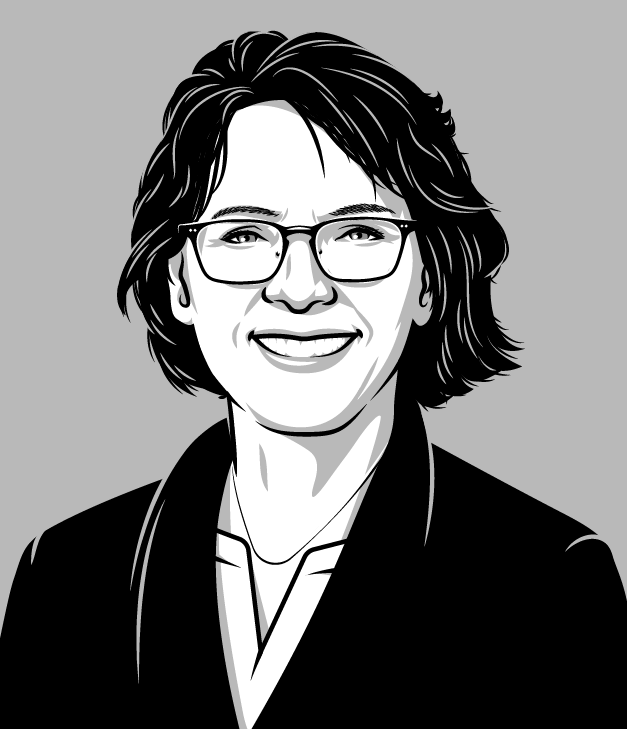
Psychologist Susan Turk Charles
University of California, Irvine
For the past 20 years, Susan Turk Charles, a psychologist at the University of California, Irvine, has been monitoring the shifting moods, the sense of satisfaction, the moments of contemplation and the occasional outbursts of anger, sadness and despair of people of all ages — with a special interest in how we handle and experience emotions as we grow older. She and her colleagues have found that, on average, older people have fewer but more satisfying social contacts and report higher emotional well-being.
What is the secret behind this grizzled levelheadedness? How can we make sure that as many people as possible can benefit from it? And what can it teach the young? In 2010, Charles and Stanford psychologist Laura Carstensen coauthored an article on social and emotional aging in the Annual Review of Psychology. We circled back to Charles to learn more about the phenomenon and how the research has unfolded. This conversation has been edited for length and clarity.
What makes a young scientist decide to specifically study the emotions of older people?
When I was an undergraduate, in the early ’90s, I was really interested in development. At that time, the scientific literature was saying that our personality and emotions were fully developed by the time we are 18. I heard this and thought, “Wow, the next 50 years, nothing gets better? This is it?” Then I took a class from Laura Carstensen at Stanford, and she was the first person to say that there was more development after age 18. She was finding that unlike physical fitness or cognition, where you may see slowing or declines, emotional regulation and experience are often as good, if not better, as we age. It was talking to her that got me excited about this field. I fell in love with the idea of studying a process related to aging that is not defined by a decline.
Watch “Keys to successful aging,” an online event held on May 6, 2021. Susan Turk Charles is one of the speakers. Additional resources available here.
What might explain why aging brains get better at managing emotions?
Some neuroscientists believe that because we’re processing information a little slower with age, that makes us think before we act, instead of reacting quickly. We do see a decline with age in overall mass of the brain’s frontal lobe, the part that is responsible for emotion regulation, complex reasoning and speed of processing. But researchers such as Mara Mather at the University of Southern California find that older adults often exhibit greater prefrontal cortex activity than younger adults when processing emotions.
A lot of work has found that older people have a positive bias, even without realizing they’re actually doing this. Their default mode is, as we say, “Don’t sweat the small stuff.” We find that older people more often let go of a situation they experience as negative, especially with friends and family. So it is really picking their battles that we think older adults are better at. If you look at older adults who have cognitive decline, they are not defaulting to the positive.
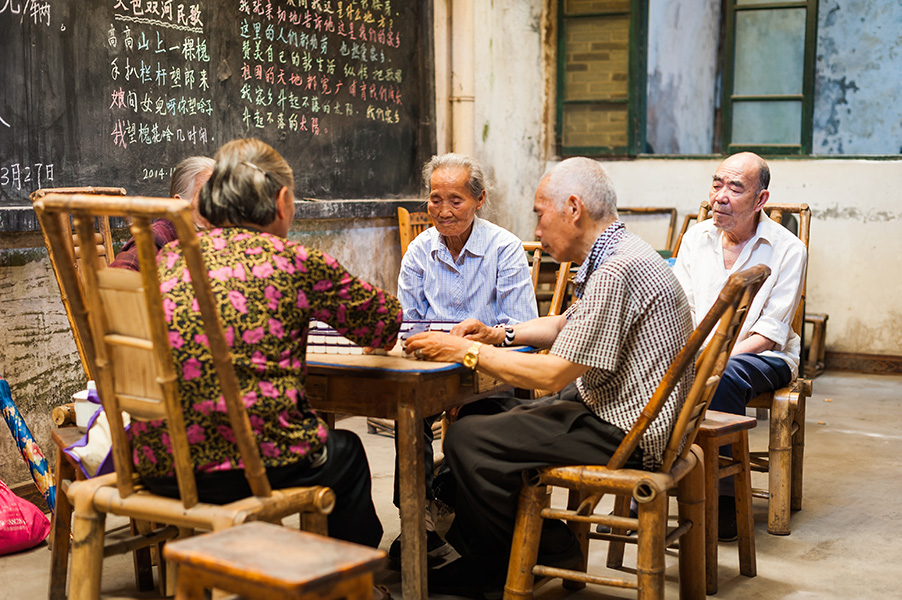
A group of elderly people enjoy a game of mahjong in Chongzhou, China. Mental challenges and social interactions help to keep the mind sharp and emotional well-being strong. In contrast, although someone may also be perfectly happy spending all their waking hours alone and passively watching TV, they risk losing their cognitive edge if they do so. In striving to age well, people should look for balance, Charles says.CREDIT: LP2 STUDIO / SHUTTERSTOCK.COM
Is there a certain age at which we reach a peak in emotional satisfaction?
It depends on what aspects you’re looking at, but the peak we see in terms of the highest positive and lowest negative emotions is between 55 and 70. Then there’s the measure of “life satisfaction,” which includes both happiness and sadness, as well as a cognitive evaluation of how your life is going. For that, we often see a little lower ratings in midlife, lowest among people who are in their early 50s, and then it goes up. So again, it’s higher with older age. Only after 75 do negative emotions start increasing again.
Yet even centenarians, you write in your review, report overall high levels of emotional well-being. I imagine that by this point, some people may start wondering whether it might just be that people who have more positive attitudes, or encounter less adversity, live longer.
It is true that people with satisfying relationships and positive emotions live longer. Researchers have looked at what could explain this, and they find that psychological well-being is consistently related to lower levels of the stress hormone cortisol and better cardiovascular health. Other researchers have modeled that, and they still see an age-related advantage.
So emotion regulation improves with age; we see this again and again. These are small effects, but they are consistent. We see improvement for the majority of people, but not for everyone. I don’t know the percentages, but let’s say you have 40 percent remaining stable, 40 percent going up and 20 percent going down, you’ll see people still going up on average.
What might explain why some people do not experience these improvements?
Most of the people who have been included in these studies are what researchers define as WEIRD — people from Western, educated, industrialized, rich and democratic societies. We also know that not only are they from WEIRD societies, they often represent people from the dominant, white culture. This demographic profile means that a lot of people had financial security, they had pensions, there were social systems in place, and often the people we would interview were middle-class white people who were employed, who had a higher level of education. Compared to younger people of comparable socioeconomic status, the older people looked a lot better. But if older people are in very vulnerable situations, without stable housing, faced with constant stressors, or if they are living in pain, you may not see these benefits.
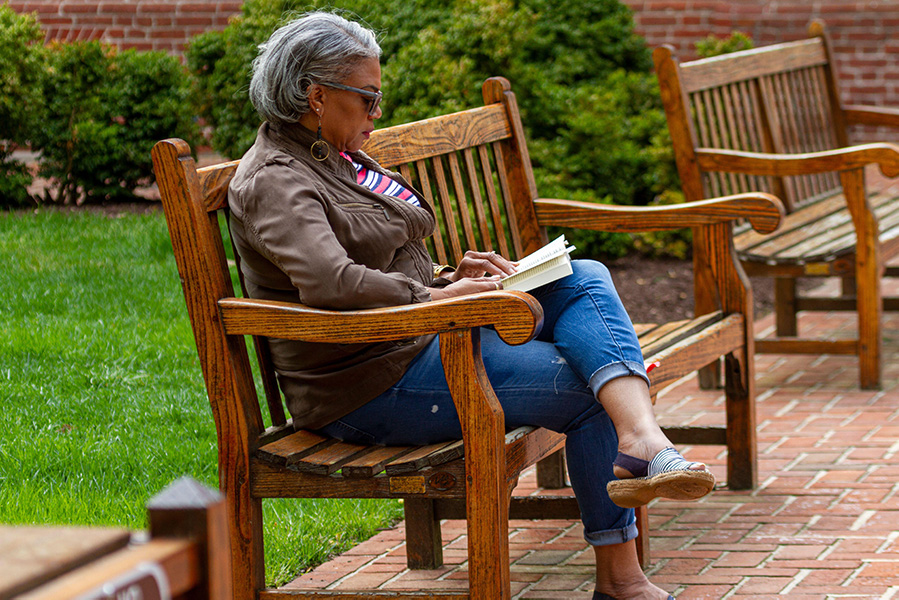
Fostering healthy aging means looking after body and mind, in ways that will differ from one individual to the next. People, Charles says, “need to think about their daily lives and how to live so that they engage in behaviors that optimize their physical health, cognitive functioning and emotional well-being.”CREDIT: GRANDBROTHERS / ALAMY STOCK PHOTO
Stable housing is a common concern for young people too. Are these the kinds of things that weigh on their minds?
I think what’s really important for emotional well-being is to know that your future is secure, to achieve the luxury of not worrying about your future. When you’re younger, there’s a lot to worry about. I sometimes tell my undergrads: When older people say, “This is the best time of your life, enjoy it while you can,” that’s a form of abuse. A lot of younger people have high rates of distress.
My former mentor Laura Carstensen’s “socioemotional selectivity theory” talks about how everyone has a sense of how much time we have left in our lives. Younger people who are healthy and expect to have a long life ahead of them put in the hard work, and they value gathering information and planning for the future. As you get older, you see that there is less and less time left, and people start valuing emotional goals more. Older people will also rather spend time with family and friends than meet brand new people who might be interesting.
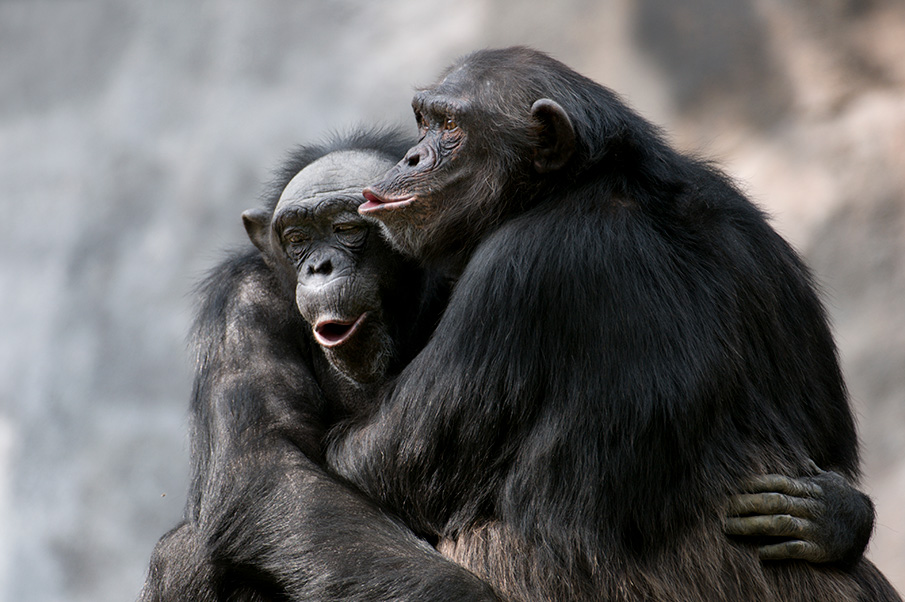
A recent study in Science found that like humans, older chimpanzees tend to have fewer but more positive social interactions, and so the researchers conclude that this development does not necessarily depend on the realization that time is running out. Do you agree that the mechanism behind these changes may be more basic than we thought?
I do think that chimpanzees who have survived into old age have adopted healthy habits that promote survival. I don’t think chimpanzees realize life is getting shorter. My speculation is that a couple of things may be happening. Human adolescents are really stimulated by novelty. They like surging emotions, and they like to take risks. This may be true with chimpanzees as well, and it might help them experience new things, reproduce and achieve dominance and status. But it is tiring, so when you have an older body, it might be nice to stay with what is familiar and comfortable. Decreasing energy levels might equally play a role in humans. In addition, [Stanford researcher] Robert Sapolsky found that grooming behavior among older male wild baboons is related to less stress. Perhaps the chimpanzees who were more prosocial and focused on companions that engaged in grooming behavior reaped the benefit of this social support.
But of course, we also have these incredible brains that allow us to put things in perspective.
Like people, older chimps also have more positive social interactions than younger ones do, a 2020 study reported.CREDIT: ISTOCK.COM / WINDZEPHER
Your findings might certainly inspire people to pursue a more positive attitude. At the same time, if you’re someone who is getting older and is unhappy, it might not make you feel better to read this.
For people who are unhappy, it’s really important to look at how to structure your days to feel more fulfilled. I guess for everyone I would say: When you’re making a list of health behaviors, getting enough sleep and exercise and eating right are important factors that most people agree should be included, but social relationships is something that is as important as your cholesterol level, yet is often forgotten. Make sure that you spend time cultivating your social ties, treasuring and prioritizing your close friends and family members, at whatever age you are. Finding purpose and meaning in life is also vitally important. What that is can be different for different people, but finding an important purpose and following that can be very emotionally gratifying.
Does that imply there might also be a risk of becoming too emotionally comfortable?
Yes. You can be so comfortable that you no longer encounter any challenges, and you really need to stay engaged in cognitive challenges. In a recently published study, we followed people over eight days. Every night, they were interviewed, and we’d ask about stressors. Did they get into an argument? Was there a situation where they could have argued, but decided not to? Are there any problems at home or at work?
We asked over 2,500 people about the relatively minor stressors they had experienced, such as a problem at work or an argument, every night over eight days. About 10 percent of the people reported never having experienced even one stressor. They also reported being happier than those who reported at least one stressor. But what we also found was that they performed worse on cognitive tests compared to people who reported at least one stressor. They also reported having received or given less help to others, and that they had spent more time watching TV.
Twenty years ago, we thought that if you have positive relationships and a certain lifestyle, you can have the highest emotional functioning, the highest cognitive functioning, the best physical health, the perfect life for you. Now it turns out to be a little more complicated. People who are reporting being happiest are also not as high in cognitive functioning.YOU MAY ALSO LIKEHEALTH & DISEASE
This may be because people who have no stressors are spending less time with other people. The people you know and love are also sometimes the source of your stress. But they also challenge you and engage you in problem-solving activities. So it’s not that you can find optimal well-being in all areas; there might be a tradeoff. It’s like: “I want to be a volunteer, it gives me emotional meaning, I have a lot of purpose in life, but I’m also going to run into some people that may bother me.”
So people should strive for some kind of balance? How would you suggest they achieve it?
People definitely should strive for balance, but no one size will fit all. For example, we know that people benefit from having strong social ties, but people vary in the number of close friends and time they spend with others. We know that people need to stay physically active, yet some people prefer swimming and others jogging. We know that activities that are challenging for some people are boring for others.
To achieve balance, people need to know themselves, and make decisions that create dynamic lives where they are socially active and engaged in a way that makes them feel a sense of belonging and makes them feel needed. They need activities that are challenging for them, where they learn new information and have to remember this information — but this could be learning a new musical instrument or learning the layout of a new park or even an alternative world in a video game. They need to engage in physical activity that maintains or even enhances their physical health and functioning.
They need to think about their daily lives and how to live so that they engage in behaviors that optimize their physical health, cognitive functioning and emotional well-being.
Stay in the Know Sign up for the Knowable newsletter today
Might there be a way for young people to press the fast-forward button to achieve some of the same emotional benefits older people acquire with age, or should they just be patient?
In the past 10 years, people have been talking more about mindfulness as an emotional regulation strategy. That is interesting, because it takes you away from focusing on the future and reminds you that the present moment is the most important. I think those are things that older people often do, but younger people may need to be reminded of. It can really help to have a moment at the end of the week to say, “Right now, things are going well — let’s just enjoy that for today.” It would be wonderful if that was something the youth could learn from older people.
I think as I grow older, I really understand it more profoundly. I always get a kick out of experiencing what the research shows.
Tim Vernimmen is a freelance science journalist based near Antwerp, Belgium. He will theoretically be turning 36 this year, though he is not sure whether Covid years should count.
Some facets of the 1918 influenza pandemic echo today’s crisis: mask mandates, campaigns against spitting and pleas for people to cover their mouths, and more than half a million Americans died. The decade that followed the pandemic, however, was marked by social change and economic prosperity—for some. (Illustration by Meilan Solly / Photos via Wikimedia Commons and Library of Congress under public domain)
As the U.S. anticipates a vaccinated summer, historians say measuring the impact of the 1918 influenza on the uproarious decade that followed is tricky
BY LILA THULINSMITHSONIANMAG.COM | May 3, 2021, 12:20 p.m.
On the afternoon of November 8, 1918, a celebratory conga line wound through a three-mile-long throng on Manhattan’s Fifth Avenue. From high-rise windows, office workers flung makeshift confetti, first ticker tape and then, when they ran out, torn-up paper. They weren’t rejoicing over the close of the influenza pandemic, although the city’s death rate had begun to fall. That afternoon, New Yorkers let loose for another reason: the end of the Great War.
The jubilance proved short-lived. A report from the United Press had prematurely declared an armistice in Europe; in reality, it would be a few days more before the war officially ended. “For the moment,” reported the New York Times, “the whole population of New York was absolutely unrestrained, giving way to its emotions without any consideration of anything but the desire to express what it felt.”
Due to a false press report, New Yorkers gathered in Times Square to celebrate the end of World War I—several days too early. (National Archives)
In that same edition of the Times that detailed the celebration and described fake caskets for Kaiser Wilhelm being hoisted through the streets, a smaller headline documented 1061 new cases and 189 deaths from the influenza epidemic, still afflicting Americans coast to coast. “About twenty persons applied to the Health Department yesterday personally or by letter to adopt children whose parents have died during the epidemic,” the paper read.
Just a week earlier, over the East River in Queens, purpled bodies had piled up in the overflow shed of Cavalry Cemetery, enough that the mayor brought in 75 men to bury the accumulated corpses.
Together, the end of the war and the influenza pandemic closed out a tumultuous decade and introduced a new era with an indelible reputation: the Roaring Twenties.
* * *
On social media and in conversations from behind the shelter of masks, many Americans bat around the idea that the nation is poised for a post-Covid-19 summer of sin, spending and socializing, our own “Roaring 2020s.” On the surface, the similarities abound: A society emerges from a catastrophic pandemic in a time of extreme social inequality and nativism, and revelry ensues. But, historians say, the reality of the 1920s defies easy categorization. “The experiences of the 1920s are uneven,” says Peter Liebhold, curator emeritus at the Smithsonian’s National Museum of American History. “If you make gross characterizations, you’re dead wrong.”
If the influenza pandemic shaped that uproarious decade, its impact cannot be neatly measured. The misnamed “Spanish flu” left some 675,000 Americans dead. The sickness particularly afflicted young people the average age of victims was 28. That death toll dwarfs the number of U.S. combat deaths (53,402, with some 45,000 additional soldiers dying of influenza or pneumonia) during World War I. Despite that disparity, authoritative histories of the era relegated the influenza pandemic on the fringes in favor of a narrative dominated by the war.
F. Scott Fitzgerald once described the 1920s as “the most expensive orgy in history.” Between quotes like that and canonical works like The Great Gatsby, the author has an outsized role in how the Roaring Twenties are viewed today. “I blame Fitzgerald for a lot of [misconceptions]” about the decade, says Lynn Dumenil, a historian who revisited the decade in her book The Modern Temper: American Culture and Society in the 1920s. In her class at University of California, Irvine, Dumenil would show the feverish, champagne-fueled party scene in Baz Luhrman’s movie adaptation of Gatsby, as good an example as any of the “unnuanced” pop-culture vision of the decade as a flapper bacchanal. “There’s this notion of the ’20s as a wild period where everyone is just grabbing everything they can get,” adds Nancy Bristow, history chair at the University of Puget Sound. This idea is broad-brush hyperbole of a reality that held true for only a certain class of Americans—not everyone.
“The 1920s were really a time of social ferment,” says Ranjit Dighe, an economic historian at the State University of New York, Oswego. Shifts in women’s roles, leisure time, spending and popular entertainment did characterize the ’20s, so those exaggerated aspects of the decade, while focused on a primarily white and upper/middle-class experience, do have a firm basis in reality. “Only [in the 1920s] did the Protestant work ethic and the old values of self-denial and frugality begin to give way to the fascination with consumption, leisure and self-realization that is the essence of modern American culture,” Dumenil, David Brody and James Henretta write in a book chapter on the era.
Notably, these changes had been brewing for years, leaving historians with no obvious link between the Roaring Twenties’ reputation and the pandemic.
The makeup and short hemlines of the “New Woman,” as over-exaggerated by this performer’s wardrobe, would have scandalized the Victorians. (Library of Congress / Getty Images)A dress worn by First Lady Grace Coolidge in the collections of the National Museum of American History. Her husband summed up the pro-business enthusiasm of the decade when he said, “The man who builds a factory builds a temple. The man who works there worships there.” (NMAH, gift of Lillian Rogers Parks)
The “New Woman” of the 1920s, typically white and middle- or upper-class, with bobbed hair and newfound social freedom, departed drastically from Victorian norms. With the ratification of the 19th Amendment in 1920, (white) women had won the right to vote, and divorce rates reached one-in-seven by the mid-decade. “Respectable” women now wore makeup, and flappers clad in shockingly short skirts wore sheer pantyhose and smoked. More traditional or religious Americans lamented the prevalence of “petting parties.” But, as Dumenil writes in The Modern Temper, the idea of the “New Woman” took root before the 1920s. As early as 1913, commentators noted that the nation had struck “sex o’clock”; in the next three years, Margaret Sanger opened one of the country’s first birth control clinics and went to jail days later. These social changes applied mostly to more well-off white women, since other groups of women had been working and having premarital sex well before the ’20s.
Prohibition is the backbone of 1920s mythology, which paints drinking as a glamorous indiscretion. Organizations like the Women’s Christian Temperance Union and the Anti-Saloon League had long agitated to dry up the nation’s heavy boozing. Such groups argued that an alcohol ban would reduce societal ills like domestic violence. They also capitalized on xenophobia, since saloons were political hubs for working-class people and immigrants. National success came in 1920, when a ban on selling alcohol went into effect.
The decade’s raucous reputation gets some things right: Prohibition did transform Americans’ relationship with alcohol, turning drinking into a coed, social activity that moved out of disreputable saloons into homes, Dighe says. New York alone housed more than 30,000 speakeasies, many run by gangsters.
But that’s not the whole picture. Alcohol consumption itself decreased in the ’20s. In rural areas, the reinvigorated Ku Klux Klan took it upon itself to enforce the Volstead Act and act upon anti-immigrant hostilities. (Historian Lisa McGirr has argued that Prohibition helped kickstart the penal state and the disproportionate imprisonment of people of color and immigrants.) This dark side of Prohibition highlights an undercurrent of nativism and racism throughout the ’20s: White Oklahomans murdered several hundred Black neighbors in the 1921 Tulsa Race Massacre, and national quotas enacted in 1924 slammed the door closed on immigration. And those speakeasies in Harlem, with their chorus girl extravaganzas, bathtub gin, and Madden’s No. 1 beer? White patrons came there to go “slumming.”
The famed Cotton Club got its start as the Club Deluxe, owned by African American boxer Jack Johnson, but later became a segregated establishment operated by gangster Owney Madden. (Bettman via Getty Images)
The ’20s were “a prosperity decade, no question about that,” says Dighe. Gross national product ballooned by 40 percent between 1922 and 1929. The Second Industrial Revolution—most notably electricity and the advent of the assembly line—led to a manufacturing boom. Cars could be put together in 93 minutes instead of half a day, and by the close of the decade, one-fifth of Americans owned an automobile, which they could use for leisure activities like traveling. The popularization of personal credit also enabled middle-class Americans to buy consumer goods in droves. The government, too, under the Republican administrations of Presidents Harding, Coolidge and Hoover, shared this spirit of wholehearted materialism, boosting corporations and otherwise taking a light touch to policy that corresponded with the prevailing anti-government sentiment of the time.
Examine this upbeat picture of consumerism more closely, though, and you’ll realize the economic boost of the ’20s was checkered. A sharp recession kicked off the decade, caused partially by the declining demand for American agricultural products after the war’s end brought European farming back into commission. (The limited data on the 1918 influenza’s impact indicates that for the most part, it caused short-term, not prolonged, business losses; scholars haven’t linked it to the prosperity of the following decade.) Then, as now, income inequality reached staggering rates. By the end of the ’20s, despite per capita income nearly doubling, the top 1 percent of U.S. families reaped more than 22 percent of the nation’s income.
The wealthy and middle class profited. African Americans, many of whom had moved to Northern cities for work as part of the Great Migration, newcomers to the country, and farmers did not share in that prosperity. The 1920 census marked the first time more than half the country’s population lived in urban areas. For rural Americans, particularly farmers, the ’20s “were roaring as in a roaring fire that was burning people out,” says curator Liebhold.
* * *
The influenza pandemic’s origins remain contested, but the disease spread quickly through the world beginning in the spring of 1918, striking crowded military camps and then American cities and towns in three to four waves. The “purple death” got its name from the colors victims’ oxygen-starved bodies turned as their lungs drowned in their own fluid, and it killed quick, sometimes within hours of the first symptoms. Americans donned masks, schools and public gathering places temporarily shut down, and one-third of the globe fell ill. Doctors, with a flawed understanding of the virus’ cause, had few treatments to offer. Life insurance claims rose sevenfold, and American life expectancy decreased by 12 years.
A typist wears a mask to work during the influenza pandemic. (National Archives)
Yale sociologist and physician Nicholas Christakis hypothesizes that the 1918 pandemic falls into an ages-old pandemic pattern, one that our Covid-19 present may mimic, too. In his 2020 book,Apollo’s Arrow: The Profound and Enduring Impact of Coronavirus on the Way We Live, he argues that increasingreligiosity, risk aversion and financial saving characterize times of widespread illness. Christakis expects the Covid-19 crisis to have a long tail, in terms of case numbers and social and economic impacts. But once the brunt of the disease abates in the U.S., which he forecasts for 2024, “all of those trends will reverse,” Christakis says. “Religiosity will decline… People will relentlessly seek out social interactions in nightclubs, in restaurants, in bars, in sporting events and musical concerts and political rallies. We might see some sexual licentiousness.”
Like the 1920s, Christakis also predicts lasting social and technological innovations will characterize this decade—think of how remote work and mRNA vaccines might shift status quos permanently. “People are going to want to make sense of what happened,” he says, positing that “we’ll likely see an efflorescence of the arts” post-pandemic. That’s not to say our A.C. (After Covid-19) reality will be all rosy. “We’ll be living in a changed world,” Christakis says, and that includes the lives lost (about 1 in 600 in the U.S.), the economic havoc wreaked, shortfalls in education, and the number of people left disabled due to Covid-19.
In Apollo’s Arrow, Christakis points to an Italian tax collector and shoemaker’s remembrance of the period that followed the Black Death in 1348 as an example of the collective relief we might experience at the pandemic’s end. Agnolo di Tura wrote:
And then, when the pestilence abated, all who survived gave themselves over to pleasures: monks, priests, nuns, and lay men and women all enjoyed themselves, and none worries about spending and gambling. And everyone thought himself rich because he had escaped and regained the world, and no one knew how to allow himself to do nothing.
* * *
Mapping the post-pandemic events of the 1920s onto the nation’s post-Covid-19 future resembles trying to trace the path of a nearly invisible thread in an elaborate tapestry. At its height, the influenza pandemic routinely made front-page headlines nationwide, says J. Alexander Navarro, a historian who co-edited the University of Michigan’s digitalInfluenza Encyclopedia, but by the beginning of 1919, before the pandemic had run its course, those articles grew shorter and less prominent.
“When we look around, unlike the Great War, there are no monuments to the flu; there are no museums to the flu; there are no heritage sites to the flu; there’s not a stamp for the flu, all the signs we associate with commemoration,” Guy Beiner, a memory studies scholar, said during a presentation hosted by the Institute of Holocaust, Genocide, and Memory Studies at the University of Massachusetts, Amherst. He describes the pandemic as an instance of “social forgetting,” an event not wiped from memory but simply left unspoken.
Even historians largely neglected the 1918 pandemic, until Alfred Crosby reignited the field in a 1976 book, where he captured these contradictions:
Americans barely noticed and didn’t recall…but if one turns to intimate accounts, to autobiographies of those who were not in positions of authority, to collections of letters written by friend to friend…if one asks those who lived through the pandemic for their reminiscences, then it becomes apparent that Americans did notice, Americans were frightened, the courses of their lives were deflected into new channels, and that they remember the pandemic quite clearly and often acknowledge it as one of the most influential experiences of their lives.
One of the many theories about why 1918 influenza faded from historical memory holds that the trauma of World War I subsumed it. “I don’t think you can divorce the experience of the 1918 pandemic with that of the war,” says Navarro, noting that in places like Denver, Armistice Day coincided with the day social distancing restrictions eased. Public health messaging intertwined the two crises, calling mask-wearing “patriotic” and promoting slogans like “Help Fight the Grippe: Kaiser Wilhelm’s Ally.” In Harper’s editor Frederick Lewis Allen’s 1931 account of the previous decade, Only Yesterday, he labels the Twenties as the “post-war decade” and mentions the pandemic a grand total of once.
“My guess is it did not sit with the story that Americans tell about themselves in public. It’s not the story that they want to put in fifth-grade U.S. history textbooks, which is about us being born perfect and always getting better,” says Bristow, who wroteAmerican Pandemic: The Lost Worlds of the 1918 Influenza Epidemic. Americans believed themselves “on the verge of putting infections disease to rest forever,” she explains, and instead, “We couldn’t do anything more about it than anybody else.” Indeed, President Woodrow Wilson, who held the office throughout the multi-year pandemic, never once mentioned it in his public comments.
An emergency hospital in Brookline, Massachusetts, during the 1918 influenza pandemic. (National Archives)
Navarro floats another theory: Deaths from infectious disease epidemics happened more routinely then, so the pandemic may not have been as shocking. (According to data compiled by the New York Times, despite the much higher proportion of deaths from the 1918 influenza, the Covid-19 pandemic has a larger gap between actual and expected deaths.) Without a solid scientific understanding of the flu’s cause—evangelical preacher Billy Sunday told congregants it was a punishment for sinning—people struggled to make sense of it.
Multiple historians pinpointed another significant discrepancy between the scarring impact of the Covid-19 pandemic and that of the 1918 influenza: Whereas many Americans today have remained masked and distanced for over a year, the 1918 influenza raged through communities quickly. Restrictions were lifted after two to six weeks, Navarro says, and most people still went in to work.
John Singer Sargent’s Interior of a Hospital Tent is one of the few, peripheral works of visual art that remember the devastating 1918 pandemic. (CDC Museum Digital Exhibits / Imperial War Museum, London)
“Talking about [influenza] being forgotten is different from whether it had an impact,” Bristow says. But she hasn’t found much evidence that concretely ties the under-discussed pandemic to the societal upheaval of the ’20s. “One of the places you could find it would be in the writing, and we don’t see it there,” she says. Hemingway briefly remembers “the only natural death I have ever seen” from the flu, but in a minor work. In Pale Horse, Pale Rider, Pulitzer Prize-winner Katherine Anne Porter draws on her bout of near-fatal flu, writing “All the theatres and nearly all the shops and restaurants are closed, and the streets have been full of funerals all day and ambulances all night.” But that novella wasn’t published until 1939.
“When you look at the canon, of cultural literature, of cultural memory,” Beiner points out, “none of these works appear in it.”
Arts and culture undoubtedly flourished in the ’20s as a shared American pop culture emerged thanks to the advent of radio broadcasting, widely circulated magazines and movies. The first “talkie” debuted in 1927 and joined paid vacations and sports games in an explosion of for-fun entertainment options. The Harlem Renaissance gave the nation artists like Duke Ellington and Lena Horne, who performed at the glitzy speakeasy The Cotton Club. While a Clara Bow movie about WWI, Wings, won Best Picture at the first-ever Academy Awards, Bristow says the pandemic didn’t appear much in cinemas, and musical references are also few and far between. (Essie Jenkins’ “The 1919 Influenza Blues” presents a rare exception to this rule: “People was dying everywhere, death was creeping through the air,” she sings.)
Young people, who’d watched peers die from influenza, spearheaded these cultural shifts. “After the Great War cost millions of lives, and the great influenza killed some 50 million [worldwide], many—particularly young people—were eager to throw off the shackles of the old and bring in the new,” says John Hasse, curator emeritus at the National Museum of American History. But keep in mind, Hasse explains, that the jazz music and dancing that characterized the performing arts of the decade had roots that preceded the pandemic, like the Great Migration, jazz recording technology, and evolving attitudes about dancing in public.
People listen to the radio and dance to jazz music on Staten Island—all cultural touchstones of the 1920s. (Bettman via Getty Images)
Just because the memory of the flu wasn’t typeset, filmed or laid on a record doesn’t mean it didn’t bruise the American psyche. About, all 1 in 150 Americans died in the pandemic; one New Yorker recalled neighbors “dying like leaves off trees.”
Pandemics don’t come with a consistent pattern of mental health side effects because humans have responded with different public health measures as our understanding of infectious diseases has evolved, says Steven Taylor, a University of British Columbia, Vancouver professor and the author of 2019’s The Psychology of Pandemics. But he expects the Covid-19 pandemic to psychologically impact between 10 and 20 percent of North Americans (a number sourced from ongoing surveys and past research on natural disasters). Typically, one in ten bereaved people go through “prolonged grief disorder,” Taylor notes, and for every pandemic death, more family members are left mourning. Studies show that one-third of intensive care Covid-19 survivors exhibit PTSD symptoms, and first responders already report deteriorating mental health. Even people with a degree of insulation from this firsthand suffering might still experience what Taylor calls “Covid stress syndrome,” an adjustment disorder marked by extreme anxiety about contacting Covid-19, xenophobia and wariness of strangers, traumatic stress symptoms like coronavirus nightmares, concern about financial security, and repeated information or reassurance seeking (from the news or from friends).
A pandemic slowed to a simmer will, of course, mitigate some stressors. Like Christakis, Taylor says he anticipates an increase in sociability as people try to claw back the “positive reinforcers” they’ve been deprived of in the past year. (Others, like people experiencing Covid stress syndrome, might struggle to recalibrate to yet another “new normal.”) His surveys of North American adults have also indicated a silver lining known as “post-traumatic growth,” with people reporting feeling more appreciative, spiritual and resilient, although it’s unknown whether this change will become permanent.
“Most pandemics are messy and vague when they come to an end,” says Taylor. “It won’t be waking up one morning and the sun is shining and there’s no more coronavirus.” We’ll doff our masks and let down our guards piecemeal. Overlay Covid-19 and the 2020s with the influenza pandemic and the 1920s and you’ll see unmistakable parallels, but looking closely, the comparison warps. If there were a causal link between the influenza pandemic and the Roaring Twenties, clear evidence of a collective exhalation of relief hasn’t shown up under historical x-rays.
The historical record tells us this: Some 675,000 people in the U.S. died of influenza then, and “in terms of a mass public mourning, people just went on with their lives” Navarro says. An estimated 590,000 Americans will have died of Covid-19 by the third week of May. How Americans will remember—or choose to forget—this pandemic remains an open question.About the Author: Lila Thulin is the digital editorial assistant for Smithsonian magazine and covers a range of subjects from women’s history to medicine. She holds a degree in Human Biology from Stanford University and wrote for Slate, Washingtonian, Nautilus and the Denver Westword before joining Smithsonian.
A Comprehensive Guide to Understanding and Healing Shared Trauma
What can you do when you carry scars not on your body, but within your soul? And what happens when those spiritual wounds exist not just in you, but in everyone in your family, community, and even beyond?
Spiritual teacher Thomas Hübl has spent years investigating why it is that old and seemingly disconnected traumas can seed their way through communities and across generations. His work culminates in Healing Collective Trauma, a new perspective on trauma that addresses both its visible effects and its most hidden roots. Thomas combines deep knowledge of mystical traditions with the latest scientific research. “In this way,” writes Thomas, “we are weaving a double helix between ancient wisdom and contemporary understanding.”
Thomas details the Collective Trauma Integration Process, a group-based modality for evoking and eventually dissolving stuck traumatic energies. Providing structured practices for both students and group facilitators, Healing Collective Trauma is intended to build a practical tool kit for integration.
Here, you will learn:
– The innumerable ways trauma shapes our world—from identity and health to economy, geopolitics, and the state of the environment – The concept of “trauma loyalty”—unconscious group bonds based in a pain narrative – How the climate crisis is both a manifestation of humanity’s collective trauma and an opportunity to heal – “Retrocausality”—how the power of presence can reshape the past and make new futures possible
Including essays contributed by experts such as Dr. Gabor Maté, Dr. Otto Scharmer, Dr. Christina Bethell, and Ken Wilber, Healing Collective Trauma offers not just an advanced look at community trauma but also a hopeful glimpse of the future. As Thomas declares, “Together, I believe we can and must heal the ‘soul wound’ that marks us all. In so doing, we will awaken to the luminous possibility and profound potential of our true, mutual nature as humankind.”
BuddhaAtTheGasPump Discussion of this interview in the BatGap Community Facebook Group: https://www.facebook.com/groups/Batga… Also see https://batgap.com/thomas-hubl-2/ Thomas Hübl is a modern mystic, spiritual teacher, author, and systems-thinker. His work integrates the essence of the great wisdom traditions, scientific knowledge, and his own personal experience. Thomas offers a unique approach to life as a ‘mystic in the marketplace’ and helps people to attain a deeper level of self-awareness and personal relationship and to transcend a ‘culture of the personal’ and a self-centered worldview. Through his work, people from all walks of life learn how to become a living expression of spirit and how to participate in ‘we cultures’ through an embodied inner and outer connection. His teachings combine transformation through the integration of trauma, somatic sensitization, advanced meditative practice, and a deepening understanding of cultural processes. Since 2004, Thomas’ leading-edge work has spread worldwide through workshops, multi-year training programs, and online courses. The non-profit ‘Celebrate Life Festival‘ brings together more than 1,200 people every year and has showcased a wide network of experts in various disciplines, through dialogue and exchange. In 2008 Thomas founded the ‘Academy of Inner Science’. This provided a framework for dialogue between the inner science of consciousness and the external scientific-academic exploration of life. Over the years Thomas has also organized several major healing events, aimed at healing the Holocaust’s cultural shadows. Thousands of Germans and Israelis have been brought together through these processes. In 2016 Thomas and his wife Yehudit founded the non-profit ‘Pocket Project‘, with the aim of exploring collective trauma and shadow work and integrating this through large-scale group processes. A global organization has been launched, intended to research and explore specific aspects of local traumatization. This applies both to past traumas and also to current conflict zones. Thomas was born in Austria in 1971 and now lives in Tel Aviv, Israel, with his wife, the Israeli artist Yehudit Sasportas and their daughter Eliya.
BuddhaAtTheGasPump (1st interview of two) Discussion of this interview in the BatGap Community Facebook Group: https://www.facebook.com/groups/Batga… Also see http://batgap.com/thomas-hubl/ Thomas Hübl was born in Vienna in 1971. As a 26-year-old medical student who was also very interested in bodywork and related therapies, he felt a strong inner calling. He took the radical step of following this inner wish, abandoning his studies and spending the next four years in retreat in the Czech Republic. During this time he did almost nothing except meditate and explore the spaces of inner consciousness. Looking back on this time, Thomas speaks of a fundamental opening that took place. After returning to Vienna, he started offering one-to-one sessions. His ability to touch people very deeply and encourage them to take a look beyond what they usually see soon led to invitations to lead larger workshops. His popularity then grew further and he became known internationally. Since 2004 Thomas has been active worldwide, organising talks, workshops, trainings, tonings and larger events such as the popular Celebrate Life Festival or his Healing Events which have brought together thousands of Germans with many Israelis to acknowledge, face, and heal the cultural shadow left by the Holocaust. When he is not travelling, he lives in Berlin and Tel Aviv together with his partner, the Israeli artist Yehudit Sasportas. www.thomashuebl.com www.innerscience.info www.celebrate-life.info
Consciousness, spirituality, biography, sexuality, androgyny, futurism, space, the arts, science, astrology, democracy, humor, books, movies and more



 No two human beings ever experience two sensations, experiences, feelings, or thoughts identically.



/https://public-media.si-cdn.com/filer/34/e0/34e071d4-980a-4eca-b7ad-3636d4d1407a/nmah-et2011-45097-000001.jpg)


