BAB EDH-DHRA, JORDAN—Upending long-held theological notions about how the famous biblical cities met their end, new evidence presented by a team of archaeologists Tuesday indicates that God, Maker of Heaven and Earth, destroyed Sodom and Gomorrah to make way for a luxury condo development. “Despite scriptural claims that these ill-fated cities were punished for their sinfulness, it appears their obliteration was actually phase one of a plan to replace their older housing stock with brand-new condominium apartments that featured roof decks, indoor and outdoor pools, and onsite fitness centers,” said Ricardo Rosales, who led the excavation of sites where scholars believe Sodom and Gomorrah might have been located, explaining that ancient building plans suggest fire and brimstone raining from the sky were merely a demolition technique used by the Almighty to clear the way for opulent high-rises overlooking the Dead Sea. “While anger over debauchery and illicit sex might have played some small role in God’s decision, it also had a lot to do with His desire to better leverage property assets with a product that appealed to a more affluent clientele. Indeed, it appears the goal of razing the two cities was not to purge the fornicators, but rather to purge the low-income residents who were making it difficult to attract outside investment.” Rosales added that the erroneous story found in religious texts might derive from the fact that, years later, God was forced to smite the luxury condominium residents due to their rampant, widespread practice of bestiality.
Activities combining the conscious and unconscious – like playing chess with a demon or signing a contract with a ghost – can be growth experiences. (Shutterstock)
Sagittarius, it’s a good time to make peace with challenging influences
ARIES (March 21-April 19): In one of her poems, Emily Dickinson tells us, “The pedigree of honey / Does not concern the bee; / A clover, any time, to him / Is aristocracy.” I suggest you be like Dickinson’s bee in the coming weeks, my dear Aries. Take pleasure and power where they are offered. Be receptive to just about any resource that satisfies your raw need. Consider the possibility that substitutes and stand-ins may be just as good as the supposed original. OK? Don’t be too fussy about how pure or prestigious anything is.
TAURUS (April 20-May 20): A fan once asked composer Johann Sebastian Bach about his creative process. He was so prolific! How did he dream up such a constant flow of new music? Bach told his admirer that the tunes came to him unbidden. When he woke up each morning, they were already announcing themselves in his head. According to my analysis of the astrological omens, Taurus, a comparable phenomenon may very well visit you in the coming weeks—not in the form of music, but as intuitions and insights about your life and your future. Your main job is to be receptive to them, and make sure you remember them.
GEMINI (May 21-June 20): “I love unmade beds,” writes Gemini poet Shane Koyczan. “I love when people are drunk and crying and cannot be anything but honest. I love the look in people’s eyes when they realize they’re in love. I love the way people look when they first wake up and they’ve forgotten their surroundings. I love when people close their eyes and drift to somewhere in the clouds.” In the coming days, Gemini, I encourage you to specialize in moments like those: when you and the people you’re interested in are candid, unguarded, raw, vulnerable and primed to go deeper. In my opinion, your soul needs the surprising healing that will come from these experiences.
CANCER (June 21-July 22): Trailblazing psychologist C. G. Jung said his loneliness wasn’t about a lack of people around him. Rather, it came from the fact that he knew things that most people didn’t know and didn’t want to know. He had no possibility of communicating many of the interesting truths that were important to him! But I’m guessing that won’t be much of a problem for you in the coming months. According to my astrological analysis, you’re more likely to be well-listened to and understood than you have been in quite some time. For best results, ASK to be listened to and understood. And think about how you might express yourself in ways that are likely to be interesting and useful to others.
LEO (July 23-Aug. 22): The French government regularly gives the Legion of Honor award to people deemed to have provided exceptional service to the world. Most recipients are deserving, but a few have been decidedly unworthy. In the latter category are Panamanian dictator Manuel Noriega and Syrian dictator Bashar al-Assad, as well as drug-cheating athlete Lance Armstrong, sexual predator Harvey Weinstein and Nazi collaborator Marshal Pétain. I bring this to your attention, Leo, because the coming weeks will be a favorable time to reward people who have helped and supported you. But I also suggest that you pointedly exclude those who have too many negatives mixed in with their positives.
VIRGO (Aug. 23-Sept. 22): In 2010, an American engineer named Edward Pimentel went to Moscow to compete in the World Karaoke Championship. He won by singing Usher’s “DJ Got Us Fallin’ in Love.” His award: one million dumplings, enough to last him 27 years. I have a good feeling about the possibility of you, too, collecting a new prize or perk or privilege sometime soon. I just hope it’s a healthier boon than dumplings. For best results, take some time now to clearly define the nature of the prize or perk or privilege that you really want—and that will be truly useful.
LIBRA (Sept. 23-Oct. 22): I will love it if sometime soon you find or create an opportunity to speak words similar to what novelist D. H. Lawrence once wrote to a lover: “You seem to have knit all things in a piece for me. Things are not separate; they are all in a symphony.” In other words, Libra, I’ll be ecstatic if you experience being in such synergistic communion with an empathic ally that the two of you weave a vision of life that’s vaster and richer than either one of you could summon by yourself. The astrological omens suggest this possibility is now more likely than usual.
SCORPIO (Oct. 23-Nov. 21): Sometimes people don’t like the provocative posts I publish on Facebook. They leave comments like, “You stupid idiot!” or “I hope you commit suicide!” and far worse. When I delete their messages, they become even more enraged, accusing me of censorship. “So you don’t believe in free speech, you jerk?” they complain. I don’t try to reason with them. They don’t deserve any of my time or energy. But if I did communicate with them, I might say, “My Facebook page is my sanctuary, where I welcome cordial conversation. If you came into my house and called me an idiot, would it be ‘censorship’ if I told you to leave?” I hope these thoughts inspire you to clarify and refine your own personal boundaries, Scorpio. It’s a good time to get precise and definite about what’s acceptable and unacceptable from the people with whom you engage.
SAGITTARIUS (Nov. 22-Dec. 21): Have you ever kissed a monster in your nightly dreams? Have you won a chess match with a demon or signed a beneficial contract with a ghost or received a useful blessing from a pest? I highly recommend activities like those in the coming weeks—both while you’re asleep and awake. Now is a good time to at least make peace with challenging influences, and at best come into a new relationship with them that serves you better. I dare you to ask for a gift from an apparent adversary.
CAPRICORN (Dec. 22-Jan. 19): What does it mean to “follow the path with heart”? I invite you to meditate on that question. Here are my ideas. To follow the path with heart means choosing a destiny that appeals to your feelings as well as to your ambitions and ideas and habits. To follow a path with heart means living a life that fosters your capacity to give and receive love. To follow the path with heart means honoring your deepest intuitions rather than the expectations other people have about you. To follow the path with heart means never comparing your progress with that of anyone else’s, but rather simply focusing on being faithful to your soul’s code.
AQUARIUS (Jan. 20-Feb. 18): “It’s a good thing when people are different from your images of them,” wrote Aquarian author Boris Pasternak. “It shows they are not merely a type. If you can’t place them in a category, it means that at least a part of them is what a human being ought to be. They have risen above themselves, they have a grain of immortality.” I love that perspective! I’m offering it to you because right now is a favorable time to show that you are indeed different from the images people have of you; that you transcend all stereotyping; that you are not uncategorizable.
PISCES (Feb. 19-March 20): You have personal possession of the universe’s most monumental creation: consciousness. This mercurial flash and dazzle whirling around inside you is outlandishly spectacular. You can think thoughts any time you want to—soaring, luminescent, flamboyant thoughts or shriveled, rusty, burrowing thoughts; thoughts that can invent or destroy, corrupt or redeem, bless or curse. There’s more. You can revel and wallow in great oceans of emotion. Whether they are poignant or intoxicating or somewhere in between, you relish the fact that you can harbor so much intensity. You cherish the privilege of commanding such extravagant life force. I bring these thoughts to your attention because the time is right for a holiday I call Celebrate Your Greatest Gifts.
Homework: Send testimony or proof of how you’ve seized control of your own life. Truthrooster@gmail.com.
We all experience feelings of guilt or shame at some point. What should we do with them? Clinical psychologist June Tangney differentiates between constructive guilt and crippling shame so that we can learn to better identify and manage our feelings. (This video is part of TED’s “How to Deal with Difficult Feelings” series.)
On May 11th, 2021 we have a beautiful New Moon at 21° Taurus.
The Moon feels great in Taurus because she is exalted in the Earthy sign of the Bull. Another wonderful thing about the New Moon in Taurus is that it makes harmonious aspects with other planets: a trine to Pluto in Capricorn and a sextile to Neptune.
This is definitely a New Moon to look forward to!
Each new New Moon is an opportunity to tap into the energy of that particular sign. We have 12 New Moons in a year, one in each sign of the zodiac. Now, in the Taurus season, we have the opportunity to tap into the energy of Taurus.
The Taurus Archetype
What do we know about Taurus?
Taurus is a Fixed Earth sign. The combination of Fixed and Earth energy makes Taurus stable, grounded, practical, steady and reliable.
Taurus follows Aries, the first sign of the Zodiac. If Aries is the initial spark, the big-bang, Taurus takes Aries’ spark and consolidates that energy into form.
In Taurus, the seed of life begins to sprout, growing bigger and stronger. At the same time, the plants sink their roots deeper into the Earth, searching for nutrients from the soil. Taurus’ role is to find what is nutritious, nourishing, and can support growth.
Taurus answers a very simple – but very important, yes or no question: does this support life? Good! I’ll take it in. It doesn’t support life? I’ll pass it!
Taurus people just ‘know’ what’s good for them, and have a great ability to distinguish the good stuff from the weeds.
This is not a super complicated, abstract, philosophical understanding of life. This is a very common-sense, tangible, practical understanding of life. Taurus takes things at face value. With Taurus, what you see is what you get.
Taurus – What Is Good For You
Taurus people are some of the best investors, because they just have this gift of knowing when something is valuable, when something has potential.
Thankfully, Taurus is not just about seizing the opportunity. Taurus has the stamina and determination to stick with it and turn it into something valuable.
Taurus is naturally associated with food. The Taurus ‘food’ is not just what we eat. It is everything we take in: energy, resources, information, emotions – and we ‘store’ within our bodies and psyche. The saying “You are what you eat” couldn’t be more accurate.
Taurus is connected to Nature, to the Earth, to the Life Force. Taurus is a stable and grounded energy that helps us create solid foundations. Taurus teaches us how to be autonomous, self-sufficient and self-reliant so that we are not at the mercy of fate or other people.
Thanks to Taurus, we can provide for ourselves, and we are in control of our resources.
When we have a healthy Taurus energy we are well-rounded, practical, connected with nature and our environment, and have a healthy sense of self-worth.
When a new opportunity is presented to us, we can apply good judgment and decide whether it is the right opportunity for us, if we have the skills, energy, and time to take it – or NOT.
When we have an unbalanced Taurus energy, we feel disconnected from the physical world. We do not know when to go for what we want, or when to say no. We don’t know if something is actually good for us.
Accumulating assets to have a safe, comfortable life is of course a healthy, mature thing to do, but when we substitute self-worth for possessions, we can become obsessed with money, gifts and valuables. That’s the dark side of Taurus energy.
The most extreme manifestation is hoarding, and the inability to let go of some of the most insignificant things in the house.
New Moon in Taurus – How It Will Influence You
When we have a New Moon in Taurus, we are invited to tap into Taurean energy, to take the “Taurus approach”, to manifest positive Taurus qualities, and let go of Taurus negative qualities.
The New Moon in Taurus is great for new beginnings that are connected to Taurus topics: the earth, the body, food and nutrition, money, land, properties, and valuables.
The New Moon is also a “reset” and an opportunity to let off some unhealthy Taurus behaviors like low self-worth, addictions, stubbornness, overeating, or overaccumulation.
The Full Moon in Taurus will influence a particular area of your life – that is, the house where you have Taurus in your natal chart. To find out how the New Moon in Taurus will influence you, look where 21° Taurus falls in your chart.
If the New Moon is in your 1st house for example, then it will influence your personality, health and vitality. This is your opportunity to start a new health regimen or to let go of an addiction.
If the New Moon is in your 3rd house, pay attention to any news or communication – an opportunity awaits, but you need to figure out if it is good for you. If the New Moon is in your 11th house, a new friend, or a new group opportunity can come into your life. These are just a few examples.
Also look to see whether the New Moon in Taurus makes any aspects with a planet or angle – this will give you further insights into what to expect from this New Moon. Happy New Moon in Taurus and happy manifesting Taurus things!
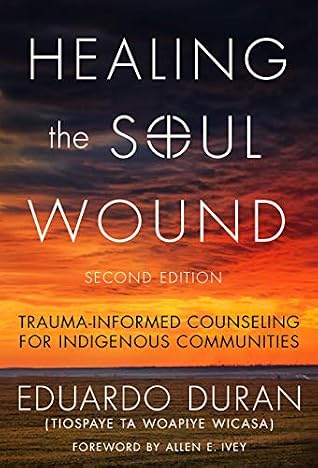
In this groundbreaking book, Eduardo Duran–a psychologist working in Indian country–draws on his own clinical experience to provide guidance to counselors working with Native Peoples and other vulnerable populations. This second edition includes an important new chapter devoted to working with veterans, examining what it means to go to war and what is required for veterans to heal. Duran also updates his thinking on research, including suggestions on how to invent a new liberation research methodology through applied story science. Translating theory into day-to-day practice, the text presents case materials that illustrate effective intervention strategies for prevalent problems, including substance abuse, intergenerational trauma, and internalized oppression. This unique resource explores theoretical Indigenous understanding of cosmology and how understanding natural law can lead us to new ways of understanding and healing the psyche.
Book Features:
Offers a culture-specific approach that has profound implications for all counseling, therapy, and trauma-informed care. Provides invaluable concepts and strategies that can be applied directly to practice. Outlines very different ways of serving American Indian clients, translating Western metaphor into Indigenous ideas that make sense to Native People. Presents a model in which patients have a relationship with the problems they are having, whether these are physical, mental, or spiritual. This model can be used with any population dealing with the legacy of trauma and with all individuals who present symptoms and complications resulting from trauma. Includes a section in each chapter to help non-American Indian counselors generalize the concepts presented to use in their own practice in culturally sensitive ways.
This unique childhood memoir of the Holocaust has been praised as “powerful” ( “Cincinnati Inquirer” ), “touching” ( “Jewish Digest” ), and “heartbreaking” ( “Library Journal” ). A true story of rare beauty and remarkable power, it has become an enduring classic. One day, when Jacob Kuperblum was eight, he came home to his town in Poland. His family and friends were gone, rounded up by the Germans only hours earlier. He would never see them again. Thus begins a journey of survival as a young boy travels from town to town in a desperate search for safety and shelter, growing up in fear, deprived of his home and his people–and even his identity. All that survived was his spirit–and his indomitable will to live. “Child of the Holocaust” is the acclaimed account of Jacob Kuperblum–an unforgettable and moving tale of adversity and triumph.
In 2014, Kaiwei Tang joined the inaugural class of a startup incubator in New York. It was backed by Google, among others, and its goal was to turn Tang and his classmates into creators of viral apps and world-changing tech companies.
Given his experience designing phones for Motorola, Nokia and Blackberry, Tang was more than qualified. Yet he thought about technology differently from his teachers and peers. For them, he says, success was about users spending more and more time on their phones, engrossed in the founders’ new apps. But to Tang, who describes apps and phones as ‘tools’, this sounded perverse. Would the maker of a hammer boast about how long his customers spent using it?
By now, Tang’s gripe is solidly mainstream: millions of people feel (and are) addicted to their phones and social media. We worry about checking email during family dinners or about the fact that we spend more time documenting vacations on Instagram than enjoying them. Unlike most of us, though, Tang was in a position to do something about it. He co-founded a company, raised millions of dollars, and released a new product: the Light Phone.
The Light Phone made phone calls. That was it. It couldn’t even text. It was the phone you bought because you wanted to stare at the clouds or notice the flowers blooming when you walked to work. Tang’s target customers were desk workers who downloaded meditation apps and people who paid for digital-detox camps. But other people wanted the Light Phone, too. Tang found himself speaking with parents who sought a stripped-down phone for their young teens – and, in a development that surprised him, members of ultra-Orthodox Jewish families.
Tang’s Orthodox-Jewish customers live near the Light Phone offices, but in Williamsburg, Brooklyn – a neighbourhood increasingly associated with art and hipsters – they stand out, not least for their conservative black garb. While many use the internet regularly, their rabbis have vigorously debated avoiding it entirely.
‘I respect that,’ Tang tells me. They are customers, yes, but also peers in thinking critically about how to use technology.
Tang didn’t expect these unorthodox customers, but perhaps he should have. Because, in certain parts of the United States, you can find vendors selling new computers that can’t connect to the internet, and home appliances that must be powered by batteries, instead of conveniently plugging into an outlet. These customers are a group that’s approached technology for centuries with a focus on intentionality and on creating tools that align with their values. Better known for their horses, buggies and farms, that group is the Amish.
Despite growing up within driving distance of Amish Country, I never expected to see the Amish as a source of tech-savvy guidance. A decentralised religious group with roots in Germany and Switzerland, the Amish immigrated to the US in the 1700s – mainly to Lancaster County, Pennsylvania, where they remain a regular sight, sporting simple outfits, working on family farms, and driving horse-drawn buggies. Many Americans think of them as Luddites who make nice wooden furniture. For years, I viewed them (naively) as a society frozen in time. Had they just picked a year, I wondered, and refused to use any technology invented later than that?
The Amish make slow and deliberate decisions as a collective. Rather than rushing optimistically or blindly into the future, they move forward cautiously, open but sceptical
My interest in the Amish began in a way that surprised me. A while ago, I started to feel like my days were too undirected, spent scrolling, scrolling, scrolling through Twitter and news aggregators and apps in a habitual, unfulfilling way. I didn’t have a breaking point, exactly, but I knew something was up when I realised I’d developed a habit of pulling out my phone on the toilet. With fresh eyes, as I started reading up on the business model of addictive technology and the advice for resisting it, I found myself reading about the Amish.
The fear that technology is changing us for the worse – by speeding up the world beyond our ability to cope – has been around for a long time. Decades ago, white-collar workers bemoaned the frenzy of after-hours faxes and the pressure to check their PalmPilots. Even further back, conservative intellectuals fretted over the ‘confusion’ and ‘froth’ unleashed by the printing press. For students of these silicon-induced inquietudes, the Amish have served, quietly, as an intriguing model of resistance.
‘The Amish communities of Pennsylvania, despite the retro image of horse-drawn buggies and straw hats, have long been engaged in a productive debate about the consequences of technology,’ noted Wired magazine in 1999. In 2013, an NPR reporter observed that the ‘Amish community [is] not anti-technology, just more thoughtful’. Kevin Kelly, the co-founder of Wired, spent time geeking out with ‘Amish hackers’ and peeking into workshops whose modern machines are powered by compressed air for his bookWhat Technology Wants (2010). He concluded that: ‘In any discussion about the merits of avoiding the addictive grip of technology, the Amish stand out as offering an honourable alternative.’
The foundation of this ‘honourable alternative’ is to not adopt every single new technology, or use cars, phones and social media as soon as they become the norm. Instead, the Amish make slow and deliberate decisions as a collective. Rather than rushing optimistically or blindly into the future, they move forward cautiously, open but sceptical.
As it happens, Amish communities are home to plenty of tinkerers, hackers and technophiles. Just like early adopters who read the news online when ‘the internet’ was still a strange term, they rigged up light bulbs, bought telephones and surfed the web before their peers or church leaders knew much about them. Due to the decentralised nature of Amish religious life (there’s no Amish pope), no one set a policy for addressing these novelties. Contrary to what outsiders might expect, early adopters often aren’t censored, nor necessarily discouraged.
Nonetheless, in their small, tight-knit communities, neighbours and church leaders will take note. Many Amish communities shunned car ownership after watching car-owning families drive away for the weekend and play a reduced role in small-town life. Many banned phones in the house once their threat to the cherished tradition of neighbourly visits became clear.
Many Amish families share a telephone shanty: they keep a telephone in a small structure and walk to it to make the occasional call or check their voicemail
Over a phone call with Ola Yoder, an Amish resident of Indiana who owns and runs a kitchen and bath company called Kountry Wood Products, I ask if he’s heard that people like me feel addicted to our phones. ‘I go to Chicago and see people walking with their smartphone out in front of them and almost walk in front of a car,’ he says with a chuckle. ‘It’s the craziest thing in the world. We don’t want to get away from [in-person] communication.’
As my call with Yoder makes clear, though, it’s rare that the church bans a technology outright. (In some cases, bishops do make these decisions – although most communities that Yoder knows of rely on conversations among church members that lead to votes and agreements.) Many Amish families share a telephone shanty: that is, they keep a telephone in a small structure and walk to it to make the occasional call or check their voicemail. Many Amish who are not allowed to own cars will accept rides in taxis, ambulances – or, my personal favourite, buses that drive straight to ‘Amish Vegas’, a Florida beach town where Amish let loose by playing shuffleboard and eating ice-cream.
‘The Amish adopt technology selectively,’ writes Donald Kraybill, professor of Anabaptist and Pietist Studies, in The Riddle of Amish Culture (1989), ‘hoping that the tools they use will build community rather than harm it.’
The Amish are not perfect, of course. Plenty of them use cellphones illicitly and, as Yoder notes, the church will often defer to business needs. ‘We go to banks and use ATMs and are very much involved in tech, whether we like it or not,’ he says, ‘because the world is changing.’ And no matter how addicted to your phone you might feel, you might remain understandably averse to delegating your decisions to others.
But anyone can still learn from the Amish example by adopting a few strategies.
For one thing, you might consider putting any new app or gadget through a trial period. Think about what you want out of the tool, try it out, discuss its influence with people you’re close to – and only then make a decision, adjusting your usage to meet your goals. If following people at random on Instagram turns into an addictive distraction, or puts pressure on you to keep up with the Joneses, consider following just a few friends and family members. Using your laptop or smartphone mindlessly? Maybe lock your devices in a closet whenever you don’t need them, just to create that added barrier to pointless use.
As you pick and choose, adapting technology to your needs, it might help to establish a set of guiding principles. For example, the Amish ethos places prime value on family and neighbourly life. It also strives to maintain a separation from the world, which informs their policy of not connecting to the electric grid, but rather powering appliances with batteries or other alternatives. For Tang – who is now adding features to the Light Phone II in response to customers’ frustrations with the extremely minimal first version – the company’s core principles now include commitments to stay ad-free, and to ensure that every action has a clear ending. That means saying ‘yes’ to calling an Uber on a Light Phone, but ‘no’ to social media’s infinite feeds. You might want to borrow the ‘no infinite feeds’ policy from Tang, as well as the relatively relaxed approach of the Amish toward technology at work but greater restrictiveness at home. (Yoder has email for work, but he and his wife go to the post office regularly to mail personal letters.)
Above all, decide to be OK with seeming eccentric. The Amish’s unusual approach has allowed them to survive for centuries, even while other cooperatives and intentional communities fall by the wayside. Most Silicon Valley CEOs severely restrict their own children’s access to phones and screens. Given that current research suggests that millions of people are carrying machines in their pockets that stress them out and make them unhappy, perhaps an approach that seems a little unusual is called for. Even if that means taking technology lessons from the Amish.
The Taurus New Moon brings issues of security to the fore — where it already exists in our lives and where it needs reinforcement. The sign of the Bull relates to earth, giving a strong association with the material world. Yet this may also be where we discover our greatest illusions! While grand buildings may be symbols of enormous energy, aspiration, and achievement, over time they can be destroyed — and occasionally they simply crumble, if sufficient investment, maintenance, and support have been lacking.
Illusions of security may be under greater threat in our increasingly changing world, since so much of what many took for granted — as a continuing, normal way of life — no longer exists. People have had to adjust to different ways of behaving on a daily basis and for long stretches of time, probably needing to continue to do so into the future. Taurus is the earth sign most averse to changes and adjustments, due to its “fixed” quality. In considering the various states of earth itself — the soil of our planet — we can see how this element manifests as solid ground and mountainous regions. It can take a lot for soil to be moved in such states! Maybe it is no surprise that individuals with strong Taurus planets can feel they need a blast behind them to launch them into making major changes.
It may be hard to put words around energies springing up during this period, but they need to find a route of expression, all the same. For some of us, this could emerge in a rather clumsy, awkward fashion. Just as the Bull struggles to move gently around the proverbial china shop to make progress, so at the time of this New Moon we may see us flailing around, making a bit of a mess of things at first! This is reinforced by the Moon separating from a square to Saturn — where it may have felt too restricted and serious — and applying to a square to Jupiter, where it may be over-exuberant, while trying to grow and do something positive.
Right now growth and creativity may, indeed, occur quite messily. The important thing is to embrace the Taurean urge to bring improvements in life or build on something, however messy it may be. Handling this chaotic scenario may have an emotional and physical impact on us, but it will be more tolerable if we remember we are dealing with a work in progress. We cannot paint and clean the art studio at the same time!
Background conditions may heavily influence our decisions now. Jupiter is in the last degree of Aquarius (29°45′), adding a “now or never” pressure factor. We may feel the urgency to take action, to do or say something, especially with Venus in Gemini, near Mercury and the North Node — even if we do not have the full map in front of us yet.
A wide conjunction (10° orb) of the Moon with Uranus also suggests that an unexpected opportunity could arise. We may feel ready to make a last-ditch attempt at something. Or we view ourselves as with the luck of a “rank outsider” — with a potential win against the odds. If we don’t try for the desired result, perhaps we’ll just never know if it is attainable! The opportune background adds an element of courage, helping us to venture out of old territory and into the new.
The full plan and final result may not be in our sights. The Moon’s sextile to Neptune in Pisces hints at inspiration, without clear definition. Notice that Neptune happens to be conjunct Pallas, the asteroid linked with principles and right action. Maybe we can trust those inner instincts after all and achieve something pretty special!
This article is from the Mountain Astrologer, written by Diana Collis.
Consciousness, spirituality, biography, sexuality, androgyny, futurism, space, the arts, science, astrology, democracy, humor, books, movies and more