SEARCHING FOR MY GRANDFATHER AND THE TULSA IN ME

100 Years Later, I’m Still Sifting Through the Tulsa Race Massacre’s Destruction to Find Our Family’s History
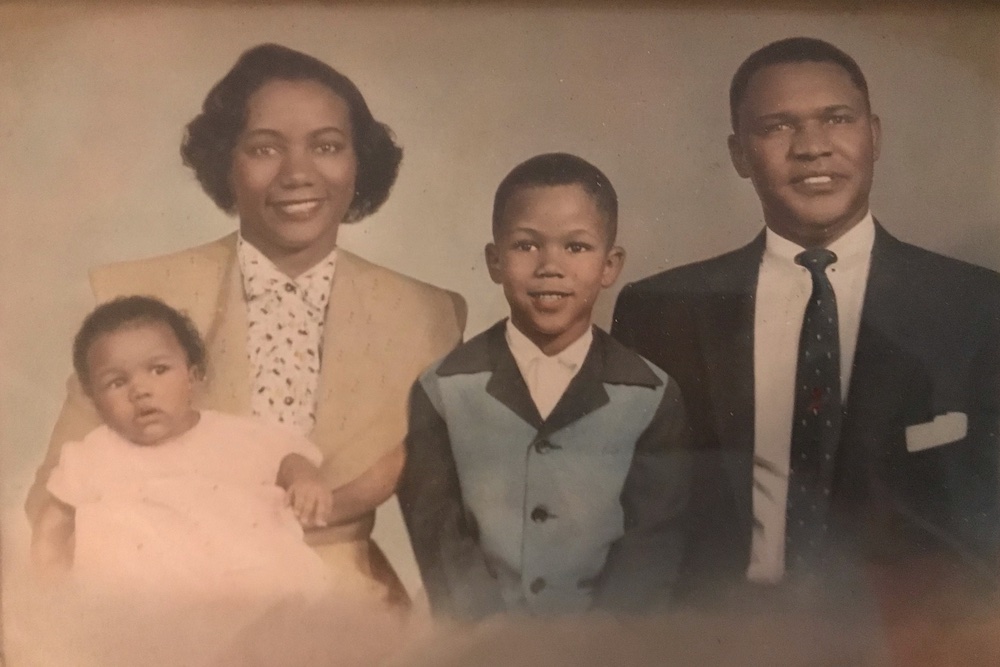
Searching for My Grandfather and the Tulsa in Me | Zocalo Public Square • Arizona State University • Smithsonian

Courtesy of Olga Idriss Davis.

by OLGA IDRISS DAVIS | JUNE 3, 2021 (zocalopublicsquare.org)

I am my father’s daughter.

I am the first-born daughter, the middle child, who was called Sweet Pea, Mama-Daddy, and Peanie. Naming is very important in the Black community. The act of naming is a great power, reminding each of us how to find one’s voice and how to define, and redefine oneself. Children’s nicknames suggest characteristics that relatives have observed, or into which they believe young people will grow; these can serve as the foundation of your identity.

Sweet Pea is my father’s endearing recognition of the energy and life-giving traits of the legume and the preciousness of the flower. My most important name, my official birth-given name, is Olga. It means “Holy One of God” in Russian, and when spelled backward, it is “A Glo.” I like to amuse myself by thinking my identity is somewhere between God’s holiness and the quality of illuminating others, but I know the real foundation is that I am my father’s daughter.

By association and genetics, that also means I am my paternal grandfather’s granddaughter. His name was Jason, and everyone, family included, addressed him as his professional name, Dr. Sneed. I never had the chance to meet him, but, hearing so much about him, I held him in awe. I grew interested in whatever connections he and I may have had. Many Black families are searching to know the history of their ancestors. And, for the past 26 years, I’ve been searching—as a scholar and as our family’s unofficial cultural historian—for my grandfather.

Born in 1877, Dr. Sneed attended the first medical school for aspiring Blacks in the medical profession in the South, Meharry Medical School in Nashville, Tennessee, at the turn of the 20th century. To date, my grandfather and I are the sole ancestral linkages to degree-granting achievement in the professional rank of doctor. His, a Doctor of Medicine (M.D.). Mine, a Doctor of Philosophy (Ph.D.).

For years, I had wondered what this other doctor was like, and why family members and relatives eluded my questions about him. As a child, I was told, “Don’t ever ask your father about your grandfather.” Being the precocious child I was, that was the very question I wanted to ask.

While completing my doctoral degree in human communication from the University of Nebraska in 1994, I had to decide on a topic for my dissertation research. I pondered for a long time, and was considering the study of the emancipatory persona of Black female slave narratives. In the course of my indecision, I mentioned my dilemma to my father, who finally gave me my opening. “Why don’t you write about Tulsa?” he asked. “There’s a lot of history there, and history about our family that you don’t know about.”

Cautiously, I approached the topic with which I was most unfamiliar. Still, I proceeded. “Um, Daddy, what was Grandfather like?”

He was silent, then responded. “Your grandfather was a fine man, dapper, one of the first Black physicians in Tulsa, Oklahoma, and a social activist. He spoke out against Jim Crow segregation and organized people when he was supposed to be silent. He was taken away to prison, and we lost him to lynching.”

He then paused for what seemed like a lifetime before he said, “You know, I’m 70 years old, and I still miss my father.”

Somewhere between the pain of that statement and the unheard tears of my father as he quickly hung up under the guise of a “bad phone connection,” I knew I had to locate Tulsa within me.

Over the next few years, I would spend research time in Tulsa and in Oklahoma City, mostly during summers, reading files, microfiche records, and turn-of-the-century newspapers at historical societies and libraries, and interviewing men and women who would have been my grandfather’s contemporaries.The search for identity is an ongoing search for myself within the shadows of a people who have struggled, resisted, and survived the racial, economic, and social intolerance of Black life in America.

I learned that, after graduating from medical school, my grandfather relocated to Tulsa and established his medical practice. He was part of a larger migration in the early decades of the 20th century of forward-thinking, progressive Black business owners. Buoyed by the booming American oil industry, they established a presence in African Creek towns, such as Muskogee, and newly established Black towns, such as Boley, Langston, and Rentiesville, and began building community, establishing education for their young people, and growing their businesses. Those early settlers dreamed of a Black economic blueprint that would serve as a model for other Black towns and communities across the country. My grandfather, and other men and women like him who represented Black excellence in education, entrepreneurship, and business acumen, wanted to redefine the pathway of opportunity, success, and citizenship for Black people.

One result was the thriving North Tulsa business community known as “Greenwood” or “Negro Wall Street.” My grandfather’s medical practice—at the corner of Greenwood and Pine Streets—was just one of the businesses that filled approximately 40 blocks. There were shops, hotels, dental offices, a hospital, a library, theaters, barber and beauty salons, grocery and millinery establishments, and more. But with this newfound prosperity came hostility, fear, and jealousy by whites, leading to the Tulsa Race Riot/Massacre of 1921.

The search for identity is an ongoing search for myself within the shadows of a people who have struggled, resisted, and survived the racial, economic, and social intolerance of Black life in America. My research has guided me–not as a canine sniffs out a bone, but as a motherless child searches for an unknown parent, or as a veteran returning from war looks for that which will make them whole—toward the inclusivity of community. It’s that very inclusivity that the Tulsa Race Massacre sought to destroy during three days of pillaging, aerial bombing, and destruction by white mobs of the community my grandfather helped build. The reported death toll was 300, but many more lost their lives, homes, and livelihoods, while a host of Black bodies unaccounted for were dumped in unmarked graves.

When the Tulsa Race Massacre is mentioned now, it is spoken as something of the past, an event to be memorialized, as it has been this past week. But not everyone agrees on how to do so, or why. Until recently, even the name of the event failed to narrate it accurately: the Tulsa Race Riot, now known as the Tulsa Race Massacre. The term riot, in America, is often imagined as being linked to the idea of a violent Black presence, of Black bodies perpetually defined and affected by violence. In the context of Tulsa, however, riot reveals an enactment of white bodies representing the violent embrace of white racial domination. Here, the violence was solely perpetrated on Black Tulsan landowners, families, and businesses by whites. The term riot fails to capture the essence of brutality and attempted obliteration of those two days. The term massacre suggests the attempt at genocide, of wiping away the Black community of Tulsa and sending a message that a Black economic infrastructure in the U.S. would not be tolerated.

In February 2001, a Tulsan complained in the local newspaper, Tulsa World, “The Tulsa race riot is history you read about it, you learn from it, then move on.” But, what does it mean to move on? What about the stories of survivors, and how they overcame the haunting memories of burning homes, bombed businesses, and charred corpses lying in the streets of the once-booming Black business community? What about their descendants, grappling with generational trauma, like my father and me?

The account of my grandfather’s experience of living through the Tulsa Race Massacre has been told by my aunt, the late Willie Mae Thompson, respectfully known in the community as “Aunt T” and mother of Morning Star Baptist Church. Her most prominent memory was of my grandfather being “tagged” so as not to be killed but rather identified as one who could pass the restrictions of the local white militia. They allowed my grandfather, as a medical professional, a physician, to comb the streets of Greenwood to identify the dead Black bodies from the living ones. Imagine what he must have undergone, surrounded by charred remains and smoldering embers. Imagine the horrifying reality of identifying neighbors, former patients, church members, and young children he may have delivered in birth.

After those days of violence, the Black community was relegated to tents constructed by the Red Cross. They held on to their faith—a faith in God and in community that would create a spirit of endurance, a strength within that gave way to organizing, regrouping, and still attempting to rebuild—in spirit, in community, in memory. Resilience is a term often characterized by the ability to bounce back, to not give up, to refuse defeat. That was the character of these powerful, disciplined, courageous, and defiant people of North Tulsa and of the Greenwood business district.

Dr. Sneed’s death took place in the aftermath of the Massacre. I don’t know much more than what my father told me all those years ago, including exactly when he died. My research is a continual unfoldment of the story of my grandfather’s life, leading me on a path of deeper exploration and inquiry into reconciliation, reparative justice, and accountability.

The survivors of the Race Massacre are often thought of as a group—a sorrowful, pitiful group, dead, buried, and forgotten. Yet their accounts, told by some who are still living (a number that can be counted on one hand today), are narrative discourses—stories—that reveal lives of courage and love, struggle and resistance, pain and despair, and transcendence and hope for future generations of the Tulsa community and of African American communities at-large. The late Mrs. Mabel B. Little, a Race Massacre survivor at the time of my interview in 1996, was a successful business woman who owned a beauty salon in the Greenwood district. She offered this reflection in an oral history published in 2002, which captured the essence of the brilliance of Greenwood and the challenge of its remembrance:

We have lost our memory as a people, so that we have no clear vision of our future. We have lost our sense of direction, if not our sense of purpose. We’re going to have to return to the past to see where we have been so we can know where we are going; not to get bogged down in the past, but to use the past as a springboard to a new and as yet unimagined future. We must take the best of the past and leave the rest alone.

Acknowledging Mrs. Little’s admonition, I will keep snooping, digging, and finding myself in the Tulsa narratives of Black bodies’ lived experience while I continue the search for my grandfather, and to illuminate public memory of the continuum of struggle and resistance of African American life in the United States.

What I have learned is to be vigilant, and to embrace a culture of resilience established by the Black Tulsans in Greenwood in the telling of the story so that none will ever again forget nor fail to be taught and told.

OLGA IDRISS DAVIS is associate dean of Barrett, The Honors College Downtown Phoenix campus and full professor of communication in the Hugh Downs School of Human Communication at Arizona State University. Her scholarly work focuses on the social determinants of health and health equity among underrepresented communities, and aims to shape the research of next-generation health disparities scholars in the field of critical health communication.
A Dancer’s Disruption of Conservative Flamenco Culture

In “Flamenco Queer,” Manuel Liñán plays with gender, transforming both his appearance and a traditional art.

By Fergus McIntosh

Film by Frederick Bernas and Ana González June 2, 2021 (NewYorker.com)

When I was six and my sister was four, our parents, on holiday in Andalusia, bought us postcards of flamenco dancers. Mine had a yellow dress, and came wearing a real skirt made of lace-edged satin that you could lift up to see the printed version underneath—a talisman of exotic femininity, to the mind of a six-year old boy. When the journalist and filmmaker Ana González was growing up near Madrid, in the nineteen-nineties, flamenco seemed both ubiquitous and retrograde. For González, this exuberant style of dance and music, which emerged in southern Spain, represented a cloying brand of nationalism. “I used to reject the conventional flamenco story, because I associated it with a very conservative tradition,” she said.

It took Manuel Liñán, the subject of “Flamenco Queer,” to change her mind. The film, which González made with her partner, Frederick Bernas, follows Liñán, a seasoned flamenco dancer and choreographer, as he prepares for a big show in the Andalusian city of Granada. In the opening scene, Liñán and five fellow-dancers sit in a horseshoe, clapping and stamping as another dancer storms and twirls in the center. They’re dressed for the stage, with flouncing dresses in gorgeous hues, high-heeled shoes, and lacquered hair. All of them are men, and their performance is revolutionary. “In the world of flamenco, there is a conservative faction, like with society in general,” Liñán explains. “Just for being a man, you’re not allowed to dance in a particular way.” In another scene, we see Liñán, wearing a long polka-dot skirt over Adidas sweatpants, teaching a class of five girls and one boy how to form the sultry hand gestures that are characteristic of the genre. “When I was learning to dance, they told me that I should only move two fingers,” he says, didactically. “That was really boring for me. I preferred the whole hand. I thought it was nicer. But you can choose.” The kids mimic their teacher, holding their hands high above their heads and turning them in graceful, halting circles.The New Yorker Documentary

View the latest or submit your own film.

“Art should change with society,” González told me. Bernas agreed. “If you don’t adapt, you become irrelevant,” he said. But art cannot change itself—that requires artists. Liñán began his training while still in kindergarten, and he was performing professionally by the age of thirteen. A clip, preserved on V.H.S., shows him appearing on a children’s television show, dressed in a man’s outfit of a white shirt and black waistcoat, but with the same concentrated pout he wears decades later. The rules of how boys could dance, or what they could wear, were constricting, and at home, in private, Liñán began to experiment with women’s clothing. (His father, a bullfighter, disapproved, but his mother didn’t mind.) As an adult, Liñán’s expertise in the flamenco form gives him the authority to make it his own. On the night of the show, at a theatre in the gardens of the ancient Alhambra palace, he dances solo on a huge stage backed by cypress trees. His dress is geranium red, his movements fluid and entrancing. “In flamenco, I found the most honest way to communicate,” he says, in voice-over. “I transform a private act into a public spectacle.” It’s how artists make change, one by one.Fergus McIntosh is on the editorial staff of The New Yorker.

Joan of Arc: Cross-dressing warrior-saint and LGBTQ role model

by Kittredge Cherry | May 30, 2021 (qspirit.net)

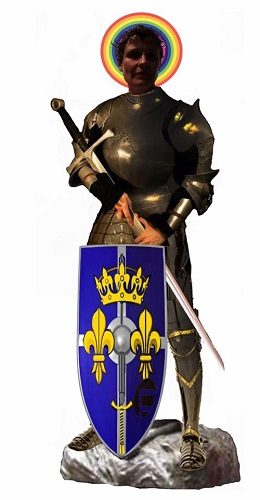
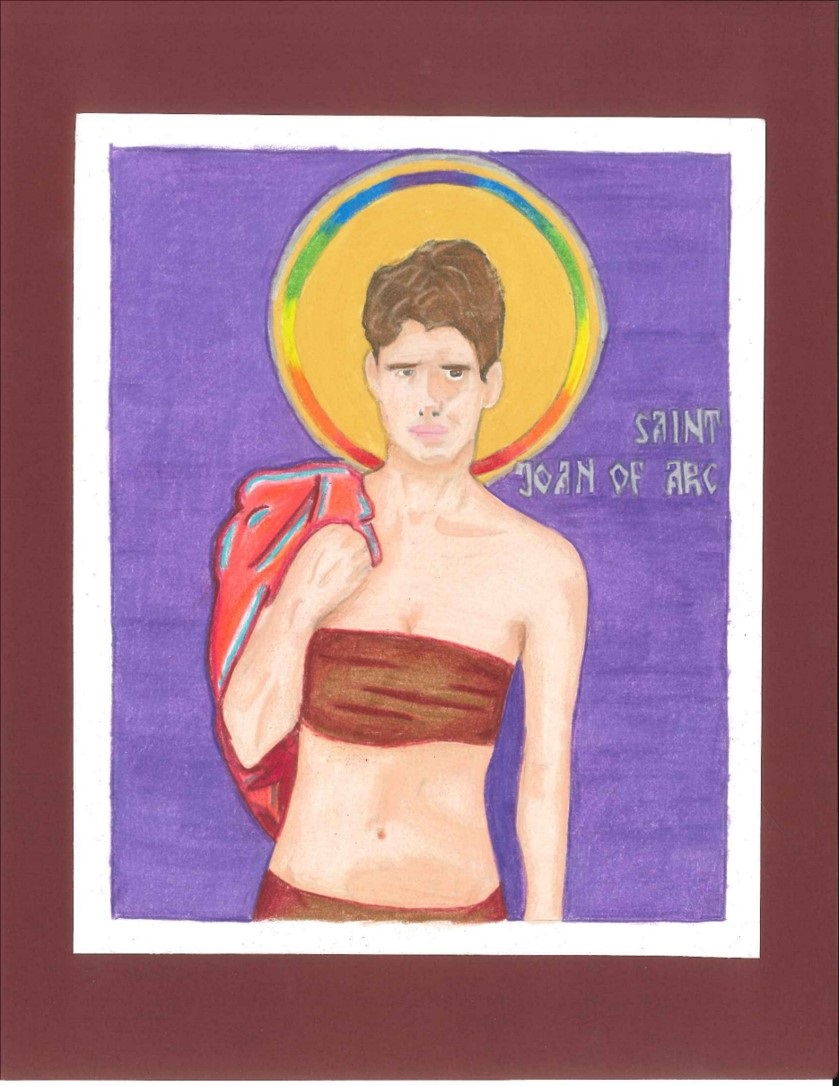
Joan of Arc by Katy Miles-Wallace

Joan of Arc was a tough cross-dressing teenage warrior who led the medieval French army to victory when she was 17. She is a queer icon, girl-power hero and patron saint of France. Her feast day is May 30.

Smart and courageous, Joan of Arc (c. 1412-1431) had visions of saints and angels who told her to cut her hair, put on men’s clothes and go to war. At age 18 she helped crown a king and at 19 she was killed by the church that later made her a saint. She died for her God-given right to wear men’s clothing, the crime for which she was executed on May 30, 1431.

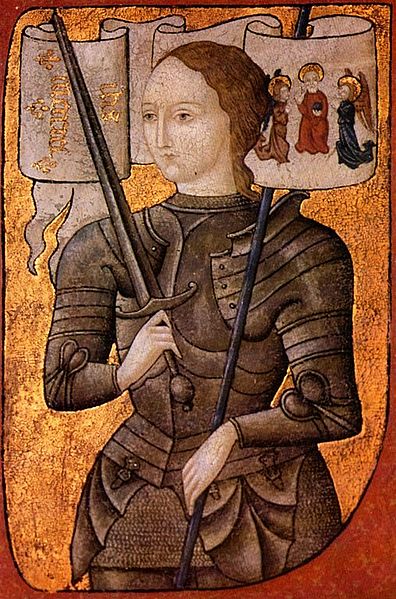
Joan of Arc portrait, c. 1485
Wikimedia Commons

Contemporary LGBTQ people recognize a kindred spirit and role model in her stubborn defiance of gender rules. Queer writers tend to downplay Joan’s Christian faith, while the church covers up the importance of her cross-dressing. In truth, Joan believed strongly in God AND in cross-dressing. She insisted that God wanted her to wear men’s clothes, making her what today can be called “queer,” “lesbian” or “transgender.” It’s hard to apply these contemporary categories to people who lived centuries before those terms existed, and both the lesbian and trans communities claim Joan as one of their own.

She fits the medieval archetype sometimes known as the trans saint or “holy transvestite.” Cross-dressing was illegal, but what really upset the church authorities, then as now, was the audacity of someone being both proudly queer AND devoutly Christian. Her belief that God was the source of her gender-bending queerness makes her especially inspiring for LGBTQ Christians and our allies.

This post features contemporary portraits of Joan by Katy-Miles Wallace (top), Tony O’Connell, Rowan Lewgalon, Robert Lentz and Tobias Haller, plus many historical images.Saints Against Gender Roles Stargirllily

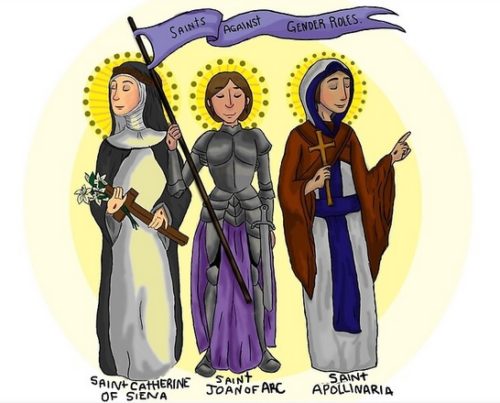
Apollinaria, right, carries a banner proclaiming, “Saints Against Gender Roles,” along with Catherine of Siena and Joan of Arc in an image that is available on many products from Stargirllily at Redbubble.

Joan’s extraordinary life continues to fascinate all kinds of people. Many are eager to claim her as a symbol, from LGBTQ people and feminists to the Catholic Church and French nationalists. There is speculation that she was an intersex person with androgen insensitivity syndrome. Joan is the subject of more than 10,000 books, plays, paintings and films, including recent works by transgender author Leslie Feinberg and lesbian playwright Carolyn Gage.

Gage’s one-woman show “The Second Coming of Joan of Arc” is an underground classic with Joan as “a cross-dressing, teenaged, runaway lesbian” confronting male-dominated institutions. Feinberg has a chapter on Joan as “a brilliant transgender peasant teenager leading an army of laborers into battle” in her history book “Transgender Warriors: Making History from Joan of Arc to Dennis Rodman.”  And Joan is included in the 2017 LGBTQ history book for teens, “Queer, There, and Everywhere: 23 People Who Changed the World” by Sarah Prager.

The extensive records of her trials by the Inquisition make Joan of Arc the best-documented person of 15th century. There are only hints that she may have acted on lesbian attractions, but the evidence is absolutely clear about her cross-dressing — which can be interpreted as transgender expression, butch lesbian expression or a chaste heterosexual woman disguising herself to remain safe. On March 25 of her trial, Joan said that “it is not in her” to wear women’s clothes and that that men’s clothes “did not burden her soul.”

Joan of Arc’s life story

Joan of Arc, also known as Jeanne d’Arc, was born to peasants in an obscure village in eastern France around 1412, toward the end of the Hundred Years War. Much of France was occupied by England, so that Charles, the heir to the French throne, did not dare to be crowned. When Joan was 13, she began hearing voices that told her to help France drive out the English.

The visions continued for years, becoming more detailed and frequent. Once or twice a week she had visions of Michael the Archangel and two virgin saints: Catherine of Alexandria and Margaret of Antioch (another transvestite saint who refused to marry a man). They told her that God wanted her to meet Charles and lead an army to Reims for his coronation.

Joan’s family tried to convince her that her visions weren’t real, and her first attempt to visit the royal court was rejected. When she was 17 she put on male clothing and succeeded in meeting Charles. He agreed to outfit her as a knight and allowed her to lead a 5,000-man army against the English.

“Saint Joan of Arc” by Brother Robert Lentz. Prints available at Amazon and Trinity Stores.

On Charles’ order, a full suit of armor was created to fit Joan. He had a banner made for her and assigned an entourage to help her: a squire, a page, two heralds, a chaplain and other servants.

Joan of Arc on Horseback, 1505
Wikimedia Commons

Joan’s appearance awed the soldiers and peasants when she traveled with the army. Mounted on a fine warhorse, she rode past cheering crowds in a suit of armor. Her hair was “cropped short and round in the fashion of young men.” She carried an ancient sword in one hand and her banner in the other. Her sword was found, as Joan predicted, buried at the church of St. Catherine at Fierbois. The banner showed Christ sitting on a rainbow against a background of white with gold lilies and the motto “Jhesus-Maria.” Legend says that white butterflies followed Joan wherever she rode with her banner unfurled.

With Joan leading the way, the army won the battle at Orleans and continued to defeat English and pro-English troops until they reached Reims. She proudly stood beside Charles VII at his coronation there on July 17, 1429.

Joan soon resumed leading military campaigns. Even during her lifetime the peasants adored her as a saint, flocking around her to touch her body or clothing. Her cross-dressing didn’t disturb them. In fact, they seemed to honor her for cross dressing. Perhaps, as some scholars say, the peasants saw Joan as part of a tradition that linked transvestites and priests in pre-modern Europe.

Was Joan of Arc a lesbian?

One of the first modern writers to raise the possibility of Joan’s lesbianism was English author Vita Sackville-West. She implied that Joan was a lesbian in her 1936 biography “Saint Joan of Arc.” The primary source for this idea was the fact, documented in her trials, that Joan shared her bed with other girls and young women. She followed the medieval custom of lodging each night in a local home. Joan always slept with the hostess or the girls of the household instead of with the men.

Joan of Arc: Her Trial Transcripts” by Emilia Philomena Sanguinetti is a 2016 book that explores whether Joan was a lesbian or transgender person. Extensive evidence that Joan of Arc was a lesbian or transgender person is presented in the epilogue of this groundbreaking book about the cross-dressing medieval saint. She explores how Joan shared her bed with another woman and insisted on wearing male clothing.

Nobody knows for sure whether Joan of Arc was sexually attracted to women or had lesbian encounters, but her abstinence from sex with men is well documented. Her physical virginity was confirmed by official examinations at least twice during her lifetime. Joan herself liked to be called La Pucelle, French for “the Maid,” a nickname that emphasized her virginity. Witnesses at her trial testified that Joan was chaste rather than sexually active. Some contemporary feminists believe that “virgin” did not mean sexless, but belonging to no man. There are many “virgin saints” who refused heterosexual marriage and joined convents to have their primary relationships with women. They become role models for lesbians of faith.

Capture and trial of Joan of Arc

Joan’s illustrious military career ended in May 1430. She was captured in battle by the Burgundians, the French allies of the English. During her captivity they called her “hommase,” a slur meaning “man-woman” or “masculine woman.”

In a stunning betrayal, Charles VII did nothing to rescue the warrior who helped win him the crown. It was normal to pay ransom for the release of knights and nobles caught in battle, but he abandoned Joan to her fate. Historians speculate that French aristocrats felt threatened by the peasant girl with such uncanny power to move the masses.

The Burgundians transferred Joan to the English, who then gave her to the Inquisition. She spent four torturous months in prison before her church trial began on Jan. 9, 1431 in Rouen, the seat of the English occupation government. She was charged with witchcraft and heresy.

The politically motivated church trial was rigged against her, and yet Joan was able to display her full intelligence as she answered the Inquisitors’ questions. Her subtle, witty answers and detailed memory even forced them to stop holding the trial in public.

Witchcraft was hard to prove, so the church dropped the charge. (Many of today’s Wiccans and pagans still honor Joan as one of their own.) The Inquisitors began to focus exclusively on the “heresy” of Joan’s claim that she was following God’s will when she dressed as a man. The judges told her that cross-dressing was “an abomination before God” according to church law and the Bible. (See Deuteronomy 22:5.)

“Joan of Arc Kisses the Sword of Liberation” by Dante Gabriel Rossetti, 1863 (WikiPaintings)

Convicted of cross-dressing

They accused Joan of “leaving off the dress and clothing of the feminine sex, a thing contrary to divine law and abominable before God, and forbidden by all laws” and instead dressing in “clothing and armor such as is worn by man.”

Joan swore that God wanted her to wear men’s clothing. “For nothing in the world will I swear not to arm myself and put on a man’s dress; I must obey the orders of Our Lord,” she testified. She outraged the judges by continuing to appear in court wearing what they called “difformitate habitus” (“monstrous dress” or “degenerate apparel.”)

Today Joan’s conservative admirers claim that she wore men’s clothes only as way to avoid rape, but she said that it meant much more to her. Joan of Arc saw cross-dressing as a sacred duty.

The judges summarized Joan’s testimony by saying, “You have said that, by God’s command, you have continually worn man’s dress, wearing the short robe, doublet, and hose attached by points; that you have also worn your hair short, cut ‘en rond’ above your ears with nothing left that could show you to be a woman; and that on many occasions you received the Body of our Lord dressed in this fashion, although you have been frequently admonished to leave it off, which you have refused to do, saying that you would rather die than leave it off, save by God’s command.”

Joan refused to back down on the visions she received from God, and she was sentenced to death. She was burned at the stake on May 30, 1431 in Rouen. Twenty five years later she was retried and her conviction was overturned. Joan was declared innocent.

Her armor, that “monstrous dress,” became an object of veneration, sought after like the Holy Grail with various churches claiming to possess her true armor. Joan of Arc was canonized as a saint in 1920.

Joan of Arc in the arts

In the icon at the top of this post, an androgynous Joan of Arc has a bound chest and a rainbow halo. It was created by queer Lutheran artist and seminarian Katy Miles-Wallace in 2017 as part of her “Queer Saints” series. Her icon of Joan is modeled after genderqueer model Rain Dove. The series presents traditional saints with queer qualities and heroes of the LGBTQ community.

The icons are rooted in queer theology and in Miles-Wallace’s eclectic faith journey that began at a Baptist church in Texas and led to study at Pacific Lutheran Theological Seminary in Berkeley, California. She drew many of them on the altar of a seminary chapel. For more info, see the Q Spirit article “New icons of Queer Saints created by artist Katy Miles-Wallace.”Joan of Arc by Tony O'Connell

Saint Joan of Arc from “Triptych for the 49” by Tony O’Connell

Joan of Arc also has a rainbow halo in “Triptych for the 49” by gay artist Tony O’Connell of Liverpool. Joan of Arc and Sebastian appear as “wrathful protector saints” in the artwork, which honors those killed in the 2016 mass shooting at the Pulse gay bar in Orlando, Florida.

“Jeanne D’Arc” by Rowan Lewgalon

Lewgalon is a spiritual artist based in Germany and also a cleric in the Old Catholic Apostolic Church.  Lentz is a Franciscan friar known for his innovative and LGBTQ-positive icons. He is stationed at Holy Name College in Silver Spring, Maryland.

“Jeanne d’Arc” by Tobias Haller

“Jeanne d’Arc” was sketched by Tobias Haller, an iconographer, author, composer, and retired vicar of Saint James Episcopal Church in the Bronx, still assisting at a parish in Baltimore, Maryland. He is the author of “Reasonable and Holy: Engaging Same-Sexuality.” Haller enjoys expanding the diversity of icons available by creating icons of LGBTQ people and other progressive holy figures as well as traditional saints. He and his husband were united in a church wedding more than 30 years ago and a civil ceremony after same-sex marriage became legal in New York.

Joan of Arc also appears with a rainbow halo as a “wrathful protector saint” in O’Connell’s “Triptych for the 49,” a tribute to the people killed by a mass shooter at the Pulse gay nightclub in Orlando, Florida.

Famous writers and composers who have done works about her include Shakespeare, Voltaire, Verdi, Tchaikovsky, Mark Twain, Bertolt Brecht and George Bernard Shaw. A stunning portrait of Joan kissing her sword was painted by Pre-Raphaelite artist Dante Gabriel Rossetti, whose sister Christina Rossetti is also part of the LGBTQ Saints series at the Jesus in Love Blog at Q Spirit.

Joan has a dialogue with the fire that is about to consume her in a haunting song written by award-winning Canandian poet Leonard Cohen and sung on July Collins video .

Joan of Arc Prayer

A widely used prayer to Saint Joan of Arc makes a powerful statement that can inspire those who believe in equality for LGBTQ people, despite rejection by religion and society:

“In the face of your enemies,
in the face of harassment, ridicule, and doubt,
you held firm in your faith.
Even in your abandonment,
alone and without friends,
you held firm in your faith.
Even as you faced your own mortality,
you held firm in your faith.
I pray that I may be as bold
in my beliefs as you, St. Joan.
I ask that you ride alongside me
in my own battles.
Help me be mindful
that what is worthwhile
can be won when I persist.
Help me hold firm in my faith.
Help me believe in my ability
to act well and wisely. Amen.”

Links related to Joan of Arc

Wikipedia article on Cross-dressing, sexuality, and gender identity of Joan of Arc

Joan of Arc trial transcript online

The Patron Saint of Dysphoria: Joan of Arc as Transgender (thingstransform.com)

Joan of Arc: Cross-dressing martyr at Queering the Church Blog

Jeanne-darc.info

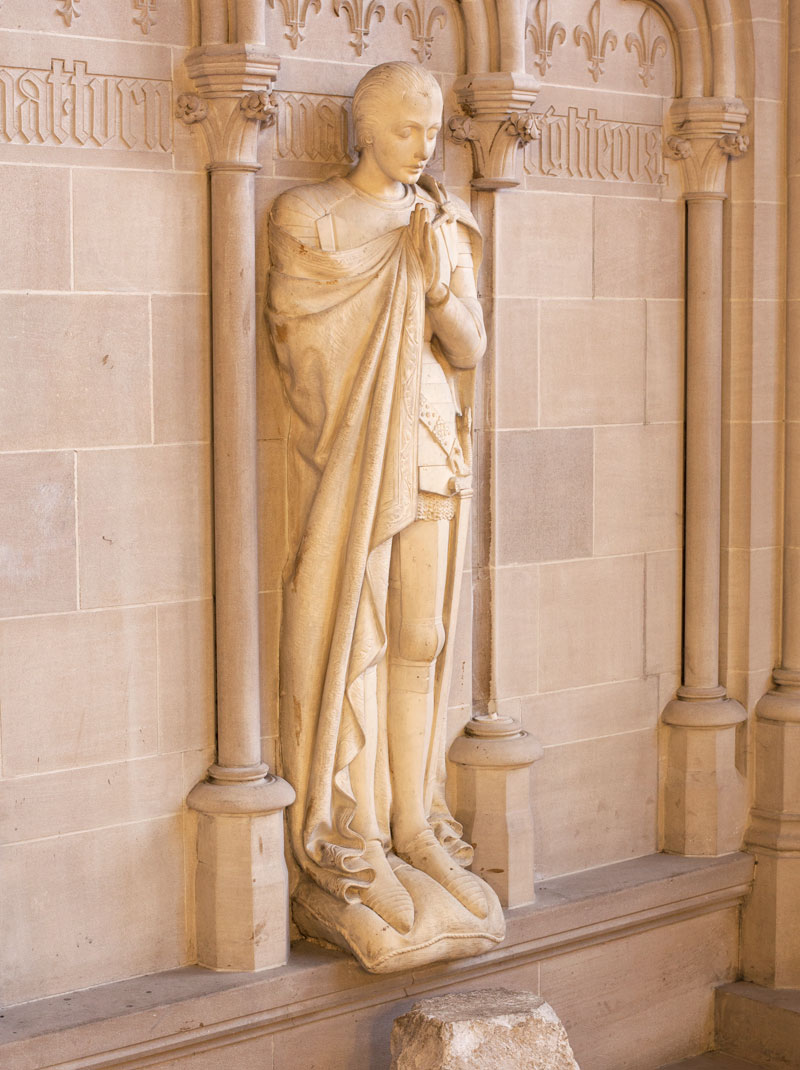
Joan of Arc sculpture by Anna Hyatt Huntington at the Cathedral of Saint John the Divine in New York City

Translations on Joan of Arc as a queer icon

To read this article in Spanish / en español, go to Santos Queer:
Juana de Arco: Santa Travesti

To read this article in Italian, go to Gionta.org:
Una guerriera genderbender. La favolosa vita di Giovanna d’Arco

To read a French interview about Joan of Arc with Q Spirit founder Kittredge Cherry, go to Komitid.fr:
Marine Le Pen s’est trompée, Jeanne d’Arc est en fait une icône queer
(Marine Le Pen was wrong, Joan of Arc is actually a queer icon)

___
Top image credit:
“Queer Saints: St. Joan of Arc” by Katy Miles-Wallace.

___
This post is part of the LGBTQ Saints series by Kittredge Cherry. Traditional and alternative saints, people in the Bible, LGBTQ martyrs, authors, theologians, religious leaders, artists, deities and other figures of special interest to lesbian, gay, bisexual and transgender and queer (LGBTQ) people and our allies are covered.

This article was originally published in May 2017 and was updated for accuracy and expanded with new material on May 30, 2021.

Copyright © Kittredge Cherry. All rights reserved.
Qspirit.net presents the Jesus in Love Blog on LGBTQ spirituality.

Kittredge Cherry

Kittredge Cherry Founder at Q Spirit Kittredge Cherry is a lesbian Christian author who writes regularly about LGBTQ spirituality.She holds degrees in religion, journalism and art history.She was ordained by Metropolitan Community Churches and served as its national ecumenical officer, advocating for LGBTQ rights at the National Council of Churches and World Council of Churches.

Book: “The Masque of the Red Death”

The Masque of the Red Death

The Masque of the Red Death

by Edgar Allan Poe 

The story follows Prince Prospero’s attempts to avoid a dangerous plague known as the Red Death by hiding in his large converted abbey home. He and many other wealthy nobles, have a masquerade ball using seven rooms in the abbey, each decorated with a different color. The last one is velvet black.

In the midst of their revelry, a mysterious figure disguised as a Red Death victim enters and makes his way through each of the rooms.

The story follows many traditions of Gothic fiction and is often analyzed as an allegory about the inevitability of death, though some critics advise against an allegorical reading. Many different interpretations have been presented, as well as attempts to identify the true nature of the titular disease.

Librarian’s note: this entry relates to the story “The Masque of the Red Death.” Collections of short stories by the author can be found elsewhere on Goodreads.

(Goodreads.com)

James Baldwin on Love, the Trap of Labels, and His Liberating Advice on Coming Out

By Maria Popova (brainpickings.org)

jamesbaldwin_thelastinterview.jpg?fit=320%2C488

“Every person of ordinary sex endowment has a capacity for diffuse ‘homosexual’ sex expression … according to the temperamental situation,” the influential anthropologist Margaret Mead wrote in a visionary 1933 letter that framed human sexuality as a matter of fluid attraction to temperaments, not a fixed attraction to genders, eight decades before the modern plight for marriage equality ushered in the universal dignity of love.

This conviction made Mead the perfect conversation partner for James Baldwin (August 2, 1924–December 1, 1987) when they sat down for their remarkable dialogue about identity four decades later. By then one of the most celebrated writers and thinkers in the world, Baldwin was among the era’s handful of openly gay public intellectuals and someone whom the legendary interviewer Studs Terkel aptly described as “one of the rare men in the world who seems to know who he is today.”

No book since Virginia Woolf’s Orlando would do more to enlist art as a force of empathic insight into same-sex desire than Giovanni’s Room, which Baldwin wrote in his early thirties against enormous resistance from American publishers, at a time when the DSM — the Diagnostic Manual of Mental Disorders, psychiatry’s Bible — classified homosexuality as a “sociopathic personality disturbance.” But although Baldwin had devoted his entire life to defending human dignity in all its guises, it was only in his final years that he addressed the question of sexuality and the dark specter of homophobia directly, thanks to Village Voice journalist Richard Goldstein — one of the generation of gay people who had found in Giovanni’s Room what Goldstein considered “an early vector of self-discovery.”

Appalled that a lengthy interview with Baldwin in the New York Times Book Review had swept its subject’s sexuality under the rug, Goldstein decided to take matters into his own hands. He persuaded the beloved writer, “a man who traced much of his acuity and pain to the nexus of racism and homophobia,” to meet with him for a conversation that would become Baldwin’s most personal interview, eventually included in James Baldwin: The Last Interview and Other Conversations (public library).jamesbaldwin.jpg?resize=680%2C425

James Baldwin

From the very beginning of the conversation, Baldwin exerts a lively resistance to all the labels within which we confine the expansiveness of human love. He tells Goldstein:

2e292385-dc1c-4cfe-b95e-845f6f98c2ec.pngGiovanni’s Room is not really about homosexuality… It’s about what happens to you if you’re afraid to love anybody. Which is much more interesting than the question of homosexuality.

[…]

The question of human affection, of integrity, in my case, the question of trying to become a writer, are all linked with the question of sexuality. Sexuality is only a part of it. I don’t know even if it’s the most important part. But it’s indispensable.

Reflecting on what gave him the courage to release the novel in Europe despite American publishers’ vehement refusal to publish it, Baldwin considers the deepest societal seedbed of the malady of homophobia, symptoms of which we’ve begun to see anew all these decades later. Echoing Rilke’s assertion that “for one human being to love another: that is perhaps the most difficult of all our tasks,” he tells Goldstein:

2e292385-dc1c-4cfe-b95e-845f6f98c2ec.pngIt’s very frightening. But the so-called straight person is no safer than I am really. Loving anybody and being loved by anybody is a tremendous danger, a tremendous responsibility. Loving of children, raising of children. The terrors homosexuals go through in this society would not be so great if the society itself did not go through so many terrors which it doesn’t want to admit. The discovery of one’s sexual preference doesn’t have to be a trauma. It’s a trauma because it’s such a traumatized society.

harveymilk11.jpg

Illustration from The Harvey Milk Story, a picture-book biography of the slain LGBT rights pioneer

Three decades after Hannah Arendt’s incisive treatise on how tyrannical regimes use isolation as a weapon of terror and oppression, Baldwin considers the wielding of homophobia as a cultural control mechanism by political propagandists, “a way of exerting control over the universe, by terrifying people.” The consequence, he suggests, is a fragmentation of unity on the basis of a rather arbitrary point of difference:

2e292385-dc1c-4cfe-b95e-845f6f98c2ec.pngBALDWIN: I know a great many white people, men and women, straight and gay, whatever, who are unlike the majority of their countrymen. On what basis we could form a coalition is still an open question. The idea of basing it on sexual preference strikes me as somewhat dubious, strikes me as being less than a firm foundation. It seems to me that a coalition has to be based on the grounds of human dignity. Anyway, what connects us, speaking about the private life, is mainly unspoken.

GOLDSTEIN: I sometimes think gay people look to black people as healing them…

BALDWIN: Not only gay people.

GOLDSTEIN: …healing their alienation.

BALDWIN: That has to be done, first of all, by the person and then you will find your company.

sendak_jackandguy14.jpg

Art by Maurice Sendak from We Are All in the Dumps with Jack and Guy, one of history’s greatest LGBT children’s books

When Goldstein remarks, three decades before this became a reality, that he imagines the election of a black president would be better for gay people, Baldwin considers the cross-pollinatory empowerment of the disenfranchised:

2e292385-dc1c-4cfe-b95e-845f6f98c2ec.pngThere is a capacity in black people for experience, simply. And that capacity makes other things possible. It dictates the depth of one’s acceptance of other people. The capacity for experience is what burns out fear. Because the homophobia we’re talking about really is a kind of fear.

sagesohier_athomewiththemselves6.jpg?w=680

Photograph by Sage Sohier from At Home with Themselves, a portrait series of gay couples in the 1980s

Affirming the notion that homosexuality is universal, Baldwin considers how language can be both the prison bars of our identity and the crowbar for breaking out of that prison:

2e292385-dc1c-4cfe-b95e-845f6f98c2ec.pngThere’s nothing in me that is not in everybody else, and nothing in everybody else that is not in me. We’re trapped in language, of course. But “homosexual” is not a noun. At least not in my book… Perhaps a verb. You see, I can only talk about my own life. I loved a few people and they loved me. It had nothing to do with these labels. Of course, the world has all kinds of words for us. But that’s the world’s problem.

Envisioning the future for gay people, Baldwin offers:

2e292385-dc1c-4cfe-b95e-845f6f98c2ec.pngNo one will have to call themselves gay. Maybe that’s at the bottom of my impatience with the term. It answers a false argument, a false accusation … that you have no right to be here, that you have to prove your right to be here. I’m saying I have nothing to prove. The world also belongs to me.

When Goldstein asks what advice he might have for people about to come out, Baldwin answers:

2e292385-dc1c-4cfe-b95e-845f6f98c2ec.pngBest advice I ever got was an old friend of mine, a black friend, who said you have to go the way your blood beats. If you don’t live the only life you have, you won’t live some other life, you won’t live any life at all. That’s the only advice you can give anybody. And it’s not advice, it’s an observation.

Complement this particular portion of the wholly fantastic James Baldwin: The Last Interview and Other Conversations with literary history’s most beautiful LGBT love letters and the real-life story behind “the longest and most charming love letter in literature,” then revisit Baldwin on freedom and how we imprison ourselvesthe artist’s responsibility to societywhat it means to be truly empowered, and his increasingly timely conversation with Chinua Achebe about the political power of art.

How Much Longer is America Going to Last?

The GOP’s Snuffing Out Democracy, One Step at a Time. So What Happens Next?

umair haque · May 30 · Medium.com

Image Credit: Brett Mackenzie

Right about now, I’m wondering, and perhaps you are too: how much longer is America going to last? If your gut is asking that question, I’m here to tell you: it’s not wrong, paranoid, hyperbolic, it’s exactly right.

America now faces a true nightmare scenario. It goes like this, in three stages. Stage one, the GOP escalates and retaliates, seeking vengeance for a “stolen” election. Stage two, democracy’s snuffed out, state by state. Stage three, that paves the way for democratic collapse at the federal level. That appears to be the central approach the GOP is now overtly and explicitly taking — and the crisis America’s facing. Let’s take each of those step by step.

Stage one. The Democrats have refused to punish the GOP’s authoritarian fascist wing — just as I and other survivors and scholars of social collapse were afraid of. What happens when you don’t punish such malign forces? They don’t magically give up and go away politely, because they’ve come to their senses. They double down. They escalate, harden, and retaliate.

So the GOP is now home to a new wave of rising stars. Figures like Marjorie Taylor Greene and Josh Hawley and Kevin McCarthy and so on. I’m here to tell you, again, that what your gut is shouting at you about these people is right, They are not normal. They embrace violence, intimidation, sheer outright craziness. They revel in hate, and find the damage they do and the hurt they cause delicious. These are not normal people. They are the kinds of figures it takes to produce a true and final social collapse — the violent fanatical extremists, who, revelling in the pain and suffering brutality causes, think of themselves as righteous swords of justice and truth.

Today’s MJTs and Josh Hawleys are tomorrow’s Saddams, Gadhafis, Udays, and Qusays. No, I’m not kidding. Your gut is right. Take it from those of us who’ve lived all this before — we know a certain personality type when we see it. Trump? A malignant narcissist. These figures, though, are different — they’re sociopaths, who enjoy causing harm and hurt, and find no meaning or purpose in their lives without it. These kinds of personalities becomes tomorrow’s torturers, death squads, dictators — that is their path and destiny when given power.

That’s stage one — the Dems didn’t punish the fascists, so now the truly hardcore and dangerous fanatics are assuming power of the movement. What, you might ask, should the Democrats have done? They control the House, Senate, and Presidency. They should have put in place a special process of extraordinary justice — something like a Nuremberg Trials — for the coup attempt of Jan 6th and the abuses of power of Trumpism both. You have to show the fascists you are willing to bring them to justice — or, thinking you are weak, rightly, they will simply escalate and harden.

That brings me to stage two. Escalation and retaliation. The fascists have taken over the GOP. Yesteryear, maybe, in the brief interregnum between Presidencies, there was talk of a “civil war” within the GOP. “Moderates” like Mitt Romney and Liz Cheney — still off the charts hard right in global terms, but nonetheless not exactly MJTs — versus the new wave of fanatics. Who would win? Seasoned observers and scholars of social collapse warned: it wasn’t going to be much of a fight — the fanatics would win, because the Dems weren’t serious about punishing fascism, and the GOP’s base believed in it heavily. And so, winning control of the party, the fanatics would double down on extremist tactics.

And that is exactly what’s happened. Texas is just about to pass a bill that lets elections be overturned without any real evidence of fraud or malfeasance. That’s it — bang, the end of democracy in one of America’s biggest states. It’s not a joke, and it’s not something to be taken lightly. It is a huge deal. Because what it means in practice is that Texas can stay ultra-conservative — and then use its power in the next Presidential election, to vote ultra conservative, no matter what, too. There goes the whole country.

And yet Texas is just one state. In state after state, the GOP’s new wave of authoritarians is waging a soft war on democracy. They’re attacking it with everything they’ve got, procedurally, formally, institutionally. In Arizona, the vote is being “audited” by a company called Cyber Ninjas — go ahead and laugh — whose leadership is ultra conservative. Efforts to restrict voting rights and even to stifle any kind of thinking are underway across the country — Republicans are literally banning critical race theory in some states. Think about that: what kind of a country begins to ban theoriesCritical ones? Soviet style societies do, of course.

Why is the GOP waging a full-blown soft war on democracy itself in state after state? It is now employing a strategy common in social collapses. Having failed to seize power at the federal level, it’s now attempting to curtail and pervert and suffocate democracy at the state level.

They failed on Jan 6th — thanks to a few brave officers and sheer dumb luck — but remember, they built a gallows, chanted death threats, were out for blood, wanted to assassinate and massacre political leaders — all to prevent the peaceful transfer of power. They came this close — within a hair’s breadth of succeeding.

The fanatics in the GOP have reasoned that if they can’t seize power at the federal level, what they can do is suffocate democracy dead at the state level. And if they can do that, then next time, they can seize power at the federal level. How will that work?

That brings me to stage three, which is the really scary one.

You and I both are beginning to entertain thoughts like this. The Republicans retake the House in 2022. Democrats’ fragile alliance between minorities and progressives and young people splinters. Minorities and young people, in particular, feel betrayed by the Democrats softly-softly approach to fighting fascism with a whimper — which many feel amounts to complicity. So turnout is low, and the GOP retakes the House.

What happens then? Well, then American democracy has a very good chance of coming to an end. There are altogether too many ways it could happen. The House could refuse to certify election results. The case would go before the Supreme Court — if it even heard it — and it’d probably decide in the GOP’s favour, since it’s stacked now with arch-conservatives.

Or maybe, by then, democracy would have been successfully snuffed out in state after state. Especially key states, which were crucial swing states this last time around. Texas, Arizona, Georgia. There, Republicans have managed to pass such severe and extreme restrictions that democracy simply fails. The House doesn’t even have to act — votes are lost, thrown away, not counted, people are disenfranchised, and so forth.

Bang. American democracy has come to an end.

Because this time around, if the Republicans win the Presidency in 2024, all bets are off. Trump’s first term only saving grace, only small mercy, was that sheer incompetence got in the way of malice. That will not happen a second time around. The GOP has gotten much, much better at the practical side of fascism, fast. Their soft war on democracy proves it. If they take the Presidency in 2024, you can count on the stuff of nightmares coming true.

What kind of stuff? Well, last time around, America saw all the following: concentration camps, kids in cages, ethnic bans, “raids,” minorities hunted in the streets, purges, hate, vitriol, the press and anyone different demonized, minorities scapegoated. This was the stuff of fascism. Still, the sheer incompetence of the first Trump Administration meant it was bumbling and fumbling, not quite on a tremendous social scale.

Make no mistake, though, that is what the GOP’s fanatics wantThey want an ethnically cleansed homeland of the pure in blood and true in faith — and everyone else is not a human being in formal, institutional, even legal terms. The GOP’s new wave of fanatics — MJT, Josh Hawley, and so forth, want to create a society that resembles Iran, North Korea, or Russia much more than it does Canada or Europe.

And the scary part is that unlike Trump and his coterie of bumbling fools, they’re slick and organized enough to make it happen.

If the GOP ascends to the Presidency in 2024 — and heaven forbid takes the Senate and House back, too — then America is going to see truly horrific and terrible things. Things like knocks on the door of critics and dissenters, who get carted away to concentration camps. Which are already full of minorities, who’ve been hunted down by paramilitaries. Who’ve been elevated to the position of SS’s, given formal power to do all the violence they want. To preserve a certain social order: men, true in blood and pure in faith at the top of a social hierarchy of personhood, the women they effectively own beneath them, and then, in declining position of “racial purity”, everyone else, who’s treated like chattel, like subhumans, like things, not people at all.

Take everything you’re imagining, and telling yourself, “no, don’t be ridiculous. That’s implausible. It’s not going to happen here!” — and stop telling yourself that. The last time you told yourself that, it happened hereIt’s a lie, every time. It can’t happen here. All it does is let “it” happen here — fascism, authortiarianism, social collapse. Take all that stuff of your worst fears right now — what is it? I bet it goes like this. Secret polices, gulags, demagogues, fanatics controlling your town or city, extremists in charge of social institutions and systems, hate pervading society, violence and brutality as social norms, the true believers revelling in it all, enjoying the hate and harm and hurt, because it proves they’re pure of blood and true of faith. Take all that, and believe it.

That is what’s on the way for America. If. If what? If things continue their light-speed downward spiral. If the GOP’s continues being allowed to harden, escalate, retaliate. To snuff out democracy state by state. Until, by 2022, there’s little enough left to ensure that by 2024 there’s none left.

Don’t do it. Don’t lie to yourself. Don’t say “it can’t happen here!”

It is.

Umair
May 2021Eudaimonia and Co

Eudaimonia & CoFollow

WRITTEN BY

umair haque

vampire.

Eudaimonia and Co

Eudaimonia and Co

Eudaimonia & Co

“Peace Within” by Teresa Avila


Teresa of Ávila

“May today there be peace within.

May you trust God that you are exactly where you are meant to be.

May you not forget the infinite possibilities that are born of faith.

May you use those gifts that you have received, and pass on the love that has been given to you.

May you be content knowing you are a child of God.

Let this presence settle into your bones, and allow your soul the freedom to sing, dance, praise and love.

It is there for each and every one of us.”

― Teresa of Ávila

Teresa of Ávila, born Teresa Sánchez de Cepeda y Ahumada, also called Saint Teresa of Jesus (born March 28, 1515), was a Spanish noblewoman who felt called to convent life in the Catholic Church. Wikipedia

Consciousness, spirituality, biography, sexuality, androgyny, futurism, space, the arts, science, astrology, democracy, humor, books, movies and more