Lucas LaFreniereis an assistant professor in psychology at Skidmore College in New York state.
Edited by Lucy Foulkes
8 June 2021 (psyche.co)
It all started with Goofy blowing lewd kisses at my mom. I was a five-year-old at Disney World, happily exploring with my parents. Happily, that is, until I entered what seemed like an adulterous nightmare. My mom started to flirt back with Goofy – poking his waist, petting his pectorals – and my dad just watched. My heart seized up with dread and my brain sounded the alarm: Mom would leave Dad for Goofy. I spent the rest of my vacation worrying that, if we saw Goofy again, the affair was inevitable. We had to avoid him at all costs. I steered clear of exciting attractions and felt incredibly distressed all day, ruining my appreciation of a fun (and expensive!) day out.
As an adult now, I can see the humour in the story. Of course, my worry was highly improbable and unrealistic. But it was torment for my child self – and it perfectly captures what worry is all about. Worry is defined as an expectation that an event will turn out poorly in the future, and a thought process that involves identifying and focusing on a potential upcoming threat. The vast majority of people worry from time to time, but the frequency and severity of these worries exist on a spectrum. Some people’s worries are infrequent, less persistent and more realistic, and cause them a fairly low amount of distress. For others, worries are uncontrollable, relentless, unrealistic and emotionally overwhelming. At this extreme, such worries can form part of debilitating anxiety disorders.
People who worry a lot (whether or not they have an anxiety disorder) tend to believe that worrying is useful – despite the distress, exhaustion, and frustration it can cause. They hold what psychologists call ‘positive worry beliefs’. These include believing that worry helps you effectively prepare for and prevent future challenges, increases motivation for upcoming tasks, and helps you solve problems. Those who have higher levels of worry tend to hold these beliefs more strongly, but many people think that worry is useful on some level. But is that right? Is worry actually helpful?
In some respects, yes – to a degree. Worry helps the mind scan for potential future problems and threats, then uses unpleasant, anxious feelings to fuel preparation for and prevention of those problems. When the threat is realistic, this can be helpful. For example, when living through a pandemic, some worry is beneficial. Reasonable worry about catching or spreading COVID-19 might increase the likelihood that someone would wear a mask in public places or turn up to their vaccine appointment. Yet worry is not a flawless tool, nor is it a free one. Worry bears consequences – a high price that often far surpasses its returns.
To start, the things that people worry about rarely actually happen. Compared with infrequent worriers, frequent worriers predict that negative events are more likely to occur, come up with more reasons why they would occur, and predict that the outcomes would be more harmful. According to research, these predictions are very often proven false.
When predictions are driven by worry, people tend to magnify the threat’s power while downplaying their own ability to cope – falsely
My colleague Michelle Newman and I recently carried out a study in which we assessed how often worries come true for people with generalised anxiety disorder (GAD) – a disorder characterised by high levels of excessive, uncontrollable worry. We asked undergraduate students with GAD to record their worries every day for 10 days. These participants then tracked whether the things they worried about actually happened in the following month. We found that 91.4 per cent of all worries didn’t come true. In fact, for individual participants, the most common percentage for worries that didn’t come true was 100 per cent. Furthermore, those who had the most worries that did come true tended to worry about doing poorly on exams. Other studies have shown that such worrying actively interferes with academic performance. In cases such as worrying about school, worry actually creates its negative outcome. But, even if it doesn’t do this, these findings suggest that the energy and distress involved in worrying is most often a waste of time.
People who worry a lot tend to believe that they couldn’t handle the negative outcomes if they did occur. They engage in what psychologists call ‘catastrophising’ – not just thinking that the worst will happen, but also thinking that the consequences of a worry coming true will be disastrous and unmanageable for them. But this is another area where worry plays tricks on us. Because even when worries do come true, people often handle the fallout much better than they expected – even those highly prone to worry. Much research on ‘affective forecasting’ has shown that when upsetting things happen – such as not getting a promotion or not getting the desired result on a pregnancy test – people tend to experience them much less negatively than they predicted they would. Moreover, another study tracking the worries of people with GAD found that when participants’ worries did come true, they reported coping better than expected in the majority of cases (79 per cent). Put simply, when predictions are driven by worry, people tend to magnify the threat’s power while downplaying their own ability to cope – falsely.
Clearly, worry is inaccurate and unhelpful in multiple ways. So why keep paying for this shoddy fortune-teller?
Perhaps worry helps us solve problems – this is a common belief among those who worry a lot. Unfortunately, it turns out this isn’t the case. In one experiment, participants who were instructed to worry about a current personal problem generated fewer effective solutions compared with those who were told to think objectively about their problem. In fact, participants who were told to worry didn’t even outperform participants who were told to just sit there breathing. Those in the worry group reported the most anxiety after trying to generate solutions and, across all groups, participants who worried more said they also had less intention to actually carry out possible solutions. All in all, this and otherresearch suggests that worry is not the aid to problem-solving that many people might think.
More specifically: worry might help people anticipate possible problems, but it isn’t helpful for solving those problems. After you initially come up with all the ways that events could go sour, worry’s benefits go straight downhill. Even so, worry repeats again and again in the mind. Thus, worry often far outlasts its minimal usefulness, going on and on after identifying a problem.
Worry is worse than useless, because it also racks up significant costs along the way. For example, do you feel good when you worry? Of course not! Worry generates distress in-the-moment, then maintains that distress over time by repeating itself. People find worry unpleasant, and it increases physiological stress. There’s a sick irony here: worry creates misery in the present to prevent misery in the future – future misery that hardly ever even happens!
If I worry that women will reject me, I never ask anyone out. If I worry that my normal aches are always cancer, I miss work for unnecessary doctor’s appointments
It also actively interferes with thinking and decision-making. When you worry, it takes up your mental attention and depletes your ability to think well. Frequent worrying is associated with difficulty concentrating, poorer memory, slowed and impaired learning, and delayed decision-making. If you’re trying to solve a problem, worry isn’t helping you prepare for the worst. It’s harming your chances of success.
Worry can also mean we avoid or miss out on activities that we value. If I worry that women will reject me, I never ask anyone out. If I worry that my body’s normal aches are always cancer, I end up missing work for unnecessary doctor’s appointments. If I use up lots of mental energy worrying during quality time with my loved ones, I don’t fully connect with them or enjoy the moment. In short: when we succumb to worry, it can coerce our behaviour into creating futures that are worse than the ones we fret about.
If you’re counting up the costs here, you’ll see that worry is emotionally distressing, messes with our thinking, and makes us miss out on life and the things that matter. It’s also highly inaccurate and provides little benefit to problem-solving. In short, it’s a bad deal. Don’t get me wrong: there are certainly times when brief, realistic worry is productive and necessary. Yet even when worrying fits the situation, it’s best to worry just enough to identify a possible problem. Afterward, turning to calmer objective thinking and implementing solutions is more useful. When there are no solutions, it might be best to first accept the presence of the thought (because trying to push it away can make it come back), consider challenging its accuracy, then turn one’s attention to something more meaningful and worthwhile. In most cases, our worry doesn’t serve us well enough to justify its price. As the abundance of research suggests, worry’s benefits simply don’t outweigh its costs. Worry just isn’t worth it.
The trouble is, even if you know this, it can be difficult to just stop worry by force of will. Often, it’s a strongly conditioned ‘bad habit’ that takes heavily repeated countermeasures to break. Fortunately, there are many resources and therapeutic approaches for effectively reducing your worry. Some, such as mindfulness practices and acceptance and commitment therapy (ACT), focus on accepting worries and not struggling against them. These practices involve noticing your worries in a nonjudgmental way, and refraining from analysing, resisting or acting on them. Worries are observed as though from a distance: you let the tumbleweed of worry roll by without getting tangled up in it.
In contrast, approaches such as cognitive behavioural therapy (CBT) attempt to actively change worry and its effects. For example, the practice of challenging worrisome thoughts involves using logic and evidence to argue against the claims of a worry. This might include determining the realistic probability that the worry will come true, and/or your means and likelihood of coping if it did. Lastly, practices for relaxing the body – such as progressive muscle relaxation or steady breathing – can relax the mind as well, reducing worry’s frequency and grip.
Whatever method you use, it might be time to ‘break up’ with worry. Worry is like having a bad boyfriend or girlfriend. It lies, makes you feel bad when you’re around it, and never lives up to your expectations. Despite all that, you keep going back to it over and over for reasons that aren’t worth the trouble. And, just like clinging to a worthless lover, it might help to realise that worry’s pains eclipse its gains. Breaking up with worry isn’t easy, but many people benefit from doing so. I highly recommend leaving this costly life strategy behind. Dump worry while you still can.
Nina Westbrook|How to Deal with Difficult Feelings
May 2021 (ted.com)
In big and small ways, we all experience loss: whether it’s the passing of a loved one, the close of a career or even the end of a dream. Explaining how to process many types of sorrow, marriage and family therapist Nina Westbrook highlights the importance of grief as a natural emotion and a powerful lens to help you imagine new futures — and shares ways to support yourself and others through difficult times. (This conversation, hosted by TED curator Cloe Shasha Brooks, is part of TED’s “How to Deal with Difficult Feelings” series.)
scienceandnonduality You can watch all our videos at https://scienceandnonduality.com In the ancient Hebrew tradition, discovering hidden relationships between words, letters, and sounds serves to shift our consciousness into states of greater presence and expansion. In this session, we will explore the esoteric relationship between form and formlessness embedded within the Shema, an ancient mystical formula and sacred-sound practice designed to awaken our consciousness into an embodied state of nondual realization and universal love. In this process, the relationship between the dual and the nondual is clarified: the formless is recognized as the form, the transcendent as the immanent, the unmanifest as the manifest, the spiritual as the material. Zvi Ish-Shalom, Ph.D., is an ordained rabbi, a professor of wisdom traditions at Naropa University, and the founder of Kedumah, a universal mystical school that teaches a step-by-step approach to spiritual awakening and personal development. He is the author of the book The Kedumah Experience: The Primordial Torah and the forthcoming Sleep, Death, and Rebirth: Mystical Practices of the Kabbalah. To find out more about Zvi’s upcoming events, books, and programs, visit: www.kedumah.org Science and Nonduality is a community inspired by timeless wisdom, informed by cutting-edge science, and grounded in direct experience. We come together in an open-hearted exploration while celebrating our humanity.
On June 10th, 2021 we have a powerful New Moon and Annular Solar Eclipse in Gemini.
This is a North Node eclipse. North Node Eclipses, unlike South Node Eclipses, are connected with the future. Something new comes up and changes the trajectory of our destiny.
North Node Eclipses push us out of our comfort zone, but also come with opportunities for those who are ready to seize them. At a North Node Eclipse, we create new karma.
Nothing obvious may happen, because Solar Eclipses, much like the New Moons, are rather subtle. However, if we were to accurately trace the most important turning points of our life, we would probably find out that they originated at a Solar Eclipse.
This is not your regular Solar Eclipse. It is an Annular Solar Eclipse.
In an Annular Eclipse, the disk of the Moon totally covers the Sun just like in a Total Eclipse, but because the Moon is a bit farther away from the Earth than usual, there is a ring of Sun around the edge of the Moon, which looks like a ring of fire, or a halo.
A halo has a deep spiritual meaning, symbolizing resurrection, or the idea that what is holy and divine (the light) cannot be overcome by darkness.
Why are Annular Eclipses different?
To better understand an Annular Solar Eclipse, let’s come back to the anatomy of the New Moon and of the Solar Eclipse.
Normally, the Sun and the Moon have the same size (of course, as seen from Earth). That’s how eclipses are possible.
A Solar Eclipse always occurs at the New Moon, when the Sun and the Moon are in the exact same area of the sky. On a New Moon, the Moon is invisible, because it is so close to the Sun, we just can’t see it. The Sun outshines it.
The New Moon has a Solar, or Yang energy. That’s why New Moons are associated with new beginnings (YANG energy is associated with new beginnings), while Full Moons are associated with culminations (YIN energy makes things happen and feels ‘fated’).
What about a Solar Eclipse? A Solar Eclipse is a ‘special’ New Moon. Yes, the Sun and the Moon are still conjunct, they are still in the same area of the sky. The Moon should be invisible, because it is outshined by the Sun, right?
However, because the Sun, the Moon and the Earth are aligned in a straight line, and the Moon is in between the Sun and the Earth, the Moon covers the disk of the Sun.
What was supposed to be day, becomes night. What was supposed to be the victory of light, becomes the victory of fate. The Moon outdarkens the Sun – that’s why we say Eclipses are fated.
A Solar Eclipse is a fated new beginning, something that happens TO us, and can present itself in the form of an opportunity, or a demand to adjust to a new situation.
Finally, let’s talk about Annular Eclipses (our Gemini Eclipse is an Annular Eclipse). An Annular Eclipse is a Total Solar Eclipse with a twist. The Sun, the Moon, and the Earth align in the same way they do when we have a Total Solar Eclipse.
HOWEVER. Since the Moon is a bit farther away from the Earth than usual, she doesn’t get to fully cover the disk of the Sun. Because she’s a bit smaller, we get that ring of fire, or the halo effect.
We can still see the disk of the Sun. We know the Sun is still there. The light is not overcome by darkness.
And in the fertile union of the Sun and the Moon, something special, something divine emerges. Annular or halo Eclipses are windows into the divine.
Have you ever thought why saints or important spiritual or religious figures are depicted with a halo around their heads? To draw attention to their message. A Halo is the sign of a divine message, a very important message, a message that cannot be overlooked
Solar Eclipse In Gemini – Mercury Retrograde And Neptune
The Eclipse is at 19° Gemini and it is conjunct Mercury retrograde.
A Gemini Eclipse conjunct Mercury is very interesting, because Mercury is the ruler of this Eclipse. When the ruler of the Eclipse is conjunct the Eclipse, the Eclipse is much more powerful because it is on the same frequency with the energy of that particular astrological season.
Mercury is retrograde, bringing a deep spiritual message that will change us at an identity level. The lights may go off, but the trace of light that remains will guide us to discover what is otherwise invisible to the eye.
In the heart of the Sun, we are called to find answers from the informatic fabric of our being.
Mercury (or Hermes) is the only god who has the freedom to travel through all of the worlds: heaven, the earth, and the underworld.
Similarly, our mind can travel into the past, present, and future, or from the superconscious, the conscious, and the subconscious.
When Mercury is conjunct an eclipse, our awareness is razor-sharp. Right now, we have the unique ability to communicate with the different parts of our brain, AND with the brain of the Universe, the brain of infinite possibilities.
The most important aspect the eclipse makes (apart from the conjunction with Mercury) is a square to Neptune.
Mercury-Neptune squares in general have a reputation for being confusing.
Mercury is all about facts, what we can see with our eyes, what we can decode with our senses. Neptune is everything we cannot see – our intuition, imagination, and creativity. Multiple Mercury sensorial inputs come together to create something that hasn’t existed before.
Dreams are a good example of Neptune’s process of rearranging existing information to create something new.
Dreams can be confusing, we all know that. But dreams can also be illuminating. What’s not fully processed during the day emerges at night, to find new paths of exploration and expression. Dreams help us navigate through life and find new answers to old problems.
Neptune rules the process of imagination. Many people argue imagination is not a “real thing”. Of course, imagination is not a “real thing”, but it is not supposed to be a real thing. Imagination creates possibilities.
Once this new mental image is created, we can then go ahead and pursue it, and materialize it in the real world. But we need this Neptune mental possibility first.
Neptune also dissolves things that are otherwise difficult to untangle. Again, let’s take the example of dreams. During the day, we have millions of thoughts and mental imprints. If we didn’t sleep, we would go crazy and run out of brainpower.
When we sleep, those thoughts and mental imprints that are not necessary or relevant are “deleted” or moved to the cellars of our psyche (in our modern times, we move them to the cloud). We can retrieve them when needed. But right now, no need to keep them in our RAM.
Who decides what’s important and what’s to be archived?
Neptune. Neptune is the higher octave of Venus. Venus is what matters to us, at a personal level. Neptune is what matters to us in the context of the world we live in – at a meta-level.
Imagination – creating new possibilities – and dissolving what’s no longer needed are two important functions of Neptune.
At this Mercury and Neptune flavored Solar Eclipse in Gemini:
Ask Neptune to dissolve what’s no longer needed – but also invite him to create new possibilities for you.
Listen to what Mercury retrograde has to tell you. It’s not that you haven’t heard it before. But this time, you may discover new nuances and deeper meanings.
Finally, let the union of the Sun and the Moon guide you to that part of your Self that you need to reinvent and recreate. You are the result of billions of years of evolution, yet you are not your past. Just like the planets and the galaxies, you are in constant motion and evolution.
Are we part of a dying reality or a blip in eternity? The value of the Hubble Constant could tell us which terror awaits
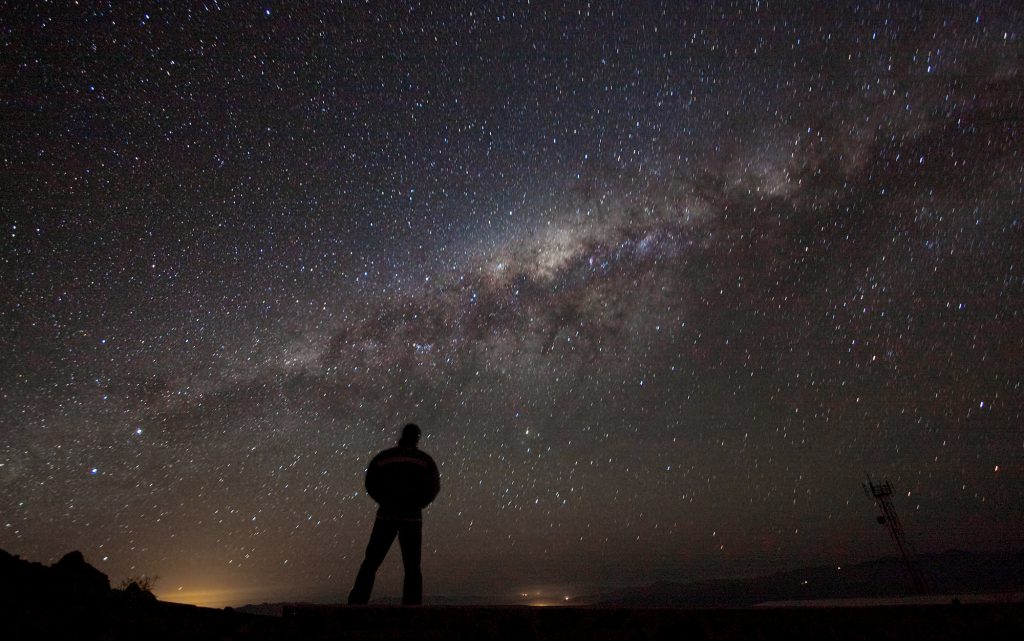
At the European Southern Observatory, La Silla, Chile. Photo courtesy Alan Fitzsimmons/ESO
Corey S Powell is a science editor and journalist. He has been editor at Discover, Scientific American and Aeon. He is the author of God in the Equation (2003), and co-authored Undeniable (2014), Unstoppable (2016) and Everything All at Once (2017) with Bill Nye, with whom he also makes the Science Rules! podcast. He lives in Brooklyn, New York.
What determines our fate? To the Stoic Greek philosophers, fate is the external product of divine will, ‘the thread of your destiny’. To transcendentalists such as Henry David Thoreau, it is an inward matter of self-determination, of ‘what a man thinks of himself’. To modern cosmologists, fate is something else entirely: a sweeping, impersonal physical process that can be boiled down into a single, momentous number known as the Hubble Constant.
The Hubble Constant can be defined simply as the rate at which the Universe is expanding, a measure of how quickly the space between galaxies is stretching apart. The slightest interpretation exposes a web of complexity encased within that seeming simplicity, however. Extrapolating the expansion process backward implies that all the galaxies we can observe originated together at some point in the past – emerging from a Big Bang – and that the Universe has a finite age. Extrapolating forward presents two starkly opposed futures, either an endless era of expansion and dissipation or an eventual turnabout that will wipe out the current order and begin the process anew.
That’s a lot of emotional and intellectual weight resting on one small number. Both the retrospective and the prospective interpretations of the Hubble Constant have stoked ongoing controversy in the 90 years since Edwin Powell Hubble published the first definitive evidence of an expanding universe in 1929. Recently, the controversy has taken on yet another guise, as increasingly precise techniques for measuring the expansion rate have begun to yield distinctly different predictions. The discrepancy has cosmologists wondering whether they are missing important elements in their models of how the Universe evolved from the Big Bang to today.
In scientific parlance, the Hubble Constant is expressed in units of kilometres per second per megaparsec, but cosmologists rarely speak of it in that abstruse way. They typically discuss it as a naked number, talismanic in its significance. In the 1930s, cosmologists calculated that the Hubble Constant was 500, and argued sharply about its meaning. Today, they engage in equally passionate, fine-grained debates about whether the true value is 67 or 73. The hope is that applying sufficient quantitative precision to this number will yield answers to sweeping questions about humanity’s place in the cosmic order. Either we are a part of a slowly dying reality or a blip in an unfathomable eternity. The Hubble Constant could tell us which of these contradictory existential terrors awaits.
Scientists’ fascination with the Hubble Constant began before the number had any proper measurement – before there was clear evidence that it was even a real thing. The first hints of expanding space came not from observation at all but from Albert Einstein’s general theory of relativity, completed in 1915, which described the nature of gravity and its effect on space and time. Two years later, Einstein capped his triumph with an audacious paper exploring the implications of his new theory on the Universe as a whole.
Working from the prevailing astronomical knowledge at the time, Einstein assumed that the Universe was static and eternal. In this attitude, he also hewed to a philosophical tradition going back at least to Aristotle and his conception of a universe constructed of perfect, nested crystalline spheres. However, in the decidedly non-crystalline framework of relativity, stasis was not easy to achieve. Gravity would naturally cause space to collapse in on itself unless the Universe as a whole were expanding – or unless there was some antigravity effect that would prevent that from happening.
Einstein opted for the second solution and added an extra term, denoted by the Greek letter Lambda (Λ), to his equation describing the state of the Universe. Lambda was, in essence, a hypothetical force that would exactly counter the pull of gravity to keep everything in balance. In anachronistic terms, Einstein found a way to set the Hubble Constant at zero. Or so he thought.
Einstein’s equations permit expanding universes, contracting universes, and even oscillating universes
At about the same time, Einstein’s friend Willem de Sitter at the University of Leiden presented his own cosmological interpretations of general relativity to the Royal Astronomical Society. To reduce the complexity of the problem, de Sitter considered the case of a simplified model of the Universe without galaxies and complex structure. To his surprise, he found that objects within his model would appear to move apart from each other, although he regarded it as an illusion rather than as a physical description of expanding space.
Then, a visionary Russian physicist and meteorologist, Alexander Friedmann, went several steps further and set the static universe irrevocably into motion. Starting with his publication ‘On the Curvature of Space’ (1922), he took the instabilities implicit in de Sitter’s interpretations and made them explicit, showing that Einstein’s equations permit a wide range of allowable solutions: expanding universes, contracting universes, and even oscillating universes. Astronomers were well aware that stars and planets could change over time. Friedmann’s work implied that a universe as a whole could evolve.
Einstein was critical at first, but the following year he sheepishly recognised ‘an error in calculations’. In a letter to the journal Zeitschrift für Physik, he wrote that ‘Mr Friedmann’s results are correct and shed new light’, accepting in principle the concept of cosmic expansion.
For the first time in history, Friedmann put a timescale on the age of the Universe, introducing the idea that it might have a measurable beginning. In a little-recognised passage in a 1924 paper, he considered the case of a cyclic universe, and estimated that the expanding phase would last ‘of the order of 10 billion years’, a number extraordinarily close to the current estimates that the Universe is 13.8 billion years old. There’s no way to know how much further Friedmann’s theoretical insights might have taken him. He died in 1925 at the age of 37, possibly of pneumonia contracted during a high-altitude ballooning experiment.
By then, astronomers were beginning to discern vague glimmers of evidence that galaxies appear to be racing outward in all directions, hints of the Hubble Constant in action. At Lowell Observatory in Arizona, the astronomer Vesto Melvin Slipher had been scrutinising the objects he knew as ‘spiral nebulae’ (now recognised as spiral galaxies) since 1909. He examined their light to determine their motion and found that they were moving at tremendous speeds, with almost all of them receding from us. Even more surprising, the fainter ones were generally moving more quickly than the brighter ones.
That pattern is a sign of an expanding universe: if all of space is expanding equally, more distant objects will inevitably expand away from an observer at a faster rate. By 1914, Slipher had found that 11 of the 15 spirals he had studied closely were fleeing rapidly. When he presented his results to a meeting of the American Astronomical Society in August that year, he received a standing ovation. But the Lowell Observatory’s modest 24-inch refractor telescope was too limited for him to continue this enquiry. Slipher’s cosmological studies came to an end, and his name slipped into obscurity.
It was another decade before Georges Lemaître, a Belgian cleric and astronomer, aggressively picked up where Slipher had left off. Inspired by the work of de Sitter, he had already begun exploring the theoretical arguments for an expanding universe with an explosive beginning. He soon recognised that the idea had empirical support as well. In 1927, he performed a new analysis of Slipher’s measurements, combining them with more recent published and unpublished studies, and came up with the very first measurement of the Hubble Constant: 575 kilometres per second per megaparsec, or what today’s cosmologists would shout out as ‘575!’
Lemaître published his findings in an obscure Belgian journal, the Annales dela SociétéScientifique de Bruxelles, and the paper received scant attention at the time. Only recently have historians of science begun to appreciate the extent of Lemaître’s contributions and to question the validity of ignoring his name in discussions of the expanding Universe. Last year, members of the International Astronomical Union voted by nearly a 4-1 margin to rename the Hubble law (the pattern of motions used to derive the Hubble Constant) the ‘Hubble-Lemaître law’.
What Edwin Hubble added to the cosmic conversation – what permanently embossed his name on all modern discussions of the origin and fate of the Universe – was unprecedented power of observation. Partly that is a credit to Hubble himself, a relentlessly ambitious and painstaking observer who dedicated his life to exploring what he called ‘the realm of the nebulae’. Partly, too, that is a credit to Hubble’s equipment. After enlisting in the First World War, he took a position at the Mount Wilson Observatory in Pasadena, California, home to an extraordinary new instrument.
The more remote galaxies appear to be moving away from us more rapidly than the nearer ones
The Hooker telescope, funded by the businessman John Hooker and the industrialist-philanthropist Andrew Carnegie, was the largest such instrument in the world at the time. It was a totem of the burgeoning wealth and scientific prestige of the United States, eclipsing the great observatories of Europe. Its enormous, 100-inch-wide mirror even came with an aristocratic pedigree, cast from green wine-bottle glass made in the foundry that had fabricated the mirrors at the Palace of Versailles.
Hubble and the Hooker telescope were a perfect match for the task of transforming nature’s philosophical mysteries into cold, hard numbers. Training his 100-inch eye on distant galaxies, Hubble observed a distinctive type of flickering star called a Cepheid variable. These stars pulsate in a rhythm that depends on their intrinsic luminosity. Measure a Cepheid’s period of variation, compare its apparent brightness to its true brightness, and – voila! – you know the star’s true distance. Hubble’s technique, combined with the Hooker telescope’s depth of vision, allowed him to vastly surpass Slipher and Lemaître as cosmic cartographer.
In his paper ‘A Relation Between Distance and Radial Velocity Among Extra-Galactic Nebulae’ (1929), Hubble compiled observations of 46 different galaxies. Not only did he confirm that the more remote galaxies appear to be moving away from us more rapidly than the nearer ones, but he was able to show that the rate of their recession is directly proportional to how far away they are. Slipher’s measurements whispered about an expanding universe. Hubble’s screamed it.
The paper’s coup de grâce was a graph illustrating the Hubble law (or Hubble-Lemaître law) etched out in indelible data points. A trend line drawn through the points denoted the linear relationship between distance and velocity promised in the paper’s title. From the graph, it was easy to read off the value of the Hubble Constant: a nice, round 500. The Universe had been set in motion, dragging science, philosophy and theology with it.
Hubble did not discuss what it would mean to travel backward along his graph, to a past when the outward-moving galaxies must have been much closer together, or forward into a future when everything would be more scattered and lonely. Mindful of his reputation as an impartial observer, he cautiously referred to ‘apparent velocities’ and shied away from speculations about their deeper meaning. Hubble made only a glancing connection to the recent cosmological models in a comment at the end of his paper, noting ‘the possibility that the velocity-distance relation may represent the de Sitter effect’.
All around Hubble, though, theorists were rushing in where he dared not tread. At a meeting of the Royal Astronomical Society in January 1930, de Sitter conferred with the English physicist Arthur Stanley Eddington, one of the leading experts in relativity, to ponder the implications of Hubble’s swiftly moving galaxies. The static Einstein universe was ruled out, but nobody was sure what to replace it with. In his bookThe Expanding Universe (1920), Eddington described an almost comical state of uncertainty. ‘Shall we put a little motion into Einstein’s world of inert matter, or shall we put a little matter into de Sitter’s Premium Mobile?’ he wondered.
On 4 February 1931, after completing a tour of the Mount Wilson Observatory, Einstein came down on the side of setting the galaxies in motion. At a crowded press conference, he officially renounced his static cosmology and endorsed the idea that the Universe is expanding. Then he glanced at his watch (he was running late, as usual), flashed one of his trademark dreamy smiles, and darted out of the room, brushing aside a frenzy of questions from the swarm of reporters.
The controversy over the Hubble Constant came to full boil later that year, on 29 September, when the British Association convened a session devoted to ‘the evolution of the Universe’ – a topic that would have been dismissed as speculative nonsense a few years earlier. The boisterous meeting drew a Who’s Who from the newly intersecting worlds of relativity and astronomy, including Eddington, de Sitter and Lemaître. So many people showed up that the meeting organisers had to open a second hall and pipe in the presentations through a set of buzzy loudspeakers.
At the top of the agenda: coming to grips with the literal meaning of the Hubble Constant. Fritz Zwicky, a Swiss-born physicist working at Caltech, took on the role of gadfly and rejected the idea that the Constant revealed anything at all about cosmic destiny. He argued that what Hubble had measured was not the expansion of the Universe but rather a previously unknown physical process that stretches the light of distant objects.
A Hubble Constant of 500 implied that the Universe began only about 2 billion years ago
Another contrarian perspective came from Edward A Milne at the University of Oxford. Unlike Zwicky, Milne was seen as sober and unassuming, but he, too, shared a distaste for abstract notions of expanding space, and for a universe of finite age. He proposed that what Hubble was observing was simply a natural sorting of random galactic motions. If a group of galaxies formed together moving at various speeds, it was natural that the fastest ones would now be the most distant, while the slow-moving ones would remain nearby.
If Zwicky and Milne were correct, the evolution of individual stars and galaxies might be unrelated to the age and evolution of the Universe, which could be eternal. More than a decade later, Milne revealed a Christian theology behind his cosmology, explaining that an infinite universe provided God ‘the means of exhibiting and practicing His own omnipotence’. Most attendees at the British Association meeting had already accepted the expanding universe, however. For them, the real question was what it meant in terms of our origin and fate.
Lemaître offered the most dramatic interpretation, advocating a ‘fireworks universe’ that began when the material that formed all the known stars and galaxies exploded from a single primeval atom. By embracing such a clear, specific beginning, his expanding universe presented a temporal puzzle. A Hubble Constant of 500, taken at face value, implied that the Universe began about 2 billion years ago – younger than the contemporary estimates of the age of the Earth.
Einstein and de Sitter favoured some form of oscillating universe, in which space would alternately expand and contract between two states. In particular, de Sitter imagined an infinite contraction followed by the current expansion, which seemed to offer a path to a universe that would be eternal and self-regenerating. But the age of the current expansion was still an issue. Richard Tolman, a Caltech physicist, analysed the ‘oscillating universe’ model and calculated that the current expansion had an implied age of a mere 1.24 billion years.
‘It is difficult to escape the feeling that the time span for the phenomena of the Universe might be most appropriately taken as extending from minus infinity in the past to plus infinity in the future,’ Tolman wrote in 1934. Many observational astronomers at the time likewise ignored the cosmic age estimates as little more than metaphysical speculations. It would take another three decades and two major new pieces of evidence before cosmologists fully embraced the idea that the Hubble Constant pointed back to a genuine moment of cosmic genesis.
The first breakthrough came in 1952 courtesy of Walter Baade, one of Hubble’s colleagues at Mount Wilson. During the Second World War, Baade found an astronomical upside to the wartime blackouts intended to thwart a Japanese sneak attack on the US west coast. The darkened California skies enabled Baade to conduct exceptionally precise studies of stars in the nearby Andromeda Galaxy. There, he uncovered a mistake that had tainted Hubble’s measurements of the expanding universe, and with them all of the estimates of the cosmic timescale.
Baade determined that Cepheid variables – those flickering stars that Hubble used as his celestial ruler to determine the distances to faraway galaxies – come in two varieties, one of them drastically brighter than the other. Hubble thought he was looking at the dim kind, so he assumed his galaxies were relatively close. In reality, he was seeing the bright kind. Baade revealed the news to an astonished crowd at the 1952 meeting of the International Astronomical Union in Rome: every known galactic distance must be at least twice as great as had been believed. By extension, the Hubble Constant was less than half as great, and the Universe more than twice as old, as Hubble’s observations led people to believe.
Over the next few years, Hubble’s protégé Allan Sandage, working at the powerful new 200-inch Hale telescope on Mount Palomar in California, kept revising the value of the Hubble Constant further downward and the cosmic age of the Universe upward. His 1958 update suggested that the Universe could easily be 13 billion years old. Tolman’s doubts no longer seemed compelling; a straight backward extrapolation of the Hubble Constant was perfectly compatible with the age of the Earth, which by then had been fixed at 4.5 billion years.
The radio noise matched predictions of what the leftover energy from the Big Bang should look like
The other breakthrough came from two young astronomers at Bell Labs in Holmdel, New Jersey. In 1963, Arno Penzias and Robert Wilson were refurbishing a horn-shaped radio-wave collector when they ran into a strange problem. There was a persistent noise in their antenna, as if it were picking up a constant hiss of microwaves. The noise continued no matter how they cleaned it or where they pointed it. This oddity came to the attention of Robert Dicke, a physicist at Princeton University, who had just been lamenting that cosmology had ‘so little observational basis that philosophical considerations still play a crucial if not dominant role’. Now he realised that the Bell Labs researchers had stumbled across evidence that could tip the balance.
In the three decades since Lemaître announced his fireworks universe, other researchers had elaborated the concept into the Big Bang, a detailed theory of how the Universe evolved from a hot, dense beginning to the ever-cooling, expanding reality we see today. It translated the Hubble Constant from a number describing the modern Universe to a narrative explaining its origin. What the Big Bang lacked was any clinching observational support that could pull it fully out of the metaphysical realm.
The radio noise picked up by Penzias and Wilson, now known as the ‘cosmic microwave background’, provided that support. It closely matched theoretical predictions of what the leftover energy from the Big Bang should look like today. Competing models that assumed an eternal, self-regenerating universe – by then known as ‘Steady State’ cosmologies – could not account for the microwave background.
Many other pieces of evidence had been tipping scientific opinion toward the Big Bang, but Penzias and Wilson completely flipped the board. The Steady State believers were increasingly regarded as throwbacks, clinging to an outdated, Aristotelian order. ‘Signals Imply a “Big Bang” Universe’ read a three-column headline across the front page of The New York Times on 21 May 1965. From then on, the Hubble Constant, the age of the Universe, and the origin of the Universe were all inextricably intertwined.
After the triumph of the Big Bang, the debate over the Hubble Constant did not go away, but for three decades it descended into little more than a series of spats over celestial bookkeeping. In the 1970s and ’80s, Sandage and his supporters confidently reported a low value for the Hubble Constant, around 50, which indicated the Universe was as much as 20 billion years old. Other researchers were equally certain that the Hubble Constant was twice as great, and the Universe half as old. Eventually, Hubble settled the dispute – that is, the Hubble Space Telescope, which in its Solomonic wisdom showed that Sandage and his rivals were both mistaken. The modern, high-precision measurements of the Hubble Constant fall almost halfway between the extremes.
A far greater shock emerged from the attempts to interpret the expansion of space not just as a record of the Universe’s past, but also as a prediction of its future. Despite its name, the Hubble Constant is not actually constant. The gravitational pull of all the galaxies on each other counter the expansion of space, tending to slow it down. In the 1990s, astronomers set out to measure that deceleration, which would offer a method to weigh the entire Universe: the more rapidly things are decelerating, the greater the amount of matter out there.
Two large research teams developed novel observing techniques (extreme versions of the approach that Edwin Hubble used in the 1920s) and in 1998 announced their results. The expansion of the Universe is not slowing down, as everyone expected. It is speeding up, with the Hubble Constant increasing over time. The only way that the Universe could accelerate is if there is something doing the accelerating – that is, space is being pushed apart by some kind of energy that acts like gravity in reverse. Cosmologists have taken to calling it ‘dark energy’. Even though nobody knows exactly what dark energy is, it earned a 2011 Nobel Prize for the leaders of the two teams: Saul Perlmutter of the Lawrence Berkeley National Lab, Brian Schmidt of the Australian National University, and Adam Riess of Johns Hopkins University.
The Universe could spin out into a very different direction, even one of repeating cycles of creation and destruction
Until then, the Universe seemed to have two possible futures. It could expand forever, slower and slower but never stopping; or it could eventually come to a halt, reverse course, and cave in on itself in a Big Crunch. ‘If the Universe had too much matter in it and recollapsed that’s at least exciting and has a finite end. It’s like death,’ Schmidt says. Dark energy points to a different future. If cosmic acceleration continues unchecked, the Hubble Constant will grow and grow, and space will expand faster and faster. Eventually, it will isolate galaxies from each other, stars from each other, and perhaps rip apart every atom in the Universe. ‘It’s going out in the bleakest fashion I can think of,’ Schmidt reflects. ‘It’s eternity, but it’s nothingness at the same time.’
That was hardly the last word on our cosmic fate, however. Cosmologists are convinced that more clues are hidden within the Hubble Constant. For instance, dark energy might change over time, in which case the future course of the Universe could spin out into a very different direction, even one of repeating cycles of creation and destruction. And just over the past couple of years, the Hubble Constant has been the subject of yet another controversy, hinting that dark energy might be more than one thing, with more than one effect on the evolution of the Universe.
Following in the tradition of Edwin Hubble, Riess and his collaborators are observing stars in neighbouring galaxies to measure the Hubble Constant, with the ambitious goal of pinning down the number to an accuracy of 1 per cent. His research is zeroing in on a value of 73. Today there is another, entirely separate way to measure the Hubble Constant, by analysing subtle patterns etched into the cosmic microwave background, detected by the Planck space telescope. This approach gives an equally precise-looking answer of 67. The disagreement, though tiny by historical standards, is unnerving enough that cosmologists have started calling it the Hubble tension.
Strictly speaking, the two sides are not measuring the same thing. Riess is looking at the expansion of the nearby Universe, at relatively modern times. The Planck telescope measures effects of expansion long ago, shortly after the Big Bang, and then researchers derive a modern value of the Hubble Constant from that measurement. One way to reconcile the two is to suppose that the very early Universe was expanding slightly faster than expected. ‘It could be that there is something funky about dark energy being stronger than we thought,’ Riess says. ‘I don’t think it’s introducing something new to say: “What if dark energy is weird?” because there’s no such thing as it not being not weird.’
Last year, a survey called DESI (for Dark Energy Spectroscopic Instrument) started making comprehensive new measurements of the Hubble Constant and dark energy. In 2022, the European Space Agency will extend the effort into orbit with the Euclid space telescope; the aim is ‘to investigate the expansion of our Universe over the past 10 billion years’. Nobody knows what these projects will find, but there are two certainties. Cosmologists will use the results to develop new narratives about how the Universe began and how it will end. And whatever story they spin, they will try to pin a number on it.
This Essay was made possible through the support of a grant to Aeon from the John Templeton Foundation. The opinions expressed in this publication are those of the author and do not necessarily reflect the views of the Foundation. Funders to Aeon Magazine are not involved in editorial decision-making.
Visitors to the 2018 Art Basel show in Hong Kong. Photo by Martin Parr/Magnum
Hrishikesh Joshiis assistant professor of philosophy at Bowling Green State University, and the author of Why It’s OK to Speak Your Mind (2021).
Edited by Sam Haselby
7 June 2021 (psyche.co)
What constitutes a flourishing human life? This question has exercised philosophers for as long as there has been philosophy. Human flourishing is presumably both a personal and a political goal – we want ourselves and our loved ones to flourish, and we also want to create institutions that best promote human flourishing. But these aims necessitate a systematic enquiry into what makes a life well lived in the most general sense.
One compelling and distinctive answer comes from the ancient Greeks, first fully developed in the writings of Aristotle. Aristotle thought that what it takes for something to flourish, or be excellent, depends on the kind of thing it is. For example, a good knife is one that cuts well. But what explains this fact? The obvious answer here is that a knife is an object with a function – namely, cutting. A good knife is one that will be able to carry out this function well: by being sharp, having a sturdy handle, etc. What makes a knife good is not what makes a table good, because a table has a different type of function. So, according to Aristotle, in order to have a sense of what makes something good, we need to discover its ergon, or function.
Well, what is the ergon of human beings? Since a thing’s function is supposed to be its distinctive work, Aristotle thinks that we need to ask what makes humans distinctive. When we look around at the animal kingdom and inanimate reality, the distinctive feature that only humans possess, Aristotle argues, is reason. Thus, a flourishing human being exhibits the proper development and exercise of the rational capacities, over the course of a reasonably complete life.
We can’t reason well if we surround ourselves with people who think exactly like us
How might we cultivate our reason? A tempting initial picture here is the solitary thinker, engaged in contemplation: reason is that capacity, unique to humans, that helps individuals come to discover truths about complex matters that aren’t directly accessible by perception and intuition. Recent work in cognitive science dramatically undermines this picture, however. In their bookThe Enigma of Reason (2017), Hugo Mercier and Dan Sperber argue for an ‘interactionist’, rather than an ‘intellectualist’ picture of reason. The basic idea is that our capacity to reason is essentially social. Reason is dialogical by nature – we use it when we share our reasons with others and evaluate theirs in turn.
Decades of research suggest that reason is lazy and biased in our favour. In the interactionist picture, these are features, not bugs – they allow for an elegant division of cognitive labour, enabling us to arrive at the truth by working together. Our legal system, though predating these arguments by hundreds of years, embraces the biased nature of reason. Each lawyer is, in a way, meant to be biased. But that’s not a problem, because justice is meant to emerge from the interaction between each side’s lawyers, the jury and the judge – it’s not up to the individual lawyer to decide. Similarly, truth can emerge as a result of each side giving their reasons, because, although we’re biased when evaluating our own reasons, we’re relatively good at evaluating the reasons of others.
If the interactionist picture is right, then the development of our rational capacities requires outward expression and engagement. Good reasoning, then, is much more like tennis than like mountain climbing – one can, in principle, do the latter alone, but to become better at tennis, one must find someone else to play with, preferably of a similar skill level. Analogously, in order to develop our rational capacities, we must find others who can challenge our ideas and expose us to different ways of thinking about things. We can’t reason well if we surround ourselves with people who think exactly like us. Indeed, a large body of social scientific research suggests that groups of likeminded individuals, no matter how smart or educated they are, often reason very poorly, especially if they have affective ties to one another.
If this is right, recent trends give us reason to worry. Opinion polls suggest that more and more people are reluctant to voice their true opinions on social and political matters, due to fear of isolation. By one estimate, this number has tripled in the United States, since the height of the McCarthy era. A further worrying aspect of the data is that individuals with higher levels of education are more likely to engage in self-censorship. Given that the US has strong legal protections for free speech, the fear mostly results from the social pressures that people feel to intellectually conform on particular matters.
Being unable to say what you really think is akin to being locked in a mental prison
Expressing our true opinions can threaten our social standing, and the maintenance of reputation is a key motivator for many people. However, if speaking our minds is important to developing ourselves as rational creatures, and if such development is at least one important aspect of the good life, then we ought not to sacrifice it willy-nilly at the altar of social status. Status is an important good, but Aristotle argued that it’s plausibly subordinate to the ultimate good of human life, whatever it might be. Status is good because it helps us achieve valuable goals; it’s not the ultimate goal in and of itself.
The interactionist view of reason also has broader social implications. As the philosopher Seana Shiffrin argues, one neglected but crucial justification for having robust free-speech protections is thinker-centred. To develop as unique and independent thinkers, to figure out the truth for ourselves, and to be recognised for the individuals that we are, we must be able to express our ideas and gain feedback from others. We can’t fully develop our own ideas without being able to externalise them and evaluate them at a distance. At the extreme, if we have no method of communicating with others, we can break down and lose touch with reality itself – as often occurs in the case of prisoners facing solitary confinement.
To be sure, being unable to speak our minds freely isn’t strictly on par with solitary confinement. Rather, Shiffrin’s point is that the setback involved lies along the same spectrum. Being unable to say what you really think is a mild version of the kind of problem that total isolation brings; it is akin to being locked in a mental prison, with nobody to share your thoughts with. In this way, we have important interests as thinking beings, which can only be properly realised within a regime that allows robust free expression.
However, as John Stuart Mill emphasised more than a century and a half ago, legal protections often aren’t enough – as social creatures, we’re very sensitive to ostracism as well as the professional costs that might accompany our speech. Given recent trends then, there’s a pressing need for further enquiry into how we might promote and cultivate habits of speaking our minds, and how we might (re)structure our intellectual institutions to allow multiple perspectives to exist and engage with each other. If Aristotle is right, these might be necessary, but perhaps underappreciated, conditions for our flourishing.
This original idea draws on thebook‘Why It’s OK to Speak Your Mind’ (2021) by Hrishikesh Joshi, published by Routledge.
Aaron Morris|TED Fellows: Shape Your Future (ted.com)
We need an inside-out approach to how we diagnose disease, says immuno-engineer and TED Fellow Aaron Morris. Introducing cutting-edge medical research, he unveils implantable technology that gives real-time, continuous analysis of a patient’s health at the molecular level. “We’re creating a diagnostic lab inside your body,” Morris says — and it may pave the way to diagnosing and treating disease better and faster than ever before.
This talk was presented at an official TED conference, and was featured by our editors on the home page.
Advance Seminar Class A monitor ZOOM class with Thane and Heather C. Williams, H.W.,M.June 12 & 13, 2021
“Everything flows and is constantly changing. You can’t step in the same stream twice.”~ Heraclitis “We are souls dressed up in sacred biochemical garments and our bodies are the instruments through which our souls play their music.” ~ Albert Einstein
Dear Friends,
We have to understand that we all play a part in the global problems today, such as, climate change, racism, police violence, poverty, extreme wealth inequality, food & water insecurity – to name a few! These problems trigger the ancient fear/aggression instinct. We must WAKE UP and come to know our True Identity. The ancient teaching is: Know Thyself!
How do we come to know our True Identity? We have to activate our curiosity; ask questions; seek answers. For example: How do we move beyond our old habits, old fears, old anxieties) and access our higher centers? ANSWER: We have to stop identifying ourselves as “separate physical things” and start identifying ourselves as “Mind unfolding”
Third, we have to really desire to WAKE UP to our True Identity as Consciousness. If this interests you – consider coming to the ADVANCE SEMINAR CLASS. This zoom class will be four hours on Saturday June 12 and four hours on Sunday June 13. Register Here
INTRODUCING YOUR TEACHERS – THANE & HEATHER
Thane Walker founded The Prosperos School of Ontology in 1956. He created a number of classes (or tools) to guide and assist people in their unique, individual life journey of waking up to our True Identity as Consciousness. In creating these classes, Thane engaged his personal experiences with the work of Gurdjieff (who he personally studied with) and Carl Jung. Thane died in 1990 at the age of 90.
The Prosperos School of Ontology teaches HOW to think, NOT what to think. ONTOLOGY IS THE STUDY OF BEING. “Beingness” is the formless part of us that is always present within us back and behind the world of physical objects, trees, bodies, things. It is the intelligence of LIFE. While the physical world thoroughly captures our attention, we can also learn to PAUSE and become aware of just being aware.
I am Heather C. Williams, H.W.,M. I am a High Watch Mentor in The Prosperos School of Ontology since 1978. I am a retired public school Art and Special Ed teacher. I am an artist and author. My book: Drawing as a Sacred Activitywas published by New World Library in 2002. I worked for 17 years in the Vista Unified School District in Vista, CA., retired in 2017 and in 2019 moved to Madison, Wisconsin. I am NOT a therapist. I am an Ontological Mentor. I use a variety of tools plus drawing and journaling activities to help people connect with their inner being and live fully. Carl Jung said: “One does not become enlightened by imagining figures of light, but by making the darkness conscious”.
In my personal life I have used drawing (and The Prosperos classes) as a way to come to KNOW myself. I use drawing (and The Prosperos tools) as a way to question and learn about the world around me and the world within me. Curiosity allows you to embrace the unknown and this is, to me, perhaps the most valuable attitude in learning.
“The goal is to know ourselves. The goal is to know that we each are individuations of One Infinite Mind. We must remember our True identity. This is the only thing we can do. As we work to lift the veil of the illusions of separation from our experience, we will see that each of us has the opportunity to be a unique expression of the ever changing stream of consciousness as it flows within the mysterious reality of Oneness.” ~ Randy Ramsley, Prosperos student



 Advance Seminar Class
 “Everything flows and is constantly changing. You can’t step in the same stream twice.”~ Heraclitis
