Psychedelics open a new window on the mechanisms of perception

Some neuroscientists think psychedelic drugs and the hallucinations they induce could help reveal how the brain generates our perceptions of the world around us — and of ourselves

By Anil Ananthaswamy 06.21.2021 (knowablemagazine.org)

Help us make scientific knowledge accessible to all
Support free, nonprofit, fact-based journalism
Donate today

“Everything became imbued with a sense of vitality and life and vividness. If I picked up a pebble from the beach, it would move. It would glisten and gleam and sparkle and be absolutely captivating,” says neuroscientist Anil Seth. “Somebody looking at me would see me staring at a stone for hours.”

Or what seemed like hours to Seth. A researcher at the UK’s University of Sussex, he studies how the brain helps us perceive the world within and without, and is intrigued by what psychedelics such as LSD can tell us about how the brain creates these perceptions. So a few years ago, he decided to try some, in controlled doses and with trusted people by his side. He had a notebook to keep track of his experiences. “I didn’t write very much in the notebook,” he says, laughing.

Instead, while on LSD, he reveled in a sense of well-being and marveled at the “fluidity of time and space.” He found himself staring at clouds and seeing them change into faces of people he was thinking of. If his attention drifted, the clouds morphed into animals.

Seth went on to try ayahuasca, a hallucinogenic brew made from a shrub and a vine native to South America and often used in shamanistic rituals there. This time, he had a more emotional trip that dredged up powerful memories. Both experiences strengthened Seth’s conviction that psychedelics have great potential for teaching us about the inner workings of the brain that give rise to our perceptions.

He’s not alone. Armed with fMRI scans, EEG recordings, computational models of the brain and reports from volunteers tripping on psychedelics, a small but growing number of neuroscientists are trying to take advantage of these drugs and the hallucinations they induce to better understand how the brain produces perceptions. The connections are still blurry, but the studies are beginning to provide new support for a provocative, more-than-acentury-old hypothesis: that one of the fundamental functions of the brain — and the root of everything we perceive — is to make best guesses about the causes of information impinging on our senses at any given moment. Proponents of this idea have argued that these powers of prediction enable the brain to find meaning amid noisy and ambiguous sensory information, a crucial function that helps us make sense of and navigate the world around us.

Is the brain a passive organ that simply collates information from the senses? Or is it active coconspirator? 

When these predictions go haywire, as they seem to under psychedelics, the perceptual aberrations provide neuroscientists with a way to probe the workings of the brain — and potentially understand what goes wrong in neuropsychological conditions, such as psychosis, that cause altered perceptions of reality.

The predictive brain

The idea that the brain is, in essence, a prediction machine traces its modern roots to the 19th century German physicist and physician Hermann von Helmholtz. He noted that our brains have to make inferences about the possible causes of the signals we receive via our senses. He pointed in particular to our ability to perceive different things given the same sensory information (a good example of this would be the famous optical illusion that can appear either as the silhouette of two people facing each other or as the contours of a vase). Given that the sensory input isn’t changing, Helmholtz argued that what we perceive must be based on the brain’s prediction of what’s there, based on prior knowledge.

Over the past century, these ideas have continued to intrigue philosophers, neuroscientists, computer scientists and others. The modern version of the theory is called predictive processing. In this view of perception, the brain is not a passive organ that simply collates information from the senses. Rather, it’s an active coconspirator. It’s constantly predicting the causes of incoming information, whether from the world outside or from within the body. In this view of perception, “the brain is actively … creating hypotheses that are the best explanation for the sensory samples that it’s receiving,” says computational neuroscientist Karl Friston of University College London. These predictions lead to perceptions, which can remain unconscious or enter conscious awareness.
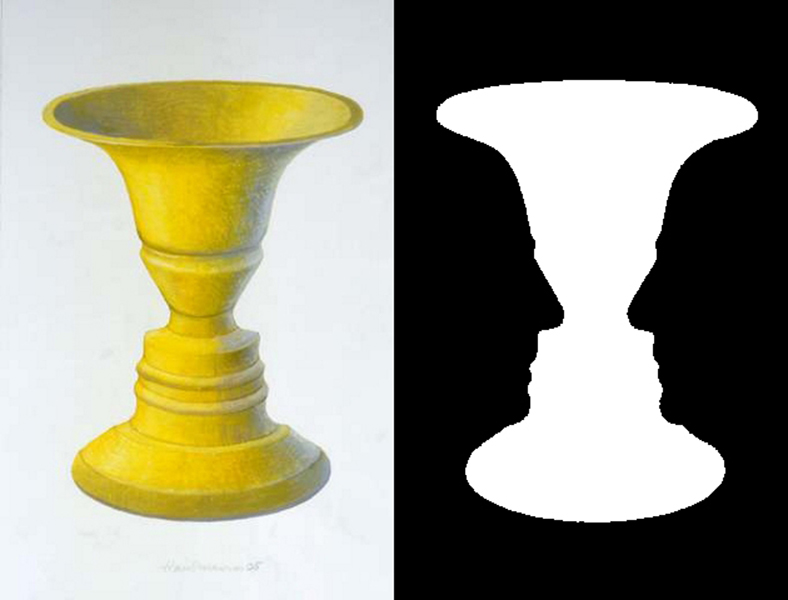
Image of a yellow vase on the left and of two faces on the right. The silhouettes of the two faces, seen side on, match the shape of the vase.
The brain is constantly trying to predict the causes of sensory inputs, and these predictions lead to perceptions. When the sensory inputs are ambiguous, the predictions can keep changing. In this case, your brain may predict that you’re seeing a vase — or two people facing each other.CREDIT: JOHN SMITHSON / PUBLIC DOMAIN

In a landmark 1999 paper that established predictive processing as a leading hypothesis of brain function, two computer scientists, Rajesh Rao and Dana Ballard (now at the University of Washington in Seattle and the University of Texas at Austin, respectively) developed a detailed model of predictive processing — specifically, addressing regions of the brain involved in recognizing objects and faces. Those regions comprise levels of a pathway that begins in the retina, moves on to the lateral geniculate nucleus of the thalamus and then to higher and higher levels of the cerebral cortex, named V1, V2, V4, IT and onward.

In Rao and Ballard’s model, each brain area that constitutes a level in such a hierarchy makes predictions about the activity of the level below: V2, for example, predicts the neural activity it expects of V1, and sends a signal down to V1 indicating this prediction. Any discrepancy between the prediction and the actual activity in V1 generates an error signal that moves up from V1 to V2, so that V2 can update its expectations of V1. So predictions flow down, from higher to lower layers, and errors move up, from lower to higher layers. In this way of thinking, the lowest layer — the one closest to the retina — makes predictions about the incoming sensory information, and the highest layers — IT and above — hypothesize about more complex features like objects and faces. Such predictions, continually updated as we move around, are what we perceive.

In the years since Rao and Ballard’s paper, neuroscientists have begun to find experimental evidence that supports such computational models. For example, the theory predicts that sensory stimuli that are expected or unsurprising should generate less neural activity in lower levels of the hierarchy (because they generate fewer error signals). And fMRI scans of neural activity in the lower layers of the visual cortex in people looking at computer-generated images bear this out

If psychedelics reduce the brain’s reliance on prior beliefs about the world, one result could be an increase in cognitive flexibility. 

But predictive processing can go wrong, posit behavioral and clinical neuroscientist Paul Fletcher and his student Juliet Griffin of the University of Cambridge in the UK — and when that happens, we may perceive things that aren’t real, be they aberrations of sight, sound or other senses. It’s an idea that piques the interest of those who study conditions such as schizophrenia, which is often accompanied by psychosis. “If predictive processing helps us to understand how the mind connects to external reality, I think it follows that it is a useful way of understanding situations in which the mind seems disconnected from reality,” says Fletcher. Indeed, Fletcher notes, such disconnection is essentially the definition of psychosis. (Griffin and Fletcher explored the potential connection between predictive processing and psychosis in the 2017 Annual Review of Clinical Psychology.)

Prior expectations

An important aspect of predictive processing is that each hypothesis generated by a level in the hierarchy is associated with a notion of confidence in the hypothesis, which in turn is based on prior expectations. The higher the confidence, the more a given level ignores error signals from the level below. The lower the confidence, the more a given level listens to upward-moving error signals. Could psychedelics be altering our perception of reality by messing with this process? Friston and Robin Carhart-Harris, a psychologist and neuroscientist at Imperial College London, think so. In 2019, they put forward a model called REBUS, for “relaxed beliefs under psychedelics.” According to their model, psychedelics reduce the brain’s reliance on prior beliefs about the world. “We feel them with less confidence,” says Carhart-Harris. “They are less reliable under psychedelics.”

If that’s what psychedelics do, one result could be an increase in cognitive flexibility. Conversely, blocking the receptors in the brain that are activated by psychedelics might do the opposite — make beliefs more rigid.

Graphic describing predictive processing.
Neuroscientists often think of the brain as organized into hierarchical levels. The concept of predictive processing holds that each level makes predictions about the activity of the level below. These predictions flow down the hierarchy, and lower levels generate an error signal that indicates the difference between the predicted and actual sensory inputs. These error signals flow upward, and higher levels use them to refine their predictions. Predictions at the highest level help to create perceptions.

Some evidence for this comes from experiments with rats in which researchers gave the animals a drug that blocks the main type of receptor on the surface of neurons that responds to LSD and other classic psychedelic drugs. These receptors, called 5-HT2A serotonin receptors, are densely distributed in the regions of the cortex responsible for learning and cognition. Blocking 5-HT2A receptors, it turns out, makes rats cognitively inflexible: They are no longer able to spontaneously change from one behavior to another in order to get a reward. In the context of predictive processing, the finding suggests that the 5-HT2A-blocker made the rats’ brains more tightly constrained by prior beliefs about the world.

Conversely, when psychedelics bind to 5-HT2A receptors, they seem to make the brain less reliant on prior expectations and more reliant on actual sensory information. This could account for the vivid perceptual experiences they cause. According to the predictive processing model, a brain on psychedelics gives more weight to information entering the lower layers, which deal with concrete visual features — say, the shape and color of a flower. Constraints imposed by abstract beliefs and expectations about the flower are relaxed. “All of these higher-level constructs have been dissolved,” says Friston. “It can be a very pleasurable experience.” 

If psychedelics mess with prior beliefs, that might also explain why they cause one to hallucinate a reality that’s untethered from real-world expectations. Take, for example, Seth’s experience of seeing clouds morphing into familiar faces. According to Friston, the brain’s visual system has strong prior beliefs — for instance, that clouds are up in the sky. Another prior belief would be that there are no faces up there. Normally, this would make it nearly impossible to perceive, say, Lucy in the sky (with or without diamonds). But as psychedelics take hold, higher levels of the predictive processing hierarchy begin to make otherwise untenable predictions about the world outside. These predictions become perceptions. We start hallucinating.

Of course, psychedelic hallucinations are not only visual. They can involve all types of altered perceptions. In 2017, for example, neuropsychologist Katrin Preller of the University Hospital for Psychiatry Zurich in Switzerland and colleagues found that people listening to music that they normally considered meaningless or neutral felt heightened emotions and attributed an increased sense of meaningfulness to the music while on LSD.

A breakdown of the boundaries of the self could be one explanation for why some people on psychedelics report mystical feelings of a sense of unity with their surroundings.

Friston argues that these altered perceptions extend even to our sense of self, which in the predictive processing framework is based on the brain’s internal models of all aspects of our own being. Psychedelics would, again, loosen the hold of these internal models. “You now lose a precise sense of self,” says Friston. Indeed, a survey by Carhart-Harris and colleagues suggests that a breakdown of the boundaries of the self could be one explanation for why some people on psychedelics report mystical feelings of a sense of unity with their surroundings.

Disrupted connections

If psychedelics do act on the brain to change predictive processing, it’s not clear how they do it. But in recent studies, researchers have found ways to approach these questions. One way to gauge changes occurring in brains on psychedelics is to measure something called Lempel-Ziv complexity, a tally of the number of distinct patterns that are present in, say, recordings of brain activity over the course of milliseconds using a method called magnetoencephalography (MEG). “The higher the Lempel-Ziv complexity, the more disordered over time your signal is,” says Seth.

Albert Hofmann with an LSD Molecule model, early 1950s.
The most famous psychedelic compound, LSD (short for lysergic acid diethylamide), was synthesized in 1938 by Swiss chemist Albert Hofmann. In 1943, after apparently absorbing some LSD through his fingertips by accident, Hofmann experienced hallucinations and had to rush home from work. Hofmann later continued his experiments and went on to document in detail the psychedelic effects of LSD.CREDIT: NOVARTIS INTERNATIONAL AG COMPANY ARCHIVES

To determine the degree of disorder of human brains on psychedelics, Seth’s team, in collaboration with Carhart-Harris, looked at MEG data collected by researchers at the Cardiff University Brain Research Imaging Centre in Wales. The volunteers were given either LSD or psilocybin, the hallucinogenic ingredient in “magic mushrooms.” On psychedelics, their brain activity was more disordered than it was during normal waking consciousness, according to an analysis of the MEG signals that was published in 2017. Seth says that while the increase in disordered brain signals does not definitively explain people’s psychedelic experiences, it’s suggestive. “There’s a lot of mind-wandering and vagueness going on,” says Seth. “The experience is getting more disordered and the brain dynamics are getting more disordered.” But he says there’s more work to do to establish a clear connection between the two.

More recently, Seth, Carhart-Harris and colleagues took another look at the brain on psychedelics, using a statistical metric called Granger causality. This is an indication of information flow between different regions of the brain, or what neuroscientists call functional connectivity. For example, if activity in brain region A predicts activity in brain region B better than the past activity of B itself does, the Granger causality metric suggests that region A has a strong functional connection to region B and drives its activity. Again, using MEG recordings from volunteers on psychedelics, the team found that psychedelics decreased the brain’s overall functional connectivity.

One possible interpretation of these Granger and Lempel-Ziv findings is that the loss of functional organization and increase in disorder is disrupting predictive processing, says Seth. Verifying that would involve building computational models that show exactly how measures of Granger causality or Lempel-Ziv complexity change when predictive processing breaks down, and then testing to see if that’s what happens in the brains of people on psychedelics.

Floral illustration shows the leaves, flower and seed of the Banisteriopsis caapi plant, the main ingredient in ayahuasca preparations.
A woody vine that grows in the Amazon and Orinoco river basins in South America, Banisteriopsis caapi is used alone or with other plants to make ayahuasca tea — a drink with psychotropic effects long a part of rituals and shamanic healing practices. Studies have shown B. caapi to have antidepressant effects.CREDIT: E.W. SMITH / HALLUCINOGENIC PLANTS (A GOLDEN GUIDE) 1977

In the meantime, evidence that psychedelics mess with functional connectivity is mounting. In a randomized, double-blind study published in 2018, Preller and colleagues gave 24 healthy people either a placebo, LSD or LSD along with a 5-HT2A blocker that impeded the drug’s effects. The subjects were then scanned inside an MRI machine, allowing researchers to measure activity in different brain regions and assess their connectedness.

Those people on LSD alone showed widespread changes: Their brains showed an increased connectivity between lower-order brain regions responsible for processing sensory input, but decreased connectivity between brain regions that are involved in the conceptual interpretation of sensory inputs. Preller thinks this might explain the heightened sensory experiences caused by LSD. Indeed, the team also found corroborating evidence, using data from the Allen Human Brain Atlas, a detailed map of gene activity: Areas of the brain that produce the 5-HT2A receptor overlapped with the regions of altered connectivity, suggesting that LSD affects these brain regions the most.

Then Preller and colleagues did a more targeted study, using fMRI data to look for changes in functional connectivity between the thalamus and the cortex. The thalamus sits in the center of the brain and processes information from the senses before sending relevant signals up to the cortex. But information also flows in the other direction. In the predictive processing model, signals going down from the cortex to the thalamus would represent predictions, and signals flowing up to the cortex would represent errors. Researchers have long hypothesized that psychedelics may cause the thalamus to function less effectively, says Preller. This may be happening on LSD: Her study, published in 2019, showed that the flow of information from the thalamus up to certain cortical areas increased in people on LSD and the flow going in the opposite direction decreased.
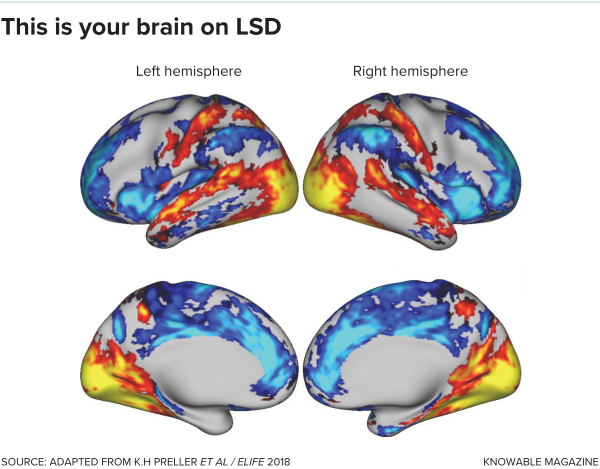
Image of four brains with colored regions on them.
These fMRI brain scans show how LSD alters communication among regions of the human brain (shown here from different angles in the four panels). Red and orange regions show stronger functional connectivity under LSD, and blue regions show reduced connectivity.

Altered brain waves

Additional hints of how psychedelics could interfere with predictive processing have come from an entirely different way of looking at brain function. In 2019, Carhart-Harris got intrigued by a paper he read about potential brain signatures of predictive coding (which is how researchers refer to the way predictive processing may be realized in the brain). He saw a way to test the hypothesis that psychedelics are messing with the brain’s prior beliefs.

The paper by computational neuroscientist Andrea Alamia of Centre de Recherche Cerveau et Cognition, CNRS, in Toulouse, France, and a colleague, involved a simplified model of predictive coding. Each level represents a population of neurons — in, say, the LGN and V1 layers of the visual system. The input to the model is a random sequence of numbers, where each number represents the intensity of a light signal. The model has two key parameters. One is the time it takes for a prediction or error to travel from level to level. The other is the time it takes for a population of neurons to return to their baseline activity after the input has waned. The team found that as the model tries to predict the intensity of the input and each level tries to update itself based on the error signal it gets when its predictions are wrong, the model produces waves of signals with a frequency of about 10 hertz, which researchers call alpha waves. These waves ripple up and down through the levels of the model.

“I wrote the French team, and I said, ‘Look, we’ve got psychedelic data, and I have a very clear hypothesis for you.’”ROBIN CARHART-HARRIS

In the presence of inputs, the alpha waves travel up from the lower to the higher levels in the hierarchy. In the absence of inputs, the waves travel down. “These are all computational results,” says Alamia. So, to check their model against actual data, the team looked at EEG recordings of electrical brain activity previously collected in volunteers who had been asked to either gauge the intensity of light signals (presence of input) or close their eyes (absence of input). The team found traveling alpha waves that move up in the presence of inputs and down when the eyes were closed — exactly as in their model of predictive coding.

Carhart-Harris found the results exciting. “I wrote the French team, and I said, ‘Look, we’ve got psychedelic data, and I have a very clear hypothesis for you,’” he says. The hypothesis was simple. Start with EEG recordings of people with their eyes closed, without psychedelics. The alpha waves should be traveling down. Then, inject them with a psychedelic. They’ll start having visual hallucinations and the alpha waves should switch direction. That’s because the psychedelic, according to the REBUS model, should cause information to flow from lower to higher levels, even with eyes closed and in the absence of real sensory input. “There’s just a drug on board that makes you see all these crazy visions,” says Carhart-Harris.

Stay in the Know
Sign up for the Knowable newsletter today

As it happens, his team had EEG recordings from an earlier study of volunteers who had been injected with DMT, the main active component of ayahuasca. They sent these recordings to the French team, who analyzed them, and found the data to be remarkably consistent with the hypothesis. “The drug goes in … and the waves just shift,” says Carhart-Harris.

“I think all this stuff is brilliant,” says Seth. But he says that such research, including his, will have to get nuanced to say something more definitive. Psychedelics have a powerful and widespread effect on the brain, he notes: “It’s very hard to find something that doesn’t change under psychedelics,” he says. “One of the concerns I have at the moment is that basically everyone — and this is the pot calling the kettle black, I’m guilty of this too — takes their favorite analysis and throws it at psychedelics and says, ‘Look, it changed.’ OK — but everything changes.”

Seth thinks a way forward is to experiment with microdosing: giving minuscule quantities of psychedelics to subjects so that they remain cognitively capable of doing specifically designed tasks rather than simply hallucinating inside scanners. “They’re not seeing unicorns promenading around the sky, but you’re still activating the same system,” says Seth. People given microdoses of LSD could be tested on how quickly they detect visual stimuli, for example, as researchers induce shifts in attention, and their reaction times could be compared against computational models of predictive processing.

Such ideas, which are only just emerging, might one day allow researchers to determine if predictive processing is indeed the right model for how the brain creates perceptions.

It’s a trippy thought.

Anil Ananthaswamy is a science journalist who enjoys writing about cosmology, consciousness and climate change. He was a 2019-20 MIT Knight Science Journalism fellow. His latest book is Through Two Doors at Oncewww.anilananthaswamy.com

Listen to the first ever recording of James Joyce reading from Ulysses

Emily Temple

By Emily Temple

February 2, 2021 (lithub.com)

On February 2, 1922, Sylvia Beach, through her legendary bookstore and occasional imprint Shakespeare and Company, published the entirety of James Joyce’s modernist novel, Ulysses. (It was also Joyce’s 40th birthday.) Two years later, she sought to have at least some of it recorded in Joyce’s own voice. In 1924, she writes, she sought and gained permission to use the equipment at the recording studio His Master’s Voice—though they would have nothing much to do with the record, and she would have to pay for it herself, out of pocket. Beach did so, ordering thirty copies of the final recording on vinyl, which she mostly gave to Joyce to distribute to friends and family. “Joyce himself was anxious to have this record made, but the day I took him in a taxi to the factory in Billancourt, quite a distance from town, he was suffering with his eyes and very nervous,” Beach recounts.

Luckily, he and [Piero] Coppola [the person in charge of musical records] were soon quite at home with each other, bursting into Italian to discuss music. But the recording was an ordeal for Joyce, and the first attempt was a failure. We went back and began again, and I think the Ulysses record is a wonderful performance. I never hear it without being deeply moved.

Joyce had chosen the speech in the Aeolus episode, the only passage that could be lifted out of Ulysses, he said, and the only one that was “declamatory” and therefore suitable for recital. He had made up his mind, he told me, that this would be his only reading from Ulysses.

I have an idea that it was not for declamatory reasons alone that he chose this passage from Aeolus. I believe that it expressed something he wanted said and preserved in his own voice. As it rings out—“he lifted his voice above it boldly”—it is more, one feels, than mere oratory.

However, C. K. Ogden, the linguist, told Beach that Joyce’s recording was “very bad,” and “boasted that he had the two biggest recording machines in the world at his Cambridge studio.” He asked Beach to “send Joyce over to him for a real recording.” Joyce dutifully went, this time recording the “Anna Livia Plurabelle” section from Finnegans Wake. “So I brought these two together,” Beach writes,

the man who was liberating and expanding the English language and the one who was condensing it to a vocabulary of five hundred words. Their experiments went in opposite directions, but that didn’t prevent them from finding each other’s ideas interesting. Joyce would have starved on five or six hundred words, but he was quite amused by the Basic English version of “Anna Livia Plurabelle” that Ogden published in the review Psyche.

How beautiful the “Anna Livia” recording is, and how amusing Joyce’s rendering of an Irish washerwoman’s brogue! This is a treasure we owe to C. K. Ogden and Basic English. Joyce, with his famous memory, must have known “Anna Livia” by heart. Nevertheless, he faltered at one place and, as in the Ulysses recording, they had to begin again.

Ogden gave me both the first and second versions. Joyce gave me the immense sheets on which Ogden had had “Anna Livia” printed in huge type so that the author-his sight was growing dimmer-could read it without effort. I wondered where Mr. Ogden had got hold of such big type, until my friend Maurice Saillet, examining it, told me that the corresponding pages in the book had been photographed and much enlarged. The “Anna Livia” recording was on both sides of the disc; the passage from Ulysses was contained on one. And it was the only recording from Ulysses that Joyce would consent to.

The Astrology Of July 2021 – Venus Conjunct Mars

by Astro Butterfly (astrobutterfly.com)

July 2021 comes with several tense T-squares, a creative concoction of Leo energy, and Jupiter back in Aquarius.

After a tense first week of the month, Venus and Mars join forces in Leo, clearing the dust (or the dusk?) of the previous cycle, and infusing fresh energy into our relationships. 

Mid-month, Chiron retrograde and Sun opposite Pluto ask us to be honest with ourselves. We can no longer ignore our conflicting feelings and ideas. Some things can no longer be avoided, some feelings really need to be processed. And no one can do this on our behalf – it’s totally up to us.

Time for introspection – even if that means we will get humbled in the process.  

Towards the end of the month, the energy showy shifts into Virgo, inviting us to turn the exciting ideas we birthed with Venus and Mars in Leo into something tangible. 

But let’s take a look at the most important transits of the month:

July 1st, 2021 – Mars Opposite Saturn And Square Uranus

On July 1st, Mars (at 12° Leo) is opposite Saturn in Aquarius.

Two days later, on July 3rd, Mars also squares Uranus. Mars is now a part of a tense fixed T-square with Saturn and Uranus.

Warning: anger levels will rise.  We may feel that the whole world is against us.

At the same time, we won’t take no for an answer. The Mars-Uranus square will push all our buttons. Change is around the corner, so we need to act, despite the blockages, despite the difficulties.

Thankfully, Chiron (now at 12° Aries) comes to support us with a harmonious trine. When we finally deal with our blockages and take action, healing quickly follows. 

July 7th, 2021 – Venus Opposite Saturn And Square Uranus

On July 7th-8th, Venus in Leo is opposite Saturn in Aquarius and square Uranus in Taurus

Just like with Mars, Venus’ T-square with Saturn and Uranus will initially push us outside our comfort zone.

Venus is how we feel about life, and when Saturn is opposite Venus, the way we feel about life is restricted, confined and controlled.

Yet, Uranus wants us to break free from emotional patterns that no longer serve us. Uranus wants us to transform instant gratification into emotional freedom, stripped of unhealthy emotional attachments.

Just as with Mars, Chiron comes to save the day. This back and forth process of rewiring our heart to higher frequencies will be extremely healing and cathartic. 

July 9th, 2021 – New Moon In Cancer

On July 9th, 2021 we have a beautiful New Moon at 18° Cancer.

The New Moon is trine Neptune in Pisces, sextile Uranus in Taurus, and opposite Pluto in Capricorn. Basically the New Moon makes aspects with all outer planets, so it will have a surreal feel.  Expect serendipities and divine guidance.

Cancer is the sign of conception, so New Moons in Cancer are great for birthing personal projects that you’ve been nurturing and creating for some time. 

July 11th, 2021 – Mercury Enters Cancer

After a long journey in the sign of Gemini, Mercury enters Cancer.

If Mercury in Gemini is outward-looking, Mercury in Cancer is private and introspective. After 2 months of paying attention to the world, now it’s time to tune in, and listen to your own narrative. Your emotions and perceptions are just as important as facts and logic. 

July 13th, 2021 – Venus Conjunct Mars 

On July 13th, 2021 Venus is conjunct Mars at 19° Leo. Venus and Mars are like the opposite poles of a magnet.

They attract each other, and as a result of their passion, something new comes into existence. Whether it’s a new life, new relationship, or a new creative project, Venus conjunct Mars is our cosmic go-ahead to get our creative juices flowing. 

The Sabian symbol of the Venus-Mars conjunction is “Zuni Indians performing a ritual to the Sun”, suggesting a return to the source.

Creativity doesn’t mean being trendy or cool, or doing “creative” or geeky things like watercolor painting or Instagram reels.

Creativity means going back to the source, understanding who you really are – and then simply unleashing your truth, whatever that may be. Maybe your authentic creative expression is crunching the numbers. The Venus-Mars conjunction will reveal something very fundamental about yourself that will set you on a new path. 

July 15th, 2021 – Chiron Goes Retrograde

On July 15th, 2021 Chiron goes retrograde at 12° Aries.

Chiron is the wounded healer, and Chiron transits always trigger a desire to heal what has been broken, to integrate what has been separated.

When Chiron is direct, we look for healing outside. We go to the doctor, the shaman, the spiritual guru, the coach. When Chiron goes retrograde, we look for answers inside. We become our own medicine. 

July 17th, 2021 – Sun Opposite Pluto

On July 17th, 2021 Sun (at 25° Cancer) is opposite Pluto (at 25° Capricorn).

The Sun is our personal identity. Pluto is the power of nature.

When the 2 oppose each other, there is a conflict that requires integration.

On one hand, we want to affirm our identity (Sun). But being human means that there are always forces outside of our control (Pluto) that we need to deal with.

An extreme reaction to this conflict is attempting to control the world around us, which leads to power struggles and ego wars. Pluto doesn’t like this. The other extreme reaction is feeling helpless and resigning to circumstances. The Sun doesn’t like this. 

The solution? Learning to let go of egoic concerns while at the same time building inner strength and resilience. Yes, we can change our circumstances, yes, we are not always at the mercy of fate, but the secret is acting from our Higher Self, not from our Egoic Self. 

July 21st, 2021 – Venus Enters Virgo

On July 21st, 2021 Venus enters Virgo. Virgo is a practical Earth sign. Virgo is also a mutable sign. Mutable signs move things around. That’s why Virgos like to be of service – they move practical stuff around, where that “stuff” is needed. 

Venus is the planet of feelings. Venus in Virgo has the unique ability to “use” her feelings to get stuff done. This may sound like a practical approach to what is not supposed to be practical (our feelings), but this emotional pragmatism may be a “useful” quality to have, at least from time to time. 

In the next weeks, Venus in Virgo will teach us how to be more pragmatic and down to earth with our feelings. Do you feel energized? Then do some work. Do you feel down? Write poetry. Do you feel emotional? Have a chat with your Water sign friends. Do you feel angry? Clean the house. Channel your feelings and do something useful. 

One nice thing about Venus in Virgo (and any Virgo transit), is that it makes harmonious aspects with Uranus in Taurus and Pluto in Capricorn, which is a great transit for any practical projects. 

July 22nd, 2021 – Sun Enters Leo

Happy b-day to all Leos out there! On July 22nd, the Sun enters its favorite sign, Leo. There is a certain magic to the Leo season. No matter what your Sun sign is, this is the best time of the year to embody Sun’s qualities: authenticity, confidence, courage, radiance, warmth, and generosity.

July 23rd, 2021 – Full Moon In Aquarius 

On July 23rd, we have a Full Moon at 1° Aquarius. The Full Moon is conjunct Pluto, and 10° away from Saturn – not too close, but close enough to feel its influence.

At this Full Moon we may feel like we did back in early 2020, when we had the Saturn-Pluto conjunction.

But this time the Moon and Saturn are in Aquarius, so there is a sense of moving forward. “Look at how far we’ve come!”.

Full Moons are when things are revealed and we gain clarity about something that has previously been kept in the dark. The Full Moon will illuminate some hidden truths about the Saturn-Pluto conjunction from January 2020, as well as the Jupiter-Saturn conjunction in December 2020.   

July 27th, 2021 – Mercury Enters Leo

After a 12-day sprint in the sign of Cancer, Mercury enters Leo. Once we’ve done our introspection (thank you Mercury in Cancer, that was quick) it’s time to speak out. To deliver our message. To roar the truth. 

July 28th, 2021 – Jupiter (Re)Enters Aquarius

On July 28th, 2021 Jupiter leaves Pisces and re-enters Aquarius. This is your time to revisit any “unfinished” Jupiter in Aquarius business.

Hopefully, Jupiter’s brief transit through Pisces has stirred your imagination, broadened your horizons, and helped you find answers outside the box of logic and reason. Now it’s time to go back to logic and reason, and finish what you have started. 

Join The Age Of Aquarius

The Age Of Aquarius Community has grown and we now have a large pool of astrological resources, training and webinars. You can now get instant access to tens of hours of high-quality astrology content!

We have also leveled up our support, so that our members can gain even more personal attention – absolutely all chart questions are answered by Astro Butterfly and our Age Of Aquarius astrologers.

From July 1st, 2021, the cost of the membership will go up from $24 to $29/month. $29 is still a bargain compared to the membership benefits, but if you join before July 1st, 2021 you will get locked into the $24/month (or 240$/year) rate for as long as you remain a member.

If you considered joining the Age Of Aquarius Community, now is the time!

Join the Age Of Aquarius Before July 1st (and save 20%)

PBS series: The Mysteries of Mental Illness

June 27, 2021

Last night I watched part 1 of this four-part series. It was very informative about the historical origins of the persistent stigma associated with mental illness; the timeline of people who have worked to understand and treat it; and the compelling story of a young woman who is on the USA Olympic boxing team who deals with OCD on a daily basis.

It’s great too see such a strong effort made towards greater public awareness and understanding of mental illness, and by implication, mental health.

–Michael Kelly, H.W.

Link to PBS series: https://www.pbs.org/wgbh/mysteries-mental-illness/

IN UTERO Trailer

Susy O’Hare IN UTERO is a cinematic rumination on what will emerge as the most provocative subject of the 21st Century – life in the womb and its lasting impact on human development, human behaviour, and the state of the world. Epigenetics, Alice In Wonderland, The Matrix, scientists, psychologists and doctors converge to prove that we are not what we think we are. IN UTERO brings together for the first time convincing data that explains why some of us face challenges from the start while others thrive. Prepare to be surprised, intrigued, but no longer baffled by what the future holds for yourself, your loved ones, and the human race! This film will change everything – IN UTERO…where it all began. I’m organising a screening of this on the 23rd Nov 2017 in Perth. Please go here for more details.

Radical acceptance

The painful feelings you avoid grow twisted in the dark. By facing your sorrows and struggles you can take back your life

Photo by Paolo Pellegrin/Magnum

Joshua Coleman is a psychologist in private practice and senior fellow with the Council on Contemporary Families. His books include The Marriage Makeover (2004), The Lazy Husband (2005), When Parents Hurt (2007) and Rules of Estrangement (2021). He lives in the San Francisco Bay Area.Listen here

Brought to you by Curio, an Aeon partner

14 June 2021 (aeon.co)

Edited by Pam Weintraub

Aeon for Friends

Terrible things can happen. You get diagnosed with an incurable disease. Your accident changes your ability to do the activities that made life fun and meaningful. Your spouse decides that they want someone else. Even if you’re lucky enough to avoid huge life-changing events, you’re going to be faced with disappointments, hurts or humiliations that require you to make sense of the many ways that existence can be painful.

The inevitability of suffering is written into every aspect of our shared past. It has preoccupied philosophers such as Aristotle, Socrates, the Stoics, the Epicureans and the Cynics. Religious leaders have instructed the faithful in the meaning of suffering since humans first conceived of spirits or gods. The belief that our interpretation of events determines our experience of pain was seen in the writings of the 7th-century Buddhist Dharmakīrti and the 11th-century Islamic polymath Ibn al-Haytham. The universality of suffering is made palpable through works of art such as Michelangelo’s unfinished sculpture the Rondanini Pietà (1552-64), or J S Bach’s Chaconne in D Minor (c1710s-20s), to name only a few.

Despite all of that accumulated wisdom and perspective, I am still at a loss for what to say to some of my friends or clients in pain. There isn’t a new body for the woman diagnosed with Stage 4 ovarian cancer. No new spine for my friend who had a severe spinal cord injury from a skiing accident. There are also no straightforward solutions for the parents whose adult children no longer want them in their lives – an area in which I’ve been specialising for the past 15 of my 40 years as a psychologist. It’s not uncommon for such people to ask: ‘Will I die alone in a hospital bed with no children or grandchildren to comfort me? Who will bury me? Will my children even miss me once I’m gone?’

Nobody trained me for these questions, and I’m sure I responded clumsily and ineffectually in the first few years when I began to be flooded with referrals after writing my first book on estrangement, When Parents Hurt (2007). But after working with so many estranged parents over the past 15 years and doing my own research through the University of Wisconsin Survey Center, summarised in my new book Rules of Estrangement (2021), I slowly discovered something important: the more we try to evade or avoid painful realities, the more entangled we become in the tentacles of their embrace.

I found guidance in the research of the psychologist Marsha Linehan, the founder of dialectical behaviour therapy. ‘The path out of hell is through misery,’ Linehan wrote. ‘By refusing to accept the misery that is part of climbing out of hell, you fall back into hell.’ The path out of hell is through misery. What’s that supposed to mean? It means that you have to start by ‘radically accepting’ where you are right now. Radical acceptance means that you don’t fight what you’re feeling in this moment. You feel sad? Feel sad. Don’t judge it, don’t push it away, don’t diminish it, and don’t try to control its passage. Turn toward the feeling rather than turning away from it.

I learnt this lesson the hard way. Part of my interest in estrangement started with my own daughter cutting off contact with me for several years in her early 20s. I had been divorced from her mother for some time, but eventually remarried and had more children, an act that caused her to feel displaced in ways that I hadn’t fully understood until she was an adult. During those terrible years of my estrangement, I found myself daily rehearsing every parental mistake I’d ever made. Tender memories that had seemed impervious to revision became infested with doubt and self-criticism. The times when I knew that I’d been far from my best parenting self were thrust into a torturous spin cycle of ‘If only I hadn’t said that, done that, written that.’ At some point, instead of continuing down this path I thought: ‘Your daughter might never talk to you again. Ever. Last time you saw her? That might be the last time you’ll ever see her. You’re going to have to accept that.’ It wasn’t a harsh or critical voice – more like wise counsel from some censored part of me. And the allowance of that gloomy reality was oddly, paradoxically, reassuring. It helped me to stop fighting something that wasn’t changing. It freed me to be more open to facing the ways that I’d let her down, an act that led to our eventual and blessed reconciliation.

Radical acceptance emphasises the importance of facing our present condition in all of its awful implications. Statements such as ‘This isn’t fair,’ ‘I don’t deserve this,’ ‘This isn’t how it’s supposed to be,’ however true, only heighten our suffering. To use a mundane example, consider being stuck in traffic, a situation where you have little control. It’s tempting to berate yourself for not leaving earlier, for living in a congested city, or to hate the person who’s causing the traffic because he didn’t check his petrol gauge before leaving home. In these moments, we can either get worked up into a frenzy over the injustice of it all – or take a deep breath and accept that it is what it is, and that it’s beyond our control.

Yet, it isn’t only feeling victimised by life in small or large ways that creates suffering: sometimes it’s our attempt to replace painful thoughts with happy ones. The title of a paper by the psychologists Matthew Killingsworth and Daniel Gilbert, ‘A Wandering Mind Is an Unhappy Mind’ (2010), sums up this reality. Killingsworth and Gilbert found that people were less happy when they attempted to avoid thinking about the present by thinking about the past or the future. In other words, fighting what they were feeling, even with happy thoughts, was more aversive than accepting their present condition. In a related saying, questionably attributed to Laozi: ‘Depression is living in the past, anxiety is living in the future, and joy is found living in the present.’

Of course, living in the present doesn’t necessarily mean more joy – or any joy, for that matter. If anything, focusing on the immediate present might well intensify your feelings of sadness, fear or anger. However, we can gain increasing control and awareness over how long and how intensely we experience painful realities by facing them in the present. We can reinterpret the meaning of painful events, take actions to decrease the pain and reduce the distance it travels through other aspects of our lives. Facing our thoughts and feelings head-on might also free us to appreciate positive aspects of our lives, unrelated to the preoccupying event: those whom we love and those who love us.

An example of going toward painful feelings is illustrated in the work of the psychologist and neuroscientist Lisa Feldman Barrett, who advises people to get into the ‘granularity’ of their emotions. If there’s something that’s making you sad, try to go even deeper in your exploration and description. Ask yourself whether it’s just sadness, or is it actually despair, grief, misery, agony, rejection, insecurity, sorrow or defeat? Is it just anger? Or is it resentment, rage, irritation, jealousy, annoyance or bitterness?

Why should you get more specific? Barrett, who wrote the book How Emotions Are Made (2017), found that higher emotional granularity was associated with lowered needs for medication, fewer hospitalisation days for illnesses, and greater flexibility in regulating emotions. Barrett doesn’t recommend that we dwell on the feeling, but rather that we try to explore its shape and boundaries to increase its definition.

Barrett notes that culture greatly determines what we attend to and how our emotions are made. She disagrees with researchers such as the psychologist Paul Ekman who believes that each emotion has its own neurological signature that can be similarly identified across cultures. Instead, she observes that some cultures don’t have a unified concept for the experiences that Westerners lump together as ‘an emotion’. She lists as examples the Ifaluk of Micronesia, the Balinese, the Fulani of West Africa, the Ilongot of the Philippines, the Kaluli of Papua New Guinea, the Minangkabau of Indonesia, the Pintupi of Western Australia and the Samoans as cultures that characterise emotions not as something that occurs within the individual, but as interpersonal events that require two or more people.

The power of radical acceptance can also be found in exposure therapy, a form of cognitive behavioural therapy (CBT). In exposure therapy, participants are guided to gradually turn up the heat on events or outcomes that they most fear, dread or seek to avoid. This form of therapy can be done either by imagining the experience – for example, when a solider with post-traumatic stress disorder (PTSD) is guided to relive a traumatic event from the war – or when someone who fears public speaking joins Toastmasters and is required, over time, to get up on stage and talk to an audience.

Exposure therapy, like radical acceptance, operates from the premise that what stays in the dark grows in the dark; that serenity is better achieved by looking more deeply into the face of what we fear than by heading in the other direction. For example, the first time you watch a horror movie, you’re going to be horrified – that is, if it’s doing its job. But how scared will you be by the fifth, let alone the 10th viewing of the same movie? At some point, your mind concludes that, since nothing terrible has happened, you should go check your email or get something to eat. The parallel to the horror movie is that the more we expose ourselves to (and radically accept) that which we fear, the more we lessen its hold on us. The more we avoid facing our fears, the less we’re able to loosen their hold.

Facing death might allow us to feel more accepting and grateful for being alive

Another technique used in exposure therapy is ‘flooding’, which employs the ‘downward arrow’ technique. Here, you take the event that most troubles you and you keep going down, down, down until you’ve reached your absolute worst-case scenario. For example, Jennifer discovered that her husband was cheating on her. When she confronted him, he admitted to it, said he was in love with the other woman and wanted to file for divorce. Jennifer was understandably devastated and in enormous pain. However, she had a bigger problem, and that was the way her mind terrorised her by telling her that it was her fault, that she’d never fall in love again and, perhaps most important, that the pain she was experiencing was intolerable. Using the model of the horror movie, I had Jennifer write out a paragraph of her most compelling predictions about the future and beliefs about her lack of worth in all their scary detail. I directed her to write it out each day and read it over and over for 5 to 15 minutes until her anxiety and emotions began to come down for that day. I discouraged her from distracting herself because I knew that her mind couldn’t get appropriately bored with the horror movie unless she was intensely watching it. Over time, her anxiety began to ease and her ideas began to challenge the automaticity of her pathogenic beliefs. Like most psychological interventions, it took daily practice and diligence. However, with time and effort, she was able to shorten both the duration and intensity of her suffering by going toward it rather than away from it.

The techniques of flooding and exposure might sound similar to what you’re already doing – endlessly repeating and replaying negative events without any positive consequence. However, the goal isn’t just to obsess about your worries or difficult emotions; it’s to consciously set aside a limited time every day – typically with the instruction of a therapist trained in CBT – to gradually tolerate more and more of your worst-case beliefs until the emotions stop being so compelling.

Mindfulness meditation is a common way to practise radical acceptance since the goal is to observe whatever thoughts and feelings arise and then return to the breath, mantra or whatever else anchors the practitioner to the present. The difference between meditation and the techniques of exposure is that the latter intentionally encourages bringing to mind worst-case scenarios, whereas meditators are commonly instructed to simply observe and accept whatever appears – positive or negative – and then watch it pass.

Yet, the distinction between exposure and meditation might be thin. A meditation called maranasati (death awareness) encourages individuals to frequently think about their own mortality. As the Buddha is reported to have said: ‘Of all mindfulness meditations, that on death is supreme.’ Facing death might allow us to feel more accepting and grateful for being alive. It might remind us that – despite life’s pain and complications – it’s better than the alternative. And if you want to practise facing your inevitable passing, there’s an app for that called We Croak (seriously).

Psychedelics might also provide an opportunity for radical acceptance. While they’ve been shown to be beneficial in the treatment of psychological maladies such as depression, anxiety, PTSD and end-of-life issues, their mechanism isn’t completely understood. I believe that part of the efficacy of psychedelics lies in the way that they remove from us the ability to regulate or control what comes in and out of our minds while we’re under the influence of these powerful agents. The oft-reported experience of rebirth during the psychedelic encounter might result, in part, from having to radically face and accept your fears – their terrifying or beautiful truths – and seeing that you’re not destroyed. The integrity of the ship holds despite being tossed back and forth in tumultuous seas.

The paediatrician and psychoanalyst Donald Winnicott argued that infants and toddlers internalise the attitude and disposition of the parent by playing independently in the mother’s presence (almost all psychology research was about mothers up until roughly two decades ago, when we discovered fathers). In the play scenario, the ‘holding environment’ of parental interest and availability allows infants to explore their environment with more confidence and feelings of security. Later theorists of attachment, such as Mary Ainsworth, found that infants who felt securely attached were more adventurous in their explorations than those who were less securely attached.

Winnicott described therapy as a form of play where clients explore the full range of their thoughts or feelings with the support of their therapist. For example, much of what I do as a psychologist is listen. I advise where I can, make suggestions where appropriate, but I also offer a willingness to not only hear the pain of my clients, but to do so without interrupting, advising or challenging them to consider alternative explanations. Instead of reassuring them that it’s not so bad, that things will get better, that it’s bound to change, I’m more likely to accept that their pain is understandable, that their situation might not improve – it might, in fact, get worse – and that their current painful reality might be the new normal. It took me years to see the therapeutic value in just shutting up and allowing my clients to get into their details, without trying to make it all better. In the process of just listening and caring, I’m extending my radical acceptance of their painful situation.

Of course, most people do want advice and direction from their therapist, and I’m happy to oblige them. But first they have to know that I can tolerate hearing how intensely compelling are their painful thoughts or feelings, how wretched were their actions, and how much to blame they feel for their life’s outcomes. Once that’s in place, I’m better able to help them move toward self-compassion, especially in cases where they’re burdened by ongoing feelings of self-criticism. Radically accepting our flaws – the ways that our actions hurt those we love, the ways that we’re not whom we hoped to be – isn’t only our best chance at redemption in the eyes of those we hurt; it’s our best chance of changing our relationship to our own profound feelings of guilt, sorrow or regret.

Radical acceptance might still be too weak to silence the shrill voices that threaten your wellbeing

But why is feeling anxious so common? It’s because our brains didn’t evolve to keep us happy; they evolved to keep us alive. To that extent, our minds inflate potential dangers because those who failed to assess real threats didn’t live long enough to transmit their genes. For example, if my Jewish ancestors had said: ‘Dictator, schmictator. You worry too much!’ and stayed in eastern Europe, they wouldn’t have survived long enough to pass on their anxious genes to me and my offspring. Put another way, the cast of annoying, catastrophising, over-generalising, self-criticising mental characters that create so much suffering have adaptive value; they just shouldn’t be put in charge of the show. Radical acceptance is a way of saying: ‘You have my attention. Thank you for your concern that things are as terrible as you’re describing and might be that bad in the future, too. I have taken seriously what you have to say, but now I’m going to see what else emerges in my consciousness.’ While plenty of painful feelings pass without our intervention, those that create the most acute suffering require more from us. If we neither investigate and label nor accept the nettlesome thoughts or feelings, the part of us that believes we’re truly in danger might get louder and more insistent.

On the other hand, if I’ve learnt anything as a psychologist, it’s that what works for one person will be useless for another. Practising radical acceptance, or any of the other methods that I’ve described here, might still be too weak a remedy to silence the shrill and compelling voices that threaten your wellbeing. If that’s the case, you might be better helped with actions and activities that move you away from your ruminations, such as intense exercise, loud music, supportive friends, spending time in nature, giving to others and cultivating self-compassion.

Culture can also determine how hard we need to work to escape the confines of our painful beliefs. There’s increasing evidence that cultures with high rates of social inequality such as those found in the United States, China or India have much higher rates of depression and anxiety than those with low social inequality such as Germany, Japan and the Scandinavian countries. Recent research by the psychologist Iris Mauss and colleagues found that the more actively we pursue happiness as an individual quest, as is commonly prescribed in the US, the more unhappy, lonely and depressed we’re likely to become. By contrast, in those countries where happiness is defined as a form of social engagement rather than an individual pursuit, greater happiness is the result.

That’s because our fates are inextricably tied to others. Americans, despite our staggering wealth, are poor in relations. We’re more isolated, more tribal, more lonely. While practising radical acceptance is an important way to face truths we’d rather avoid, friends and supportive family can make the act of acceptance less scary, less lonely and, ultimately, less painful. It’s ‘very, very dangerous’, writes Virginia Woolf in Mrs Dalloway (1925), ‘to live even one day’.

But far more dangerous when we forge our paths alone.

To read more about emotion regulation, visit Psyche, a digital magazine from Aeon that illuminates the human condition through psychology, philosophical understanding and the arts.

Mood and emotionPsychiatry and psychotherapyMental health

Consciousness, spirituality, biography, sexuality, androgyny, futurism, space, the arts, science, astrology, democracy, humor, books, movies and more