
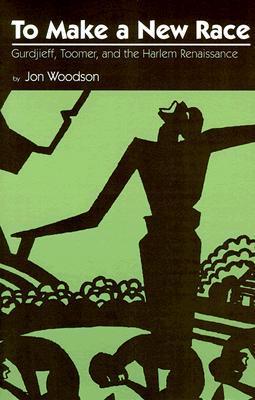
To Make a New Race
Jon Woodson
Jean Toomer’s adamant stance against racism and his call for a raceless society were far more complex than the average reader of works from the Harlem Renaissance might believe. In To Make a New Race Jon Woodson explores the intense influence of Greek-born mystic G. I. Gurdjieff on the thinking of Toomer and his coterie-Zora Neale Hurston, Nella Larson, George Schuyler, Wallace Thurman-and, through them, the mystic’s influence on many of the notables in African American literature.
Gurdjieff, born of poor Greco-Armenian parents on the Russo-Turkish frontier, espoused the theory that man is asleep and in prison unless he strains against the major burdens of life, especially those of identification, like race. Toomer, whose novel Cane became an inspiration to many later Harlem Renaissance writers, traveled to France and labored at Gurdjieff’s Institute for the Harmonious Development of Man. Later, the writer became one of the primary followers approved to teach Gurdjieff’s philosophy in the United States.
Woodson’s is the first study of Gurdjieff, Toomer, and the Harlem Renaissance to look beyond contemporary portrayals of the mystic in order to judge his influence. Scouring correspondence, manuscripts, and published texts, Woodson finds the direct links in which Gurdjieff through Toomer played a major role in the development of “objective literature.” He discovers both coded and explicit ways in which Gurdjieff’s philosophy shaped the world views of writers well into the 1960s. Moreover Woodson reinforces the extensive contribution Toomer and other African-American writers with all their international influences made to the American cultural scene.
Jon Woodson, an associate professor of English at Howard University in Washington, D.C., is a contributor to the collection, Black American Poets Between Worlds, 1940-1960 . He has published articles in African American Review and other journals.
About the author
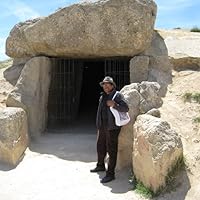
Jon Woodson
An innate surrealist sensibility was instilled in me during my time wandering the bomb-damaged streets of Frankfurt, Germany at the age of eight years old in 1952. I never completely recovered from being taken to see Carl Sandburg when he was performing for Negro children at the Library of Congress in about 1956. Realizing the dangerous tendencies in my personality, my parents tried to turn me into a normal person by forceful applications of baseball on the radio and brutal tennis training. Once I discovered science fiction and Samuel Beckett’s novel Molloy —read at the age of fourteen—the hopes for my recovery were grim. I was sent away to a New England preparatory school at fifteen, where I suffered a further decline by discovering Beat literature and dada. I finished high school in Washington, DC, where I began to write poetry and was published in the Howard University literary magazine, Stylus, which ran a contest for high school students. At the University of Rhode Island I published poems and edited the literary journal. After earning an M.A. in English from U.R.I. in 1969, I taught at Lincoln University in the 13 College Curriculum Program (TCCCP), a massive avant garde experiment in higher education. From 1971 to 1979 I studied literature at Brown University and taught at George Mason University. At Brown University I was taken under the wing of Edwin Honig, translator of Fernando Pessoa, and I also was associated with Keith and Rosmarie Waldrop. I wrote a dissertation that read Melvin B. Tolson’s poetry through the lens of Gurdjieff’s esotericism, a view that was immediately rejected by other scholars. I have since worked to explore the esoteric cast of American modernism and have published To Make a New Race: Gurdjieff, Toomer, and the Harlem Renaissance(1999) an account of how Tolson was introduced to esotericism by contact with the members of the Harlem Renaissance, many of whom were writing coded esoteric fiction and poetry. I have continued to write and to publish on this topic, showing that other major figures were also involved in this tendency—James Agee, Djuna Barnes, Dawn Powell, and Ralph Ellison. I have taught at Towson University and Howard University. As a Fulbright lecturer in American Literature, I taught at two Hungarian universities in 2006. I now am at work on a series of comic novels.
(Goodreads.com)