
SEPTEMBER 17, 2020 (fitmind.co)
What is nonduality?
You may have heard of this concept that’s expressed in all of the world’s major meditation traditions, from Advaita Vedanta and Sufism to Buddhism and Kabbalah, that claims we’re “one with everything.”
It sounds nice, but what does that actually mean?
Nondualism is pointing to the direct first-person experience, upon careful inspection, revealing that the mind contains no separate observer from its contents. The result is a feeling of unity and connection to the world.
When living from a place of nondual recognition, you don’t see the computer in front of you but rather feel as if you are the computer. It’s as if the world appears to be occurring inside of “you.” That is to say, inside of nondual awareness. The duality of separation between self and other disappears.
You realize nonduality when your sense of being a witness, or subject, looking out at the world disappears. If you don’t think this is possible, try the reverse – locate the part of you that appears to be the witness right now…
And you’ll quickly realize that you can’t locate one. It’s just a mental construct.
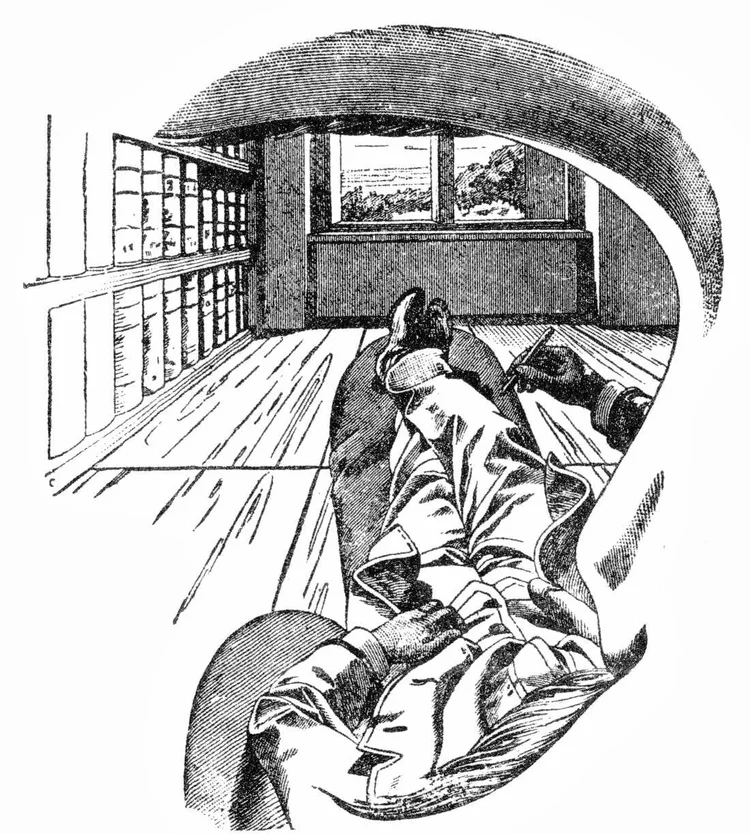
We spend all of our lives walking around and thinking we’re a tiny mini-me located somewhere in our heads. But, upon further inspection, it becomes clear that the feeling of being a subject looking at objects is an illusion.
It’s likely that a baby experiences the world in a nondual way before they’re given a name and create models of selfhood. Now, you might wonder why we’d want to “regress” into a toddler’s view of the world.
The key is that an adult who recognizes nonduality will still be able to operate fully, but will no longer be burdened by the mental baggage of “I, me, mine” stories running in their head. It turns out that most of our mental suffering comes from this dualistic mentality. We feel like a mini-me in the head that always has to uphold its dignity, figure out its identity, and solve some problem that it concocts.
Nonduality isn’t making metaphysical claims that, “Hey this is the way the Universe works.” Rather, it’s useful in so far as it’s something that you, and everyone else, can directly experience for themselves as an enhanced mode of being, like a flow state. By recognizing the nondual state you’re upgrading your mental software.
For nondual guided meditations and in-depth instruction, try FitMind.
Nonduality and Science
Nonduality is compatible with modern science. The materialist scientific worldview states that your entire experience of the world is being generated by a brain. Therefore, it stands to reason, you’ve never actually seen the real world. What you think is “real” had to enter your eyes, ears, and other senses and then get projected in your brain somewhere.
Following that logic, everything you experience in your brain is a part of you. The world as you experience it is inside of you. Even your feeling of having a head is, according to science, appearing inside your head. Where that head is exactly, is a matter of philosophical debate without an answer.
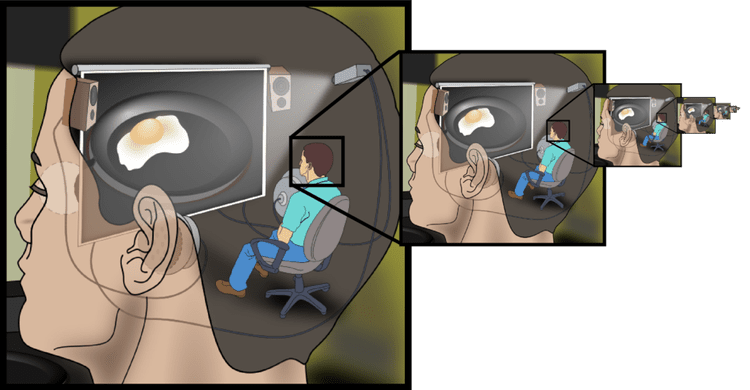
One of the leading theories of consciousness, called Multimodal User Interface (MUI) Theory, was developed by cognitive psychologist Donald Hoffman. MUI suggests that you’re not experiencing reality at all, just projecting a user interface that helps you navigate the world. As an analogy, take the icons on your computer screen. A trashcan on your desktop computer is not a real trashcan, but it’s useful for discarding unwanted files so that you don’t have to deal with the tangle of underlying code and wires in your computer. Similarly, your projection of the world is a mental simulation to help you navigate a vastly complex amount of “real world” data.
But thinking about the metaphysics and philosophy of nonduality, while interesting, isn’t necessarily useful. All of this is just to say that nonduality does not contradict modern science. In fact, theories like Hoffman’s are starting to support the concept as a closer picture of reality.
What’s important here is that if you notice your experience of the world very carefully it’s all occurring in the same place – your field of nondual awareness.
What is nondual meditation?

There are meditation techniques designed specifically to uncover nondual awareness. If you’ve been practicing the methods taught on the FitMInd meditation app, you may have already experienced this.
It’s important to note that nondual meditation doesn’t strive for a particular state. Rather, it’s trying to point out and uncover the true nature of mind as it already is. Unlike many “effortful” techniques, the nondual meditations are often trying to relax the very part of the mind that’s striving.
Neuroscientist and philosopher Sam Harris gives a clear analogy. Picture someone tapping on a window through which you’re staring and trying to get you to see the pane of glass itself rather than just the objects that appear through the glass.
When you perceive the world such that there is no constructed observer and instead you appear to be everything in your awareness, that’s nonduality. What matters is your direct experience of this, which can be glimpsed if you pay careful attention and are able to drop your conditioned ideas and conceptions about how the world works.
For example, you know that you have a head but the Headless Way exercise (see below) gets you to reexamine your direct experience. What does it feel like? And that’s a pointer toward nonduality.
This is such a big part of meditation because it’s completely liberating. You’ll notice that as you glimpse nondual awareness in practice it’s very enjoyable and, in fact, a life-changing perspective.
Nondual Meditation Techniques
The primary traditions that were focused on uncovering nonduality with direct “pointing out” methods were Advaita Vedanta and Tibetan Buddhist Mahamudra and Dzogchen.
Here are a few of the popular nondual meditation techniques, primarily derived from these traditions:
- Just Being – A practice in which you rest the mind without intentions, effective for revealing the nondual nature of mind when it’s not striving to solve problems.
- Self-Inquiry – A method of meditation in which you inquire deeply into the nature of “I.” For straightforward instruction in this method, check out Ramana Maharshi’s explanation in this online pdf.
- Headless Way – Richard Lang, a disciple of Douglas Harding and the primary teacher of the Headless Way meditation technique, came on The FitMind Podcast to discuss it in more detail.
- Glimpse – Glimpses are a broad name (possibly coined by Loch Kelly) for short practices that can give us a “glimpse” of nonduality.
- Awareness of Awareness – Another type of meditation meant to reveal nonduality by directing attention toward the context, rather than the contents, of experience.
Some of these have many names or are broad terms for a category of nondual practice. For example, there are many forms of self-inquiry.
Below are two nondual guided meditation from famous teachers Loch Kelly and Diana Winston, who led these meditations on The FitMind Podcast.
After years of striving in her “deliberate mindfulness” practice, Diana discovered the nondual meditation practices. She calls the state they lead to “natural awareness,” but it has traditionally been called advaita, anatta, shunyata, rigpa, or tathagatagarbha. The very fact that this has so many names across cultures should clue us into the fact that it is a universal human experience.
Similar to Diana, Loch Kelly practiced traditional mindfulness meditation for years before discovering stabilizing nondual meditation techniques like Tibetan Mahamudra and Dzogchen. He calls these “glimpse practices” that can help you shift you into nondual awareness with repeated use.
Here’s Loch demonstrating a couple of his glimpses, or pointers.
Once you’ve glimpsed nonduality, the practice becomes to continue to glimpse it until this becomes a new, default way of living.
And if you haven’t tasted nondual awareness yet, there’s no need to worry. It can take some time and repeated practice of the techniques. The key is not to strive for any result, but rather just to do the practices with curiosity and an open mind and let things unfold.
Summary of Nondual Awareness
In this blog post, we’ve covered the key facts about a timeless and simple (yet hard to grasp in words) subject. Ultimately, however, philosophizing about nondual awareness won’t help; it’s an experience you have to have for yourself.
Thankfully, there are meditation techniques, like Mahamudra and Dzogchen, devised over thousands of years of people experimenting with their minds, that can predictably induce nondual experiences.
For nondual guided meditations and in-depth instruction, try FitMind. Below is a video summarizing much of what’s written above and also giving further guided nondual instruction, similar to what you’d find on the FitMind meditation app.