
Letter from Salzburg
| ANNE APPLEBAUM JUL 27, 2025 (anneapplebaum@substack.com) |
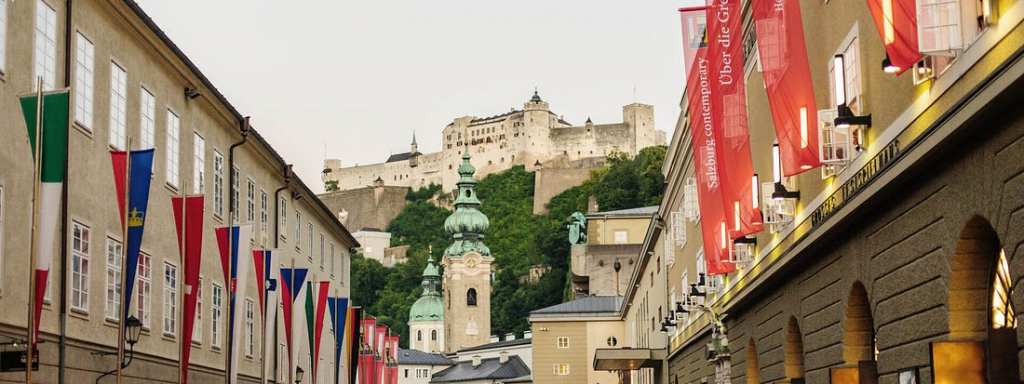
In 1920, a year of hunger and hardship, a group of Austrians decided to start a music festival. World War I had just ended. The Habsburg empire had just disappeared, putting to an end a society that the writer Stefan Zweig once described as a “stabilized bourgeois world with its countless little securities, well palisaded on all sides” where “nothing unexpected ever occurred.” Millions of young men had died in the trenches.
The poet Hugo von Hofmannsthal, the director Max Reinhardt, the composer Richard Strauss and others nevertheless felt that this was exactly the moment to stage plays and conduct concerts. They hoped that their festival, in the words of Reinhardt, would ‘repair the torn threads of our common European heritage’. They hoped it would lay the foundations for peace. They chose to put it in Salzburg, Mozart’s birthplace, but from the beginning they wanted artists and audience members to come from across the continent, and to include people from many backgrounds.
The twentieth century offered a brutal answer to their utopian vision of a united Europe and a world without war. The festival was constricted by the Nazis. But it was reborn again under American occupation, with the same aspirations. Now it continues, and every year they invite an outside speaker to open the festival. This year they invited me.
My speech, Democracy and the Music Festival, talked a little bit about this history, and then made an argument:
by working together, by building something new, by creating connections between people in Austria and people elsewhere in Europe, they were not only organizing a festival but also laying the foundations for a future Austrian democracy.
The whole text is below. You can also watch the whole ceremony by clicking on the video at this link. The speeches are in German (and mine has a voiceover) but music is a universal language.
Before I spoke, a group of protestors appeared (in the video you can hear them at about 40 minutes, though the camera doesn’t show much). They were so well-coordinated that at first I thought their role had been staged. They entered the back of the theater and unfurled banners, calling for an end to starvation of people in Gaza: “Food is right, not a weapon.”
This was a crowd of officials, politicians and festival sponsors, people who would not normally like their elegant opening ceremony disrupted. But mostly, they seemed to approve. Some applauded.
In response, I started my speech calling on Israel to stop, respect humanitarian norms. They applauded that too. Anger and disgust at the disaster now unfolding in Gaza – the starving children, the shots being fired at hungry civilians – is now universal in Europe, and rightly so. In response the Israeli army says it has begun dropping food aid into Gaza but it’s not clear yet whether that will make a difference.
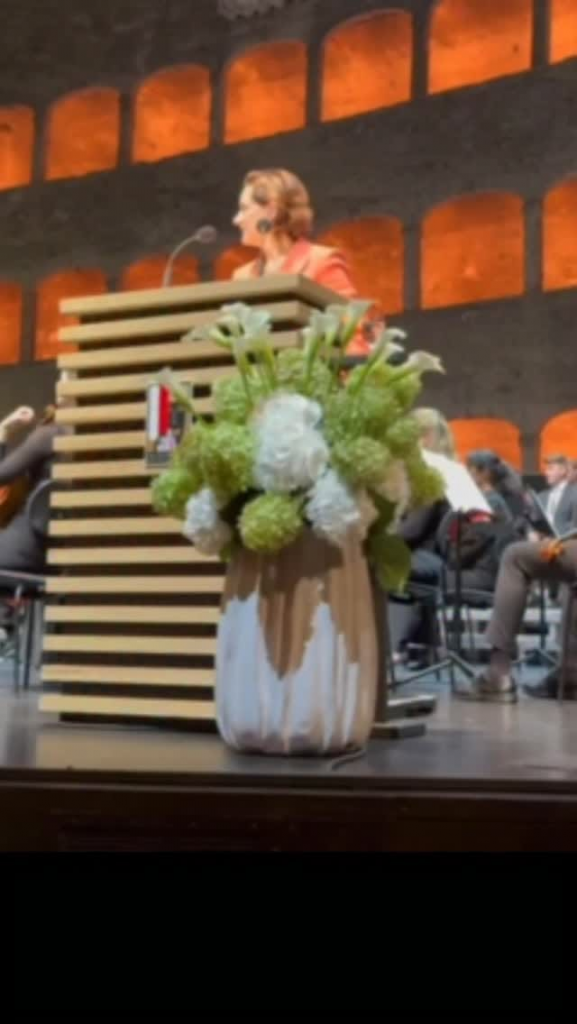
My husband filmed this moment:
Instagram video: https://www.instagram.com/reel/DMkhtHcoUFb/?utm_source=ig_web_copy_link
The text of the speech follows

Democracy and the Music Festival
What is the purpose of a music festival?
I realize that’s an odd question to ask here in Salzburg, at the beginning of one of the most famous music festivals, or rather arts festivals, in the world. You surely think you know what this festival is, because you are here. You are part of the audience, or the organization, or perhaps you are an artist yourself. You bought tickets, you drove here or flew here. You arrived knowing what to expect.
But think a little bit longer about the definition of an arts festival, and it becomes more mysterious. Like so many things that human beings do, the creation of a festival is a group project. It requires someone with a vision, but also someone who can persuade audiences to travel to a particular place, someone who can choose the right mix of artists and directors, someone who can raise money, someone who can carefully spend it.
To succeed, all of these people must be not just ambitious, but motivated. Arts festivals don’t flourish because someone with political power orders them to flourish. They flourish because a group of people have been inspired by an ideal of excellence, or of enlightenment, or of beauty and harmony, and because they have decided to work together to realize that ideal. This festival is no exception.
Certainly no one ordered Hugo von Hofmannsthal, Max Reinhardt, or Richard Strauss to create an arts festival in 1920, a year of hunger and tragedy. No one told them to stage a production of Everyman, with the Salzburg Cathedral as a backdrop, or to use the wood from a former prisoner of war camp to build, symbolically, a new stage for a new era. They decided to do these things because they wanted their festival to occupy the public square, both literally and figuratively, and because they wanted to bring art back to the center of public life too, for everybody. In a country broken by the violence of World War I and its aftermath, Reinhardt wrote, ‘art, far from being a luxury for the rich and complacent, is nourishment for the needy.’
They were also very ambitious about what they believed art could achieve. They hoped that their festival, in the words of Reinhardt again, would ‘repair the torn threads of our common European heritage’. But even so, their project might have been more important than they understood. For by working together, by building something new, by creating connections between people in Austria and people elsewhere in Europe, they were not only organizing a festival but also laying the foundations for a future Austrian democracy.
To explain what I mean by this, it’s worth turning to the words of another great European. Alexis de Tocqueville had traveled extensively in the United States in the early 19th century because he wanted to explain why democracy seemed to be working there, whereas it had just failed, spectacularly, in his native France. One of the things that he discovered was the importance, to 19th-century Americans, of what he called ‘associations’. Despite the vast spaces of their country, he observed, Americans met one another, made decisions together, carried out projects together. They formed associations – the myriad organizations that the British philosopher Edmund Burke called ‘little platoons’, and that we now call ‘civil society’, and they did so everywhere.
‘Americans use associations,’ Tocqueville wrote, ‘to give fêtes, to found seminaries, to build inns, to raise churches, to distribute books, to send missionaries to the antipodes; in this manner they create hospitals, prisons, schools […] Everywhere that, at the head of a new undertaking, you see the government in France and a great lord in England, count on it that you will perceive an association in the United States.’
Tocqueville reckoned that the true success of democracy in America rested not on the grand ideals expressed on public monuments nor even in the language of the Constitution, but in these habits and practices. Democracy worked in America, he argued, because Americans practiced democracy, organizing events and projects with their fellow citizens every day. The Salzburg Festival was the result of exactly that kind of effort: voluntary, grassroots, authentic.
Tocqueville was not the only one to notice the power of informal organizations. Many decades after he published his famous book, Democracy in America, a very different kind of thinker, on the other side of the world, also became interested in independent associations. But Vladimir Lenin described these kinds of groups differently. He called them ‘separatist’ or ‘caste’ divisions within society, and he argued that they should be abolished, to make way for a different kind of regime.
In fact, Lenin and the Bolsheviks, and later Hitler and the Nazis, disliked independent organizations for the same reasons that Burke and Tocqueville admired them: because they gave individual people the power to control their own lives, because they encouraged independent thought and activity, because they were sources of social cooperation and of new ideas. The Bolsheviks wanted instead to build a totalitarian regime, one in which the ruling party would control not just politics and economics, but also culture, art, education and even leisure time. Civil society got in their way.
In the immediate wake of the Russian Revolution, at about the same time as the very first Salzburg Festivals were being organized, the Bolsheviks applied their theory and carried out the Sovietization of Russian society. Famously, they nationalized industry, built a one-party state and terrorized their opponents. But they also took control of the arts, forced painting, music and literature to serve the needs of the state and destroyed independent groups and associations of all kinds. Dmitry Likhachev – who later became Russia’s most celebrated literary critic – was arrested in 1928 because he belonged to a philosophic discussion circle whose members saluted one another in Ancient Greek. While in prison Likhachev encountered, among others, the head of the Petrograd boy scouts, who had been arrested for exactly the same reason: he belonged to a civic organization not controlled by the state.
A few years later, when the Red Army entered Central Europe in 1945, they repeated these policies. Soviet-occupied East Germany outlawed hiking groups. In Poland the secret police broke up jazz clubs, even smashing records. All across the bloc new secret police forces destroyed or undermined youth organizations, sending their leaders to prison. Even in the brief period when the Red Army occupied a small part of Austria, Soviet officers kept a careful eye out for anything that believed might be an ‘anti-Soviet organization’ and made hundreds of arrests.
As I don’t have to tell this audience, Adolf Hitler’s policies were similar, although you have a different word for it in German, not Sovietization but Gleichschaltung. From September 1933, the Reich Culture Chamber sought not only to dominate politics, but also to coordinate everything from literature and theater to the press. All kinds of sports teams, music groups and arts associations were disbanded, or else re-organized under the leadership of the Nazi Party. For several years, under the Nazi regime, this Festival lost its independence too. Max Reinhardt went into exile and died in the United States.
Now I know, to most of you sitting here, all of that seems a long time ago. The Second World War ended more than eighty years ago. The Soviet Union and the Soviet empire disappeared more than thirty years ago. Since then, Europe has reunited. Neither the Soviet Communist Party nor the Nazi Party threaten us anymore.
And yet, I would argue, civil society, free associations and the artistic freedom that they promote, the freedom we have taken for granted for two generations, are now threatened once again around the world, more so than at any point in my lifetime.
Certainly we see creeping changes on this continent, with the rise of political leaders who once again understand civic organizations and associations as threats. The current Russian president, Vladimir Putin, was trained by the KGB to treat any self-organized activity as suspicious. His particular form of paranoid nationalism also leads him to treat civic organizations as agents of espionage. In November 2012, the Russian Duma passed a law which required any organization receiving any Western funding to register as a ‘foreign agent’ – in other words, to declare themselves to be spies. Later laws gave the Russian state the right to shut down ‘undesirable’ organizations, including cultural and philanthropic organizations, even those that were explicitly apolitical.
Artists, actors and playwrights have since then been repressed. Inspectors from the FSB have been sent to galleries to review exhibitions before they are allowed to open. But the victims of repression are not only individuals. They are also groups of people who work together, often for apolitical or cultural goals and causes. Among them are Memorial, once Russia’s most important historical society; the Sakharov Center; the Moscow School of Civic Education.
This assault on associations has spread beyond Russia. Belarus, under direct Russian influence, has adopted similar laws against civil society. Other autocracies, from China to Venezuela to Egypt, now have laws modeled on (or resembling) those in Russia, restricting civic organizations. Failing democracies like Hungary and Georgia, influenced by the Russian example, have done or tried to do the same. We may soon see similar attempts inside the United States.
But Russia has also imposed its system on others by force. The Russian invaders who arrived in Ukraine, first in 2014 and then in 2022, used random violence to terrorize people, built torture chambers and concentration camps. They transformed cultural institutions, schools and universities to suit the Russian nationalist, imperialist ideology of the new regime. But they put special pressure on volunteers: people who were running charities or civic organizations, people who were spontaneously rushing to help others.
A couple of years ago Ukrainian colleagues of mine from a group called The Reckoning Project interviewed a man who had escaped from a part of Kherson province that is still under Russian control. He had been part of a neighborhood-watch group that stepped in to replace the police when the occupation began, and had worked at a humanitarian-aid distribution center as well. Because he engaged in these activities, Russian soldiers detained and interrogated him. They demanded to know about his connection to the Ukrainian security services (he had none) and the CIA (he had even less), as well as, ludicrously, George Soros’s Open Society Foundations.
Like the Soviet officials who treated Boy Scout leaders and members of philosophy clubs as conspirators, the Russians seemed incredulous that this man was just a local volunteer, working with other local volunteers. Their questions made it seem as if they had never heard of such a thing. And when he couldn’t give them any information about a larger conspiracy, he was beaten, tormented with electric shocks, and hit with a hammer. Eventually he escaped occupied Ukraine. It was clear to him, and to many others, that the Russian occupiers feared activists, charity workers and volunteers of all kinds, because they could not understand them, and above all, because they could not control them.
But it is not only dictators and autocrats who threaten the organizations and associations that have upheld our political systems for so long. Civil society is also eroding thanks to changes in technology and in behavior across the democratic world. Twenty-five years ago, the political scientist Robert D. Putnam was already describing the decline of what he called ‘social capital’ in the U.S.: the disappearance of clubs and committees, community and solidarity. In an era that provides so many other forms of entertainment many Americans, like many Europeans, no longer have much experience of associations – in the Tocquevillian sense – at all. And as internet platforms allow all of us to experience the world through a lonely, personalized lens, this problem is beginning to morph into something more sinister.
Instead of participating in civic organizations that give us a sense of community as well as practical experience in tolerance and consensus-building, many of us join internet mobs, in which we are submerged in the logic of the crowd, clicking ‘Like’ or ‘Share’ and then moving on. Instead of entering a real-life public square like this one, we drift anonymously into digital spaces where we can attack opponents without revealing who we are. We aren’t organizing, planning or working with other people. We are not practicing democracy at all.
Instead of civic engagement, this new online world promotes cynicism, nihilism and apathy. Instead of solutions to problems, or even debate about problems, we are offered trivia, sarcasm and mockery. In this world, the loudest, most negative, most emotional voices often overpower those who use the language of reason and debate. Persuaded to scroll through hundreds of words and images all day long, we have no time to organize, to work together, to focus on the larger issues that shape our world.
In this manner our traditions of civil society and civic engagement, so fundamental to our democracy, are under assault, both from dictators and from internet culture, both from above and from below. So let me conclude by returning, again, to the question I began with: What is the purpose of a music festival?
In an era of lonely surfing and online culture, and in an era when dictators around the world try to prevent their citizens from organizing for any purpose, an arts festival, and certainly this arts festival, defies those trends simply by creating networks of friendship and association, by offering live performances to live audiences, by offering forums for discussion and debate. This is how citizens acquire the habits of democracy, by working together to achieve common goals.
This Salzburg Festival will also defy the influence of autocratic nationalism by welcoming artists and guests from more than seventy countries, proving that it is possible for an event to be both intensely Austrian and very global at the same time. The false, misleading divisions between local, national and international are erased in a place where people from many cultures voluntarily come together to discuss ideas that affect us all. Arts festivals give us space and time to think not so much about the daily political debates we find on our individualized social media feeds, but about the larger, deeper forces that shape the world and always have. What is power? Why do we abuse it? Why do human beings go to war? Why do we commit acts of violence? How do we stop?
The contemplation of older works of art also helps us better understand the present. I began this talk with historical examples for a reason: I wanted to remind everyone here that these threats are not new. Now let me remind you that people have learned to defeat them before. In his famous essay ‘The Power of the Powerless’, written in 1978, during one of the darkest eras of totalitarian control, the Czech playwright Václav Havel offered one of the most famous prescriptions for dissent.
Havel famously described how the Czech Communist Party sought to monopolize every sphere of human activity, to use apathy as a means of control. But he also argued that the best way to fight the system was for citizens not to retreat, but to act and behave as if they were free, in order to preserve the ‘independent life of society’. By that he meant ‘everything from self-education and thinking about the world, to creative activity and its communication to others, to the most varied, free, and civic attitudes, including independent social self-organization.’
Imagination and creativity, he argued, can defeat fear and control. Civic engagement can overcome apathy and fear. The ‘independent life of society’ that Havel described is preserved at civic events like this one, and I am proud to have been invited to join you in opening it.
Thank you very much.
Kleptocracy Tracker
Continuing to monitor conflicts of interest, ostentatious emoluments, outright corruption and policy changes that will facilitate outright corruption. (Read my original article, Kleptocracy Inc.)
July 18
- Trump signed the GENIUS Act into law, establishing a legal category to further legitimize stablecoins—creating new opportunities for him to profit from World Liberty Financial’s USD1 stablecoin.
July 21
- Trump Media and Technology Group purchased $2 billion worth of bitcoin and related securities in an effort to become a crypto treasury company—joining other businesses linked to the Trump family pursuing the same strategy.
July 23
- Columbia University agreed to pay the US government $200 million to settle the Department of Justice’s Title VI lawsuit after the Trump administration froze $400 million worth of the school’s federal grants.
July 24
- The FCC approved Paramount’s merger deal with Skydance—after the media company paid Trump $16 million to settle his frivolous lawsuit and canceled The Late Show with Stephen Colbert.