
Russ Baker 07/27/26 (WhoWhatWhy.org)
Lindsey Graham knew, and what did he do about it? The legacy media knew, and what did they do about it?
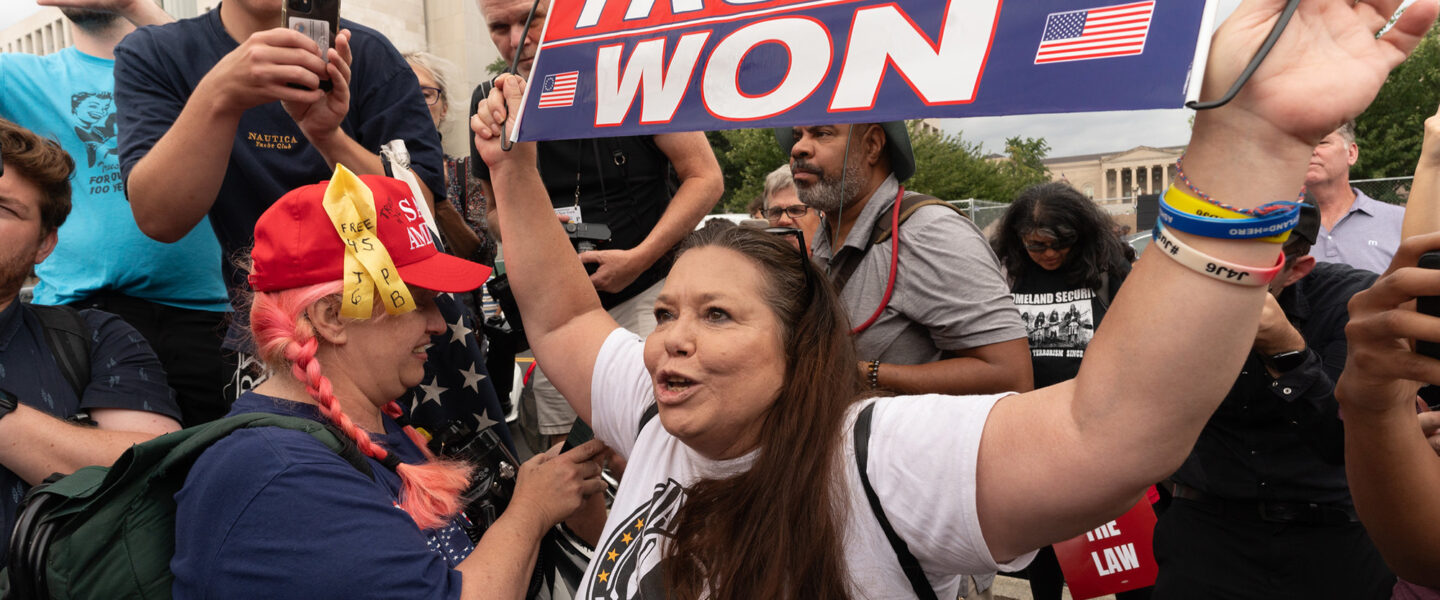
Some weeks ago, I wrote a column addressing what I am convinced is the single thing that keeps the entire Trump enterprise from unraveling: Trump’s “Big Lie” about the 2020 election.
I believe that, notwithstanding his narcissism and megalomania, Trump actually knows he lost, but also understands that, as with any cult, he has to demand that his followers agree to some core principle proving their loyalty. And that the ultimate test of whether someone will blindly follow is to ask them to profess belief in something ridiculous. As I’d written:
When dangerously incompetent people pretend to believe the lie (or actually believe it), they obtain positions of extraordinary power — power they abuse in all sorts of ways, resulting in damage, some of which is tragically irreversible.
I think it is one of the legacy media’s greatest failings that, although it routinely dismisses Trump’s stolen election claim as untrue, it does not consistently put front and center the basic fraud underlying the worst administration in history.
A recent example of such failure is this, which I read on CNN’s website some time after my column appeared:
The sweeping DOJ campaign for nearly every state’s unredacted voter roll is one of several examples of how the administration — fueled by President Donald Trump’s longstanding beliefs that the 2020 election was rigged against him — has sought to assert more federal control in elections.
Oh really? Trump’s “longstanding beliefs” that the election was rigged? Outlets like CNN are doing the public a huge disservice by not focusing on the centrality of the lie in his strategy to keep power.
Anyway, after my Big Lie column appeared, I heard from Anthony Essaye, a retired attorney who, among other things, had worked as a lawyer for The Washington Post in the Pentagon Papers case. He had read and very much agreed with what I said. And he told me that he and a team of retired Washington lawyers (their names appear below) have put together a document that makes the further case that Trump’s claims should be much more aggressively challenged.
With the permission of Anthony and his team, I publish a condensed version of his document here:
Setting the Record Straight: 10 Reasons Why the 2020 Election Was Fair and Accurately Decided
For the past five and a half years, President Donald Trump has contended that the 2020 election was stolen from him by massive fraud. And he is now using this contention as an excuse to continually pursue highly restrictive voting policies in order to maintain Republican control of the Congress in the 2026 midterm elections.
As memories may understandably be fading about the magnitude of the evidence disproving that claim, here, among many, are 10 reasons why Trump’s claim is entirely untrue.
-
- Postelection recounts confirmed results.
Shortly after the election, in each of the six states where Donald Trump was claiming massive fraud (Arizona, Georgia, Michigan, Nevada, Pennsylvania, and Wisconsin), election officials conducted recounts and other electoral reviews. In every instance, the state election officials and governors, Republican and Democrats alike, concluded that the results were accurate.
-
- Courts rejected all cases alleging fraud.
Also shortly after the election, Donald Trump’s legal team and other Trump supporters brought 62 lawsuits seeking judicial intervention to overturn the election, based primarily on allegations of fraud. Sixty-one of these failed, and the lone success was a legal interpretation that did not involve fraud. Even judges who had been nominated by Trump were highly critical of the paucity of evidence presented.
-
- Senior Trump administration officials rejected Trump’s allegations of fraud.
Not long after the election, top officials at Trump’s Department of Justice reviewed the various fraud allegations being made and informed the president that none of them were supportable. Moreover, Trump’s own White House legal counsel agreed with this determination.
-
- Top government security agency found no evidence of tampering.
The Cybersecurity and Infrastructure Security Agency is charged with protection of the election processes. After the election, it announced that it had found “no evidence that any voting system deleted or lost votes, changed votes, or was in any way compromised.” The then-head of the agency, a Republican, has since staunchly maintained this position.
-
- Trump’s own campaign committee failed to find fraud.
After the election, the Trump campaign committee contracted, at the cost of $1,350,000, with two investigative organizations to review the allegations of fraud so as to provide the committee with the ability to support and publicize those that appeared merited. But after their investigations, both organizations reported that none of the allegations could be substantiated. These investigative reports were quietly buried by the Trump campaign committee and only came to light in 2023.
-
- “Forensic audits” also failed to find fraud.
After completely failing in their lawsuits, Donald Trump and his supporters turned to having so-called “election audits” initiated by Republican-controlled legislatures in states such as Arizona, Michigan, and Wisconsin. Even though their purpose was to use every means possible to find meaningful fraud, they completely failed to do so.
-
- Review by prominent conservatives confirmed the integrity of the election.
Moreover, in July 2022, a group of prominent conservative former judges and election law experts issued a thorough and detailed review of the fraud allegations. They concluded: “There is absolutely no evidence of fraud in the 2020 presidential election on the magnitude necessary to shift the result in any state, let alone the nation as a whole. In fact, there was no fraud that changed the outcome in even a single precinct.”
-
- Even Fox newscasters and executives did not believe the election was stolen.
As a result of a defamation lawsuit filed against Fox News by an election equipment manufacturer, it came to light that top Fox TV personalities who after the election were hyping Trump’s claims of fraud did not in fact believe them. Rather, they were endorsing them in order to retain their audience. Moreover, in April 2023, Fox paid a $787.5 million settlement to the manufacturer in order to avoid a trial which would likely have required some of its executives to testify that the network’s claims of fraud regarding the 2020 election were false.
-
- Some of Trump’s claims were bizarre.
Some of the fraud claims promoted by Donald Trump and his supporters are bizarre. Three examples:
-
- That a long-deceased Venezuelan dictator oversaw the development of election equipment that was later used in the US election to enable the fraudulent miscounting of votes.
- That some 40,000 fake Biden ballots were secretly shipped into Arizona from an Asian country and could be identified by the bamboo content of the paper.
- That voting machines were remotely compromised using military technology and satellites via the US Embassy in Rome.
-
- Despite the evidence, Trump refuses to accept reality.
Along the same lines, in January 2026, grand jury testimony was made public in which Sen. Lindsey Graham of South Carolina, a friend and staunch ally of Donald Trump, had this to say about Trump’s claim of electoral fraud in 2020: “I have told him more times than we can count that he fell short,” and that “if you told him Martians came and stole votes, he’d be inclined to believe it.”
See this document for more information on these and other points reflecting that the results of the 2020 election are indisputable.
Anthony Essaye is a retired attorney. He is a graduate of Georgetown University and Harvard Law School and a longtime partner in an international law firm.
Nina Bang-Jensen is a lawyer, volunteer election monitor, former executive director of a nongovernmental organization, and former Senate staff member.
Thessalia (Lia) Merivaki is an associate professor at Georgetown University and an election science researcher specializing in voter confidence and election integrity.
C.J. Larkin is a recent graduate of Georgetown’s McCourt School of Public Policy.
***
The evidence above speaks for itself. The late Lindsey Graham himself knew perfectly well that Trump lost in 2020. He told him so at the time. Then he no longer said it. Graham and virtually all of his GOP colleagues swallowed the Kool-Aid — for their own survival.
That’s the larger story here. Unfortunately, to date, the narrative of Trump as cult leader has not gotten the front and center attention it deserves from legacy media. In my opinion, traditional news organizations, for various reasons, cannot be expected to lead with a powerful narrative that will “explain it all.”
It is up to independent media — partnering with the public — to do that. And in the meantime, this country, and others around the world, are suffering from irreversible damage thanks to a Congress that caters to the will of a mad man, a Congress whose greatest qualification is to pretend to believe the Big Lie.
- Russ Baker Russ Baker is Editor-in-Chief of WhoWhatWhy. He is an award-winning investigative journalist who specializes in exploring power dynamics behind major events.