Category Archives: Obit

Tim Curry, star of ‘Rocky Horror’ and much more, dies at 80

  • Bruce Weber | © 2025 The New York Times Company
  • Aug 26, 2026 (SFExaminer.com)
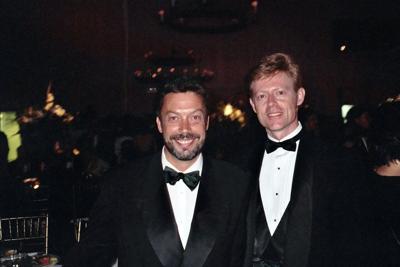
Tim Curry and Alan Light at 1994 Emmy Awards Wikimedia
Tim Curry (left) and Alan Light at the 1994 Emmy Awards. Photo: photo by Alan LightCC BY 2.0, via Wikimedia Commons

Tim Curry, the British-born actor whose gift for garish eccentricity lit up stage and screen, most notably as the outlandish, cross-dressing mad scientist in the midnight cult film “The Rocky Horror Picture Show,” died Tuesday at his home in Los Angeles. He was 80.

The death was confirmed by Marcia Hurwitz, his longtime agent and manager. In 2012, Curry suffered a serious stroke, from which, he said last year, “I’ve been recovering for quite a long time.”

With a mischief-maker’s good looks, a casual athletic grace and a supple and resonant voice, Curry was a favorite in roles calling for expressive villainy or general cartoonishness.

In the first screen version of “Annie” (1982), he brought more than a dollop of slime to the part of Rooster Hannigan, the con artist who concocts a plot to kidnap the plucky orphan of the title.

In “Clue” (1985), a suspense spoof derived from the popular board game, he played Wadsworth, a logorrheic butler who leads a cast full of murder suspects around a spooky mansion with the fast-talking fervor of a manic Sherlock Holmes.

In “Spamalot,” the stage musical based on the Monty Python troupe’s bottomlessly goofy retelling of the King Arthur legend, which opened on Broadway in 2005, he played Arthur himself and was nominated for a Tony Award. It was the most straight-faced role in the show, and yet, as Ben Brantley wrote in his review in The New York Times, he was “the best of the cast at translating classic Python style into a musical-comedy idiom.”

But no other role marked Curry’s career as emphatically as that of Dr. Frank-N-Furter, the “sweet transvestite from Transsexual, Transylvania,” as he proclaimed himself in “The Rocky Horror Picture Show.”

The 1975 screen adaptation of “The Rocky Horror Show” was based on the hit London stage musical that played for seven years in different theaters, and in which Curry originated the part in 1973. He also starred in the premiere American production in Los Angeles in 1974 and on Broadway in 1975, where it was a notable flop, closing after 45 performances.

A gleefully lurid send-up of the horror and science fiction genres, “Rocky Horror” tells the story of a clean-cut couple with a flat tire on a rainy night that leaves them at the home of the good doctor, whose scientific work involves the creation of a monster with a muscular body and a handsome face as a sexy plaything for himself. The movie became a cult hit shown at midnight around the world for fans who dress in costume and sing along; it celebrated its 50th anniversary in 2025, and the stage show returned to Broadway earlier this year.

Curry’s performance opened many casting doors, and his Frank-N-Furter was the first of many threatening bad guys he played, finding a variety of hues — arch or giddy or resonantly mean — with which to color their evildoing.

They included Darkness, the embodiment of bass-voiced evil, in Ridley Scott’s 1985 horror fantasy “Legend”; Pennywise, a murderous demon posing as a clown, in the 1990 miniseries adapted from Stephen King’s mammoth horror novel “It”; and Cardinal Richelieu in “The Three Musketeers” (1993). As a greedy gazillionaire presumed to be the chief malefactor in “Charlie’s Angels,” the 2000 movie adaptation of the television series about three female detectives, Curry laid on the oily self-satisfaction until the moment he was killed by the real villain.

Appearing on Broadway in 1980 in “Amadeus,” Peter Shaffer’s portrayal of the rivalry between the Hapsburg court composer Antonio Salieri (Ian McKellen) and the upstart genius Mozart, Curry introduced American audiences to Shaffer’s shocking depiction of one of history’s most gifted composers as a vulgar libertine.

“It’s a marvelous role to play,” Curry told the Times. “It has such a terrific arc. Mozart starts out as an energetic little punk and ends up as a truly tragic figure. So you get to go from high comedy to tragedy. This kind of role is a gift.”

The play won a Tony; Curry was nominated for best actor but lost to his castmate, McKellen. (In Milos Forman’s Oscar-winning 1984 film version, Salieri was played by F. Murray Abraham and Mozart by Tom Hulce.)

The Mozart depicted in the production, Frank Rich wrote in his review in the Times, was not “truly despicable, at least as delineated in the impressively fine-tuned performance by the braying yet sensitive Mr. Curry.”

His voice was perhaps the staunchest aspect of Curry’s talent. He may have been even more prolific as a disembodied performer — often giving voice to anthropomorphic animals — than he was in the flesh.

In “Valiant” (2005), an animated feature set during an ornithological version of World War II, he was the intimidating General Von Talon, a hook-billed hawk wearing an eye patch. He played a haughty gray cat named Fluffy with an imperious French accent in “A Turtle’s Tale: Sammy’s Adventures” (2010), and Terrence, a flamboyantly expressive toucan with a multihued beak, in “Ribbit” (2014), the story of an insecure tree frog.

Timothy James Curry was born April 19, 1946, in Grappenhall, England. His father, Jim, was a Methodist chaplain in the British navy; his mother, Maura Patricia (Langmead) Curry, was a secretary.

Radio was his prime source of entertainment as a child — he said that was why voice work later intrigued him — and he sang in a church choir as a young soprano.

He was 12 when his father died. “By the time I was 15 or so, I knew that acting was what I wanted to do,” he told The Washington Post in 1988. “And then I spent a long time trying to talk myself out of it, because everybody else was trying to. Particularly my widowed mother, who didn’t have very much money. She would have preferred a secure profession for me, and quite rightly, I guess, from her point of view.”

He acted in school and attended the University of Birmingham, graduating in 1968, before moving to London, where he earned a place in a new musical, “Hair.” He appeared in other productions in London and Glasgow before being cast in “Rocky Horror.”

“I couldn’t make up my mind whether to be a singer or an actor,” he told the Los Angeles Times in 1974. “Although in ‘Hair’ they never let me sing that much, because the score was fairly high and I didn’t have a high enough voice.”

He added: “I was offered things, recording contracts, offered to join groups. But as I thought about it, I got rather snippy. No, no, no, I decided, I want to be an actor.”

In the late 1970s and early ’80s, Curry had a brief run as a rock singer, with limited success — although the second of his three albums, “Fearless,” reached No. 53 on the Billboard chart in 1979 — before returning to the stage in London in 1982 as the Pirate King in “The Pirates of Penzance.”

His other theater roles included Tristan Tzara, the Dadaist writer, in Tom Stoppard’s “Travesties,” in London and on Broadway in the mid-1970s; Alan Swann, the onetime movie star who has become a swaggering, comic reprobate, in the Broadway musical version of the film “My Favorite Year,” which earned Curry his third Tony nomination; and, in 2001, Ebenezer Scrooge in the extravagant Madison Square Garden holiday production of “A Christmas Carol.”

Curry never married and resolutely declined to discuss his private life.

“I guarantee you, if it matters, that I have experienced true love, true heartbreak and everything in between, including no small amount of wreckage,” he wrote in his 2025 memoir, “Vagabond.” “Which, naturally, helps inform who I am. I have loved and been loved and I hope you have, too. But I’m not interested in your romances.”

Information on his survivors was not immediately available.

When Fox aired a new made-for-TV version of “The Rocky Horror Picture Show” in 2016, Curry had a small part as the narrator; Laverne Cox played Frank-N-Furter. Although the mad doctor would become Curry’s signature role, he initially had doubts about taking it.

“I was hesitant in that, if it worked, it might be a difficult image to shake off,” he said in a television interview in England just as “The Rocky Horror Picture Show” was opening in 1975. “But then, really, I’ve always thought it wasn’t worth doing unless you took a risk, really. So I just took the risk.”

Forty years later, when he received a lifetime achievement award from the Actors Fund, Los Angeles magazine asked him to reflect on his career-making role. How did he look at it in retrospect?

“With a sort of bemused tolerance,” he said. “It’s neither a blessing nor a curse. I was lucky to get it.”

This article originally appeared in The New York Times.

Tim Curry, Midnight Movie Legend and Singular Acting Talent, Dead at 80

Known for “The Rocky Horror Picture Show,” “Clue,” and more cult classics, the electric performer was a patron saint of the midnight movie whose seductive impact can never be forgotten.

By Alison Foreman

August 26, 2026 (indiewire.com)

The late Tim Curry in "The Rocky Horror Picture Show" (1975)
The late Tim Curry in ‘The Rocky Horror Picture Show’ (1975)Courtesy Everett Collection

Tim Curry, the shape-shifting English thespian whose entertainment career never failed to defy industry expectations, has died at 80 years old, according to reports from multiple outlets. TMZ was first to report the news.

For audiences familiar with the transgressive thrill of repertory screenings, Curry was more than “just” an actor. An icon of cult cinema whose electric spirit never flickered, even when he was ailing in his final years, Curry was an undeniable force in acting whose ability to sell viewers on the seductive power of fearless spectacle is still unmatched. Whether Curry was strutting onstage live in fishnets and heels for “The Rocky Horror Show” on the West End — or purring through the musical’s perfectly calibrated film adaptation in movie theaters for decades after that — the man rarely missed.

To witness even a split second of a top-tier Curry performance means to almost instantly understand that a lived-in caricature can be both technically precise and strategically unhinged for an actor. Few artists have made that duality appear as natural as Curry, in part because so few scripts have dared to make that quality of camp he could deliver essential to their stories. From “Annie” (1982) to “Clue” (1985) to “The Three Musketeers” (1993), the wild energy that Curry brought to screens big and small should be remembered as a hallmark of titles not just worth watching once but combing for details.

CLUE, Lesley Ann Warren, Martin Mull, Madeline Kahn, Michael McKean, Tim Curry, Christopher Lloyd, Eileen Brennan, 1985
‘Clue’ (1985)©Paramount/Courtesy Everett Collection

Born April 19, 1946, in Grappenhall, England, Curry trained in drama at the University of Birmingham before sharpening his acting skills in theater. That traditional arts foundation never left Curry’s characteristically British approach to the craft. Even at his filmography’s most cinematic across film and TV, Curry retained an immediacy that recalled the high-risk potential of being on stage — as reflected in his Tony-nominated parts for “Amadeus,” “Spamalot,” and more. 

It’s impossible to talk about Curry without stressing the mammoth impact of “The Rocky Horror Picture Show” (1975). A genre-bending, queer fringe film phenomenon that immortalized Curry as a countercultural icon decades before his death, the beloved indie remains the longest-running midnight movie of all time. As the simultaneously menacing and strangely sympathetic Dr. Frank-N-Furter, Curry didn’t just anchor the zany world created by writer and co-star Richard O’Brien. Instead, the movie’s unexpected main attraction became indelible proof of its timelessly powerful thesis of acceptance. 

ROCKY HORROR PICTURE SHOW, Tim Curry, Barry Bostwick, Susan Sarandon, 1975. TM and Copyright © 20th Century Fox Film Corp. All rights reserved. Courtesy: Everett Collection.
‘The Rocky Horror Picture Show’ (1975)©20thCentFox/Courtesy Everett Collection

Equal parts sexy and satire, “The Rocky Horror Picture Show” turned ritualized screening culture into an essential safe haven for theater-going weirdos that’s stood its ground for more than half a century. It’s well documented, but Curry’s singular contribution to the texture and mood of the genre filmmaking landscape around “Rocky Horror” cannot be overstated. Other performers have tried to replicate his command of audacious, boundary-pushing comedy, but few (if any) have succeeded.

After slowly changing the theatrical underworld as the king of midnight movies, Curry spent the rest of his acting career gleefully refusing to be pinned down. He was the embodiment of what happens when a classically trained performer with infinite talent decides typical taste is optional for his path through Hollywood, and any one Curry’s films is arguably worth reevaluating in the wake of his death. 

THE THREE MUSKETEERS, Tim Curry (right), 1993, (c) Buena Vista/courtesy Everett Collection
‘The Three Musketeers’ (1993)©Buena Vista Pictures/Courtesy Everett Collection

In Ridley Scott’s “Legend” (1985), Curry disappeared under layers of prosthetics to deliver a demonic performance that’s so committed it became the epic fantasy film’s defining image. In the 1990 miniseries adaptation of Stephen King’s “It,” Curry used Pennywise the Dancing Clown as an avenue to redefine, intentionally or not, what serialized horror could even look like — doubling-down on the genre expertise in his earlier film adaptation of the boardgame “Clue.”

The cherished cult classic from 1985 is an ideal showcase for Curry’s impeccable physical humor and timing. As the ever-exasperated butler, Wadsworth, Curry guides the main characters and audience through an escalating experiment in choose-your-own absurdity that sees pure chaos choreographed. That palpable elasticity extended into Curry’s voice work for animation, unearthing another layer of the late actor’s otherworldly talent. Curry’s turn in Disney’s “Beauty and the Beast: The Enchanted Christmas” (1997) is an oddly vivid example that shouldn’t be missed if you’re even vaguely tempted to the possibility of this particular performer speaking for a villainous pipe organ named Maestro Forte.

RUGRATS GO WILD, Nigel Thornberry, Tim Curry, 2003, (c) Paramount/courtesy Everett Collection
Behind the scenes for ‘Rugrats Go Wild’ (2003)©Paramount/Courtesy Everett Collection

Over the years, Curry was also the voice of Nigel on “The Wild Thornberrys,” Emperor Palpatine in “Star Wars: The Clone Wars,” and Hexxus in “FernGully: The Last Rainforest” (1992). Whether by Curry’s charismatic nature or through a perfectionist drive to study, the late artist understood how to expand almost any creative assignment. Curry was the rare actor to recognize that genre films rely as much on their gutsy style as they do performers earnestly engaging with outrageous universes around them through a proportionately grounded sense of play.

He also appeared in “Home Alone 2: Lost in New York” (1992), “Muppet Treasure Island” (1996), and more. Curry never condescended to material, but consistently elevated scripts by taking them seriously. That paradox is at the heart of why Curry’s work will always endure. It’s also why so much of his filmography has found a second life in the cult film world of today. Sincerity and audacity are not opposing forces but complementary ones in this space, and for writers, retro programmers, and other film fans who came of age after midnight at the movies, Curry’s impact persists as its own kind of religion.

MUPPET TREASURE ISLAND, Tim Curry, Kermit the Frog, Miss Piggy, 1996, (c)Buena Vista Pictures/courtesy Everett Collection
‘Muppet Treasure Island’ (1996)©Buena Vista Pictures/Courtesy Everett Collection

In his later years, even as Curry’s health declined following a major stroke in 2012, the actor remained a devoted presence in the ever-lasting orbit of “The Rocky Horror Picture Show” — up through its triumphant 50th anniversary. Curry continued to make appearances for the film’s obsessives, who never stopped doing the “Time Warp” alongside him. Let’s just hope this saint’s practically inevitable second coming doesn’t leave his fans forever hanging in antici…

WHAT A LOVELY, LOVELY SOUL

She will be missed. She will always be loved

Marianne Williamson Aug 25, 2026

Photo: Richard Aaron

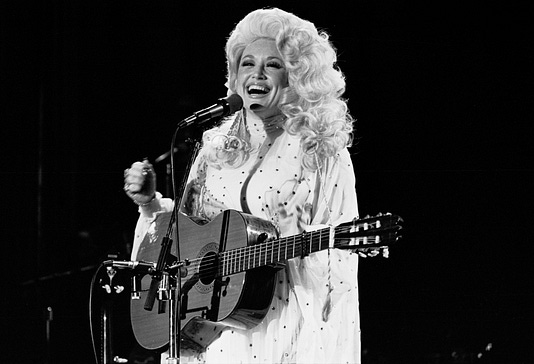
I burst into tears when I heard that Dolly Parton had left us. Damn, we didn’t need that right now.

But then again, perhaps we did. Nothing makes the brilliance of a life more obvious than when someone dies. What a light, what a talent, what a burst of love, what a powerful woman, what a talented artist, and what a generous soul she was on every level. Her light lives on and will bless us all.

If you experience after you die everything you gave to others while you were here, then eternal bliss is certainly guaranteed for Dolly. I don’t know how we can look at her life and think she was anything other than a very big soul.

May her passage be joyful, which I’m sure it is. May those who grieve her be comforted (her sister Stella is a deeply appreciated warrior for justice. I often felt Dolly was probably encouraging her in the background). Whom God has brought together no one and nothing can put asunder, not even death itself. May God wipe away all tears….

Dear God,

Thank you for the experience

Of the soul we call Dolly Parton.

Thank you for her goodness,

And thank you for her love,

And thank you for the joy she gave us.

May she be blessed,

And may those we loved her be comforted.

May we carry forward

The Light she shone.

Amen

Jean Houston, ‘Midwife of Souls’ Who Advised Hillary Clinton, Dies at 89

[Jean Houston is also the half-sister, I believe, of Prosperos student and friend Steve Houston.]

–Mike Zonta, BB editor

The author of books like “The Possible Human,” she held workshops that drew on mythology, psychology and the experiential ethos of Esalen. But she refused to be called a guru.

A close-up of a middle-aged Jean Houston with long brown hair, wearing dark eyeliner and coral lipstick.
Jean Houston in 1996. During her multiday workshops, participants engaged in imaginary conversations with historical figures like Gandhi and translated their dreams into elaborate dances.Credit…Ed Bailey/Associated Press
Michael S. Rosenwald

By Michael S. Rosenwald

June 18, 2026 (NYTimes.com) 

Jean Houston, a spellbinding figure in the human potential movement of the 1960s who used guided imagery to inspire unmoored suburbanites, burned-out executives and even Hillary Rodham Clinton, helping Mrs. Clinton conduct imaginary conversations at the White House with Eleanor Roosevelt, died on May 16 at her home in Ashland, Ore. She was 89.

Her death was confirmed by her friend and business partner, Constance Buffalo.

The daughter of a gag writer for Bob Hope, George Burns and Henny Youngman, Ms. Houston rejected any association with the word “guru,” viewing it as an intellectual demotion. She called herself an “evocateur of the possible” and a “midwife of souls.”

“In my definition, guru is spelled ‘Gee, You Are You,’” she said on the Oprah Winfrey television show “Super Soul Sunday.” “I seem to be a process. I seem to be a verb of becoming, and held by the lure of becoming that keeps us going on.”

As the founder of numerous organizations, including the Human Capacities Corporation, Mystery School, Social Artistry School and the Possible Society, Ms. Houston led workshops at empowerment retreats, in corporate boardrooms, at her geodesic-domed house in Oregon and in far-flung countries with the United Nations.

An older Jean Houston with long dark hair, wearing a blue pantsuit, sits on a stage holding a microphone, next to an older man who is also holding a microphone. They are surrounded by fiddle-leaf fig trees and white poinsettias.
Ms. Houston in 2012 at a seminar in Carlsbad, Calif., with the New Age celebrity Deepak Chopra. She promoted the idea that by making yourself a better person, you could make the world a better place.Credit…Sam Hodgson for The New York Times

“She had a remarkable capacity to be present to others,” Robertson Work, a U.N. policy adviser who accompanied her on trips around the world, said in an interview. “You felt like you were being seen. You could discover: ‘What is my greatness? What is my potential?’”

Ms. Houston synthesized mythology, the psychology of Carl Jung and Joseph Campbell, and the experiential ethos of Esalen, the California retreat that shaped the human potential movement.

During her multiday workshops, participants engaged in imaginary conversations with historical figures like Mahatma Gandhi and Pablo Picasso, acted out the stages of evolution while pretending to be a fish or a monkey, and translated their dreams into elaborate dances.

“The idea was that it’s possible to cultivate a higher power within yourself,” Marion Goldman, a professor emeritus of sociology and religious studies at the University of Oregon and the author of “The American Soul Rush: Esalen and the Rise of Spiritual Privilege” (2012), said in an interview. “By making the self a better place, you make the world a better place.”

In addition to her workshops, Ms. Houston published more than two dozen books, including “The Possible Human: A Course in Enhancing Your Physical, Mental and Creative Abilities” (1982), which sold more than 400,000 copies.

“The imaginal realms of inner space proliferate and spill over into the external world in a phenomenal growth of new science, art, music, literature, politics, and above all in a new vision of mankind and world that is the glory of humanism,” she wrote in the book’s introduction.

A black-and-white photo of a young Jean Houston with long dark hair, wearing a paisley print blouse and patterned pants, stands in a parking lot next to a man with bushy dark hair wearing a dark jacket over a striped polo shirt.
Ms. Houston in 1970 with her husband, Robert E.L. Masters Jr. They spent their honeymoon writing “The Varieties of Psychedelic Experience,” which was reviewed on the cover of The New York Times Book Review.Credit…Edward Fiske/The New York Times

There were dissenters.

Writing in Skeptical Inquirer magazine, Martin Gardner, a critic of pseudoscience, called Ms. Houston’s workshops “bewildering” and judged her “flowery New Age jargon” to be “so vague and murky that it is often difficult to understand.” (Adding insult to injury, the article’s headline labeled her a guru.)

Still, her pull was gravitational — even at the White House. In 1994, Ms. Houston was among a group of motivational speakers whom President Bill Clinton and the first lady invited to Camp David for a series of pick-me-up conversations after their universal health care initiative failed and Republicans took control of Congress.

She and Mrs. Clinton hit it off.

“Jean wraps herself in brightly colored capes and caftans and dominates the room with her larger-than-life presence and crackling wit,” Mrs. Clinton wrote in her memoir “Living History” (2003). “She is a walking encyclopedia, reciting poems, passages from great works of literature, historical facts and scientific data all in the same breath.”

Ms. Houston helped Mrs. Clinton prepare for a visit to India, Nepal and Bangladesh in 1995. That year, the first lady invited her to the White House to brainstorm ideas for “It Takes a Village,” Mrs. Clinton’s book about the well-being of children.

Mrs. Clinton was physically and mentally exhausted. Perhaps, Ms. Houston suggested, she should speak with her hero, Mrs. Roosevelt. The idea was for Mrs. Clinton to talk as herself and then answer back as Mrs. Roosevelt — the sort of role-playing exercise that Ms. Houston had conducted thousands of times.

At some point, she described the sessions with Mrs. Clinton to the Washington Post reporter Bob Woodward, who recounted the details in his 1996 book, “The Choice.” After an excerpt appeared in The Post, tabloids and Republican opponents of the Clintons accused the first lady of holding seances at the White House.

Mrs. Clinton released a lengthy statement in her defense. “This was an interesting intellectual exercise to help spark my own thoughts,” she said. “It was a brainstorming session for my book — not a spiritual event.”

In an appearance on the “Today” show, Ms. Houston told Katie Couric that she was simply helping the first lady focus her mind by imagining “what she would say to Eleanor Roosevelt should she have the occasion to do so.”

Ms. Houston felt that she had been unfairly maligned.

“I’m not a psychic,” she said. “I’m not a guru.”

A book cover in shades of blue and gray with a photo of a face next to the words “The Possible Human.”
Ms. Houston published more than two dozen books, including “The Possible Human” (1982), which sold over 400,000 copies.Credit…Tarcher

Jean Houston was born on May 10, 1937, in Brooklyn. Her mother, Mary (Todaro) Houston, was an actress, interior designer and stock analyst. Her father, Jack Houston, was a comedy writer.

Growing up, she found inspiration in a dummy. When she was 8, she accompanied her father to deliver a script to the ventriloquist Edgar Bergen. Upon arriving, they found Mr. Bergen talking to his plastic-and-wood buddy, Charlie McCarthy.

“Charlie, what is the meaning of life?” Mr. Bergen asked the dummy, as Ms. Houston recalled in her memoir, “A Mythic Life” (1996). “What is the nature of love? Is there any truth to be found?”

The dummy mumbled some answers.

“At that moment,” Ms. Houston wrote, “my skin turned to gooseflesh, an electric hand seemed to touch mine, and a fractal wave of my future activities crashed on the shore of my 8-year-old self. For I suddenly knew that we all contain ‘so much more’ than we think we do.”

Her epiphanies proliferated. On a school trip, she met Helen Keller and marveled at how happy she seemed despite being blind and deaf. She joined an international pen pal club and corresponded about the scriptures of Sikhs, Hindus and Buddhists. She had long conversations with an old man in Central Park; later, she discovered that she had been talking to the philosopher Pierre Teilhard de Chardin.

Ms. Houston smiles wearing a teal outfit with rainbow touches in front of a brightly colored fabric backdrop.
Ms. Houston in 2004. Of a childhood epiphany, she wrote, “I suddenly knew that we all contain ‘so much more’ than we think we do.”Credit…Jamie McCarthy/WireImage for Backstage Creations, via Getty Images

“When you befriend your own brain,” she said, “a great deal becomes possible.”

At Barnard, she studied religion and theater, acting in Off Broadway plays at night. She attended a doctoral program in religion offered by Columbia University and the Union Theological Seminary, but did not receive a degree. (She later received one in psychology from Union Institute in Cincinnati.)

During graduate school, while conducting studies on LSD use, she met Robert E.L. Masters Jr., a writer. They married in 1965 and spent their honeymoon writing “The Varieties of Psychedelic Experience,” which was reviewed on the cover of The New York Times Book Review.

Also in 1965, the couple founded the Foundation for Mind Research, the first of many organizations that Ms. Houston started to promote and study human potential.

“We are living at the beginnings of the golden age of brain, mind and body research,” she told The Washington Post in 1978. “We may well be standing, with regard to these, where Einstein stood in the year 1904 with his discovery of the special theory of relativity.”

Mr. Masters died in 2008. Ms. Houston has no immediate survivors.

Among her fondest memories was her childhood meeting with Ms. Keller, who was then in her late 60s — a story she recounted often.

Ms. Keller put her hand on Jean’s face to read her lips.

“Why are you so happy?” Jean asked.

“My child,” Ms. Keller responded, “it is because I live my life each day as if it were my last. And life in all its moments is so full of glory.”

(Contributed by Michael Kelly, H.W.)