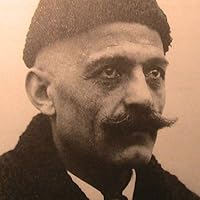
First printed on 26 August 1933 by La Société Anonyme des Editions de l¿Ouest, this is the 75th anniversary edition, a reprint of the first edition. This edition has been digitally retypeset and is not a facsimile.
Georges Ivanovich Gurdjieff (Armenian: Գեորգի Իվանովիչ Գյուրջիև, Georgian: გიორგი გურჯიევი, Greek: Γεώργιος Γεωργιάδης, Russian: Гео́ргий Ива́нович Гюрджи́ев, Georgiy Ivanovich Gyurdzhiev, or Gurdjiev) was an influential Greek-Armenian mystic, spiritual teacher of the early to mid-20th century, and a self-professed ‘teacher of dancing’.
He taught that the vast majority of humanity lives their entire lives in a state of hypnotic “waking sleep,” but that it was possible to transcend to a higher state of consciousness and achieve full human potential. Gurdjieff developed a method for doing so, calling his discipline “The Work” (connoting “work on oneself”) or “the Method.” According to his principles and instructions, Gurdjieff’s method for awakening one’s consciousness is different from that of the fakir, monk or yogi, so his discipline is also called (originally) the “Fourth Way.” At one point he described his teaching as being “esoteric Christianity.”
At different times in his life, Gurdjieff formed and closed various schools around the world to teach the work. He claimed that the teachings he brought to the West from his own experiences and early travels expressed the truth found in ancient religions and wisdom teachings relating to self-awareness in people’s daily lives and humanity’s place in the universe. The title of his third series of writings, Life Is Real Only Then, When ‘I Am’, expresses the essence of his teachings. His complete series of books is entitled All and Everything.
This article applies to left-wing political organizations, but I think it could apply to The Prosperos as well. –Mike Zonta, BB editor
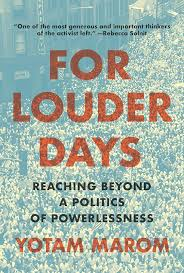
(Image from Amazon.com)
Google AI Overview
For Louder Days: Reaching Beyond a Politics of Powerlessness by Yotam Marom is a non-fiction book that challenges progressive and left-wing movements to overcome their ambivalence toward power, insularity, and comfortable defeat, offering strategies for more effective, strategic, and loving political activism. [1]
Book Details
Author: Yotam Marom (experienced organizer and leader in movements like Occupy Wall Street)
Publisher: The New Press
Core Theme: A critique of the Left’s tendency to prioritize moral purity over actually winning, a trap the author defines as the “politics of powerlessness”. [1, 2]
Why Readers Vibe With It
Action-Oriented: Marom provides practical tools and stories drawn from his decades of organizing experience to help activists transition from feeling powerless to building enduring, collective strength. [1]
Raw & Tender Tone: It is noted for its unguarded honesty, blending fierce critique with a deep compassion for the movement and a hopeful vision for the future. [1, 2]
You can track reviews, read community ratings, or add it to your reading list on Goodreads. To explore purchasing options or read more about the book’s premise, check out The New Press or Amazon. [1]
The essential guide to establishing an effective opposition movement in the age of Trump, from the leading activist and organizer
“I consider [Marom] one of the most generous and important thinkers for the activist left, for anyone who cares about where we are and how to get to where we should be.” —Rebecca Solnit
There is no way to stop the descent into authoritarianism, nor win a world in which all people can thrive, without massive numbers of people organizing for social, political, and economic change.
Yet experienced movement leader Yotam Marom delivers a hard truth: progressive and left movements too often get in their own way. They can be ambivalent about power, choosing insularity and purity over winning. This amounts to what Marom calls the “politics of powerlessness,” which has kept movements small, weak, and defeated.
In For Louder Days: Reaching Beyond a Politics of Powerlessness, Marom offers a brilliant, lyrical clarion cry for a more honest, more strategic, more loving approach to progressive activism and movement building. Grounded in decades of experience in movements, from leading at Occupy Wall Street and other movement moments to supporting some of the most important climate, racial justice, and democracy movements of our time, Marom dives deep into the challenges that hold movements back, and offers stories, tools, and paths toward real power and enduring change.
Published at the most perilous time in our modern political history, For Louder Days comes not a moment too soon. It is essential reading for committed activists as well as the wider public concerned about the state of our world and hoping to change it for the better.
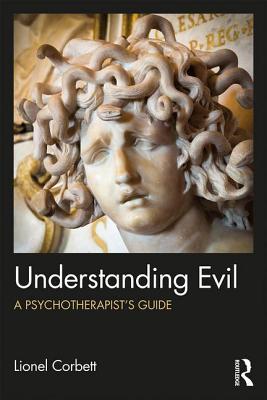
Evil is a ubiquitous, persistent problem that causes enormous human suffering. Although human beings have struggled with evil since the dawn of our species, we seem to be no nearer to ending it. In this book, Lionel Corbett describes the complexity of the problem of evil, as well as many of our current approaches to understanding it, in ways that are helpful to the practicing psychotherapist, psychoanalyst, or Jungian analyst. Psychotherapists often work with people who have been the victim of evil, and, occasionally, the therapist is faced with a perpetrator of evil. To be helpful in these situations, the practitioner must understand the problem from several points of view, since evil is so complex that no single approach is adequate. Understanding A psychotherapist’s guide describes a range of approaches to evil based on Jungian theory, psychoanalysis, social sciences, philosophy, neurobiology, mythology, and religious studies. The book clarifies the difference between actions that are merely wrong from those that are truly evil, discusses the problem of detecting evil, and describes the effects on the clinician of witnessing evil. The book also discusses what is known about the psychology of terrorism, and the question of whether a spiritual approach to evil is necessary, or whether evil can be approached from a purely secular point of view. In Understanding Evil , a combination of psychoanalytic and Jungian theory allows the practitioner a deep understanding of the problem of evil. The book will appeal to analytical psychologists and psychotherapists, psychoanalysts, and academics and students of Jungian and post-Jungian studies. It will also be of great interest to researchers approaching the question of evil from a variety of other fields, including philosophy and religious studies.
War is a timeless force in the human imagination—and, indeed, in daily life. Engaged in the activity of destruction, its soldiers and its victims discover a paradoxical yet profound sense of existing, of being human. In A Terrible Love of War , James Hillman, one of today’s most respected psychologists, undertakes a groundbreaking examination of the essence of war, its psychological origins and inhuman behaviors. Utilizing reports from many fronts and times, letters from combatants, analyses by military authorities, classic myths, and writings from great thinkers, including Twain, Tolstoy, Kant, Arendt, Foucault, and Levinas, Hillman’s broad sweep and detailed research bring a fundamentally new understanding to humanity’s simultaneous attraction and aversion to war. This is a compelling, necessary book in a violent world.
James Hillman (1926-2011) was an American psychologist. He served in the US Navy Hospital Corps from 1944 to 1946, after which he attended the Sorbonne in Paris, studying English Literature, and Trinity College, Dublin, graduating with a degree in mental and moral science in 1950.
In 1959, he received his PhD from the University of Zurich, as well as his analyst’s diploma from the C.G. Jung Institute and founded a movement toward archetypal psychology, was then appointed as Director of Studies at the institute, a position he held until 1969.
In 1970, Hillman became editor of Spring Publications, a publishing company devoted to advancing Archetypal Psychology as well as publishing books on mythology, philosophy and art. His magnum opus, Re-visioning Psychology, was written in 1975 and nominated for the Pulitzer Prize. Hillman then helped co-found the Dallas Institute for Humanities and Culture in 1978.
Retired into private practice, writing and traveling to lecture, until his death at his home in Connecticut on October 27, 2011 from bone cancer.
Is AI a bubble or humanity’s last invention? An existing harm or an existential threat? Obsolete cuts through the hype and false binaries to answer all the AI questions you have, while raising some you probably aren’t prepared for.
The richest companies in history are racing to build a machine that replaces human labor—all of it. And, as this provocative new book insists, the only surefire way they won’t succeed is if we stop them.
Many today don’t get further than seeing AI as a boondoggle—a new shiny object for techno-capitalists to sink their cash into as we barrel toward climate disaster. Obsolete takes those concerns seriously, but implores us to keep our eye on the ball: the attempt to render you obsolete.
The scale of their project has no real precedent. What we think of as big—the Gilded Age monopolies, the Manhattan Project, the Apollo program—doesn’t even come close to capturing its size. Almost none of us wants this vast transformation to succeed. Yet we’re letting it proceed virtually unabated. Why? Because we don’t know it’s happening, we don’t believe it will work, or we don’t think we can stop it. Obsolete takes on all three.
AI expert and journalist Garrison Lovely’s debut is a refreshing reset on an AI debate in which basically everyone is getting some big things wrong. With deep access to top researchers, advocates, and industry insiders, Obsolete offers a new way to think about the technology and a plan for deciding its future democratically.
Arthur Versluis clearly and tautly argues that mysticism must be properly understood as belonging to the great tradition of Platonism. He demonstrates how mysticism was historically understood in Western philosophical and religious traditions and emphatically rejects externalist approaches to esoteric religion. Instead he develops a new theoretical-critical model for understanding mystical literature and the humanities as a whole, from philosophy and literature to art.
Mossbridge reveals how awakening begins not with external revelation but with inner truth. She demonstrates that you already know how to release fear, deepen compassion, and live from a higher awareness. In the second part of the book, Dr. Mossbridge then brings these capacities into her own disclosure about what appears to be a U.S. government-run gifted student program that seems to have been interested in psychic abilities as well as other forms of unusual cognition.
One of the hardest hurdles facing people in intuition is trusting what they get. It’s easy to second-guess and wonder if your inner guidance is intuition or imagination. Henry Reed’s process moves you into trust and confidence. Your own wisdom, accumulated from your life experiences, is stored in memories. Henry shows you how to work with your memories to make powerful connections to your own wisdom. Everything is drawn from within.
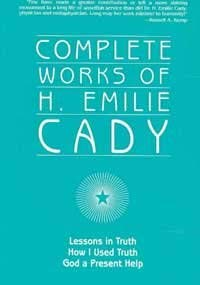
Joseph, in speaking of the action of his brethren in selling him into slavery, “Even though you intended to harm me, God intended it for good.” (Genesis 50:20)
Truth is that which is so.
However humble your place in life, however unknown to the world you may be, however small your capabilities may seem at present to you, you are just as much a necessity to God in His efforts to get Himself into visibility as is the most brilliant intellect, the most thoroughly cultured person in the world. Remember this always, and act from the highest within you.
[K]now once and forever that you are not seeking God, but God is seeking you.
“I AM” is God’s name. Every time you say, “I am sick,” “I am weak,” “I am discouraged,” you are speaking God’s name in vain. I AM cannot be sick; I AM cannot be weary or faint or powerless, for I AM is all-life, all-power, All-Good. “I AM,” spoken with a downward tendency, is always false, always ‘in vain.”
Ralph Waldo Emerson said: “Prayer that craves a particular commodity, — anything less than all good, — is vicious. Prayer is the contemplation of the facts of life from the highest point of view. It is the soliloquy of a beholding and jubilant soul. It is the spirit of God pronouncing his works good. But prayer as a means to effect a private end is meanness and theft. It supposes dualism and not unity in nature and consciousness. As soon as the man is at one with God, he will not beg.”
[Jesus] said, “I thank you Father … because you had hidden these things from the wise and the intelligent and have revealed them to infants.” (Matthew 11:25)
To pardon means simply to remit or wipe out the penalty and let the offender go free, but to forgive means much more than this. It means to give “for”; that is, to give some definite positive good in return for the evil received.
The divine Father of us all is forever trying to manifest Himself in what the dear Scottish minister, George MacDonald, called “a reckless extravagance of abundance.”
John Searle launches a formidable attack on current orthodoxies in the philosophy of mind. More than anything else, he argues, it is the neglect of consciousness that results in so much barrenness and sterility in psychology, the philosophy of mind, and cognitive science: there can be no study of mind that leaves out consciousness. What is going on in the brain is neurophysiological processes and consciousness and nothing more—no rule following, no mental information processing or mental models, no language of thought, and no universal grammar. Mental events are themselves features of the brain, “like liquidity is a feature of water.”
Matthew McKay explains how to use Deep Knowledge Meditation to access all of your soul’s accumulated knowledge, everything you have learned across all of your incarnations. Channeling his late son, Jordan, McKay shares Jordan’s lessons on the mysteries of human existence, including what the Divine or God is, the nature of a soul, the nature of matter and energy, the role of love in our lives, and the origin of the universe.
Murray Stein has written both a basic introduction to Carl Jung’s psychological theories and a venture into looking more deeply into his genius as this is expressed in his Collected Works, his recently published letters and seminars, his Red Book: Liber Novus and his “autobiography,” Memories, Dreams, Reflections. As an advanced introduction to the landscape of the psyche and how it relates to every aspect of life, it also invites readers into an exploration in depth of their own personal inner worlds.
In powerful black-and-white comic strip images, Satrapi tells the story of her life in Tehran from ages six to fourteen, years that saw the overthrow of the Shah’s regime, the triumph of the Islamic Revolution, and the devastating effects of war with Iraq. The intelligent and outspoken only child of committed Marxists and the great-granddaughter of one of Iran’s last emperors, Marjane bears witness to a childhood uniquely entwined with the history of her country.
Persepolis paints an unforgettable portrait of daily life in Iran and of the bewildering contradictions between home life and public life. Marjane’s child’s-eye view of dethroned emperors, state-sanctioned whippings, and heroes of the revolution allows us to learn as she does the history of this fascinating country and of her own extraordinary family. Intensely personal, profoundly political, and wholly original, Persepolis is at once a story of growing up and a reminder of the human cost of war and political repression. It shows how we carry on, with laughter and tears, in the face of absurdity. And, finally, it introduces us to an irresistible little girl with whom we cannot help but fall in love.
Marjane Satrapi (Persian: مرجان ساتراپی) was born in Rasht (Iran, 22nd November 1969 – Paris, June 4th, 2026). Conditioned by the extremism of the 1979 Revolution, her parents sent her to Vienna in 1983 to finish her studies at the French Lyceum in the Austrian capital. She later returned to Tehran and enrolled in the School of Fine Arts, but, in 1994, she moved to France before graduating. She studied at the School of Decorative Arts in Strasbourg (currently, Haute école des arts du Rhin) and later moved to Paris. According to specialists, Marjane Satrapi is one of the most prominent names in international comics, author of what is, for many, one of the best graphic novels ever published: Persepolis (2000), an autobiographical story that narrates her childhood and adolescence in Iran, of which it has been said that “few works have had such an ability to permeate pop culture and, at the same time, be one of the best historical narratives of our time”. Persepolis won the Angoulême Coup de Coeur Award for Best New Author at the Angoulême Festival. In 2001, the second volume also received the award for Best Script at Angoulême. The third and fourth volumes achieved even greater popularity, garnering international success. In 2007, she teamed up with Vincent Paronnaud to turn the comic into an animated film. The adaptation won the Film Critics Grand Prix at the Cannes Festival in 2007 and the César Award for Best Adapted Screenplay in 2008, in addition to being nominated for Best Animated Feature at the 2008 Oscars. Other notable works of hers include Broderies (2003) (Embroideries, 2005) and Poulet aux prunes (2004) (Chicken with Plums, 2006), which was also adapted to film in 2011. In 2023, she coordinated the book Femme, vie, liberté (Woman, Life, Freedom, 2024) together with political scientist Farid Vahid and historian Abbas Milani, both Iranians, and French reporter Jean-Pierre Perrin, in addition to an international group of seventeen comic book authors (including Spaniards Patricia Bolaños and Paco Roca and several Iranians). In this work, she illustrates the revolts that occurred in Iran after the murder of Mahsa Amini in 2022 at the hands of the so-called “morality police”, and denounces the repression and lack of human rights that, according to Satrapi, Iranian society, especially women, suffer at the hands of the regime. The Persian version of this book is accessible online for free to all Iranians.
In addition to the film adaptation of Persepolis, Satrapi has directed the films La Bande des Jotas (The Gang of Jotas, 2012), The Voices (2014) and Radioactive (2019), a biography of scientist Marie Curie. Another discipline in which she has stood out has been painting, with important exhibitions in Parisian galleries such as the Galerie Jérôme de Noirmont. This year, a tapestry designed by Satrapi commissioned by France’s statutory Mobilier Nacional is on display at the Hôtel de la Marine in Paris to mark the upcoming Olympic Games in Paris. Commander of France’s Order of Arts and Letters, Marjane Satrapi holds honorary degrees from the Belgian universities UC Louvain and KU Leuven. She was elected member of the French Academy of Fine Arts in 2024.
From a millennial climate activist, an exploration of how young people live in the shadow of catastrophe
“Strikingly perceptive.” –Jenny Offill, author of Weather
“Beautifully rendered and bracingly honest.” –Jenny Odell, author of How to Do Nothing
Warmth is a new kind of book about climate change: not what it is or how we solve it, but how it feels to imagine a future–and a family–under its weight. In a fiercely personal account written from inside the climate movement, Sherrell lays bare how the crisis is transforming our relationships to time, to hope, and to each other. At once a memoir, a love letter, and an electric work of criticism, Warmth goes to the heart of the defining question of our time: how do we go on in a world that may not?
(Goodreads.com)
Consciousness, spirituality, biography, sexuality, androgyny, futurism, space, the arts, science, astrology, democracy, humor, books, movies and more