
From Wikipedia, the free encyclopedia
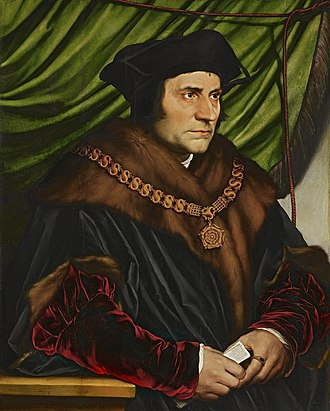
“Sir Thomas More” redirects here. For the play, see Sir Thomas More (play).
For other uses, see Thomas More (disambiguation).


Sir Thomas More (7 February 1478 – 6 July 1535), venerated in the Catholic Church as Saint Thomas More,[7][8] was an English lawyer, judge,[9] social philosopher, author, statesman, and noted Renaissance humanist. He also served Henry VIII as Lord High Chancellor of England from October 1529 to May 1532.[10] He wrote Utopia, published in 1516,[11] which describes the political system of an imaginary island state.
More opposed the Protestant Reformation, directing polemics against the theology of Martin Luther, Huldrych Zwingli, John Calvin and William Tyndale. More also opposed Henry VIII’s separation from the Catholic Church, refusing to acknowledge Henry as supreme head of the Church of England and the annulment of his marriage to Catherine of Aragon. After refusing to take the Oath of Supremacy, he was convicted of treason and executed. On his execution, he was reported to have said: “I die the King’s good servant, and God’s first”.
Pope Pius XI canonised More in 1935 as a martyr. Pope John Paul II in 2000 declared him the patron saint of statesmen and politicians.[12][13][14]
Early life
Born on Milk Street in the City of London, on 7 February 1478, Thomas More was the son of Sir John More,[15] a successful lawyer and later a judge,[9] and his wife Agnes (née Graunger). He was the second of six children. More was educated at St. Anthony’s School, then considered one of London’s best schools.[16][17] From 1490 to 1492, More served John Morton, the Archbishop of Canterbury and Lord Chancellor of England, as a household page.[18]: xvi
Morton enthusiastically supported the “New Learning” (scholarship which was later known as “humanism” or “London humanism”), and thought highly of the young More. Believing that More had great potential, Morton nominated him for a place at the University of Oxford (either in St. Mary Hall or Canterbury College, both now gone).[19]: 38
More began his studies at Oxford in 1492, and received a classical education. Studying under Thomas Linacre and William Grocyn, he became proficient in both Latin and Greek. More left Oxford after only two years—at his father’s insistence—to begin legal training in London at New Inn, one of the Inns of Chancery.[18]: xvii [20] In 1496, More became a student at Lincoln’s Inn, one of the Inns of Court, where he remained until 1502, when he was called to the Bar.[18]: xvii
Spiritual life
According to his friend, the theologian Desiderius Erasmus of Rotterdam, More once seriously contemplated abandoning his legal career to become a monk.[21][22] Between 1503 and 1504 More lived near the Carthusian monastery outside the walls of London and joined in the monks’ spiritual exercises. Although he deeply admired their piety, More ultimately decided to remain a layman, standing for election to Parliament in 1504 and marrying the following year.[18]: xxi
More continued ascetic practices for the rest of his life, such as wearing a hair shirt next to his skin and occasionally engaging in self-flagellation.[18]: xxi A tradition of the Third Order of Saint Francis honours More as a member of that Order on their calendar of saints.[23]
Family life
More married Joanna “Jane” Colt in 1505. In that year he leased a portion of a house known as the Old Barge (originally there had been a wharf nearby serving the Walbrook river) on Bucklersbury, St Stephen Walbrook parish, London. Eight years later he took over the rest of the house and in total he lived there for almost 20 years, until his move to Chelsea in 1525.[19]: 118, 271 [24][25] Erasmus reported that More wanted to give his young wife a better education than she had previously received at home, and tutored her in music and literature.[19]: 119 The couple had four children: Margaret, Elizabeth, Cecily, and John. Jane died in 1511.[19]: 132
Going “against friends’ advice and common custom,” within 30 days, More had married one of the many eligible women among his wide circle of friends.[26][27] He chose Alice Middleton, a widow, to head his household and care for his small children.[28] The speed of the marriage was so unusual that More had to get a dispensation from the banns of marriage, which, due to his good public reputation, he easily obtained.[26]
More had no children from his second marriage, although he raised Alice’s daughter from her previous marriage as his own. More also became the guardian of two young girls: Anne Cresacre who would eventually marry his son, John More;[19]: 146 and Margaret Giggs (later Clement) who was the only member of his family to witness his execution (she died on the 35th anniversary of that execution, and her daughter married More’s nephew William Rastell). An affectionate father, More wrote letters to his children whenever he was away on legal or government business, and encouraged them to write to him often.[19]: 150 [29]: xiv
More insisted upon giving his daughters the same classical education as his son, an unusual attitude at the time.[19]: 146–47 His eldest daughter, Margaret, attracted much admiration for her erudition, especially her fluency in Greek and Latin.[19]: 147 More told his daughter of his pride in her academic accomplishments in September 1522, after he showed the bishop a letter she had written:
When he saw from the signature that it was the letter of a lady, his surprise led him to read it more eagerly … he said he would never have believed it to be your work unless I had assured him of the fact, and he began to praise it in the highest terms … for its pure Latinity, its correctness, its erudition, and its expressions of tender affection. He took out at once from his pocket a portague [A Portuguese gold coin] … to send to you as a pledge and token of his good will towards you.[29]: 152
More’s decision to educate his daughters set an example for other noble families. Even Erasmus became much more favourable once he witnessed their accomplishments.[19]: 149
A portrait of More and his family, Sir Thomas More and Family, was painted by Holbein; however, it was lost in a fire in the 18th century. More’s grandson commissioned a copy, of which two versions survive.