
From Wikipedia, the free encyclopedia
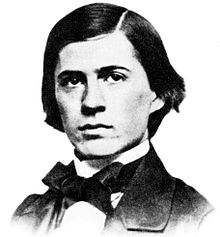
| Charles Sanders Peirce | |
|---|---|
| Born | September 10, 1839 Cambridge, Massachusetts, U.S. |
| Died | April 19, 1914 (aged 74) Milford, Pennsylvania, U.S. |
| Alma mater | Harvard University |
| Relatives | Benjamin Peirce (father) |
| Era | Late modern philosophy |
| Region | Western philosophy |
| School | Pragmatism Pragmaticism |
| Institutions | Johns Hopkins University |
| Notable students | showList |
| Main interests | Logicmathematicsstatistics[1][2]philosophymetrology[3]chemistryexperimental psychology[4]economics[5]linguistics[6]history of sciencePhilosophical logicmetaphysicsepistemology |
| showInfluences | |
| showInfluenced | |
| Signature | |

.png)
Charles Sanders Peirce (/pɜːrs/[8][9] PURSS; September 10, 1839 – April 19, 1914) was an American philosopher, logician, mathematician and scientist who is sometimes known as “the father of pragmatism“.[10][11]
Educated as a chemist and employed as a scientist for thirty years, Peirce made major contributions to logic, a subject that, for him, encompassed much of what is now called epistemology and the philosophy of science. He saw logic as the formal branch of semiotics, of which he is a founder, which foreshadowed the debate among logical positivists and proponents of philosophy of language that dominated 20th-century Western philosophy. Additionally, he defined the concept of abductive reasoning, as well as rigorously formulated mathematical induction and deductive reasoning. As early as 1886, he saw that logical operations could be carried out by electrical switching circuits. The same idea was used decades later to produce digital computers.[12]
In 1934, the philosopher Paul Weiss called Peirce “the most original and versatile of American philosophers and America’s greatest logician”.[13]
Life

Peirce’s birthplace. Now part of Lesley University‘s Graduate School of Arts and Social Sciences.
Peirce was born at 3 Phillips Place in Cambridge, Massachusetts. He was the son of Sarah Hunt Mills and Benjamin Peirce, himself a professor of astronomy and mathematics at Harvard University. At age 12, Charles read his older brother’s copy of Richard Whately‘s Elements of Logic, then the leading English-language text on the subject. So began his lifelong fascination with logic and reasoning.[14] He went on to earn a Bachelor of Arts degree and a Master of Arts degree (1862) from Harvard. In 1863 the Lawrence Scientific School awarded him a Bachelor of Science degree, Harvard’s first summa cum laude chemistry degree.[15] His academic record was otherwise undistinguished.[16] At Harvard, he began lifelong friendships with Francis Ellingwood Abbot, Chauncey Wright, and William James.[17] One of his Harvard instructors, Charles William Eliot, formed an unfavorable opinion of Peirce. This proved fateful, because Eliot, while President of Harvard (1869–1909—a period encompassing nearly all of Peirce’s working life), repeatedly vetoed Peirce’s employment at the university.[18]
Peirce suffered from his late teens onward from a nervous condition then known as “facial neuralgia”, which would today be diagnosed as trigeminal neuralgia. His biographer, Joseph Brent, says that when in the throes of its pain “he was, at first, almost stupefied, and then aloof, cold, depressed, extremely suspicious, impatient of the slightest crossing, and subject to violent outbursts of temper”.[19] Its consequences may have led to the social isolation of his later life.
Early employment
Between 1859 and 1891, Peirce was intermittently employed in various scientific capacities by the United States Coast Survey and its successor, the United States Coast and Geodetic Survey,[20] where he enjoyed his highly influential father’s protection until the latter’s death in 1880.[21] That employment exempted Peirce from having to take part in the American Civil War; it would have been very awkward for him to do so, as the Boston Brahmin Peirces sympathized with the Confederacy.[22] At the Survey, he worked mainly in geodesy and gravimetry, refining the use of pendulums to determine small local variations in the Earth’s gravity.[20] He was elected a resident fellow of the American Academy of Arts and Sciences in January 1867.[23] The Survey sent him to Europe five times,[24] first in 1871 as part of a group sent to observe a solar eclipse. There, he sought out Augustus De Morgan, William Stanley Jevons, and William Kingdon Clifford,[25] British mathematicians and logicians whose turn of mind resembled his own. From 1869 to 1872, he was employed as an assistant in Harvard’s astronomical observatory, doing important work on determining the brightness of stars and the shape of the Milky Way.[26] On April 20, 1877, he was elected a member of the National Academy of Sciences.[27] Also in 1877, he proposed measuring the meter as so many wavelengths of light of a certain frequency,[28] the kind of definition employed from 1960 to 1983.
During the 1880s, Peirce’s indifference to bureaucratic detail waxed while his Survey work’s quality and timeliness waned. Peirce took years to write reports that he should have completed in months.[according to whom?] Meanwhile, he wrote entries, ultimately thousands, during 1883–1909 on philosophy, logic, science, and other subjects for the encyclopedic Century Dictionary.[29] In 1885, an investigation by the Allison Commission exonerated Peirce, but led to the dismissal of Superintendent Julius Hilgard and several other Coast Survey employees for misuse of public funds.[30] In 1891, Peirce resigned from the Coast Survey at Superintendent Thomas Corwin Mendenhall‘s request.[31]
Johns Hopkins University
In 1879, Peirce was appointed lecturer in logic at Johns Hopkins University, which had strong departments in areas that interested him, such as philosophy (Royce and Dewey completed their Ph.D.s at Hopkins), psychology (taught by G. Stanley Hall and studied by Joseph Jastrow, who coauthored a landmark empirical study with Peirce), and mathematics (taught by J. J. Sylvester, who came to admire Peirce’s work on mathematics and logic). His Studies in Logic by Members of the Johns Hopkins University (1883) contained works by himself and Allan Marquand, Christine Ladd, Benjamin Ives Gilman, and Oscar Howard Mitchell,[32] several of whom were his graduate students.[7] Peirce’s nontenured position at Hopkins was the only academic appointment he ever held.
Brent documents something Peirce never suspected, namely that his efforts to obtain academic employment, grants, and scientific respectability were repeatedly frustrated by the covert opposition of a major Canadian-American scientist of the day, Simon Newcomb.[33] Peirce’s efforts may also have been hampered by what Brent characterizes as “his difficult personality”.[34] In contrast, Keith Devlin believes that Peirce’s work was too far ahead of his time to be appreciated by the academic establishment of the day and that this played a large role in his inability to obtain a tenured position.[35]
Peirce’s personal life undoubtedly worked against his professional success. After his first wife, Harriet Melusina Fay (“Zina”), left him in 1875,[36] Peirce, while still legally married, became involved with Juliette, whose last name, given variously as Froissy and Pourtalai,[37] and nationality (she spoke French)[38] remains uncertain.[39] When his divorce from Zina became final in 1883, he married Juliette.[40] That year, Newcomb pointed out to a Johns Hopkins trustee that Peirce, while a Hopkins employee, had lived and traveled with a woman to whom he was not married; the ensuing scandal led to his dismissal in January 1884.[41] Over the years Peirce sought academic employment at various universities without success.[42] He had no children by either marriage.[43]
More at: https://en.wikipedia.org/wiki/Charles_Sanders_Peirce