
Extinction Re Jul 15, 2023 #globalwarming#climatechange#extinctionrebellionXR – Being the Change We believe: ?The current systems of “democracy”, miseducation and economics are part of the problem and won’t get us out of this mess ?We need to link our struggles, peoples to peoples (we call it “glocal linking”) through internationalist solidarity ?We need to support or build peoples justice, grass roots assemblies, local cooperative / commoning and more ?because our food, climate, finance and social systems are and will enter composting / collapse ?We build our resistance through coordinating the stopping of harm …. And refusing odious debts and bills ?Based in reparatory, environmental and cognitive justice. There are many (pluriversal) ways of knowing and being in the world…. We are soulful beings – Ubuntudunia- i am because you are, interdependence, one l❤ve! Join us and find out more: ? https://www.xrisn.earth/bcan The UK community of concerned climate conscious citizens who ‘Rebel for Life’!. Connected around the globe to other activists and supporters by our similarities and our compassion for all life on earth. Using non-violent direct action (NVDA) to highlight the need to upgrade democracy and create a future decided by us, not to us. Share, comment, subscribe, like, mobilise, donate! https://chuffed.org/xr/uk Extinction Rebellion UK: https://extinctionrebellion.uk/ THE 3 DEMANDS 1. Tell The Truth 2. Act Now 3. Decide Together
All posts by Mike Zonta
Book: “Breaking Together: A freedom-loving response to collapse”
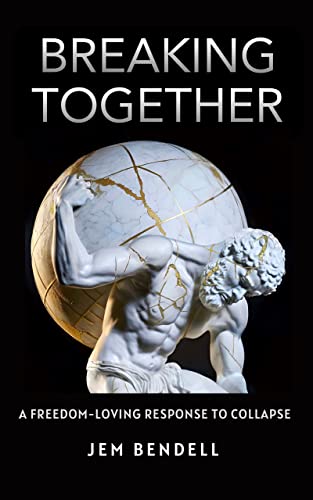
Breaking Together: A freedom-loving response to collapse
Jem Bendell
“This is a prophetic book” Satish Kumar, founder, Schumacher College The collapse of modern societies has begun. That is the conclusion of two years of research by the interdisciplinary team behind Breaking Together . How did it come to this? Because monetary systems caused us to harm each other & nature to such an extent it broke the foundations of our societies. So what should we do? This book describes people allowing the full pain of our predicament to liberate them into living more courageously & creatively. They demonstrate we can be breaking together, not apart, in this era of collapse. Jem Bendell argues that reclaiming our freedoms is essential to soften the fall & regenerate the natural world. Escaping the efforts of panicking elites, we can advance an ecolibertarian agenda for both politics & practical action in a broken world.
“This book is part of a healing movement that extends beyond what we normally think of as ecological” Charles Eisenstein, author, A New Story
” This book shows that instead of imposing elitist schemes and scams, regenerating nature and culture together is the only way forward ” Dr Stella Nyambura Mbau, Loabowa Kenya
” A signpost for people made politically homeless by the craziness of the last few years” Aaron Vandiver, author, Under a Poacher’s Moon
“The mother of all ‘mic drops’ on the myth of sustainable development” Katie Carr, Deep Adaptation Forum
” A new compass for navigating collapse ” Pablo Servigne & Raphael Stevens, authors, Another End of the World is Possible
“If you want to save some of the world but hate being told what to do, this book is for you.” Clare Farrell, co-founder, Extinction Rebellion
Contents
Introduction
1 Economic collapse
2 Monetary collapse
3 Energy collapse
4 Biosphere collapse
5 Climate collapse
6 Food collapse
7 Societal collapse
8 Freedom to know
9 Freedom from progress
10 Freedom from banking
11 Freedom in nature
12 Freedom to collapse & grow
13 Freedom from fake green globalists
Conclusion
“Breaking Together constructs a comprehensive, compelling yet nuanced argument that societal collapse is well underway. Professor Bendell skillfully and seamlessly integrates personal reflection and hard data from virtually every domain to provide a unique vision of catagenesis – the creative renewal of post collapse society. He advocates for an ecolibertarian rather than the ecoauthoritarian world that is beginning to emerge. While It’s often a cliché if the reader has but one book to choose to read this year, it should be Breaking Together. That said, please center yourself as you engage with this brilliant, heartfelt, disturbing and often heartbreaking story of the possible futures that will touch everyone of the 8 billion of us.” Herb Simmens, author, A Climate Vocabulary of the Future
“Our societies are breaking because of damage to the living systems of our planet. It’s time to face this reality and this book helps us do just that. As further collapse unfolds we need a practical alternative to global panic. Jem Bendell has got one – restoring community self-reliance as a global effort.” Pooran Desai OBE, CEO, OnePlanet
“Breaking Together provides an impressive and sobering analysis of what is happening in societies and the biosphere, why ‘we’ (in modern cultures) didn’t know sooner, and what realistic choices remain, both individually and collectively. Jem and his team didn’t just stare into the abyss – they spent two years mapping it for us. This book provides essential wisdom on the necessity of staying engaged politically and socially, whilst attending to the toxic psycho-social patterns that need healing if we are to retain dignity and justice in the coming years.” Katie Carr, Deep Adaptation Forum
Epub from 17/6/2023
(Goodreads.com)
Victor Hugo on love

“To love another person is to see the face of God.”
― Victor Hugo, Les Misérables
Victor-Marie Hugo (February 26, 1802 – May 22, 1885) was a French Romantic writer and politician. During a literary career that spanned more than sixty years, he wrote in a variety of genres and forms. He is considered to be one of the greatest French writers of all time. Wikipedia
Carl Jung on nothingness
“I begin with nothingness. … Nothingness is both empty and full. … A thing that is infinite and eternal hath no qualities, since it hath all qualities.
–Carl Jung on Gnosticism, from The Seven Sermons to the Dead
Carl Gustav Jung (July 26, 1875 – June 6, 1961) was a Swiss psychiatrist and psychoanalyst who founded analytical psychology. Jung’s work has been influential in the fields of psychiatry, anthropology, archaeology, literature, philosophy, psychology, and religious studies. Wikipedia
New Moon In Cancer – Opportunities
 | Astro Butterfly Jul 16, 2023 |
On July 17th, 2023 we have a New Moon in Cancer.
Cancer is one of the most misunderstood signs of the zodiac. Often portrayed as sensitive and shy – this is just a superficial look at the water cardinal sign of the zodiac.
Cancer-energy people are go-getters – incredibly resourceful individuals that can put the Aries, Scorpios or the Capricorns of the zodiac to shame.
Have you ever seen a Cancer competing? Cancer is a tenacious, determined and resilient sign that will surprise you with its emotional stamina and killer instinct – Cancer just goes for it, and snags the win when others are too busy ‘thinking’ or ‘strategizing’.
What does Cancer know that we – all the other signs – don’t?
Cancer just “knows” what to do – they have the natural ability to tune into their emotions and follow their instincts. Not because they’ve learned it somewhere – to them, it comes naturally.

Just like the Moon shape shifts every single day, Cancer recognizes the unique opportunity that arises every.single.moment. Today’s opportunity may mean nothing tomorrow. The time is NOW!
Just like the spring intuitively knows how to find its way to the ocean, Cancer seizes opportunities as they arise, and quickly snaps them – as opposed to, let’s say, Capricorn, which plans everything in advance.
Let’s say you’re in Time Square and someone pops out of nowhere looking for volunteers to win a cash prize. By the time Leo or Libra make up their mind, by the time Scorpio or Pisces decide how they feel about it, Cancer has already raised their hand and snapped the prize.
Cancer has that incredible gift of recognizing the potential of every single interaction. Cancer energy is quick and potent – because it’s rooted in our instincts and emotions.
What can we learn from Cancer?
That there are incredible opportunities everywhere. That we are surrounded by endless opportunities. Every minute. Every second. Every moment we can birth something new into existence.
Perhaps you can think of some times in your life where opportunity knocked at your door but you didn’t recognize it. You may have simply not seen it – or thought too much about it and then talked yourself out of it.
Or perhaps you are still waiting for that 5-star opportunity that is a perfect match to your interests and aspirations.
The problem with waiting for the “perfect opportunity” is that perfect opportunities don’t actually exist. An opportunity is by definition imperfect – it’s just an emergence of ‘something’ – something that could grow, IF recognized and cultivated.
The New Moon in Cancer will help us (re)connect with our inner Cancer – with that part of us that naturally recognizes opportunities and takes chances.
New Moon In Cancer – The Aspects
The New Moon (at 24° Cancer) is sextile Uranus in Taurus, adding an element of serendipitous chance. And it’s trine Neptune, helping us relax into the creative emergence process.
The New Moon is also opposite Pluto in Capricorn. Certain circumstances might force us into taking action. But when one door closes, another opens.
How can we align ourselves with the energy of the New Moon in Cancer and seize opportunities?
New Moon In Cancer – Opportunities
The easiest way to tap into Cancer’s energy is to recognize your emotions as they arise.
Cancer energy at its core is really all about the art of paying attention.
Mindfulness exercises are not meant to shut down our mind, but to help us recognize the natural flow of our thoughts and emotions. They come and go. The idea here is not to dismiss these thoughts and feelings – on the contrary, to acknowledge them.
Every little thought, every mood, every impulse, every emotion emerges for a reason. Everything we experience is pure life energy, and comes with incredible potential. It screams for our attention. It wants to be birthed. It wants to come into existence. It wants to be actualized.
At the New Moon in Cancer, if something comes to you – an idea, an encounter, a proposal – check in with how you feel about it. It doesn’t matter if it makes sense or not. We don’t want to bring in any judgments.
Just tune into your body and feelings. You’ll know you’re onto something if you feel a spark of aliveness, if the cells in your body feel energetically charged and ‘ready’ for emergence.
WHY DID OUSPENSKY LEAVE GURDJIEFF?
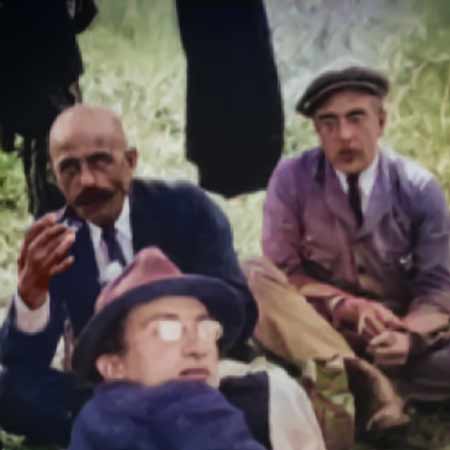

Question: I am finishing the reading of Ouspensky’s In Search of the Miraculous and am quite intrigued to know why did Ouspensky leave Gurdjieff. Why did he decide to distance himself at some point and work separately? The book is not clear about it; I sense that Ouspensky protects Gurdjieff by saying the minimum. Could you tell me what happened or direct me to some other sources on the topic?
Ouspensky indeed speaks minimally about why he decided to leave Gurdjieff. In the context of the book In Search of the Miraculous, I suspect it has to do with his aim in writing the book. If he digressed into criticism about Gurdjieff’s methods, or a long apology for why he decided to leave him, it would taint the entire book with the spirit of gossip and intrigue, and detract from the objectivity of the knowledge presented.
However, Ouspensky’s reluctance to speak about why he left Gurdjieff extended beyond his books. We are told that, at some point, he got tired of being asked about Gurdjieff and gave his students a task not to mention him. I suspect it might have been impossible for him to explain exactly what happened. He implies this in In Search of the Miraculous. Language has limitations. An experience put into words cannot capture the time and place in which it occurred. We, who were not there, fill in the blanks with our own imagination and corrupt the original event. In the spirit of remaining objective, it is often more prudent not to speak at all than to open the door to distortion.
What Ouspensky does tell us in In Search of the Miraculous is that the rift was gradual. In the summer of 1916, a year after Ouspensky met Gurdjieff, Gurdjieff took eight of his students to a country house in Finland for more concentrated work. This was a pivotal period for Ouspensky that deepened his understanding of the work and left him very hopeful that he might accomplish real inner change with Gurdjieff’s help. After this gathering, he wrote:
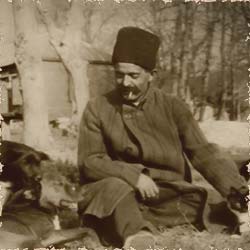
Gurdjieff (cir. 1917)
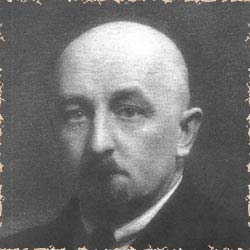
Thomas de Hartmann
[OUSPENSKY] “At this time certain very definite changes began in my views on myself, on those around me, and particularly on “methods of action” …they were not in any way connected with what was said in Finland but they had come as a result of the emotions which I had experienced there… Somewhere very deep down inside me I understood the esoteric principle of the impossibility of violence, that is, the uselessness of violent means to attain no matter what.” i
About a year later, in 1917, Gurdjieff gathered 13 of his students for six weeks at Essentuki, at the base of the Caucasus mountains in Russia. Again, Ouspensky singled out the knowledge and methods shared during this gathering as deeply significant. “We were given some general propositions by which I thought we could be guided later on,” he said. Surprisingly, however, the Essentuki gathering came to an abrupt and sour ending:
[OUSPENSKY] “And suddenly everything changed. For a reason that seemed to me to be accidental and which was the result of friction between certain members of our small group, Gurdjieff announced that he was dispersing the whole group and stopping all work.” i
Needless to say, this incident was a big blow to everyone involved. It is impossible for us, who were not there, to comprehend the extent of the disappointment in seeing one’s investment in a teacher come to nothing, and for seemingly trifling reasons. We learn a little more about the circumstances behind this abrupt ending from the De Hartmanns, who are the only others present in Essentuki to later recount it in their memoir:
[THOMAS DE HARTMANN] “[Gurdjieff] had been trying Petrov (another student attending, not Peter Ouspensky) almost beyond endurance. At last Petrov could not hold out any longer. He forgot himself and answered Mr Gurdjieff angrily. Mr Gurdjieff turned and left the house, and an hour later it was announced that all further work was to stop for everyone because one of the senior pupils had manifested himself in this way towards his teacher.” ii
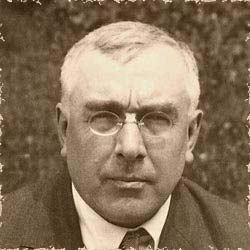
Peter Ouspensky

Olga de Hartmann
[OUSPENSKY] “All this surprised me very much. I considered the moment most inappropriate for “acting,” and if what Gurdjieff said was serious, then why had the whole business been started? During this period nothing new had appeared in us. And if Gurdjieff had started work with us such as we were, then why was he stopping it now?” i
The natural disappointment in realizing Gurdjieff was dispersing the whole group and stopping all work—coupled with Ouspensky’s earlier realization of the uselessness of using violence—give good grounds for understanding why a rift would form.
[OUSPENSKY] “And I have to confess that my confidence in Gurdjieff began to waver from this moment. What the matter was and what particularly provoked me is difficult for me to define even now. But the fact is that from this moment there began to take place in me a separation between Gurdjieff himself and his ideas. Until then I had not separated them.” i
The crack widened as events continued unfolding. Eventually, Ouspensky decided to break all contact with Gurdjieff and continue working independently. Many have subsequently tried to explain this rift without having been there. They reduced the complexity of the conflict—which Ouspensky himself admitted was difficult for him to define—into a black-and-white verdict that vindicated one side and condemned the other. Some ruled in favor of Gurdjieff, attributing his actions to his unique and inspired methods, and claiming that Ouspensky, in his intellectual blindness, missed the very lesson Gurdjieff intended to relay. Others ruled in favor of Ouspensky, taking such events as the sudden disbandment of the Essentuki group as proof that Gurdjieff was moody, violent, and manipulative, and that his students could not continue to acquiesce to his methods. Not having been there, we see what we want to see; we fill in the missing blanks to suit our own imaginary picture.
Be that as it may, to discard Gurdjieff and Ouspensky’s legacies because of their disagreements would be to throw out the baby with the bathwater. We are forced onto Ouspensky’s same conclusion: we must separate the message from its messengers. Gurdjieff himself always stressed that his teaching was rooted in ancient traditions. Part II of Seeker of Truth attempts to show that many of these are still widely available: Christianity, Buddhism, Judaism, etc. Gurdjieff’s unique contribution was twofold: he presented their original meaning in a fresh and accessible way, and offered practical tools for verifying that meaning. Once we verify an idea, we disconnect it from its messenger and make it our own.
Question: Has it ever crossed your mind to regret having ever met Gurdjieff?
Ouspensky: Never. Why? I got very much from him. I am always very grateful to myself that after the first evening I asked him when I could see him next time. If I had not, we would not be sitting here now.
Question: But you wrote two very brilliant books.
Ouspensky: They were only books. I wanted more. I wanted something for myself.iii

SOURCES
- In Search of the Miraculous by Peter Demianovich Ouspensky
- Our Life with Mr. Gurdjieff by Thomas and Olga de Hartmann
- Ouspensky’s Meeting Transcripts from the Yale Library
(ggurdjieff.com)
Rupert Spira on the finite mind and the infinite one

“As the finite mind passes through the portal ‘I’ in one direction, it loses its limitations and stands revealed as God’s infinite being.
As God’s infinite being passes through the same portal in the opposite direction, it acquires a limit and becomes, or seems to become, a finite mind.“
–Rupert Spira
Rupert Spira (born March 13, 1960) is an English spiritual teacher, philosopher and author of the Direct Path based in Oxford, UK. Wikipedia
(newsletter@rupertspira.com)
Backs Against The Wall: The Howard Thurman Story (2019) | Full Movie
EncourageTV Premiered Jul 2, 2021 Backs Against the Wall: The Howard Thurman Story explores the extraordinary life and legacy of one of the most important religious figures of the 20th century. Thurman was a prolific writer, celebrated preacher and recognized by Martin Luther King, Jr as the “spiritual foundation” for the Civil Rights Movement. Starring Keith David, Martin Doblmeier, Walter Earl Fluker, Jesse Jackson
Book: “Urban Shaman”

Urban Shaman
Serge Kahili King
Now, even if you can’t get out into the wilderness or undertake a long apprenticeship, you can learn to practice the art of shamanism. Uniquely suited for use in today’s world, Hawaiian shamanism follows the way of the adventurer, which produces change through love and cooperation – in contrast to the widely known way of the warrior, which emphasizes solitary quests and conquest by power.
(Goodreads.com)
Rainer Maria Rilke on beauty

“For beauty is nothing but the beginning of terror
which we are barely able to endure, and it amazes us so,
because it serenely disdains to destroy us.
Every angel is terrible.”
― Rainer Maria Rilke, Duino Elegies
René Karl Wilhelm Johann Josef Maria Rilke, shortened to Rainer Maria Rilke (December 4, 1875 – December 29, 1926), was an Austrian poet and novelist. Acclaimed as an idiosyncratic and expressive poet, he is widely recognized as a significant writer in the German language. Wikipedia