Wearing peasant clothing, often kneeling with his hands upraised in prayer; crucifix worn about his neck; hands crossed over chest
Seraphim of Sarov (Russian: Серафим Саровский; 30 July [O.S. 19 July] 1754 (or 1759) – 14 January [O.S. 2 January] 1833), born Prókhor Isídorovich Moshnín (Mashnín) [Про́хор Иси́дорович Мошни́н (Машни́н)], is one of the most renowned Russian saints and is venerated in the Eastern Orthodox Church,[1] the Eastern Catholic Churches,[2] and the Anglican Communion.[3] He is generally considered the greatest of the 18th-century startsy (elders). Seraphim extended the monastic teachings of contemplation, theoria and self-denial to the layperson. He taught that the purpose of the Christian life was to receive the Holy Spirit. Perhaps his most popular quotation amongst his devotees is “acquire a peaceful spirit, and thousands around you will be saved.”
“Spirituality is an attempt to accesss the divine. Religion is crowd control.”
–Steve Bhaerman aka Swami Beyondananda
Swami Beyondananda is the cosmic comic alter ego of writer, humorist, performer and uncommontator Steve Bhaerman. The Swami, whose favorite yoga pose is tongue-in-cheek, is the spokesperson for a new non-religion, FUNdamentalism (accent on “fun”).
The Cancer New Moon introduces a new phase of caring, whether our role is to look after another or pay more attention to our own needs. It may be time to shift focus to who’s last on the list. Perhaps we feel the impetus emotionally before doing so. But, in certain scenarios, it will simply be that the task rolls itself up, like a boulder we just can’t get around. Our job is plain: press on with whatever is required.
This role doesn’t have to be onerous or thankless. Maybe the deeper task is to work out methods that feel positive to give and pleasant to receive. The Cancerian Moon often brings a reminder of the mother archetype, offering unconditional love, which we frequently crave, but find can be in short supply. To receive it, we may first have to give it — or model something of that nature.
The New Moon opposes Pluto, so we could finally put an end to a chapter, relationship, or mode of being. When Pluto hangs over us, we can get fed up with a state of oppression and want out — whatever the cost may be. A resulting state of freedom can be worth so much more. Ensure that whatever is stipulated or agreed to can hold, so the situation is finally declared “over.”
During a Moon–Pluto opposition, matters may not roll out especially simply, which could pit our energies, desires, or needs against someone else’s. A dramatic showdown might be followed by a void or sense of nothingness. We should not worry too much, however, because any alarming drama should end once the energy has been expended. There’s work to do but the new direction that needs to be built will likely be more clear. The ground we thought safe is different, or the resource we relied upon may have run dry. It’s time to set sights elsewhere and ascertain where fertile land exists — it’s surely out there somewhere!
Occasionally, with Pluto transits where we’ve faced some situation, lack, or devastation, there is gold to be panned or a prize to be had. We might just need to dig deeper or try harder to uncover it! This will require extra energy of us, and we’ll have to work out whether we have enough, or if we’re willing to wait until we do.
Since the Moon trines Neptune in Pisces, the really good news is that we can escape from people or situations that are stifling, blocking, or tempestuous. We can sail on calmer seas or find easier-going people to hook up with. A Neptune trine can be a little like receiving salve on a wound: we get the care and healing we need, no matter how deep the injury. And now we sense that things can only get better!
A sextile between the Moon and Uranus indicates an opportunity to leave behind an outdated system or situation, opening the door to a new lease on freedom, a breath of fresh air, and a chance for more individual expression.
The strength of our feelings counts more when the Moon is in its own sign. Tuning in and listening to their messages may move you to tears, intense joy, anger, or delight. But with outer planets involved, feelings can be more subtle, showing up as signals in the body. The chakra energy centers — bands through the body from head to feet — indicate points of healing. If we work out correspondences for where we feel sensations, we can see where healing is possible.
One method is to sample single aromatherapy essences and notice in which part of the body you feel a resonance (e.g., the heart, the stomach). Particularly, if you like the aroma, it’s likely some healing can be achieved in the corresponding body area (if you plan to apply that oil in the same place). This could be part of a plan to help change an emotional pattern or offer a physical boost. (Note: Essential oils should be diluted before use.)
This article is from the Mountain Astrologer by Diana McMahon Collis
July 16, 2023 Updated: July 17, 2023 (SFChronicle.com)
Even as COVID wanes, litigants keep filing lawsuits over vaccine mandates, masking and other public health policies enacted during the pandemic. Their endgame is stoking misinformation.Marilyn Nieves/Getty Image
Public health has had its day in court lately. And another day. And another day.
Over the course of the pandemic, lawsuits came from every direction, questioning public health policies and hospitals’ authority. Petitioners argued for care to be provided in a different way, they questioned mandates on mask and vaccine use, and they attacked restrictions on gatherings.
Historically, “there’s been nothing but a cascade of supportive deference to public health,” said Lawrence Gostin, a professor specializing in public health law at Georgetown University. That changed during the pandemic. “It’s the opposite. It’s been a torrent.”
Even as COVID-19 wanes, lawyers representing the health care sector predict their days in court aren’t about to end soon. A group of litigators and media companies, among others, are looking at policy changes and even some profits from yet more lawsuits.
Because such groups can reach millions of people, public health advocates like Gostin and Brian Castrucci, president of the de Beaumont Foundation, a public health nonprofit, suggest that the result, beyond creating legal setbacks, could spread more misinformation about their work. The imprimatur of a lawsuit, they think, can help spread vaccine skepticism or other anti-public-health beliefs, if only through news coverage. “You know, lawsuits have a galvanizing effect,” Gostin said. “They tend to shape public opinion.”
Lawyers are organizing to promote their theories. Late in March, a group of them gathered in Atlanta for a debut Covid Litigation Conference to swap tips on how to build such cases. “Attention, Atlanta lawyers,” proclaimed an ad promoting the event. “Are you ready to be a part of the fastest-growing field of litigation?”
The conference was sponsored in part by the Vaccine Safety Research Foundation, which was established on vaccine-skeptical views. The gathering promised to share legal strategies for suing federal and state public health agencies over COVID policies, as well as hospitals and pharmaceutical firms for alleged malfeasance.
It’s the sort of thing that has people like Gostin paying attention. “It’s very worrisome,” he said. Even if lawsuits don’t succeed, it could make hospitals and public health officials gun-shy, he said. At the height of the pandemic, lawyers were successfully forcing hospitals to administer ivermectin to treat COVID — despite many gold-standard, randomized, controlled trials demonstrating it wasn’t particularly useful.
The conference was a good way to meet like-minded advocates, explained Steven Warshawsky, a New York lawyer who attended. “There’s networking and an effort to create a legal community that’s knowledgeable,” he said. And colleagues can also “spread the word about different legal angles.” Indeed, panels covered subjects ranging from licensure to hospital negligence, and allegations of vaccine injuries.
The conference was organized by Steve Kirsch, a wealthy San Francisco Bay Area tech executive, who describes himself as a “truth-teller” regarding COVID vaccines and policies. He has persistently raised questions about masks and vaccines and other standard public health measures. The conference, he said, is meant to help encourage lawyers to further that stance. He said he hopes that “the lawyers are successful in getting large settlements” because “it will incentivize other lawyers” to bring their own suits against pharmaceutical firms and government agencies alike.
He’s been known to tweet about situations in which he, an unmasked person, encountered masked counterparts. For example, during a flight, he offered $100,000 to an airplane seatmate to remove her mask. (He said he did it to test the level — and potential hypocrisy — of people’s attachment to masks.)
Kirsch’s legal entrepreneurism is on full display in his newsletter: Individuals seeking his comments can check boxes if they are lawyers who would represent him in various lawsuits against the federal government on vaccine-related issues.
Visitors can also book his time in 15-minute increments, at $500 a pop; subscriptions to his newsletter — of which he claims “tens of thousands” — are $50 a year. (He says he donates the subscription income.)
The lawyers’ conference attracted speakers well-known in the COVID litigation world. One, Robert Malone, did early work on messenger RNA and has now grown skeptical over alleged defects in COVID vaccines. (They’ve been approved by the Food and Drug Administration after large trials.) Malone and other plaintiffs threatened Twitter last year with a lawsuit seeking to reverse a ban on spreading misinformation. After taking a media tour, he’s now back on the social media network.
For public health officials, it’s not merely the potential outcome of the courts’ rulings but also the publicizing of the theories that poses a risk.
“Even one win, despite countless losses, for some will provide supposed evidence and vindication that questions need to be answered, liability needs to be assigned, or a wrong needs to be righted,” Castrucci told California Healthline. “But the decision of any one trial can’t and shouldn’t supplant the findings of clinical trials enrolling nearly 70,000 Americans.”
“I think this is part of a grander destabilization of public health, through the judicial system,” Castrucci said.
Readers wanting to connect favored theories to courtroom drama through the media have no lack of opportunity. Take the Daily Wire, an online publication featuring conservative political commentator Ben Shapiro. The company was a plaintiff in one federal lawsuit, part of a barrage of successful litigation, challenging the Occupational Safety and Health Administration’s policy of giving large businesses an option of either requiring their employees to get vaccinated or test weekly for COVID. The regulation was stymied by the Supreme Court and later withdrawn by the agency.
The lawsuit served a second purpose. It provided a continual, evolving theme for Facebook ads promoting the outlet’s fight — and asking viewers to subscribe, sign petitions or purchase merchandise. In a November 2021 ad, Shapiro asserted there was “no bigger fan” of vaccines than he. But any pro-vaccine claim was not a centerpiece of future ads, which inveighed against mandates, vaccine passports, and the like. The Daily Wire claimed in February 2022 that it was bringing in $100 million in annual revenue.
The publication made COVID messaging, particularly around lawsuits or legal matters, a frequent theme of its advertising. One ad, for example, mentioned how police were enforcing vaccine passports in “certain cities” — it didn’t specify which cities. But the Daily Wire published an article about police checking such passports in Paris, not the United States. The media outlet didn’t respond to multiple requests for comment.
In all, California Healthline found the publication had at least 10 million ad impressions on Meta platforms — Facebook and Instagram — from October 2021 to February 2023 concerning lawsuits, mandates, lab leaks and other COVID-related topics.
Earlier, conservative media groups were happy to contribute by writing amicus briefs in support of certain cases. But there’s now plenty of far-right voices trying to seize an audience, said A.J. Bauer, an assistant professor of journalism studying conservative media at the University of Alabama. “We’re seeing an oversaturated media space, with a lot of competition,” especially on the right, Bauer said. As such, he said, they need to stand out — even if it means embracing “stunts,” like participating directly in lawsuits.
Darius Tahir is a Washington, D.C.-based correspondent for KFF Health News, a national newsroom that produces in-depth journalism about health issues and is one of the core operating programs at KFF. Reach him at DariusT@kff.org; Twitter @dariustahir
“There is hardly any activity, any enterprise, which is started with such tremendous hopes and expectations, and yet, which fails so regularly, as love,” the humanistic philosopher and psychologist Erich Fromm wrote in his classic on the art of loving. In some sense, no love ever fails, for no experience is ever wasted — even the most harrowing becomes compost for our growth, fodder for our combinatorial creativity. But in another, it is indeed astonishing how often we get love wrong — how, over and over, it stokes our hopes and breaks our hearts and hurls us onto the cold hard baseboards of our being, flattened by defeat and despair, and how, over and over, we rise again and hurl ourselves back at the dream of it, the delirium of it, the everlasting wonder of it.
How to go on doing it undefeated is what British philosopher Gillian Rose (September 29, 1947–December 9, 1995) examines in her part-memoir, part-reckoning Love’s Work (public library), written in the final years of her prolific and passionate life, and published just before her untimely death of ovarian cancer.
In a startling inversion of the iconic opening sentence of Anna Karenina, Rose writes:
Happy love is happy after its own fashion: it discovers the store of wonders untold, for it is the intercourse of power with love and of might with grace. Nothing is foreign to it: it tarries with the negative; it dallies with the mundane, and it is ready for the unexpected. All unhappy loves are alike. I can tell the story of one former unhappy love to cover all my other unhappy loves… The unhappiest love is a happy love that has now become unhappy.
However satisfying writing is — that mix of discipline and miracle, which leaves you in control, even when what appears on the page has emerged from regions beyond your control — it is a very poor substitute indeed for the joy and the agony of loving. Of there being someone who loves and desires you, and he glories in his love and desire, and you glory in his ever-strange being, which comes up against you, and disappears, again and again, surprising you with difficulties and with bounty.
Most of life’s difficulties have to do with its relationship to power — to the desire for power, to the fear of it. An epoch after Bertrand Russell insisted that “the touchstone of any love that is valuable” lies in relinquishing the desire for power over the love object, Rose writes:
In personal life, people have absolute power over each other, whereas in professional life, beyond the terms of the contract, people have authority, the power to make one another comply in ways which may be perceived as legitimate or illegitimate. In personal life, regardless of any covenant, one party may initiate a unilateral and fundamental change in the terms of relating without renegotiating them, and further, refusing even to acknowledge the change… There is no democracy in any love relation: only mercy. To be at someone’s mercy is dialectical damage: they may be merciful and they may be merciless. Yet each party, woman, man, the child in each, and their child, is absolute power as well as absolute vulnerability. You may be less powerful than the whole world, but you are always more powerful than yourself. Love in the submission of power.
[…]
Exceptional, edgeless love effaces the risk of relation: that mix of exposure and reserve, of revelation and reticence. It commands the complete unveiling of the eyes, the transparency of the body. It denies that there is no love without power; that we are at the mercy of others and that we have others in our mercy.
Mercy, of course, would be unnecessary, irrelevant, even nonexistent without its object: fear. We yearn for mercy only when we are and because we are afraid. In consonance with Hannah Arendt’s observation that “fearlessness is what love seeks,” Rose considers why such fearlessness is the most difficult and counter-natural achievement in the gauntlet of the heart:
Lover and Beloved are equally at the mercy of emotions which each fears will overwhelm and destroy their singularity. For the Lover, these are the frightening feelings roused by the love: for the Beloved, these are the frightening feelings trusted to love, but now sent back against her.
[…]
You may be weaker than the whole world but you are always stronger than yourself. Let me send my power against my power… Let me discover what it is that I want and fear from love. Power and love, might and grace.
If the Lover retires too far, the light of love is extinguished and the Beloved dies; if the Lover approaches too near the Beloved, she is effaced by the love and ceases to have an independent existence. The Lovers must leave a distance, a boundary, for love: then they approach and retire so that love may suspire.
We might know all this, and yet we keep getting it wrong, miscalibrating the optimal distance, miscalibrating our own capacity for love. But getting it wrong might be precisely what keeps us trying, keeps us hoping, keeps us living. After meeting a woman who was diagnosed with cancer at sixteen and survived to be vivacious at ninety-six, Rose marvels:
How can that be — that someone with cancer since she was sixteen exudes well-being at ninety-six? Could it be because she has lived sceptically? Sceptical equally of science and of faith, of politics and of love? She has certainly not lived a perfected life. She has not been exceptional. She has not loved herself or others unconditionally. She has been able to go on getting it all more or less wrong, more or less all the time, all the nine and a half decades of the present century plus three years of the century before.
Looking back on her own life, perched on the precipice of death, she reflects:
A crisis of illness, bereavement, separation, natural disaster, could be the opportunity to make contact with deeper levels of the errors of the soul, to loose and to bind, to bind and to loose. A soul which is not bound is as mad as one with cemented boundaries. To grow in love-ability is to accept the boundaries of oneself and others, which remaining vulnerable, woundable, around the bounds. Acknowledgement of conditionality is the only unconditionality of human love.
In How to Be Animal: A New History of What It Means to Be Human (public library), poet turned environmental historian and philosopher of science Melanie Challenger traces our slow self-alienation from our own nature and invites an urgent recalibration of the organizing principles by which we perceive, respond to, and reverence the world.
We live behind a hidden membrane through which — at any moment — one of us may tumble to find ourselves on the other side. Opening our eyes, we face the truth of what we are, a thinking and feeling colony of energy and matter wrapped in precious flesh that prickles when it’s cold or in love. We are a creature of organic substance and electricity that can be eaten, injured and dissipated back into the enigmatic physics of the universe. The truth is that being human is being animal. This is a difficult thing to admit if we are raised on a belief in our distinction.
We know not only that the Earth is not the centre of the universe but that we are not the centre of life. Instead, we are an animal that finds itself aware of being an animal bound into the dark tissues of time and energy. The human species is an integrated part of the life on our planet, not an exceptional creation by itself… If a kind of magic quickens the sinews of living things, then humans simply possess a share in a sacred cosmos.
Observing that the numinous cosmogony of hunter-gatherer cultures did not survive the transition to large agricultural societies, which turned nature from kin to resource, Challenger examines the origin of our destructive delusion of exceptionalism:
History shows us that knowledge doesn’t necessarily lead to enlightenment but only to the search for a different source of light. Each scientific or intellectual threat to our singular status has been followed by a fracturing of existing beliefs and renewed efforts to ground the basis of our separation from the rest of life. One solution was to redirect the emphasis on to becoming human. Solace could be found in the possibility that, as Thomas Huxley put it, we may be “from them” but we are not “of them.” This has been repeated in different forms ever since. It’s common to hear that while science tells us that we are animals subject to the same laws as other organisms, humans are “uniquely unique.” In this way, scientists swallow Darwinism but remain immune to its effects.
If we no longer see into the lives of other animals, it’s not because they don’t have minds or we can’t. It’s because we don’t want to. Yet now we’re told that everything should make way for humankind’s greatest invention: artificial intelligence. This is a far more dangerous delusion than anything dreamed up in a church. In this cult of freedom, nothing much is said of the consequences for the eight million or so species that live alongside us. Little is said for the passing of all the intelligence found in flesh and bone, feather and fang.
At the crux of our self-permission to so elevate ourselves is not only our faulty measure of intelligence but the deeper tendency to reduce the measure of consciousness, of vitality, of creaturely worth to the measure of intelligence. With an eye to the relatively nascent finding that consciousness arose in the body before the brain, Challenger writes:
It’s only when we forget that our conscious experience is a feature of our bodies that we stumble when we see it at work… That our subjective consciousness is a physical phenomenon that can be interrupted by everything from diet and disease to depression only reaffirms that we are an animal… Our sense of self is a purposeful extension of the needs of our bodies… Consciousness is just a convenient word that stands for a global function that emerges from but extends beyond our immediate anatomy. The person we build our lives around is a consequence of the body, a detonation of senses and interpretations, the meaningful content of the central nervous system.
For a long time, researchers hoped to find a “music bit” of the brain to explain what seemed a peculiarly human behaviour. No such luck. In a recent study across Chinese and American participants, at least thirteen overarching emotions were activated by music, many of which rely on different aspects of our biology. The great waves of sadness and joy, exhilaration and pleasure we experience when we listen to music pull from multiple aspects of being an animal. Not only that, but they don’t just unfold in the brain or rely on our sense of self. They’re modulated by organic chemicals and processes that act like filigrees of feeling, tied throughout the body in a net of impossible complexity… Music depends on us being animal… Listening to music has more to do with the scent of honey or the pleasure of reproducing or of being healthy in a plentiful landscape than it does with a mathematical algorithm. For that matter, responding to music, whether it’s Mozart or Lady Gaga, has more to do with the experiences of whales deep in the Atlantic Ocean than it does with the computer through which we might be listening.
At the heart of our aversion to being animal is precisely this awful knowledge that we do have a body for only a short time — that we live our lives in entropy’s shadow, inclining toward oblivion from the moment we are born, inhabiting a sliver of spacetime as transient miracles of sinew and sentience. But while our mortality may be what gives meaning to our lives, it is also the primal terror that makes us wish to transcend the temporality of our animal flesh. Noting our irrational “fear of being animal that was the price of becoming a person,” Challenger writes:
As we became self-conscious, our personal view floodlit what can be a danger to our bodies and laid bare the inescapable danger of death. We’ve become the conundrum of an animal that doesn’t want an animal’s body. What was survival has re-emerged, by a long, curious path, as psychological imperative. Other animals don’t have to justify themselves to themselves. But humans seek what might give their lives a meaning that no other animal possesses. If we don’t belong to the rest of nature, its dangers can’t reach us.
But rather than reassure us, this strategy has left us reliant on a falsehood. The myth of human exceptionalism is as unsettling as it is irrational. The idea of our superiority runs with mercenary and sometimes aggressive features of our psychology. Being animal is a kind of syndrome for us, a peculiar combination of symptoms, emotions and opinions. It’s something we deny, manipulate as a weapon and seek to escape. At other times, being animal is given as a reason for our actions and, as often, the excuse for them. And so our lives are spent quietly haunted by the truth of a connection to nature we can barely admit.
This self-expatriation from nature is what Denise Levertov captured in her haunting poem “Sojourns in the Parallel World.” But while it was easier to justify in prior eras of religious dogma and Cartesian dualism, it emerges as an increasingly pitiable delusion at a time when we know that dolphins are our evolutionary cousins and we share 98% of our genetic material with a piece of broccoli. Challenger writes:
We now understand that the condition of a species is an almost magical weaving of time, a contemporary reality and a saga of metamorphosis. In this vision there’s no evidence of the hard border between us and other animals of which we dream. Genes offer only change, mutation, disease and entanglement. Our physical form is porous, taking in scents, parasites, and even assimilating the DNA of other organisms. There’s very little about us that suggests persistence. Our bodies are sublime, rebellious colonies of cells and our minds are floating, chameleon-like processes. This doesn’t mean that we should see human life as meaningless. Thinking we are exceptional is different from thinking our lives have meaning. There’s every reason to believe that our sense of significance is something we can’t do without. But the weighing of human significance is less a fact of the world than a facet of our psychology. Where the difficulty lies is not in recognising ourselves as distinct creatures but in the ways our psychology builds its distinction.
[…]
It’s time we told ourselves a new story of revolutionary simplicity: if we matter, so does everything else.
“Writing is very subconscious and the last thing I want to do is think about it.”
–CORMAC McCARTHY
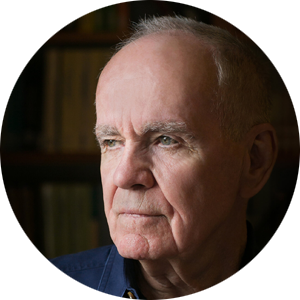
Cormac McCarthy (July 20, 1933 – June 13, 2023) was an American writer who authored twelve novels, two plays, five screenplays, and three short stories, spanning the Western and postapocalyptic genres. He was known for his graphic depictions of violence and his unique writing style, recognizable by a sparse use of punctuation and attribution. Wikipedia
Sidewalks without a hint of shade. Heat radiating up from asphalt streets and down from walls. Hot exhaust belching from cars, trucks and buses — all these summer-in-the-city miseries and more are contributors to the urban heat-island effect.
Depending on the city, says Angel Hsu, an environmental scientist who founded and heads the Data-Driven EnviroLab at the University of North Carolina at Chapel Hill, its downtown area can average 3 to 4 degrees Celsius hotter than the surrounding suburbs and countryside. And certain neighborhoods — often the poorest — can be hotter by 10 degrees Celsius or more.
Environmental scientist Angel Hsu
University of North Carolina at Chapel Hill
Worse, says Hsu, this is not just a matter of discomfort. The heat-island effect is starting to endanger the health, productivity and lives of billions of people worldwide, especially now that it’s coming on top of killer heat waves spawned by climate change. And in a classic vicious circle, she adds, the straightforward solution — use more air conditioning — is hugely energy-intensive and could push climate-warming greenhouse gas emissions even higher than they already are.
The good news, says Hsu, is that excess urban heat isn’t inevitable. Knowable Magazine recently spoke with her about ways to mitigate the effect — one of several topics covered in a report that she coauthored in the 2021 Annual Review of Environment and Resources on how cities can reach their goal of reducing greenhouse gas emissions to zero.
This conversation has been edited for length and clarity.
What causes the urban heat-island effect?
Primarily, it’s the conversion of natural landscapes to urban infrastructure: materials like asphalt, brick and concrete that tend to absorb more solar radiation than a grassy or a forested area. But in addition, this conversion makes urban areas and cities a lot less able to absorb rainwater. As a result, you get more runoff and less of the nice cooling effect from evapotranspiration, which is when grasses and trees move water from the ground into the air.
Then there’s the way people live in cities. They drive cars. They have air conditioners, which cool interior spaces by sucking out the heat and dumping it into the air outside. They build apartments and houses and offices that are incredibly dense, providing little room for green space and air circulation. All of this increases the heat.
And of course, this has all been happening as climate change has shifted the baseline background temperature an average of 1.1 degrees Celsius above pre-industrial levels, which makes our urban heat islands feel that much hotter.
Watch the replay of this event held on October 26, 2022.
How does the effect vary from one neighborhood to the next?
It depends on a lot of things, including how built-up an area is, and how much tree cover and green space it has. But there are still many gaps in our understanding. For example, many cities measure temperature from just one monitoring station, which is often located at the airport. But most people live in downtown areas or in suburbs far away from the airport. So whether you’re a decision-maker or an individual, there are going to be questions you can’t answer with that one number. I have young kids, for example — is it safe to take them outside to play?
This is why a lot of my work has been focused on getting better granular data. In a study last summer, for example, we partnered with the town of Chapel Hill and the Museum of Life and Science in Durham, North Carolina, to send citizen scientists out with handheld temperature and humidity sensors on an incredibly hot day in late August. The official weather station for Chapel Hill said that temperatures were something like 93 degrees Fahrenheit (34 degrees Celsius). But in some parts of downtown, our volunteers were measuring temperatures as high as 108 degrees Fahrenheit (42 degrees Celsius). This is consistent with other studies, including ours, showing that heat disparities exist within cities throughout the US.
One reason for that huge difference is that, when you’re walking in a downtown area that’s been baking in the sun on a hot summer day, you don’t just feel the air temperature. You’re also feeling all the absorbed heat radiating back at you from the sidewalk, and the asphalt, and the buildings as well. In the scientific literature, this total heat load is called the mean radiant temperature. And unfortunately, weather stations and satellites can’t get this number at an individual scale.
How does urban heat affect the people who live in cities?
A lot of studies in the public health literature have shown that underlying health conditions like diabetes and cardiovascular disease are actually made worse when people are exposed to heat, particularly in older demographics.
And then there are these extreme heat events. The 2003 European heat wave comes to mind, when there were tens of thousands of people who died from temperatures that spiked during that summer. We’ve started to see that again this past summer in Europe, the Pacific Northwest in the US, China and India, each of which had weeks of blistering, 100-plus degree Fahrenheit temperatures. That led to all those premature deaths, along with other less deadly but more prevalent health effects such as dehydration and heatstroke.
Finally, there are a lot of subtle, but pernicious effects. Some studies show that aggression levels and crime rates tend to go up when temperatures are higher. Other studies have looked at schools during particularly intense heat events — especially schools that lack air conditioning, or properly working air conditioning — and find that test scores tend to be lower because students are less able to concentrate and study.
Even more pernicious is that heat within cities doesn’t affect everyone in the same way.
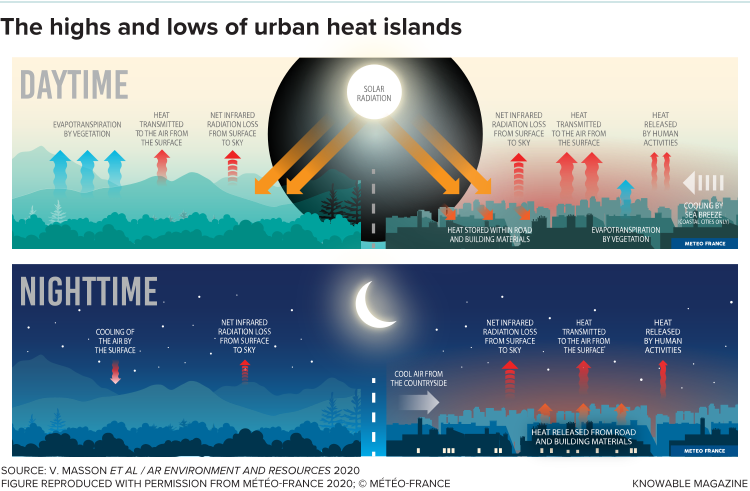
Central cities tend to be hotter than the surrounding suburbs and countryside for several reasons. The biggest is that urban materials like brick, concrete and asphalt absorb more solar radiation than green spaces do; this makes built-up areas hotter during the day and keeps them from cooling off as much after sundown. In addition, plants can pull heat from the ground by absorbing warm water through their roots and releasing it to the air as vapor – a process known as evapotranspiration.
Do you mean that the effects are worse in disadvantaged areas?
Yes. We did a research study where we looked at neighborhoods in all the major urban areas in the continental US with a population of more than a quarter million, about 175 cities, and found that people living below the poverty line and people of color were systematically exposed to higher levels of urban heat than wealthier counterparts, who are often white. It’s important to note that most people of color are not living in poverty. But we still found that a person of color had roughly the same exposure to the urban heat island effect as a person living in poverty. The only six cities where we didn’t see this disproportionate exposure were those that didn’t have high percentages of people of color. That was really shocking to me.
We’re seeing some of the same patterns when we look at cities across the world: People who live in neighborhoods that have less income per person tend to be exposed to higher levels of urban heat than those who are wealthier.
Why does income make such a difference?
There are many reasons. In higher-income neighborhoods, for example, there is often more tree cover and green space, which provides shade and more evaporative cooling than buildings, streets and sidewalks. Also, population density is usually higher in lower-income areas, where structures and housing are often packed tightly together, inhibiting air circulation, and have less green space and tree cover.
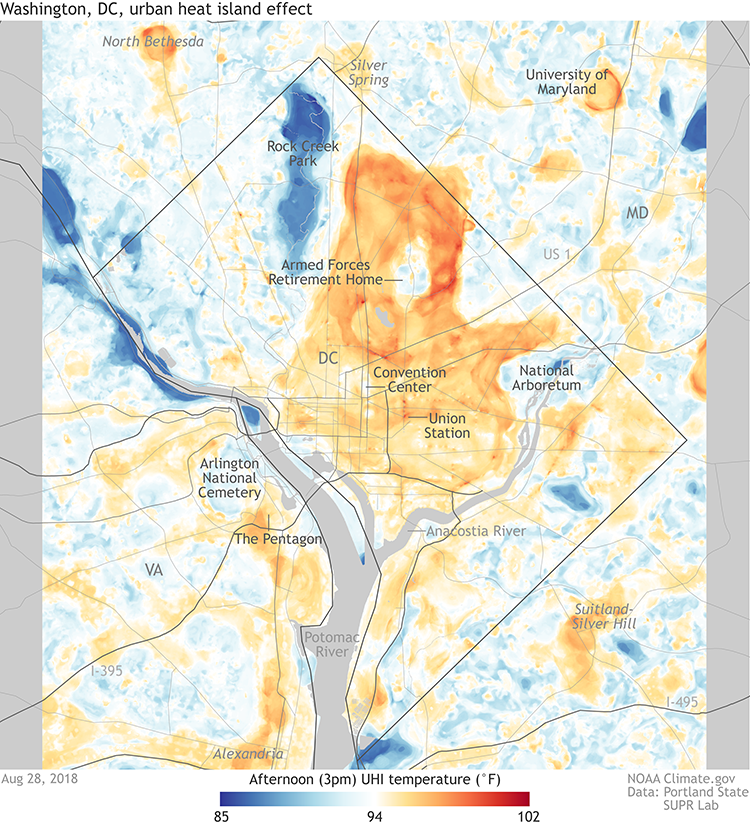
Volunteer citizen scientists fanned out through Washington, DC, to take local temperature measurements on a brutal summer day in 2018. The resulting map shows the city’s wooded parklands as cool oases. But it also shows that the relatively poor neighborhoods east of Rock Creek Park are much hotter than the leafy, generally wealthier neighborhoods to the west.CREDIT: NOAA CLIMATE.GOV
What’s the solution? More air conditioning?
The increasing demand for air conditioning in cities is just an inevitability because of how humans have affected the climate. Look at what happened in Europe this past summer, when people were dying in the heat wave because they didn’t have access to air conditioning — because they traditionally have not needed it.
But air conditioning uses a lot of electricity, and when electricity to power that cooling is sourced from more fossil fuels, climate change can be made even worse.
Ultimately, of course, we hope to power air conditioning and everything else with renewable sources of electricity such as wind and solar. We also need to encourage the use of energy-efficient technologies like heat pumps, which are essentially air conditioners modified to work in both directions. The modern ones can be somewhat more efficient than old-line central air systems at pumping heat out of your building in the summer, and much more efficient than a standard furnace or electric heater at pumping heat in to warm the place in the winter.
Then we need to replace the hydrofluorocarbon refrigerants that most air conditioners and heat pumps use. The most common ones have around 1,000 to 3,000 times the potency of carbon dioxide as a greenhouse gas.
And in the meantime, we need to do anything we can to make cities cooler.
How do we manage that?
There are some things that individuals can do. Personal transport is a big one. The internal combustion engine generates a lot of heat, whether it’s cars in developed countries or the motor scooters that a lot of people ride in the Global South and developing countries. So taking public transit, or using electric vehicles, electric bikes or bicycles can help.
Or, if you have the opportunity to build your own house, you could use materials that are not as heat-absorbing. I’m thinking about the house in Greer, South Carolina, where I grew up: It was brick, and just incredibly hot to live in in the summer. There are lots of alternatives that would be cooler and lower your energy bills, including natural building materials like wood or bamboo. Another recent example was in our current house, where we ended up choosing to cover an addition to our roof with a type of TPO (thermoplastic polyolefin) that reflected heat better than the standard roofing material.
But there are limits to individual action. If you live in an apartment building, you can’t just decide to go up and plant a green roof or paint your rooftop white to make it more reflective, because somebody else owns that building. The same goes for planting trees, which can cool your neighborhood by providing shade and transpiration: Most public parks and street corridors are owned and controlled by the city.
So overall, tackling urban heat needs to be a government-led effort, simply because governments have the jurisdiction and can impose mandates on a much larger scale. I think about one example in New York City about 13 years ago. Michael Bloomberg, who was mayor at the time, said that a certain square footage of New York City’s rooftops was going to be made into cool roofs. So I volunteered and spent an afternoon painting a rooftop white, which increased its surface reflectance.
I also think about a high-resolution mapping campaign where our lab volunteered with Raleigh and Durham, North Carolina, to send out citizen scientists to identify areas that were particularly vulnerable and particularly hot using mobile car sensors. Based on that, Raleigh decided to invest in urban-heat mitigation measures, including coating some of the roadways with titanium oxide to make them more reflective.
And I think about Singapore, where I lived for five years. Urban heat is a huge issue for Singapore, since it’s located at the equator and has extremely high levels of humidity. So some of its shopping malls are designed like wind tunnels to allow for breezes to pass through and carry heat away instead of trapping it between the buildings. Singapore has also been doing a lot of research on building materials, and how to make them less absorptive and produce less radiant heat. And they’ve done a lot of thinking about vertical gardens and rooftop gardens to cool buildings.
Stay in the Know Sign up for the Knowable Magazine newsletter today
What’s the long-term outlook? Can we really get urban heat under control?
Absolutely, there’s a lot that can be done. Many of them we’ve already discussed — moving away from fossil fuels and drawing on renewable sources of electricity, making air conditioning more efficient, thinking about building materials.
In addition, though, we need better long-term planning and policy that actually addresses the urban heat-island effect. Again, simply because most of it is so new, Singapore is a great example of the huge opportunity planners and policymakers have — to think about the future design of cities, particularly in the Global South, and finding building materials and urban forms to make them more cooling.
In the past this has not been considered a priority in many places, or even a real issue. But now there is increasing awareness among cities and local governments that climate change is shifting the baseline to where heat waves are more prevalent, more severe and more prolonged.
And climate change is not going away in our lifetimes. Something that always leaves students in my climate-change class gobsmacked is when I tell them that, even if we stopped emitting all greenhouse gases today, we’ve still committed ourselves to centuries of warming just because of how long carbon dioxide stays in the atmosphere.
10.1146/knowable-101922-2
M. Mitchell Waldrop is a freelance writer based in Washington, DC.
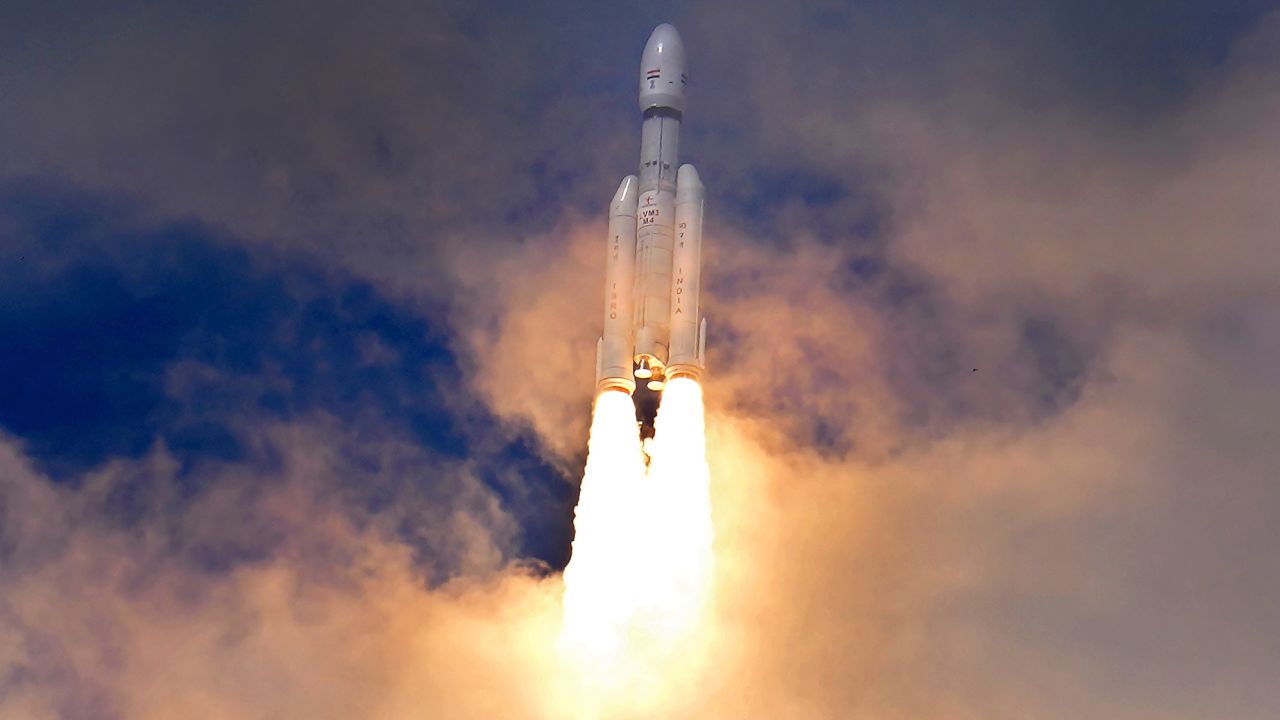
India is bidding to become only the fourth country to execute a controlled landing on the moon with the successful launch Friday of its Chandrayaan-3 mission.
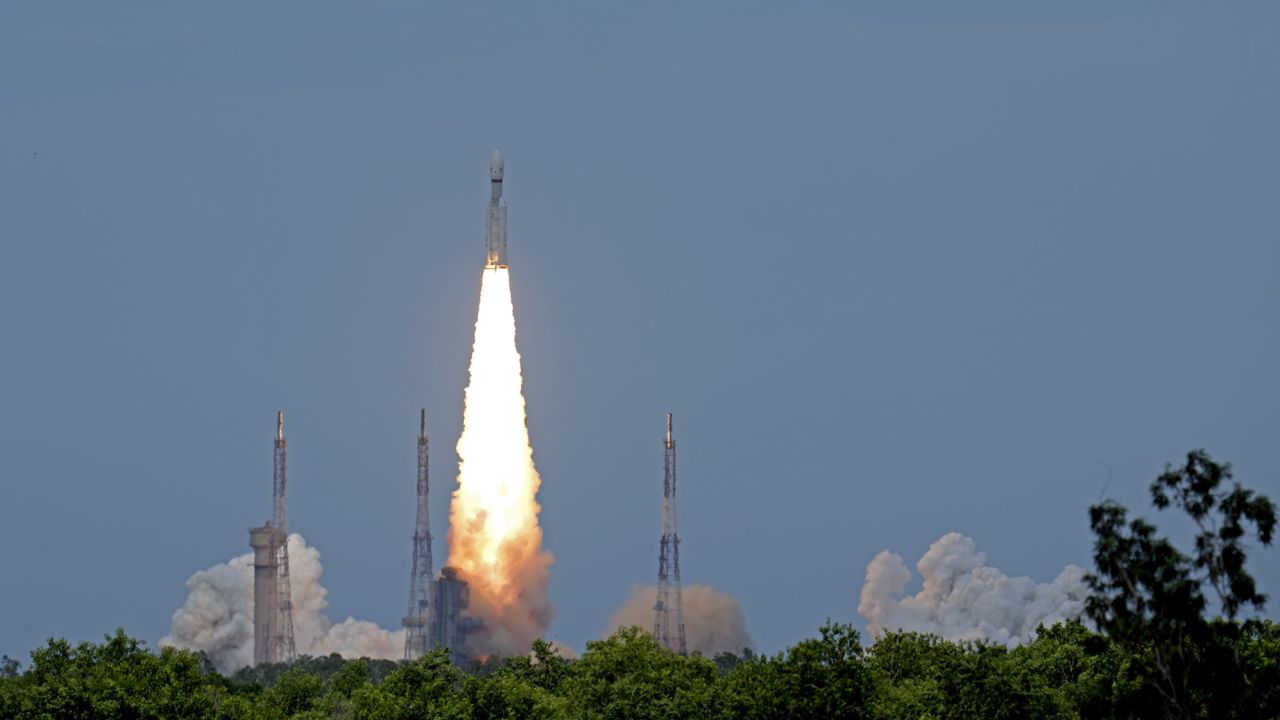
Chandrayaan, which means “moon vehicle” in Sanskrit, blasted off from the Satish Dhawan Space Center at Sriharikota in southern Andhra Pradesh state at just after 2:30 p.m. local time (5 a.m. ET).
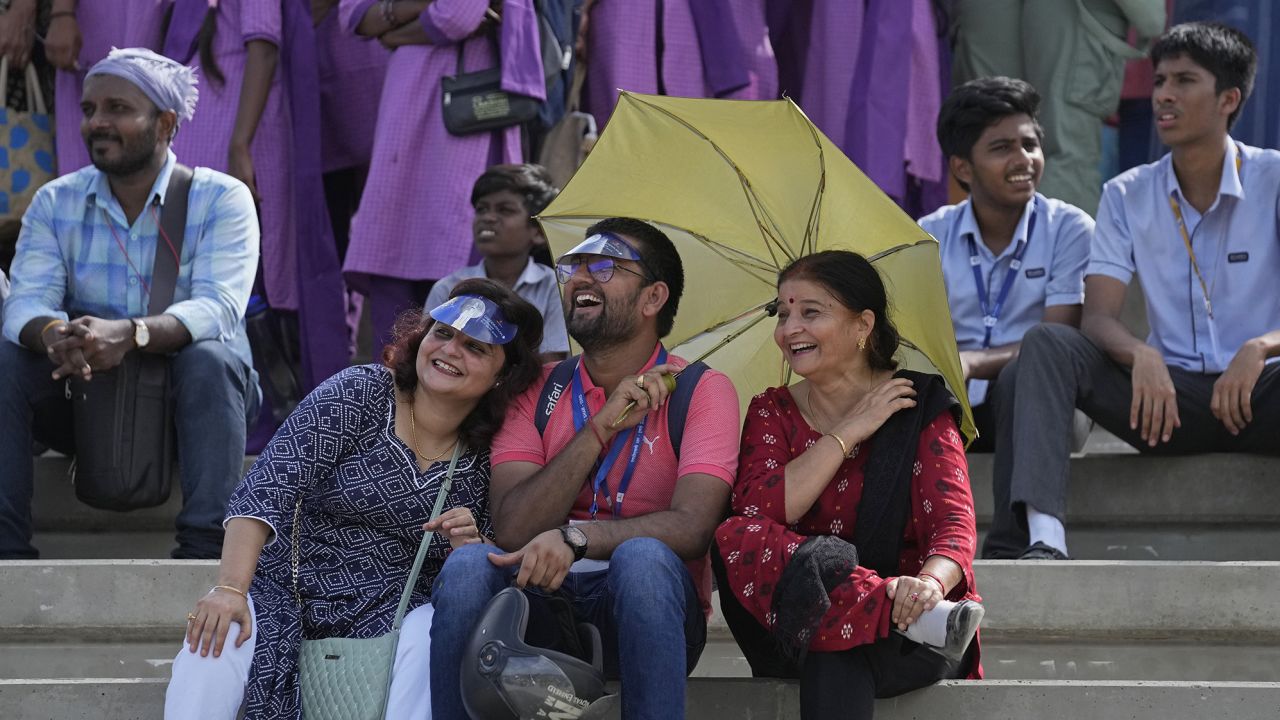
Crowds gathered at the space center to watch the history-making launch and more than 1 million people tuned in to watch on YouTube.
The Indian Space Research Organization confirmed on Twitter later Friday that Chandrayaan-3 is in “precise orbit” and has “begun its journey to the moon.”
It added that the health of the spacecraft is “normal.”
In response, Indian Prime Minister Narendra Modi tweeted: “Chandrayaan-3 scripts a new chapter in India’s space odyssey. It soars high, elevating the dreams and ambitions of a every Indian. This momentous achievement is a testament to our scientists’ relentless dedication. I salute their spirit and ingenuity!”
The craft is expected to land on the moon on August 23.
It’s India’s second attempt at a soft landing, after its previous effort with the Chandrayaan-2 in 2019 failed. Its first lunar probe, the Chandrayaan-1, orbited the moon and was then deliberately crash-landed onto the lunar surface in 2008.
Indian spacecraft Chandrayaan-3, the word for “moon craft” in Sanskrit, blasts off.Aijaz Rahi/AP
The Indian spacecraft blazed its way to the far side of the moon Friday in a follow-up mission to its failed effort nearly four years ago to land a rover softly on the lunar surface.
Developed by the Indian Space Research Organization (ISRO), Chandrayaan-3 is comprised of a lander, propulsion module and rover. Its aim is to safely land on the lunar surface, collect data and conduct a series of scientific experiments to learn more about the moon’s composition.
Only three other countries have achieved the complicated feat of soft-landing a spacecraft on the moon’s surface – the United States, Russia and China.
Indian engineers have been working on the launch for years. They are aiming to land Chandrayaan-3 near the challenging terrain of the moon’s unexplored South Pole.
India’s maiden lunar mission, Chandrayaan-1, discovered water molecules on the moon’s surface. Eleven years later, the Chandrayaan-2 successfully entered lunar orbit but its rover crash-landed on the moon’s surface. It too was supposed to explore the moon’s South Pole.
At the time, Indian Prime Minister Narendra Modi hailed the engineers behind the mission despite the failure, promising to keep working on India’s space program and ambitions.
Just before Friday’s launch, Modi said the day “will always be etched in golden letters as far as India’s space sector is concerned.”
“This remarkable mission will carry the hopes and dreams of our nation,” he said in a Twitter post.
India has since spent about $75 million on its Chandrayaan-3 mission.
Modi said the rocket will cover more than 300,000 kilometers (186,411 miles) and reach the moon in the “coming weeks.”
Decades in the making
India’s space program dates back more than six decades, to when it was a newly independent republic and a deeply poor country reeling from a bloody partition.
When it launched its first rocket into space in 1963, the country was no match for the ambitions of the US and the former Soviet Union, which were way ahead in the space race.
Now, India is the world’s most populous nation and its fifth largest economy. It boasts a burgeoning young population and is home to a growing hub of innovation and technology.
And India’s space ambitions have been playing catch up under Modi.
For the leader, who swept to power in 2014 on a ticket of nationalism and future greatness, India’s space program is a symbol of the country’s rising prominence on the global stage.
People listen to a live broadcast of scientists speaking after the launch of spacecraft Chandrayaan-3.
In 2014, India became the first Asian nation to reach Mars, when it put the Mangalyaan probe into orbit around the Red Planet, for $74 million – less than the $100 million Hollywood spent making space thriller “Gravity.”
Three years later, India launched a record 104 satellites in one mission.
In 2019, Modi announced in a rare televised address that India had shot down one of its own satellites, in what it claimed was an anti-satellite test, making it one of only four countries to do so.
That same year ISRO’s former chairman Kailasavadivoo Sivan said India was planning to set up an independent space station by 2030. Currently, the only space stations available for expedition crews are the International Space Station (a joint project between several countries) and China’s Tiangong Space Station.
The rapid development and innovation has made space tech one of India’s hottest sectors for investors – and world leaders appear to have taken notice.
Last month, when Modi met US President Joe Biden in Washington on a state visit, the White House said both leaders sought more collaboration in the space economy.
And India’s space ambitions do not stop at the moon or Mars. ISRO has also proposed sending an orbiter to Venus.
Art (or Temperance) is numbered fourteen and usually shows the figure of a young woman or angelic being, who is pouring water from one vessel into another. Not a single drop is spilt. This card is related to the union and harmonisation of opposites.
Art shows us that those among us who allow a free flow of life force use it the most effectively, wasting the least and achieving most. If we are thoughtful, receptive and in harmony, we allow the Higher Powers to run unhindered through our spirits and emotions – and finally into our daily lives.
Life is a river. Instead of clinging on to a rock let go and become part of the water. Find the still point within and live from that point and by doing that our hopes and dreams come closer.
(via angelpaths.com and Alan Blackman)
Consciousness, spirituality, biography, sexuality, androgyny, futurism, space, the arts, science, astrology, democracy, humor, books, movies and more






 ©2023 Hearst Communications, Inc.

 Happy love is happy after its own fashion: it discovers the store of wonders untold, for it is the intercourse of power with love and of might with grace. Nothing is foreign to it: it tarries with the negative; it dallies with the mundane, and it is ready for the unexpected. All unhappy loves are alike. I can tell the story of one former unhappy love to cover all my other unhappy loves… The unhappiest love is a happy love that has now become unhappy.