
All posts by Mike Zonta

Why we crave ‘comfort food’
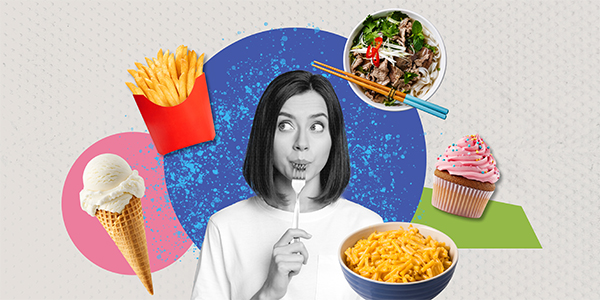
CREDIT: KNOWABLE MAGAZINE
Nostalgia plays a big role in the meals that bring us solace — which mean we might be able to recondition ourselves toward healthier foods that still soothe
By Debbie Koenig 04.27.2026 (knowablemagazine.org)
Support sound science and smart stories
Help us make scientific knowledge accessible to all
Donate today
When I’m stressed, I often crave kasha varnishkes, an Ashkenazi Jewish dish made from buckwheat groats, sautéed onions and bow-tie noodles that appeared on nearly every holiday table as I grew up. Thanks to its distinctive aroma, my husband can’t even be in the same room with the stuff. For him, comfort comes in a bowl of pasta with his Sicilian great-grandmother’s tomato sauce. When there’s no time for old-world cooking, ice cream works for both of us.
This is the essence of a term apparently coined in a 1966 newspaper column by psychologist Joyce Brothers: “Adults, when under severe emotional distress, turn to what may be called ‘comfort food’ — food associated with the security of childhood, like mother’s poached egg or famous chicken soup.”
YOU MAY ALSO LIKE
What can we do about ultraprocessed foods?

What we talk about when we talk about food

Foods of abuse? Nutritionists consider food addiction
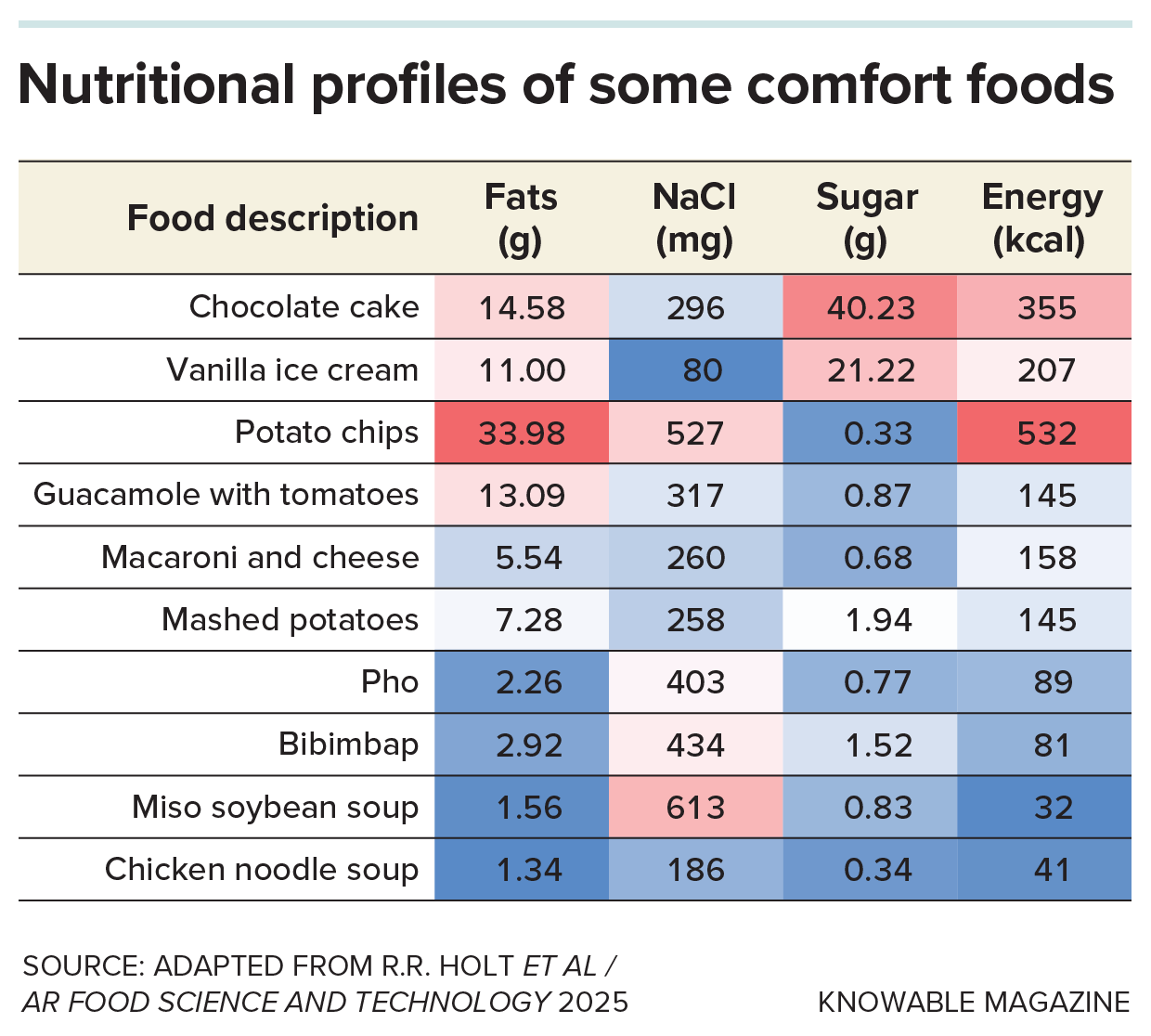
Back in Brothers’ day, most comfort food (like most foods) would have been homemade or minimally processed. But in the decades since, food manufacturers have used increasingly sophisticated technologies to create affordable, highly processed versions of favorite American comfort foods like mashed potatoes, cake and ice cream. Calorie-laden and heavy on salt, fat and sugar, these ultraprocessed foods make today’s comfort foods more bingeable and less healthy than those of previous generations.
Science, though, may show the way to comfort foods that are more healthful and have fewer calories. Research shows that the effects of these foods are largely psychological, so you might be able to train your brain to seek more nutritious foods — or maybe find the comfort you seek without eating anything at all.
Ultraprocessed
Thanks to the modern world’s need for convenience, odds are high that at least one of your comfort foods is ultraprocessed. In a not-yet-published study, A. Janet Tomiyama, a psychological scientist at UCLA, examined data from the UCLA Eating in America Study, in which 1,760 respondents who self-identified as “comfort eaters” listed their top three choices. Of the 300 comfort foods listed by participants, 42.7 percent were ultraprocessed, Tomiyama’s team found.
These foods approximate their homemade analogs with ingredients that are extracted from whole foods, rather than using the foods themselves. For instance, all mac and cheese is processed since both macaroni and cheese are themselves minimally processed — but ultraprocessed versions use the most highly refined options. They often include stabilizers, flavor enhancers and other substances you wouldn’t use in your home kitchen, added to maximize shelf life, and the palatability produced by salt, fat and sugar. And since heavily processed foods tend to require little to no cooking, busy parents have come to rely on them.
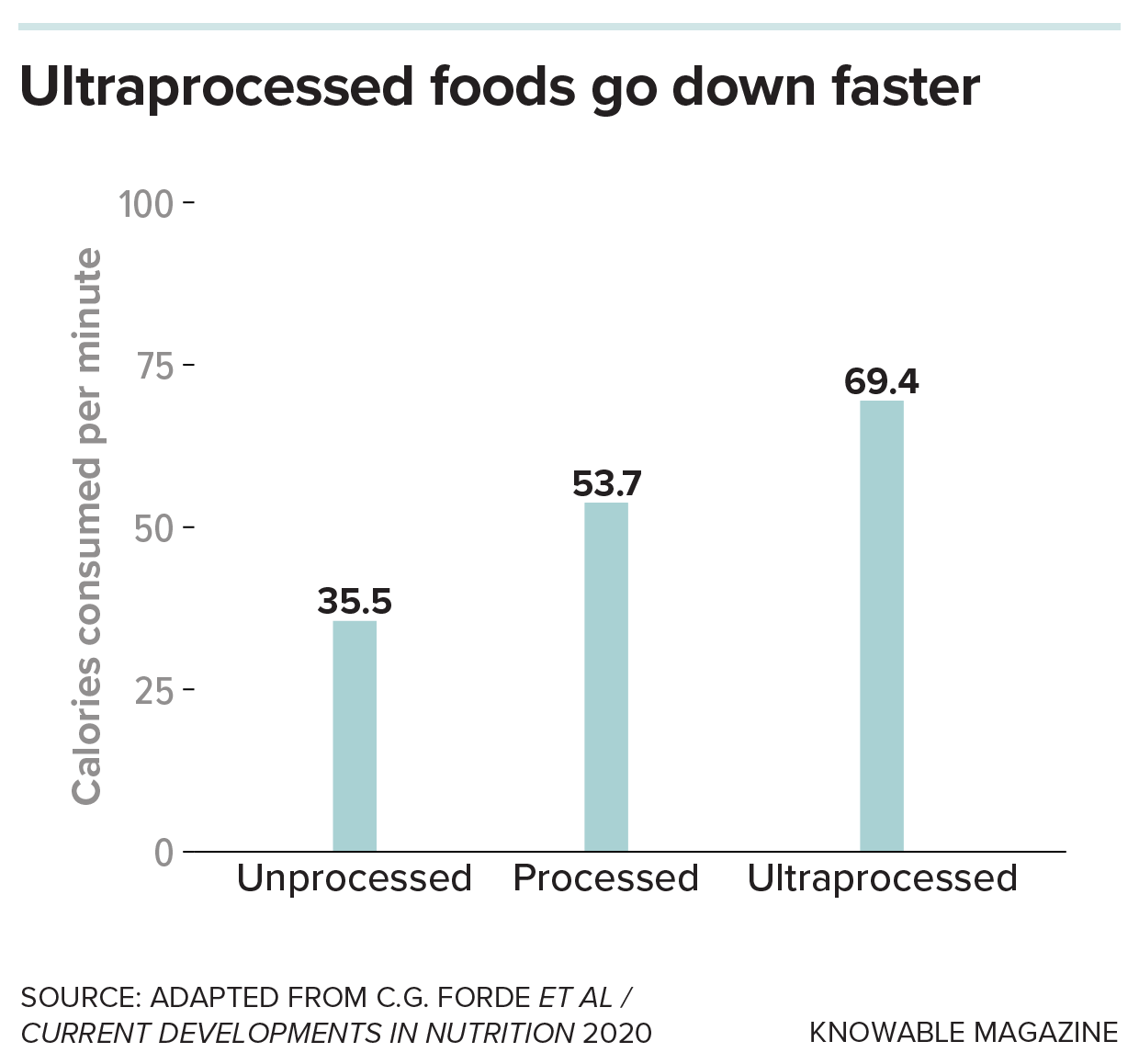
Ultraprocessed foods are also easier to overeat, because they require less chewing — processing strips away the ingredients’ innate structure, so the product goes down quicker. Research shows that we consume them faster than unprocessed or minimally processed foods, taking in up to twice as many calories per minute. In a 2024 study, participants ate an ultraprocessed breakfast sandwich prepared either on commercial toast with margarine, ham, and cheese or a minimally processed sandwich using bread from a local bakery and eggs cooked in soybean oil. The meals were matched for calories and macronutrients, but the ultraprocessed sandwiches went down faster, with fewer bites and less chewing — and those who ate them reported feeling more hunger afterward than those who’d eaten the whole-food option.
But that’s not all: Scientists have evidence that ultraprocessed foods pose risks beyond mere overindulgence. Some research also suggests that these packaged foods, especially sweet ones, can hijack the brain’s reward system to create an addictive effect.
To try to sidestep the link between ultraprocessing and comfort, nutrition scientists are working to understand how and why certain foods lift our moods. They’ve found that Brothers was right: Comfort food does reach back to childhood.
In a 2025 study, for example, University of Pittsburgh sociologist Nick Rogers and colleagues conducted long-form interviews to find out why, exactly, comfort food is so comforting. Nearly every one of the 27 demographically diverse participants, each of whom was interviewed for about an hour across several occasions, described an emotional attachment to particular dishes they ate as children, though the specific dishes varied by culture. Those experiences steeped the foods in memories of good times, of feeling safe and cared for. As adults, participants said, they turned to those foods during bouts of loneliness.
“Comfort food has an ability, it seems, to make us feel safe, content and connected in a way that maybe nothing else can quite match,” Rogers says.

Familiarity, reliability and convenience factored in for many of the participants, so it’s not surprising that ultraprocessed foods like McDonald’s french fries and Kraft macaroni and cheese got name-checked. But the childhood link still holds: Because food manufacturers have spent decades engineering ultraprocessed foods to be cheap, accessible and enticing, parents have come to lean on them heavily — and now their children carry those associations forward.
It is, in essence, conditioning. “Most cultures celebrate with food, or they use food as a way to come together with friends and loved ones,” Tomiyama says. “People learn to associate that with positive emotions, and that connection gets strengthened across a lifetime, but especially in your early years.”
This means that the food each of us finds comforting is highly personal, stemming from a combination of psychological, cultural and physiological factors, says John Munafo, a flavor scientist at the University of Tennessee, who cowrote an article about the science of comfort food in the 2025 Annual Review of Food Science and Technology. Without the psychological connection to a specific food, you may enjoy eating it, but you won’t find the soothing sensation you seek.
To many Americans, comfort food is synonymous with indulgence, but the food’s nutritional value varies by culture, Munafo’s review of the research makes clear. As a third-generation American, I myself turn to carbs, carbs and more carbs. But had I been raised in Vietnam, I might opt for pho, a soothing beef broth with rice noodles and good-for-you garnishes like fresh herbs. In Colombia, I might have been raised on ajiaco, a restorative soup of chicken, potato and corn. The psychological connection matters more than the food itself.
Nostalgia, that wistful yearning for a time when you felt happy and connected to others, is a key element of comfort food’s power, says Chelsea Reid, a social psychologist at the College of Charleston. She and colleagues conducted four experiments, published in 2025, exploring the links between food nostalgia, social connectedness and comfort. When they asked participants to rate foods on their ability to evoke feelings of nostalgia and comfort, they found that the more nostalgia a food inspired, the more likely it was to make the participant feel comforted: Participants would recall times when they felt connected to others, and those recollections enhanced their mood. In other words, Reid says, the comfort food served as a reminder of missing friends and caregivers.
In three out of four of Reid’s experiments, participants didn’t actually eat anything. Instead, they just visualized the experience of eating certain foods and wrote about the imagined experience, then rated the foods for nostalgia and comfort. Even without eating, they experienced emotional benefits. This fits with previous research that found merely writing about comfort food can reduce feelings of loneliness.
“It points to the psychological component being incredibly important, maybe over and above active chewing or tasting,” Reid says. “It’s really the pairing of, ‘This is what the food means to me, this is the situation I consumed it in, and with these individuals,’ that seems to be driving that relationship.”
Reid’s research suggests that while the mood-boosting effects of comfort food are genuine, it may not be only the act of eating that provides them. Just thinking about your culinary source of comfort could evoke similarly warm, nostalgic feelings.
Stay in the Know
Sign up for the Knowable Magazine newsletter today
Reprogramming
Scientists have also explored whether we can recondition our brains to connect comfort with healthy, and thus find solace without the indulgence. In one experiment, Tomiyama and her colleagues had people listen to a recorded relaxation session, known to reduce stress, while eating fruit. The volunteers did this every day for one week, and then got the fruit alone. The Pavlovian connection worked, Tomiyama says — participants reported a greater decrease in negative emotions compared to a control group, as if their brains had learned to associate relaxation with fruit.
Another study by Tomiyama and colleagues takes this a step further. Participants were first asked to choose their preferred comfort foods from two lists, one made up of processed foods high in fat and/or sugar, and the other of fruits and vegetables. On experiment day, each participant was required to deliver a five-minute speech to induce high levels of stress. Then they were presented with their top choice from either the healthy or the unhealthy comfort food list, or no food at all. Throughout, they were monitored on physiological and psychological measures.
The results showed that everyone’s mood rebounded after the stress of the speech, whether they ate their favorite ultraprocessed food, fresh produce or nothing at all. Their negative feelings simply ebbed with time. Eating comfort food didn’t provide any extra boost beyond normal recovery, and the ultraprocessed “treat” foods were no more soothing than fruits and vegetables.
Even participants in the no-food condition, who just sat and later watched a neutral video about how hearing aids are made, felt better as the stress passed. In other words, we may be giving indulgent comfort foods credit for a mood lift we’d experience anyway.
Collectively, Reid’s and Tomiyama’s experiments suggest there’s nothing uniquely comforting about the act of eating calorie-dense, ultraprocessed foods. That’s good news for the world’s stressed eaters. “People don’t necessarily have to reach for that pint of ice cream in order to get comfort,” Tomiyama says.
So while you may think eating your childhood comfort food will make you feel better, you can almost certainly find relief another way. As for me, the next time stress has me grabbing a spoon, I plan to sketch my cookies and cream instead.
Debbie Koenig is a New York-based freelance writer who often writes about food and health, together or separately. Learn more on her website.
Chanda Prescod-Weinstein on Cosmic Wonder as Resistance to Despair
Physicist Chanda Prescod-Weinstein urges curiosity and joy as tools to confront fascism and break imposed limits.
By Kelly Hayes , OrganizingMyThoughts
Published May 3, 2026 (truthout.org)

Did you know that Truthout is a nonprofit and independently funded by readers like you? If you value what we do, please support our work with a donation.
Do you ever feel like your imagination is being pummeled by an endless churn of bad news? Depressing headlines, hateful rhetoric, and dire predictions can leave us locked in a cycle of painful reaction. How can we envision a way forward without minimizing the harsh realities of the present? Chanda Prescod-Weinstein’s new book, The Edge of Space-Time: Particles, Poetry, and the Cosmic Dream Boogie, offers an unexpected answer. On its surface, this is a book about physics — quantum mechanics, black holes, and dark matter. But it’s also a profound exploration of how we think, and the possibilities that emerge when we reject the limits imposed on our imaginations.
Prescod-Weinstein, an associate professor of physics and astronomy at the University of New Hampshire and core faculty in women’s and gender studies, brings a unique perspective to both cosmology and social justice. Her research spans theoretical physics and Black feminist science studies, and in this book, she takes readers on a cosmic journey that connects neutron stars to poetry, quantum theory to pop culture, and our place in the universe to our struggles here on Earth.
This week, I caught up with Prescod-Weinstein to discuss curiosity and cosmic wonder, the mythology of genius, Deep Space Nine, and how to think beyond false narratives and manufactured inevitabilities.
This interview has been lightly edited for clarity.
Kelly Hayes: In a moment shaped by fascism, genocide, and climate crisis, what does it mean to you to be a cosmologist? Has this period changed how you think about your work, your responsibilities, or what science is for?
Related Story
Reclaiming Possibility: A Rant Against Despair
Fear can crowd out our imaginations and dampen our compassion. By Kelly Hayes , Truthout
October 28, 2020
Chanda Prescod-Weinstein: I’m writing against despair. A sense of the big, of the wonders of the cosmos, and also the strange, like quantum theory, reminds us that the universe still holds curiosity and possibility for us. My thinking about cosmic science in this particular moment is shaped by something my mom told me, that people need to know that the universe is bigger than the bad things that happen to us. My mom, Margaret Prescod, has spent her whole life organizing, but as she said to me while I was starting work on The Edge of Space-Time, “Without joy, what the fuck is the point?” Joy is part of how we refuse the totalitarian function of dystopian politics. I was on a panel recently with Kate Marvel, who trained as a cosmologist but is now a climate scientist, and she said that cosmology helps her remember why Earth is worth saving. Every other planet we’ve found with astronomical observation is a trash planet compared to Earth, at least when it comes to habitation. I thought that was a good point, too.
Well, I want to note that, two chapters into The Edge of Space-Time, I hurriedly bought another copy to share with someone I love, because I feel like this book is doing something very important, particularly for people being captured by false narratives, false binaries, and manufactured inevitabilities. It offers a chance to think expansively about the universe in ways that can help set our minds loose. But before I go on too much about why I think people should read this book, I want to ask: what did you want this book to open up for people? What kind of conversation, or shift in perception, were you hoping to facilitate?
One of the ways that authoritarianism works on us is by foreclosing on imaginative possibilities. Thinking about the fundamental nature of space-time, the quantum physics of particles, and the idea of quantum gravity resists that foreclosure. We know how to use space-time as a concept, but we don’t really understand it, metaphysically. The fact that anything happens at all — that shit happens — is kind of odd when you think about it. Even when a region of space is completely empty, it’s still filled with energy, and we don’t really know how to account for what we measure. All these really basic things that we don’t understand, which call out to us to use our imaginations — to recognize that the edge of what we know isn’t actually all there is to know. That part is important: knowing there is more to the universe than we’ve been told. Plus, what we do know is so fucking weird. Like neutrinos are non-trinary! There are three kinds of neutrinos, and they randomly oscillate between those three flavors. Why? We don’t know. But we know somewhere in nature, there is a non-trinary thing, hardwired into the universe’s basic building blocks.
This book feels committed to wonder, but it never asks readers to become less politically alert in order to access that wonder. I was really struck by the way you frame cosmic inquiry as entangled with grief, struggle, and defiance rather than separate from them. Can you talk about that?
The cosmos is an important part of every community’s natural environment and ecosystem. Every community has star stories, and every community has, in its own way, concerned itself with mathematical patterns that seem to track with physical phenomena. In this sense, cosmic inquiry is an ancestral inheritance, and I wonder about who we are when we are alienated from that. The Edge of Space-Time takes seriously the idea that we need to be attuned to physical cosmology as a matter of being in conversation with our ancestors. Who are we to refuse their wonder about the cosmos? To say that this multigenerational, multi-millennial wonder is not profoundly meaningful? As a member of the Black Atlantic diaspora, I don’t see how we are entitled to ignore that legacy.
Another part of the story I wanted to tell in The Edge of Space-Time is that cosmic science can be part of how we stay politically alert. Because physics challenges our sensibilities about what is normal and how things work, it encourages us to use our critical faculties and hone our ability to engage with the abstract. I’m really inspired by The Algebra Project, which focuses on the idea that learning algebra is a civil rights issue. This is not just because of the job opportunities it opens up, but also because of the importance of knowing how to navigate symbols and metaphors. The struggles we are facing involve big, sprawling systems. They are hoping we don’t have our wits about us, can’t analyze what they are doing. Being with physics gives you a safe place to exercise parts of our brain that we need to be sharp.
I was especially fascinated by your engagement with Natasha Trethewey’s essay and with Robert Frost’s assertion that “You are not safe in science [and] you are not safe in history” unless you are at home in metaphor. I had never encountered that quotation or Trethewey’s essay before, and as someone who studied creative writing and poetry when I was young, I found myself deeply moved by this idea of a “poetical education” in metaphor. I have long felt that my engagement with poetry, and learning to write poetry as a young adult, shaped the way I engage with everything from organizing to journalism. Can you talk about what Frost and Trethewey’s words opened up for you, and about how you think metaphor shapes the way we move through science, history, and the world?
I really feel that those two essays were life-changing for me. I was reading Trethewey’s essay in a book edited by Jericho Brown, How We Do It. It’s a collection of Black writers talking about the craft of writing. I was so caught off guard that I suddenly found myself plunged into a discourse on science, race science, and the relationship between science and poetry. Around that same time, Katherine McKittrick insisted that I had to read Aimé Césaire’s essay “Poetry and Knowledge.” I was trying to work through what I liked and didn’t like about the hard boundary he drew between physics and poetry. I found myself disagreeing with him about what physics did and whether it was at all different from poetry. And I realized this was a political perspective.
Physics, when it is oriented toward serving the notion that “man dominates over nature,” gets away from poetics. But when we refuse that kind of hierarchical relationship between different parts of the ecosystem, the distinction collapses, and it becomes a matter of technique. Trethewey, Frost, and Césaire made me realize that education by cosmos is its own kind of education by metaphor, because equations operate like metaphors. Trethewey’s essay also pushed me to ask myself which abiding metaphors had shaped me intellectually as a young physicist and might shape the boundaries I set for myself.
I appreciated your discussion of Star Trek, and I really related to the place it holds in your imagination in relation to space. This year actually marks the 60th anniversary of Star Trek, and I am a big enough nerd to get hyped about that. I also appreciated that you mentioned Deep Space Nine, my favorite Trek series, more than once in the book. And I just knew the show had to come up, because if we’re talking about space and time, and how we understand ourselves in relation to those things, of course, we have to talk about the show where a Black man explains trauma and linear time to a bunch of god-like noncorporeal beings who live in a wormhole. As my longtime readers and listeners know, I watched that show as a young person, and it had a profound impact on me. So I just want to ask, one nerd to another: what stories or moments from DS9 still inspire you, or stoke your curiosity? And what DS9 character do you wish were here today to help us fight Nazis?
To the last question: this is a tough one. We need Major Kira Nerys (Nana Visitor), but also we need Captain Benjamin Sisko (Avery Brooks), the Emissary. Each, in their own way, is a warrior who must learn to make peace, but not at the expense of justice. Maybe I will cop out and say I think Garak (Andrew Robinson), the tailor, could be really useful, actually. I have a soft spot for Loki-like chaos actors.
DS9 interests me in part because I think the writer’s room knew they were writing not just about Ireland and The Troubles, but also Israel and Palestine. They also knew they were writing about Black liberation and understood they were pushing a bit in queer directions too. They also understood they were dealing with queerness, even though Ira Steven Behr has said he regrets not fighting harder with the studio to make that more manifest in the show. The show captures, deeply, the importance of resisting oppression and challenges us to think about how we judge violence and evaluate what constitutes “peace.” And actually, it shows that the Federation is flawed, that there are limits to the liberal humanist theories that underpinned Star Trek as a franchise. I think it is also one of the best representations of how religion might fit into a larger physical schema — what we interpret as the supernatural might be what we are yet to understand. The Prophets are such fascinating characters.
In your note on “great” men of science, you argue that people historically associated with important intellectual work should not be mythologized or made to seem singular or uniquely chosen. That felt deeply connected to something we are witnessing in the present, which is that some of the most powerful people wreaking havoc and destruction right now are allowed to wear the cultural costume of genius, visionary thinking, and historical destiny, often with science-fiction-inflected fantasies attached. Some people’s harms are erased by the work they wear, and some people are simply allowed to wear the mystique of great work. You also write a bit about the billionaire class in The Edge of Space-Time, and about what they have laid claim to. Could you talk about this idea of genius, about what it shields, and about who has been allowed to invoke it, historically and in the current moment?
First of all, Elon Musk is not some kind of technical genius. If he’s good at anything, it’s surrounding himself with people who are good enough at technical stuff to carry him along. In that sense, he is simply an inferior villain to a morally bankrupt J. Robert Oppenheimer, who was actually technically highly proficient. In both cases, they had substantial social and economic capital, which made it easier for them to succeed in their endeavors. But even if someone wants to debate me about Musk’s scientific skill set, the main point is that being really good at something doesn’t make you a really good person, or a person with good values, or a person with the nerve to live those values. Oppenheimer was actually educated at the Ethical Culture School. But in the end, he was also a guy who apparently tried to poison one of his instructors at Cambridge. And his parents sailed to England to clean up that mess. And because they did, he got to go on and have an incredible academic career before helping to build one of the worst technological creations humans have ever imagined. That whole story should give us pause — though sadly, I don’t think the Nolan film encourages us to ask the right questions.
Scientists are not apart from humanity. We are people. And in some cases, we are people wielding a lot of power, but rarely with any training to evaluate what to do with it or whether that distribution of power is right in the first place. We can and should judge individuals for their moral failings, but it’s a structural problem too.
In the book, you write, “Physics is a practice of struggling to get answers — and always finding new questions among the ways in which our relationship to the cosmos can be part of our boogie-woogie rumble: our challenge to a dream deferred.” Can you say more about that, and about the kinds of questions you hope readers will keep asking after they put this book down?
I hope people will allow themselves to be curious about all kinds of things. Don’t say, “Oh well, I’m not smart enough to be curious about that.” Let yourself be curious, including about what rhetorical choices political actors are making. Be curious about hope and the function of despair. Ask questions when someone says things are natural or the way that things just have to be. Push on those boundaries and look past those edges to see if there’s something else, something better on the other side. And get worried if you stop being curious. We don’t know what 96% of the matter-energy content of the universe is. So let’s take that as a proxy, the suggestion that actually, we don’t know most things. If you’ve gotten to the point where you think you’ve got it all worked out, you’re probably wrong.
We are in a fucked up situation right now. It’s been bad for a while, and the circle of people it is bad for has widened. And the ways in which it is bad have broadened. It is easy to give in to despair, but now more than ever, we have to be curious and imaginative about how we might get out of this. We owe it not just to the ancestors, who did their part in the fight, making sure we would have a chance to live and thrive in the ways that we occasionally do. We also owe it to the generations that will come after us to do everything we can. And part of the task before us is to teach them the power of wonder and the importance of joy. Because living in good relations with each other is the point, and I believe wonder and joy are part of good relations.
Media that fights fascism
Truthout is funded almost entirely by readers — that’s why we can speak truth to power and cut against the mainstream narrative. But independent journalists at Truthout face mounting political repression under Trump.
We rely on your support to survive McCarthyist censorship. Please make a tax-deductible one-time or monthly donation.
about:blankThis piece was reprinted by Truthout with permission or license. It may not be reproduced in any form without permission or license from the source.

Kelly Hayes is a Menominee author, organizer, movement educator and photographer. She is the host of Truthout‘s podcast Movement Memos, and the creator of Organizing My Thoughts, a weekly newsletter about politics and justice work. She is co-author of the book Let This Radicalize You, with Mariame Kaba, and editor of the upcoming book, Read This When Things Fall Apart: Letters to Activists in Crisis. Kelly’s written work can also be found in Teen Vogue, The Huffington Post, Yes! Magazine, Pacific Standard, The Appeal and numerous anthologies. Her movement photography is featured in the “Freedom and Resistance” exhibit of the DuSable Museum of African American History.
(Contributed by Gwyllm Llwydd and Cliff)
Einstein’s Persistent Illusion

Albert Einstein famously wrote that “the distinction between past, present and future is only a stubbornly persistent illusion.”
He wrote this in a 1955 letter of condolence to the family of his friend Michele Besso after Besso’s death.
What he meant: from the perspective of relativity, time isn’t necessarily something that “flows” the way it feels to us. Past, present, and future may all be part of a larger spacetime structure, so our everyday sense that only the present is real could be more about human perception than about how the universe fundamentally works.
(ChatGPT)
You’re The One (The Messiah)
I Want to be a Girl
yxkalle Oct 20, 2024 Not the Messiah (He’s a Very Naughty Boy) is a comedic oratorio based on Monty Python’s Life of Brian. It was written by former Monty Python cast member Eric Idle and collaborator John Du Prez, and commissioned by the Luminato festival. Copyright 2007 Stage 6 Films and Python (Monty) Pictures
President’s drug-prices boast shows the math isn’t mathing
- By Marc Sandalow | Special to The Examiner
- 16 hrs ago (SFExaminer.com)
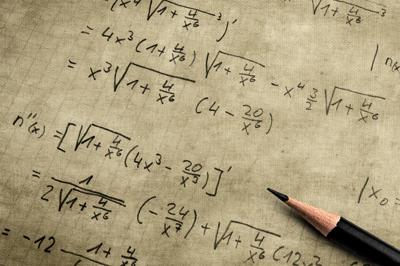
Here’s something for “reckless, feckless and defeatist” haters of President Donald Trump to ponder now that algebra is back in San Francisco’s middle schools.
Trump repeatedly boasts of reducing drug prices by 600%, sometimes as much as 1,500% — a seeming mathematical impossibility. Last week his health secretary, Robert Kennedy Jr., came to his defense twice, once in testimony before Congress and once before reporters in the Oval Office, insisting that Trump’s claim is one of “two ways of calculating” percentages.
Those who understand basic arithmetic ridicule the assertion as “MAGA math.” It conjures up the twisted reality portrayed in George Orwell’s “Nineteen Eighty-Four,” in which fear arises that Big Brother will declare that two plus two is five.
But what if the critics could be proven wrong? With apologies to those who understand mathematics on a much higher level than I do, here’s one explanation supporting Big Brother’s calculation.
Let’s start with something everyone can agree on: 0 = 0.
And you don’t need algebra to know that any number subtracted from itself is zero. Which means, in algebraic terms, x – x = 0. Or, x – x = x – x.
Furthermore, any number multiplied by zero equals zero. So, it is also true that 4(x – x) = 5(x – x) is a mathematically sound equation.
Now comes the more complicated calculation, which will soon be introduced to San Francisco eighth graders. In algebra, one way to simplify an equation is by dividing each side by an identical number.
So, divide both sides by x – x and you end up with 4 = 5. And if 4 equals five, then 2 + 2 = 5.
Perhaps Big Brother, Trump and Kennedy are right!
Kennedy, who holds degrees from Harvard and the University of Virginia and attended the London School of Economics, insisted that his boss’s math was accurate.
“If a drug was $100 and its price rose to $600, that would be a 600% increase” Kennedy said last week (that’s actually a 500% increase, but who’s counting?). “If it drops from $600 to $100, that would be a 600% savings.”
“Right,” the president proclaimed.
Actually, that’s wrong, as most eighth-graders could tell them. You can’t divide by zero. And prices can’t fall by more than 100%.
Say a 300-pound man balloons up to 600 pounds. That’s a 100% increase. But if drops back to 300 pounds, he hasn’t lost 100% of his weight. If he had, he’d be gone.
Though it might be confusing to some — including Trump and Kennedy — going from 300 to 600 is a 100% increase. Falling from 600 to 300 is a 50% decrease.
Of course, haggling over numbers is only important if you are concerned about reality. And reality, as comedian Stephen Colbert once observed, “has a well-known liberal bias.”
Were Trump or Kennedy making an honest mistake, they would correct themselves. But assertions such as “the U.S. has already won the war in Iran,” or that prices have plummeted since Joe Biden was president, or that the U.S. economy is the hottest in the world are not meant to fact-checked.
“This is the problem with the media,” Trump’s first campaign manager, Corey Lewandowski, said after the 2016 election. “You guys took everything that Donald Trump said so literally. The American people didn’t. They understood it.”
And the White House is counting on Americans not understanding algebra.
In the final season of the HBO comedy series “Veep,” the buffoonish Jonah Ryan insists he has more delegates than the math shows in his quixotic run for the presidency. He then learns that algebra was developed by Muslims in the 9th century.
“How do you explain that when I add up my delegates — with Christian math — the number is quite different?” he says, vowing to end the teaching of “Sharia math” in schools.
Americans have grown accustomed to MAGA math. It explains how Trump’s victory over Kamala Harris in 2024 by a margin of 1.5 percentage points was a “historic landslide,” how Washington, D.C., no longer has crime, or how such an unpopular president can have a “100% approval rating.”
And if bringing algebra back to eighth grade doesn’t make believers out of them, perhaps the White House can find alternate facts that will.
Attracting chicks
Why Critical Thinking is Sexy
by Calvin Harris H.W., M
One of the things that I find more and more important to me and what I enjoy in my long-term love language with friends, family, or imitate partners is Critical Thinking.
Critical Thinkers are essential!
So, what is a Critical Thinker?
Well, that is not the person who is quick to consider or say everybody is wrong about everything. That person only thinks they are a critic.
Rather a Critical Thinker is a person who has judgement. Who thinks carefully about all the different possible solutions to a problem before coming to a reasoned conclusion or solution, now that to me, is more in line with a critic, and applying the thinking of a Critical Thinker.
Getting into a state of Critical Thinker, takes conscious work. First step is to stop or not try to be right all the time, (Now I can tell you that is hard.),
Because what is beneath that action is that you do not want to be wrong. To let go of that response is to stop acquiring knowledge as a competition tool, where being right means you win.
That is not what Critical Thinking is about or how it works.
Critical Thinking requires you first to be open-minded and open-ear-ed. You need to be willing to be curious and listen to people. That may require you to ask the question, who, what, where, when, why, and/or how. of them to better understand their position in their conversation with you.
This is different from being in an echo chamber of your own mind. You cannot dwell in an echo loop of thinking. You must be willing to get out from under the safety blankets of your own thinking, to talk and listen to people, who you might not normally be disposed of to listen to.
I like the analogy of very young children. They are inquisitive, they ask questions all the time and they are open to hearing all sorts of answers, we call that being open-minded.
So if you want to get better at Critical Thinking, think more like a child gathering information.
Next consider yourself like a computer, analyzing data, then systematically cleaning, transforming, and modeling data to discover useful information, draw conclusions, and support decision-making. It involves defining objectives, gathering data, cleaning out opinions, prejudice and ignorance to gain accuracy in your conclusions (what we call unlearning), by applying tools and techniques that bring about unpredictable good, as a result.
That takes a lot more mental activity than giving people the first thing that comes to your mind. But it allows you to be in a Conscious state of giving and receiving.
What a loving moment for two or more people to be in that state of Consciousness.
Calvin
May: The Moving Function
(oldnewmethod.com)

May
The Moving Function
Of our three bodies, the physical body seems, at first glance, the easiest to observe. Its movements and postures are physical, and therefore, traceable. If I take a step forward, it is my physical body that coordinates this action; if I move an object from one place to another, it is my physical body that accomplishes this task. But along with this capacity for movement, there are many subtle nuances also rooted in our physical body that deeply influence our psychology and will be the focus of our May and June labors.
When we presented the physical body in February, we mentioned that its function was movement. However, to observe its more subtle nuances, we must further divide the manifestations of our physical body into two: a moving function and an instinctive function. The first is responsible for the body’s capacity for movement, the second for maintaining its well-being. Neither of these two functions is exclusively physical; they influence our entire psychology. The labor of May will span the moving function; that of June, the instinctive function.
The moving function in the physical body enables us to walk, type, dance, play sports, and perform a wide range of external motions. It also grants us the ability to imitate and automate complex actions, such as riding a bicycle or driving a car, which at first require our concentrated attention, but through repetition become automatic. This ability of automation calls for deeper examination, because it permeates the other functions and enables their fluidity. For example, the moving function enables the intellectual function to connect words and meaning seamlessly and master the ability to speak. It enables the emotional function to match reactions to stimuli and gives it the ability to respond with ease to social customs and expectations. In effect, our moving function operates like a rolling wheel that enables fluidity not only for itself, but also for the other functions.
This rotational nature correlates our moving function with time, because time is also rotational; it is determined by the rotation of physical orbs—the rotation of the earth around its own axis marking a day, the waxing and waning of the moon marking a month, the earth’s orbit around the sun marking a year. In fact, it can be said that our moving center is under the law of time, although the full implications of this claim may require a more lengthy explanation. Our moving function is influenced by physical time the way a tiny cog is forced into rotation by adjacent, massive mechanical wheels. It cannot resist time; it ‘believes’ time and correlates time with progression and accomplishment. The task at hand is always a means to an end, a ‘now’ pointing to a ‘later’. But being relegated to perpetual rotation, when ‘later’ eventually comes around, our moving function cannot but perceive it as a new ‘now’ to be sacrificed for an even later ‘later’. As a result, through the influence of our moving function over our psychology, we are prone to falling into repetitive mechanical momentums: continually daydreaming random scenarios, continually replaying interactions with others, continually humming randomly recalled tunes, and many more such repetitive sequences that color our internal landscape against our will.
That these automations are powered by momentum, rather than our own will, is simple to verify, provided we are sincere with ourselves: they do not stop when we want them to. It follows that any conscious effort to jam the wheels of our psychological automations will help us observe our moving function.
An effective area in which to apply this is our habitual usage of the cell phone. When the fluidity of our moving center is impeded—as happens, for example, when we are forced to wait in line, in traffic, or in an elevator—our moving function seeks alternative ways to perpetuate movement, and will often revert to checking our phone unnecessarily. Therefore, a good exercise for interrupting automation is the discipline of checking our phone only when seated. Any time we must use our phone, we find the nearest place to sit down , and only then pull it out.
This type of exercise reveals the influence of our moving function over our psychology. It also represents a meaningful step towards establishing inner government. In spreading automation indiscriminately, our moving function tyrannizes, as it were, the other functions into subordination. By restricting its influence over the other functions, we force it back to its rightful place.
The farmer who labors in this way has begun clearing the land from the invasive weed of unnecessary movement and has fulfilled the obligations for May.
About the Founder

Asaf Braverman is the founder of the Old New Method, a worldwide community of people dedicated to self-development.