
New Thinking Allowed with Jeffrey Mishlove May 3, 2026 James Tunney, LLM, is an Irish Barrister who has lectured on legal matters throughout the world. He is a poet, a visual artist, and author of The Mystery of the Trapped Light: Mystical Thoughts in the Dark Age of Scientism plus The Mystical Accord: Sutras to Suit Our Times, Lines for Spiritual Evolution. His website is http://www.jamestunney.com. James explores the life and spiritual transformation of Edith Stein, the phenomenological philosopher who became Saint Teresa Benedicta of the Cross. He discusses her journey from Judaism through atheism to Catholic mysticism, and her deep engagement with suffering, empathy, and the nature of the soul.Tunney also examines her philosophical legacy, her martyrdom at Auschwitz, and her enduring relevance in a modern world shaped by scientism and technological abstraction. 00:00:00 Introduction 00:08:45 Early life and Jewish roots 00:17:30 Philosophical awakening and Husserl 00:26:15 Conversion and Teresa of Avila 00:35:00 Carmelite vocation and inner life 00:43:45 Empathy, suffering and the cross 00:52:30 Phenomenology and spiritual insight 01:01:15 Nazism, martyrdom and destiny 01:10:00 Legacy, sainthood and Europe 01:15:00 Conclusion New Thinking Allowed host, Jeffrey Mishlove, PhD, is author of The Roots of Consciousness, Psi Development Systems, and The PK Man. Between 1986 and 2002 he hosted and co-produced the original Thinking Allowed public television series. He is the recipient of the only doctoral diploma in “parapsychology” ever awarded by an accredited university (University of California, Berkeley, 1980). He is also the Grand Prize winner of the 2021 Bigelow Institute essay competition regarding the best evidence for survival of human consciousness after permanent bodily death. He is Co-Director of Parapsychology Education at the California Institute for Human Science. (Recorded on Saturday, April 18, 2026)
All posts by Mike Zonta
Parapsychology and the Soul with Doug Marman
New Thinking Allowed with Jeffrey Mishlove May 4, 2026 Doug Marman, an Eckankar practitioner, is author of The Whole Truth: The Spiritual Legacy of Paul Twitchell; It Is What It Is: The Personal Discourses of Rumi; The Hidden Teachings of Rumi; The Silent Questions: A Spiritual Odyssey; The Spiritual Flow of Life and the Science of Catalysts; Sukhmani: The Secret of Inner Peace; and Lenses of Perception: A Surprising New Look at the Origin of Life, the Laws of Nature, and of Our Universe. His website is http://spiritualdialogues.com/ In this video from 2020, he provides insights about parapsychology based on his experience with “soul travel”. He describes the dynamics, based on his experience, of the astral plane, the causal plane, and the mental plane. He discusses a unique state of consciousness that he characterizes as half in and half out of the body. He suggests that this unusual state could be the source of many ostensible UFO abduction reports. New Thinking Allowed host, Jeffrey Mishlove, PhD, is author of The Roots of Consciousness, Psi Development Systems, and The PK Man. Between 1986 and 2002 he hosted and co-produced the original Thinking Allowed public television series. He is the recipient of the only doctoral diploma in “parapsychology” ever awarded by an accredited university (University of California, Berkeley, 1980). He is also the Grand Prize winner of the 2021 Bigelow Institute essay competition regarding the best evidence for survival of human consciousness after permanent bodily death. He is Co-Director of Parapsychology Education at the California Institute for Human Science. (Recorded on September 25, 2020.)
18 Staggering, Shocking, Or Horrifying Differences Between Living In A Red Vs. Blue State, According To People Who’ve Lived In Both
Posted on Apr 30, 2026 (buzzfeed.com)
“Reds glorify their ignorance while Blues weaponize their money and status over people they say they’ll support but don’t.”

After covering a viral TikTok of a woman explaining the “stark differences” she noticed after moving from a Republican-leaning to a Democratic-leaning state, BuzzFeed Community members who did the same (or vice versa) also came out to share their own stories — and they didn’t hold back. Here are some of the biggest, wildest differences people who’ve lived in both blue-leaning and red-leaning states have noticed:
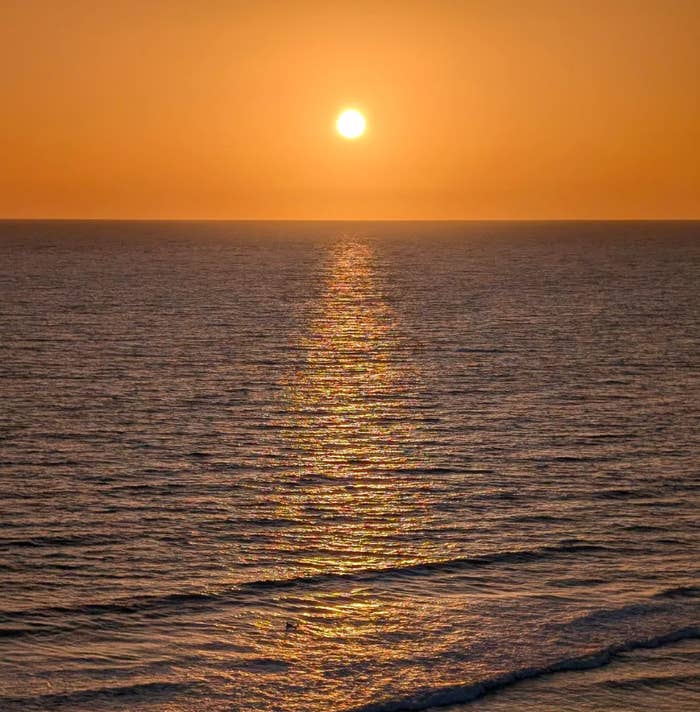
1. “We moved from Wisconsin to California and actually wondered why it took us so long to get out of racist Wisconsin. The kids went to college here and were definitely not coming back to Wisconsin. We retired and went back to work once we got to California, and it was the best decision ever. Nobody here asks, ‘What does your husband do that you can afford a house like that?’ You also just can’t beat the weather, which is perfect every day. The mountains and the beautiful Pacific Ocean are shared by all, not just those who purchased a home nearby. You have to have a good job to be able to live and make it in California, but so far, we are living the good life and are here to stay. Blue all the way!”
2. “I live in Ohio and grew up in Indiana, but I’m from Michigan and do research in Chicago for work. Red states are inhabited by people who are constantly in a state of fear. They point out what’s wrong with everything different than them, but in reality, they’re miserable people. Chicago is a vibrant, happy city, and Detroit is fun and has good-working folk. Are red states cheaper? Sure, but you have no choices there. There’s much more diversity of economy in blue ones.”
3. “My wife and our two school-aged boys lived outside of Charlotte, North Carolina about 15 years ago. At the time, there was no Trump or MAGA, so things weren’t nearly as polarized as they are today. BUT, there are two aspects that basically made my wife and me decide to move back to Maryland: extremely poor public schools (even though we lived in an affluent area), and everyone is a Bible thumper. Rural NC is very backward.”
4. “I moved from a blue state to a red state to be near family. The people are friendly but not well-educated. They always talk about freedom, yet vote for idiots who pass laws that infringe on their personal rights and economic well-being. I don’t get it.”
5. “I’ve lived in New York, Ohio, and Kentucky. Ohio was the worst. I met the most prejudiced people of every color there. It was surprising and shocking. Growing up in New York, we never knew which neighbor was going to stop in for coffee and a chat. The doors were kept unlocked and open during the day, and neighbors helped each other. But Kentucky is my home now. Even though it’s a red state, most people are kind and respectful. It’s safer here, and I love it. I have great neighbors who are like family, and it’s a beautiful state, too!”
6. “I was born in NYC. At 10, my parents moved my sister and me to Jacksonville, Florida. At 27, I moved back to NYC and am now living on Long Island. Jacksonville has gotten worse over the years, and I’ve never liked the politics, with the fake Christians and racism. The irony is that Long Island is more red than Jacksonville.”
7. “I hate admitting this, but Idaho had the best Medicaid. My children are disabled, so we’ve dealt with Medicaid in Louisiana, Idaho, Washington, and now Illinois. Idaho hadn’t privatized its Medicaid, whereas these other states force you to pick a management plan from a crappy insurance company, and then you’re limited to what these insurance companies will pay for, or who takes it. You need prior approval for anything out of the ordinary. In Idaho (from 2013 to 2016), if you are on Medicaid, you’re on Medicaid. Everybody seemed to take it, and you never had to worry if this person took Aetna or if that person only took Blue Cross. It was so much easier. I really wish other states did this, and I have to wonder how much these states are paying to get these management companies to do Medicaid, and if it’s really worth it.”
—Anonymous
8. “I grew up in Louisiana and ended up in Maryland for grad school. It’s a bit more expensive, but other than the DC burbs, it’s pretty affordable for the Mid-Atlantic. I’m so never moving back to Louisiana, especially with the likes of Landry in charge down there.”
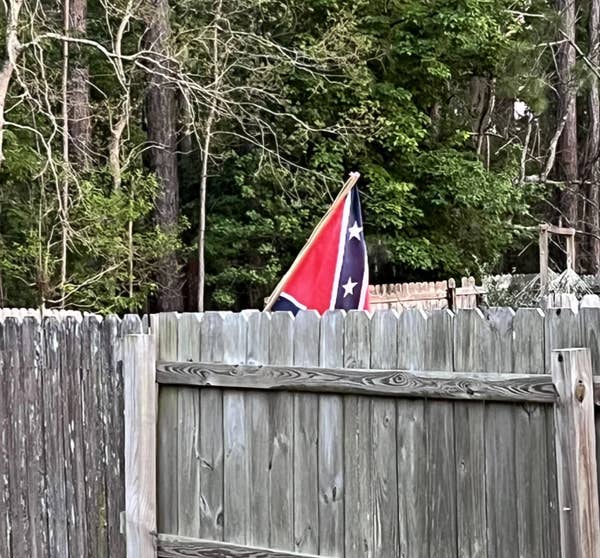
9. “I moved from Houston to rural South Carolina for a job. The culture shock was what got me. Yes, my property taxes on an acre of land are $700 per year (I’m retired now), but the celebrating-everything-regarding-the-Civil-War stuff was disgusting: Confederate Ball, Confederate Memorial Day, having the first shot, being the first to secede, etc. There being Confederate flags displayed in yards is too much. I just want to scream, ‘You lost, get over it!’ It’s not bad on the coast, but it’s pathetic in rural upstate.”
10. “I moved from New York state to Florida. It’s awful. It’s very red here, and the politics are all about racism and being anti-gay. They’re banning books and now sociology in college. God forbid anyone is actually educated and informed. People in my area can be friendly, but it’s surface. It’s all about money and outdoing everyone. The cost of living isn’t really any cheaper. The big difference is there’s no state income tax. I’m counting the days ’til I can move back home.”
—Anonymous
11. “I moved from Northern California to George five years ago, and people from the South already seem to have negative feelings about California. For the most part, people are friendly, but they let you know they don’t want you to try to change things here. I can’t understand how fellow Christians think being a Democrat is somehow wrong. One of the most important rules is to love the Lord above all else, and secondly, brotherly love. Wouldn’t social programs fill that bill?”
12. “I live in a very red part of an overall blue state in the Northeast. The thing I’ve noticed is how insulated the MAGA folks keep themselves. They live in a bubble where they somehow ignore the drugs and the unhoused around, so they can say they live in a more ‘high-end’ area. They claim those types of problems are all in bigger cities. They somehow don’t see the unhoused sleeping downtown at night, or the kids in school without lunches and in dirty clothes, or the guy tweaking and arguing with himself next to the farmers market every weekend. They see what they want to see and will call you a liar for pointing out the truth. The brainwashing is complete, and they will believe their GOP- and FOX news-fed lies over what they are seeing in front of them.”

13. “I moved from the tri-state area of New York, New Jersey, and Connecticut to Virginia. Southern hospitality is a myth. People here are still fighting the Civil War. I moved after four years to the east coast of Florida, and the mix of people and beliefs was much better.”
—Anonymous
14. “I was raised in super rural Missouri, went to college in a liberal pocket of Nebraska, went to grad school in Indiana, chose Louisville, Kentucky as a home for 15 years, and have now been in a blue pocket of Kansas for nearly three years now. I won’t leave the Midwest (or South, if that’s how you want to categorize Louisville) because I want the US to stay purple. Admittedly, I stay near blue pockets, but every state I have lived in is similar. If you don’t bring up politics or religion, then everything is copacetic. As you create true friendships, you’ll find out that a close friend is actually of a very different school of thought than you, but that’s where we as a society learn to stretch. I love not being in an echo chamber. We have great conversations about the ‘why’ behind our deeply held beliefs, and we respect each other enough to grow.”
“I would say Indiana is the least expensive state to live in, but I really appreciate that every single Kansas person I’ve met is entirely respectful of alternate opinions. Kansas is perfectly purple. The communities come together for emergencies and truly care about everyone. There are so many pride flags and ‘Don’t tread on me’ bumper stickers. It runs the gamut. In the end, the overwhelming sense is ‘I won’t regulate you if you don’t regulate me.’ Sad that legislators used the ‘gut and stuff’ tactic to strip our communities of trans protections this year, though. My 8-year-old boy with long hair is now scared to turn 9 because he might get fined for coming into the bathroom with me next month….But hey, that was the work of a few. I haven’t met a single Kansan who agrees with that bill.”
—Meg, Kansas
15. “I’ve lived in Arizona and Indiana. Indiana is a ruby red state, but only because the ‘QpubliKKKlan’ cult has gerrymandered the hell out of this state. It’s really mostly 50/50, but the Democrats have been separated into separate districts. My representative only represents parts of multiple counties. I’ve worked with die-hard Republicans, and we got along fine and had some interesting debates, but only as long as their cult leader was in power in the White House. But as soon as that piece of shit lost in 2020, they decided they hated all Democrats. When I lived in Arizona, I didn’t notice that division, but of course, that was decades before Diaper Don the Con started dividing us all.”
16. “I bought a house last year in a deeply red Southern state (I hate it here, but I grew up here, and I committed to relocation before the 2024 election since I believed there was no way Trump would win). Anyway, I was in disbelief when I got my property tax bill and saw how low it was. First, I was relieved, but then I got a little angry. The roads are shit, the schools aren’t great, and public services are shit. These rednecks refuse to invest in anything that would improve the quality of life here.”
17. “I’ve lived in both blue and red states, and each has people who are equally ignorant and judgmental of the others’ ways of life. But I also think they have an equal quotient of assholes. Red state assholes will loudly announce who they hate with their voices and faces showing, while blue state assholes will say ‘Hola’ to the local Latine community, go to pro-women charity dinners, write checks at benefits for Black children, and then silently promote or hire their kids or rich friends for the best positions of power to fill. They’ll put Kamala signs in their yard but vote for Trump for the third time. Reds glorify their ignorance while Blues weaponize their money and status over people they say they’ll support but don’t.”
18. Lastly: “I went from Upstate New York to Pittsburgh. It was uncomfortable to live in a swing state because, even though Pittsburgh itself was pretty liberal, the entire state’s laws could affect me as a woman and a member of the LGBTQ+ community. Pennsylvania was uptight and loose in all the wrong ways.”
—Anonymous
If you moved from a Republican-leaning state to a Democratic-leaning one or vice versa, what was your experience? Share with us in the comments, or you can anonymously submit your story using the form below.
Note: Some submissions have been edited for length and/or clarity.
“Paradise is where I am.”
| “Paradise is where I am.” Voltaire (1694-1778) French Philosopher |
 AN OPPORTUNITY FOR DAILY REFLECTION BROUGHT TO YOU BY THE SCHOOL OF PRACTICAL PHILOSOPHY AN OPPORTUNITY FOR DAILY REFLECTION BROUGHT TO YOU BY THE SCHOOL OF PRACTICAL PHILOSOPHY |
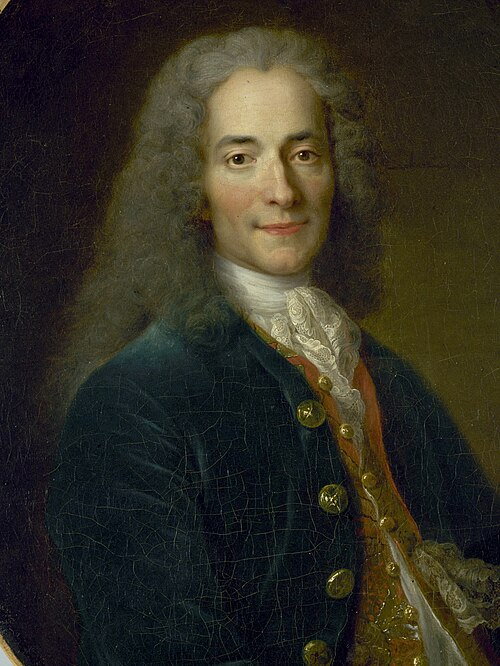
Portrait by Nicolas de Largillière, c. 1720s
François-Marie Arouet, known by his pen name Voltaire, was a French Enlightenment writer, philosopher, satirist, and historian. Famous for his wit and his criticism of Christianity and of slavery, Voltaire was an advocate of freedom of speech, freedom of religion, and separation of church and state. Wikipedia
BornNovember 21, 1694, Paris, France
DiedMay 30, 1778 (age 83 years), Paris, France
The Black Robin and the Power of Tenacious Tenderness: How a Single Mother Brought an Entire Species Back from the Brink of Extinction
By Maria Popova (themarginalian.org)
This essay is adapted from Traversal.
“In the great chain of cause and effect,” Alexander von Humboldt wrote as he was teaching science to read the poetry of nature, “no single fact can be considered in isolation.”
When the first European colonists made landfall on New Zealand’s shores in Humboldt’s lifetime, the cats and rats that descended from their ships began decimating the native population of black robins — sparrow-sized birds with yellow-soled feet that had evolved without mammalian predators, mate for life in monogamous pairs, and raise only two chicks per year in cuplike nests close to the ground.
Bird by bird, claw by claw, there were only seven survivors within a century.
Black robin among other native birds (John Gerrard Keulemans, 1907)
Desperate to encourage the survivors to breed, conservationists moved them to Mangere Island, where twenty thousand trees were planted just to provide a hospitable habitat for the robins. But they would not pair — mysterious are the ways of even a bird’s heart, for it is all a single mystery.
Two of the seven died.
Among the five survivors there was a sole female capable of laying fertile eggs — a robin so aged that she came to be known as Old Blue. At eight, she had outlived the average black robin twofold. With the survival of the species resting on Old Blue’s near flightless wings, scientists thought that if her offspring were raised by surrogate parents, she would be able to lay more eggs.
Warblers were the first designated foster parents, but they failed to feed the chicks enough.
Tomtits were tried next, but they were too successful as foster parents — the black robin chicks grew up perceiving themselves as tomtits and wanted to mate only with other tomtits.
Finally, the chicks were returned to Old Blue, in whose care they thrived as black robins.
A single mother brought a whole species back from the brink of extinction.
Old Blue lived to be fourteen and raised eleven chicks. All the black robins in the world today, numbering around 250, are fractal emissaries of her genes — a winged reminder that immensities of harm can be undone by a single act of tenacious tenderness.
How to Make the Impossible Possible: Cristina Campo on the Crucial Difference Between Hope and Trust
By Maria Popova (themarginalian.org)

“What are we, anyway, at our best, but one small, persistent cluster in a greater ferment of human activity — still and forever turning toward, tuned for, the possible,” Adrienne Rich wrote in her classic Arts of the Possible while the field of counterfactuals was emerging in theoretical physics as the science of the possible.
Everything that is possible is in some sense real, because behind every “what if” is the “if/then” of a causality tethered back to the first thing that ever happened — the inception of this particular universe with its particular set of permissions — and dominoing forward to what has not yet happened but is happenable in this very universe. Hope is the potential energy of reality. But it takes trust in the possible to release it.
Card from An Almanac of Birds: 100 Divinations for Uncertain Days.
Alongside physics and poetry, fairy tales may be our best instrument for discerning the axioms of reality and building from them scale models of possibility. (“If you want your children to be intelligent, read them fairy tales,” Einstein reportedly told one mother who wished for her son to become a scientist. “If you want them to be very intelligent, read them more fairy tales.”)
In her revelatory reckoning with how fairy tales reveal us to ourselves, found in her posthumous essay collection The Unforgivable (public library), Italian writer Cristina Campo (April 29, 1923–January 10, 1977) examines the relationship between the hope and trust, and the dangers of confusing them, in our quest for the possible. She writes:
The impossible awaits the hero of a fairy tale. But how is a person to reach the impossible if not, precisely, by means of the impossible?
[…]
The fairy-tale hero… must forget all his* limits when he contends with the impossible and pay constant attention to these limits when he performs the impossible.
Art by Stanislav Kolíbal from The Fairy Tale Tree
The great appeal of the fairy tale and its ultimate payoff, Campo argues, is “victory over the law of necessity, the constant transition to a new order of relationships” — that is, a new organizing principle that is not deterministic but possibilistic. “I said to my soul,” wrote T.S. Eliot, “be still and wait without hope, for hope would be hope for the wrong thing.” Addressing the soul of the person who wishes to be the hero of their own fate — that is, to refuse to be a victim of the myth of the impossible — Campo writes:
Century-old art by the adolescent Virginia Frances Sterrett. (Available as a print and stationery cards.)
The great paradox of real life — this social contract so trammeled by permissions as to be blind to possibilities — is that those who see the tapestry are often seen as mad. (This, of course, has always been the case — take Kepler, take Blake, take Dickinson.) An epoch after G.K. Chesterton contemplated how we stay sane in a mad world and offered his insightful taxonomy of life as a poem, a novel, or a fairy tale, Campo writes:
Couple with Nobel-winning Polish poet Wisława Szymborska on fairy tales and the necessity of fear, then revisit John Steinbeck on the true meaning and purpose of hope and J.R.R. Tolkien on fairy tales and the psychology of fantasy.
The Wildest Bet Is the Winning Bet
By Maria Popova (themarginalian.org)
We place life’s bets by countless calculations of probability, conscious and unconscious, only to discover over and over how short they fall of the wildest reaches of the possible, which always includes but exceeds the probable. It helps to remember that we ourselves are children of improbability, that everything we treasure exists not because it had to, not because it was likely or necessary, but because the universe took a gamble against the staggering odds otherwise.

by Maria PopovaYou wouldn’t have bet on it,
the battered rock
orbiting a star
from the discount bin
of the universe,
wouldn’t have guessed
that it would bloom
mitochondria and music,
that it would mushroom
mountains and minds,and the hummingbird wing
whirring a hundred times faster
than your eye can blink,and your eye that took
five hundred million years
from trilobite to telescope,and the unhurried orange lichen
growing on the black boulder
two hundred times more slowly
than the tectonic plates beneath
are drifting apartand the marbled orca
carrying her dead calf
down the entire edge
of the continent,
carrying the weight
of consciousnessand consciousness
how it windows
this tenement
of breath and bone
with wonder,
how it hovers over everything,
gigantic and unnecessary,
like music,
like love.
Corneliu Baba: Self Portrait (Portrait of a grumpy old man) 1980
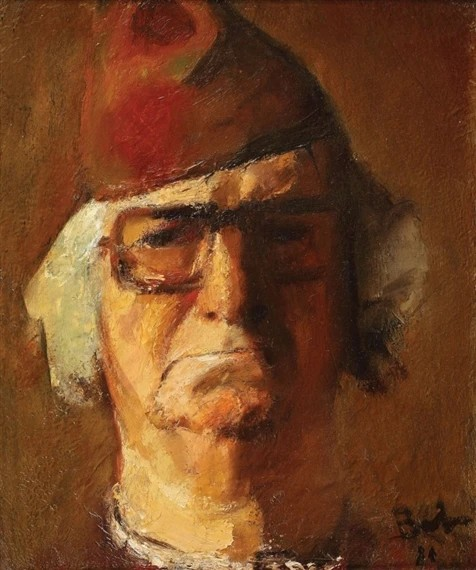
Self Portrait (Portrait of a grumpy old man), 1980. Art: Corneliu Baba
A.Word.A.Day with Anu Garg
querimonious
PRONUNCIATION:
MEANING:
adjective: Habitually complaining; querulous; full of grievances.
ETYMOLOGY:
From Latin querimonia (complaint), from queri (to complain). Earliest documented use: 1604.
USAGE:
“When he spoke, too, his voice was like an old man’s, harsh, yearning, querimonious.”
Robin Jenkins; The Cone Gatherers; Macdonald; 1955.
A THOUGHT FOR TODAY:That’s the terrible hypnotism of war, the brute mass-impulse, the pride and national spirit, the instinctive simplicity of men that makes them worship what is their own above everything else. I’ve thrilled and shouted with patriotic pride, like everyone else. Music and flags and men marching in step have bewitched me, as they do all of us. And then I’ve gone home and sworn to root this evil instinct out of my soul. God help — let’s love the world, love humanity — not just our own country! -Christopher Morley, writer (5 May 1890-1957)
America Chose Wealth Over Well-Being: How Billionaires Rewrote the American Dream
While other nations offer universal benefits, we double down on serving billionaires’ interests…
Jan 07, 2025 (wisdomschcool.com)
Yesterday, Congress certified the electoral vote count making a billionaire president again, starting after he’s sworn in on January 20th.
Yes, we chose a billionaire. Again. After other billionaires spent billions to convince us to make that choice.
As you’re reading these words, billionaires from America and around the world are making pilgrimages to his shabby golf motel to kiss our upcoming billionaire president’s ass and hand him envelopes with $1 million checks that represent a few hours (at most) of income for most of them or their companies.
Meanwhile, our billionaire president-in-waiting is packing his cabinet — the heads of all of the most important federal agencies — with even more billionaires. This is all being celebrated over on billionaire-owned Fox “News” and on billionaire-owned hate radio networks, as well as in the billionaire-owned Washington Post, LA Times, and the roughly half of American local newspapers owned by billionaire hedge funds.
Other countries enjoy benefits like free healthcare and college; modern mass transit; and affordable housing, food, and drugs.
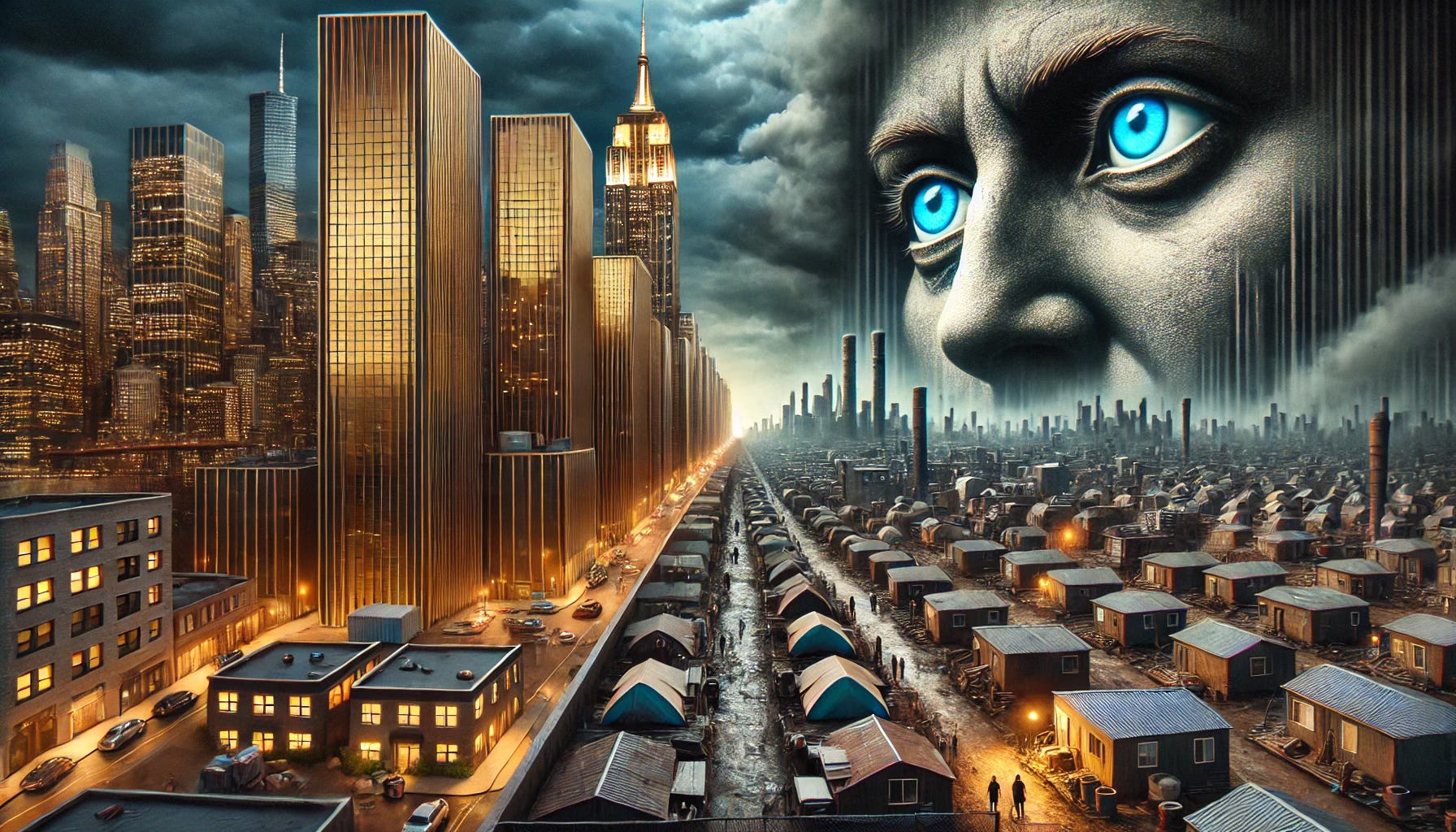
They also have inexpensive internet and phone service without companies listening in and selling their information, schools that don’t even need to mention school shooters, and streets and parks filled with pedestrians and children instead of tents for the homeless.
Additionally, they benefit from renewable electricity that gets cheaper every year while cleaning their environment.
We, on the other hand, have the world‘s largest collection of billionaires.
Most Americans probably didn’t realize this was the choice they were making in the election of 1980 when Reagan and Bush promised “Morning In America.”
We’d been battered by that generation’s version of the Covid shock: when Arab nations got together to punish us for taking Israel’s side and cut off our oil supply in 1973, it threw us into a decade-long period of “stagflation” (high unemployment and inflation).
Nixon couldn’t handle it; odd/even days at the gas pumps merely infuriated drivers.
Jerry Ford couldn’t handle it; his “WIN” (Whip Inflation Now) buttons were a sad joke that guaranteed he’d become a one-term president.
Jimmy Carter made some good progress — particularly with his plan for a “national solar bank” that would provide 20% of the country’s energy by 2000 — but Reagan’s campaign cut a deal with Iran to hold the American hostages until after the 1980 election, ending Jimmy’s hopes for a second term.
By the time Reagan ran for office in 1980, inflation was still a problem; it was an echo of the 1973 oil embargo, amplified by a second oil shock resulting from the 1979 Iranian revolution, again exploding American gasoline prices and cutting economic growth.
By that time, as I detail in The Hidden History of the American Dream, we were desperate.
Reagan — an even more talented actor than Trump (who NBC spent millions training to act for TV cameras) — convinced us he had it all figured out. At first, his promises were vague; something about supply-side economics, “trickle down,” and Laffer Curves that nobody really understood (and George HW Bush initially called “Voodoo Economics”).
Once he took office, America watched with hope and some trepidation as Reagan turned our economy inside-out, massively cut taxes on the country’s thirteen billionaires, repeatedly raised taxes on millions of working-class people, cut and taxed Social Security, stopped enforcing our anti-monopoly laws, gutted federal funds for education, killed off two-thirds of the country’s unions, and, negotiating the GATT and NAFTA agreements, beginning the process of offshoring over 60,000 factories.
Reagan never got inflation below 4 percent and he almost tripled the national debt (from $800 billion to roughly $2.2 trillion), but throwing around those trillions in borrowed money made it seem like the economy was getting better even as wages were frozen by monopolists and a lack of union representation.
And that’s how we got the billionaires.
Back in 1980, nobody in America was rich enough to shoot himself into space on a penis-shaped rocket, and superyachts were a fantasy. The nation’s richest man was shipping magnate Daniel Ludwig, whose net worth — at just a bit below $2 billion — wouldn’t even qualify him for today’s Forbes 500 list; he lived a low-key life and, like most wealthy men of that era, didn’t much involve himself in politics (there were laws back then against rich people subsidizing federal judges or politicians).
But Reagan’s changes in the tax code and destruction of unions led to a 50,000 billion dollar ($50 trillion) transfer of wealth from the pensions, homes, incomes, and bank accounts of middle class Americans into the money bins of the morbidly rich between 1981 and today.
We had only 13 billionaires from 1980 to 1986 but — with Reagan’s final tax cut which took the rate on multimillion-dollar incomes from over 70% down to 28% — that number began to explode. By 1990, there were 99 billionaires in America; today there are over 800 of them, representing a more-than-50-fold increase in just four decades.
Not content with simply grabbing much of America’s wealth for themselves, a handful of our billionaires next reached out for control of our government.
They created media empires, think tanks, and policy centers, both writing and then pushing their own legislation that was dutifully carried into law by politicians they’d bought off. They outright purchased the entire GOP, along with a large handful of elected “problem solver” Democrats.
They set up institutions to seize control of our independent judiciary; five corrupt Republicans on the Supreme Court returned the favor by fully legalizing billionaires buying elections with their Citizens United decision in 2010.
Total spending on federal elections — for president, the House, and the Senate combined — was $92 million in 1980, $103 million in 1984, and $324 million in 1988. How quaint!
Just one billionaire — Elon Musk — spent over a quarter billion dollars putting Trump into office this past fall. Other billionaires jumped in, pushing total 2024 spending over $7 billion (and that doesn’t count dark money, which is almost certainly billions more).
Saudi billionaires jumped in to help billionaire Musk purchase Twitter for $44 billion, turning it, along with an alleged army of Russian-billionaire-funded trolls pretending to be Americans, into a massive megaphone to elect billionaire-friendly Republicans including billionaire Trump.
They’re now building “conservative” colleges and primary schools, funded with state tax money thanks to bought-off politicians, that will educate the generation coming up that billionaires are a necessary and benevolent force in the world.
And we don’t talk about our nation’s billionaire problem because billionaires own or control so many of the nation’s channels of news and discussion from social media to television networks to newspapers.
Even simple, traditional political endorsements get censored; G-d forbid somebody (who won a Pulitzer!) should draw a cartoon showing media billionaires bowing down to our new billionaire president. Or speak out on billionaire-owned social media.
Maybe one day America will join the other 37 OECD “rich” nations in offering to our average- and low-income people nearly-free college and healthcare, removing guns from our streets and schools, housing the homeless, and building modern mass transit.
Maybe our middle class will again become socially and economically mobile, we’ll rid ourselves of over $2 trillion in student debt, and we’ll never again be the only developed country in the world where people lose everything to bankruptcy because somebody in the family got sick.
For at least the next four years, however, we must content ourselves with the proud knowledge that we have more billionaires than any other country in the world. That they now run out government, with their top 1 percent owning fully 40.5 percent of our nation’s entire wealth ($43.45 trillion). As the Forbes “Capitalist Tool” headline gloats: “The 3 Richest Americans Hold More Wealth Than Bottom 50% Of The Country.”
Yep, sure enough: We’re number one! And Trump and the GOP promise to do everything they can to keep it that way.
The Hartmann Report is a reader-supported publication. To receive new posts and support my daily fight on behalf of a newly prosperous American middle class, please consider becoming a free or paid subscriber.
My reading this article as an audio podcast is here.
My new book, The Hidden History of the American Dream, is now available.
You can follow me on Blue Sky here.
How We Restore Turkey’s Democracy


How We Restore Turkey’s Democracy
President Erdoğan’s rule has grown more repressive as he realizes he has no democratic path to power. But we are united in our resolve and determined to make Turkey a democratic republic worthy of its people.
By Özgür Özel