
What alchemy represented before it lost its raison d’être.


Alchemy vs. Chemistry| They work on the same mineral substances, use the same apparatus, and generally, apply the same experimental methods. Historians of science recognize a gradual centuries-long transition from alchemy to chemistry. So how did they differ? How did one become the other? To know, we must fit ourselves into very old shoes. And it leads to a seemingly intractable problem: How do we understand ancient, non-extant, or derivative cultures?
There is, indeed, only one way of understanding a cultural phenomenon which is alien to one’s own ideological pattern, and that is to place oneself at its very centre and from there to track down all the values that radiate from it. — Mircea Eliade, The Forge and The Crucible
With this as my basis, I will tell a quick story, from the perspective of a man of the middle ages.

Readers, meet Godwin. He’s a good man, a farmhand with two acres of fertile pasture and two strong oxen which he incurred in dowry with his wife, Rhosyln. He’s in a pickle and he needs your help.
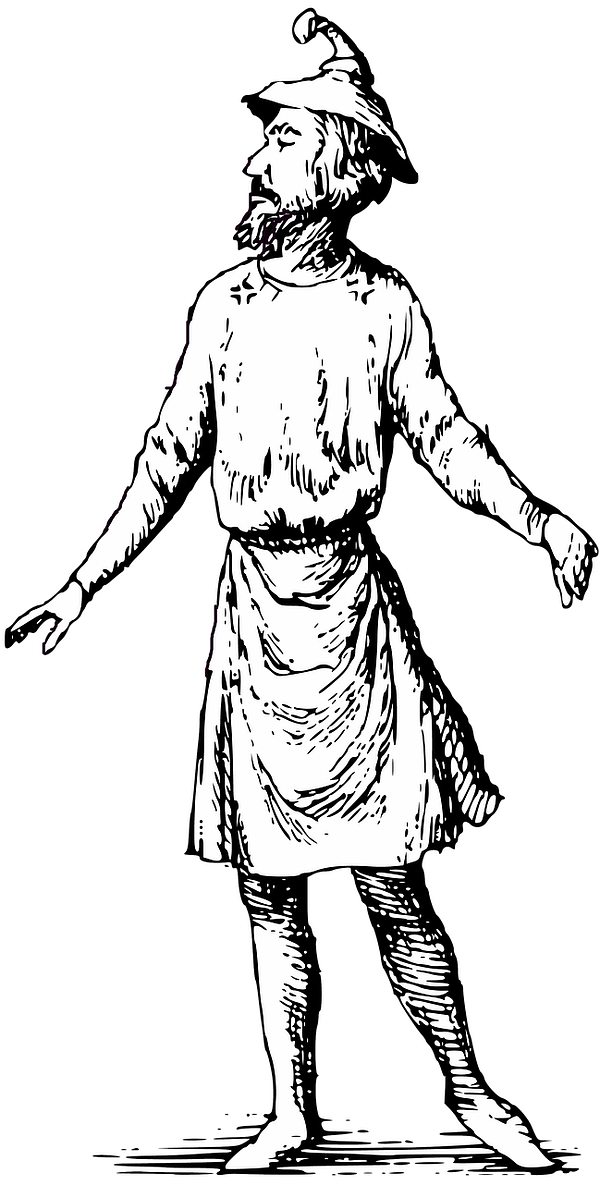
I haven’t many moons left in me. I know not what ails, but it has drawn the fire from me and turned my blood to rot. Yesterday I went to the formulary and spoke to the apothecary and the physicke. They say my blood has gone bad. They prescribed to me a regiment of leaching, bloodletting, and medicament, tincture of opium, for the pain. I also visited the wisewoman of the village, who told me that I had done debased things to offend the gods. She advised me to be celibate for 2 months, drink no wine, fast for 9 days and then to sacrifice a chicken to the hearth and offer due libations of wine to the hearth in order to appease the gods ailing me. My wife Rhoslyn recommends I do the latter, for her uncle Luther died from bloodletting. But, he performed the rituals of the wisewoman before this, and that did not save him either. It appears that I’m damned regardless. Whatever shall I do?
— Signed, Godwin
To the medieval man in need of hope, neither of these options are likely to save him. One is based on the scientific ideas of the time, and one is based on the religious ideas of the time; each with their own antidote, albeit unsophisticated in a modern sense. So what is he to do? If he takes modern medicine, he’s likely to die, and if he takes the offer from the church, he also might die eventually. But, he is likely to die with resolve and in peace, knowing that he has relinquished the demons festered within him, and will go to heaven. Hence, if he is a religious man, this option holds more value.
Alchemy was never an empirical science| The alchemists viewed chemistry as the secularization of an essentially sacred science. Whereas the practical chemist carried out systematic experiments to penetrate to the structure and behavioral properties of matter; the alchemist studied the ‘passion,’ the ‘death,’ and the ‘marriage’ of substances, and their transmutability and ability to endow sacrid attributes upon human life. The Philosopher’s Stone, the Elixir Vitae, and chrysopoeia — the transmutation of the ‘base’ metals into the ‘noble’ gold — were his domain. Alchemy worked on the level of the symbol and attempted to marry sacred ideals of form with that of profane, earthly matter.
Historians record the secularization of theatre from the age of the origin of the drama and Greek tragedy. Gilbert Murray has shown that the tragedies of Euripides, an Athenian tragedian, retain the same pattern of conflict between antagonistic principles (Life and Death, God and the Dragon) that is retained in old rituals. So, there are grounds for the basis that even the secular theatre and chemistry have their derivations in fundamentally theological principles.
So, if you’re following, alchemy begot chemistry, which was engendered from the disintegration of the ideology of its forbearer. Alchemy posed as a sacred science, whereas chemistry came into being only once the substances had shed their mysterious attributes, and in a sense, ceased to be sacred. Alchemy had at its core ancient ideals, such as that of ‘purity’ and ‘perfection.’ And as we’ll discuss later, the spirit of these selfsame ideals is still alive today.
It is important to understand the impracticality of the chemists of the age , most of whom, as formularies, prepared simple medicaments which may or may not have taken effect. Even the science of chemistry was married with the ideals of religious thought. And often, it was these ideals which were of more practical importance to the layman. Likewise, the alchemist, with his notions of perfection and his ideal of gold as the supreme substance, was, perforce, more accustomed to making medicaments than experimenting away like a mad man (as we tend to see him) in search of the Philosopher’s stone, because at least people paid for medicine. Hence, a historian analyzing the transition between alchemy and chemistry cannot do so without insodoing addressing the secularization and desacralization of man.
Pre-scientific modalities are historically debased| In light of everything stated, historians of alchemy have looked at it under the wrong lens — that of a proto-chemistry — when they should have been adjusting their lens to the demands of antiquity.

Having for so long (and so heroically!) followed the path which we believed to be the best and only one worthy of the intelligent, self-respecting individual, and having in the process sacrificed the best part of our soul in order to satisfy the colossal intellectual demands of scientific and industrial progress, we have grown suspicious of the greatness of primitive cultures. — Mircea Eliade, The Forge and The Crucible
Alchemy is a pre-scientific creation| This doesn’t make it debased or primitive. Alchemy served a soteriological function — soteriology meaning the doctrine of salvation. From the perspective of nineteenth and twentieth century historians of chemistry, alchemy looks to be a debased chemistry, but, those writings pay less attention to the psychological and soteriological function of alchemy, and more to that of modern empirical science. I posit that this leads to a critical misdiagnosis as to its triumphs and functions. In order to see the value of the soteriological and psychological functions of alchemy, you must begin to think like Godwin, our Middle Age man.
Medieval thought patterns:
Mineral embryology| To the Metal Age metallurgist, rock is fecund, owing in part to the mythological idea of petra genetrix, or birth from the rock. He believes ores, as embryos, grow in the belly of the terra mater (Earth-Mother), and man has a culminating role in the rhythm of maturation of these ores. To he, all ores, in their chthonian navel, grow obeying the same life-death rhythms as biology. To him, all ores eventually transmute into the ‘noble’ metal, gold. And his role is to pluck the ores from the earth at the right time. To him, the moon governs the maturation of silver, planet Venus governs copper, Mars governs iron, and Saturn governs lead. And to him, aeroliths, or meteoric rock, are charged with celestial sanctity. When alchemy came into being, it was common to sexualize the inanimate world and personify its components. To the metallurgist, his job in forging and smelting was to wield fire and take the place of time itself, to accelerate the maturation of metals. Lastly, there was the idea of regressus ad uterum, the symbological primordial state of matter, often ascribed as ‘liquid’ before it takes form.
What perhaps Nature is still doing, assisted by the time of centuries, in her subterranean solitudes, we can make her accomplish in a single moment, by helping her and placing her in more congenial circumstances. As we make bread, so we will make metals. — Jean Reynand, Études encyclopédique, vol. IV, p. 487.
To the Metal Age metallurgist, gold is seen as symbolizing sovereignty and immortality. And the quest for gold was sometimes more metaphysical than material.
What Nature cannot perfect in a vast space of time we can achieve in a short space of time by out art. — Summa Perfectionis
The furnace as a symbol| The furnace allowed for the development of ores ex utero, outside of the navel of the earth. And us humans took the garb of time by wielding fire, in effect, making us gods (for the power to create was prehistorically granted to the divine). Many ancient societies have the mythological constant of a prime artificer of fire, or a First Smith, and the function of smith is a venerated one in many a civilization across time and space. The smith is known mythologically to have a symbiotic role with the Hero, for it is he who crafts his weapon, and imbues it with magical power. This brings us to the medieval leitmotif of homo faber — the mythologized victory of the smith over nature, wielding his hammer, portending the future triumph of the industrial ages which were to come.
Hopefully by now it is clear that the psyche of thinking dominated by cosmological symbolism in the age of alchemy made for an experience of the world vastly different from that which is accessible to us in the modern day. To the alchemist, matter is alive and an object is never simply itself. The spade is both a phallus and an agricultural tool, and ploughing the field, is both a mechanical labour and a sexual union prescribed for the hierogamous fertilization of the Earth-Mother.
We must not believe that the triumph of experimental science reduced to nought the dreams and ideals of the alchemist. On the contrary, the ideology of the new epoch, crystallized around the myth of infinite progress and boosted by the experimental sciences and the progress of industrialization which dominated and inspired the whole of the nineteenth century, takes up and carries forward — despite its radical secularization — the millenary dream of the alchemist. — Mircea Eliade, The Forge and The Crucible
The modern man, argues Eliade has continued this heritage in the “secularized theologies of materialism, positivism, and infinite progress” — everywhere, in short, where lies the domain of the limitless homo faber.
_______________________
FAREWELL EXTANT HOMO
_______________________