
Woman Holding a Balance
c. 1662-1663 Art: Johannes Vermeer

By Robert Lea published yesterday (Space.com)
“We all would have been thrilled to find technosignatures coming from 3I/ATLAS, but they’re just not there.”
(Image credit: Robert Lea (created with Canva))Share
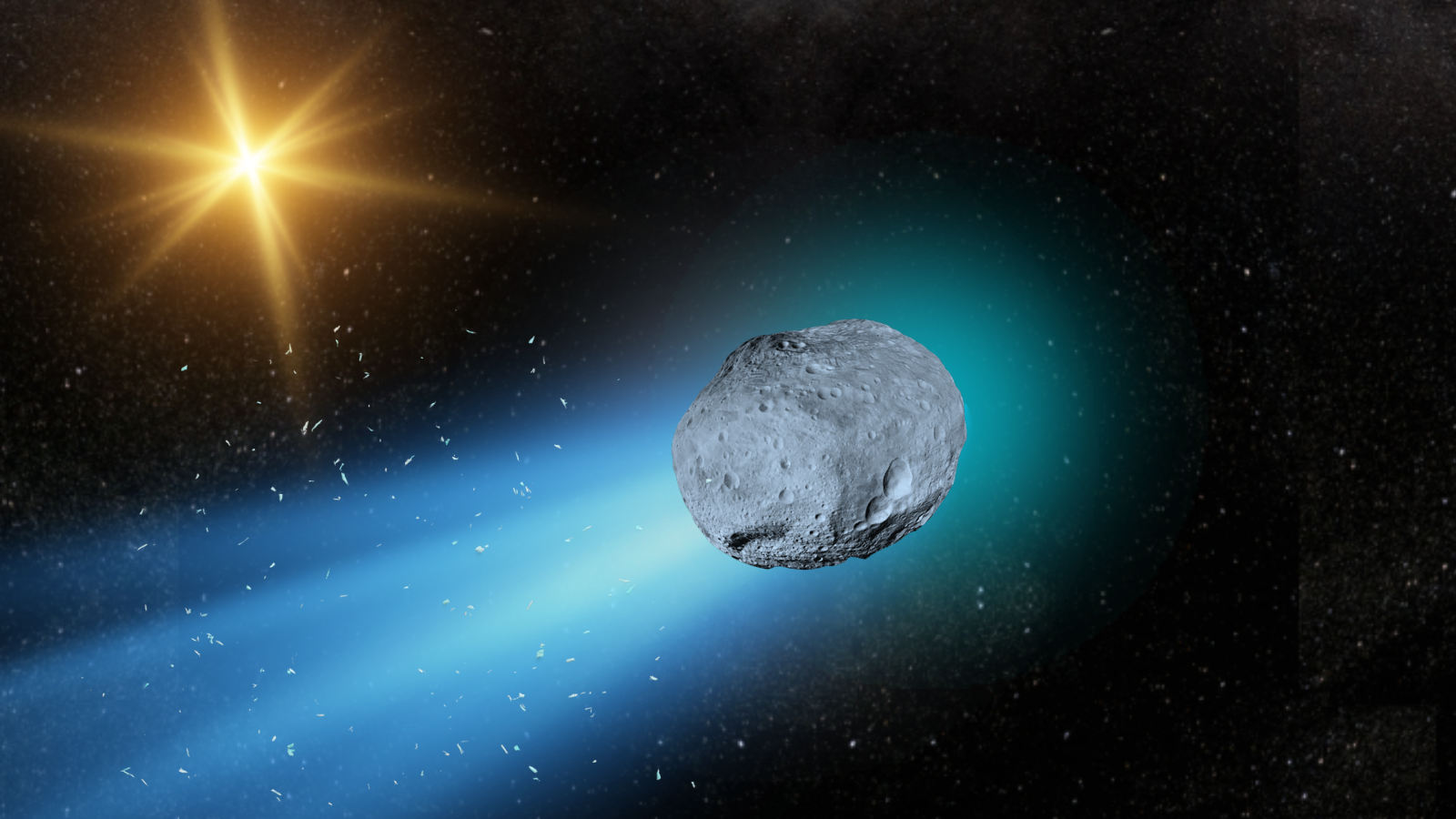
Space fans hoping that the intruder from beyond the solar system known as Comet 3I/ATLAS is actually an alien spacecraft may be disappointed by new research that could close the book on this speculation once and for all.
Astronomers used the Green Bank Telescope, employed in the Breakthrough Listen extraterrestrial signal-hunting astronomy project, to search 3I/ATLAS for measurable signs of technology from extraterrestrial civilizations, or “technosignatures.”
Though this hunt came up empty, the fact that 3I/ATLAS is only the third known object found in the solar system after entering from interstellar space (the others being 1I/’Oumuamua, seen in 2017, and 2I/Borisov, detected in 2019) means that it is still an object of great fascination, albeit a natural one.You may like
Click here for more Space.com videos…
“We all would have been thrilled to find technosignatures coming from 3I/ATLAS, but they’re just not there,” lead researcher Benjamin Jacobson-Bell from the University of California, Berkeley, told Space.com. “Finding no signals was the result we expected, due to the significant evidence for 3I/ATLAS being a comet with only natural features.
“The evidence was against 3I/ATLAS being one such probe, but we would have been remiss not to check.”
Jacobson-Bell explained that scientists have even discussed conducting this exact kind of exploration using probes of our own. An example of this is the Breakthrough Starshot initiative, a concept that proposes to launch thousands of extremely lightweight probes toward Alpha Centauri, the nearest star system to our sun.
“There are compelling reasons to think a spacefaring species would send probes to other star systems as a way to learn more about their stellar neighborhood,” Jacobson-Bell added.
Get the Space.com Newsletter
Breaking space news, the latest updates on rocket launches, skywatching events and more!Contact me with news and offers from other Future brandsReceive email from us on behalf of our trusted partners or sponsorsBy submitting your information you agree to the Terms & Conditions and Privacy Policy and are aged 16 or over.
The team behind this research theorized that if we find them, the brightest extraterrestrial technosignatures are likely to be narrowband radio signals, because these take comparatively little energy to produce and travel well over long distances.
“Breakthrough Listen searches for life beyond Earth in a variety of ways. The Green Bank Telescope is a radio dish 100 meters wide, situated in a zone federally regulated to be free of most radio interference,” Jacobson-Bell said. “Its sensitivity enables us to verify the absence of transmitters down to 0.1 watts, the strongest evidence against technology of any 3I/ATLAS observation to date.”
For comparison, modern cell phones typically emit radio waves at roughly the 1-watt level.You may like
“This is to say that if there were any transmitters on 3I/ATLAS up to ten times weaker than a cell phone, we would have found them,” Jacobson-Bell continued.
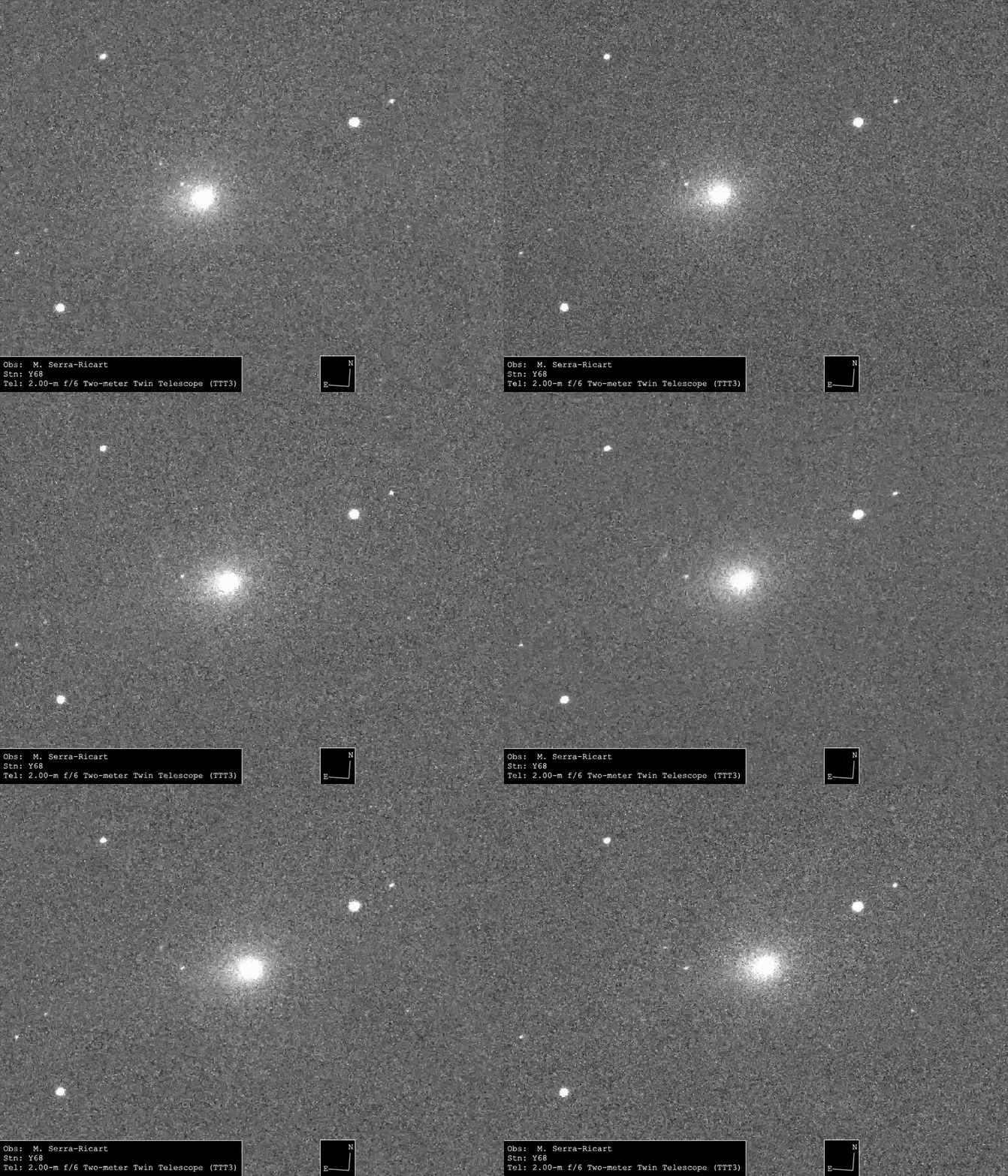
“Humans produce a lot of narrowband radio signals, including for communication with our own spacecraft,” Jacobson-Bell said. “However, by modeling our search strategy on human technological output, we end up detecting a lot of human-made signals! Therefore, we run any detections through filters to distinguish probable human-made interference from possible extraterrestrial signals.”
The Green Bank Telescope covers a very broad range of radio frequencies, meaning the team is unlikely to have missed any signals purely because they were looking in the wrong part of the electromagnetic spectrum.
“We did find nine ‘events,’ which is our term for signals that pass certain filters in our search strategy, but on closer inspection, we could readily attribute all nine of them to known radio transmitters here on Earth,” Jacobson-Bell said. It’s very common to find, then discard, false alarms like this.
“Past work has shown that 3I/ATLAS looks like a comet and behaves like a comet, and our observations show that, like a comet, 3I/ATLAS is not a source of technological signals. In the end, there were no surprises.”
As Jacobson-Bell pointed out, this may be perhaps slightly disappointing, but it doesn’t mean that 3I/ATLAS isn’t still hugely scientifically significant.
“There is considerable excitement around 3I/ATLAS because it’s only the third-ever discovery of an interstellar object within our solar system,” he continued. “Sending spacecraft to other star systems could be very informative, so it’s tempting to imagine that some interstellar objects might be intentional probes.”
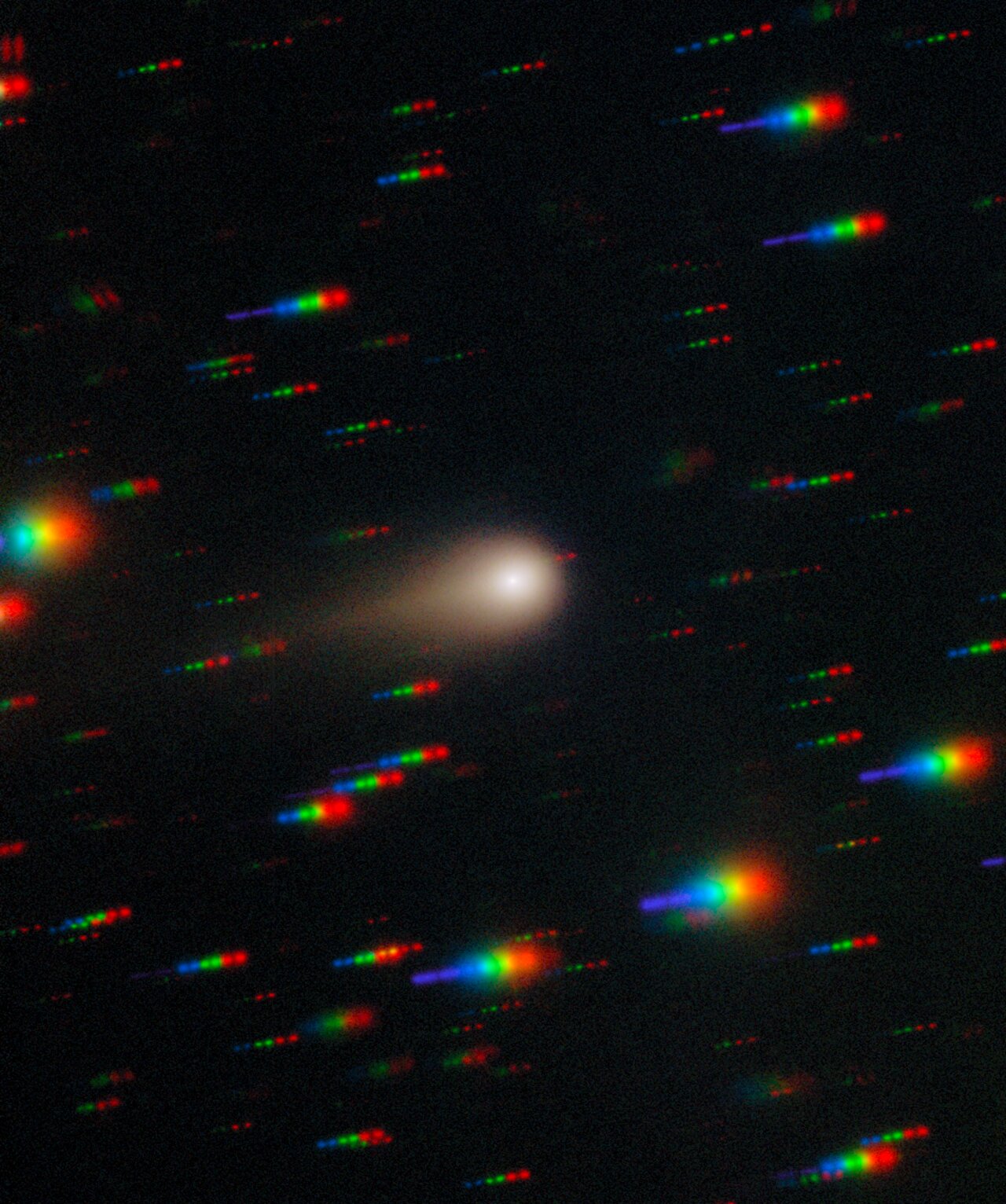
Jacobson-Bell believes that discoveries of interstellar objects are likely to become much more common as the recently completed Vera C. Rubin Observatory begins its 10-year-long Legacy Survey of Space and Time (LSST).
“Whereas each individual interstellar object is currently an anomaly, future surveys will amass such a population of interstellar objects that we’ll start to be able to tell which are typical and which are actually anomalous,” he said. “Some of these objects will merit follow-up observations — could their anomalies be due to technology?”
This new research and its findings regarding 3I/ATLAS thus pave a path toward answering that question.
“We hope our search helps dispel the idea that this object is artificial, but likewise we hope that public interest in interstellar objects remains strong — they’re very interesting whether they’re spacecraft or comets, and it’s entirely possible that one day, one of them will indeed be transmitting technological signals,” Jacobson-Bell concluded. “If we don’t look, we’ll never know.”
The team’s research is available as a pre-peer-reviewed paper on the repository site arXiv.

Senior Writer
Robert Lea is a science journalist in the U.K. whose articles have been published in Physics World, New Scientist, Astronomy Magazine, All About Space, Newsweek and ZME Science. He also writes about science communication for Elsevier and the European Journal of Physics. Rob holds a bachelor of science degree in physics and astronomy from the U.K.’s Open University. Follow him on Twitter @sciencef1rst.

Published: January 6, 2026 (TheOnion.com)
WASHINGTON—As he wandered aimlessly through the halls of the U.S. Capitol building, lost Jan. 6 rioter Alex Morris told reporters Tuesday that he was still searching for former Vice President Mike Pence. “Oh my God, how am I back in Statuary Hall again? Where the hell is Pence?” said Morris, tucking a noose under his arm while opening Google Maps and reorienting himself in the direction of the National Mall. “At this point, I can barely remember why I wanted to hang the guy in the first place. It feels like I’ve circled the Senate Chamber a million times. Does anyone know where Ashli Babbitt is? She knows her way around here.” At press time, Morris reportedly attempted to jog his memory by taking a shit in the office of Rep. Nancy Pelosi (D-CA).
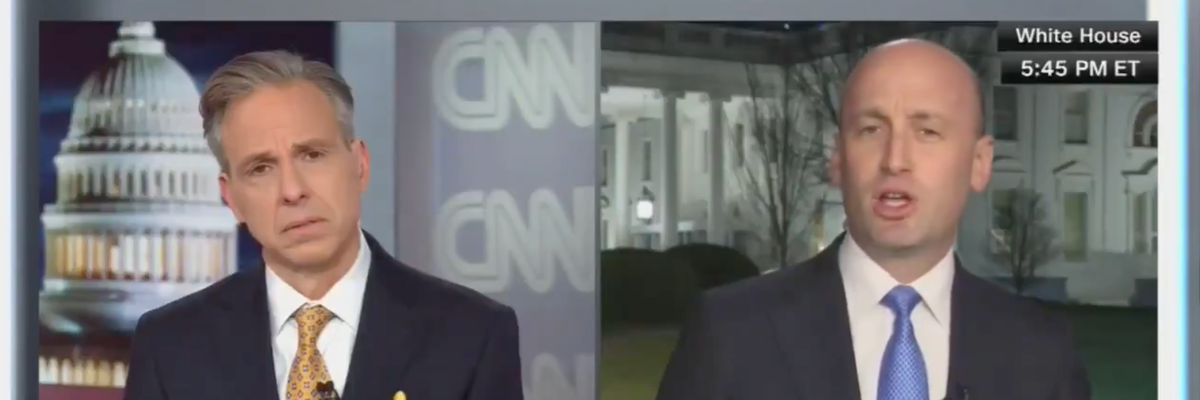
CNN anchor Jake Tapper listens as White House Deputy Chief of Staff Stephen Miller says the US has the right to take over Greenland in an interview on January 5, 2026.
(Photo: screenshot/CNN)
Jan 06, 2026 (CommonDreams.org)
“Belligerent” was how one Democratic lawmaker described a diatribe given by top White House adviser Stephen Miller on CNN Monday evening regarding the Trump administration’s right to take over Venezuela—or any other country—if doing so is in the supposed interest of the US.
To Sen. Bernie Sanders (I-Vt.), however, Miller was simply providing viewers with “a very good definition of imperialism” as he described the worldview the administration is operating under as it takes control of Venezuela and eyes other countries, including Greenland, that it believes it can and should invade.
RECOMMENDED…

“This is what imperialism is all about,” Sanders told CNN‘s Jake Tapper. “And I suspect that people all over the world are saying, ‘Wow, we’re going back to where we were 100 years ago, or 50 years ago, where the big, powerful countries were exploiting poorer countries for their natural resources.’”
The senator spoke to Tapper shortly after Miller’s interview, in which the news anchor asked whether President Donald Trump would support holding an election in Venezuela days after the US military bombed the country and abducted President Nicolás Maduro and his wife.
Miller refused to directly engage with the question, saying only that it would be “absurd and preposterous” for the US to install Venezuelan opposition leader María Corina Machado as the leader of the country, before asking Tapper to “give [him] the floor” and allow him to explain the White House’s view on foreign policy.
“The United States is using its military to secure our interests unapologetically in our hemisphere,” said Miller. “We’re a superpower and under President Trump we are going to conduct ourselves as a superpower. It is absurd that we would allow a nation in our backyard to become the supplier of resources to our adversaries but not to us.”
Instead of “demanding that elections be held” in Venezuela, he added, “the future of the free world depends on America to be able to assert ourselves and our interests without an apology.”
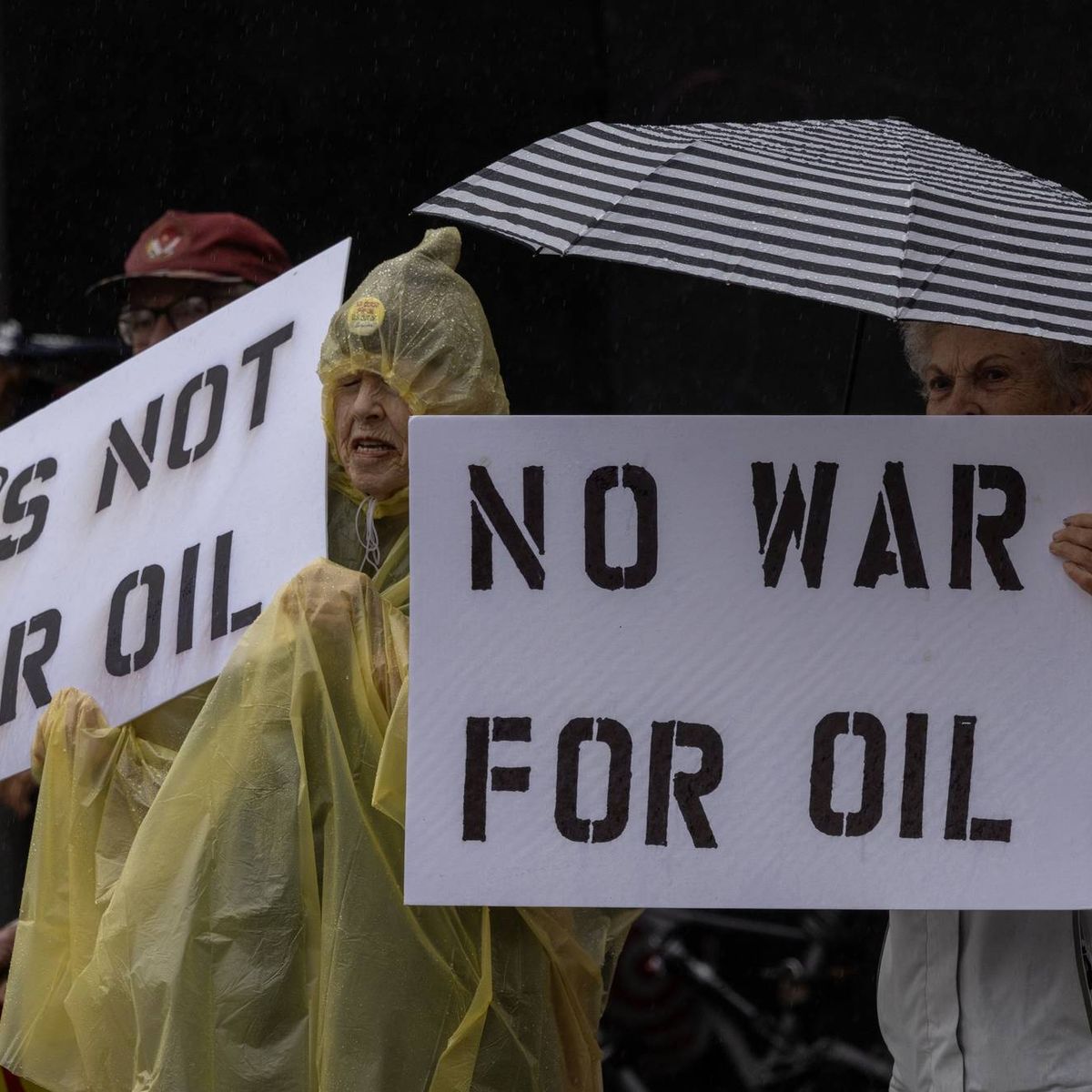
The Trump administration has repeatedly claimed that Venezuela “stole” oil from the United States. The country is believed to have the largest oil reserves in the world, and the government nationalized its petroleum industry in 1976, including projects that had been run by US-based ExxonMobil. The last privately run oil operations were nationalized in 2007 by then-President Hugo Chavez.
Miller offered one of the most explicit explanations of the White House’s view yet: that “sovereign countries don’t get sovereignty if the US wants their resources,” as Rep. Seth Moulton (D-Mass.) translated in a social media post.
Moulton called Miller’s tirade “genuinely unhinged” and “a disturbing window into how this administration thinks about the world.”
Miller’s remarks followed a similarly blunt statement at a UN Security Council emergency meeting by US Ambassador Michael Waltz.
“You cannot continue to have the largest energy reserves in the world under the control of adversaries of the United States,” said Waltz.
Miller’s description of the White House’s current view on foreign policy followed threats from Trump against countries including Colombia, Mexico, and Greenland, and further comments suggested that the administration could soon move to take control of the latter country—even though it is part of the kingdom of Denmark, which along with the US is a founding member of the North Atlantic Treaty Organization (NATO).
“Greenland should be part of the United States,” said Miller. “The president has been very clear about that, that is the formal position of the US government.”
He dismissed the idea that the takeover of Greenland, home to about 56,000 people, would involve a military operation—though Trump has said he would not rule out using force—and said that “nobody’s going to fight the United States militarily over the future of Greenland.”
The vast island is strategically located in the Arctic Circle and has largely untapped reserves of rare-earth minerals.
Danish and Greenlandic officials have condemned Trump’s latest threats this week, with Denmark’s prime minister, Mette Frederiksen, warning that, in accordance with the NATO treaty, “everything would come to an end” if the US attacks another NATO country.
“The international community as we know it, democratic rules of the game, NATO, the world’s strongest defensive alliance—all of that would collapse if one NATO country chose to attack another,” she told Danish news channel Live News on Monday.
The Danish government called an emergency meeting of its Foreign Affairs Committee on Tuesday to discuss “the kingdom’s relationship with the United States.”
On CNN, Sanders noted that as Trump sets his sights on controlling oil reserves in Venezuela and resources in Greenland, people across the president’s own country are struggling under rising costs and financial insecurity.
“Maybe instead of trying to run Venezuela,” said Sanders, “the president might try to do a better job running the United States of America.”
Our work is licensed under Creative Commons (CC BY-NC-ND 3.0). Feel free to republish and share widely.
Julia Conley is a staff writer for Common Dreams.
Jan 07, 2026 (wisdomschool.com)

For nearly three decades, Dr. Stuart Hameroff has been swimming against the scientific mainstream with a radical idea: consciousness doesn’t emerge from the firing of neurons alone, but from quantum processes happening inside the microscopic structures within our brain cells.
What seemed like fringe science in the 1990s is now finding unexpected support from cutting-edge research, forcing us to reconsider one of humanity’s greatest mysteries.
Dr. Hameroff’s journey into consciousness research began with a simple observation that troubled him during his medical training. As an anesthesiologist at the University of Arizona, he watched patients slip in and out of consciousness daily, yet the medical community had no real explanation for how these drugs worked their magic.
His department chair’s challenge echoed in his mind: “If you want to understand consciousness, figure out how anesthesia works because we don’t know how it works.”
While most neuroscientists focused on neurons—the brain’s nerve cells—Hameroff looked deeper. His research revealed that anesthetics seemed to target something much smaller: structures called microtubules inside the neurons themselves.
These tiny protein tubes, which he describes as resembling “hollow ears of corn,” are part of every cell’s internal scaffolding. But Hameroff suspected they might be doing something far more profound than just providing structural support.
The breakthrough came when Hameroff discovered Sir Roger Penrose’s 1989 book “The Emperor’s New Mind.” The Nobel Prize-winning physicist argued that consciousness couldn’t be explained by classical computation alone, so it had to be quantum in nature. But Penrose lacked a biological mechanism for explaining how quantum effects could exist in the warm, wet environment of the brain.
Reading Penrose’s work, Hameroff had his eureka moment: “Damn straight, Roger. It’s freaking microtubules.” The anesthesiologist reached out to the physicist, and their collaboration would birth one of the most controversial theories in neuroscience.
Together, Penrose and Hameroff developed what they called the Orchestrated Objective Reduction (Orch OR) theory. At its heart, the theory suggests that consciousness emerges when quantum wave functions “collapse” inside microtubules, a process they termed “objective reduction.” This quantum collapse, they proposed, creates the moments of conscious experience we call awareness.
Think of it this way: instead of consciousness being like a light bulb gradually brightening as more neurons fire, it’s more like a series of quantum “clicks,” discrete moments where possibilities collapse into actual conscious experiences.
These quantum computations happening inside microtubules could explain not just awareness itself, but the rich, subjective quality of our inner lives like why we experience the greenness of green or the particular feeling of joy.
When Penrose and Hameroff presented their theory in 1996, the scientific community’s response was swift and harsh. Stephen Hawking dismissed it as merely “connecting two mysteries.” Critics argued that the brain was too warm and chaotic for delicate quantum effects to survive. The theory was relegated to the fringes of science, viewed by many as pseudoscience dressed up in fancy physics.
The criticism centered on a fundamental assumption: quantum effects require extremely cold, isolated conditions to persist. In the noisy, warm environment of living cells, these effects should disappear almost instantly, a process called “decoherence.”
How, the skeptics demanded to know, could consciousness depend on quantum processes that seemingly couldn’t exist in biological systems?
But science has a way of surprising us. In recent years, researchers have discovered quantum effects thriving in biological systems that were thought impossible.
Photosynthesis, the process plants use to convert sunlight into energy, appears to use quantum mechanics to achieve near-perfect efficiency. Some birds navigate using quantum effects in proteins called cryptochromes, allowing them to literally see magnetic fields.
Most significantly for Hameroff and Penrose’s theory, recent research has found evidence of quantum effects in microtubules themselves.
A groundbreaking study by Chinese physicists discovered that entangled photons—particles of light connected at the quantum level—can be emitted by carbon-hydrogen bonds in nerve cell insulation. These quantum connections might help synchronize brain activity in ways classical physics alone can’t explain.
Another study identified “superradiance,” a quantum phenomenon, in cellular frameworks similar to microtubules. While this doesn’t prove the Orch OR theory, it demolishes the assumption that quantum effects can’t exist in warm biological systems.
If Hameroff and Penrose are correct, the implications are staggering. Consciousness wouldn’t be an emergent property of complex neural networks, but a fundamental feature of the universe’s quantum fabric.
This could explain why consciousness feels so different from other mental processes: why there’s something it’s like to be you, experiencing the world from the inside.
The theory also suggests that true artificial intelligence—the kind that genuinely experiences consciousness rather than just simulating it—might be impossible with classical computers. No matter how sophisticated our silicon-based AI becomes, without quantum processes in microtubule-like structures, it might never cross the threshold into genuine awareness.
Hameroff has become increasingly willing to explore the spiritual implications of his theory. If consciousness emerges from quantum processes connected to the fundamental structure of spacetime, it raises profound questions about the nature of death, the possibility of an afterlife, and our connection to the cosmos itself.
While these ideas venture into territory that makes many scientists uncomfortable, Hameroff argues they’re natural extensions of the quantum consciousness framework.
Despite growing evidence for quantum biology, we’re still far from proving that consciousness emerges from quantum processes in microtubules. The research showing entangled photons in neural tissue is intriguing, but it’s a long leap from detecting quantum effects to proving they create consciousness.
However, the scientific landscape has shifted dramatically since 1996. The discovery of quantum effects in biological systems has forced researchers to reconsider assumptions about what’s possible in living tissues. Major institutions are now funding research into quantum biology, and the field is gaining respectability.
Whether or not Hameroff and Penrose’s specific theory proves correct, their work has pushed science to ask deeper questions about consciousness. They’ve challenged the assumption that awareness can be reduced to classical neural computation and opened our minds to the possibility that consciousness might be woven into the very fabric of reality.
As we stand on the brink of creating artificial minds and potentially uploading human consciousness to computers, understanding the true nature of awareness becomes more than an academic question: it becomes essential to our future as a species. Dr. Hameroff’s three-decade journey from ridiculed outsider to cautiously respected researcher reminds us that in science, today’s heresy might be tomorrow’s breakthrough.
The quantum nature of consciousness remains one of science’s greatest unsolved puzzles. But thanks to researchers like Hameroff and Penrose, we’re finally asking the right questions and finding that the answers might be stranger and more wonderful than we ever imagined.

By Andrew Kaczynski, CNN
Updated November 21, 2024 (CNN.com)
““‘We may not have that many outright Nazis in America, but we have plenty of cowards and bootlickers, and once those fleshy dominoes start tumbling into the Trump camp, the game is up,”
–Kennedy
CNN rolls the tape on RFK Jr.’s past criticisms of Trump: https://www.cnn.com/2024/11/21/politics/kfile-rfk-jr-trump-critique
Robert F. Kennedy Jr., President-elect Donald Trump’s pick for secretary of Health and Human Services, has a long history of scathing critiques against Trump, labeling him a “threat to democracy,” a “bully,” and, as recently as July, a “terrible president.”
But Kennedy’s harshest attacks date back to Trump’s rise in 2016, when on his radio show “Ring of Fire,” Kennedy applauded descriptions of Trump’s base as “belligerent idiots” and suggestions that some were “outright Nazis” and “spineless fellow travelers.” Kennedy also likened Trump to historical demagogues like Adolf Hitler and Benito Mussolini, accusing Trump of exploiting societal insecurities and xenophobia to amass power.
After Trump won in 2016, Kennedy concluded in one episode from December of that year that Trump was at least in one way not like Hitler, because, “Hitler was interested in policy.”
A CNN KFile review of Kennedy’s past comments shows they fit a pattern of consistent, broad-based criticism that Kennedy has leveled at Trump over the years.
In 2019, Kennedy argued that Trump had turned his first administration over to corporate lobbyists from industries they were supposed to regulate— industries that Kennedy would actually be able to regulate in some cases if confirmed as Trump’s HHS secretary.
As the head of HHS, Kennedy would oversee vast swathes of the American food and health care industries. The sprawling federal agency has a mandatory proposed budget exceeding $1.7 trillion and oversees key public health initiatives, including the Centers for Disease Control and Prevention (CDC), Food and Drug Administration, the National Institutes of Health (NIH), and Medicare and Medicaid, which together impact the lives of all Americans.
In a statement to CNN, Kennedy expressed pride in serving in Trump’s administration, supported Trump’s vision for the country and said he regrets his past comments about the former president.
“Like many Americans, I allowed myself to believe the mainstream media’s distorted, dystopian portrait of President Trump. I no longer hold this belief and now regret having made those statements,” he said.
Kennedy’s years of criticism toward Trump began to soften after he was shunned by the Democratic Party during the 2024 primary, prompting him to run as an independent.
Asked in August whether he would ever serve in Trump’s cabinet, Kennedy said, “No.” but weeks later, he ended his campaign and endorsed Trump. Kennedy has since refrained from any public criticism of Trump, aligning himself with the former president on issues like government censorship and public health.
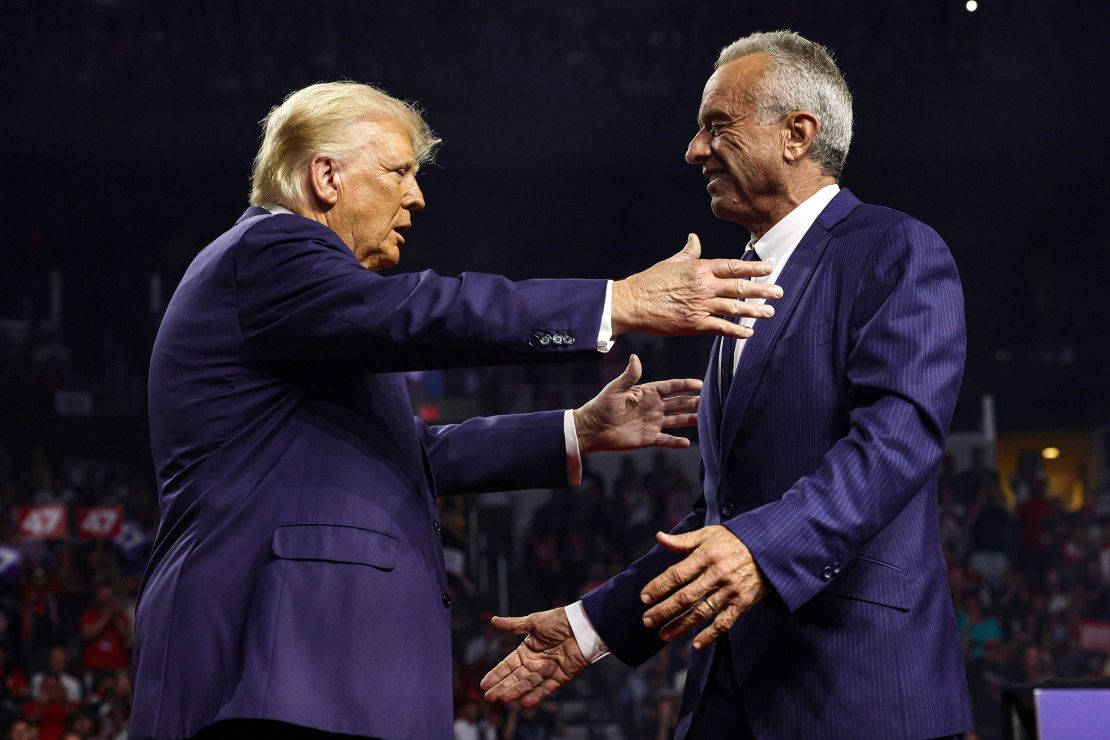
Trump, left, greets Robert F. Kennedy Jr., at a campaign rally in Glendale, Arizona, on August 23. Kennedy had just suspended his independent campaign and threw his support behind Trump. Adriana Zehbrauskas/The New York Times/Redux
But the newly uncovered comments from Kennedy’s radio show underscore the intensity of his past rebukes of Trump, including having leveled charges of racism toward him.
Kennedy repeatedly accused Trump of exploiting fear, bigotry and xenophobia to build a “dangerous” nationalist movement and warned Trump would destroy both the climate and clean water. Kennedy also compared Trump’s supporters to white Americans in the 1970s who, he said, viewed the Civil Rights Movement as a “social demotion.”
In one episode of “Ring of Fire” from December 2016, Kennedy compared Trump’s strategy to historical demagogues who rose during times of crisis.
Drawing comparisons to global crises such as the Great Depression, Kennedy said periods of economic and social instability had often given rise to demagogues who exploit fear, prejudice and insecurity to gain power. He cited figures abroad like Hitler, Francisco Franco and Mussolini, as well as Huey Long and Father Coughlin in the US, as historical parallels.
“And you can see that every statement that Donald Trump makes is fear-based,” Kennedy said on his radio show in December 2016. “Every statement he makes. You know, we have to be fear of the Muslims. We have to be fear of the black people, and particularly the big Black guy Obama, who’s destroying this country, who’s making everybody miserable.”
“And only one person has the genius and the capacity to solve these things. And I’m not gonna tell you how I’m gonna do it. Just trust in me, vote for me and everything will be great again. And of course, that whole thing is like a carnival barker,” Kennedy concluded.
He also compared Trump’s appeal to that of famous segregationist Alabama Gov. George Wallace.
“Wallace’s appeal … was to White middle-class men who had experienced the Civil Rights Movement of the 1960s as a social demotion, and who found their lives in turmoil,” Kennedy said. “And that kind of insecurity, I think, is the target of the summons that Donald Trump has sent out to the American public.”
In March 2016, Kennedy praised journalist Matt Taibbi’s critique of Trump’s base, reading on-air a passage that harshly condemned Trump and his followers which he called “beautifully” written.
“One of the things that you write so beautifully, and your stuff is so fun to read, but you write about Trump, quote, ‘The way that you build a truly vicious nationalist movement is to wed a relatively small core of belligerent idiots to a much larger group of opportunists and spineless fellow travelers whose primary function is to turn a blind eye to things,’” Kennedy said, reading Taibbi’s own writing back to him.
“‘We may not have that many outright Nazis in America, but we have plenty of cowards and bootlickers, and once those fleshy dominoes start tumbling into the Trump camp, the game is up,’” Kennedy said in finishing the passage Taibbi wrote.
“And, you know, he’s not like Hitler,” Kennedy said. “Hitler had like a plan, you know, Hitler was interested in policy,” Kennedy went on. “I don’t think Trump has any of that. He’s like non compos mentis. He’ll get in there and who knows what will happen.”
Kennedy on his radio show also harshly criticized Trump’s environmental policies, accusing him of promoting reckless climate denialism and prioritizing corporate interests over public health.
On one episode of “Ring of Fire” in December 2016, Kennedy referenced an article by climate scientist Michael Mann and said, “Michael Mann did a great article this week about the 10 worst climate deniers in the world, the most damaging, most destructive. And Donald Trump is number one.”
He accused Trump of pursuing “pollution-based prosperity” by rolling back regulations like the Clean Water Act and withdrawing from the Paris Climate Agreement.

Robert F. Kennedy Jr. speaks during a rally opposing the Constitution Pipeline outside the state Capitol on Tuesday, April 5, 2016, in Albany, New York. Erik McGregor/LightRocket/Getty Images
“Trump isn’t just gonna destroy the climate, but he’s also promised last week when he spoke to the oil industry, the shale gas industry, he promised that he would get rid of the Clean Water Act,” he added. “So he’s just gonna open the floodgates to every kind of pollution … Trump’s prosperity is gonna be pollution-based prosperity.”
Kennedy’s sharp criticisms of Trump extended into 2019, when he compared Trump’s EPA chief Andrew Wheeler to one of the “Four Horsemen of the Apocalypse” and called Trump’s efforts to boost fossil fuel production “despicable,” accusing him of knowingly prioritizing coal, oil and gas over the planet’s future.
By Kenna Hughes-Castleberry published yesterday (space.com)
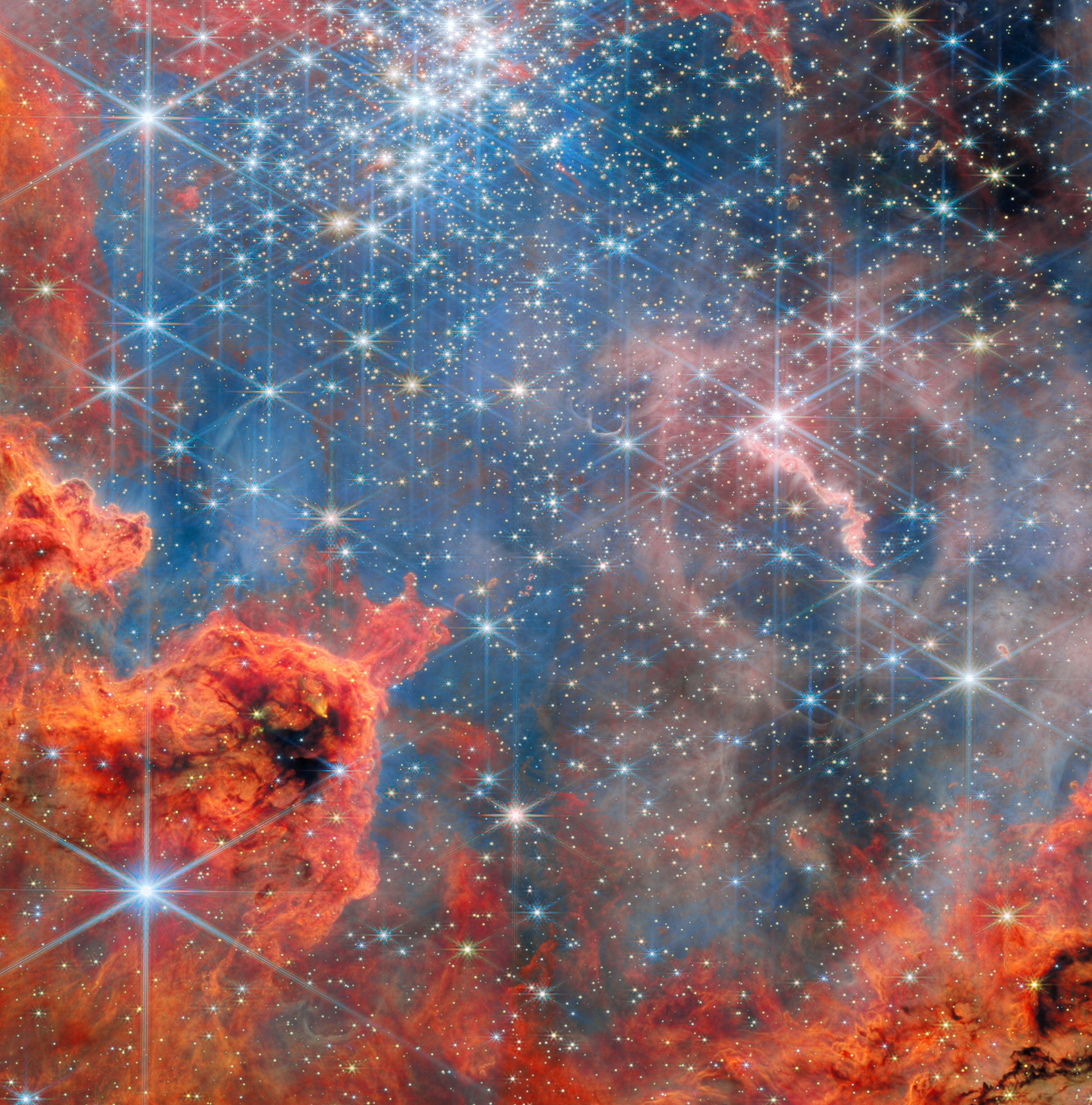
The Westerlund 2 star cluster is home to some of the Milky Way’s brightest stars.
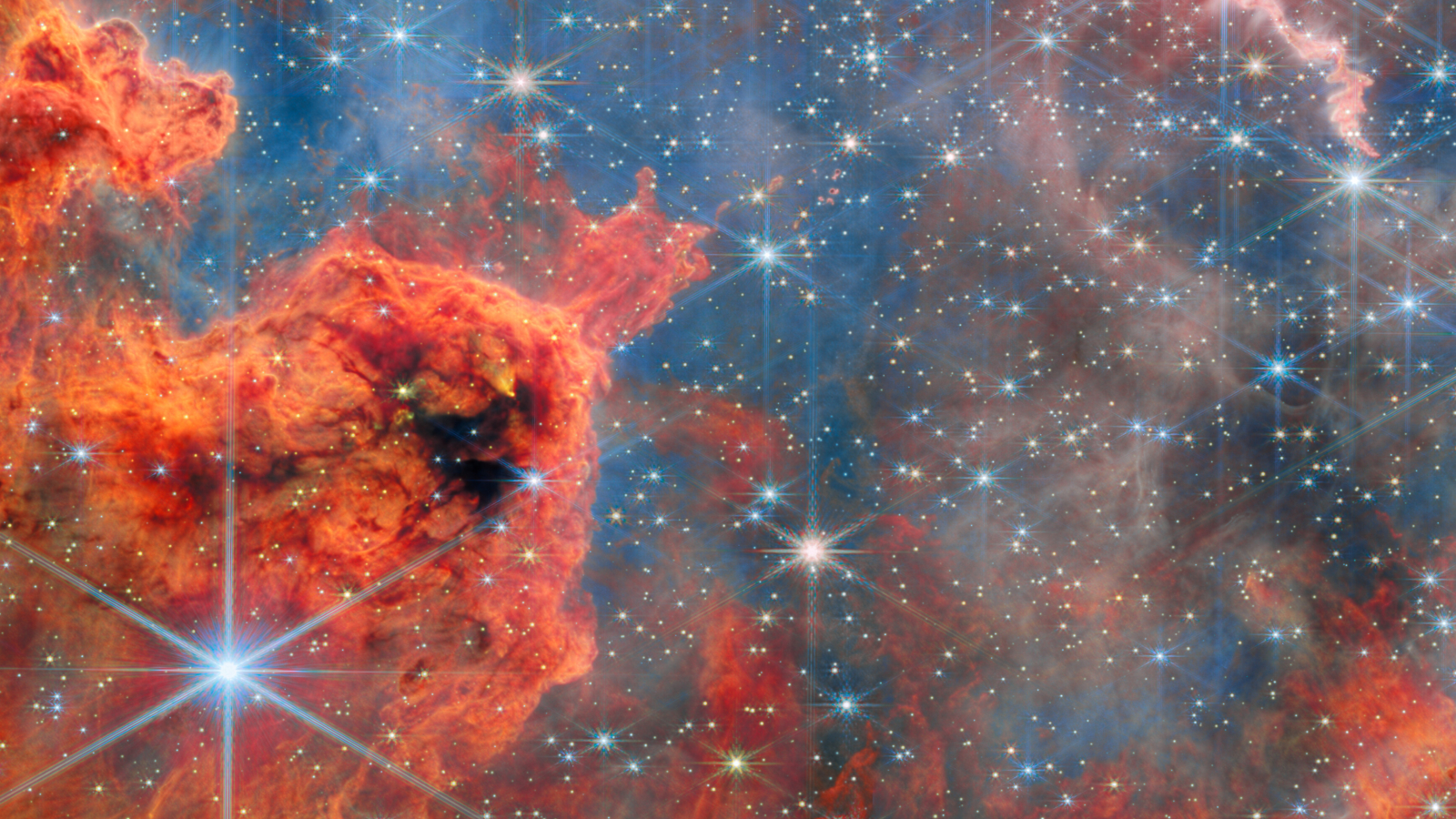
This stellar nursery located in the Carina Nebula is a key focal point for astronomers. (Image credit: ESA/Webb, NASA & CSA, V. Almendros-Abad, M. Guarcello, K. Monsch and the EWOCS team)Share
Recently, the James Webb Space Telescope (JWST) took a stunning image of the star cluster known as Westerlund 2, located in a stellar nursery called Gum 29 found within the Carina Nebula. The cluster is 6-to-13 light-years across and has some of the hottest and biggest stars found in the Milky Way.
While the Westerlund 2 cluster was the subject of Hubble’s 25th anniversary image in 2015, JWST has taken a different view of the area, resulting in what previous telescopes struggled to count: the cluster’s faintest members.
The JWST helped uncover for the first time the full population of brown dwarfs in this massive young star cluster, including objects as small as around 10 times the mass of Jupiter.
Latest Videos From Space
Click here for more Space.com videos…You may like
Brown dwarfs are grouped under the “dwarf” umbrella because they are star-like objects that form from collapsing gas clouds, yet never become big enough to sustain long-term hydrogen fusion like true stars.
The Carina Nebula is located in the Carina constellation, around 20,000 light-years away from Earth.
Finding brown dwarfs in this harsh and brilliant environment is important because it helps astronomers answer a key question: How efficiently are low-mass objects, like brown dwarfs, being made when there’s intense radiation in the area? A complete census of the stars in the image lets scientists compare the Westerlund 2 cluster to quieter star-forming regions and test whether extreme conditions change the “mix” of the objects that are formed.
You can learn more about the James Webb Space Telescope and star formation.
Get the Space.com Newsletter
Breaking space news, the latest updates on rocket launches, skywatching events and more!Contact me with news and offers from other Future brandsReceive email from us on behalf of our trusted partners or sponsorsBy submitting your information you agree to the Terms & Conditions and Privacy Policy and are aged 16 or over.
Kenna Hughes-Castleberry is the Content Manager at Space.com. Formerly, she was the Science Communicator at JILA, a physics research institute. Kenna is also a freelance science journalist. Her beats include quantum technology, AI, animal intelligence, corvids, and cephalopods.

Published: January 5, 2026 (TheOnion.com)
DANBURY, CT—Emphasizing the local parish’s dedication to serving its most vulnerable community members, St. Mary’s Catholic Church announced Tuesday that it was opening its doors to any single mothers in need of judgment. “Times are tough right now, but we want divorcées and unwed moms to know they can rely on the church to cast doubt on their way of life,” said parish administrator Dianne Barry, explaining that priests and nuns would be available around the clock to provide a disapproving “hmmm,” a raised eyebrow, or a critical sneer to any single mothers struggling to get by. “Regardless of your background or whether you’re rich or poor, this is a safe space where you can come to find out everything that’s wrong with you. We have plenty of snide comments to hand out, and our staff is specially trained to disparage you for driving men away and raising your children in sin. Our goal is to judge thousands of unmarried mothers this season.” St. Mary’s also announced that the new program would not interfere with its regularly scheduled judgment of childless women.
Jan 05, 2026 (transformarticles.com)
“O, it is excellent / To have a giant’s strength; but it is tyrannous / To use it like a giant,” wrote Shakespeare in Measure for Measure. What an appropriate commentary that is, regarding Donald Trump’s imperialistic aspirations. It looks like Venezuela was just the beginning.
Following last Friday night’s ouster of Nicolas Maduro, Secretary of State Rubio said on a Sunday news program, “We’re not going to tell anyone our plans but it’s no secret we’re no fan of the regime in Havana.” Senator Lindsey Graham, traveling with the president on Air Force One, then echoed his sentiment saying, “You just wait for Cuba… Its days are numbered.” Trump then agreed with him, saying “Cuba is ready to fall.”
So are we going to invade Cuba now?
President Trump once again reminded reporters that “we do need Greenland.” It doesn’t matter to him that the Danish Prime Minister protests, saying Greenland’s future is for Denmark and Greenland to decide.
So are we going to invade Greenland now?
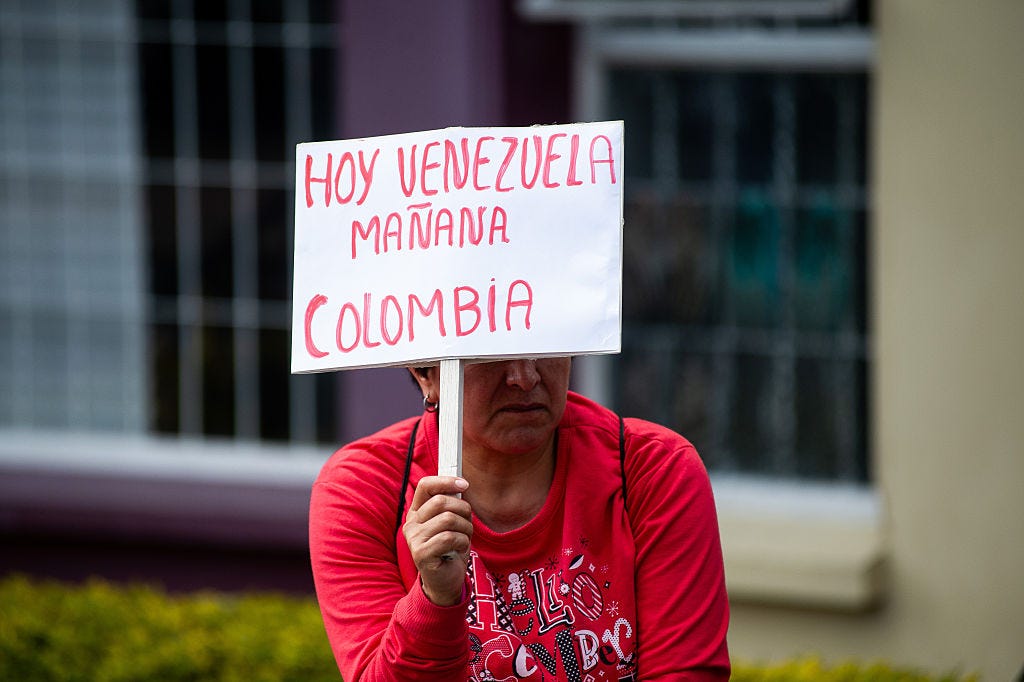
Now Colombia is on the President’s hit list, as well. Trump told reporters on board Air Force One that Colombia’s President Petro is “a sick man who likes making cocaine and selling it to the United States.” He continued, “And let me tell you, he’s not going to be doing it very long.”
The President says a military operation in Colombia “sounds good” to him, prompting Colombia’s Foreign Ministry to state that Trump’s comment represents “an undue interference in the internal affairs of the country, against the norms of international law.” Well, we know how much that matters to Donnie. President Petro told Trump he should stop slandering him, saying Latin American countries should not be treated by the United States as “servants or slaves.” Petro indicated that should the United States come after Colombia next, his country would be prepared to take up arms.
Brazil, Chile, Colombia, Mexico, Uruguay and Spain all condemned the US action in Venezuela as a “dangerous precedent for peace and regional security,” but such statements make little difference to the Trump administration. President Trump says he’s been in touch with Venezuela’s new President, Maduro’s former Vice-President Delcy Rodriguez, and told her she’ll pay a big price if she doesn’t go along with what Washington wants.
The hot water continues to boil.
Continuing to act on what some now call the Donroe Doctrine, President Trump also warned Mexico “to get their act together.” He wants Mexico’s government to take more action against the drug cartels and keeps hinting that if they won’t do it, he will. Mexico’s President Claudia Sheinbaum reminds him repeatedly that American gun manufacturers heavily arm the drug cartels, and if he really wanted to limit the power of the cartels he would limit the power of American companies to sell them guns. The violence this spawns has ben a large contributing factor to waves of migrations at our Southern border, by the way. But Trump is as loathe to take on the power of American gun manufacturers as Sheinbaum is afraid of taking on the drug cartels.
If this was ten years ago, all of the above would be part of a comedy sketch on Saturday Night Live. But at this point, none of this is funny. What should be evident to everyone by now, of course, is that Donald Trump isn’t kidding. He doesn’t just bluster. He makes very real threats and to the extent to which he’s capable, he makes good on them. He feels constrained by nothing (except possibly Melania). The latest, and most frightening thing of all, is how he says he isn’t afraid of putting boots on the ground… in Venezuela, or anywhere else.
UK Prime Minister Keir Starmer says his main concern is that Venezuela transition to democracy as soon as possible, which seems almost silly considering that neither Trump nor Rubio have mentioned the word “democracy” even once. The President said “You can’t have an election. We have to fix the country first.” In other words, you can either have American oil companies and their surrogates in DC running a country, or you can have democracy; you can’t have both. Trump seems as concerned about democracy in Venezuela as he is about democracy in America, and that isn’t much.
One of the worst parts of this imperialistic playbook – and it is a playbook, almost sickeningly repetitive – is how they never want you to think there will be meaningful opposition to what they’re doing. They mythologize the power of the U.S. military to create the impression that nothing could possibly match its might. Rather, we should all feel secure in the knowledge that the U.S. will get its way, easily, no problem. After all, we’re the most powerful military in the world!
I remember Dick Cheney saying we’d be greeted as liberators by the Iraqi people, which in fact we were for a short while before everything fell apart. I also remember Candy Crowley, then chief political correspondent and anchor for CNN, saying that Special Forces could take care of things no problem, that regime change in Iraq would take six weeks at most. She said that while rolling her eyes at then Congressman Dennis Kucinich for saying that if we invaded Iraq, we’d see hand to hand combat on the streets of Baghdad. She turned out to be wrong, of course – the war lasted eight years and killed anywhere from several hundred thousand to a million people – and Dennis Kucinich was right. The simple truth is that hard power isn’t everything. The U.S. has been good at breaking things, but terrible at putting them back together. The war in Afghanistan lasted 20 years and ended up with the Taliban back in power. But America’s war machine views success and failure differently than you and I. What you and I would call things going wrong, in many ways for them are things going right. “Boots on the ground,” by the way – as horrifying as it might sound to us – is simply the sound of money to those who are behind all this. Where war is a humanitarian disaster for some, it is a profit center for others.
This, ladies and gentlemen, is how our military-industrial-technology complex works. They’re everything they have always been, plus technology giants have now gotten in on the game. Do not expect any of this to turn out well.
Last year, the President ousted any military leaders who might question his agenda. In General Dan Caine, the Chairman of the Joint Chiefs of Staff and venture capitalist (you can’t make this stuff up) he has found a soul brother in going after his imperialistic agenda. He basically intends to turn Latin America into a U.S. corporate empire. It’s much like the covert CIA operations that messed with Latin American countries for decades during the last century, except that this time they don’t even pretend not to be doing it. Trump seems to have grown tired of pretending to be anything other than what and who he is. His administration’s response to any criticism now – from citizens, or even from Congress – is simply, “Get over it.”
America has not always been good – far from it – but at our best we’ve at least tried to be. It totally shifts everything that as long as this administration is in power, the United States is a rogue country with no allegiance to a rules-based world order. It’s hard to overestimate what this means not only for the United States, but potentially for the entire world. The U.S. Dept. of State posted a meme today with the words, “THIS IS OUR HEMISPHERE,” but there are millions of people in Latin America and Canada who would disagree. It is theirs as well. Latin America has roughly twice the population of the United States, by the way. We’re being led by fools who have no idea the razor blades they’re tossing around the room.
The rest of the world have taken notice of all this. Should the madness continue, we will not be given a pass.