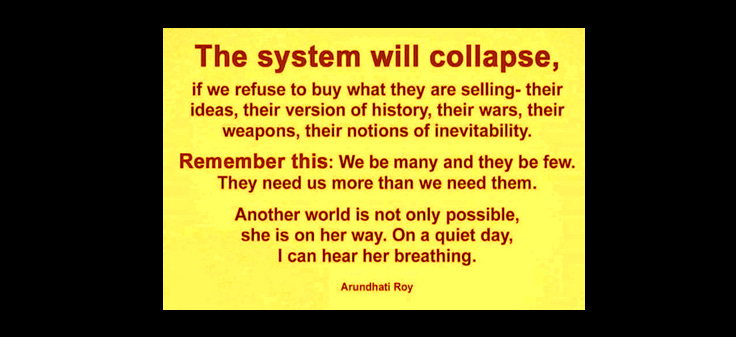
This is the elemental speaking: It is during phase transition — when the temperature and pressure of a system go beyond what the system can withstand and matter changes from one state to another — that the system is most pliant, most possible. This chaos of particles that liquefies solids and vaporizes liquids is just the creative force by which the new order of a more stable structure finds itself. The world would not exist without these discomposing transitions, during which everything seems to be falling apart and entropy seems to have the last word. And yet here it is, solid beneath our living feet — feet that carry value systems, systems of sanity, just as vulnerable to the upheavals of phase transition yet just as resilient, saved too by the irrepressible creative force that makes order, makes beauty, makes a new and stronger structure of possibility out of the chaos of such times.
Cultures and civilizations tend to overestimate the stability of their states, only to find themselves regularly discomposed by internal pressures and tensions too great for the system to hold. And yet always in them there are those who harness from the chaos the creative force to imagine, and in the act of imagining to effect, a phase transition to a different state.
We call those people artists — they who never forget it is only what we can imagine that limits or liberates what is possible. “A society must assume that it is stable,” James Baldwin wrote in reckoning with the immense creative process that is humanity, “but the artist must know, and he must let us know, that there is nothing stable under heaven.” In the instability, the possibility; in the chaos, the building blocks of a stronger structure.
A century of upheavals ago, suspended between two World Wars, Hermann Hesse (July 2, 1877–August 9, 1962) considered the strange power and possibility of such societal phase transitions in his novel Steppenwolf (public library). He writes:
Every age, every culture, every custom and tradition has its own character, its own weakness and its own strength, its beauties and ugliness; accepts certain sufferings as matters of course, puts up patiently with certain evils. Human life is reduced to real suffering, to hell, only when two ages, two cultures and religions overlap. A man of the Classical Age who had to live in medieval times would suffocate miserably just as a savage does in the midst of our civilisation. Now there are times when a whole generation is caught in this way between two ages, two modes of life, with the consequence that it loses all power to understand itself and has no standard, no security, no simple acquiescence.
We too are living now through such a world, caught again between two ages, confused and conflicted, suffocating and suffering. But we have a powerful instrument for self-understanding, for cutting through the confusion to draw from these civilizational phase transitions new and stronger structures of possibility: the creative spirit.
Hesse observes that artists feel these painful instabilities more deeply than the rest of society and more restlessly, and out of that restlessness they make the lifelines that save us, the lifelines we call art. A century before Toni Morrison, living through another upheaval, insisted that “this is precisely the time when artists go to work,” Hesse insists that artists nourish the goodness of the human spirit “with such strength and indescribable beauty” that it is “flung so high and dazzlingly over the wide sea of suffering, that the light of it, spreading its radiance, touches others too with its enchantment.”
The Dove No. 1 by Hilma af Klint, painted during World War I. (Available as a print and as stationery cards.)
Often, they do the nourishing at great personal cost. He considers what it means, and what it takes, to be an artist:
You will, instead, embark on the longer and wearier and harder road of life. You will have to multiply many times your two-fold being and complicate your complexities still further. Instead of narrowing your world and simplifying your soul, you will have to absorb more and more of the world and at last take all of it up in your painfully expanded soul, if you are ever to find peace.
Most people, Hesse laments while watching his contemporaries, are instead “robbed of their peace of mind and better feelings” by the newspapers they read daily — the social media of his time — through which the world’s power-mongers manipulate our imagination of the possible. “The end and aim of it all,” he prophecies, “is to have the war over again, the next war that draws nearer and nearer, and it will be a good deal more horrible than the last.”
That is what happened. The next war did come, the world’s grimmest yet — a phase transition that nearly destroyed every particle of humanity. And yet something was left standing, stirring — that same creative force that made of the chaos a new era of possibility never previously imagined: civil rights and women’s liberation, solar panels and antibiotics, One Hundred Years of Solitude and Nina Simone.
On the other side of that war’s ruins, another thinker of uncommon depth and sensitivity considered the role of the artist and of art in the collapse and reconfiguring of civilizations. In a 1949 address before the American Academy of Arts and Letters, later included in his lifeline of a collection Two Cheers for Democracy (public library), the English novelist, essayist, and broadcaster E.M Forster (January 1, 1879–June 7, 1970) celebrates the stabilizing power of art in times of incoherence and discord:
A work of art… is the only material object in the universe which may possess internal harmony. All the others have been pressed into shape from outside, and when their mould is removed they collapse. The work of art stands up by itself, and nothing else does. It achieves something which has often been promised by society, but always delusively. Ancient Athens made a mess — but the Antigone stands up. Renaissance Rome made a mess — but the ceiling of the Sistine got painted. James I made a mess — but there was Macbeth. Louis XIV — but there was Phèdre. Art… is the one orderly product which our muddling race has produced. It is the cry of a thousand sentinels, the echo from a thousand labyrinths; it is the lighthouse which cannot be hidden.
If our present society should disintegrate — and who dare prophesy that it won’t? — [the figure of the artist] will become clearer: the Bohemian, the outsider, the parasite, the rat — one of those figures which have at present no function either in a warring or a peaceful world. It may not be dignified to be a rat, but many of the ships are sinking, which is not dignified either — the officials did not build them properly. Myself, I would sooner be a swimming rat than a sinking ship — at all events I can look around me for a little longer — and I remember how one of us, a rat with particularly bright eyes called Shelley, squeaked out, “Poets are the unacknowledged legislators of the world,” before he vanished into the waters of the Mediterranean… The legislation of the artist is never formulated at the time, though it is sometimes discerned by future generations.
This, he assures us, is not a pessimistic view — it is a kind of faith in the future, made of our creative devotion to the present. (I am reminded here of his contemporary Albert Camus’s insistence that “real generosity toward the future lies in giving all to the present,” and of C.S. Lewis, who reckoned with our task in troubled times from the middle of a World War to remind us that “the present is the only time in which any duty can be done or any grace received.”) Forster writes:
Society can only represent a fragment of the human spirit, and that another fragment can only get expressed through art… Looking back into the past, it seems to me that that is all there has ever been: vantage-grounds for discussion and creation, little vantage-grounds in the changing chaos, where bubbles have been blown and webs spun, and the desire to create order has found temporary gratification, and the sentinels have managed to utter their challenges, and the huntsmen, though lost individually, have heard each other’s calls through the impenetrable wood, and the lighthouses have never ceased sweeping the thankless seas.
Art by Caldecott-winning children’s book author and artist Sophie Blackall
Amrit Sandhu ???????? Jan 14, 2026 Inspired Evolution Podcast ???????? 2026 is not a normal year… In this conversation, Marianne Williamson explains why the turbulence we’re witnessing is not random — and not merely spiritual, political, economic, or cultural. According to her, A Course in Miracles says the world we see reflects a way of thinking that is no longer sustainable. What’s being undone are the systems built on that thinking — so something truer can emerge. This is a correction in consciousness. And while the moment is collective, how it shows up in your life is deeply personal.
ARIES (March 21-April 19): Japanese Zen master Hakuin (1686–1769) painted with astonishing vigor well into his eighties. When asked his secret, he said he treated each brushstroke as if it were his first. He approached the ink and paper with a beginner’s inspired innocence. I propose that you adopt a version of Hakuin’s practice. Dive into your familiar routines with virgin eyes. Allow your expertise to be influenced by surprise. As for the mastery you have earned, may I suggest you use it as a launching pad for enthusiastic amateurism? Being skilled is wonderful. Being skilled and willing to experiment like a newcomer? That’s the high art of perpetual combustion, an Aries specialty.
TAURUS (April 20-May 20): In 1971, NASA’s Apollo 15 mission delivered a new asset to the moon: the Lunar Roving Vehicle. This battery-powered “moon buggy” enabled astronauts to explore farther from their landing site than ever before. They gathered a record haul of rock and soil samples and a deeper understanding of the lunar surface. I think you Bulls would be wise to get your own equivalent of that moon buggy. The apt metaphor here is enhancing your ability to extend your reach and explore beyond the familiar. In the coming weeks, I hope you will seek access to tools, allies and freedoms that expand your range. Use them to push into new territory and scout around for intriguing valuables.
GEMINI (May 21-June 20): Are you ready to unveil the half-hidden, half-beautiful truths you have been keeping tucked away? I think you are. You might shake, sweat and second-guess yourself right up until the moment the pivotal moment arrives. But then, I predict, you will zone in on how best to carry out your sublime assignment. The perilous blessings or radiant burdens you’ve been hoarding like secret treasures will finally spill out of you in just the right ways.
CANCER (June 21-July 22): A hermit crab finds a new shell not because the old one was bad, but because the creature grew. A similar urge stirs in you now: an instinct to relocate your sensitivity and tenderness into roomier housing. You don’t have to abandon your favorite people or situations. Just ripen and update your containers so your emotional intelligence can flourish even more. Maybe revise your work rhythms. Dream up new bedtime stories. Be braver in declaring your needs. Your ongoing transformations could be a bit bumpy, but mostly healing and cherished. Give them the spaciousness they require.
LEO (July 23-Aug. 22): Poet Jack Gilbert wrote, “We must risk delight. We can do without pleasure but not delight.” Here’s what I think he meant: Pleasure is easy to access, available in many transactions. But delight requires courage. We must be undefended enough to be astonished and elated. Here’s the potential glitch for you Leos: You sometimes feel inclined to perform your joy; you make your happiness into entertainment for others to be inspired by. But true delight is riskier and more real. It comes when you forget to curate yourself because you’re too enchanted to remember you’re being watched. Your next assignment: Conjure up three moments of private delight that no one but you will see.
VIRGO (Aug. 23-Sept. 22): Many of you are renowned for your precision, but that’s just half the story. The more complete truth is that when you are most robust, you’re a connoisseur of refinement. Your careful edits can transmute muddles into medicines. Your subtle fixes may catalyze major corrections. Here’s my bold declaration: You are now at the height of your Virgo powers. I hope you wield them with utter flair and finesse. Make everything you touch better than it was before you touched it.
LIBRA (Sept. 23-Oct. 22): Some astrologers work without ever glancing at the night sky. Their bond with the planets lives mostly through abstract ideas. To balance that approach, Daniel Giamario developed a more hands-on approach to astrology. In his retreats, students trek into wild country, far from city lights, and spend the dark hours watching the dance of the heavenly bodies. He teaches that cosmic energies can be sensed through our beautiful bodies as much as they can be understood by our fine minds. In the weeks ahead, I invite you to infuse all your explorations with that spirit. Learn through direct encounters, not just through concepts and recycled reports.
SCORPIO (Oct. 23-Nov. 21): English is my first language. I love how its wild, hybrid, restless qualities enable me to express myself. I never grow weary of exploring its limits and discovering new ways to use it with flair and care. But I am also very grateful that my horoscopes are translated into Italian, French, Japanese and Spanish. I am supremely blessed to have editors who turn my idiosyncratic prose into language that non-English speakers can enjoy. It’s one of the great gifts that life has given me. In the coming months, Scorpio, I will be wishing and expecting a similar bonus for you: help and support in expanding your ability to reach further in your self-expression.
SAGITTARIUS (Nov. 22-Dec. 21): Your intrepid spirit is most likely to find exciting adventures if it’s exquisitely prepared. While I love your daring spontaneity and experimental expansiveness, I hope that in the coming weeks, you will work hard to support them with good planning and rigorous foresight. Be imaginative and disciplined, wild and calculating, irrepressible and solidly responsible. If you heed my advice, you could break your previous records for making marvelous discoveries in the frontiers. PS: Treat wonder like a muscle. Flex it daily—with gratitude.
CAPRICORN (Dec. 22-Jan. 19): Sandcastles are good reminders of how temporary everything is. We build them on the damp edge of the shore after the tide recedes, and then they crumble when the sea rolls back a few hours later. Let’s make the sandcastle your power symbol for the months ahead. In doing so, I don’t mean to imply that your certainties will be demolished. Rather, it’s my way of urging you to enjoy and capitalize on the ever-changing nature of all things. In fact, I believe that knack should be one of your specialties in the coming months. As the Buddhist monk Thich Nhat Hanh told us, we should be grateful for impermanence, because it keeps every possibility alive.
AQUARIUS (Jan. 20-Feb. 18): During World War II, the United States faced a natural rubber shortage and funded research into synthetic substitutes. The effort was partly successful, but there were also failed experiments. Among these was a substance that later became a popular toy named Silly Putty. It sold millions of units and made its marketer wealthy. I suspect a metaphorically similar breakthrough is looming for you, Aquarius: an unplanned discovery that holds unforeseen value. You may soon have your own “Silly Putty moment”—an invention, idea or situation that is technically a detour from your original goal but still delivers a gift. So keep your curiosity loose and your judgment soft. Don’t dismiss the byproducts of your efforts. Some diversions may reveal themselves to be the magic you didn’t realize you needed.
PISCES (Feb. 19-March 20): I suggest you try an “as-if” exercise, Pisces. Here’s what I propose: Enjoy a five-day period visualizing what your life would be like if you stopped saving yourself for a mythical future—including both the positive and negative aspects. Instead, envision yourself spending the coming months doing exactly what you yearn to do most, gleefully and intensely pursuing your sweetest dreams and prime mission. During this sabbatical, you will refrain from invoking excuses about why you can’t follow your bliss. You will assume that you are attuned with the heart of creation. You will act as if you are a joy specialist who adores your life.
Henry Benjamin Whipple (February 15, 1822 – September 16, 1901) was an American religious leader and activist. He was the first Episcopalbishop of Minnesota and gained a reputation as a humanitarian and an advocate for Native Americans.
Born in Adams, New York, he was raised in the Presbyterian church but became an Episcopalian through the influence of his grandparents and his wife, Cornelia, whom he married in 1842. Whipple attended Oberlin College from 1838 to 1839 and worked in his father’s business until he was admitted to holy orders in 1848.
After ordination Whipple served parishes in Rome, New York, and Chicago, where he gained a reputation for his service to poor immigrant groups. His Chicago ministry drew him to the attention of the newly formed Episcopal Diocese of Minnesota, which elected him its first bishop in 1859. He served until his death in 1901.
Although concerned with establishing his denomination in the new state of Minnesota, Whipple soon began to champion the cause of Native American groups in the state against what he saw as an abusive and corrupt Federal policy towards Native Americans. He is best known for his clemency pleas in favor of a group of Dakota who fought against the United States government in the U.S.-Dakota War of 1862 in the area around New Ulm, Minnesota. On December 26, 1862, the largest mass execution in U.S. history occurred in Mankato during the pause in US military operations. Thirty-eight Dakota were hanged for war crimes in the conflict. A total of 303 were sentenced to be hanged but President Lincoln commuted 265 in the largest mass commutation on record. Lincoln’s intervention was not popular at the time. Two commemorative statues are located on the site of the hangings (now home to the Blue Earth County Library and Reconciliation Park). He was referred to as “Straight Tongue” by some Dakota because of his honesty in dealing with them.
Whipple is memorialized by the Bishop Whipple Federal Building in Fort Snelling, Minnesota, which houses, among other things, offices for members of Minnesota’s congressional delegation. His name is also found on a building on the campus of Concordia College in Moorhead, Minnesota, called Bishop Whipple Hall, a building which was originally a prep school built by Episcopalians but which was purchased by Norwegian Lutherans in 1891 as the main building of their newly founded Concordia College.[1]
Shattuck School (now coordinated with St. Mary’s Hall and St. James School as Shattuck-St. Mary’s School, formerly The Bishop Whipple Schools: Shattuck, St. Mary’s, St. James)[2] is a prominent Episcopal boarding preparatory school in Faribault, Minnesota, which grew up around the campus of Seabury Divinity School, which Whipple founded. (The seminary itself merged with Western Theological Seminary in Evanston, Illinois, and the campus of Seabury-Western Theological Seminary was in Evanston until its merger with Bexley Hall, and what is now known as Bexley Seabury Seminary has its campus on the south side of Chicago.) The main boy’s dormitory at Shattuck is called Whipple Hall. He is buried beneath the altar of the Cathedral of Our Merciful Saviour in Faribault, Minnesota.
Early life
Henry Benjamin Whipple was born on February 15, 1822, in Adams, New York. He was educated at a private boarding school in Clinton[disambiguation needed], New York, and at Jefferson County Institute in Watertown, New York. In 1839, he attended Oberlin Collegiate Institute, but his health failed and his physician recommended an active business life.
After several years working for his father, a country merchant, Whipple began studying for the ministry in the Episcopal Church. He was ordained a deacon on August 17, 1849, became rector of Zion Church in Rome, New York, in November 1849, and was ordained priest on July 16, 1850.[3] Whipple served as rector of Zion Church from 1849 to 1857, becoming known both for the size and wealth of his parish and for his work among the poor. In 1857, Whipple helped organize and became the first rector of the Church of the Holy Communion on Chicago‘s South Side, the first free church in the city. He drew his parishioners from “the highways and the hedges” – clerks, laborers, railroad men, travelers, and derelicts – sought converts among the city’s Swedish population, and regularly officiated in a Chicago prison.
On June 30, 1859, Whipple was elected the first Episcopal bishop of Minnesota, an office he held until his death more than forty years later. He was consecrated bishop on October 13, 1859, the feast day of James, brother of Jesus, at St. James Episcopal Church during the General Convention in Richmond by bishops Jackson Kemper, Leonidas Polk, and William H. DeLancey, with George Burgess delivering the sermon.[4] In December of that year, Whipple made his first visitation of his diocese, including the Ojibwe missions of E. Steele Peake and John Johnson Enmegahbowh. In the spring of 1860 he moved his family to Faribault, establishing it as the see of the diocese.
During his episcopate, Whipple guided the development of the Episcopal Church in Minnesota from a few missionary parishes to a flourishing and prosperous diocese. For many years, especially during the first two decades of his episcopate, he made regular missionary sojourns by wagon or coach through the rural areas of the state, often in mid-winter, preaching in cabins, school houses, stores, saloons, and Native American towns. Until the diocese was financially secure, he pledged himself to personally support several of its missionary clergy and assumed many other financial obligations of the church. He unified a diocese that at the time of his election was divided into two quarreling factions.
In 1860, Whipple incorporated the Bishop Seabury Mission in Faribault, building it upon the foundations laid by James Lloyd Breck and Solon W. Manny, who in 1858 had founded a divinity school and school for boys and girls. With the help of gifts from eastern donors, the mission developed into three separate but closely connected schools: Seabury Divinity School, Shattuck School for boys, and St. Mary’s Hall for the education of daughters of the clergy. Whipple also helped found the Breck School in Wilder, Minnesota, to educate the children of farmers.
Advocate for Native Americans
Whipple was best known outside of Minnesota for his dedication to the welfare of the Native Americans and for his missionary work among Dakota and Ojibwe in Minnesota. He returned from his first visitation of his diocese with a firm commitment to establish Native American missions and reform of the United States American Indian system. Whipple regularly included Native American towns on his visitations, built up the Episcopal mission to the Ojibwe based at the White Earth Reservation, and appealed for support of Native American missions by lectures throughout the United States and in Europe.
In the early years of his episcopate, Whipple’s espousal of American Indian reform and commitment to Native American missions earned him the enmity of many white settlers who hated Native Americans, and led some of his fellow bishops to look upon him as a fanatic. His attitude was denounced most bitterly after the Dakota War of 1862, when, in appeals to President Lincoln and through the press, Whipple opposed wholesale executions and extermination or deportation of the Dakota. Whipple even criticized his distant cousin and former Minnesota governor, Colonel Henry Sibley in such matters.
Fighting ICE’s Violence While Preserving Our Gorgeous Soul Power
Thirty-seven-year-old poet and mother of three children Renee Nicole Good was murdered by a masked, cursing ICE agent. It was yet another in a series of tragic atrocities perpetrated by Trumps’ gang of thugs.
It was also a clarification: The masks ICE agents wear aren’t about anonymity but about removing the last vestiges of accountability. They’re the final erasure of the human face from state violence. This is what tyranny looks like when it stops pretending.
Sorry to be so blunt, but it’s the sad and shocking truth.
So how do we fight the escalating brutality without becoming brutalized ourselves? How do we resist the fascist creep without letting it colonize our inner landscape?
+
The Insurrectionary’s Paradox
Here’s the challenging practice: We need wrathful compassion, that fierce Buddhist concept where love becomes so intense it manifests as holy rage against those who harm the vulnerable. Not hatred, which damages the hater, but a righteous anger that’s an expression of care extended so far it won’t tolerate cruelty.
We can think of it this way: If someone were beating a child in front of us, our immediate intervention wouldn’t come from hatred of the abuser but from love of the child. The force we would use to stop the violence would be an expression of our care.
This is the alchemy we need now. ICE’s violence against immigrants (and even non-immgrants) demands our intervention because we love what they’re destroying: human dignity, sanctuary, and refuge.
+
Practical Insurgency as Self-Care
On our behalf, I’m tempted to ask the question “how do we fight while caring for ourselves?” But that contains a false premise. Done right, the fighting is the self-care. Here’s why:
We stay sane by taking vigorous action. Helplessness is the real psychological poison. Every practical thing we do is an antidote to the corrosive feeling of complicity through inaction: joining rapid response networks, contributing to immigrant defense funds, participating in ICE office disruptions, providing sanctuary, and documenting abuses.
We preserve joy by defending it collectively. The authoritarian gangsters want to steal our capacity for delight, to make us so despairing and exhausted that we forfeit our imagination.
But we refuse. We organize potlucks for undocumented neighbors. We hold dance parties outside detention centers. We make beauty while we make trouble. The exuberance isn’t separate from the resistance; it’s one of the main points of the resistance.
We resist mass hallucination by grounding ourselves in embodied reality. The fascist atrocity project depends on abstractions: immigrants as “invaders” and humans as “illegals.”
We counter this with fierce particularity. We learn the name of every person ICE detains. We tell their specific stories, as in: Renee Nicole Good was an award-winning queer poet who was renowned for her kindness. Her last words on earth, uttered to her killer, were, “That’s fine, dude. I’m not mad at you.”
We make the violence concrete and the humanity undeniable. This refusal to let brutality be normalized into abstraction is both activism and meditation.
+
Can Our Struggle Be a Form of Play?
The question might ostensibly seem frivolous given the stakes. But consider the possibility that rigid seriousness is just another form of the authoritarian rigidity we’re fighting against. What if we approach resistance with the spirit of serious play—not frivolous, but creative, surprising, and uncontainable?
For example: street theater that mockingly reenacts ICE raids with agents played as cowardly masked thugs. Paint or chalk murals that celebrate immigrants’ contributions, impossible to remove without admitting some fascist is trying to erase these truths. Flash mobs singing lullabies outside detention centers in multiple languages. Memes that make ICE agents’ violence so recognizable as un-American that even moderate citizens recoil.
The playfulness isn’t disrespectful to the horror. It’s a refusal to let the horror dictate the terms of engagement entirely. It keeps our imaginations wild and hungry and free because the authoritarian mind can’t comprehend or predict creative insurgency.
+
Constructive Anger, Unconsumed
How do we summon a righteous blend of practical love and constructive anger? Here’s the recipe:
We root the anger in specific compassion. We don’t let it become abstract fury at “the system” or “fascism.” We focus it: The ICE agent named Jonathan Ross shot Renee Nicole Good in the face at pointblank range and then cursed her as she died.
Honduran asylum seeker Mirian G. was detained in Texas and held in an ICE-run detention center while her 18‑month‑old son was taken to a separate facility 120 miles away, with no chance to comfort him or say goodbye.
A farmworker in Ventura County, California, Jaime Alanís García / Alanís, died after falling 30 feet from a greenhouse roof while fleeing an ICE raid at Glass House Farms in Camarillo on July 10, 2025.
Specificity like this keeps the anger clean, purposeful, and constructive.
And we channel it into action that empower us. Because anger that just churns inside us becomes acid. Whereas we can turn our anger into sacred fuel: Use it to build mutual aid networks, fund legal defense, disrupt deportation operations, create sanctuary spaces.
We also tend the opposite pole equally. For every hour of wrathful organizing, we spend time cultivating beauty. We register the power and glory of our loved ones, our creative practices, our moments of sensory pleasure, and our moments of imagining better worlds.
They’re what we’re defending. They keep us from becoming burned-out husks who’ve won some battles but lost our souls.
+
Cheerful Buoyancy as Revolutionary Technology
The authoritarian thugs are counting on our despair. Our cheerful buoyancy (which isn’t the same as naive optimism) can disrupt their evil plans. (And yes, they are EVIL.)
So we hold the full weight of the terror, cruelty, and fascist acceleration . . . AND we ALSO experience joy, pleasure, and fun. Because joy, pleasure, and fun aren’t contingent on circumstances being good. They’re our choice to remain alive to beauty even amidst dire situations.
This is embodied spirituality in action. Disembodied spirituality would tell us to transcend the political horror and not let it disturb our inner peace. But a path of embodied spirituality says: No. We feel it all. The rage, the grief, the fear . . . AND the delight, the sensory pleasure, the connection, the hope.
Practical applications:
– Start meetings with a genuinely delightful burst like a poem, a song, or good news
– Build regular sabbath time into our activism (one day a week, no news, no organizing, just pleasure)..
– Practice what adrienne maree brown calls “pleasure activism”—the insistence that what we’re fighting for should be present in how we fight.
– Cultivate absurdist humor about the situation. It’s not dismissive, but recognizes how cartoonishly evil masked federal agents are.
+
How Do We Refrain From Being Consumed by Hatred?
Even as we fight against the hatred and danger unleashed by masked bullies perpetrating harm under the aegis of ICE, we remember: Hatred corrodes the hater. It’s a toxin that poisons from within.
The answer isn’t to suppress the rage or pretend we don’t feel it. Instead, we transform rage by grounding it in love: love for the victims, love for the possibility of justice, and love for the world we’re trying to build.
Here’s a practice: When we feel hatred rising toward an ICE agent, a collaborating judge, or a politician enabling this violence, pause, we ask ourselves: What am I really feeling?
Beneath the hatred is often grief. That’s the deeper feeling.
We let ourselves feel that grief all the way down to the bottom of the grief. It connects us to life’s deep sources. And from the grief comes the fierce determination that can sustain a long struggle without consuming us.
This doesn’t mean being soft on perpetrators. It means staying human while fighting inhumane systems.
+
Building While Burning
How do we remain dedicated to building beauty and truth and justice and love even as we keep our imaginations wild and hungry and free?
The key insight: We don’t build these things AFTER we have defeated fascism. We build them as one of the methods of defeating fascism.
Every one of our mutual aid networks is doing prefigurative politics. We are showing what a caring society looks like. Every sanctuary space is a liberated zone. Every community defense training is both practical skill-building and a demonstration that we protect each other, not the corrupt state.
Our art, writing, music, and poetry aren’t separate from the fight. They comprise our consciousness-building infrastructure. They give people the philosophical and imaginative resources to resist authoritarian simplicity with complex, embodied alternatives.
When we write a poem, we’re not escaping the struggle. We’re modeling the attention and beauty and truth-telling the world needs. When we make music, we’re creating the soundtrack for resistance and joy. When we build community, we’re establishing the networks that will sustain us through the fight ahead.
+
OUR ALIVENESS IS A THREAT TO THEM
Remember: our aliveness is a threat to them. The autocrats want to turn everyone into fearful, passive, joyless subjects. Every moment we choose vitality, creativity, connection, we are already winning a small battle. We’re proving that their project of domination is incomplete, that something in us remains untamed and unbowed.
So here’s the practice, the working, the way forward:
We wake each morning and feel the full weight of what’s happening. Don’t numb ourselves to the ongoing terror.
Then we choose, deliberately, to also feel joy. Make breakfast with sensuous attention. Notice beauty. Connect with our beloveds.
Let both feelings be true simultaneously. This is embodied spirituality: not transcending the difficulty but fully inhabiting our life within it.
Take action, any action, toward protecting immigrants, disrupting ICE, building sanctuary. Even small actions break the paralysis and feed the soul.
Do it with others. Isolation is the enemy; connection and community are the medicine.
Be creative, surprising, and playful in our methods. The autocrats expect grimness and despair. Give them something they can’t predict or control.
Tend our own beauty and truth and joy as fiercely as we fight for others’. We are what we’re defending.
The fight is long. We must pace ourselves. This is a marathon, not a sprint.
And finally: Our art, our relationships, our pleasures, and our wild imagination aren’t separate from the resistance. They’re the point of it. They’re what makes us dangerous to authoritarianism. We know that life can be beautiful, strange, free, and we won’t forget it, won’t let their brutality have the final word.
The masked ICE agents think the masks make them powerful. But we see through them to the cowardice, the complicity, and the abandonment of humanity. And we will fight them with everything we have: rage and love, seriousness and play, practical solidarity and wild imagination.
Because the fight itself is how we stay human while they choose to be monsters.
“A life truly lived constantly burns away veils of illusion, burns away what is no longer relevant…until we are strong enough to stand in our naked truth.”
Marion Woodman (1928-2018) Canadian Psychologist
AN OPPORTUNITY FOR DAILY REFLECTION BROUGHT TO YOU BY THE SCHOOL OF PRACTICAL PHILOSOPHY
Misuse of State power killed Renee Good and is being used to suppress dissent and condition the public to fear government
In this article I lay out the constitutional rights ICE agents routinely violate with impunity; Rights which belong to all persons in the United States:
The killing in Minneapolis of Renee Good, by an agent of the Immigration and Customs Enforcement, (ICE) marks an inflection point in American history, not unlike the famous “shot heard ‘round the world,” that sparked a revolution in the American colonies.
As a member of Congress, I voted against the creation of the Department of Homeland Security. I understood then, as I understand now, that the expansion of federal police power inevitably endangers freedom. That danger is no longer theoretical. Federal police power has entered our communities and is a menace. This is no longer a debate about immigration policy. We are in a Constitutional crisis.
In a democratic society there are safeguards to prevent the abuse of power. This Administration has stripped those safeguards. None of us are safe when government agents, gestapo-like, bring terror to our streets, arbitrarily detaining people based on skin color, ethnicity, or accent, denying due process, and acting as police, prosecutor, judge, jury and executioner.
Americans are flooding streets in major cities with massive marches and other acts of resistance, which will be further fueled by the federal government’s complicity and the transparently calculated attempt by top officials to cover-up the murder.
The killing of Renee Good comes at a moment when Americans are already weary of escalating government intrusion into their private life: Mass surveillance, facial recognition, warrantless searches, investigation of journalists, monitoring of protestors, and the expansion of artificial intelligence for domestic law enforcement further erode Americans’ expectation of privacy.
The specter of the National Guard activated by the President, for obvious partisan purposes, was a clear violation of the Posse Comitatus Act of 1878 which was passed to prevent federal troops from being involved in local law enforcement.
As protests against wars abroad and conflicts at home escalate, the possibility exists that this President will invoke the Insurrection of Act of 1807, placing Posse Comitatus in abeyance, federalizing the National Guard and sending the Guard and the US military to quell civil disorder which the President himself has incited.
Before our eyes America is being transformed from a republic in which the rights of citizens are protected by law into something very dark, an authoritarian order in which individual rights are nullified.
Our government, acting as though unbridled by law, has licensed itself to accost, beat up, drag, kidnap and imprison people within the United States, including American citizens, while abroad it wages war wantonly and kills with abandon. ICE has stormed into American cities, not in a manner consistent with lawful immigration enforcement, but as a show of force, directed at the public itself.
The clear purpose in intimidation. State power is being used to suppress dissent and condition the public to fear its own government.
A timid public, cowed by the knock at the door and armed agents roaming neighborhoods, schools, workplaces, and places of worship, may forfeit their rights, unless it understands the urgency of knowing and then asserting them.
Here are the constitutional rights ICE agents routinely violate with impunity; rights which belong to all persons in the United States:
First Amendment rights to freedom of speech, peaceful protest, freedom of the press, to record public officials, and the right to freedom of association.
Fourth Amendment rights to be secure against unreasonable search and seizures.
Fifth Amendment rights to avoid custodial interrogation without being read Miranda rights.
Sixth Amendment rights include assistance of legal counsel, prevention of indefinite detention, notice of charges, right to know the nature of the accusation.
Fourteenth Amendment right to due process and equal protection, including protection from racial profiling, excessive use of force and unjustified deadly force
Taken together, ICE’s violations threaten the life and liberty of every person in this country.
None of us are safe when agents of the federal government aggressively roam the streets of our cities, invade our schools, our places of worship, our workplaces, our businesses without warrants, and arbitrarily arrest people based on their skin color, their ethnicity, their accents, denying due process as though storm troopers.
Like many Americans, I have carefully studied the videos of the killing of Renee Good. As a former chair of a congressional investigative subcommittee on Domestic Policy, I am committed to a careful review of all available evidence.
The evidence supports but one conclusion. Renee Good was killed by an agent of the United States government who was visibly not in imminent danger when, in less than a second, he fired three shots, point blank, at Renee Good as her vehicle slowly turned away from him.
At least two rounds from the agent’s 9mm Glock struck her in the head, killing her instantly. This happened almost immediately after (with her driver’s window rolled down), she calmly told the agent: “I’m not mad at you.”
After the fatal shots were fired, as the car careened, the agent added a chilling, dehumanizing punctuation which could lead to first degree murder charges: “Fcking btch.” The agent walked away from the site, unmoved and unscathed.
Renee Good was not a domestic terrorist, despite false and defamatory claims made by high-ranking officials attempting to smear the dead woman to deflect accountability. The fictionalized account of her “running over” the agent, the lack of an immediate interview of the agent by his supervisor, the spiriting away of the agent from the scene, the concoction of an official narrative at odds with observable facts, will raise profound questions about a cover up which could shake the foundations of this country.
Renee Good was a mother of three. An award-winning poet. A wife. She had just dropped her six-year-old child at school. Her car contained stuffed animals children hug for comfort. The car’s rear window was covered with decals from visits to America’s National Parks.
What makes her death so searing is the violent collision on the streets of an American city between a gentle soul expressing warmth and compassion to the very government agent who then murdered her.
We must not direct hate toward the agent, or toward the government itself, which remains our government. But accountability is not negotiable. That accountability extends to every official who authorized, condoned, or excused the killing of Renee Good.
Her death is a warning to the nation:Government power without restraint leads to deadly repression. A silent Congress enables it. A passive public invites it.
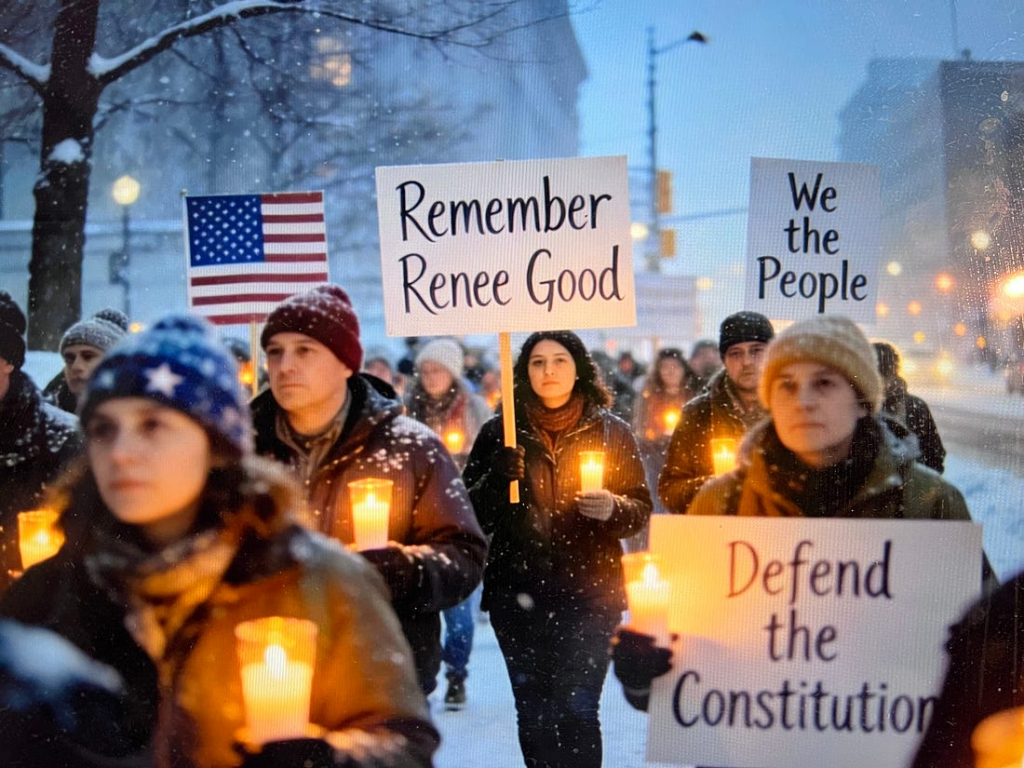
We the People must know our constitutional rights and be prepared to assert them. The Founders pledged their lives, fortunes, and sacred honor to secure our Independence, our Constitution,and our Bill of Rights. If we fail to defend freedom now, we risk losing everything.
We must all become peacefully visible, everywhere, to affirm we heard the shots, that we saw what happened to Renee Good, and that we will challenge our government to honor the Constitution of the United States.
After the shooting, Renee Good’s wife, Becca, in heartbreaking grief, sat in the snow alongside the couple’s dog. She called out, plaintively, in a voice that surely must have touched Heaven itself: “What are we going to do?!”
What Must Now Be Done
Renee’s killing provokes deep grief and outrage. It necessarily requires lawful action to restore constitutional boundaries and to reassert civilian control over the use of federal police power.
First, Legal Accountability Must Occur. An independent special prosecutor should be appointed to fully investigate Renee Good’s killing, including the actions of the federal agent involved, the chain of command and any officials who participated in the construction or dissemination of a false narrative. Illegal use of lethal force must be prosecuted, as should concerted attempts to construct a cover-up.
ICE must be Investigated for Civil Rights Violations. A special, independent prosecutor must be appointed to initiate a wide-spread probe into practices of ICE which have violated the constitutional rights of countless persons in America. If sufficient evidence exists that ICE has systematically violated the U.S. Constitution, ICE must be abolished.
Courts must impose constitutional restraint. The federal courts exist to check executive overreach. Judges must rigorously enforce limits on search, seizure, detention, interrogation and the use of force. Suppression of unlawfully obtained evidence, civil liability for rights violations, and injunctive relief against abusive practices all must be considered. The rule of law must be restored to its fullness.
Congress must reclaim its rightful role as a co-equal branch of government. Congressional oversight has been abdicated. That abandonment of duty must end. Congress must investigate the militarization of ICE, its violent enforcement tactics and the erosion of constitutional safeguards.
Congress must reclaim its power of the purse, conditioning department funding on strict constitutional compliance and full adherence to due process rights. Legislation must limit federal police activities within states and municipalities, place further prohibitions on the use of military force for civilian law enforcement, and require transparency regarding the action of federal agents who use force.
The Constitution does not defend itself.
Citizens must act, lawfully and visibly.
Rights survive only when people know them, can recite them and insist upon them. Citizens must document encounters with federal agents, assert their right to remain silent, demand warrants and refuse unlawful searches, consistent with constitutional rights.
Peaceful protest is not disorder. It is one of the highest expressions of our freedom. Communities must organize peaceful, visible, nonviolent assemblies that affirm constitutional rights and reject intimidation.
It is time to return to campuses with teach-ins about the individual rights granted by the Constitution and the legal means to assert those rights. Faith communities, civic organizations and local governments must publicly affirm constitutional protections apply to all persons, without exceptions.
The Founders understood that the principles they inscribed upon parchment could be guaranteed only by an informed and engaged public. When government forgets its limits, it is the duty of the people to remind it. This is the sacred obligation of citizenry.
The shots that killed Renee Good must not be answered with fear or silence. They must be answered with law, with accountability and the unyielding insistence that the Constitution still governs this nation.
Arrest at the age of 15 in Montgomery, Alabama for refusing to give up her seat to a white woman on a segregated bus, nine months before the similar Rosa Parks incident.
Children
2
Claudette Colvin (born Claudette Austin; September 5, 1939 – January 13, 2026) was an American pioneer of the 1950s civil rights movement and nurse aide. On March 2, 1955, she was arrested at the age of 15 in Montgomery, Alabama, for refusing to give up her seat to a white woman on a crowded, segregated bus. It occurred nine months before the similar, more widely known incident in which Rosa Parks, secretary of the local chapter of the National Association for the Advancement of Colored People (NAACP), helped spark the 1955 Montgomery bus boycott.[1]
Colvin was one of four plaintiffs in the first federal court case filed by civil rights attorney Fred Gray on February 1, 1956, as Browder v. Gayle, to challenge bus segregation in the city. In a United States district court, Colvin testified before the three-judge panel that heard the case. On June 13, 1956, the judges determined that the state and local laws requiring bus segregation in Alabama were unconstitutional. The case went to the United States Supreme Court on appeal by the state, which upheld the district court’s ruling on November 13, 1956. One month later, the Supreme Court affirmed the order to Montgomery and the state of Alabama to end bus segregation. The Montgomery bus boycott was then called off after a few months. The court subsequently declared all segregation on public transportation unconstitutional.
For many years, Montgomery’s black leaders did not publicize Colvin’s pioneering effort. She said, “Young people think Rosa Parks just sat down on a bus and ended segregation, but that wasn’t the case at all.”[2] Colvin’s case was dropped by civil rights campaigners because she was unmarried and pregnant during the proceedings.[3][4] It is now widely accepted that she was not accredited by civil rights campaigners due to her circumstances. Rosa Parks said, “If the white press got ahold of that information, they would have [had] a field day. They’d call her a bad girl, and her case wouldn’t have a chance.”[3][5]
In 2021, the record of Colvin’s arrest and adjudication of delinquency was expunged by the district court in the county where the charges against her had been brought more than 66 years earlier.
Early life
Claudette Colvin was born Claudette Austin in Montgomery, Alabama, on September 5, 1939,[6][7] to Mary Jane Gadson and C. P. Austin. When Austin abandoned the family, Gadson was unable to financially support her children. Colvin and her younger sister, Delphine, were taken in by their great aunt and uncle, Mary Anne and Q. P. Colvin, whose daughter, Velma, had already moved out.[7] Colvin and her sister referred to the Colvins as their parents and took their last name.[8] When they took Claudette in, the Colvins lived in Pine Level, a small country town in Montgomery County, the same town where Rosa Parks grew up.[7][9] When Colvin was eight years old, the Colvins moved to King Hill, a poor black neighborhood in Montgomery where she spent the rest of her childhood.[10][11]
Two days before Colvin’s 13th birthday, Delphine died of polio.[7][12] Not long after, in September 1952, Colvin started attending Booker T. Washington High School.[7][13] Despite being a good student, Colvin had difficulty connecting with her peers in school due to grief.[7] She was a member of the NAACP Youth Council, where she formed a close relationship with her mentor, Rosa Parks.[14]
Bus incident
In 1955, Colvin was a student at the segregated Booker T. Washington High School in the city. She relied on the city’s buses to get to and from school because her family did not own a car. The majority of customers on the bus system were African American, but they were discriminated against by its custom of segregated seating. Colvin was a member of the NAACP Youth Council and had been learning about the civil rights movement in school.[15] On March 2, 1955, she was returning home from school when she boarded a Highland Gardens bus and sat down near an emergency exit in a middle row.[16]
If the bus became so crowded that all the “white seats” in the front of the bus were filled until white people were standing, any African Americans were supposed to get up from nearby seats to make room for whites, move further to the back, and stand in the aisle if there were no free seats in that section. When a white woman who got on the bus was left standing in the front, the bus driver, Robert W. Cleere, commanded Colvin and three other black women in her row to move to the back. The other three moved, but another black woman, Ruth Hamilton, who was pregnant, got on the bus and sat next to Colvin.[3]
The driver looked at the woman in his mirror. “He asked us both to get up. [Mrs. Hamilton] said she was not going to get up and that she had paid her fare and that she didn’t feel like standing,” recalls Colvin. “So I told him I was not going to get up either. So he said, ‘If you are not going to get up, I will get a policeman.'” The police arrived and convinced a black man sitting behind the two women to move so that Mrs. Hamilton could move back, but Colvin still refused to move. She was forcibly removed from the bus and arrested by the two policemen, Thomas J. Ward and Paul Headley.[17][18][3] This event took place nine months before the NAACP secretary Rosa Parks was arrested for the same offense.[2] Colvin later said: “My mother told me to be quiet about what I did. She told me: ‘Let Rosa be the one. White people aren’t going to bother Rosa[,] her skin is lighter than yours and they like her.'”[2] Colvin did not receive the same attention as Parks for a number of reasons: she did not have “good hair”, she was not fair-skinned, she was a teenager, and she was pregnant. The leaders in the Civil Rights Movement tried to keep up appearances and make the “most appealing” protesters the most seen.[15][19]
When Colvin refused to get up, she was thinking about a school paper she had written that day, about the local customs that prohibited Black people from using the dressing rooms in order to try on clothes in department stores.[20] In a later interview, she said: “We couldn’t try on clothes. You had to take a brown paper bag and draw a diagram of your foot … and take it to the store”.[15] Referring to the segregation on the bus and the white woman, Colvin recalled: “If she sat down in the same row as me, it meant I was as good as her.”[2]
“The bus was getting crowded, and I remember the bus driver looking through the rearview mirror asking her [Colvin] to get up for the white woman, which she didn’t,” said Annie Larkins Price, a classmate of Colvin. “She had been yelling, ‘It’s my constitutional right!’. She decided on that day that she wasn’t going to move.”[21] Colvin recalled, “History kept me stuck to my seat. I felt the hand of Harriet Tubman pushing down on one shoulder and Sojourner Truth pushing down on the other.”[22] Colvin was handcuffed, arrested, and forcibly removed from the bus. She shouted that her constitutional rights were being violated.[2][18] Colvin said, “But I made a personal statement, too, one that [Parks] didn’t make and probably couldn’t have made. Mine was the first cry for justice, and a loud one.”[23]
The police officers who took her to the station made sexual comments about her body and took turns guessing her bra size throughout the ride.[7] After one officer jumped in the back seat of the police car, Colvin recalled, “I put my knees together and crossed my hands over my lap and started praying.”[24] This made her very scared that they would sexually assault her because this happened frequently. Price testified for Colvin, who was tried in juvenile court. Colvin was initially charged with disturbing the peace, violating the segregation laws, and battering and assaulting a police officer. “There was no assault”, Price said.[21]
A group of black civil rights leaders including Martin Luther King Jr. was organized to discuss Colvin’s arrest with the police commissioner.[25] She was bailed out by her minister, who told her that she had brought the revolution to Montgomery.[15]
Through the trial Colvin was represented by Fred Gray, a lawyer for the Montgomery Improvement Association (MIA), which was organizing civil rights actions.[26] She was convicted on all three charges in juvenile court. When Colvin’s case was appealed to the Montgomery Circuit Court on May 6, 1955, the charges of disturbing the peace and violating the segregation laws were dropped, although her conviction for assaulting a police officer was upheld.[26]
Colvin’s moment of activism was not solitary or random. In high school, she had high ambitions of political activity. She dreamed of becoming the President of the United States. Her political inclination was fueled in part by an incident with her schoolmate, Jeremiah Reeves. His case was the first time that she had witnessed the work of the NAACP.[27] Reeves was sentenced to death and executed for raping a white woman when he was 16. Although there is evidence that Reeves, who was the prime suspect in the rapes or attempted rapes of five other white women,[28] was actually guilty, the case drew protests not due to questions about his guilt, but the racial disparities in sentencing. Martin Luther King Jr. noted that the controversy stemmed not from the question of guilt or innocence, but the clear racial disparities in sentencing that were further emphasized by Reeves’s young age.[29][26]
Claudette Colvin was one of four plaintiffs in the first federal court case filed by civil rights attorney Fred Gray on February 1, 1956, Browder v. Gayle, which challenged bus segregation in Montgomery, Alabama. Colvin testified before a three-judge panel in the United States District Court that heard the case. On June 13, 1956, the court ruled that state and local laws enforcing bus segregation in Alabama were unconstitutional.[30] The state appealed the decision to the United States Supreme Court, which upheld the lower court’s ruling on November 13, 1956. One month later, the Supreme Court affirmed the order for Montgomery and the state of Alabama to end bus segregation.[31] As a result, the Montgomery Bus Boycott, which had lasted over a year, was officially called off. The ruling ultimately led to the declaration that all segregation on public transportation was unconstitutional.
Life after activism
Colvin gave birth to a son, Raymond, in March 1956. Colvin left Montgomery for New York City in 1958,[3] because she had difficulty finding and keeping work following her participation in the federal court case that overturned bus segregation. Similarly, Rosa Parks left Montgomery for Detroit in 1957.[32] Colvin stated she was branded a troublemaker by many in her community. She withdrew from college, and struggled in the local environment.[33]
In New York, Colvin and her son Raymond initially lived with her older sister, Velma Colvin. In 1960, she gave birth to her second son, Randy.[34] Claudette began a job in 1969 as a nurse’s aide in a nursing home in Manhattan. She worked there for 35 years, retiring in 2004. Raymond Colvin died in 1993 in New York of a heart attack at age 37.[34][2] Her son Randy is an accountant in Atlanta and father of Colvin’s four grandchildren.[34]
Death
Colvin died under hospice care in Texas, on January 13, 2026, at the age of 86.[35][36]
Legacy
Colvin was a predecessor to the Montgomery bus boycott movement of 1955, which gained national attention. But she rarely told her story after moving to New York City. The discussions in the Black community began to shift toward black entrepreneurship rather than focusing solely on integration, although national civil rights legislation did not pass until 1964 and 1965. NPR‘s Margot Adler said that black organizations believed that Rosa Parks would be a better figure for a test case for integration because she was an adult, had a job, and had a middle-class appearance. They felt she had the maturity to handle being at the center of potential controversy.[15]
Colvin was not the only woman of the Civil Rights Movement who was left out of the history books. In the south, male ministers made up the overwhelming majority of leaders. This was partially a product of the outward face the NAACP was trying to broadcast and partially a product of the women fearing losing their jobs, which were often in the public school system.[37]
In 2005, Colvin told the Montgomery Advertiser that she would not have changed her decision to remain seated on the bus: “I feel very, very proud of what I did,” she said. “I do feel like what I did was a spark and it caught on.”[38] “I’m not disappointed. Let the people know Rosa Parks was the right person for the boycott. But also let them know that the attorneys took four other women to the Supreme Court to challenge the law that led to the end of segregation.”[32]
In an interview in 1998 with Paul Hendrickson, Colvin reflected back on her protest and why she did what she did. She stated, “I was done talking about “good hair” and “good skin” but not addressing our grievances. I was tired of adults complaining about how badly they were treated and not doing anything about it. I’d had enough of just feeling angry about Jeremiah Reeves [a classmate who had been sentenced to death in 1953 on specious charges that he had sexually assaulted white women]. I was tired of hoping for justice. When the moment came I was ready.” This statement reflected on how African Americans were feeling in the years leading up to the civil rights movement in Montgomery, Alabama. It shows the growing frustration held and the want for change. Colvin’s determination to stand up for herself paved the way for others to do the same.[39]
On May 20, 2018, Congressman Joe Crowley honored Colvin for her lifetime commitment to public service with a Congressional Certificate and an American flag.[40]
Colvin often said she was not angry that she did not get more recognition; rather, she was disappointed. She said she felt as if she was “getting [her] Christmas in January rather than the 25th.”[41]
I don’t think there’s room for many more icons. I think that history only has room enough for certain—you know, how many icons can you choose? So, you know, I think you compare history, like—most historians say Columbus discovered America, and it was already populated. But they don’t say that Columbus discovered America; they should say, for the European people, that is, you know, their discovery of the new world.[42]
— Claudette Colvin
In 2016, the Smithsonian Institution and its National Museum of African American History and Culture (NMAAHC) were challenged by Colvin and her family, who asked that Colvin be given a more prominent mention in the history of the civil rights movement. The NMAAHC has a section dedicated to Rosa Parks, which Colvin does not want taken away. Still her family’s goal is to get the historical record right, and for officials to include Colvin’s part of history. Colvin was not invited officially for the formal dedication of the museum, which opened to the public in September 2016.[43] “All we want is the truth, why does history fail to get it right?” Colvin’s sister, Gloria Laster, said. “Had it not been for Claudette Colvin, Aurelia Browder, Susie McDonald, and Mary Louise Smith, there may not have been a Thurgood Marshall, a Martin Luther King or a Rosa Parks.”[43]
In 2000, Troy University at Montgomery opened the Rosa Parks Museum in Montgomery to honor the town’s place in civil rights history. Roy White, who was in charge of most of the project, asked Colvin if she would like to appear in a video to tell her story, but Colvin refused. She said, “They’ve already called it the Rosa Parks museum, so they’ve already made up their minds what the story is.”[44]
In 2010, the street Colvin lived on when she was a young girl was named Claudette Colvin Drive in her honor. It is located off Upper Wetumpka Road in Montgomery, Alabama.[45]
Reverend Joseph Rembert has said, “If nobody did anything for Claudette Colvin in the past why don’t we do something for her right now?” He contacted Montgomery Councilmen Tracy Larkin (whose sister was on the bus in 1955 when Colvin was arrested) and Charles Jinright. In 2017, the Council passed a resolution for a proclamation honoring Colvin. March 2 was named Claudette Colvin Day in Montgomery. Mayor Todd Strange presented the proclamation and, when speaking of Colvin, said, “She was an early foot soldier in our civil rights, and we did not want this opportunity to go by without declaring March 2 as Claudette Colvin Day to thank her for her leadership in the modern day civil rights movement.” Rembert said, “I know people have heard her name before, but I just thought we should have a day to celebrate her.” Colvin could not attend the proclamation due to health concerns.[46]
In 2019, a statue of Rosa Parks was unveiled in Montgomery, Alabama, and four granite markers were also unveiled near the statue on the same day to honor the four plaintiffs in Browder v. Gayle, including Colvin.[47][48][49]
In 2021, Colvin applied to the family court in Montgomery County, Alabama to have her juvenile record expunged. Daryl Bailey, the District Attorney for the county, supported her motion, stating: “Her actions back in March of 1955 were conscientious, not criminal; inspired, not illegal; they should have led to praise and not prosecution”.[50] The judge ordered that the juvenile record be expunged and destroyed in December 2021, stating that Colvin’s refusal had “been recognized as a courageous act on her behalf and on behalf of a community of affected people”.[51]
Former US Poet LaureateRita Dove memorialized Colvin in her poem “Claudette Colvin Goes To Work”,[53] published in her 1999 book On the Bus with Rosa Parks; folk singer John McCutcheon turned this poem into a song, which was first publicly performed in Charlottesville, Virginia’s Paramount Theater in 2006.[54]
A re-enactment of Colvin’s resistance is portrayed in a 2014 episode of the comedy TV series Drunk History about Montgomery, Alabama. She was played by Mariah Wilson.[56]
In the second season (2013) of the HBO drama series The Newsroom, the lead character, Will McAvoy (played by Jeff Daniels), uses Colvin’s refusal to comply with segregation as an example of how “one thing” can change everything. He remarks that if the ACLU had used her act of civil disobedience, rather than that of Rosa Parks’ eight months later, to highlight the injustice of segregation, a young preacher named Dr. Martin Luther King Jr. may never have attracted national attention, and America probably would not have had his voice for the Civil Rights Movement.[57]
The Little-Known Heroes: Claudette Colvin, a children’s picture book by Kaushay and Spencer Ford, was published in 2021.[58]
In 2022, a biopic of Colvin titled Spark written by Niceole R. Levy and directed by Anthony Mackie was announced, with Saniyya Sidney as Colvin.[59][60]
“We have it in our power to begin the world over again.”
― Thomas Paine
Thomas Paine (February 9, 1737 – June 8, 1809) was an English-born American Founding Father, French Revolutionary, inventor, political philosopher, and statesman. His pamphlets Common Sense and The American Crisis framed the Patriot argument for independence from Great Britain at the outset of the American Revolution. Wikipedia
Consciousness, spirituality, biography, sexuality, androgyny, futurism, space, the arts, science, astrology, democracy, humor, books, movies and more

Every age, every culture, every custom and tradition has its own character, its own weakness and its own strength, its beauties and ugliness; accepts certain sufferings as matters of course, puts up patiently with certain evils. Human life is reduced to real suffering, to hell, only when two ages, two cultures and religions overlap. A man of the Classical Age who had to live in medieval times would suffocate miserably just as a savage does in the midst of our civilisation. Now there are times when a whole generation is caught in this way between two ages, two modes of life, with the consequence that it loses all power to understand itself and has no standard, no security, no simple acquiescence.