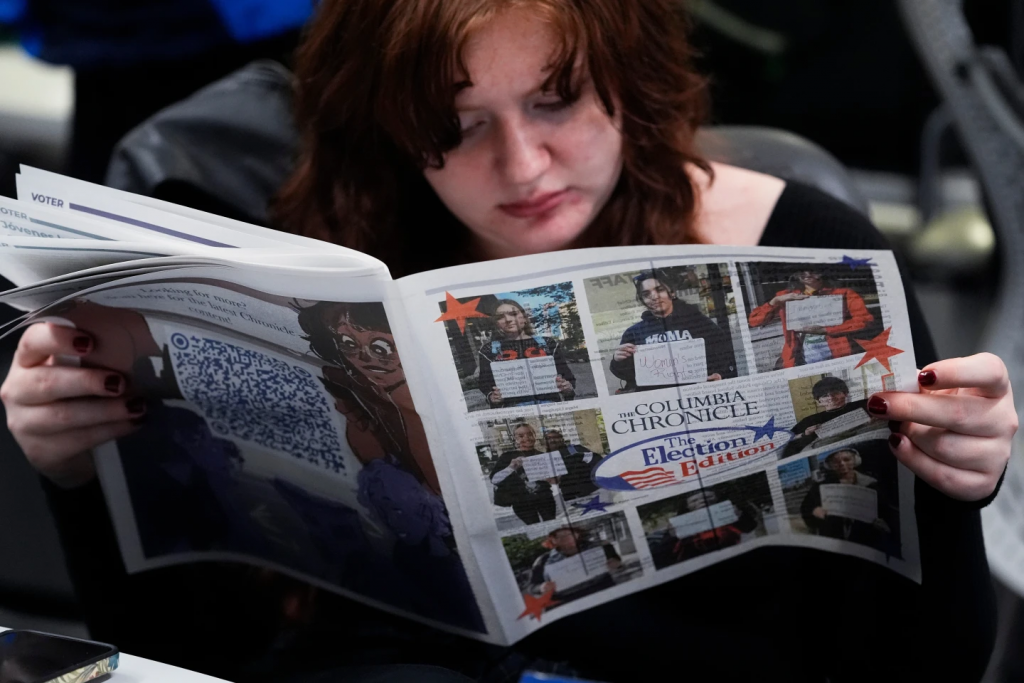
A lost generation of news consumers? Survey shows how teenagers dislike the news media

(AP Photo/Nam Y. Huh, File)

Dave Bauder stands for a portrait at the New York headquarters of The Associated Press on Tuesday, Aug. 23, 2022. (AP Photo/Patrick Sison)

By  DAVID BAUDER Updated December 1, 2025 (APNews.com)

NEW YORK (AP) — Cat Murphy, a college student, has wanted to be a journalist since she was 11. Many of her friends don’t understand why.

When they engage with the news — if they do — they hear a cacophony of voices. They don’t know who to believe. Reporters are biased. They make mistakes. Besides, why would you hitch your future to a dying industry?

“There is a lot of commentary — ‘Oh, good for you. Look what you’re walking into. You’re going to be screaming into the void. You’re going to be useless,’” said Murphy, a 21-year-old graduate student at the University of Maryland’s journalism school.

She is undeterred. And it’s also why she’s not surprised by the findings of a study this fall that documented negative attitudes toward the news media among 13- to 18-year-old Americans. The press rarely fares well in surveys of adults, but it’s sobering to see the same disdain among people whose opinions about the world are still forming.

Words to describe the news media today

Asked by the News Literacy Project for one word to describe today’s news media, 84% of teens responded with something negative — “biased,” “crazy,” “boring,” “fake, ”bad,” “depressing,” “confusing,” “scary.”

About half of the teens surveyed believe journalists give advertisers special treatment, make up details such as quotes, or pay or do favors for sources “always or almost always” or “often,” and about 6 in 10 say journalists regularly take photos and videos out of context. About one-third or less believe that reporters correct errors when they happen, confirm facts before reporting them, gather information from multiple sources or cover stories that help protect the public interest at least “often” — practices ingrained in the DNA of reputable journalists.

To some degree, teens reflect the attitudes they’re exposed to, particularly when the most prominent politician of their age has made “fake news” a mantra. Experts say few teens follow news regularly or learn in school about the purpose of journalism.

Journalists don’t help themselves with mistakes or ethical lapses that make headlines. Opinionated reporters or commentators in an era of political division make readers wonder what to believe.

“Some of this (attitude) is earned, but much of it is based on misperception,” said Peter Adams, senior vice president of research and design for the Washington-based News Literacy Project.

Never picking up the news habit

There are ways to turn things around, but it will take work.

Many of Lily Ogburn’s classmates get their information from social media. Their parents didn’t watch or read news reports as they grew up, so they didn’t pick up the habit, said Ogburn, a senior at Northwestern University’s journalism school.

Ogburn is the former editor-in-chief at the well-regarded Daily Northwestern student newspaper. The newspaper’s 2023 reports on alleged hazing and racism within the school’s football program led to the ouster of its coach. Still, she found some students don’t understand the newspaper’s role; they believe it exists to protect people in power rather than hold them accountable.

She frequently had to explain what she did to classmates. “There’s a lot of mistrust toward journalists,” she said. But it has firmed her resolve to stick with the profession.

“I want to be a journalist that people trust,” Ogburn said, “and I want to report news that makes people believe and trust in the media.”

The news industry’s financial troubles over the past two decades have hollowed out newsrooms and left fewer journalists on duty. Along with not seeing much legitimate journalism, young people frequently don’t experience it through popular culture — unlike a previous generation, which learned in detail how Washington Post reporters Robert Woodward and Carl Bernstein exposed the Watergate scandal in the Academy Award-winning movie “All the President’s Men.”

When the News Literacy Project asked, two-thirds of teens couldn’t think of anything when asked what movies or TV shows come to mind when they think about journalism. Those who had answers most frequently cited the “Spider-Man” franchise or the movie “Anchorman: The Legend of Ron Burgundy.” Neither portrayal was particularly flattering.

Upon retiring as editor of Newsday, Howard Schneider helped develop the State University of New York system’s first School of Journalism. But instead of teaching future writers, editors or producers, he became drawn to teaching non-journalists about being news consumers.

Now the executive director of SUNY Stony Brook’s Center for News Literacy, Schneider wasn’t surprised about any of the recent survey’s findings, either.

“The negativity, the feeling that news is biased, is just a reflection of how their parents feel,” Schneider said. “The more exposed to news, legitimate news, the more their attitudes turn positive.”

He has developed news literacy programs for school districts. “Students will say, ‘I get my news from YouTube,’” he said. “I say, ‘No, you don’t,’” and explains where the news originates and how to be discerning about what they see.

Lessons from a news literacy class

That’s one of the lessons that 16-year-old Brianne Boyack has taken from her course in news literacy at Brighton High School in Cottonwood Heights, Utah. She had little trust in news going in, but has learned the importance of double-checking sources when she sees something interesting and seeking outlets she’s found reliable.

Her classmate, Rhett MacFarlane, applied what he learned in class to investigate when a friend told him the Louvre was robbed in Paris.

“I’ve learned that there is definitely fact-checking (in journalism),” MacFarlane, also 16, told The Associated Press. “You guys are professionals and you have to tell the truth or you’d be fired. I thought you guys just did whatever you wanted and chose what to say about a topic.”

Still, news literacy programs in schools are relatively rare. Schools already have a lot of subjects to cover to prepare students for the future. And, remember, journalists don’t have the best reputations. It can be hard for educators to stick their necks out for them.

“There’s an inertia here,” Schneider said, “and this is an urgent issue.”

At the University of Maryland, Murphy said she didn’t think there was an inherent hatred toward journalists among her fellow students. “They don’t have any experience reading journalism,” she said.

That’s where she sees the journalism industry needing to make more of an effort. One of the things she finds most frustrating about her chosen field is a resistance to change, particularly an unwillingness or inability to make meaningful use of social media.

“There’s very little movement in the direction of going to where people are, as opposed to expecting them to come to where you are,” Murphy said. “The only way to turn it around is going to be to switch to doing things that captivate people today, as opposed to captivating people 20 years ago.”

___

David Bauder writes about the intersection of media and entertainment for the AP. Follow him at http://x.com/dbauder and https://bsky.app/profile/dbauder.bsky.social

DAVID BAUDER

DAVID BAUDER

Bauder is the AP’s national media writer, covering the intersection of news, politics and entertainment. He is based in New York.
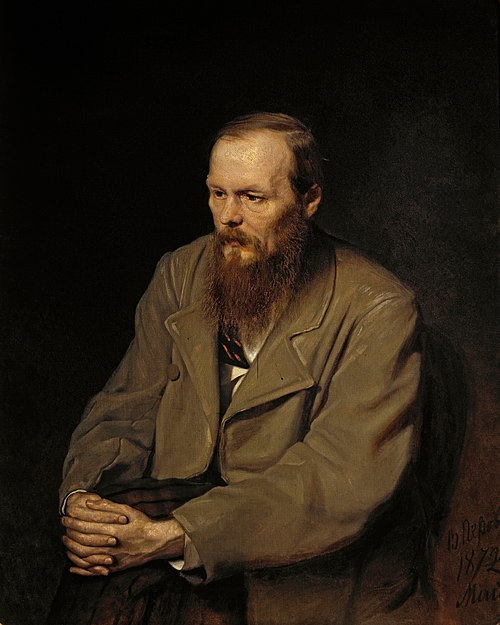
Dostoyevsky on consciousness in mind and heart

Portrait by Vasily Perov, c. 1872

“Although your mind works, your heart is darkened with depravity; and without a pure heart there can be no complete and true consciousness”

~ Dostoyevsky

Russian novelist (October 30, 1821 – February 9, 1881), short story writer, essayist and journalist. He is regarded as one of the greatest novelists in both Russian and world literature, and many of his works are considered highly influential masterpieces. Wikipedia

Why do you write in the midst of a genocide?

I know my poem won’t / prevent the next bomb / won’t even save itself / from choking under the rubble.

Basman Derawi

  • November 18, 2025 (wearenotnumbers.org)

A young bearded man in a medical shirt, in profile by a window.

Abed El Hameed (Abood). Photo: Basman Derawi

I know my poem won’t
prevent the next bomb,
won’t even save itself,
from choking under the rubble.
So why do I write in the midst of a genocide?

Every time I ask myself this question,
the words of Nour Aldeen Hajjaj,
a young poet killed by Israeli missiles
that bombed his neighborhood
 of Al-Shuja’iya in December 2023,
echo in the space, penetrate to my soul:
“I do not consent to my death being passing news.”

I hear the voice of Dr. Refaat Alareer, reciting,
“If I must die,
you must live
to tell my story.”

I see the smiles of Essa and Ouda
enjoying our last tasha* on Gaza’s beach
when Essa beat Ouda again at cards
then we all enjoyed spicy grilled chicken,
its citrusy sumac flavor, while discussing
our dreams of studying for our Master’s
degree together, and traveling to Spain
to watch a soccer game live without having  
to stress our bladders during a long
exhausting circuitous journey.

I think of my friend, Abed El Hameed,
who I used to call Abood,
killed recently while going
to his job as a physiotherapist at
Médecins Sans Frontières in Deir Al Balah,
the so-called safe zone.
In addition to physiotherapy,
Abood was obsessed with history,
especially the history of Gaza,
its historical monuments,
like the Great Omari Mosque,
the Church of Saint Porphyrius,
Qasr al-Basha, that the occupier
has been hungry to erase.

I tell you the age of Eliaa, my nephew.
If the most moral army in the world
had let him live until next June,
when he would have turned four,
he could have told you himself.

I don’t write to humanize Essa, Ouda,
Nour, Refaat, Eliaa and Abood,
all passionate, resilient, caring human beings.
I write to prepare myself for our meeting.

*Tasha is when friends hang out together, enjoy their time, and have fun.

Editor’s note: Essa Fayez Essa and Ouda Al Haw are also commemorated in another of Basman’s poems, We will beat you next time. The full statement of Noor Aldeen Hajjaj is found at Passages through Genocide.

Connection between deserve and dessert

  • Google AI Overview

The words 

“deserve” and “dessert” are connected through a common French root and an old noun form of the verb “to deserve,” called “desert”. While they sound identical in the phrase “just deserts” (meaning what one has earned or what is rightfully due), the confusion comes from the similar spelling to the sweet food item, “dessert”

Shared origin

  • Both words ultimately derive from the Old French word deservir, meaning “to serve well”.
  • From this root, the verb “to deserve” (to earn or merit) came into English, while a related noun form also emerged. 

The phrase “just deserts”

  • The correct spelling for the phrase meaning “what one deserves” is “just deserts,” pronounced like “desserts”.
  • “Desert” in this case is the archaic noun form of the verb “to deserve”.
  • It can refer to either a reward or a punishment.
  • The confusion arises because the pronunciation is identical to the food item “dessert,” which also comes from a French root (desservir) meaning “to clear the table”. 

Modern usage

  • While the noun “desert” is rarely used today except in the phrase “just deserts,” the verb “deserve” remains common.
  • Many people incorrectly write “just desserts” because it makes intuitive sense to them, linking deserved punishment or reward with a literal sweet treat. 

France will investigate Musk’s Grok chatbot after Holocaust denial claims

Elon Musk listens as President Donald Trump speaks during a news conference in the Oval Office of the White House, May 30, 2025, in Washington. (AP Photo/Evan Vucci, File)

By  THOMAS ADAMSON, November 21, 2025 (APNews.com)

Leer en español

PARIS (AP) — France’s government is taking action against billionaire Elon Musk ‘s artificial intelligence chatbot Grok after it generated French-language posts that questioned the use of gas chambers at Auschwitz, officials said.

Grok, built by Musk’s company xAI and integrated into his social media platform X, wrote in a widely shared post in French that gas chambers at the Auschwitz-Birkenau death camp were designed for “disinfection with Zyklon B against typhus” rather than for mass murder — language long associated with Holocaust denial.

The Auschwitz Memorial highlighted the exchange on X, saying that the response distorted historical fact and violated the platform’s rules.

In later posts on its X account, the chatbot acknowledged that its earlier reply to an X user was wrong, said it had been deleted and pointed to historical evidence that Auschwitz’s gas chambers using Zyklon B were used to murder more than 1 million people. The follow-ups were not accompanied by any clarification from X.

In tests run by The Associated Press on Friday, its responses to questions about Auschwitz appeared to give historically accurate information.

Related Stories

Elon Musk launches Grokipedia to compete with online encyclopedia Wikipedia

Elon Musk launches Grokipedia to compete with online encyclopedia Wikipedia

Francia investigará al chatbot Grok de Musk por supuesta negación del Holocausto

Francia investigará al chatbot Grok de Musk por supuesta negación del Holocausto

President Donald Trump speaks with Elon Musk and Nvidia CEO Jensen Huang, during the Saudi Investment Forum at the Kennedy Center, Wednesday, Nov. 19, 2025, in Washington. (AP Photo/Evan Vucci)

Trump’s economy depends on AI for growth, a reality made clear in Saudi crown prince’s US visit

Grok has a history of making antisemitic comments. Earlier this year, Musk’s company took down posts from the chatbot that appeared to praise Adolf Hitler after complaints about antisemitic content.

The Paris prosecutor’s office confirmed to The Associated Press on Friday that the Holocaust-denial comments have been added to an existing cybercrime investigation into X. The case was opened earlier this year after French officials raised concerns that the platform’s algorithm could be used for foreign interference.

Prosecutors said that Grok’s remarks are now part of the investigation, and that “the functioning of the AI will be examined.”

France has one of Europe’s toughest Holocaust denial laws. Contesting the reality or genocidal nature of Nazi crimes can be prosecuted as a crime, alongside other forms of incitement to racial hatred.

Several French ministers, including Industry Minister Roland Lescure, have also reported Grok’s posts to the Paris prosecutor under a provision that requires public officials to flag possible crimes. In a government statement, they described the AI-generated content as “manifestly illicit,” saying it could amount to racially motivated defamation and the denial of crimes against humanity.

French authorities referred the posts to a national police platform for illegal online content and alerted France’s digital regulator over suspected breaches of the European Union’s Digital Services Act.

The case adds to pressure from Brussels. This week, the European Commission, the EU’s executive branch, said that the bloc is in contact with X about Grok and called some of the chatbot’s output “appalling,” saying it runs against Europe’s fundamental rights and values.

Two French rights groups, the Ligue des droits de l’Homme and SOS Racisme, have filed a criminal complaint accusing Grok and X of contesting crimes against humanity.

X and its AI unit, xAI, did not immediately respond to requests for comment.

THOMAS ADAMSON

THOMAS ADAMSON

Adamson is a foreign reporter based in Paris for The Associated Press. He covers European politics, culture and style. He has reported across the continent in an over two-decade career.