“True teachers are called into being by the contradictions generated by civilization,” the poet Gary Snyder reflected in his reckoning with the real work of life. “We need them.”
We have always needed them because we need each other, because we have always been each other’s teachers. Ever since one human being watched another rub wood and flint into fire, we have taught each other how to use our hands and how to use our minds, how to wield our tools at the world and our theories of living at the predicament of being alive. Social learning — this jungle gym for training the plasticity of being we call adaptation — may be the lever by which we lifted ourselves up from the flatland of survival to the mountain of civilization, the key that liberated us from the prison of our destiny as predators to become poets.
And yet social learning is not unique to the human animal, not even to the so-called higher animals. (“Never say higher or lower,” Darwin argued in the margin of a book he was reading. “Say more complicated.”) It may even be most interesting — because it reveals reaches of reality alien to us — in minds that are most unlike ours.
Few minds are more other than that of the caracara — the planet’s southernmost bird of prey and one of the rarest, about as few of them alive as there are giant pandas.
1775 watercolor of a caracara by Georg Forster from James Cook’s second voyage under 2025 images of the Triffid and Lagoon nebulae from the Vera Rubin Observatory. Available as a print and a greeting card.
Unless you live south of the Rio Grande, chances are you’ve never even heard of caracaras. But if you try to imagine ten separate attempts to build a crow on a falcon chassis, with results falling somewhere between elegant, menacing, and whimsical, you wouldn’t be far off. A few species are drab and inconspicuous, but most are boldly patterned in black and white, with red or yellow skin on their faces and legs. Some are nearly as small as magpies; others are as large as ravens. All have broad wings, hooked beaks, and an alert, curious expression, and they live in every part of their supremely varied continent, from the arid peaks of the Andes to the steaming forests of the Amazon basin.
Their most striking qualities, however, are their minds. Unlike most birds of prey, caracaras are social and curious, and they feed with gusto on foods other predators disdain… In the high Andes, a species whose feathers adorned the heads of Inca emperors has been seen working in teams to uncover lizards and insects by flipping heavy rocks, and the crested caracaras who unnerved Darwin in Patagonia are said to spread wildfires by dropping burning sticks in dry grass, and feasting on the ensuing stream of refugees.
[…]
[Caracaras] have surprising and important stories to tell us: about the history of life, about the hidden worlds of their grand and mysterious continent, about how evolution can fashion a mind like ours from different materials. They might even offer us some advice about surviving in a world primed for an upheaval.
Among the three extant species of caracaras — striated, crested, and chimango — the chimangos (Milvago chimango) astonish with their feats of what we readily recognize as intelligence (like the use of memory in the service of planning and the use of tools in the service of executing plans) and what is more subtly so (like the capacity for deep play and the capacity for boredom). Reflecting on his encounter with two especially intelligent chimangos and their human companions, Meiburg draws on the science of how cells become selves to consider the surprising understanding between them despite the divergent development of our two kinds of brains:
As you grew inside your mother’s womb, drawing nutrients through your umbilical cord, your folded neocortex grew from the lower surface of your fetal forebrain. Tina’s equivalent structure, a smooth bulb called a pallium, grew from the upper surface of hers, as she slowly absorbed the yolk of her hard-shelled egg. But though the structures of the neocortex and the pallium are distinct, their functions are alike: Geoff and Tina, like Hudson and Polly, could understand each other because their parallel journeys had led them to the same place.
The interesting question, the irresistible question, is why markers of intelligence like curiosity and innovation can clearly develop independently in different lineages, yet have not developed in every branch of the tree of life — why can’t mayflies solve mazes and snails perpetrate revenge? Meiburg argues that social learning, and the plasticity of being it implies, may be the key:
One factor that seems especially important in the evolution of what we call intelligence is a habitat in which the distribution, type, and availability of food is inherently unpredictable. Any animal that finds itself in this situation can’t afford to rely on pure routine or rote behaviors; it needs to be observant and curious enough to find new sources of food, even if it’s never seen them before.
[…]
This is where social learning is especially helpful. If you can learn from the example of your peers, you can reap the benefits of their successes and failures in your own lifetime, without waiting for natural selection to do its slow work on your gene pool. But keeping track of so many details — the individual personalities and relationships of other members of your social group, the locations of many different food sources, and the places you might have hidden food to eat later — requires a larger, more flexible brain. It’s also the kind of life that you’d expect to favor generalists over specialists. Indeed, nearly all the animals we regard as intelligent — baboons, crows, raccoons, caracaras, humans — are big-brained social generalists that thrive in unpredictable environments.
This, indeed, may be what makes an intelligent creature in the deepest sense — a teachable generalist capable of teaching, a social animal endowed with the behavioral plasticity and “negative capability” necessary for embracing the inherent uncertainty of this brief embodiment.
Steps are events, experiments, miniature rebellions against gravity and chance. With each step, we fall and then we catch ourselves, we choose to go one way and not another. The foot falls and worlds of possibility rise in its shadow. Every step remaps the psychogeography of the walker. Every step in space is also a step in time, slicing through the twilight between the half-fathomed past and the unfathomed future — a verse in the poetry of prospection. We walk the world to discover it and in the process discover ourselves.
Craig Mod was nineteen when he moved from small-town America to Japan’s majestic Kii Peninsula and began walking, only to find himself face to face with the questions he had tried to leave behind — what it means to forgive, what it takes to constellate a family beyond biology, how to live with the ghosts that haunt the history of the heart and the history of the world. These questions quiver alive in Things Become Other Things (public library) — part memoir of the search for belonging, part love letter to his childhood best friend, who “bled out on a dirt yard under the stars” when the boys were teenagers, part record of alchemizing loss into a largeness of being by learning “to walk, and walk well, and witness the people along the way.”
Craig considers the primal nature of “this simple impulse to traverse dirt, to push on the edges of what’s known to us,” the strangeness of being impelled “to walk and walk alone and do so for days and weeks and months at a time”:
I’ve come to crave the solitude and asceticism of these solo walks. There is no quieter place on earth than the third hour of a good long day of walking. It’s alone in this space, this walk-induced hypnosis, that the mind is finally able to receive the strange gifts and charities of the world.
I’ve come to realize the only true walk is the re-walk. You cannot know a place without returning. And even then, once isn’t enough. That’s why I’m back. Back on the Peninsula. Walking these roads I’ve walked before. It’s only through time and distance and effort — concerted, present effort, controlled attention, a gentle and steady gaze upon it all — that you begin to understand old connections, old wounds. That the shape of once-dark paths becomes clear.
Over and over he confronts the old wound of his origins — carried by “someone nameless, faceless, someone pregnant at thirteen,” raised by a mother whose husband left her shortly after the adoption to become a halfway father flitting in and out of Craig’s childhood, too absent to be a parent, too present to be a stranger. Looking back on the longing to break free from his addiction to anger and blame, Craig writes:
How could I be sure I was free? So I walked. I walk. I walk and I walk and I walk and feel the air of our town leave my cells and be replaced by the air and ideas of a different time and place. The more I breathe this Peninsula air, the more I realize that it would have been so easy to have elevated my father as a child. This shocks me, the first time I feel this on the road: the space in my heart for forgiveness — forgiveness! The moment I felt that was like getting hit in the head with a basketball — a freakish pang, a dull ache in the skull. I almost fell into a bush. I was hyperventilating — realizing my heart had expanded in some immeasurable, beyond-physics way that hearts can expand, and in that expansion I had new space. There’s a word in Japanese that sums up this feeling better than anything in English: yoyū. A word that somehow means: the excess provided when surrounded by a generous abundance. It can be applied to hearts, wallets, Sunday afternoons, and more… This extra space, this yoyū, this abundance… carried with it patience and — gasp — maybe even… love?
Rising from the pages is a prayer for abundance against the backdrop of all that is taken away, an insistence on the possibility of finding beauty amid the ruins of our hopes. As he walks, Craig encounters “moss lush enough to lie down on naked and wilt in reverence”; he watches mountain crabs move like Claymation as they emerge from the wet forest at sunrise “as if birthed by the light of day”; he comes face to face with the unblinking kamoshika — the Japanese goat-like antelope, exuding “an aura of magic in how fast and sure-footed it is,” this most alien and holiest of forest animals; he feels the primal consolation of his own animal nature, this biped whose peripatetic balance has been honed by myriad exquisite evolutionary adaptations, tiny structures shaped over eons to do one thing perfectly, elaborate chemistries mixed in the cauldron of time to translate the laws of physics into flesh:
I think about how a walk begins, with balance, in the ear, vestibular, a few feet above the earth… Endolymph, a potassium-heavy fluid, oozes inside the so-called bony and membranous labyrinthine canals of the inner ear…. inside [which] gelatinous bulbs called cupula, attached to stereocilia, detect the sloshing of our endolymph. The body moves, the endolymph splashes, heeds the laws of gravity. The stereocilia bend and transmit details of the bend — how far, how quickly, which orientation — to the cerebellum, the brain-nugget secreted at the back of the noggin. The cerebellum decodes the signals, translates, makes a follow-up microsecond game plan.
The great reward is that each step can be such a cosmos of complexity and at the same time lead to such simple, elemental truths. Having distilled the core tenet of a good walk to “real-time observation of unfiltered life,” having observed the core tenet of life in the Kii Peninsula — “a pervasive care throughout generations, a sense of knowing your happiness and health are intertwingled with those of your neighbor” — Craig captures an evanescent moment shimmering with the eternal:
Silent morning, abundant sunlight, abundant life. Thinking about this care. Water in the fields rippling in the wind. Mountains of Kii all around, a silent sloshing in my head, keeping the sky up and the ground down.
Autumn Moon over Tama River by Utagawa Hiroshige, 1838. (Available as a print and a postcard.)
Traversing these enchanted landscapes via historic routes and backroads, passing through small towns vanishing before his eyes with depopulation, staying in thousand-year-old temples, he meets and walks with people who end up becoming family — father-figures, brother-figures, elderly innkeepers who put the hardest truths in simple words annealed in the hearth of living. One tells him of the young woman who wandered in years earlier looking for work and turned into a daughter. “Time passes, life moves, and that’s what happens,” the old man tells him. “Things become… other things.” Looking back on half a lifetime of walking his own way to belonging, Craig reflects:
Somehow as an adult I’ve managed to attract and surround myself with these people, these beacons of good… I love them so much that my bones ache — ache because I know I’ll lose them someday. I will follow them anywhere. Together we walk in the near-frozen morning air and the sun rises. Light works its way across the rippling peaks of the Peninsula. Feeling returns to hands, to feet, to hearts. The mind moves once again. We carry our lives on our backs and traverse the spine of the world, no humans for miles, no routes down, just forward or back, the beast below always shifting, always ready to heave us off.
Mount Fuji by Herbert Geddes, 1910. (Available as a print.)
It must be encoded there, in the childhood memories of our synapses and our cells — how we came out of the ocean 35 trillion yesterdays ago, small and slippery, gills trembling with the shock of air, fins budding feet, limbs growing sinewy and furred, then unfurred, spine unfurling beneath the bone cave housing three pounds of pink flesh laced with one hundred trillion synapses that still sing with pleasure and awe when touched by the wildness of the world.
Even as the merchants of silicon and code try to render us disembodied intellects caged behind screens, something in our animal body knows where we came from and where we belong.
Gibbons from from Natural History and Illustrations of Mammals by Heinrich Rudolf Schinz, 1824. (Available as a print and a greeting card.)
“Our origins are of the earth,” Rachel Carson wrote. “And so there is in us a deeply seated response to the natural universe, which is part of our humanity.” A century before her, William Henry Hudson (August 4, 1841–August 18, 1922) — another of humanity’s great writers devoted to rewilding the human spirit — captured the essence of what science now calls “soft fascination”: the way our brains and bodies respond when we immerse ourselves in the natural world. In a passage from his altogether wonderful 1893 book Idle Days in Patagonia (public domain), Hudson writes:
What has truly entered our soul and become psychical is our environment — that wild nature in which and to which we were born at an inconceivably remote period, and which made us what we are. It is true that we are eminently adaptive, that we have created, and exist in some sort of harmony with new conditions, widely different from those to which we were originally adapted; but the old harmony was infinitely more perfect than the new, and if there be such a thing as historical memory in us, it is not strange that the sweetest moment in any life, pleasant or dreary, should be when Nature draws near to it, and, taking up her neglected instrument, plays a fragment of some ancient melody, long unheard on the earth… Nature has at times this peculiar effect on us, restoring instantaneously the old vanished harmony between organism and environment.
At the end of his life, looking back on how becoming “a better observer” made him “a happier creature,” Hudson writes in his wonderful Book of a Naturalist (public domain):
The power, beauty, and grace of the wild creature, its perfect harmony in nature, the exquisite correspondence between organism, form and faculties, and the environment, with the plasticity and intelligence for the readjustment of the vital machinery, daily, hourly, momentarily, to meet all changes in the conditions, all contingencies; and thus, amidst perpetual mutations and conflict with hostile and destructive forces, to perpetuate a form, a type, a species for thousands and millions of years! … [One feels] the wonderfulness and eternal mystery of life itself; this formative, informing energy — this flame that burns in and shines through the case, the habit, which in lighting another dies, and albeit dying yet endures for ever; and the sense, too, that this flame of life was one, and of my kinship with it in all its appearances, in all organic shapes, however different from the human… the roe-deer, the leopard and wild horse, the swallow cleaving the air, the butterfly toying with a flower, and the dragon-fly dreaming on the river; the monster whale, the silver flying-fish, and the nautilus with rose and purple tinted sails spread to the wind.
Tuning into this primal resonance between us and the rest of nature is the mightiest act of unselfing I know — a vital quieting of our ruminative self-reference that is the dynamo of most of our suffering. Perhaps to be a happier creature means simply to be more of a creature — a life-form among life-forms, alive only because countless other creatures died along the way to perfect this form in a world that didn’t have to be beautiful, didn’t even have to exist.
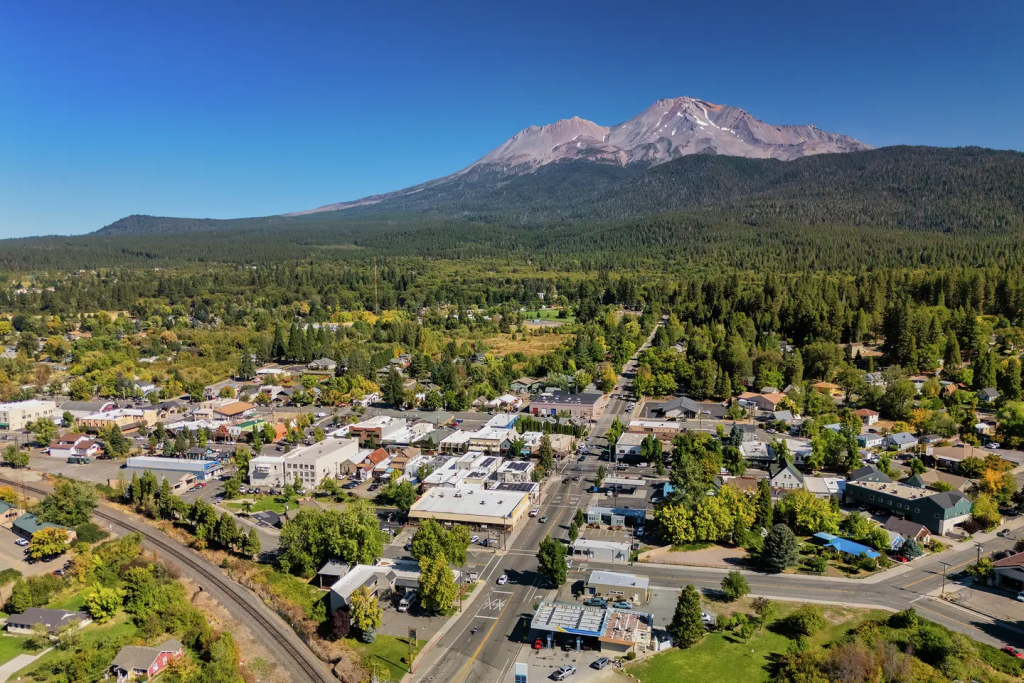
Near the end of summer 2019, David Henderson went out to celebrate his 21st birthday with friends. They spent the night in Mount Shasta, California, beneath the quiet mass of the roughly 14,000-foot volcano that looms over the town.
At one point, Henderson said, they “decided to take a walk in the park.”
Mount Shasta City Park is no pocket park. Its trails wind through meadows and pine forests. Two public lodges — and a building called the Dance Hall — look like Western film set pieces. The 26-acre park carries a kind of gravity.
It was here, in the middle of the night, that Henderson stumbled onto something unforgettable.
Henderson had “wandered off a bit from my friends,” he recounted to SFGATE, eventually finding himself off the park’s main path. He paused, noticing how quiet it had become. Then, out of the dark, two strange figures emerged. Tall. Gaunt. Arms outstretched. When they finally came into focus, things only got weirder.
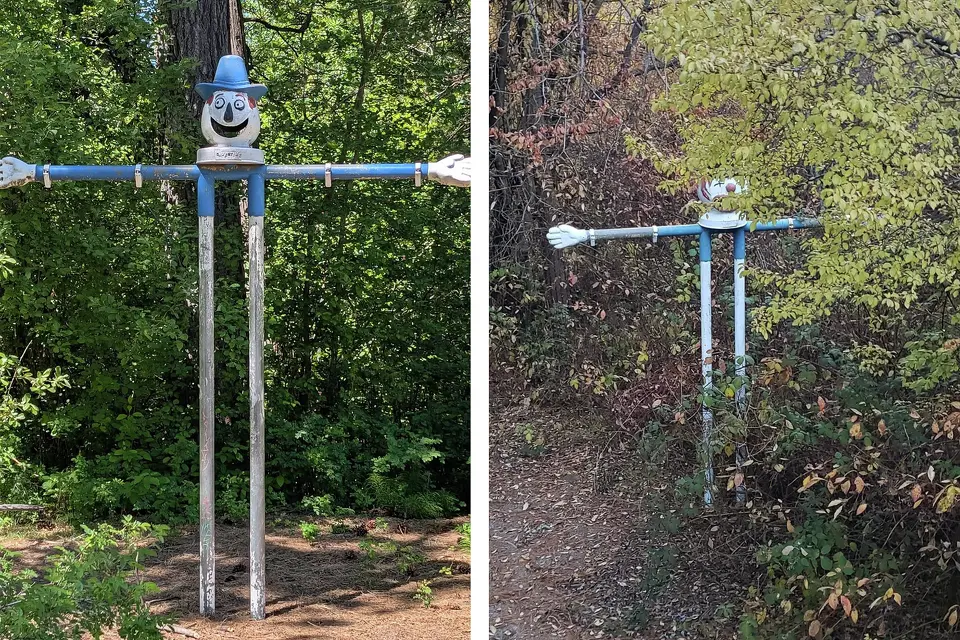
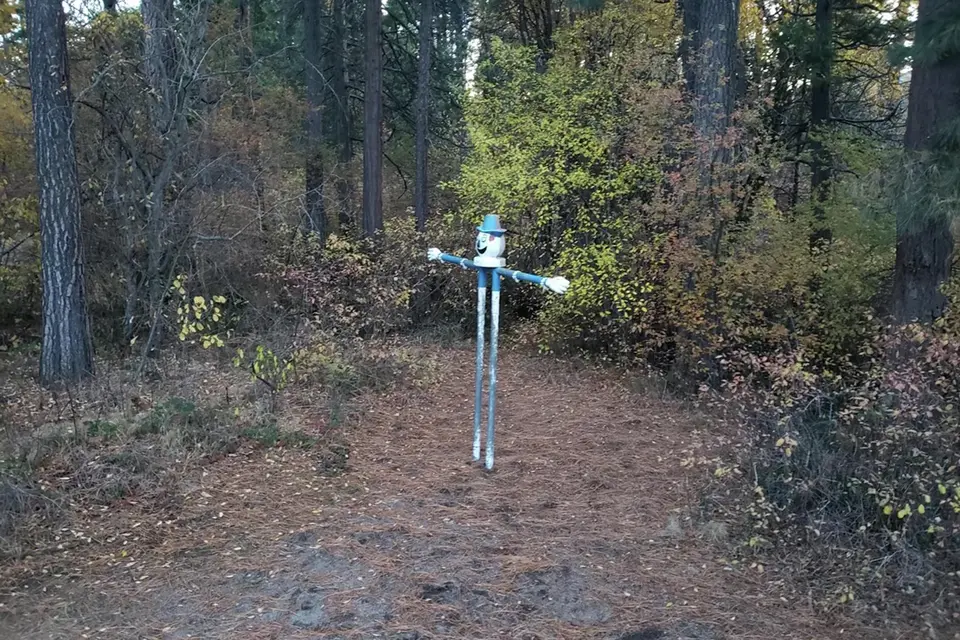
Henderson had discovered long-abandoned play structures: one with a clown head, its eyes x-ed out; the other, a confused scarecrow. “Things felt pretty ominous when I spotted them,” he told SFGATE. After he realized he was safe — just unsettled — he returned to his friends, but not before collecting some evidence.
On the left, the scarecrow swing glows in the sun; on the right, the clown swing with x-ed out eyes sits shrouded in foliage, its atmosphere far gloomier.Courtesy of Nichole Solga Smith/Reddit User
“I had to take a picture because I wasn’t sure my friends would believe me if I said there were clowns lurking in the bushes,” he said. He fired off a quick Snapchat with an appropriate caption: “good god why are these here.”
The towering terrors are parts of old swing sets tucked in the park’s far corner. They are often referred to as the “clown swings” by locals, and older residents remember them as a full-fledged T-frame swing set: two cartoonish heads mounted and centered on the structure, with arms outstretched with strange, white and mittened approximations of hands. Chains once hung from those arms, holding seats for children to swing in beneath the fixed, frozen faces.
Today, however, the chains are long gone. The frames linger in an overgrown corner of the park — visited less, weathered more and standing as silent sentinels of a forgotten era.
‘A Stephen King novel’
Nichole Solga Smith, 45, sparked a recent online outpouring of memories about the clown swings. In a Facebook post on the “Mount Shasta History: If the mountain could talk” page, she wrote, “How old are the scary clown swings at Mt Shasta City Park and were they always meant to be kinda spooky? What’s the backstory there? I remember them feeling old when I was young.”
She told SFGATE that she was inspired to ask online about the clowns after revisiting the park with her daughter during a school field trip. “I was feeling very [nostalgic],” she wrote to SFGATE, describing how she “grew up playing in that park” and remembered how the “clowns were always around” with their swings.
Seeing them again with her daughter, she wrote, “The clowns must have a backstory; they’re just too unique.”
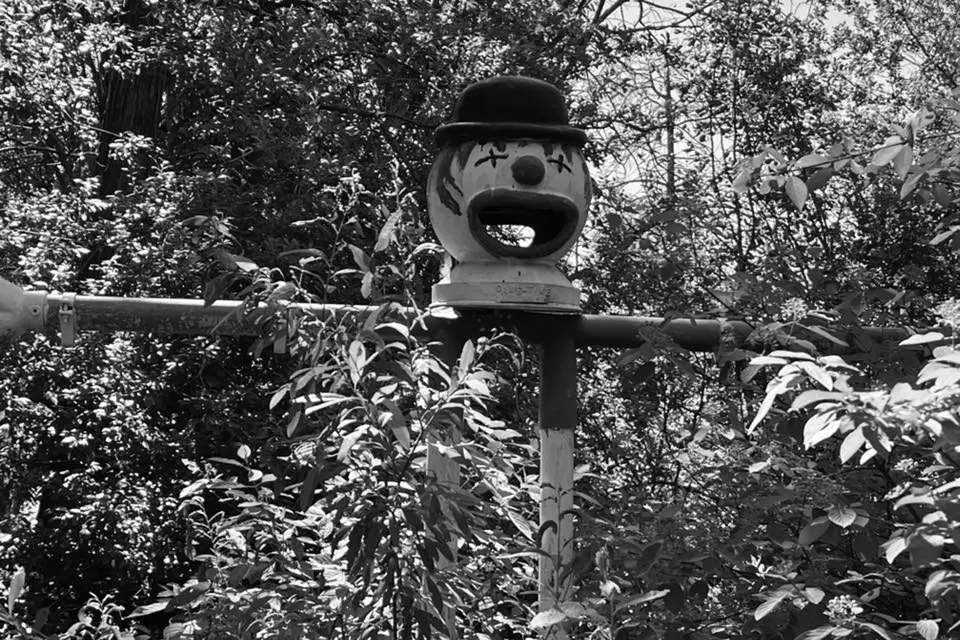
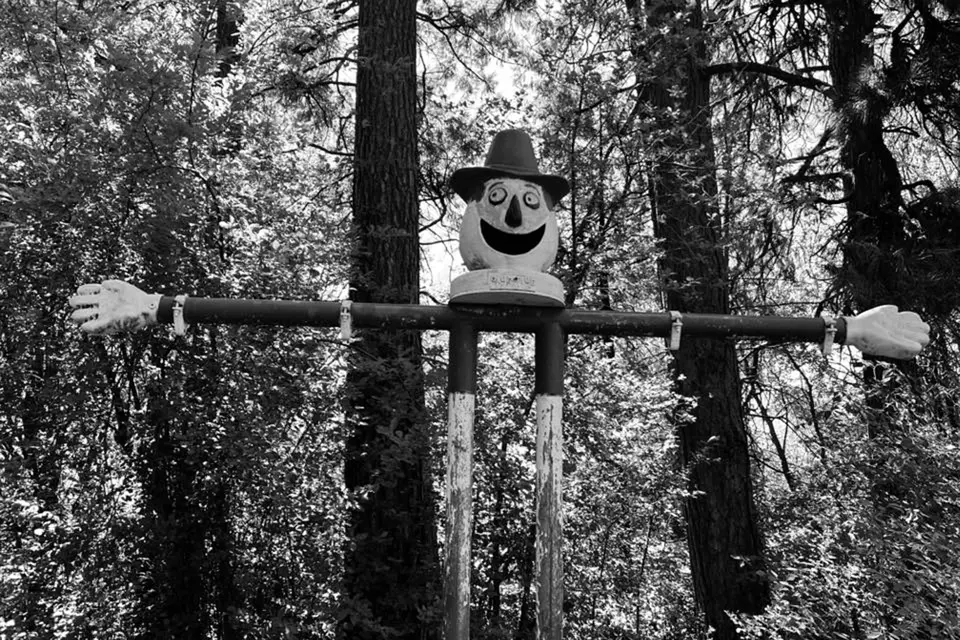
Bill Craig, 58, a Mount Shasta native, responded to Smith’s post by sharing two black-and-white photos of the clown swings with the community. He went down memory lane with SFGATE, describing how he and his fellow Gen X kids got the full brunt of playground designs prior to safety regulations. He recalled a “merry-go-round that was like scalding hot metal” and that “burned off 12 layers of your skin,” as well as “these little horses on a spring where, you know, you just beat yourself up on them.” Off to the side, always watching, “there were two different clown swing sets.”
In black and white, the clown’s x-ed out eyes stare from the shadows, dark foliage closing in to deepen the gloomy atmosphere. Courtesy of Bill Craig
As a kid, he “didn’t even give it a second thought.” Beneath those cartoonish heads, he said, “You just go and you play on the swing set.” But he’s since come to realize their presence is rather alarming.
Craig returned to the park years later and saw how the clown swings had become “really dilapidated,” he said. Through the lens of his camera, the scene shifted: “All of a sudden, it is a Stephen King novel, right?” In his haunting photos, the clown with x-ed out eyes looms lifeless, while the scarecrow’s arms reach into the dark.
“I don’t know the history of it,” Craig said. “I wish I did. I wish I knew how they got there.”
Fortunately, Smith’s Facebook post created a trail of digital breadcrumbs — vague references, obscure catalogs and half-remembered stories — that together sketch out an origin story for the erstwhile swings.
Piecing together the timeline
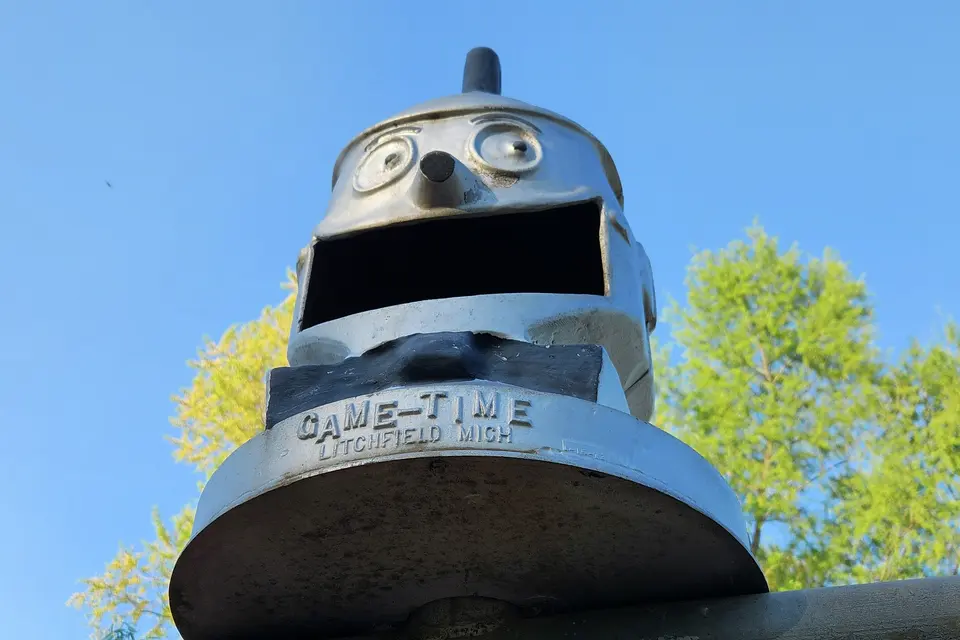
Shannon Shaw, a district administrator with Mount Shasta’s Recreation and Parks District, said the best information she could offer to SFGATE about the structures’ origin was that “they were manufactured by GameTime in Litchfield, Michigan, and seem to have been part of a clown-themed playground equipment and amenities production.”
GameTime began making playground equipment in 1929 in rural Michigan, according to the company’s website. In 1979, GameTime moved to Alabama, later becoming part of Playcore. SFGATE reached out to the company but did not receive a response before the time of publication.
The Mount Shasta Sisson Museum offered up a stronger lead when SFGATE called: Mike Rodriguez, Mount Shasta’s first full-time Recreation and Parks director. Rodriguez started that job in 1973 and lived in a cabin at Mount Shasta City Park. If anyone knew how the swings got there, perhaps it would be him.
In black and white, the scarecrow swing’s outstretched arms cut across the frame, stark against the dark vertical trees rising behind it.Courtesy of Bill Craig
But Rodriguez quickly shut that door. “I don’t know who put them in,” he told SFGATE. “When I arrived in ’73, they were there.”
Still, he remembered how unusual they were. “Very unique back in the early ’70s,” he said.
Later in the interview, Rodriguez noted that the swings “drew a lot of attention over the years, where people would want to go swing down there.”
Eventually, the swings were removed because of safety concerns, he said, as the area became “highly overgrown by the creek, and it wasn’t a real safe area for a playground.”The frames — cartoonish heads and all — were left behind.
Redding resident Noah Everett joined the community’s discussion on the “Mount Shasta History: If the mountain could talk” Facebook page, offering a lead that could help solve the mystery. About 70 miles downstream, in the town of Anderson, three similar GameTime swing sets stand in a riverside park, Everett wrote, but instead of clowns, they feature characters from “The Wizard of Oz”: the Scarecrow, the Tin Man and the Cowardly Lion. In photos provided to SFGATE by Everett, they look to be in far better condition than the swings at Mount Shasta City Park. SFGATE reached out to Anderson’s Parks and Recreation Department to ask about when its GameTime swings were installed but did not receive a response before the time of publication.
About 70 miles south of Mount Shasta, in the town of Anderson, the Tin Man swing — inspired by “The Wizard of Oz” — showcases GameTime’s whimsical design style.Courtesy of Noah Everett
Separately, an SFGATE scouring of the internet turned up a 2017 auction catalog with a listing for “Amusement Park Garbage Can Toppers” — two of them bearing the same clown and scarecrow faces as Mount Shasta’s swings, alongside the Tin Man and Cowardly Lion. The items were dated to around 1950. A blogger who documents vintage playgrounds found a version of the X-eyed clown behind a kitschy roadside stop in Hamer, South Carolina, and dated it to 1971.
If the blogger is right, then the swings likely arrived between 1971 and Rodriguez’s hiring in 1973. Newspaper searches from the era turned up no ribbon cuttings or announcements, but quiet clues appeared. A November 1971 article mentioned a new nature trail and noted that the park “offers a variety of playground equipment.” A map included in that piece marked the playground’s exact location — the same spot where the figures still stand. By May 1972, another article described plans to install “two playgrounds with swings and slides.” A May 1973 tourism ad invited families to spend “a day at Mt. Shasta’s city park with its busy playground.”
The clowns become myth
It seems the clown and scarecrow arrived without fanfare — slipping into the park and into memory before becoming legends. By now, these quiet landmarks have taken on a mythic quality. There’s little documentation, few photos of them and no easily discoverable formal recognition of their existence, yet nearly every local knows them.
In 2016, author Rob Murphy published “Miller’s Park,” a novella loosely based on the Mount Shasta City Park. The clown swings loom large in the text, described at one point as “intrusive and out of place.” The narrator notes that “every kid stayed away from them” and that “the clowns were even positioned like they didn’t belong.”
Photos of the swings have also made it to the r/weird subreddit, where images of the rusting structures racked up hundreds of upvotes. The top comment reads: “That would be horrifying at night.”
From above, the scarecrow swing stands tall and gaunt amid dark foliage in Mount Shasta City Park — a rusting relic of a playground long gone.Courtesy of Reddit User/Courtesy of Reddit user
Shaw, the district administrator with Mount Shasta’s Recreation and Parks District, acknowledged the clown swings’ eerie pull. “It’s interesting how their current out-of-commission state and the overgrowth around them contribute to their mysterious and even unsettling aura,” she wrote in an email to SFGATE. “They certainly do spark a lot of conversation!”
Even those who played beneath them can’t quite shake the feeling. “I can’t quite wrap my head around them ever being not spooky,” said Smith, whose Facebook post sparked a nostalgic reunion for Mount Shastans of a certain age. “The one with the ‘x’s for eyes is especially so.”
Over his roughly five decades running Mount Shasta’s parks, Rodriguez saw the swing sets become more than rusting relics. They endured through seasons, through changes in the town around them, until they were woven into its fibers. To him, the haunting clown and the melancholy scarecrow hold “a little bit of a nostalgia and a little bit of history.”
Matt LaFever has reported on California’s North Coast in print and radio for nearly a decade. A Humboldt State grad and 20-year Emerald Triangle resident, he strives to document the wilderness, wildlife, and wild people who call this place their home. Reach him at matt.lafever@sfgate.com.
This suggests a different model of political leadership and societal organization where humility, collective well-being, and potentially, reciprocal obligations among individuals and the community, played a significant role, rather than the pursuit of individual power or prestige.
The book highlights that such societies were able to achieve complex forms of organization and even monumental constructions without necessarily relying on hierarchical structures or authoritarian rule typically associated with the development of “civilization” in Western thought.
“THESE are the times that try men’s souls. The summer soldier and the sunshine patriot will, in this crisis, shrink from the service of their country; but he that stands by it now, deserves the love and thanks of man and woman. Tyranny, like hell, is not easily conquered; yet we have this consolation with us, that the harder the conflict, the more glorious the triumph. What we obtain too cheap, we esteem too lightly: it is dearness only that gives every thing its value. Heaven knows how to put a proper price upon its goods; and it would be strange indeed if so celestial an article as FREEDOM should not be highly rated”
Thomas Paine (February 9, 1737 – June 8, 1809) was an English-born American Founding Father, French Revolutionary, inventor, political philosopher, and statesman. Wikipedia
Trauma is often seen as something to be hidden, medicated, or overcome. In our culture, we treat it like a malfunction—a deviation from the ideal of happiness and success. But what if trauma is not a curse? What if it’s a doorway?
Across spiritual traditions, mythologies, and even modern psychology, there is a recurring truth: it is through our wounds that we awaken. The pain we carry—when held consciously—becomes the very seed of our transformation. And when we do this healing not only for ourselves, but in service to others, it becomes a sacred act.
Trauma is not the end of the story. It is, quite often, the beginning of our real one.
The Wound That Speaks
Carl Jung called it the “wounded healer” archetype. In myth and in life, it is often the person who has been broken open who becomes the vessel for healing others. Chiron, the ancient Greek centaur, was struck by an incurable wound but used the pain to become a master healer and teacher. Jesus, too, rose with wounds still visible—transfigured, but not untouched.
This is not accidental. There is wisdom in the wound.
In the moment of shattering—whether it’s grief, betrayal, abuse, or loss—something deeper wakes up. Our usual defenses fall away. The ego can no longer maintain control. And into that rupture, something holy can enter.
Trauma strips us down to the raw core of being. And if we have the courage to stay with it—not bypass it with distraction or spiritual clichés—it can become the very ground of awakening.
Science Catches Up
Modern neuroscience and NeuroLinguistic Programming are beginning to affirm what the mystics have always known: trauma changes the brain. But it can also expand it.
In the early aftermath, trauma can produce hypervigilance, flashbacks, and a shattered sense of safety. But under the right conditions—therapy, ritual, deep community—this same experience can lead to what researchers now call post-traumatic growth.
Studies show that people who integrate their trauma often report:
· Greater empathy and compassion for others
· A stronger sense of purpose
· Increased spiritual awareness
· A deeper appreciation of life
The wound becomes a well. But only if we draw from it intentionally.
The Journey Downward
Many spiritual traditions teach a version of the same thing: that real initiation doesn’t take us up, but down. Into the underworld. Into the shadow. Into the grief we’ve avoided for years.
This is not pathology. It is initiation.
Jesus spends 40 days in the wilderness. The Buddha sits under the Bodhi tree facing Mara. In tribal societies, initiates are taken into darkness, into symbolic death, so they may emerge reborn.
Trauma is our modern initiation. It is involuntary, often chaotic, and rarely supported by culture. But its structure is ancient. First comes the rupture. Then the descent. Then the struggle to find meaning. And if we do the work—then, maybe, the rebirth.
But rebirth doesn’t mean erasing the past. It means being transformed by it.
The Social Body
Healing is not only personal. It is also collective.
We live in a traumatized society. We see it in addiction, violence, loneliness, racism, inequality, and ecological destruction. These are not just policy failures—they are the symptoms of a wounded culture.
As my friend Dr. Gabor Maté writes, trauma is not what happens to us; it’s what happens inside us when we are overwhelmed and unsupported. And this is true on a societal scale. Colonization, slavery, genocide, poverty—these collective traumas still live in our nervous systems and institutions. They don’t just go away. They repeat until we remember them consciously, grieve them together, and begin to transmute them.
Healing trauma is spiritual work. But it is also justice work.
When we do our own inner healing, we create the capacity to hold others’ pain without fear or judgment. We become less reactive. Less punitive. More capable of building the kind of communities where others can heal too.
Our personal healing contributes to a field of collective compassion.
Sacred Activism
If you carry trauma, you are not broken. You are initiated. You are being invited into sacred activism—not just to protest injustice, but to embody its opposite. To become a presence of healing in a world built on pain.
This doesn’t mean you need to be fully healed before you serve others. Often, it’s our unhealed parts that help us connect most deeply. They remind us to stay humble, to stay human, to speak from the scar and not just the script.
Jesus didn’t heal from a throne. He healed with his hands, in the dust, alongside the wounded. He met people in their suffering—not to preach doctrine, but to touch them with love. He saw trauma not as failure, but as the very place where grace enters.
We are called to do the same.
The Invitation
Your trauma is not your shame. It’s your testimony.
It holds within it a wisdom that no textbook, no guru, no perfect life could ever teach you. It is your initiation into the depths of being human—and the invitation to become a bridge for others.
In a world that teaches us to numb, to hide, to distract—healing becomes rebellion.
And in a world built on separation, your wound is the key to connection.
So bless the scar. It means you survived. And maybe, just maybe, you’ve been chosen to help someone else find their way home.
“When you can so readily create a world when you dream, why do you believe the impossibility of your creating another world when you are awake?”
~ Wu Hsin
Wu Hsin is a pseudonym of Roy Melvyn. Although Melvyn presents himself as the “translator” of the supposedly lost writings of Wu Hsin, the character is in reality entirely fictional. According to his biography, Wu Hsin was a Chinese sage who lived about one hunMore.
Consciousness, spirituality, biography, sexuality, androgyny, futurism, space, the arts, science, astrology, democracy, humor, books, movies and more


 Unless you live south of the Rio Grande, chances are you’ve never even heard of caracaras. But if you try to imagine ten separate attempts to build a crow on a falcon chassis, with results falling somewhere between elegant, menacing, and whimsical, you wouldn’t be far off. A few species are drab and inconspicuous, but most are boldly patterned in black and white, with red or yellow skin on their faces and legs. Some are nearly as small as magpies; others are as large as ravens. All have broad wings, hooked beaks, and an alert, curious expression, and they live in every part of their supremely varied continent, from the arid peaks of the Andes to the steaming forests of the Amazon basin.