‘We are not a cult’: Alternative California church hits a nerve

The Alien Church is one of many SoCal UFO spiritual groups
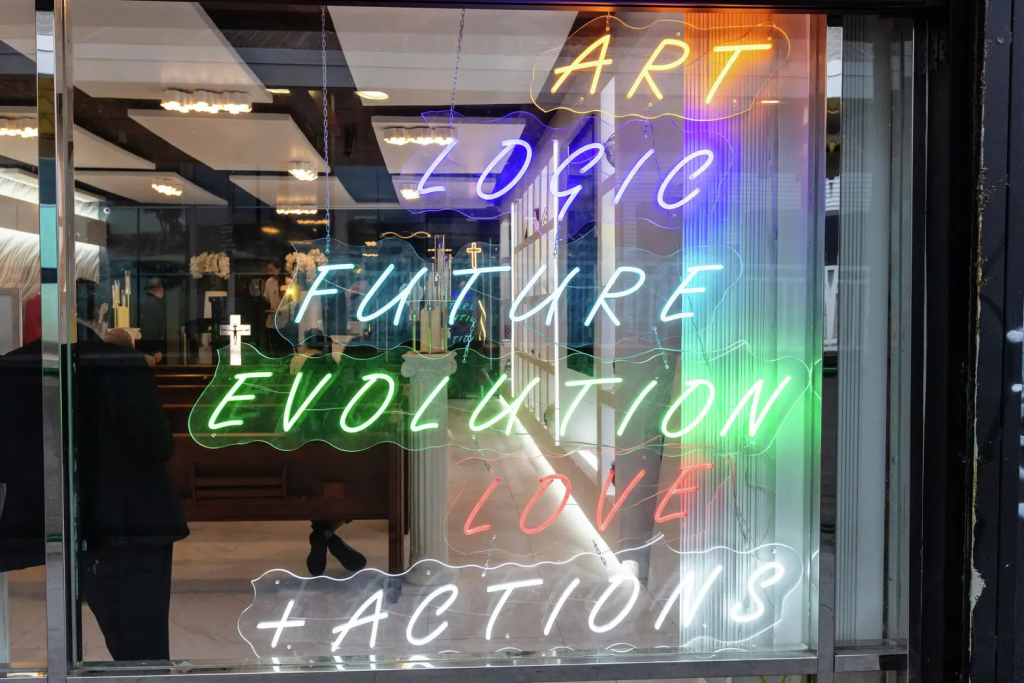
A sign in the window lets curious passersby know what is talked about at the Alien Church, in Downtown Los Angeles on March 31, 2025.Douglas Zimmerman/SFGATE

By Paula Mejía,Contributing LA Culture Editor

Aug 15, 2025 (SFGate.com)

Steps away from a bustling downtown Los Angeles metro station, an unusual storefront beams back at commuters. The space’s spare glass walls and minimalist neon signs — blinking out words like “art” and “love” — suggest that an art gallery lies inside. The T-shirts and trucker hats for sale make it seem like a retailer, not unlike a Melrose merch emporium. 

The storefront also prominently features a cross, but a closer look dispels any comparisons to a regular strip mall worship hall. This cross has an alien crucified on it.

A few provocative words above the storefront double down on this extraterrestrial focus: “If you believe in Jesus, you believe in aliens.”

Dubbed the Alien Church, this mysterious entity cropped up months ago on this downtown stretch, prompting confusion, curiosity and scorn alike. If you peer inside, a green man dressed in priestly robes stares back at you. A litany of 3D-printed art sits on shelves, including crowns of thorns. A portrait of da Vinci’s “The Last Supper” mural painting — only with aliens instead of Jesus and his disciples — adorns one wall.

One member, Isaiah Dupree, tells me that he was abducted by aliens as a child, then sticks a magnet onto his finger and lets it hover there — proof that extraterrestrials implanted him, he says.

The Alien Church intends to be “many places in one place,” says its founder, who goes by Mercury. “It’s an art gallery for artists; they can come and sell their art here. Performers, they can come here and share whatever they would like to share with the public. Also, it’s a special place for positive actions.”

Some tenets of the Alien Church may feel familiar to those who grew up with organized religion. Its practitioners believe in a higher power and that “you are a part of its creation,” as a brochure inside reads, and that “mankind must be united.” Other ideas have a more unconventional strain, such as the belief that “aliens have seen much more of God’s creation than humans.” One of the church’s eventual goals, Mercury tells SFGATE, is to create a missile that “can put wildfires down in minutes.” 

Every week brings various events to the small space’s pews, including a “TGIF interfaith sermon” that addresses topics like “from angels to aliens.” “Energy healing” sessions run on other nights. 

When I ask Mercury how the church stays afloat, he says the endeavor is “privately funded” in part by his other businesses, including print manufacturing and a venture where he rents trucks “for entrepreneurs that want to sell something or perform something.” He says he is “not seeking any type of profit” from people who come to services, but also wants the church to grow. In addition to marketing T-shirts and hats emblazoned with the alien logo and words like “evolved,” the Alien Church also sells water bottles to “support the church,” he adds. The brand is called H2O Holy.

‘We are not a cult’

The Alien Church is not an anomaly within Southern California. The region has long been a hotbed of spiritual organizations, fringe groups and some cults for whom extraterrestrial life comprises a core part of their respective belief systems. (A minister who goes by Jah, who delivers the TGIF sermons at the Alien Church, tells me, unprompted, “We are not a cult.”) 

There’s the Aetherius Society, a Los Angeles-based group that believes in communing with aliens and “karma yoga,” or acts of service to others, and Heaven’s Gate, a cult in which 39 members took their own lives in 1997, in Rancho Santa Fe, claiming they were hitching a ride on a spacecraft following the Hale-Bopp comet. NASA Jet Propulsion Laboratory co-founder Jack Parsons spent years living in and leading a Pasadena commune that practiced Thelema, the occult philosophy from UFO believer Aleister Crowley; L. Ron Hubbard spent years with Parsons before going on to found Scientology, which itself has links to the extraterrestrial.

Conventions like the Conscious Life Expo, which has been operating for over two decades, also bring together countless metaphysical and spiritual practitioners in the area, many of whom put stock in the presence of alien life. Extraterrestrial tourism is having a moment, too, especially out in the Mojave Desert. 

D.W. Pasulka, a professor of religious studies at the University of North Carolina, Wilmington, argues in her book “American Cosmic” that “belief in extraterrestrials and UFOs constitutes a new form of religion.” The vast majority of these UFO-based groups emerged throughout the 20th and 21st centuries — a phenomenon that David Weintraub, a professor emeritus of astronomy at Vanderbilt University who has written about the relationship between scientific discovery and organized religion, credits to a combination of forces.

“There’s all sorts of stuff happening in the early 20th century in which the popular mainstream activities had a lot of focus on extraterrestrial life,” Weintraub tells SFGATE, noting the emergence of science fiction novels, technological advancement and scientific discovery, the Space Age and Hollywood productions.

Contemporary TV shows like “Ancient Aliens” have also had a hand in spurring viewers’ curiosity about what else might be out there. “People are talking a whole lot more about what’s beyond the Earth, and anybody can look up and think about this stuff,” he says. “So it’s easy to speculate.” 

More recently, Weintraub points to the internet as a key driver of outré religious and spiritual ideas. “You don’t have to be a scientist or knowledgeable — let alone accurate about anything — to spread information or disinformation,” he says. 

Aliens and anxiety

UFO religions have a way of materializing when specific societal anxieties rear their heads. In 2020, the filmmaker Annalise Pasztor spent time with the Aetherius Society, eventually making a short documentary for the New York Times Opinion vertical. The Aetherius Society first emerged during the Cold War, a time when anxiety about nuclear war was rife within the United States.

“I have this theory that a lot of this extreme interest in the extraterrestrial is a lot of having lost faith in humans and our ability to get our s—t together,” she says, “and this is a way of looking to the outside a little bit more.” 

The Alien Church opened recently, at a moment when mass societal polarization is colliding with multiple international and domestic crises. The decline of third spaces, combined with a populace that’s spending more time alone, is but one factor in the dissolution of community writ large. The Alien Church’s founder, who grew up in Mexico, comes from a Christian background; he explains that he lost faith after he “saw a lot of contradictions in the religion.” He was later inspired to start Alien Church (initially a restaurant concept) to help others who were struggling, he says. 

Weintraub says that the decline in community might be one reason why UFO religions have taken off. “That’s what religion is about: It provides organization and structure for community, it provides explanations for births and deaths and disease,” he says. “And in many ways, UFO religions just have a different answer for explaining why things happen. I think there’s an attractiveness, at least for some, to ideas that are outside the mainstream.”

“It’s a community focused on aliens, for the alienated,” Weintraub adds.

More Los Angeles Coverage

California is getting its own New York Post
The California city that rejected Disneyland
The defiant taco truck owner who beat the LA fires
I can’t believe I waited this long to try LA’s Black tacos
LA’s secret celebrity tunnel was just a rumor. Until workers found it.

Get SFGATE’s top stories sent to your inbox by signing up for The Daily newsletter here.

Aug 15, 2025

Paula Mejía

CONTRIBUTING LA CULTURE EDITOR

Paula Mejía is a Colombian American writer and editor from Houston, Texas. She is a contributing culture editor at SFGATE, and was formerly the arts editor at the Los Angeles Times and a Senior Editor at Texas Monthly. Her writing has appeared in the New Yorker, the New York Times, GQ, Rolling Stone and more. A co-founding editor of “Turning the Tables,” NPR Music’s Gracie Award–winning series about centering women and nonbinary artists in the musical canon, she is also the author of a 33⅓ series installment on the Jesus and Mary Chain’s 1985 album Psychocandy. She teaches graduate arts writing at USC’s Annenberg School for Communication and Journalism and lives in Los Angeles.

Could the rest of the world unite against Trump?

Kuttner on TAP

By ROBERT KUTTNER

August 15, 2025 (Prospect.org)

So far, he has played off one country against another—and played on everyone’s fears. It’s a classic collective-action problem. But the ultimate winner is not the U.S.
You might think, by now, that the rest of the world would be wise to Trump’s game—make extreme threats, then cut special deals, and keep other world leaders from collaborating in unified resistance. Yet the entire history of international relations is one of balance-of-power politics and shifting alliances in response to the rise of new aggressor nations. So what stops that process now?
Doubtless, the world’s leaders are in regular contact with each other, seeking a common strategy. But for the most part, they are acceding meekly to Trump’s terms.
The short answer is that they are all heavily reliant on exports to the U.S., and high tariffs would severely damage their economies. Ironically, that reliance is the fruit of nearly a century of free trade, led and modeled by the U.S. And once they get down to bargaining with Trump over the details, the fine print of the actual tariffs is usually far lower than the headline numbers. But of course, it’s headlines that Trump wants. So he prevails.
Which, if any, nations have the leverage to push back and organize a concert of like-minded nations? An instructive comparison is between Brazil and India. If there is one nation in the world that might lead a common front, it is Brazil under Luiz Inácio Lula da Silva.
Trump has made it clear that his animus against Brazil is not about trade. The U.S. actually has a trade surplus with Brazil, $7.4 billion last year. Trump wants the Brazilians to exonerate his failed dictator pal, Jair Bolsonaro, who is awaiting trial for trying to overthrow Brazil’s democracy. (All of Trump’s trade actions are illegal under U.S. law, which allows the president to unilaterally impose tariffs only in cases of extreme economic emergency. None of the other cases meets that definition—but Trump’s trade war against Brazil is even more illegal; in Trump’s own words, it is not about economics at all.)
Lula, uniquely among world leaders, is refusing to play Trump’s game. And even the nominal 50 percent tariffs that Trump has levied against Brazil are not nearly as bad as they seem, because Trump has exempted Brazilian exports that the U.S. needs, notably coffee and orange juice, aircraft, as well as eggs, where Brazilian production complements U.S. short supply.
Trump’s executive order on Brazil allowed 694 individual exemptions, covering around 43 percent of the total $42.3 billion of Brazilian exports to the U.S. in 2024. According to the Financial Times, Brazil relies on other exports to the U.S. for only about 3.7 percent of its GDP.
So while other world leaders bow and scrape, Lula has told Trump what he can do with his tariffs. The problem is that Brazil is a unique case—a nation with a tough social democratic leader who has strong support of his citizens against an outrageous incursion against Brazil’s sovereignty, as well as an economy that can survive Trump’s sanctions.
In early July, Lula hosted a summit conference of the so-called BRICS nations (Brazil, Russia, India, China, and South Africa). If there were any nucleus of a global counterforce to Trump, BRICS should be it. But the BRICS group was a lot more unified a decade ago. The communiqué issued on July 6 by the BRICS leaders plus heads of six other large emerging economies mentioned a wide range of global issues, including peace and security, Global South collaboration, climate action, Gaza, and governance of AI. Conspicuous by its absence was the subject of tariffs.
India presents a poignant contrast to Brazil. Trump has punished India by imposing a 25 percent tariff as of July 1, then last week doubled it to 50 percent as punishment for Indian purchases of Russian oil, which Trump contends are helping fuel Russia’s war in Ukraine. (This policy itself is incoherent at a time when Trump’s own line against Putin is softening.)
But although Indian Prime Minister Narendra Modi has spoken bravely about a “self-reliant India,” a theme that dates back to Gandhi, India since Gandhi has become heavily reliant on exports. Loss of the U.S. export market, unlike in the case of Brazil, would be a catastrophe for India.
So Trump’s strategy of divide and rule persists. But to what end?
All of this represents a major victory for one nation—and it is not the United States of America. China under Xi Jinping, unlike Trump, has a patient and coherent grand strategy, and China will gradually fill this geopolitical and economic vacuum. China is supposed to be Trump’s top nemesis, but Trump keeps cutting special deals with U.S. corporations such as Nvidia and AMD at the expense of U.S. security, and he just extended his own deadline for a deal with China for another 90 days, displaying his own weakness.
So if the rest of the world does unite against the United States, it will be under Chinese leadership and hegemony. Quite a legacy for Trump.

Moon Wobble peaks September 11, 2025

Moon Wobble Peaks September 11, 2025

Click here to see the Moon Wobble Chart 

If this is useful to you please consider a contribution below:

Contribute!

*** General suggestions / observations ***

• This cycle is based on empirical data meaning enough data was observed and recorded to make it possible to suggest attitudes and  reactions.  Keep in mind that we all have free will and thus results will vary from one individual to another.

• The graph shows the energy high at the beginning of the cycle (not unlike any other astrological aspect) followed by a slow down before it gets strong and again this reflects years of tracking and noting feedback from our many students.

• If you are making a decision during this time you might want to let it set for a day or two then check your decision again to see if it still makes sense. However, you can feel into the ebb and flow and find good times to work on self emotionally in both the low and high points. Impatience, emotion and acts without thinking are common.

• With practice you can feel when the energy is there to help bring completion to tasks, goals and projects you may be working on.

Aloha,
The Prosperos

Go to TheProsperos.org

Committees of correspondence

From Wikipedia, the free encyclopedia

For other uses, see Committees of correspondence (disambiguation).

The Boston Committee of Correspondence, which usually gathered at the Liberty Tree in Boston Common

The committees of correspondence were a collection of American political organizations that sought to coordinate opposition to British Parliament and, later, support for American independence during the American Revolution. The brainchild of Samuel Adams, a Patriot from Boston, the committees sought to establish, through the writing of letters, an underground network of communication among Patriot leaders in the Thirteen Colonies. The committees were instrumental in setting up the First Continental Congress, which convened in Philadelphia in September and October 1774.

Function

The function of the committees was to alert the residents of a given colony of the actions taken by the British Crown, and to disseminate information from cities to the countryside. The news was typically spread via hand-written letters or printed pamphlets, which would be carried by couriers on horseback or aboard ships. The committees were responsible for ensuring that this news accurately reflected the views of Patriots, and was dispatched to the proper receiving groups. Many correspondents were members of colonial legislative assemblies, and others were also active in the Sons of Liberty and Stamp Act Congress.[1]

A total of about 7,000 to 8,000 Patriots served on these committees at the colonial and local levels, comprising most of the leadership in their communities; Loyalists were naturally excluded. The committees became the leaders of the American resistance to Great Britain, and largely directed the Revolutionary War effort at the state and local level.

The committees promoted patriotism and home manufacturing, advising Americans to avoid luxuries, and lead a more simple life. The committees gradually extended their power over many aspects of American public life. In late 1774 and early 1775, they supervised the elections of provincial conventions, which began the operation of a true colonial government.[2]

History

Further information: Currency Act and Stamp Act of 1765

This section needs expansion. You can help by adding to it(September 2021)

The first committees of correspondence were established in Boston in 1764 to rally opposition to the Currency Act and unpopular reforms imposed on the customs service.[3]

During the Stamp Act crisis the following year, the Province of New York formed a committee to urge common resistance among its neighbors to the new taxes. The Province of Massachusetts Bay‘s correspondents responded by urging other colonies to send delegates to the Stamp Act Congress that fall. The resulting committees disbanded after the crisis was over.

Pro-revolutionary Patriot leaders in Boston, believing they were confronting increasingly hostile threats by the British royal government, established the first long-standing committee with the approval of a town meeting in late 1772. By spring 1773, Patriots decided to follow the Massachusetts system and began to set up their own committees in each colony. The Colony of Virginia appointed an eleven-member committee in March, quickly followed by the colonies of Rhode IslandConnecticut, the Province of New Hampshire, and the Province of South Carolina. By February 1774, 11 colonies had set up their own committees; of the thirteen colonies that eventually rebelled, only the provinces of North Carolina and Pennsylvania did not.

Delaware

Further information: Delaware Colony

In Delaware Colony, a committee of correspondence was established by Thomas McKean after ten years of agitation centered in New Castle County. In neighboring Kent CountyCaesar Rodney set up a second committee, followed by Sussex County. Following the recommendation of the First Continental Congress in 1774, the committees were replaced by elected “committees of inspection” with a subcommittee of correspondence. The new committees specialized in intelligence work, especially the identification of men opposed to the Patriot cause. The committees were a driving force in popularizing the demand for independence.

The correspondence committees exchanged information with others in Boston, Philadelphia, and elsewhere. Their leadership was often drawn upon to provide Delaware with executive leaders. The committees of inspection used publicity as weapons to suppress disaffection and encourage patriotism. With imports from Britain cut off, the committees sought to make America self-sufficient, so they encouraged the cultivation of flax and the raising of sheep for wool. The committees helped organize local militia in the hundreds and later in the counties and all of Delaware. With their encouragement, the Delaware Assembly elected delegates to Continental Congress favorable to independence.[4]

Massachusetts

Further information: Province of Massachusetts Bay

In November 1772 in the Province of Massachusetts BaySamuel AdamsJoseph Warren, and Mercy Otis Warren formed a committee in response to the Gaspée Affair and to the recent British decision to have the salaries of the royal governor and judges be paid by the British Crown rather than the colonial assembly, a measure which effectively stripped the colony of its means of holding public officials accountable to their constituents.

In the following months, more than one hundred other committees were formed in towns and villages throughout Massachusetts. The Massachusetts committee’s headquarters, based in Boston and led by Adams, became a model for other Patriot groups. The meeting establishing the committee set its purpose, outlining “the rights of the colonists, and of this province in particular, as men, as Christians, and as subjects; to communicate and publish the same to the several towns in this province and to the world as the sense of this town.”[5]

Maryland

Further information: Province of Maryland

The Province of Maryland became the eighth of the thirteen colonies to appoint a committee of correspondence on October 15, 1773.[6] The Maryland committee stated that there was an “absolute necessity of a general and firm union of sister colonies to preserve common liberties”, and called for a meeting of this union to be held in Philadelphia.[7]

New Jersey

New Jersey formed a Committee of Correspondence on February 8, 1774.[8] The New Jersey Committee of Correspondence consisted of a nine-member panel and met in New Brunswick, New Jersey on May 31, 1774 to respond to the emergency message of the Boston Committee of Correspondence regarding the Port Act.

New York

Main article: Committee of Sixty § Committee of Fifty-one

Further information: Province of New York

Fraunces Tavern in Lower Manhattan, the meeting place of the Committee of Fifty on May 16, 1774

On January 20, 1774, New York formed their Committee of Correspondence.[8]

In response to the news that the Port of Boston would be closed under the Boston Port Act, an advertisement was posted at the coffee house on Wall Street in New York City, a noted place of resort for shipmasters and merchants, inviting merchants to meet on May 16, 1774, at the Fraunces Tavern “in order to consult on measures proper to be pursued on the present critical and important situation.”[9] At the meeting, chaired by Isaac Low, the committee resolved to nominate a 50-member committee of correspondence to be submitted to the public. On May 17, 1774, they published a notice calling on the public to meet at the coffee house on May 19 at 1 p.m. to approve the committee and appoint others as they may see fit.[10] At the meeting on May 19, Francis Lewis was also nominated and the entire Committee of Fifty-one was confirmed.[11]

On May 23, 1774, the committee met at the coffee house and appointed Isaac Low as permanent chairman and John Alsop as deputy chairman.[12] The committee then formed a subcommittee, which produced a letter in response to the letters from Boston, calling for a “Congress of Deputies from the Colonies” to be assembled, which became known as the First Continental Congress and was approved by the committee.[13]

On May 30, 1774, the Committee formed a subcommittee to write a letter to the supervisors of New York’s counties to exhort them to also form similar committees of correspondence, which was adopted in a meeting of the Committee on May 31.[14]

On July 4, 1774, a resolution was approved to appoint five delegates contingent upon their confirmation by the freeholders of the City and County of New York, and to request that the other counties also send delegates.[15] Isaac Low, John Alsop, James DuanePhilip Livingston, and John Jay were then appointed, and the public of the City and County was invited to attend City Hall and approve the appointments on July 7.[16] This caused friction with the more radical Sons of Liberty, known as the Committee of Mechanics faction, who held a meeting in the fields on July 6.[17] Three counties, WestchesterDuchess, and Albany acquiesced to the five delegates, while three counties, KingsSuffolk, and Orange, sent delegates of their own.[18]

North Carolina

Further information: Province of North Carolina

By 1773, the political situation had deteriorated. There was concern about the courts. Massachusetts’ young and ardent Boston patriot, Josiah Quincy Jr.,[19] visited North Carolina for five days. He spent the night of March 26, 1773, at Cornelius Harnett‘s home near Wilmington, North Carolina. The two discussed and drew up plans for a Committee of Correspondence. The committee’s purpose: communicate circumstances and revolutionary sentiment among the colonies. It was after this meeting that Quincy dubbed Harnett the “Samuel Adams of North Carolina.”[20][21]

In December 1773, the North Carolina Committee of Correspondence formed in Wilmington. Although Harnett was absent, he was made chairman of the committee. Other members included John HarveyRobert HoweRichard CaswellEdward VailJohn AsheJoseph HewesSamuel Johnston, and William Hooper.[22][23]

Pennsylvania

Further information: Province of Pennsylvania

Among the last to form a committee of correspondence, the Province of Pennsylvania did so at a meeting in Philadelphia on May 20, 1774. In a compromise between the more radical and more conservative factions of political activists, the committee was formed by combining the lists each faction proposed. That committee of 19 diversified and grew to 43, then to 66, and finally to two different groups of 100 between May 1774 and its dissolution in September 1776. Ultimately, 160 men from Pennsylvania participated in one or more of the committees, though only four were regularly elected to all of them: Thomas Barclay, John Cox Jr., John Dickinson, and Joseph Reed.[24]

Virginia

Further information: Colony of Virginia

In early March 1773, Dabney Carr proposed the formation of a permanent Committee of Correspondence before the Virginia House of Burgesses. Virginia’s own committee was formed on March 12, 1773. Its members were Peyton RandolphRobert Carter NicholasRichard BlandRichard Henry LeeBenjamin HarrisonEdmund PendletonPatrick HenryDudley DiggesDabney CarrArchibald Cary, and Thomas Jefferson.[25]

Other colonies

By July 1773, Rhode IslandConnecticutNew Hampshire, and South Carolina had also formed committees.

With Pennsylvania’s action in May 1774, all of the colonies that eventually rebelled had established such committees.[26]

The colonial committees successfully organized common resistance to the Tea Act and even recruited physicians who would write that drinking tea would make Americans “weak, effeminate, and valetudinarian for life.”

These permanent committees performed the important planning necessary for the First Continental Congress, which convened in September 1774. The Second Congress created its own committee of correspondence to communicate the American interpretation of events to foreign nations.

These committees were replaced during the revolution with Provincial Congresses.

By 1780, committees of correspondence had also been formed in Great Britain and Ireland.[27]

More at: https://en.wikipedia.org/wiki/Committees_of_correspondence

The PsychoMagic of Alejandro Jodorowsky with Paul Leslie

New Thinking Aug 13, 2025 Paul J. Leslie, EdD, is a psychotherapist in private practice in Aiken, South Carolina. He is professor of psychology at Aiken College. He is author of The Art of Creating a Magical Session: Key Elements for Transformative Psychotherapy, Low Country Shamanism: An Exploration of the Magical and Healing Practices of the Coastal Carolinas and Georgia, Potential Not Pathology: Helping Your Clients Transform Using Ericksonian Psychotherapy, and Shadows in the Session: The Presence of the Anomalous in Psychotherapy. Here Paul and Jeff share a passion that they both feel for the legendary filmmaker, psychotherapist, surrealist, and Tarot master, Alejandro Jodorowsky. The discussion focuses on the films, El Topo, The Holy Mountain, The Dance of Reality, and Endless Poetry. It also touches on Jodorowsky’s many graphic novels and his work in psychotherapy. New Thinking Allowed host, Jeffrey Mishlove, PhD, is author of The Roots of Consciousness, Psi Development Systems, and The PK Man. Between 1986 and 2002 he hosted and co-produced the original Thinking Allowed public television series. He is the recipient of the only doctoral diploma in “parapsychology” ever awarded by an accredited university (University of California, Berkeley, 1980). He is also the Grand Prize winner of the 2021 Bigelow Institute essay competition regarding the best evidence for survival of human consciousness after permanent bodily death. He is Co-Director of Parapsychology Education at the California Institute for Human Science. (Recorded on December 17, 2019)

The Nature of Conspiracy Theories with Darryl Schoon

New Thinking Allowed with Jeffrey Mishlove Aug 11, 2025 Darryl Robert Schoon is a financial analyst famous for having predicted the 2008 market crash. He is author of Light in a Dark Place: The Prison Years. He has also written a novel titled You Can’t Always Get What You Want. He is a minister with the Temple of Universality in Tucson, Arizona. Here he employs Plato’s allegory of the cave as pointing toward the idea that we are all the prisoners of our own misperceptions. Going a step further, he invokes Carlos Castaneda’s Teachings of Don Juan Matus to suggest that something akin to a parasitic infection prevents humans from functioning in a full, open-hearted manner. This is a vision held in common by many in the shamanic and gnostic communities. He ascribes many conspiracy theories to what he calls “ego dissociative syndrome” (EDS) and points out many of the hazards of accepting conspiracy beliefs. He also describes a number of conspiracy theories about which he suggests he has personal information. New Thinking Allowed host, Jeffrey Mishlove, PhD, is author of The Roots of Consciousness, Psi Development Systems, and The PK Man. Between 1986 and 2002 he hosted and co-produced the original Thinking Allowed public television series. He is the recipient of the only doctoral diploma in “parapsychology” ever awarded by an accredited university (University of California, Berkeley, 1980). He is also the Grand Prize winner of the 2021 Bigelow Institute essay competition regarding the best evidence for survival of human consciousness after permanent bodily death. He currently serves as Co-Director of Parapsychology Education at the California Institute for Human Science. (Recorded on October 31, 2019)

Psychological Reflections on the Bhagavad Gita with Kiran Kumar Salagame

New Thinking Allowed with Jeffrey Mishlove Aug 12, 2025 Kiran Kumar Salagame, PhD, is former chairman of the psychology department at the University of Mysore, India. He is also vice-president of the International Transpersonal Association. He is author of The Psychology of Meditation: A Contextual Approach. Here he shares his reflections on India’s great spiritual classic, the Bhagavad Gita. He explains that the text goes into detail regarding the transcendental aspects of mind and how it differs from conventional psychological operations. He addresses questions of war and violence in relationship to the Indian philosophy of “ahimsa,” or nonviolence. He compares the revelations of the godhead to observations reported by contemporary transpersonal psychologists. New Thinking Allowed host, Jeffrey Mishlove, PhD, is author of The Roots of Consciousness, Psi Development Systems, and The PK Man. Between 1986 and 2002 he hosted and co-produced the original Thinking Allowed public television series. He is the recipient of the only doctoral diploma in “parapsychology” ever awarded by an accredited university (University of California, Berkeley, 1980). He is also the Grand Prize winner of the 2021 Bigelow Institute essay competition regarding the best evidence for survival of human consciousness after permanent bodily death. He is Co-Director of Parapsychology Education at the California Institute for Human Science. (Recorded on January 7, 2020)

‘Despicable’: Ex-Trump lawyer reveals underage rape claims made against president in 2016

RawStory

JOIN RAW STORY FOR JUST $1

‘Despicable’: Ex-Trump lawyer reveals underage rape claims made against president in 2016

Travis Gettys

August 13, 2025 (RawStory.com)

'Despicable': Ex-Trump lawyer reveals underage rape claims made against president in 2016

U.S. President Donald Trump speaks with reporters, as he departs for travel to Pennsylvania from the South Lawn at the White House in Washington, D.C. U.S., July 15, 2025. REUTERS/Jonathan Ernst

President Donald Trump’s former fixer Michael Cohen revealed in a new interview that he handled a rape complaint against him and the late financier Jeffrey Epstein just weeks before the 2016 election.

Cohen mentioned the Jane Doe complaint almost in passing during an interview with journalist Tara Palmieri, who wrote on her “Red Letter” website that the details revealed by the former attorney resembled allegations made at that time by a woman known as Katie Johnson.

“She was a Jane Doe who accused President Trump in three different lawsuits of raping her in Jeffrey Epstein’s Manhattan townhouse in 1994, when she was a 13-year-old aspiring model,” Palmieri wrote. “She was planning to hold a press conference in Los Angeles days before the 2016 election, but instead, she dropped her suit and vanished. Her attorney Lisa Bloom cited death threats. Her lead lawyer, Thomas Meagher, filed a one-page dismissal in Manhattan federal court.”

“For years, I’ve wondered why,” the journalist added.

Palmieri has been thinking about that accuser as the Epstein case has been foregrounded by the Justice Department’s announcement that no new details would be released, and she decided to speak to Cohen after he seemingly cleared Trump’s involvement in the disgraced financier’s sex trafficking network.

“If anyone knew what happened to Katie Johnson’s case, it would be Cohen,” Palmieri wrote. “He was in Trump’s orbit in September 2016 when her final suit was filed in the Southern District of New York. He was simultaneously arranging payouts for Stormy Daniels and Karen McDougal. This was exactly the kind of mess Trump’s fixer would ‘fix.’”

Cohen insisted he had never met Epstein, who’d had a falling out with Trump a year or so before Cohen joined the Trump Organization, and he also said he had never spoken to co-conspirator Ghislaine Maxwell – although he said lawmakers asked him about the pair during his February 2019 testimony about Russia collusion.

“Do you really think that of all of these members of Congress that asked me questions for a total of 63 hours, do you think they didn’t bring up this sort of stuff with Jeffrey Epstein?” Cohen said. “And I turn around and I say the same thing. I have no knowledge of anything with Jeffrey Epstein. Zero, I didn’t handle it.”

But he did bring up work he had done for Trump on one Epstein-related case, which Palmieri said had a similar timeline and details from Katie Johnson’s rape complaint, which was filed right before the election and then withdrawn on November 4, 2016.

“As far as the only case that I was involved with was a Jane Doe, an infant, by and through her mom, Mary Jane Doe, right, as legal guardian,” Cohen said, “and the allegations in it are awful. They’re despicable. It talks about, basically, rape of an underage female, claiming and alleging that Donald was involved in it and all that other nonsense.”

Copyright © 2025 Raw Story Media, Inc. PO Box 21050, Washington, D.C. 20009 | Masthead | Privacy Policy | Manage Preferences Debug Logs
For corrections contact corrections@rawstory.com , for support contact support@rawstory.com .

Meet your new office bestie: ChatGPT

The rise of AI ‘coworkers’ might be a disaster for IRL office BFFs

A robot and a employee conversing in front of a water cooler

By Sarah E. Needleman

Aug 14, 2025 (BusinessInsider.com)

Add us on 

Deborah has fast become one of Nicole Ramirez’s favorite colleagues. She’s quick to deliver compliments, sharp-witted, and hyper-efficient. Perhaps best of all, there’s no internal competition with Deborah at the health marketing agency they work for, because she isn’t on the payroll. She isn’t even human.

Ramirez, a 34-year-old who lives in the Pittsburgh area, says she randomly chose the name Deborah as a way to refer to the generative AI app ChatGPT, which she began using about a year ago to help her with basic tasks like drafting emails. As time went on, she asked Deborah to do more complex work, such as market research and analysis, and found herself typing “thank you” after the results came back. Eventually the relationship got to the point where the app became akin to a coworker who’s always willing to give feedback — or listen to her gripes about real-life clients and colleagues. And so the bot became a bud.

“Those are things that you would usually turn to your work bestie over lunch about when you can go to ChatGPT — or Deborah, in my case,” says Ramirez.

People are treating AI chatbots as more than just 24/7 therapists and loyal companions. With the tools becoming ubiquitous in the workplace, some are regarding them as model colleagues, too.

Unlike teammates with a pulse, chatbots are never snotty, grumpy, or off the clock. They don’t eat leftover salmon at their desks or give you the stink eye. They don’t go on a tangent about their kids or talk politics when you ask to schedule a meeting. And they won’t be insulted if you reject their suggestions.

For many, tapping AI chatbots in lieu of their human colleagues has deep appeal. Consider that nearly one-third of US workers would rather clean a toilet than ask a colleague for help, according to a recent survey from the Center for Generational Kinetics, a thought-leadership firm, and commissioned by workplace-leadership strategist Henna Pryor. Experts warn, though, that too much bot bonding could dull social and critical-thinking skills, hurting careers and company performance.


In the past two years, the portion of US employees who say they have used Gen AI in their role a few times a year or more nearly doubled to 40% from 21%, according to a Gallup report released in June. Part of what accounts for that rapid ascendance is how much Gen AI reflects our humanity, as Stanford University lecturer Martin Gonzalez concluded in a 2024 research paper. “Instead of a science-fiction-like ball of pulsing light, we encounter human quirks: poems recited in a pirate’s voice, the cringeworthy humor of dad jokes,” wrote Gonzalez, who’s now an executive at Google’s AI research lab DeepMind.

Business Insider Tech Memo

Where Big Tech secrets go public — unfiltered in your inbox weekly.Sign up

One sign that people see AI agents as lifelike is in how they politely communicate with the tools by using phrases like “please” or “thank you,” says Connie Noonan Hadley, an organizational psychologist and professor at Boston University’s Questrom School of Business.

Like junk food, it’s efficient when you need it, but too much over time can give you relational diabetes.Laura Greve, clinical health psychologist

“So far, people are keeping up with basic social niceties,” she says. “AI tends to give you compliments, too, so there are some social skills still being maintained.”

Human colleagues, on the other hand, aren’t always as well-mannered.

Related stories

Your coworker may be too close to their AI chatbot

AT&T just made it official: Workplace loyalty is dead

Monica Park, a graphic designer for a jeweler in New York, used to dread showing early mock-ups of her work to colleagues. She recalls the heartache she felt after a coworker at a previous employer angrily responded to a draft of a design she’d drawn with an F-bomb.

“You never know if it’s a good time to ask for feedback,” Park, 32, tells me. “So much of it has to do with the mood of the person looking at it.”

Last year she became a regular ChatGPT user and says that while the app will also dish out criticism, it’s only the constructive kind. “It’s not saying it in a malicious or judgmental way,” Park says. “ChatGPT doesn’t have any skin in the game.”

Aaron Ansari, an information-security consultant, counts Anthropic’s AI chatbot Claude among his top peers. The 46-year-old Orlando-area resident likes that he can ask it to revise a document as many times as he wants without being expected to give anything in return. By contrast, a colleague at a previous job would pressure him to buy Girl Scout cookies from her kids whenever he stopped by her desk.

“It became her reputation,” Ansari says. “You can’t go to ‘Susie’ without money.”

Now a managing partner at a different consulting firm, he finds himself opening Claude before pinging colleagues for support. This way, he can avoid ruffling any feathers, like when he once attempted to reach a colleague in a different time zone at what turned out to be an inconvenient hour.

“You call and catch them in the kitchen,” says Ansari. “I have interrupted their lunch unintentionally, but they certainly let me know.”


AI’s appeal can be so strong that workers are at risk of developing unhealthy attachments to chatbots, research shows. “Your Brain on ChatGPT,” a study published in June from researchers at the Massachusetts Institute of Technology, found that the convenience that AI agents provide can weaken people’s critical-thinking skills and foster procrastination and laziness.

“Like junk food, it’s efficient when you need it, but too much over time can give you relational diabetes,” says Laura Greve, a clinical health psychologist in Boston. “You’re starved of the nutrients you need, the real human connection.”

And if workers at large overindulge in AI, we could all end up becoming “emotionally unintelligent oafs,” she warns. “We’re accidentally training an entire generation to be workplace hermits.”

In turn, Hadley adds, businesses that rely on collaboration could suffer. “The more workers turn to AI instead of other people, the greater the chance the social fabric that weaves us together will weaken,” she says.

Karen Loftis, a senior product manager in a Milwaukee suburb, recently left a job at a large tech company that’s gone all-in on AI. She said before ChatGPT showed up, sales reps would call her daily for guidance on how to plug the company’s latest products. That’s when they’d learn about her passion for seeing musicians like Peter Frampton in concert.

But when she saw the singer-songwriter perform earlier this year, it was “like a non-event,” she said, because those calls almost entirely stopped coming in. “With AI, it’s all work and no relationships,” she said.

Workers who lean heavily on AI may also be judged differently by their peers than their bosses.

Colleagues are more inclined to see them as dependent on the technology, less creative, and lacking growth potential, says David De Cremer, a behavioral scientist and Dunton Family Dean of Northeastern University’s D’Amore-McKim School of Business. “It’s objectification by association,” he says.

Company leaders, however, are more likely to view workers who demonstrate AI chops as assets. Big-company CEOs such as Amazon’s Andy Jassy and Shopify’s Tobi Lütke have credited the technology for boosting productivity and cost savings.


Workers who spoke with BI about using chatbots — including those who work remotely — say they still interact with their human peers, but less often as they did before AI agents came along.

Lucas Figueiredo, who lives near Atlanta and works at a revenue management specialist for an airline, says he previously struggled to tell whether the AirPods a former colleague constantly wore were playing music whenever he wanted to ask this person a coding question.

“You don’t want to spook someone or disrupt their workflow,” the 27-year-old tells me, though he admits he has done just that.

These days, if Figueiredo gets stuck, he will first go to Microsoft’s Copilot before approaching a colleague for an assist. The new strategy has been paying off.

“I’ve learned to be more self-sufficient,” he says. “You don’t want to ask those silly questions.”


Sarah E. Needleman is Business Insider’s leadership & workplace correspondent.