Does venting actually help you cool off, or does it just add fuel to the fire? Social psychologist Jennifer Parlamis busts common myths about anger, showing how curiosity — not catharsis — can keep you calm. Discover the surprising science behind anger management and four practical tools for building stronger relationships from a researcher who’s rethinking Freud, one deep breath at a time.
Reality checks are a powerful lucid dreaming technique that can boost your self-awareness during the day and unlock your dream world at night. When combined with other lucid dream exercises, reality checks can intensify your efforts, or they can lead to spontaneous lucid dreams by ingraining the habit of reality testing.
What Are Reality Checks?
To master lucid dreaming, you must learn to differentiate between dreams and waking reality. In most dreams, the dreamer accepts the dream as real until they wake up, realizing that something was amiss.
By incorporating reality checks into your daily routine, you train yourself to perform them within dreams, triggering your conscious mind to realize, “I’m dreaming!”
What Makes a Good Reality Check?
A reliable reality check for the unpredictable dream world demands careful consideration. The common arguments for being awake, such as sight, touch, awareness, and a general sense of existence, are insufficient since they apply equally to the dream realm. The dreamer’s mind often lacks the clarity and logical thinking of the waking state.
To reliably discern when you are dreaming, you need a test that induces an “Aha!” moment of realization. It must consist of two components: a simple question and an “impossible” pre-determined action or experience.
How To Do Reality Checks
One effective reality check involves pushing two fingers from your right hand into the palm of your left hand and willing them to pass through. In your waking life, this test consistently offers resistance, while in a dream, you can often pass your fingers through your palm.
“Once upon a time, I dreamt I was a butterfly, flittering hither and thither, to all intents and purposes a butterfly …suddenly I awoke… Now I do not know whether I was then a man dreaming I was a butterfly, or whether I am now a butterfly dreaming I am a man.”
~ Chuang-tzu
When conducting this technique during the day, ensure that you not only perform the physical action but also ask yourself, “Am I dreaming?” and genuinely mean it. Assess your surroundings, and ponder the solidity of objects, challenging your perception./p>
Repeat your chosen reality check a minimum of a dozen times daily and make each check count. Soon, you’ll find yourself asking the same question within a dream, triggering lucidity.
For instance, when I do a reality check, I might look at a cup on my desk and wonder if it really exists or am I imagining it? Can I definitely pick it up or might my fingers pass through it? If I look away and look back, is it still there?
How about the air? Can I infuse the air around me with new characteristics like warmth, color, or texture? This is how you build self-awareness, questioning your feelings and perceptions in the moment by experimenting with what’s real.
Be sure to come to a well-informed decision each time about whether you’re awake or dreaming. When a reality check occurs in a dream, it will jog your mind into critical thinking mode and you’ll realize you’re dreaming.
Top 10 Reality Checks for Lucid Dreams
While the finger and palm check is a reliable choice, you can also explore these “impossible” reality tests. You want to image the impossible actually happening, so the expectation effect works in a dream and gives up the illusion:
Breathe – Hold your nose and mouth shut and imagine breathing.
Jump – Imagine jumping across the room in slow motion.
Read – Read a sentence twice and imagine it changing.
Look– Imagine your vision gets clearer or blurrier at will.
Hand– Imagine pushing your hand through a wall.
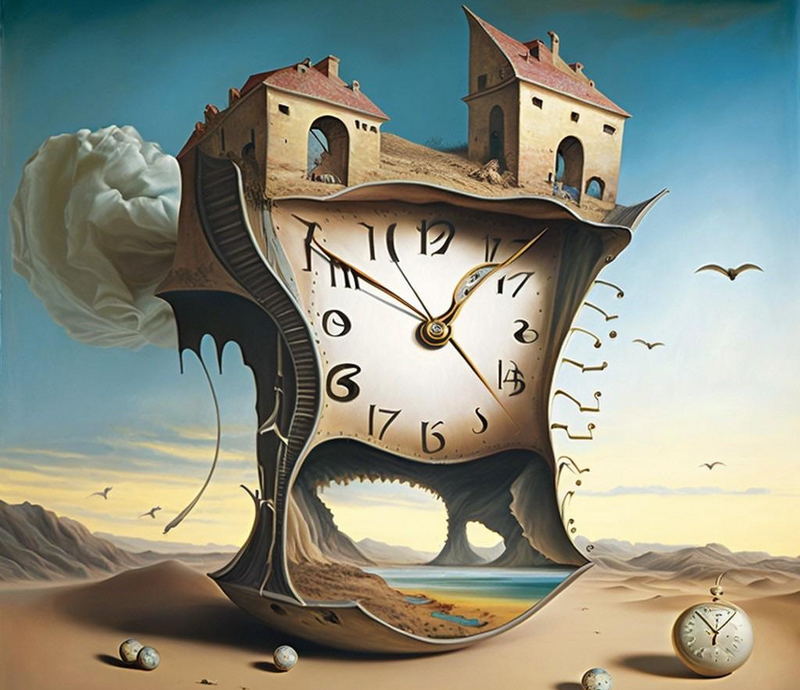
Time – Look at a clock and watch the numbers morph and drift.
Fly– Imagine flying out the window or hovering above the ground.
Palms– Look at your palms and see your hands morph close-up.
Mirrors – Stare into a mirror in low lighting and see your face change.
Play – Play an instrument and hear extra sounds from nowhere.
For good measure, perform two reality checks each time. If one fails, the other acts as a backup. My go to reality check is trying to push my hand through the desk or wall. It’s such a great feeling when it actually happens in a dream and I become lucid; it feels real no matter how absurd the situation.
Enhancing Your Self-Awareness
The mind constructs patterns based on real-life experiences. For instance, since you’ve had the experience of gravity your whole life, you don’t need to repeatedly question it. You already know that you can’t float or take off at will. Likewise, you know the sky is blue, you can’t control objects with your mind, and walls are too solid to pass through.
However, questioning your basic experiences can promote a new way of thinking, in the waking world and in dreams. Engineers call it thinking from first principles. Psychologists call it bottom-up processing. The rule is: take nothing for granted.
Increasing your self-awareness is a fun and fast learning curve. Pay attention to your surroundings, examine them in detail, and question their nature. This approach establishes a direct path to lucid dreaming.
Troubleshooting Reality Checks
As this is a very popular lucid dreaming technique, I get a lot of questions about how to do reality checks and why they don’t always work in dreams. Here are some of most common questions and answers.
How can I remember to do more reality checks each day?
Set up triggers that remind you to do reality checks, like reminders on your phone, sticky notes around the house, or draw a symbol on the back of your hand. You can also set up mental trigger points, reminding you to do a couple of reality checks every time you walk up stairs, pour a drink, or open a door.
Why aren’t any reality checks appearing in my dreams?
Ensure your process is mindful and meaningful. Since your dreams relay waking experiences, the more impressionable or frequent the experience, the more likely it is to arise in a dream. Combine reality checks with other lucid dreaming techniques for synergistic effects. Keep a dream journal and record a dream every night, practice dream incubation and meditation as you fall asleep.
Why didn’t my dreaming reality check make me lucid?
Ensure your waking reality checks are thoughtful and that you’re not simply going through the motions. It’s an easy trap to fall into when you have this same thought ten times a day. Use multiple phrasings of the question “am I dreaming?” Use your imagination to flick back and forth between what reality is showing you and what a dream could show you.
Occasionally, reality checks fail through no fault of your own. You may be having a very normal life-like dream, or even a false awakening. In fact, since lucid dreamers have many more false awakenings that non-lucid dreamers, it’s a good idea to perform a couple of deep reality checks every time you wake up.
WASHINGTON—Hoping his upcoming meeting in Anchorage with Russian President Vladimir Putin will bring a much-needed change of pace, an exhausted President Donald Trump told reporters Thursday that a fun getaway with a murderous dictator is just what he’s been needing. “It’s been a pretty busy year, so it’ll be great to take a little summer trip where I can kick back and relax with a fellow killer,” said Trump, who added that he’s looking forward to enjoying Alaska’s majestic scenery and wildlife alongside another leader with an incalculable quantity of blood on his hands. “We can just be ourselves and have a nice talk, homicidal tyrant to homicidal tyrant. Bukele couldn’t make it because he’s too busy installing himself as dictator for life, but I bet we could get Bibi on the phone. Erdoğan and Orbán too. Oh, and maybe that guy in Cambodia. These are people who get it, you know? We can hang out and shoot the shit about killing with total impunity. It’s a beautiful thing.” Trump ended the press briefing by showing off the matching “Boys Trip 2025” T-shirts made for him and Putin to wear when they meet up.
The former president has brought dehumanizing language into American presidential politics.By Anne Applebaum
Jon Cherry / Getty
OCTOBER 18, 2024 (TheAtlantic.com)
To support The Atlantic’s journalism, please consider subscribing today.
Rhetoric has a history. The words democracy and tyranny were debated in ancient Greece; the phrase separation of powers became important in the 17th and 18th centuries. The word vermin, as a political term, dates from the 1930s and ’40s, when both fascists and communists liked to describe their political enemies as vermin, parasites, and blood infections, as well as insects, weeds, dirt, and animals. The term has been revived and reanimated, in an American presidential campaign, with Donald Trump’s description of his opponents as “radical-left thugs” who “live like vermin.”
ENJOY A YEAR OF UNLIMITED ACCESS TO THE ATLANTIC—INCLUDING EVERY STORY ON OUR SITE AND APP, SUBSCRIBER NEWSLETTERS, AND MORE.Become a Subscriber
This language isn’t merely ugly or repellent: These words belong to a particular tradition. Adolf Hitler used these kinds of terms often. In 1938, he praised his compatriots who had helped “cleanse Germany of all those parasites who drank at the well of the despair of the Fatherland and the People.” In occupied Warsaw, a 1941 poster displayed a drawing of a louse with a caricature of a Jewish face. The slogan: “Jews are lice: they cause typhus.” Germans, by contrast, were clean, pure, healthy, and vermin-free. Hitler once described the Nazi flag as “the victorious sign of freedom and the purity of our blood.”
Stalin used the same kind of language at about the same time. He called his opponents the “enemies of the people,” implying that they were not citizens and that they enjoyed no rights. He portrayed them as vermin, pollution, filth that had to be “subjected to ongoing purification,” and he inspired his fellow communists to employ similar rhetoric. In my files, I have the notes from a 1955 meeting of the leaders of the Stasi, the East German secret police, during which one of them called for a struggle against “vermin activities” (there is, inevitably, a German word for this: Schädlingstätigkeiten), by which he meant the purge and arrest of the regime’s critics. In this same era, the Stasi forcibly moved suspicious people away from the border with West Germany, a project nicknamed “Operation Vermin.”
This kind of language was not limited to Europe. Mao Zedong also described his political opponents as “poisonous weeds.” Pol Pot spoke of “cleansing” hundreds of thousands of his compatriots so that Cambodia would be “purified.”
DON’T MISS WHAT MATTERS. SIGN UP FOR THE ATLANTIC DAILY NEWSLETTER.Email AddressSign Up
In each of these very different societies, the purpose of this kind of rhetoric was the same. If you connect your opponents with disease, illness, and poisoned blood, if you dehumanize them as insects or animals, if you speak of squashing them or cleansing them as if they were pests or bacteria, then you can much more easily arrest them, deprive them of rights, exclude them, or even kill them. If they are parasites, they aren’t human. If they are vermin, they don’t get to enjoy freedom of speech, or freedoms of any kind. And if you squash them, you won’t be held accountable.
Until recently, this kind of language was not a normal part of American presidential politics. Even George Wallace’s notorious, racist, neo-Confederate 1963 speech, his inaugural speech as Alabama governor and the prelude to his first presidential campaign, avoided such language. Wallace called for “segregation today, segregation tomorrow, segregation forever.” But he did not speak of his political opponents as “vermin” or talk about them poisoning the nation’s blood. Franklin D. Roosevelt’s Executive Order 9066, which ordered Japanese Americans into internment camps following the outbreak of World War II, spoke of “alien enemies” but not parasites.
In the 2024 campaign, that line has been crossed. Trump blurs the distinction between illegal immigrants and legal immigrants—the latter including his wife, his late ex-wife, the in-laws of his running mate, and many others. He has said of immigrants, “They’re poisoning the blood of our country” and “They’re destroying the blood of our country.” He has claimed that many have “bad genes.” He has also been more explicit: “They’re not humans; they’re animals”; they are “cold-blooded killers.” He refers more broadly to his opponents—American citizens, some of whom are elected officials—as “the enemy from within … sick people, radical-left lunatics.” Not only do they have no rights; they should be “handled by,” he has said, “if necessary, National Guard, or if really necessary, by the military.”
MAKE YOUR INBOX MORE INTERESTING WITH NEWSLETTERS FROM YOUR FAVORITE ATLANTIC WRITERS.Browse Newsletters
In using this language, Trump knows exactly what he is doing. He understands which era and what kind of politics this language evokes. “I haven’t read Mein Kampf,” he declared, unprovoked, during one rally—an admission that he knows what Hitler’s manifesto contains, whether or not he has actually read it. “If you don’t use certain rhetoric,” he told an interviewer, “if you don’t use certain words, and maybe they’re not very nice words, nothing will happen.”
His talk of mass deportation is equally calculating. When he suggests that he would target both legal and illegal immigrants, or use the military arbitrarily against U.S. citizens, he does so knowing that past dictatorships have used public displays of violence to build popular support. By calling for mass violence, he hints at his admiration for these dictatorships but also demonstrates disdain for the rule of law and prepares his followers to accept the idea that his regime could, like its predecessors, break the law with impunity.
These are not jokes, and Trump is not laughing. Nor are the people around him. Delegates at the Republican National Convention held up prefabricated signs: mass deportation now. Just this week, when Trump was swaying to music at a surreal rally, he did so in front of a huge slogan: trump was right about everything. This is language borrowed directly from Benito Mussolini, the Italian fascist. Soon after the rally, the scholar Ruth Ben-Ghiat posted a photograph of a building in Mussolini’s Italy displaying his slogan: mussolini is always right.
The Atlantic Daily: The atmosphere of a Trump rally
These phrases have not been put on posters and banners at random in the final weeks of an American election season. With less than three weeks left to go, most candidates would be fighting for the middle ground, for the swing voters. Trump is doing the exact opposite. Why? There can be only one answer: because he and his campaign team believe that by using the tactics of the 1930s, they can win. The deliberate dehumanization of whole groups of people; the references to police, to violence, to the “bloodbath” that Trump has said will unfold if he doesn’t win; the cultivation of hatred not only against immigrants but also against political opponents—none of this has been used successfully in modern American politics.
But neither has this rhetoric been tried in modern American politics. Several generations of American politicians have assumed that American voters, most of whom learned to pledge allegiance to the flag in school, grew up with the rule of law, and have never experienced occupation or invasion, would be resistant to this kind of language and imagery. Trump is gambling—knowingly and cynically—that we are not.
Mediaite Aug 13, 2025 Anne Applebaum, staff writer for The Atlantic, has covered dictators for decades. In an interview from before the 2024 election with Mediaite’s Press Club, she told host Aidan McLaughlin that Donald Trump’s language mirrored rhetoric from Hitler, Stalin, and Mussolini. She described a disturbing trend in his authoritarian language — and how it foreshadowed his consolidation of “absolute power” in a second term as president.
Translation is a 5-step process of “straight thinking in the abstract” comparing and contrasting what seems to be truth with what you can syllogistically, axiomatically and mathematically (using word equations) prove is the truth. It is not an effort to change, alter or heal anything.
The claims in a Translation may seem outrageous, but they are always (or should always be) based on self-evident syllogistic reasoning. Here is one Translation from this week.
1) Truth is that which is so. That which is not truth is not so. Therefore truth is all that is. Truth being all is therefore total, therefore whole, therefore whole, therefore complete, therefore otherless, therefore one. I think therefore I am. Since I am and since Truth is all that is, therefore I, being, am Truth. Since I, being, am Truth, therefore I, being, have all the attributes of Truth. Therefore I, being, am total, whole, complete, otherless, one. Since I am mind (self-evident) and since I (being) am Truth, therefore Truth is Mind. (Two things being equal to a third thing are equal to each other.) Since Truth is Mind, therefore Mind has all the attributes of Truth. Therefore Mind is total, whole, complete, otherless, one.
2) Cataracts can cause cloudy vision since light cannot reach the retina and therefore the brain.
Word-tracking: retina: light-sensitive membrane which receives an image from the lens and sends it on the brain cloudy: opacification, opaque, not transparent cataract: an easing of, film over lens, a heavy downpour of rain or a great flood image: imitation
3) Truth being Mind and Truth being all, therefore there is nothing that can get in the way of Mind. therefore Mind is thoroughly transparent. A retina is a light-sensitive membrane which receives images from the lens and sends them on to the brain. Truth being all that is is therefore all we can see, all we can imagine, all we can see images of, see imitations of. So what we see is not the real thing, it’s an imitation. Therefore what we are seeing is an imitation, a lie. Seeing implies an outside world which can be imaged to an inside world, i.e., seeing through a glass darkly (through imitation). Since Truth is one, the duality of inner and outer must be a lie about the singularity of Truth. Therefore Truth is one Mind knowing without imitation or images OR the eye of Truth is single and the whole body of Truth is full of light.
4) Mind is thoroughly transparent. Truth is all we can see, all we can imagine, all we can see images of, see imitations of. What we are seeing is an imitation, a lie. Truth is one Mind knowing without imitation or images The eye of Truth is single and the whole body of Truth is full of light.
5) The eye of Truth is single and the whole body of Truth is full of light.
Weekly Invitational Translation Group invites your participation. If you would like to submit a Translation on any subject, feel free to send your weekly Translation to zonta1111@aol.com and we will anonymously post it on the Bathtub Bulletin on Friday.
“Those who aspired to a role on the council of Tlaxcala, far from being expected to demonstrate personal charisma or the ability to outdo rivals, did so in a spirit of self-deprecation – even shame. They were required to subordinate themselves to the people of the city. To ensure that this subordination was no mere show, each was subject to trials, starting with mandatory exposure to public abuse, regarded as the proper reward of ambition, and then – with one’s ego in tatters – a long period of seclusion, in which the aspiring politician suffered ordeals of fasting, sleep deprivation, bloodletting and a strict regime of moral instruction. The initiation ended with a ‘coming out’ of the newly constituted public servant, amid feasting and celebration.”
“Clearly, taking up office in this indigenous democracy required personality traits very different to those we take for granted in modern electoral politics. On this latter point, it is worth recalling that ancient Greek writers were well aware of the tendency for elections to throw up charismatic leaders with tyrannical pretensions. This is why they considered elections an aristocratic mode of political appointment, quite at odds with democratic principles; and why for much of European history the truly democratic way of filling offices was assumed to be by lottery.”
Describing the diversity of early human societies, the book critiques traditional narratives of history’s linear development from primitivism to civilization. Instead, The Dawn of Everything posits that humans lived in large, complex, but decentralized polities for millennia.
A ceramic tile – probably painted many years after his death – shows a likeness of the poet Hafiz (Credit: De Agostini/Getty Images)
“Why Not Be Polite? Everyone Is God speaking. Why not be polite and Listen to Him?”
~ Hafiz
Khājeh Shams-od-Dīn Moḥammad Ḥāfeẓ-e Shīrāzī, known by his pen name Hafez or Hafiz (1325–1390), also known by his nickname lesān-al-ḡayb, was a Persian lyric poet whose collected works are regarded by many Iranians as one of the highest pinnacles of Persian literature. Wikipedia
John Birdsall’s “What Is Queer Food?” and Erik Piepenburg’s “Dining Out” both seek to define the place of cuisine in queer culture, history and expression.
The late, lamented Chelsea diner Florent was a mainstay of the gay dining scene for more than 20 years.Credit…Nicole Bengiveno/The New York Times
By Lukas Volger
Lukas Volger is the author of six cookbooks, and the former editor of the queer food journal Jarry.
June 14, 2025 (NYTimes.com)
WHAT IS QUEER FOOD? How We Served a Revolution, by John Birdsall
DINING OUT: First Dates, Defiant Nights, and Last Call Disco Fries at America’s Gay Restaurants, by Erik Piepenburg
What’s queer about food? Over the past decade, momentum has gathered around this conversation. By nature, the intersection resists fixed rules and embraces abstraction, but the benefits of asking seem clear: As two new books demonstrate, food can reveal a richness of queer culture, expression, possibility and survival.
Building on a 2021 New York Times article, Erik Piepenburg’s “Dining Out” looks at 150 years of queer American food establishments, from cafeterias to diners to bathhouses. He argues that gay (his chosen modifier, meant to encompass all queer and L.G.B.T.Q. people) restaurants — defined simply as places where gay people eat — have been every bit as essential to connection, activism and queer history as have bars.
Early gay restaurants were often those that attracted artists and other bohemians, who invariably numbered gays and lesbians among their ranks. The storied Pfaff’s Saloon opened in Greenwich Village in 1856 and was a known gay meeting place, counting Walt Whitman as a regular. Other restaurants became gay more serendipitously — such as Automat cafeterias, whose rapid turnover, communal seating and atmosphere of anonymity created inconspicuous venues to meet and cruise.
Like bars, gay restaurants were frequent sites of pre-Stonewall uprisings and sit-ins, as well as a backdrop to history. Annie’s Paramount Steak House in Washington, D.C., opened in 1948 and served gays and lesbians through the Lavender Scare of the McCarthy era, the gains in sexual liberation of the 1960s and ’70s, the devastation and aftermath of AIDS. It continues today.
When restaurants became a target of hysteria at the height of the AIDS epidemic, thanks to the dining public’s ignorance and panic about the virus’s transmission, gay restaurants were one of the few spaces that provided respite for queer patrons. Florent, which opened in Manhattan’s meatpacking district in 1985 and epitomized downtown cool for 23 years, helped to destigmatize AIDS, with its H.I.V.-positive proprietor, Florent Morellet, listing his latest T-cell count prominently on the day’s menu board.
The diversity of queer people has always meant a diversity of queer restaurants. Bloodroot, in Bridgeport, Conn., was one of several lesbian feminist restaurants that opened in the 1970s, leading with progressive ideals like non-hierarchical staff, and vegan and vegetarian fare. Places like La Rondalla in San Francisco attracted Latino diners, and Pink Tea Cup and Horn of Plenty in New York catered to Black gays and lesbians. Trans-specific restaurants are rarer, but Napalese Lounge and Grille in Green Bay, Wis., has long hosted a monthly “Cross Dressing/Transgender Social Gathering,” and HAGS in New York City infuses its fine dining experience with the proprietors’ queer ethos.
Piepenburg is most animated when fueled by nostalgia, such as in his chapters on 24-hour diners and the “golden age” of gay restaurants — a period he identifies as stretching from the late 1960s to the aughts — and when he ponders how to feel about dining at establishments not expressly meant for him. This invites an inevitable further question: How might lesbians or trans people capture the pleasure of their own establishments? Any topical survey will wrestle with the subjective nature of queer belonging, but in “Dining Out,” Piepenburg’s rigorous research and sensitive reporting are vital to the book’s impact.
Piepenburg is upfront about drag brunch never having been about the food, and it must be said that the menus at many of these restaurants don’t stir much excitement. So what to make of food’s claim to queerness? John Birdsall, the author of a 2020 biography of James Beard, makes immensely satisfying strides in answering the question in his book’s title — “What Is Queer Food?” — and in the process shares an approach for future writers, cooks and scholars.
Consider the case of Harry Baker’s chiffon cake, a sensation among Hollywood’s A-listers in the 1930s. In 1923, Baker fled Ohio after being caught having gay sex in a public restroom. Established in Los Angeles, he baked his renowned cakes in a makeshift kitchen in a bedroom. This closet becomes a “site of magic” for Birdsall, and Baker’s recipe, later scrubbed clean of its queer origins after General Mills bought it, represents for him “the expansion of pleasure that is possible in the defiance of limits.”
Or take paper chicken, a signature dish at Esther Eng, the Manhattan restaurant that was owned by the eponymous male-presenting lesbian (and pioneering Chinese-language film director). A fitting metaphor for Eng’s known, but rarely acknowledged, queerness, it “masks and reveals,” Birdsall writes. “It transforms base poultry into something pink and transcendentally perfumed.”
The Paris expats James Baldwin and Richard Olney, who shared meals at the recurring Left Bank “Saturday Night Function” starting in 1956, mark a diverging sensibility. For Baldwin, food functioned as a source of nourishment and catalyst for connection. But for Olney, it was a medium for expression. In his work over the subsequent decades, living in the Provençal countryside, Olney would manifest a fertile culinary space for queer excavation, fusing gay and culinary performance.
Who could ignore quiche, a dish that is, today, “embodied” with queerness? In 1948, it was just another recipe in the women’s pages of newspapers. But by the second half of the century quiche had became such a fixture of gay brunching that matters reached a tipping point. The widespread homophobic backlash was neatly captured by the 1982 publication of Bruce Fierstein’s tongue-in-cheek look at masculinity, “Real Men Don’t Eat Quiche.”
If “queer” itself may resist easy definition, food can help clarify its central conviction: that we deserve pleasure. “What Is Queer Food?” puts the sensual and the sensory at the fore, and it pulsates with hunger for what’s possible when queer life and expression is examined through food.
And at a moment when queer and trans people are increasingly under attack, the subject of quiche again becomes a poignant call to action: “Hedonism,” Birdsall writes, “can pull us deeper into our own humanity, and quiche — food of queer resilience and queer power — is fuel for the journey.”
WHAT IS QUEER FOOD?: How We Served a Revolution | By John Birdsall | Norton | 292 pp. | $29.99
DINING OUT: First Dates, Defiant Nights, and Last Call Disco Fries at America’s Gay Restaurants | By Erik Piepenburg | Grand Central | 321 pp. | $30
A version of this article appears in print on July 20, 2025, Page 8 of the Sunday Book Review with the headline: Taste the Rainbow. Order Reprints | Today’s Paper | Subscribe
Explore More in Books
Want to know about the best books to read and the latest news? Start here.
Preying on Patients: “Rehab: An American Scandal,” by the journalist Shoshana Walter, brings needed scrutiny to bear on America’s drug treatment system.
Books Times Readers Are Excited About: Thrillers, literary fiction, history, memoirs and more: Here are the books you’ve saved most to your summer reading lists.
The Book Review Podcast: Each week, top authors and critics talk about the latest news in the literary world. Listen here.