
The Alien Church is one of many SoCal UFO spiritual groups
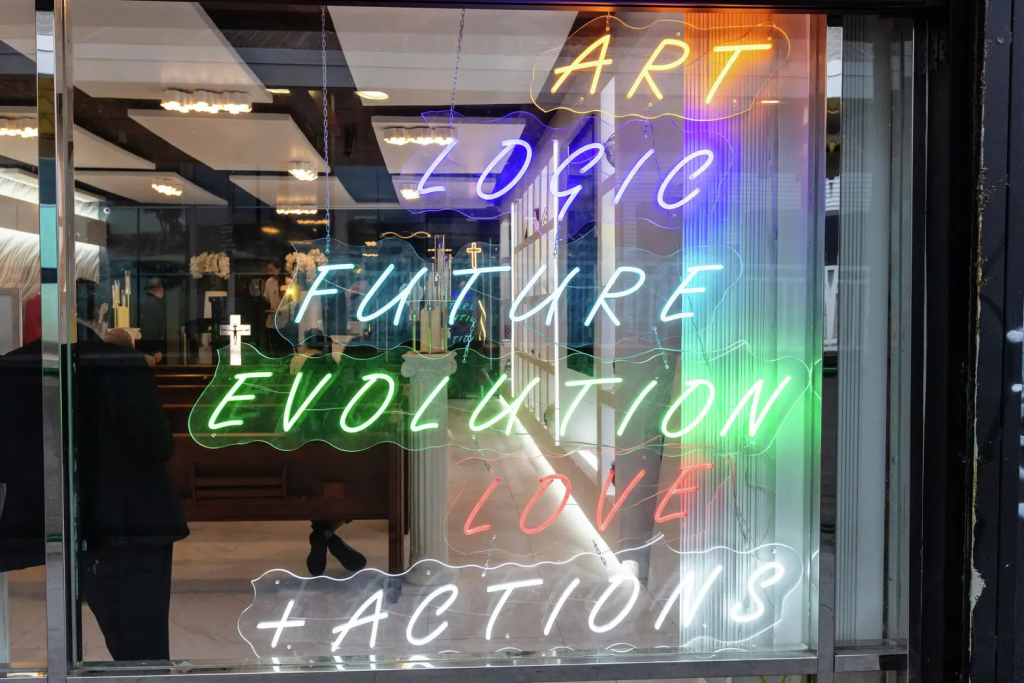
A sign in the window lets curious passersby know what is talked about at the Alien Church, in Downtown Los Angeles on March 31, 2025.Douglas Zimmerman/SFGATE
By Paula Mejía,Contributing LA Culture Editor
Steps away from a bustling downtown Los Angeles metro station, an unusual storefront beams back at commuters. The space’s spare glass walls and minimalist neon signs — blinking out words like “art” and “love” — suggest that an art gallery lies inside. The T-shirts and trucker hats for sale make it seem like a retailer, not unlike a Melrose merch emporium.
The storefront also prominently features a cross, but a closer look dispels any comparisons to a regular strip mall worship hall. This cross has an alien crucified on it.
A few provocative words above the storefront double down on this extraterrestrial focus: “If you believe in Jesus, you believe in aliens.”
Dubbed the Alien Church, this mysterious entity cropped up months ago on this downtown stretch, prompting confusion, curiosity and scorn alike. If you peer inside, a green man dressed in priestly robes stares back at you. A litany of 3D-printed art sits on shelves, including crowns of thorns. A portrait of da Vinci’s “The Last Supper” mural painting — only with aliens instead of Jesus and his disciples — adorns one wall.
One member, Isaiah Dupree, tells me that he was abducted by aliens as a child, then sticks a magnet onto his finger and lets it hover there — proof that extraterrestrials implanted him, he says.
The Alien Church intends to be “many places in one place,” says its founder, who goes by Mercury. “It’s an art gallery for artists; they can come and sell their art here. Performers, they can come here and share whatever they would like to share with the public. Also, it’s a special place for positive actions.”
Some tenets of the Alien Church may feel familiar to those who grew up with organized religion. Its practitioners believe in a higher power and that “you are a part of its creation,” as a brochure inside reads, and that “mankind must be united.” Other ideas have a more unconventional strain, such as the belief that “aliens have seen much more of God’s creation than humans.” One of the church’s eventual goals, Mercury tells SFGATE, is to create a missile that “can put wildfires down in minutes.”
Every week brings various events to the small space’s pews, including a “TGIF interfaith sermon” that addresses topics like “from angels to aliens.” “Energy healing” sessions run on other nights.
When I ask Mercury how the church stays afloat, he says the endeavor is “privately funded” in part by his other businesses, including print manufacturing and a venture where he rents trucks “for entrepreneurs that want to sell something or perform something.” He says he is “not seeking any type of profit” from people who come to services, but also wants the church to grow. In addition to marketing T-shirts and hats emblazoned with the alien logo and words like “evolved,” the Alien Church also sells water bottles to “support the church,” he adds. The brand is called H2O Holy.
‘We are not a cult’
The Alien Church is not an anomaly within Southern California. The region has long been a hotbed of spiritual organizations, fringe groups and some cults for whom extraterrestrial life comprises a core part of their respective belief systems. (A minister who goes by Jah, who delivers the TGIF sermons at the Alien Church, tells me, unprompted, “We are not a cult.”)
There’s the Aetherius Society, a Los Angeles-based group that believes in communing with aliens and “karma yoga,” or acts of service to others, and Heaven’s Gate, a cult in which 39 members took their own lives in 1997, in Rancho Santa Fe, claiming they were hitching a ride on a spacecraft following the Hale-Bopp comet. NASA Jet Propulsion Laboratory co-founder Jack Parsons spent years living in and leading a Pasadena commune that practiced Thelema, the occult philosophy from UFO believer Aleister Crowley; L. Ron Hubbard spent years with Parsons before going on to found Scientology, which itself has links to the extraterrestrial.
Conventions like the Conscious Life Expo, which has been operating for over two decades, also bring together countless metaphysical and spiritual practitioners in the area, many of whom put stock in the presence of alien life. Extraterrestrial tourism is having a moment, too, especially out in the Mojave Desert.
D.W. Pasulka, a professor of religious studies at the University of North Carolina, Wilmington, argues in her book “American Cosmic” that “belief in extraterrestrials and UFOs constitutes a new form of religion.” The vast majority of these UFO-based groups emerged throughout the 20th and 21st centuries — a phenomenon that David Weintraub, a professor emeritus of astronomy at Vanderbilt University who has written about the relationship between scientific discovery and organized religion, credits to a combination of forces.
“There’s all sorts of stuff happening in the early 20th century in which the popular mainstream activities had a lot of focus on extraterrestrial life,” Weintraub tells SFGATE, noting the emergence of science fiction novels, technological advancement and scientific discovery, the Space Age and Hollywood productions.
Contemporary TV shows like “Ancient Aliens” have also had a hand in spurring viewers’ curiosity about what else might be out there. “People are talking a whole lot more about what’s beyond the Earth, and anybody can look up and think about this stuff,” he says. “So it’s easy to speculate.”
More recently, Weintraub points to the internet as a key driver of outré religious and spiritual ideas. “You don’t have to be a scientist or knowledgeable — let alone accurate about anything — to spread information or disinformation,” he says.
Aliens and anxiety
UFO religions have a way of materializing when specific societal anxieties rear their heads. In 2020, the filmmaker Annalise Pasztor spent time with the Aetherius Society, eventually making a short documentary for the New York Times Opinion vertical. The Aetherius Society first emerged during the Cold War, a time when anxiety about nuclear war was rife within the United States.
“I have this theory that a lot of this extreme interest in the extraterrestrial is a lot of having lost faith in humans and our ability to get our s—t together,” she says, “and this is a way of looking to the outside a little bit more.”
The Alien Church opened recently, at a moment when mass societal polarization is colliding with multiple international and domestic crises. The decline of third spaces, combined with a populace that’s spending more time alone, is but one factor in the dissolution of community writ large. The Alien Church’s founder, who grew up in Mexico, comes from a Christian background; he explains that he lost faith after he “saw a lot of contradictions in the religion.” He was later inspired to start Alien Church (initially a restaurant concept) to help others who were struggling, he says.
Weintraub says that the decline in community might be one reason why UFO religions have taken off. “That’s what religion is about: It provides organization and structure for community, it provides explanations for births and deaths and disease,” he says. “And in many ways, UFO religions just have a different answer for explaining why things happen. I think there’s an attractiveness, at least for some, to ideas that are outside the mainstream.”
“It’s a community focused on aliens, for the alienated,” Weintraub adds.
More Los Angeles Coverage
—California is getting its own New York Post
—The California city that rejected Disneyland
—The defiant taco truck owner who beat the LA fires
—I can’t believe I waited this long to try LA’s Black tacos
—LA’s secret celebrity tunnel was just a rumor. Until workers found it.
Get SFGATE’s top stories sent to your inbox by signing up for The Daily newsletter here.
Aug 15, 2025
CONTRIBUTING LA CULTURE EDITOR
Paula Mejía is a Colombian American writer and editor from Houston, Texas. She is a contributing culture editor at SFGATE, and was formerly the arts editor at the Los Angeles Times and a Senior Editor at Texas Monthly. Her writing has appeared in the New Yorker, the New York Times, GQ, Rolling Stone and more. A co-founding editor of “Turning the Tables,” NPR Music’s Gracie Award–winning series about centering women and nonbinary artists in the musical canon, she is also the author of a 33⅓ series installment on the Jesus and Mary Chain’s 1985 album Psychocandy. She teaches graduate arts writing at USC’s Annenberg School for Communication and Journalism and lives in Los Angeles.