
Monthly Archives: June 2025
“I paint in the hope of removing anguish” artist Yuka Sakuma discusses her dreamlike paintings
ImagineFX staff
Wed, June 18, 2025 (Yahoo..ocm)
3 min readYahoo is using AI to generate takeaways from this article. This means the info may not always match what’s in the article. Reporting mistakes helps us improve the experience.
Generate Key Takeaways
When you buy through links on our articles, Future and its syndication partners may earn a commission.

Yuka Sakuma is a painter and illustrator based in Nagoya, Japan. Inspired by the nihonga school, her work has been exhibited at home and abroad. We caught up with her to discuss the origins of her art style, how she empathises with her characters, and how she’s reached an international audience.
If you’re inspired by Yuka’s art and want to upgrade your kit, check out our guides for the best art supplies and sketchbooks for artists. For a more portable option, take a look at the best drawing tablets for artists on the go.
What, outside of traditional art, has most influenced your work throughout the years?
Manga and anime, which are, of course, two of the most popular cultural institutions in Japan. I grew up watching and reading so much of them from an early age. The shapes of the characters, the beauty of the lines, and the contrast between black and white found in manga have all had a major part to play in my art and its development.
Is there a painting you saw in your formative years that changed everything? What was it?
When I began studying art seriously, I remember being struck by Shinsui Ito’s beautiful, highly technical piece Finger at a museum. It’s one of the artworks that became a significant influence on my art.

Tell us about your first paid commission. Does it stand as a representation of your talent?
My graduation project in college was a turning point for me. I received so many invitations to exhibit from gallerists who saw it, and it was the work that launched my career as a painter. It has since been added to my university’s art collection.
When did you decide that you wanted to be an artist?
My goal was always to become a professional artist, so I’ve never had any other future in mind than painting full-time.

What advice would you give to your younger self?
Getting started isn’t the hard part; the most difficult thing is to keep on creating. While it’s vital to hone your painting skills, it’s important to have the understanding and support of loved ones. You have to keep putting yourself in the right environment to continue painting.
How has the art industry changed for the better since you’ve been working in it?
Not long after I began painting, social networking sites exploded. Now an artist’s personality is often more important than academic background, and so on. For me, the possibility of connecting with audiences and opportunities outside of Japan has also increased, just like this interview! Even though I can’t speak English, I’m grateful for the chances that are presented by living in a more connected world.

Can you tell us a little about the subjects in your art?
I always empathise with the girls in my work. I paint in the hope of removing the anguish from them.
What character, scene or style do you most identify with?
Ukiyo-e is one of the most famous genres of Japanese art, where artists created woodblock prints and paintings. So many wonderful ukiyo-e pieces have been created, among them bijin-ga, which are portraits of beautiful women. I’m a painter who produces contemporary bijin-ga pieces, and hope that my work will encourage more people to look at Japanese art, whether that’s ukiyo-e or beyond.
Wondering how to advance your own work? See our pieces on how to publish a manga and how to draw like Jamie Hewlett.
This content originally appeared in ImagineFX magazine, the world’s leading digital art and fantasy art magazine. ImagineFX is on sale in the UK, Europe, United States, Canada, Australia and more. Limited numbers of ImagineFX print editions are available for delivery from our online store (the shipping costs are included in all prices).
(Contributed by Gwyllm Llwydd)
Book: “So Many Stars: An Oral History of Trans, Nonbinary, Genderqueer, and Two-Spirit People of Color”

So Many Stars: An Oral History of Trans, Nonbinary, Genderqueer, and Two-Spirit People of Color
Caro De Robertis
Award-winning novelist Caro De Robertis offers a first-of-its-kind, deeply personal, and moving oral history of a generation of queer and trans elders of color, from leading activists to artists to ordinary citizens to tell their stories of breathtaking courage, cultural innovations, and acts of resistance, all in their own words.
So Many Stars knits together the voices of trans, nonbinary, genderqueer and two spirit elders of color as they share authentic, intimate accounts of how they created space for themselves and their communities in the world, how they pursued their passions, and how they continue to be at the vanguard of social change. This singular project collects the testimonies of over a dozen elders, each a glimmering thread in a luminous tapestry, preserving their words for future generations—who can more fully exist in the world today because of these very voices.
Award-winning novelist De Robertis creates a collective coming-of-age story based on hundreds of hours of interviews, offering rare snapshots of ordinary kids growing up, navigating family issues and finding community, coming out and changing how they identify over the years, building movements and weathering the AIDS crisis, and sharing wisdom for future generations. Often narrating experiences that took place before they had the array of language that exists today to self-identify and to describe life beyond the gender binary, this generation lived through remarkable changes in American culture, shaped American culture, and yet rarely takes center stage in the history books. Their stories feel particularly urgent in the current political moment, but also remind readers that their experiences are not new. Young trans and nonbinary people of color today belong to a long lineage.
The anecdotes in these pages are riveting, joyful, heartbreaking—so full of life and personality and wisdom, and artfully woven together into one immersive narrative. In De Robertis’s words, So Many Stars shares “behind-the-scenes tales of what it meant—and still means—to create an authentic life, against the odds.”
(Goodreads.com)
Man Returning From Near-Death Experience Recalls Angels Making Him Sign NDA

Published: June 19, 2025 (TheOnion.com)
HOUSTON—Recounting the deeply spiritual event as one that was life-changing but contractually difficult to articulate, area man Kyle Hartsfield recalled angels asking him to sign a nondisclosure agreement following a near-death experience, sources confirmed Thursday. “It was incredible, and I really wish I could talk about it,” said Hartsfield, describing the series of events in which he lost consciousness only to be awoken by an angel stoically sliding a stack of legal papers across a desk for him to sign. “I saw a blinding white light, I felt a warm glow envelop my body, and I can’t legally say more than that at this time. Heaven was beautiful, though. Somehow I felt both outside my body yet very calm—but I shouldn’t even be telling you that. I remember seeing a vision of St. Peter leaning down to whisper in my ear that he would destroy me if I ever revealed anything. I wasn’t religious before, but now I definitely believe in NDAs.” At press time, Hartsfield was reportedly able to share the detail that there was beautiful harp music playing in heaven’s lobby.
Zookeepers Confirm Pandas Not Mating Because They’re Scared Of Messing Up Friendship

Published: March 15, 2021 (TheOnion.com)
MEMPHIS, TN—Citing the complications that a sexual relationship inevitably brings, officials at the Memphis Zoo confirmed Monday that giant pandas Ya Ya and Le Le had not mated because they were both worried about messing up their friendship. “While securing the future of their species is absolutely crucial, it could never be worth risking what they have together as friends,” said senior curator Andrew Wentz, who praised the Chinese pandas for the maturity they had displayed in resisting “one cheap night of pleasure” in favor of the far greater rewards of a platonic friendship characterized by loyalty and mutual respect. “As zookeepers, we’d love nothing more than to have a few little cubs running around the habitat, but we completely respect their decision. We’re just glad their friendship survived that time Le Le made a pass at Ya Ya in the feeding pen. She didn’t reciprocate, and thankfully he backed off right away, before things could get too weird.” Wentz noted this was especially fortunate considering the pandas haven’t seen any other members of their species for a couple decades and have to share space that, when you’re a giant bear, gets kind of tight.
Tarot Card for June 20: Princess of Swords

| The Princess of Swords When this Princess rules the day expect to come into contact with demanding or unfair situations. Use the clarity and insight offered by the card to cut away unnecessary rubbish, get behind the smoke-screens and see right to the heart of any situation that crosses your path.It is important to refuse to tolerate injustice or ill-treatment, but when you deal with situations such as this, be sure that your own responses and behaviour are moral and above board, otherwise you’ll find the Princess’s sword turning on you.Swords in general tend to suffer quite a bit of bad press, but this is based on a misunderstanding of the inner Arcana ruling here – Swords are about living life to the full, and appreciating its gifts… so long as you’re doing your honest best, given the situation you are in at the time, you will not provoke the wrath of Swords in your life. It is when you fail to live up to your standards, fail to treat others with the love and respect they deserve, that you come into contact with so-called ‘bad’ Swords.So it’s important to go for the high ground on a day ruled particularly by one of the Courts. It will be a day in which things are re-assessed, mulled over, straightened out. It may also be a day upon which unexpected and previously hidden things come to light. In this case, objectivity is the safest course of action, coupled with well-thought out action.If you do not actually come into contact with a situation which demands you deal with it, be sure and spend a little time thinking about where you place importance on morality and good standards… consider the things you see as ‘right’ and ‘wrong’, then check you’re living up to those standards. Affirmation: “Ethical Will is the Will of the Universe.” |
(Angelpaths.com)
Weekly Invitational Translation: Self-blame and suggestibility lead to hypochondria and disease.
Translation is a 5-step process of “straight thinking in the abstract” comparing and contrasting what seems to be truth with what you can syllogistically, axiomatically and mathematically (using word equations) prove is the truth. It is not an effort to change, alter or heal anything.
The claims in a Translation may seem outrageous, but they are always (or should always be) based on self-evident syllogistic reasoning. Here is one Translation from this week.
1) Truth is that which is so. That which is not truth is not so. Therefore truth is all that is. Truth being all is therefore total, therefore whole, therefore complete, therefore done. I think therefore I am. Since I am and since Truth is all that is, therefore I, being, am Truth. Since I, being, am Truth, therefore I, being, have all the attributes of Truth. Therefore I, being, am total, whole, complete, done. Since I am mind (self-evident) and since I (being) am Truth, therefore Truth is Mind. (Two things being equal to a third thing are equal to each other.) Since Truth is Mind, therefore Mind has all the attributes of Truth. Therefore Mind is total, whole, complete, done.
2) Self-blame and suggestibility lead to hypochondria and disease.
Word-tracking:
self: possession, mine
blame: blaspheme, speak against God, mea culpa, I’m guilty
suggestible: easily influenced
influence: flow, movement, move from place to place
hypochondria: under the cartilage, over concern about disease
disease: opposite of ease, comfort
worry: wrench, deceit, wrong
wrench: to pull away from
3) Truth being all that is, therefore the Self of Truth possesses all. Truth being true, being right, cannot also be wrong, therefore Truth is guiltless, blameless, exculpated, disculpated. Truth being all that is, there can be no influence other than Truth, therefore Truth easily influences Itself. Truth being all that is is therefore everywhere equally present. Truth being everywhere equally present, does not move from place to place, therefore Truth is everywhere equally present stillness. Truth being total, whole, complete, done does not require work or effort to achieve, therefore Truth is effortless presence. Truth being effortless presence, cannot be difficult or dis-eased, therefore Truth is effortless and easy. Truth being all that is, there can no nothing other than Truth, therefore Truth is one. Truth being one, nothing can be wrenched from truth, therefore there is no wrenching, worrying, deceit, wrong in truth, therefore Truth doesn’t worry. Since Truth possesses all, therefore Truth is concerned (but not overly-concerned) about everything.
4) The Self of Truth possesses all.
Truth is guiltless, blameless, exculpated, disculpated.
Truth easily influences Itself.
Truth is everywhere equally present stillness.
Truth is effortless presence.
Truth is effortless and easy.
Truth is one.
Truth doesn’t worry.
Truth is concerned (but not overly-concerned) about everything.
5) Truth is a going concern which effortlessly and easily influences Itself through stillness.
Weekly Invitational Translation Group invites your participation. If you would like to submit a Translation on any subject, feel free to send your weekly Translation to zonta1111@aol.com and we will anonymously post it on the Bathtub Bulletin on Friday.
For information about Translation or other Prosperos classes go to: https://www.theprosperos.org/teaching.
Why aren’t great Black thinkers called philosophers?

American writer James Baldwin in Paris, circa 1970. Baldwin has been called a novelist, an essayist, a social critic but, until now says author Justin Ray, never a philosopher. Sophie Bassouls/Getty Images
Philosophy has a race problem. Less than 2% of members of the American Philosophical Association are Black. This exclusion is harming us all.
By Justin Ray
June 19, 2025 (SFChronicle.com)
James Baldwin dissected the human condition with surgical precision. His essays on race, identity and American democracy didn’t just document injustice — he philosophically dismantled it, revealing profound truths about freedom and what it means to be human. “I would like us,” he once wrote, “to do something unprecedented: to create ourselves without finding it necessary to create an enemy.” That is not just social critique — it is metaphysics. It is ethics. It is philosophy.
Yet we call Baldwin a novelist, an essayist, a social critic. Anything but what he clearly was: a philosopher.
This isn’t a coincidence. It’s intellectual gatekeeping, and it robs all of us of a fuller understanding of wisdom itself.
There’s even a data point: The American Philosophical Association — the primary society for philosophers in America — has 6,985 members, according to its 2024 data. Of them, 116 are Black — a little less than 2%. If we find it alarming that Black people represent less than 6% of doctors and lawyers, why isn’t their near-total absence from philosophy — the field that shapes our understanding of justice, truth and human meaning — treated as equally troubling?
Philosophy has long positioned itself as the domain of pure reason, supposedly above the fray of politics and identity. But scratch the surface, and the bias becomes clear: The very definition of who counts as a philosopher has always been political.
Walk into almost any introductory philosophy classroom in the United States, and you’ll encounter a carefully curated lineage — from ancient Greece to medieval Europe, to Enlightenment Germany and France, and finally to a narrow slice of American white men. That’s not intellectual history. It’s intellectual mythology, one that treats whiteness and maleness as the natural vessels for deep thought.
This is not due to a lack of philosophical insight from Black thinkers. Long before Baldwin or bell hooks, philosophical traditions flourished across the African continent — from the concept of Ubuntu, which emphasizes the interdependence of humanity, to Ethiopian rationalism. Imagine if students learned Ubuntu alongside Descartes’ “I think, therefore I am.” What kind of society might that produce?
Even in the 20th century, the exclusion persisted. Audre Lorde, who wrote extensively about anger as a vehicle for truth, warned: “We cannot allow our fear of anger to deflect us nor seduce us into settling for anything less than the hard work of excavating honesty.” But Lorde is most often referred to as a poet. bell hooks wrote powerfully about connection and ontology, saying, “When we drop fear, we can draw nearer to people, we can draw nearer to the earth, we can draw nearer to all the heavenly creatures that surround us.” Yet she’s typically described as a feminist theorist or cultural critic. Angela Davis is often introduced as an activist — rarely as a philosopher.
This isn’t just mislabeling. It’s intellectual apartheid.
As George Yancy, the Samuel Candler Dobbs Professor of Philosophy at Emory University, told me, “For the most part, there still exists the racist assumption that Black people are not philosophers — and cannot be philosophers. There is still the idea that being Black and a philosopher is an oxymoron.”
This isn’t just academic hair-splitting. The people we label as philosophers are given the efficacy to shape ethical frameworks in society. America’s founding fathers were heavily influenced by Enlightenment philosophy. Socrates helped shape modern medical education. Immanuel Kant’s thoughts helped construct the idea of the United Nations.
So what might have changed if thinkers like Baldwin had been recognized as philosophers, not just commentators? If philosophy departments taught Baldwin’s meditations on identity and freedom alongside Locke and Rousseau, how might American civic life — or our national conception of liberty — look different today?
When we deny Black thinkers the title of philosopher, we don’t just rob them of recognition — we impoverish ourselves.
Philosophy is supposed to grapple with the biggest questions about human existence. Black thinkers have been wrestling with these questions for centuries, often with more urgency, clarity and moral courage than their white counterparts.
They’ve had to. When your humanity is constantly questioned, you develop profound insights into what humanity actually means. When your freedom is perpetually threatened, you understand liberty in ways that others never could.
James Baldwin was a philosopher. bell hooks was a philosopher. Angela Davis is a philosopher. So are the dozens of Black scholars quietly reshaping the field today, asking the hard questions about justice, identity and human flourishing that our moment desperately needs. One example is Amanda Gorman, who suggested in the poem she recited during Joe Biden’s 2021 inauguration that democracy isn’t something to protect, but rather something we must finally accomplish.
“We will rebuild, reconcile and recover / and every known nook of our nation / and every corner called our country, / our people diverse and beautiful will emerge, / battered and beautiful,” Gorman said.
The philosopher isn’t just in the canon. She’s here. She’s speaking. The question is whether we’ll recognize her before it’s too late.
As Lorde wisely observed: “Everything can be used / except what is wasteful.” Let’s stop wasting the brilliance we’ve already been given.
Justin Ray is a Los Angeles-based journalist who has written for the Los Angeles Times and the Guardian. He works for the independent, environmental news outlet Grist.
June 19, 2025
Justin Ray
Rodin’s rowdy rival: Medardo Rosso, the anarchist who brought sculpture into the modern era
A new retrospective shines a light on the turn-of-the-century Italian artist, one of the art world’s most obscure yet revered figures, whose legacy was eclipsed by his contemporaries
Christian House Thu 19 Jun 2025 (TheGuardian.com)
If you ask art dealers and auctioneers about the legacy of the turn-of-the-century sculptor Medardo Rosso, you are likely to be met with a uniform reply: “Medardo who?” There’s no judgment here. I’ve worked in and around the art world for 20 years, and until recently I hadn’t heard of Rosso either.
In artists’ ateliers, however, Rosso has long been a familiar and revered name. Auguste Rodin, the father of modern sculpture, was his champion and friend until the pair’s fallout. Émile Zola was a fan. The playwright Edward Albee owned a version of his sculpture Enfant Juif; French poet Guillaume Apollinaire described him as “without a doubt the greatest living sculptor”.
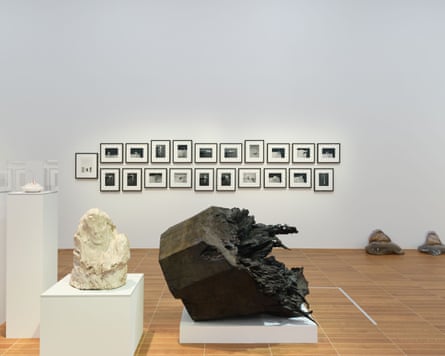
Rosso, a new retrospective at Kunstmuseum Basel, contends, brought sculpture into the modern era with busts and figures that seemed to materialise organically out of his materials – wax, plaster, bronze – like spectres in motion. The Swiss art institution has had no trouble finding 60 contemporary artists who feel a kinship with his sculptures, photographs and drawings, his fleeting impressions of street scenes, cafes and clouds – from Louise Bourgeois’s textile sculptures that look like entrails to Francesca Woodman’s wraithlike photographs.
“If you sit 10 gallerists and collectors around a table, nine out of the 10 will not know who Medardo Rosso is,” says Elena Filipovic, the director of Kunstmuseum Basel, which is holding a retrospective on this shadowy figure. “If you sit 10 artists around the table, nine out of the 10 will fall to the floor with excitement.”
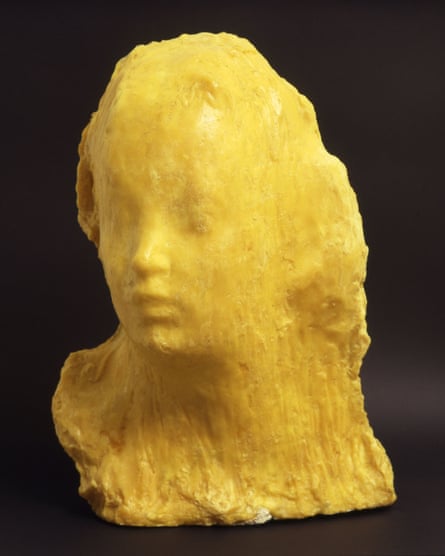
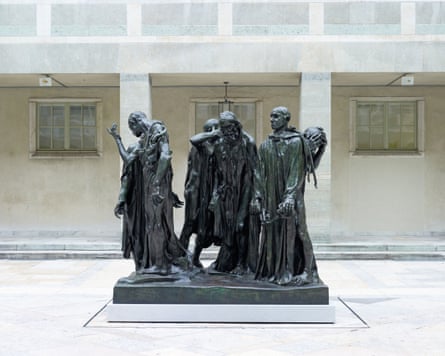
There are good reasons why Rosso has fallen into relative obscurity. Some, albeit unintentionally, are Rosso’s fault. For instance, his practice was neurotically self-contained. While Rodin followed the template for becoming famous, Rosso followed his own instincts. Rodin knew to create monumental works – “size matters,” says Filipovic – and that professional marketing was key. Rosso created small-scale works, works seen in the studio, home and exhibitions but not out on the boulevards, and he liked to promote them himself.
Rodin created monumental works and knew professional marketing was key – Rosso worked small scale and promoted himself
He worked, repeatedly, on a relatively small number of motifs. One of his most famous works, Ecce Puer (1906), is of a boy’s head shrouded in a sheet; he’s there but not there. Another, Enfant Malade (1893-95), features the inclined head of a sick child, tipping possibly towards death.
We often use the term “in the flesh” when standing in front of a sculpture, but with Rosso the phrase has a particular resonance: his faces, just that little bit smaller than in real life, with dimensions that add to a sense of unease, look as if they might blink their waxy eyelids. His sickly yellow lumps are not pretty. They’re not Degas’s dancers.
Perhaps the most disturbing of all though is Aetas Aurea (1886), a study of his wife, Giuditta, and their son, Francesco, in which the pair look conjoined at their cheeks. They melt into the background. It’s a horror movie prop rather than a loving family portrait. Other figures are drunk, leaning, screaming. His wax sculptures are the colour of nicotine stains.
Born in Turin in 1858, the second son of a railway worker, Rosso opened his first atelier in Milan in 1882 and circulated with members of the artistic group Scapigliatura – translated as “dishevelment” – a Bohemian set of a socialists and anarchists. Living up to the name, Rosso’s studies in the city’s esteemed Accademia di Belle Arti di Brera were cut short when he was expelled for assaulting another student. Three years later, however, he had a wife and son, and was successfully forging a career in Paris, wooing patrons and winning commissions.
Rosso was definitely a “very idiosyncratic personality, very persuasive, powerful, winning, someone with a big heart, especially for children, but also suspicious, controlling, obsessively pursuing his cause,” says Heike Eipeldauer, a curator and Rosso expert at the Mumok museum in Vienna, Austria. There were a lot of disagreements: his wife left him and one of his closest friends cut him off after an argument about debts. And then there was Rodin, who he got into a public spat with over who had influenced whom. “They were friends, until they weren’t,” says Filipovic.
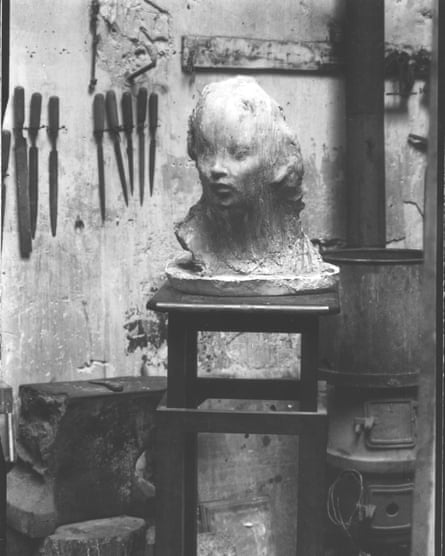
His intractable nature could work against him. He cast his own works – eating into his time and reducing the number of works created – while Rodin used foundries. And Rodin hired Edward Steichen and other well-known photographers to capture his works and produce portraits of him as the great master in the studio (often with a hammer and chisel, even though he never carved marble himself). Rosso’s sculptures were only ever photographed by the artist himself.
“He wanted to control the image,” says Filipovic. “He understood that photography and how you saw the work was also the work.” The exhibition features about 200 of Rosso’s photographs: frail prints of sculptures, some as small as stamps, otherworldly portraits rather than iconic marketing shots. He lit and staged them, with an ethereal aesthetic that echoed the Victorian craze for spirit photography.
While Rosso’s photographic studies reanimate objects, his studio-set self-portraits conjure up a phantom, his scruffy features bleached by the sun through his studio’s skylight, his figure blurred in movement: studies as faint and mercurial as his artistic footprint.
Having spent his last two decades constantly reworking a few subjects, the artist died in 1928, aged 69. He had dropped glass negatives on his foot, resulting first in the amputation of several toes, then part of his leg and finally a fatal case of blood poisoning. A gradual erosion.
Today, Rosso’s complicated nature hampers research, explains his great-granddaughter, Danila Marsure Rosso, who manages the artist’s estate. “He destroyed all the letters he received because he said that nobody should enter in his private life,” she says.
There are no biographies of Rosso. There are dozens of Rodin. Rosso’s auction record stands at £341,000 (for a version of Enfant Juif, sold in London in 2015); Rodin’s record was set in 2016, when the master’s marble Eternal Springtime sold in New York for $20m (£14m). Legacies can pay dividends.
But Rosso’s quirks had their own creative rewards. He invited groups into his studio to watch him sculpt and cast his works, as if he were a performer. “It was about understanding that there is magic in this making,” says Filipovic. “Rodin couldn’t do that because he used a foundry.”
Another idiosyncrasy was Rosso’s fondness for installing sculptures in collectors’ homes in strange, jarring configurations. Context was everything, but not always logical. I can imagine him sitting uncomfortably close to guests at dinner parties just to observe their reaction. Was he a control freak? “Certainly,” says Filipovic. “But don’t you want that in an artist?”
(Contributed by Gwyllm Llwydd)
