Years ago I saw an underwater photograph of an iceberg. As many times as we hear the phrase “tip of the iceberg,” nothing prepares you for that visual. What we see above the surface is literally just a tip rising up from the sea, while beneath the waterline lies a mass of ice scores of times bigger than that which lies above.
What we see with our naked eye is only what’s above the surface of things, not only in regards to icebergs but to life itself. What is evidenced by the physical senses is only a tiny portion of a larger reality, a world hidden by the veil of the material world. In order to understand the reality of life we must peer beneath the surface, where huge emotional, psychological and spiritual factors dwarf in significance the realm of the physical senses. For the powers underneath the surface cause what occurs above. We ignore those factors out of ignorance or out of negligence, but we ignore them at our peril. If we only try to change things on the surface then the change will be neither permanent nor stable.
Given that we’re on the Titanic, it would be best to see them in time. In order to change the world we must peer beneath the surface of things. There, things must be changed.
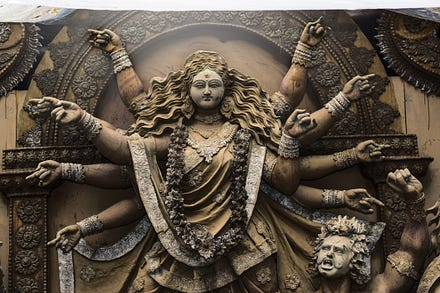
We can focus on nuclear bombs, AI, biomedical hazards, the clash of civilizations and so forth. But the problems of the world are like a many headed monster, and any time we cut off one head then another will appear. Understanding why this is so is essential to humanity’s ability to get a grip on what’s going on today. In the final analysis, the story of Durga is more powerful than the United Nations.
Durga is an incarnation of the supreme Mother/Protector energy in the Hindu religion. She is the destroyer of all demons such as jealousy, hatred, ego and selfishness. Take a moment to think about nuclear bombs, AI, biomedical hazards, the clash of civilizations and so forth, and you realize such manifestations are but the effects of those underlying demons. Demons are loveless thoughts, and until we evolve as a species beyond them then the many headed manifestations of worldly destruction will never cease to exist.
Human laws, agreements, negotiations and legislation — all are important to guarantee short term survivability of the species. But none of them address underlying causes, and until we do then the heads of the many headed monster will only grow larger and more dangerous.
That’s where Durga comes in.
As humanity grew terrified by all the monsters in their midst, people began begging Durga to save them. Durga had no interest in doing so, as the results of offending her had been predictable. Had humanity shown courage and righteousness? Had we protected the weak? Had we lived lives of ultimate truth? Hey, don’t go offending the gods – inviting karmic blowback from the universe – and then begging them to protect you from what you yourself have set in motion.
According to Hindu scripture, Durga did finally descend into the regions of the world. Casually strolling down from the clouds, she used her extraordinary power to destroy all evil. Then she ascended back up to the abode of light, a realm untouched by the darkness of the world.
We’re at a point where it would be wise to pray for Durga to return.
This is the thing, whether you’re talking about one God or many gods: They shall not be mocked. What that means is, they are not. The arrogance of the modern mind is the audacious presumption that righteousness does not matter. Compassion does not matter. What we do or think does not matter.
And that’s where we’ve gone wrong.
Morally neutral systems like unfettered capitalism, competitive geo-politics, etc. take no stand for the proactive betterment of the world or protection of the weak. In our spiritual ignorance, we thought that would not matter. We assumed powers that lay above the waterline – from money to business to governments to military – would be capable of handling whatever problems might arise.
What a childish, immature level of spiritual evolution we’ve been stuck at. Now, we will evolve or the monsters will overwhelm us.
“But Marianne,” you ask, ‘Can we invite Durga to come down here now?” Yes we can, but she will not be patronized. She will not be toyed with. She will not be mocked.
When we are ready for the most serious purification of our hearts, individually and collectively, then we will download the powers of Durga. Like all spiritual power, she cannot descend for us unless she descends through us. We must slay the monsters within ourselves. As we face and surrender our own jealousy, selfishness, hatred and ego – all such demonic thoughts – then we will begin to see her appear. She will not come from the top down but from the bottom up, for she appears not through external systems but through higher consciousness. It is our job to change the external systems. Her job is to change our hearts.
Whether we relate to Durga, the Holy Spirit, or the Fairy Godmother, the archetypes are the same. They exist beneath the surface, but our connection or disconnection from them determines what happens in our world. This is an inviolable truth, as there are objective, discernible laws of the internal as well as external world. For every action there is a reaction. For every thought there is the manifestation of form.
Spirit is merciful, but it isn’t kidding either. Humanity has done all this to ourselves. The dangers that beset us now are all dangers of our own making. The demons have emerged from the caverns of our own minds, and it is there that we must slay them.
When we are ready to own this, and to atone for what we have made of the world; when we are willing to evolve beyond competition to collaboration, beyond fear to love, beyond domination to brotherhood, then the world will self-correct. God in whatever guise will make sure of it. Until then, however, we will suffer on the cross of our own making. We did this, and only we can undo it. As it’s written in A Course in Miracles, “Miracles are everyone’s right, but purification is necessary first.”
When the extent of the university’s involvement with slavery was unearthed, a scholar tracking descendants of enslaved workers was suddenly fired
Michela Moscufo Sat 21 Jun 2025 (TheGuardian.com)
Jordan Lloyd had been praying for something big to happen. The 35-year-old screenwriter was quarantining in her apartment in North Hollywood in June 2020. Without any work projects to fill her days, she picked up the novel Roots, by Alex Haley, to reread.
The novel tells the story of Kunta Kinte, Haley’s ancestor, who is captured and sold into slavery in the Gambia and then brought to Virginia, where he is forced to labor on a plantation. It was adapted into an Emmy-award winning television series in the 1970s, and while reading it again, Lloyd thought to herself, “Wouldn’t it be nice if they could make another Roots?”
A few days later, out of the blue, she received an email from an undergraduate student at Harvard University in Cambridge, Massachusetts. The email was short. The woman introduced herself as Carissa Chen, a junior at the college studying history. She was working on an independent research project to find descendants of enslaved people connected to the university. By using historical records and modern genealogy tools, she had found Lloyd.
“I have reason to believe through archival research that you could be the descendant of Tony and Cuba Vassall, two slaves taken from Antigua by a founding member connected to Harvard University,” the email read. “Are you available anytime for a call?”
The note linked to a website containing a family tree that Chen had created, tracing the lineage of people enslaved by Isaac Royall Jr, an Antiguan planter and businessman whose endowment would eventually create Harvard Law School.
Chen hadn’t expected to find any living descendants, she told the Guardian, but through dogged research, she managed to uncover 50 names and found Lloyd through an old website she had made when she had first moved to Los Angeles.
“It all felt too specific to be a scam,” Lloyd recounted, so she agreed to a call that would eventually blow open everything she thought she knew about her family history, linking her with one of the nation’s most prestigious institutions and launching a phase in her life that would be colored with equal parts joy and pain.
US universities and the legacy of slavery
Though it contradicts a common perception of colonial New England, enslaved people were brought to work in northern cities in North America as well. In her book New England Bound, the historian Wendy Warren records the remarks of one European traveler who noted in 1687 that “there is not a house in Boston, however small may be its means, that has not one or two [enslaved people]”.
As the country’s oldest and wealthiest university, Harvard’s history is inextricable from the history of transatlantic slavery. The enslaved labored in campus buildings, university presidents and professors owned people forced into bondage, and the school’s wealth grew through a circle of donors intimately connected to the plantation system in the Caribbean, the American south and the trafficking of enslaved Africans across the Atlantic.
Harvard began, informally, to research its relationship to slavery as early as 2007, when the history professor Sven Beckert started leading undergraduate research seminars such as the one Chen took. In 2016, then Harvard president Drew Faust acknowledged the university was “directly complicit” in slavery and, in 2022, the university released an official report, Harvard & the Legacy of Slavery, which detailed its history over more than a hundred pages.
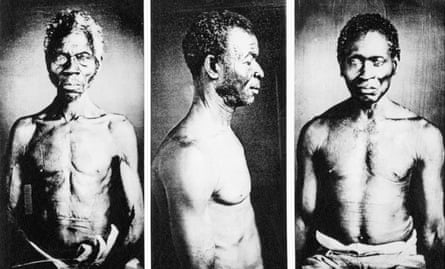
Photographs of enslaved people in the US, possibly the oldest known in the country, were discovered in the basement of a Harvard University museum in 1977. Photograph: Bettmann Archive
Harvard is not the only academic institution with this burden. Currently more than 100 universities across the world are investigating their ties to slavery, the vast majority of which are in the US. A small subset of the universities researching their ties to slavery – approximately five – have committed to conducting genealogical research and identifying living descendants. Religious denominations such as the Episcopal church and the Evangelical Lutheran church and more than a dozen cities and four states have also begun researching their legacies of slavery. The California state reparations taskforce published a 1,000-page report two years ago, and state legislators have been developing – and passing – reparations-related initiatives.
The Guardian, founded in 1821 in Manchester, England, began its own process in 2020, when its sole owner, the Scott Trust, commissioned independent academic researchers to uncover its links to transatlantic slavery. It revealed that the newspaper’s founder, John Edward Taylor, and nine out of 11 of his financial backers had direct ties, mainly through Manchester’s cotton industry. In 2023, the Scott Trust apologized for its role in transatlantic slavery and committed to a 10-year restorative justice program, with millions earmarked for descendant communities. That year, the Guardian also launched an ongoing series called Cotton Capital, which explores the legacies of slavery globally.
The 2022 Harvard report included a list of recommendations by the presidential committee: develop educational partnerships with historically Black colleges and universities, create a public memorial, and – perhaps most contentiously – identify living descendants of people enslaved by university staff, leaders and faculty. The announcement was accompanied by a $100m endowment for “implementation”.
The person the university tapped to lead the descendant research is a man named Richard Cellini, who has a kind of mythological status in the world of institutional accountability and slavery research. By his own admission, his skill lies primarily in selecting talented researchers, and “keeping them happy”. The university, it seemed, was fully committed to beginning a process of discovery and atonement, putting resources and brainpower behind a project that could set the tone for institutions around the country, and the world. If successful, Harvard could demonstrate that truth-telling and reconciliation are possible on a large scale, that an institutional culture around silence and historical revisionism can be overturned, and that light can shine into even the deepest cracks. But that would ultimately not be the case. Not yet, at least.
‘A source of guilt and shame for Harvard’
When I visited Cellini in the archives of the Harvard Business School in mid-February, he was bent over a 19th-century ledger book, trained on a set of records with a magnifying glass. He is a trained attorney and tech entrepreneur, and though jovial and quick to joke, he becomes stoic when speaking about his research.
In 2015, he started an independent project at Georgetown University in Washington DC to locate the descendants of 272 enslaved people sold by Jesuit leaders in the mid-1800s to raise money for the university. Cellini said he was driven by a sense of moral outrage upon learning about the sale, as well as a curiosity to see what he could find. Along with 10 other researchers, they would eventually locate more than 10,000 direct descendants. Cellini’s effort, called the Georgetown Memory Project, remains independent although the university has given preferential consideration during the admissions process to descendants and created a “reconciliation fund’ for their benefit.
In the winter of 2022, before the Harvard report was made public, Cellini said he was approached by the former president of the school, Larry Bacow, and a dean, Tomiko Brown-Nagin, who asked him if he could do the same thing for Harvard.
When he started the research, Harvard had already identified the names of 70 people that had been enslaved with ties to the university. Over the course of the past three years, working alongside American Ancestors, the country’s pre-eminent genealogical institute, Cellini and his researchers have identified more than 900 people that had been enslaved by university affiliates (faculty, staff and people in leadership positions) and nearly 500 of their direct living descendants.
It wasn’t long after the work began to pick up steam that Cellini started running into trouble.
In March 2023, he said he was asked to meet with the project’s executive director, Roeshana Moore-Evans, and the Harvard staff member overseeing the initiative, the public health professor and vice-provost for special projects, Sara Bleich.
These informal meetings were held in a boardroom in the student center, a tall glass building overlooking the gates of Harvard Yard. It was here and during extended phone calls that Cellini claims he was told repeatedly by Bleich “not to find too many descendants”.
“At one point the fear was expressed that if we found too many descendants, it would bankrupt the university,” he said.
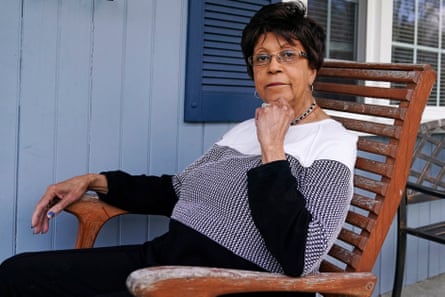
Roberta Wolff, a descendant of Tony, Cuba and Darby Vassall – people enslaved by Harvard benefactors in the institution’s first decades – on the front porch of her family home in 2022 in Bellingham, Massachusetts. Photograph: Charles Krupa/AP
Cellini told Bleich that was “ludicrous”, he said. Was he supposed to falsify the evidence, to destroy it, to ignore it? “I asked for guidance, and the answer was that she didn’t know,” he said, “but we shouldn’t report too many descendants.”
Bleich denies this. “The university never issued a directive to him to limit the number of direct descendants that could be identified through the work,” she told the Guardian during a phone interview. Moore-Evans declined to comment on the meetings.
In the process of trying to get additional funding for the project, arguing that the amount of work had increased tenfold because of all the additional names that were being uncovered, Cellini met with the finance director for the president’s office, Patricia Harrington, this past fall.
Harrington wouldn’t give him a clear answer about his funding request, telling him, “Unfortunately you keep finding more slaves,” he said, and that “every new person is a source of guilt and shame for Harvard”. A spokesperson for the university said: “Any assertion that Patricia Harrington disparaged the work of the Legacy of Slavery Initiative, including descendant research, is false.” Even though Cellini was eventually given a budget for 2025, albeit a fraction of what he had asked for, the university would soon halt his work entirely.
A family’s rich history tied to the founding of the US
The early days of discoverywere a golden time for Lloyd and her immediate family. Together with Lloyd’s father, Dennis, and Chen, they would meet over Zoom and swap stories. Her dad was sharing parts of family history that Lloyd had never heard before: about his soft-spoken mother and his dad, who owned a flower shop in a neighborhood of Boston called Charlestown.
“People will open up to a stranger in a way that’s more honest and unfiltered, wanting to be thorough in a way that you would never with your family,” Lloyd said. Chen, in turn, detailed the findings of her research to the Lloyds and they began to fill in their histories, tracing connections to the colonial period and height of the “triangular trade”.
Lloyd’s ancestor seven generations back, Cuba Vassall, was three years old when she was forcibly moved from Antigua to a suburb of Boston along with her family by Isaac Royall Jr, in 1737. The Royalls were the largest slave-owning family in the Massachusetts Bay Colony, owning nearly 70 enslaved people who labored on a 500-acre plantation just north of Boston, as well as controlling more than 100 people on their plantation in Antigua.
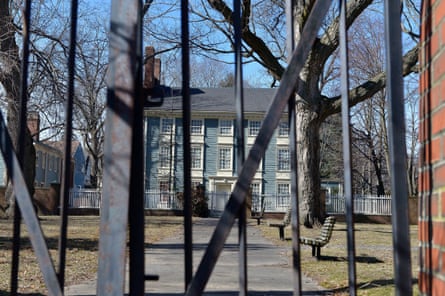
Before long, Lloyd’s ancestors were transferred to another wealthy Cambridge family, the Vassalls, for whom they labored in an elaborate Georgian mansion currently known as the Longfellow House, near the campus of the then growing Harvard University.
The Vassalls owned plantations in Jamaica where more than a thousand people were enslaved. John Vassall was a Harvard graduate, along with his brother Lewis, who once paid for a portion of his tuition with a large barrel of sugar, one of the most lucrative commodities produced by enslaved people. Cuba’s original enslaver, Isaac Royall Jr, didn’t have any direct ties to Harvard while he was living, but he endowed a professorship in his will, likely to ensure his legacy would live on as a member of the colonial elite. The seal of Harvard Law School was the Royall family crest until 2016, when students protested to demand its replacement. The Royall professorship was retired in 2022.
At the Longfellow House, Cuba met and married a man named Tony, originally from Jamaica, who was also enslaved by the Vassalls. They had six children, including Lloyd’s ancestor Darby. During the American revolutionary war, the royalist Vassalls fled and the house was occupied by George Washington, who used it as his headquarters during the siege of Boston. According to one anecdote, Washington asked then six-year-old Darby to work for him, who replied he wouldn’t work without wages.
After the war, Tony and Cuba petitioned the state to stay in a small dwelling on the property, where they cultivated a piece of land for farming. They had both spent 60 years of their life in slavery, Tony wrote in the 1781 letter, and “though deprived of what makes them now happy beyond expression yet they have ever lived a life of honesty and have been faithful in their master’s service”.skip past newsletter promotion
Sign up to Cotton Capital
Free weekly newsletter
A behind the scenes look at the Cotton Capital project, direct to your inbox for 15 weeks
Enter your email addressSign upPrivacy Notice: Newsletters may contain info about charities, online ads, and content funded by outside parties. For more information see our Privacy Policy. We use Google reCaptcha to protect our website and the Google Privacy Policy and Terms of Service apply.
after newsletter promotion
He appealed to the court’s sense of morality, writing: “They shall not be denied the sweets of freedom the remainder of their days by being reduced to the painful necessity of begging for bread.” His petition to stay in the house was refused, but Tony was given an annual pension, one of the earliest examples of a formerly enslaved person receiving compensation.
The Isaac Royall house and slave quarters in Medford, Massachusetts. Photograph: Paul Marotta/Getty Images
Tony’s son Darby went on to become an important figure in the burgeoning free Black community of Boston. He was an activist throughout his life, supporting the abolitionist movement, becoming a founding member of the African Society of Boston and adding his name to a state petition to protect Black people against the Fugitive Slave Act, along with his daughter and son-in-law.
At the end of his life, Darby chose to be buried in the Vassall family tomb underneath Christ Church in Cambridge, which Lloyd and her family went to visit last June. The tomb is in the basement, in a low-ceilinged crypt locked behind heavy black metal doors, and a couple inches of a curved brick structure, peeking above the granite dust floor, is the only indication. A dried flower arrangement that Lloyd left is still there, a tidy pile of lavender, white chrysanthemum and clover.
Making these connections and being able to visit her ancestor’s grave brought Lloyd a deep sense of “internal certainty and peace and comfort and groundedness”, she said. “I would want that for everyone whose family is somehow affiliated.” Yet the joy and excitement comes with a “deep sadness”.
“Why hasn’t this been resolved?” she wondered aloud during an interview phone call. “Why did no one in my family know?”
Lloyd’s only contact from the administration, she said, was an “icy” interaction with Brown-Nagin during a group call, and she has heard nothing since. “Naively, I was expecting them to be very welcoming and excited to facilitate discussion,” she said. “I was hoping they would be warmer, more open to reconcile the long history.” The university says it has not begun the outreach process.
Since the initiative was announced, the university has given out more than $4m in grants to local organizations and built out partnerships with historically Black colleges and universities, such as the Du Bois Scholars Program.
“This is by far the hardest job that I’ve had,” Bleich, who oversees the Harvard Legacy of Slavery initiative, said. “We are very serious about this, and we are very sincere.”
Firings, resignations and attempts to ‘dilute and delay’ research
In late January, as he was pulling his car into the parking lot of Harvard Business School, prepared to begin another day of research in the university archives, Cellini received a call from an HR person that said him and his team were fired, effective immediately.
He was never given an explanation, he said, and a university spokesperson told the Guardian “we cannot comment on personnel matters”. The genealogy research, the university announced after Cellini’s firing, would be continued through an “expanded partnership” with American Ancestors, the genealogy non-profit that had already been working closely with Cellini’s team.
“They’re the world’s best genealogists,” Cellini said. Based on his team’s research in the Harvard archives identifying school leaders, faculty or staff who owned enslaved people and the names of the people they enslaved, American Ancestors would then search “downstream”, as Cellini put it, for living descendants. In this new agreement, the organization has taken over all aspects of the research.
The initiative received its first public blow last spring, when two university professors on the committee to create a memorial stepped down, saying in an open letter the university had attempted to “dilute and delay” their efforts to reach out to descendants. The committee was formed in 2023, based on one of the recommendations of the Harvard & the Legacy of Slavery report to “honor enslaved people through memorialization”. In a statement made to the student newspaper, a spokesperson for the university said it “take[s] seriously the co-chairs’ concerns about the importance of community involvement and of taking steps that will enable Harvard to deeply engage with descendant communities”.
A couple weeks later, the executive director of the initiative, Moore-Evans, stepped down, after reporting conflicts with the university administration to HR. She told the Guardian that she left for “personal reasons”.
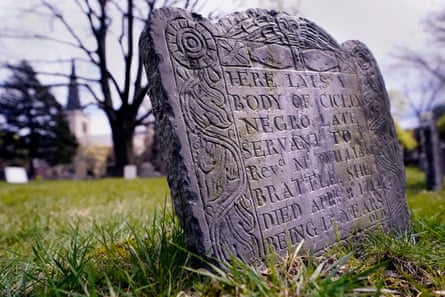
The grave of Cicely, a 15-year-old ‘Negro servant’ of the Rev William Brattle, a treasurer at Harvard College, at the Old Burying Ground just outside Harvard Yard on 27 April 2022, in Cambridge, Massachusetts. Photograph: Charles Krupa/AP
Cellini suspects the reason he was fired is simple: “We found too many slaves.” The university was afraid that identifying descendants would bankrupt the university and so each name that his team identified was “expensive”, he said. The work that he oversaw is “just the tip of the iceberg”, he added, estimating that the numbers of living descendants could be about 10,000 people.
Cellini had just come back from Antigua a couple days prior, where his team had visited the site of the Royall plantation as well as four other plantations with ties to the university. They also found a hundred additional names of enslaved people with ties to the university in public archives, he said.
Cellini and his team met with the prime minister and governor general of Antigua, who had expressed interest in working with the university to explore this connection. Cellini said he detailed his meetings with the politicians to the university, but those requests were never answered and he was fired shortly after.
The Antiguan ambassador to the US, Sir Ronald Sanders, wrote a letter to the university after learning that Cellini was fired, writing that the decision was made “without consultation or notification”. The country wants “real engagement and meaningful action that befits the benefits that Harvard derived”, he wrote.
“We would not expect a cash payment from Harvard,” a spokesperson added. “However, so well-endowed a university with expertise in a number of areas can be helpful to our country.” The cabinet discussed the possibility of Harvard funding ancestry research to identify descendants of Antiguans that were brought to colonial Massachusetts, and seeking the university’s assistance in public health matters to address the high rates of chronic illness on the islands. A spokesperson for Harvard said a letter had been sent in response, but refused to elaborate. The spokesperson for Antigua said, “I have not seen a response,” and could not confirm if a response had been received.
Lives ‘spent and exhausted’ for the production of sugarcane
The Royall plantation, which likely stretched across 200 acres down to Port Royal Bay, enslaved more than 100 people. Only the ruins of the sugar windmill remain, on private property.
The stone structure stands a hundred feet tall on a grassy field bordering some woods. Here, enslaved people lived and worked on a plantation, feeding sugar cane into metal rollers through a dangerous and physically exhausting process to make syrup.
“It’s pretty visceral,” Cellini said about visiting the site. “This is where lives were spent and exhausted and consumed for the production of sugarcane, for the wealth of the British empire.”
The Isaac Royall House and Slave Quarters in Medford, Massachusetts. Photograph: Paul Marotta/Getty Images
Ever since being contacted by Chen, Lloyd has felt the weight of her family history and a sense of responsibility. Her ancestors repeatedly petitioned for their freedom, for their rights and their humanity. Darby and his sister Flora had both been separated from their family by their enslavers as young children. Tony Vassall bought his daughter’s freedom, and when his enslaver died by injuries sustained at the battle of Bunker Hill, six-year-old Darby walked 10 miles home to his family. The family had been staunch abolitionists and activists, suffered through bondage, and fought for their freedom. Lloyd struggles with where that leaves her.
“I just don’t know where to begin,” Lloyd said. She considers taking to social media, calling the administration and making demands. Should she protest? She doesn’t know. Lloyd’s sister, who declined to be interviewed for this article, went to Antigua and Lloyd said she’s also interested in going. “I would go anywhere to talk to anyone at this point,” she said. “Except Harvard, because there’s no one I really trust there right now.”
“I feel like I’m still close to the explosion,” she said. “My ears are still ringing.”
This article was amended on 21 June 2025. John Vassall was a Harvard graduate, not John Edward Taylor, as the story originally said.
Technologist Tristan Harris has an urgent question: What if the way we’re deploying the world’s most powerful technology — artificial intelligence — isn’t inevitable, but a choice? In this eye-opening talk, he calls on us to learn from the mistakes of social media’s catastrophic rollout and confront the predictable dangers of reckless AI development, offering a “narrow path” where power is matched with responsibility, foresight and wisdom.
Debra’s life took a dramatic turn when she became the central figure in Hopkins’ best-selling book, Intruders, and in its popular TV adaptation. In Extraordinary Contact, Debra shares with the reader her close-up and personal experiences with UFOs, poltergeists, the afterlife, Electronic Voice Phenomena, premonitions, synchronicities, and non-human entities.
“Russell Targ is a parapsychological genius. He is one of the most successful and insightful parapsychologists in history. He is a man of magic! I am proud to call him my friend; and I am delighted to be able to share with readers fifteen of my conversations with this great soul.” Jeffrey Mishlove, PhD
To write Listening When Parts Speak, Floyd draws on 20-plus years of experience as a psychotherapist, teacher, consultant, and coach specializing in healing trauma, and in particular, intergenerational trauma. Each chapter offers lucid explanations of key concepts, illustrative stories from patients (as well as Floyd’s own experience), and a guided meditation that can be used either in between therapy appointments to support and reinforce the work or as a way to begin an IFS therapy journey.
Pioneering psychiatrist Bernard Beitman, MD, explores the experience and ramifications of meaningful coincidences, including how synchronistic happenings came to define his own life. Building on Carl Jung’s groundbreaking work on this phenomenon, Beitman applies new insights on coincidence, synchronicity, serendipity, and related phenomena to the contemporary age, ultimately helping readers begin to better identify patterns of synchronicity in their own lives, find deeper meaning, and more consciously align with their personal life path and goals.
You are looking at a photograph of the planet Pluto, taken in 2015 by NASA’s New Horizon spacecraft. Pluto is considered a “dwarf planet.” It is roughly two-thirds the size of Earth’s moon. It is located approximately three billion miles from Earth. This image shows that the surface of Pluto is shrouded in an atmospheric haze, containing a chemically rich melange of nitrogen, methane, and carbon monoxide. (Featured Image from New Thinking Allowed)
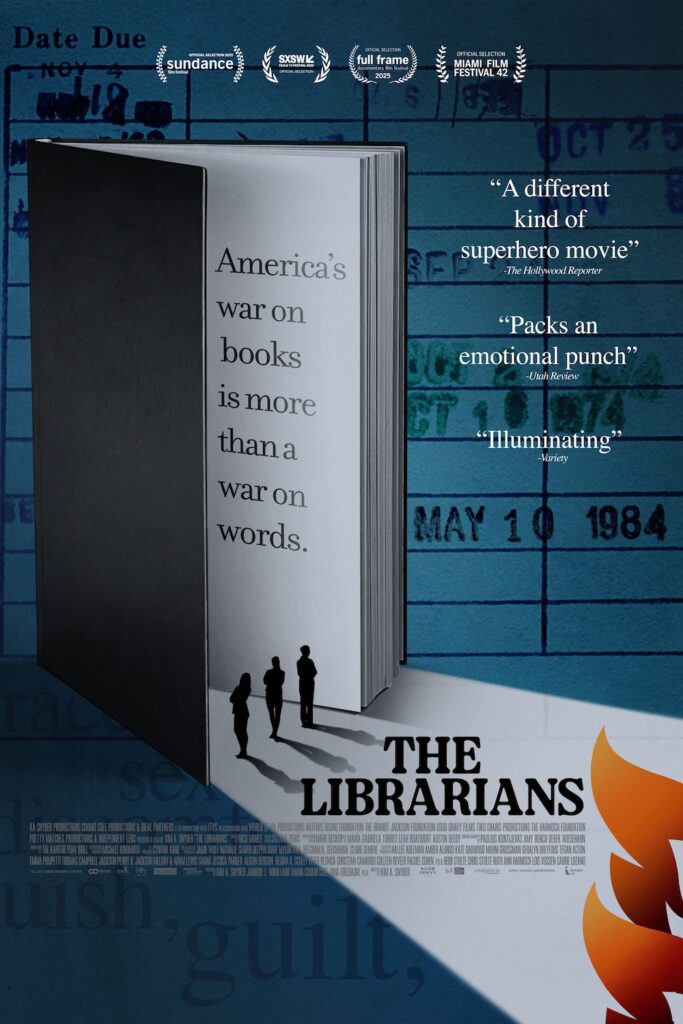
Florida elementary school librarian Marie Masferrer, one of the subjects of the documentary The Librarians, screening Sat/21 as part of Frameline (tickets are at rush), thought the principal was on her side when it came to the subject of keeping books on the shelves for students to read despite pressure from the state.
That is, until the principal pulled several LGBT titles.
Masferrer wasn’t having that, and went so as far as to tell kids at their fifth-grade graduation, “Once anyone tries to ban a book, I always ask why.” The principal responded by forbidding Masferrer from speaking at upcoming award ceremonies.
“The union came to my defense and got me back on campus, and the district backed me up,” Masferrer tells 48hills. “I think that made her even more angry. She locked me in the library and threatened my job. So, I had a teeny, tiny piece happen to me that happened to all the other librarians.”
Oscar-nominated filmmaker Kim A. Snyder’s documentary, executive produced by Sarah Jessica Parker, travels to Texas, Florida, Louisiana, New Jersey, and other states to shine a light on the conservative war on books. The movie tracks how politicians, school boards, and the curiously well-funded Moms for Liberty’s determination to keep subjects they deem to be inappropriate out of students’ hands. Librarians, at the risk of their careers and standing in their churches and communities, are shown being equally dedicated to ensuring those books remain available.
What ignited Snyder’s interest in the subject was a list of 850 books compiled by Texas Representative Matt Krause in 2021 that he said, “might make students feel discomfort.” It had a heavy emphasis on titles with LGBT, civil rights, and even historical subject matter. Among its volumes are Isabel Wilkerson’s Caste, Rob Sanders’ Pride: The Story of Harvey Milk and the Rainbow Flag, Ibram X. Kendi’s How to Be an Antiracist, Jazz Jennings’ Being Jazz: My Life as a (Transgender) Teenager, and Jeffrey Eugenides’ Pulitzer Prize-winning novel Middlesex.
“When I saw the story about the list, it felt like the match,” Snyder says. “Reading about these freedom fighters, these librarians who were organizing to fight back… I started following and met Marie and others.
“You can throw a dart at the country map and see this spread,” she adds. “We have librarians in lots of different places saying, ‘You know, this happened to me.’”
Sponsored link
Masferrer points out the issue isn’t just about the First Amendment and the right to read, but also the fact that the very books that tend to end up on banned lists are the ones most vital to students at vulnerable times in their lives.
The principal who locked Masferrer in the library was also the person who alerted her that there were two trans children enrolled in their school. The librarian responded by adding Jennings’ book and a few others so those students would have books to read that would reflect their experiences. When a Florida House bill targeted school libraries and specifically books with LGBT content, one of the students asked Masferrer what was going to happen to the books in their library.
“I promised them, I said, they’ll have to haul me out in handcuffs [before they take those books away],” she says. “But I am not giving up one of my books, because in elementary school, every book, every LGBTQ-focused or one that has characters, it’s about acceptance of yourself, acceptance of others, and kindness.
“And I came to the schoolboard, and I said, just replace LGBTQ with Black, and we’re back to 1952. To me, I see it the same way.”
The Librarians paints a damning portrait of what librarians are facing in our authoritarian age. Masferrer observes that some of her colleagues crumble and acquiesce to the bans. But the heroines of Snyder’s film—all of the librarians are women, to be expected for a profession in which over 80 percent are female—are united in their passion for maintaining the integrity of their institutions and the availability of books.
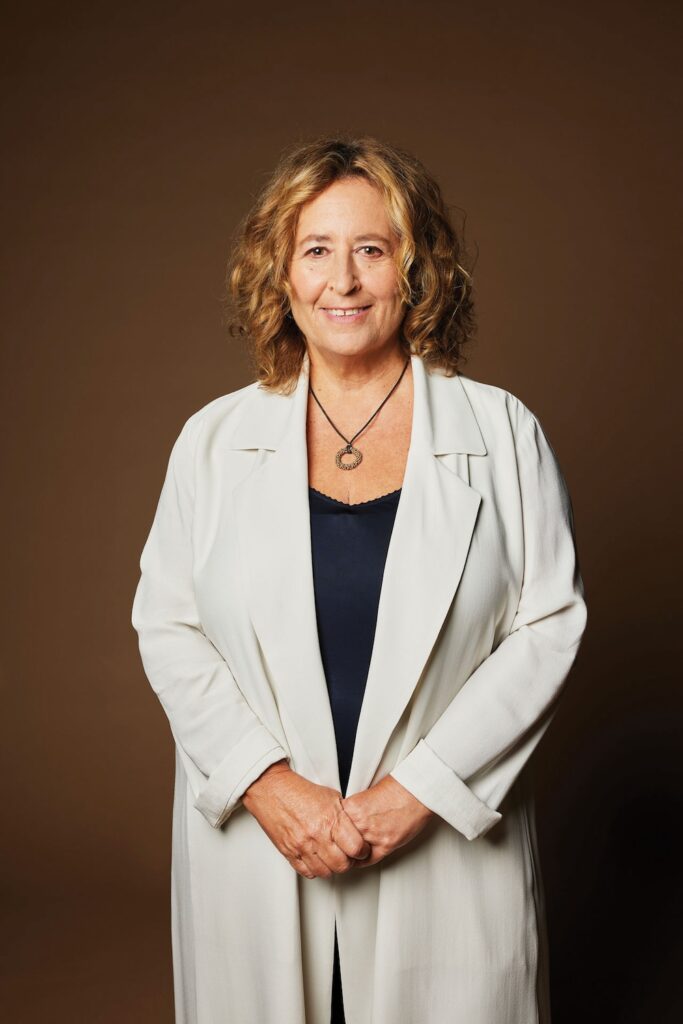
Director Kim A. Snyder
In their actions and spirit, Snyder sees a lesson.
“I think there’s modeling and an opportunity in the film for people to feel that, even if you feel helpless and hopeless at times with what’s going on a national level, you have agency in your little local community,” Snyder says. “That grassroots spirit is what I have hope in right now in this country.”
Masferrer also sees a lesson in The Librarians, one that is personal to her as part of her role as the conduit between books and their readers.
“When you see yourself in a book of any color, any background, any orientation, when you see yourself in the book, then you get it,” she says. “And that’s really what I’d like to do. Anyone who wants to ban a book, I would like to hand them a book that is truly a reflection of who they are, because it really brings home why these books make such a difference to all of our kids.”
WASHINGTON, DC—The Department of Health and Human Services issued a series of guidelines Monday designed to help parents curtail their children’s boundless imaginations, which child-safety advocates say have the potential to rival motor vehicle accidents and congenital diseases as a leading cause of disability and death among youths ages 3 to 14.
“Defuse the ticking time-bomb known as your child’s imagination before it explodes and destroys her completely,” said child-safety expert Kenneth McMillan, who advised the HHS in composing the guidelines. “New data shows a disturbing correlation between serious accidents and the ability of children to envision a world full of exciting possibility.”
The guidelines, titled “Boundless Imagination, Boundless Hazards: Ways To Keep Your Kids Safe From A World Of Wonder,” are posted on the HHS website, and will also be available in brochure form in pediatricians’ offices across the country.
According to McMillan, children can suffer broken bones, head trauma, and even fatal injuries from unsupervised exposure to childlike awe. “If your children are allowed to unlock their imaginations, anything from a backyard swing set to a child’s own bedroom can be transformed into a dangerous undersea castle or dragon’s lair,” McMillan said. “But by encouraging your kids to think linearly and literally, and constantly reminding them they can never be anything but human children with no extraordinary characteristics, you can better ensure that they will lead prolonged lives.”
Although the exact number of child fatalities connected to an active imagination is unknown, experts say the danger is very real. According to a 2006 estimate, children who regularly engage in imagination are 10 times more likely to suffer injuries such as skinned knees from mythical quests, or bruises and serious falls from the peak of Bookcase Mountain.
One of the HHS recommendations emphasizes increased communication between parents and children about the truths behind outlandish fantasies. “Speak with your children about the absolute impossibility of time travel, magical powers, and animals and toys that talk when adults are not around,” reads one excerpt. “If this fails to quell their imaginations, encourage them to stare at household objects and think clearly and objectively about their actual, physical characteristics.”
The HHS also discourages aimless playtime activities that lack a rigid, repetitive structure: “Opt instead for safe activities like untying knots, sticking and unsticking two pieces of Velcro, drawing straight lines of successively longer lengths, and quietly humming a single note for two to three hours.”
But even these relatively safe activities can become imaginative, experts warn, without proper precautions. “Do not let children know that, for example, sailors and pirates untie knots,” McMillan said.
Although no cure has yet been developed for childhood imagination, preventative measures can deter children from potentially hazardous bouts of make-believe.
“Many of the suggestions are really quite simple, like breaking down cardboard boxes or sewing cushions to couches so they cannot be converted into forts or playhouses,” McMillan said. “Blank pieces of paper, which can inspire non-reality-based drawings, should be discarded unless they are used in one of our recommended diagonal folding and unfolding activities. And all loose sticks left lying in the yard should be carefully labeled ’Not a Sword.’”
Unfortunately, removing everything from a child’s field of view that could stimulate his active young mind is extremely time-consuming, and infeasible as a long-term solution, McMillan acknowledges. “To truly protect your children, you must go to great lengths to completely eliminate their curiosity, crush their spirit of amazement, and eradicate their childlike glee. Watch for the danger signs: faraway expressions, giggle fits, and a general air of carefree contentment.”
Added McMillan: “Remember, if you see a single sparkle of excitement in their eyes, you haven’t done enough.”
New Thinkin Jun 18, 2025 The late William Bengston served as president of the Society for Scientific Exploration. He is author of The Energy Cure: Unravelling the Mystery of Hands-On Healing. He was a professor of sociology at St. Joseph’s College in New York. In this interview, rebooted from 2019, he describes how he began his investigations as a young man who encountered a psychic healer who served as his mentor and friend. When his friend backed out of participation in a healing experiment with cancer-injected mice, Bengston stepped in unwillingly. To his astonishment, after several healing sessions, the mice were completely cured. This result has now been replicated numerous times. Bengston discusses his approach to healing research and his attitude toward healing. New Thinking Allowed host, Jeffrey Mishlove, PhD, is author of The Roots of Consciousness, Psi Development Systems, and The PK Man. Between 1986 and 2002 he hosted and co-produced the original Thinking Allowed public television series. He is the recipient of the only doctoral diploma in “parapsychology” ever awarded by an accredited university (University of California, Berkeley, 1980). He is also the Grand Prize winner of the 2021 Bigelow Institute essay competition regarding the best evidence for survival of human consciousness after permanent bodily death. He is Co-Director of Parapsychology Education at the California Institute for Human Science. (Recorded on February 3, 2019)
New Thinking Jun 19, 2025 Hakim Isler is the founder and owner of Elite Guard, LLC, a martial arts, fitness and security training company. He has been involved in the martial arts for 22 years and in the security field for eight years. He also developed and instructed military combative systems for the United States Army. He is author of five books in the martial arts and survival fields. Now he is organizing the Psi Games International. The website for this event is https://psigamesinternational.com/ Psi Games International is a groundbreaking event including lectures, workshops, and demonstrations of paranormal abilities. The featured event will be a competition among skilled contestants in five different areas: Remote Viewing, Mind Sight, Precognition, Psychokinesis, and Dowsing. The event is scheduled to be held in Charlottesville, VA, in early August 2025. 00:00 Introduction 04:24 The Psi Games vision 10:56 The Roger Bannister effect 14:51 Is competition psi-conducive? 19:41 Sharing esoteric knowledge 23:49 What will the event be like? 28:06 Ethics and paradigms 33:53 Community building 39:03 Conclusion
New Thinking Jun 20, 2025 This video is a special release from the original Thinking Allowed series that ran on public television from 1986 until 2002. It was recorded in about 1987. It will remain public for only one week. David White is author of several books of poetry and a book of prose and poetry, The Heart Aroused. Whyte maintains that poetry provides a treasure of wisdom that gives guidance in times of crisis. The insights of poetry can facilitate an awakening of vision and a breakthrough from the paralysis caused by confusion, doubt and humdrum routine. Now you can watch all of the programs from the original Thinking Allowed Video Collection, hosted by Jeffrey Mishlove. Subscribe to the new Streaming Channel (https://thinkingallowed.vhx.tv/) and watch more than 350 programs now, with more, previously unreleased titles added weekly. Free month of the classic Thinking Allowed streaming channel for New Thinking Allowed subscribers only. Use code THINKFREELY.
Consciousness, spirituality, biography, sexuality, androgyny, futurism, space, the arts, science, astrology, democracy, humor, books, movies and more