
The Chris Hedges YouTube Channel May 30, 2025 Chris Hedges and novelist Eiren Caffall discuss the importance of Moby Dick, and American culture’s reluctance to face death and resist greed.
Monthly Archives: May 2025
June Astrology Forecast 2025
The Astrology Podcast May 30, 2025 A look ahead at the astrological forecast for June of 2025, with astrologers Chris Brennan and Leisa Schaim! We spend the first hour of the episode talking about the astrology of news and events that have occurred since our last forecast, and then in the second hour we transition into talking about the astrology of June. June opens with Venus and Mars wrapping up their extended retrograde periods by moving into new signs finally, with Venus moving into her home sign of Taurus and Mars moving into Virgo. A major shift this month is Jupiter moving into Cancer, which is the traditional sign of its exaltation, where it will stay for the next year. There are some tense alignments in the middle of the month, with an explosive Mars-Uranus square around June 15, and restrictive Jupiter-Saturn square going exact on the same day. By the end of the month Saturn has moved within 1 degree of a conjunction with Neptune, making that alignment peak in intensity, blurring the lines between what is real and what is not. This is episode 491 of The Astrology Podcast.
What if this were the motto of The Prosperos?
“Not for kings. Not for glory. For the one next to me.”
Oct 15, 2021 In an attempt to connect with a suspect he served with in Afghanistan, Halstead (Jesse Lee Soffer) shows up at a veterans’ support meeting.
The Reemergence of Social Darwinism
The 19th-century doctrine that most closely resembles Trumpism
MAY 29, 2025 (robertreich.substack.com)
Friends,
Cut Medicaid to give billionaires a huge tax cut. But why?
They say they want a smaller government, but that can’t be it.
Most seek a larger national defense and more muscular homeland security. Almost all want to widen the government’s powers of search and surveillance inside the United States — expunging undocumented immigrants, “securing” the nation’s borders. They want stiffer criminal sentences. Many also want government to intrude on the most intimate aspects of private, intimate life.
Many call themselves conservatives, but that’s not it, either.
They don’t want to conserve what we now have. They’d rather take the country backward — before the Environmental Protection Act, before Medicare and Medicaid, before the New Deal and its provision for Social Security, unemployment insurance, the 40-hour workweek, before official recognition of trade unions, even before the first national income tax, antitrust laws, and Federal Reserve.
Some say they want the American working class to do better. But that can’t be it, either, because they’re cutting Medicaid and other safety nets the working class depends on in order to finance a huge tax cut for the super-rich. And they support tariffs that will drive up the costs of just about everything the working class buys.
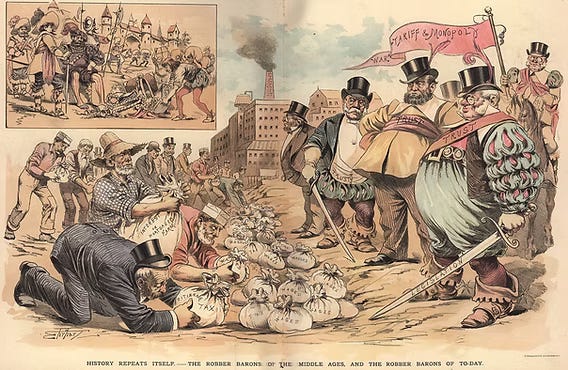
The America they actually seek is the one we last had in the Gilded Age of the late 19th century.
“We were at our richest from 1870 to 1913. That’s when we were a tariff country. And then they went to an income tax concept,” Trump said in January.
Yes, we had tariffs during that Gilded Age. It was also an era when the nation was mesmerized by the doctrine of free enterprise, although few Americans actually enjoyed much freedom.
Robber barons such as financier Jay Gould, railroad magnate Cornelius Vanderbilt, and oil tycoon John D. Rockefeller controlled much of American industry.
They corrupted American politics. Their lackeys literally deposited sacks of money on the desks of pliant legislators.
The gap between rich and poor turned into a chasm. Urban slums festered. Women couldn’t vote. Black Americans were subject to Jim Crow.
Most tellingly, it was a time when the ideas of William Graham Sumner, a professor of political and social science at Yale, dominated American social thought.
Sumner brought Charles Darwin to America and twisted him into a theory to fit the times.
Few Americans living today have read any of Sumner’s writings, but they had an electrifying effect on America during the last three decades of the 19th century.
To Sumner and his followers, life was a competitive struggle in which only the fittest could survive — and through this struggle, societies became stronger over time.
A correlate of this principle was that government should do little or nothing to help those in need, because that would interfere with natural selection.
Listen to today’s Republican debates and you hear a continuous regurgitation of Sumner. As Sumner wrote in the 1880s:
“Civilization has a simple choice [of either] liberty, inequality, survival of the fittest [or] not-liberty, equality, survival of the unfittest. The former carries society forward and favors all its best members; the latter carries society downwards and favors all its worst members.”
Sound familiar?
Trump and his Republicans on Capitol Hill not only echo Sumner’s thoughts but mimic Sumner’s reputed arrogance. They say we must reward “entrepreneurs” (by which they mean anyone who has made a pile of money) and warn us not to “coddle” people in need (for example, they want to put work requirements on Medicaid).
They oppose extending unemployment insurance because, they say, we shouldn’t “give people money for doing nothing.”
Sumner, likewise, warned against handouts to people he termed “negligent, shiftless, inefficient, silly, and imprudent.”
Trump and other Republican lawmakers are dead set against raising taxes on billionaires, relying on the standard Republican trickle-down rationale that billionaires create jobs.
Here’s Sumner, more than a century ago:
“Millionaires are the product of natural selection, acting on the whole body of men to pick out those who can meet the requirement of certain work to be done. … It is because they are thus selected that wealth aggregates under their hands – both their own and that intrusted to them … They may fairly be regarded as the naturally selected agents of society.” Although they live in luxury, “the bargain is a good one for society.”
Social Darwinism offered a moral justification for the wild inequities and social cruelties of the late 19th century — the era when, according to Trump, “we were richest.”
Social Darwinism allowed John D. Rockefeller to claim the fortune he accumulated through his giant Standard Oil Trust was “merely a survival of the fittest.” It was, he insisted, “the working out of a law of nature and of God.”
Social Darwinism also undermined all efforts at the time to build a nation of broadly based prosperity and rescue our democracy from the tight grip of a very few at the top. It was used by the privileged and powerful to convince everyone else that government shouldn’t do much of anything.
Not until the 20th century did America reject Social Darwinism. Instead of Social Darwinism, we created an inclusive society. We created the largest middle class in the history of the world — which became the core of our economy and democracy.
We built safety nets to catch Americans who fell downward through no fault of their own. We designed regulations to protect against the inevitable excesses of free-market greed.
We taxed the rich and invested in public goods — public schools, public universities, public transportation, public parks, public health — that made us all better off.
In short, we rejected the notion that each of us is on his or her own in a competitive contest for survival. We depended on one another.
But now America is in its Second Gilded Age, and its new robber barons have found the same rationale as they did in the First.
Under Trump and his lapdogs in the House and Senate, Social Darwinism is back.
Why does uncertainty bother us so much?
Adam Kucharski | TEDxLondon
• January 2025
Why do we find it easier to trust some concepts and ideas over others? Mathematician and TED Fellow Adam Kucharski explores the science of uncertainty, revealing how the very human need for explanation shapes trust in science, fear of technology and belief in conspiracy theories.
Want to use TED Talks in your organization?
About the speaker
Pierre Teilhard de Chardin on the divine

Weekly Invitational Translation: With age, cataracts can obscure vision and lead to blindness.
Translation is a 5-step process of “straight thinking in the abstract” comparing and contrasting what seems to be truth with what you can syllogistically, axiomatically and mathematically (using word equations) prove is the truth. It is not an effort to change, alter or heal anything.
The claims in a Translation may seem outrageous, but they are always (or should always be) based on self-evident syllogistic reasoning. Here is one Translation from this week.
1) Truth is that which is so. That which is not truth is not so. Therefore Truth is all that is. Truth being all is therefore total, therefore whole, therefore one, therefore pure (not mixed with anything else), therefore united, therefore harmonious, therefore orderly, therefore precise, therefore purposeful. I think therefore I am. Since I am and since Truth is all that is, therefore I, being, am Truth. Since I, being, am Truth, therefore I, being, have all the attributes of Truth. Therefore I, being, am total, whole, one, pure (not mixed with anything else), united, harmonious, orderly, precise, purposeful. Since I am mind (self-evident) and since I (being) am Truth, therefore Truth is Mind. (Two things equal to a third thing are equal to each other.) Since Truth is Mind, therefore Mind has all the attributes of Truth. Therefore Mind is total, whole, one, pure (not mixed with anything else), united, harmonious, orderly, precise, purposeful.
2) With age, cataracts can obscure vision and lead to blindness.
Word-tracking:
cataract: obstruction of the eye, opposite of transparent
old: aged, adult, completely grown, mature
vision: to see
see: to perceive, to follow, to know
blind: blend, to mix, to make dark, to confuse, to obscure
dark: to hide, to make obscure
3) Truth being Mind and Truth being without limit, therefore without beginning or ending, therefore Mind is infinite, ageless. I, being Truth being Mind, therefore I (the Universal I) am ageless. Truth being Mind, being knowing, cannot at the same time be “not knowing,” obscure, hidden, dark, therefore Truth/Mind is always apparent, always transparent, always the light OR The Right is the Light. Mind being one, there is nothing other than Mind to obscure or hide anything, therefore Mind is unobstructed vision.
4) Mind is infinite, ageless.
I (the Universal I) am ageless.
Truth/Mind is always apparent, always transparent, always the light OR The Right is the Light.
Mind is unobstructed vision.
5) The Right is the Light.
Weekly Invitational Translation Group invites your participation. If you would like to submit a Translation on any subject, feel free to send your weekly Translation to zonta1111@aol.com and we will anonymously post it on the Bathtub Bulletin on Friday.
For information about Translation or other Prosperos classes go to: https://www.theprosperos.org/teaching.
Tarot Card for May 30: Art

| Art At its highest possible level, Art is a card which marks spiritual transformation – the moment when all of the pieces of understanding we have gathered in our studies fly up, in chaos, into the air. When they land, we shall discover that they have formed a perfect pattern of life and living. This card can, when really well-dignified, signal a massive breakthrough into a totally fresh consciousness. We shall have struggled, fought, grappled for understanding, and maybe suffered more than a little, but all of that effort will become worthwhile and important.Of course, the number of times that Art’s appearance will indicate such a major development are vastly outweighed by the times the card shows more mundane matters arising – but even on the purely material level, this one is the ‘Come together’ card (suddenly I hear distant strains of Beatles’ songs!).It shows whole areas of life falling into place, and assuming their rightful pattern. Sometimes, it will indicate that a problem finally yields its own resolution. In any matter where this Major Arcana card rules, there will have been a need for patience and for moderate behaviour. Often there has been frustration and a drain on energies – but then along comes Art to indicate that all that caution and care has paid off enormously.So, on a day where Art rules, we must expect that things will just begin to fall into place. We will probably task better than usual, and therefore make good inroads on our ordinary work. New ways of dealing with things will occur to us. Fresh perspectives will appear. And, as a result, our lives will shift closer to harmony and balance.We can help all of this along by examining the polarities which exist within us – everything in life comes initially as a polarity. Male-female; dark-light; good-bad; kind-cruel; birth-death. Life emerges as we attempt to shade the space between each pair of opposites with the colours of understanding. The more we learn, the more intense our colours become.So to recognise the polarities within ourselves is to know ourselves better – and therefore to add to our personal rainbow. What do you love? What do you hate? (Don’t say nothing… it is not true!) And in between what is there – like, dislike, have no reaction to… these nuances of response are your living colours. And the more you get to know them, without standing in judgement upon them, the better you know yourself.On Art’s day, expect things to come together. And do a little work on yourself. Affirmation: “My life shapes itself in a perfect pattern around me.” |
Book: “Night”

The Night Trilogy #1
Night
Elie Wiesel, Marion Wiesel (Translator), François Mauriac (Foreword)
Born in the town of Sighet, Transylvania, Elie Wiesel was a teenager when he and his family were taken from their home in 1944 to Auschwitz concentration camp, and then to Buchenwald. Night is the terrifying record of Elie Wiesel’s memories of the death of his family, the death of his own innocence, and his despair as a deeply observant Jew confronting the absolute evil of man. This new translation by his wife and most frequent translator, Marion Wiesel, corrects important details and presents the most accurate rendering in English of Elie Wiesel’s testimony to what happened in the camps and of his unforgettable message that this horror must simply never be allowed to happen again.
About the author
Elie Wiesel
Eliezer “Elie” Wiesel was a Romanian-born American writer, professor, political activist, Nobel laureate, and Holocaust survivor. He authored 57 books, written mostly in French and English, including Night, a work based on his experiences as a Jewish prisoner in the Auschwitz and Buchenwald concentration camps.
In his political activities Wiesel became a regular speaker on the subject of the Holocaust and remained a strong defender of human rights during his lifetime. He also advocated for many other causes like the state of Israel and against Hamas and victims of oppression including Soviet and Ethiopian Jews, the apartheid in South Africa, the Bosnian genocide, Sudan, the Kurds and the Armenian genocide, Argentina’s Desaparecidos or Nicaragua’s Miskito people.
He was a professor of the humanities at Boston University, which created the Elie Wiesel Center for Jewish Studies in his honor. He was involved with Jewish causes and human rights causes and helped establish the United States Holocaust Memorial Museum in Washington, D.C.
Wiesel was awarded various prestigious awards including the Nobel Peace Prize in 1986. He was a founding board member of the New York Human Rights Foundation and remained active in it throughout his life.
(Goodreads.colm)
Challenge the Electoral College in court for violation of the 14th Amendment

The Issue:
The Electoral College should be challenged in court for violation of the equal protection clause of 14th Amendment
The Electoral College was established in 1804 by the 12th Amendment of the U.S. Constitution, but can it pass the “equal protection” test of the 14th Amendment which was established in 1866?
Consider the following:
Wyoming population 578,803 (2021) has 3 electoral votes = 192,934 per electoral vote;
California population 39,240,000 (2021) has 55 electoral votes = 713,455 per electoral vote.
So it takes almost four California voters to equal one Wyoming voter.
The Equal Protection Clause was part of the 14th Amendment (passed in 1866), which, I would think, supersedes the 12th Amendment which established the Electoral College in 1804.
If we have equal protection under the U.S. Constitution, isn’t it reasonable to conclude that the Electoral College is unconstitutional on the basis that my vote in California is only worth about a quarter of the value of somebody who’s voting in Wyoming?
Mike Zonta
Petition Starter
Link to sign petition: https://chng.it/rtVWGDq2L5