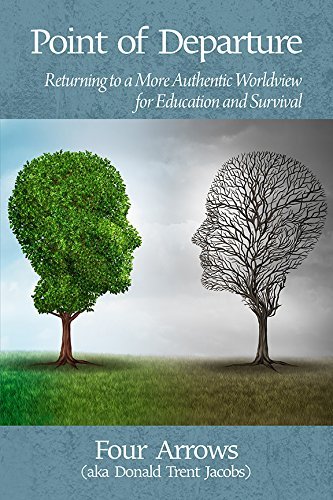
Point of Departure offers a practical metacognitive and transformational learning strategy for human surviving and thriving. Using five foundational and interactive Indigenous worldview beliefs that contrast sharply with our dominant worldview ones, everyone can reclaim the original instructions for living on Earth. Without the resulting change in consciousness that can emerge from this learning approach, no modern technologies can save us. The five foundational Indigenous precepts relate to a radically different understanding (1) Trance?based learning (2) Courage and Fearlessness (3) Community Oriented Self?Authorship (4) Sacred Communications (5) Nature as Ultimate Teacher
Praise for Point of Departure
Four Arrows provides a quintessential critique of how the collective human departure of modern society from “Indigenous Consciousness” has led to the current wholesale exploitation and destruction of “Indigenous Nature” … while providing the impetus for the urgency of a return to the “Indigenous Mind” as one of the true pathways for our future survival. ~ Greg Cajete Director of Native American Studies, University of New Mexico. Author of Native Science and Look to the Mountain
Recognizing the disastrous consequences of the dominant worldview pervading global society, Four Arrows teaches metacognitive strategies to help shift us back toward the Indigenous worldview—the only worldview that can restore balance amidst planetary crisis. With his characteristic insight, he reminds us that interconnectedness with all of creation is the basis of courage that will help each of us, Indigenous and non?Indigenous alike, rise to action in defense of Mother Earth. ~ Waziyatawin
Dakota author and activist from Pezihutazizi K’api Makoce (Land Where They Dig for Yellow Medicine) in southwestern Minnesota
Four Arrows continues to open our eyes to the possibility of a new society, one founded on the empirical data of thousands of years and within the paradigms of traditional wisdom and the people connected to all of life—theirs, ours, animal brethren and Mother Earth. Point of Departure is a MUST read for anyone who wants to be part of the solution. ~ Rebecca Adamson Founder/President First Peoples Worldwide
Anyone who is even slightly Indigenous will nod in recognition all the way through Point of Departure. Using the four sacred directions as cognitive bridges into the circle of all, Four Arrows walks the reader through trance?based, Transformative learning; courage, Indian?style, as connection not fearbased; and the Indigenous grammar of communication and truthtelling, with neither restricted to humans. Then, binding the hoop together for “all our relations,” Four Arrows recommends reacquaintance with Nature. The handy “take?away” discussions and “how?to” manuals concluding each discussion draw the reader into the circle, if only the reader is willing. ~ Barbara Alice Mann Associate Professor of Humanities, University of Toledo. Author of Spirits of Blood, Spirits of The Twinned Cosmos of Indigenous America
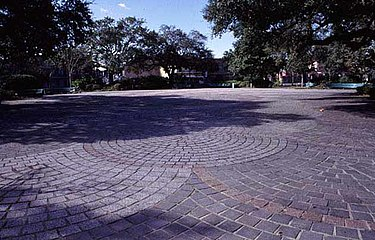
In Louisiana‘s French and Spanish colonial era of the 18th century, enslaved Africans were commonly allowed Sundays off from their work. Although Code Noir was implemented in 1724, giving enslaved Africans the day off on Sundays, there were no laws in place giving them the right to congregate. Despite constant threats to these congregations, they often gathered in remote and public places such as along levees, in public squares, in backyards, and anywhere they could find. On Bayou St. John at a clearing called “la place congo” the various ethnic or cultural groups of Colonial Louisiana traded and socialized.[2] It was not until 1817 that the mayor of New Orleans issued a city ordinance that restricted any kind of gathering of enslaved Africans to the one location of Congo Square. They were allowed to gather in the “Place des Nègres”, “Place Publique”, later “Circus Square” or informally “Place Congo” [3] at the “back of town” (across Rampart Street from the French Quarter), where the enslaved would set up a market, sing, dance, and play music. This singing, dancing and playing started as a byproduct of the original market during the French reign. At the time the enslaved could purchase their freedom and could freely buy and sell goods in the square in order to raise money to escape slavery.[4]
The tradition continued after the city became part of the United States with the Louisiana Purchase. As African music had been suppressed in the Protestant colonies and states, the weekly gatherings at Congo Square became a famous site for visitors from elsewhere in the U.S. In addition, because of the immigration of refugees (some bringing enslaved Africans) from the Haitian Revolution, New Orleans received thousands of additional Africans and Creoles in the early years of the 19th century. They reinforced African traditions in the city, in music as in other areas. Many visitors were amazed at the African-style dancing and music. Observers heard the beat of the bamboulas and wail of the banzas, and saw the multitude of African dances that had survived through the years. There were a variety of dances that could be seen in Congo Square including the Bamboula, Calinda, Congo, Carabine and Juba.[5] The rhythms played at Congo square can still be heard today in New Orleans jazz funerals, second lines and Mardi Gras Indians parades. In addition, the music played became the music of Louisiana Voodoo rites.[6]
Townsfolk would gather around the square on Sunday afternoons to watch the dancing. In 1819, the architect Benjamin Latrobe, a visitor to the city, wrote about the celebrations in his journal. Although he found them “savage”,[3] he was amazed at the sight of 500-600 unsupervised slaves who assembled for dancing. He described them as ornamented with a number of tails of the smaller wild beasts, with fringes, ribbons, little bells, and shells and balls, jingling and flirting about the performers’ legs and arms. The women, one onlooker reported, wore, each according to her means, the newest fashions in silk, gauze, muslin, and percale dresses. The men covered themselves in oriental and Indian dress and covered themselves only with a sash of the same sort wrapped around the body. Except for that, they went naked.
Photo of National Register sign in Congo Square
One witness noted that clusters of onlookers, musicians, and dancers represented tribal groupings, with each nation taking their place in different parts of the square. The musicians used a range of instruments from available cultures: drums, gourds, banjo-like instruments, and “quills” made from reeds strung together like pan flutes, as well as marimbas and European instruments such as the violin, tambourines, and triangles. Gradually, the music in the square gained more European influence as enslaved English-speaking Africans danced to songs like “Old Virginia Never Tire.” This mix of African and European styles helped create African American culture.
As harsher United States practices of slavery replaced the more lenient Spanish colonial style, the gatherings of enslaved Africans declined. Although no recorded date of the last of these dances in the square exists, the practice seems to have stopped more than a decade before the end of slavery with the American Civil War.
Voodoo
Besides the music and dancing, Congo Square also provided enslaved blacks with a place in which they could express themselves spiritually. This brief religious freedom on Sundays resulted in the practice of voodoo ceremonies. Voodoo is an ancient religion that developed from enslaved West Africans who brought this ritualistic practice with them when they arrived in New Orleans in the 18th century. Although it is not the most noted recreational activity people took part in at Congo Square, it was nevertheless one of the many forms of entertainment and social gatherings here. Voodoo was the most prominent from the 1820s to the 1860s, as Congo Square provided an opportunity to expose people to this intriguing practice. The types of voodoo ceremonies performed at Congo Square were very different from traditional voodoo, however. True voodoo rituals were much more exotic and secretive and focused on the religious and ritualistic aspect, while the voodoo in Congo Square was predominantly a form of entertainment and a celebration of African culture. Some of the dances and types of music heard in Congo Square were the result of these voodoo ceremonies. Marie Laveau, the first and most powerful voodoo queen, is one of the most well-known practitioners of voodoo in Congo Square. In the 1830s, Marie Laveau led voodoo dances in Congo Square and held darker, more covert rituals along the banks of Lake Pontchartrain and St. John’s Bayou.
Hoodoo
Hoodoo practices at Congo Square were documented by Folklorist Newbell Niles Puckett. African Americans poured libations at the four corners of Congo Square at midnight during a dark moon.[7][8] During slavery, a ring shout (a sacred dance in Hoodoo) was performed to invoke ancestral spirits for assistance and healing in the enslaved and free black community.[9]
Formal venue
Dance in Congo Square in the late 18th century, artist’s conception by E. W. Kemble from a century later
In the late 19th century, the square again became a famous musical venue, this time for a series of brass band concerts by orchestras of the area’s “Creole of color” community. In 1893, the square was officially named “Beauregard Square” in honor of P. G. T. Beauregard, a Confederate General who was born in St. Bernard Parish and led troops at the Battle of Fort Sumter. This was part of an attempt by city leaders to suppress the mass gatherings at the square. While this name appeared on some maps, most locals continued to call it “Congo Square”. Local New Orleans author and historian Freddi Williams Evans was the main advocator for the name change. As a result of her encouragement, City Councilwoman Kristin Gisleson Palmer created an ordinance to rename the area Congo Square in 2011. In the ordinance, Palmer claimed that “By restoring the name, Congo Square will continue to be remembered for the birthplace of the culture and music of New Orleans” and that “Jazz is the only truly indigenous American art form, and arguably its genesis was Congo Square, a true gift to the entire country and world.” In 2011, the New Orleans City Council officially voted to restore the traditional name Congo Square.[10][11][12]
In the 1920s New Orleans Municipal Auditorium was built in an area just in back of the square, displacing and disrupting some of the Tremé community.
In the 1960s a controversial urban renewal project leveled a substantial portion of the Tremé neighborhood around the square. After a decade of debate over the land, the City turned it into Louis Armstrong Park, which incorporates old Congo Square.
Starting in 1970, the City organized the New Orleans Jazz & Heritage Festival and held events annually at Congo Square. As attendance grew, the city moved the festival to the much larger New Orleans Fairgrounds. In the late 20th century and early 21st century, Congo Square has continued to be an important venue for music festivals and a community gathering place for brass band parades, protest marches, and drum circles.
Today
Today, there are still celebrations of the historical and cultural heritage of New Orleans. Congo Square Preservation Society is a community-based organization created by percussionist Luther Gray that aims to preserve the historical significance of Congo Square. Every Sunday, it carries on the tradition by gathering to celebrate the history and culture of Congo Square through drum circles, dancing, and other musical performances.
Along with these gatherings, other celebrations and events that are held in Congo Square every year include Martin Luther King Day celebrations, and the Red Dress Run. There are also numerous weddings, festivals, and concerts that take place in the park every year. On Martin Luther King Day, the park serves as the ceremonial starting place of a march that goes all the way to the Martin Luther King Jr. Monument on South Claiborne Avenue. On this holiday in 2012, a ceremony was held in Congo Square in which New Orleans Mayor Mitch Landrieu gave an inspirational speech calling for the city to reduce violence in the streets. The annual Red Dress Run begins in Congo Square, and is organized by the New Orleans Hash House Harriers, a running group in the city. The race is known for its participants dressing in all red and heavy drinking. The profits from the race are given to local charities. After the 2014 race, it was announced that over one million dollars had been given to over 100 local New Orleans charities.
William Safire is the most widely read writer on language in America. In his witty way, Mr. Safire enlightens us concerning proper usage, correct pronunciation, the roots of our daily discourse, and the vacuous vogue lingo in which “subsume” is co-opting “co-opt,” wood-burning stoves become “energy systems,” and stores that sell eyeglasses squint out at us as “vision centers.” He is aided in his campaign for precision and clarity in language by a legion of word buffs, language lovers, and learned eccentrics–many of them world-class wordsmen in their own right. Here are Mr. Safire’s delightful, crotchety, subtly informative, and awesomely informed comments, decisions, and advisories–the best of his famous column in The New York Times. Plus scores of letters written by enthusiastic or furious readers, who glory in nailing an expert to the wall.
William Lewis Safire was an American author, columnist, journalist and presidential speechwriter.
He was perhaps best known as a long-time syndicated political columnist for the New York Times and a regular contributor to “On Language” in the New York Times Magazine, a column on popular etymology, new or unusual usages, and other language-related topics.
Jimi Hendrix • Oct 17, 2018 Provided to YouTube by Legacy Recordings Bold as Love · The Jimi Hendrix Experience Axis: Bold As Love ℗ 2009 Experience Hendrix L.L.C., under exclusive license to Sony Music Entertainment Released on: 2022-10-26 Composer: Jimi Hendrix Producer: Chas Chandler Engineer, Re- Mastering Engineer: Eddie Kramer Re- Mastering Engineer: George Marino Auto-generated by YouTube.
Lyrics
Anger! He smiles, towering in shiny metallic purple armor Queen jealousy, envy waits behind him Her fiery green gown sneers at the grassy ground
Blue are the life-giving waters taken for granted They quietly understand Once happy turquoise armies lay opposite ready But wonder why the fight is on
But they’re all bold as love Yes, they’re all bold as love Yeah, they’re all bold as love Just ask the axis
My red is so confident, he flashes trophies of war And ribbons of euphoria Orange is young, full of daring But very unsteady for the first go round
My yellow, in this case, is not so mellow In fact, I’m trying to say it’s frightened like me And all these emotions of mine keep holding me from Giving my life to a rainbow like you, but I’m
Yeah, I’m bold as love, yeah-yeah Well, I’m bold, bold as love Hear me talking, girl I’m bold as love Just ask the axis
Ouspensky’s believed “Tertium Organum” was the third major philosophical synthesis, the previous being those of Aristotle and Bacon. With the publication of “Tertium Organum” in Russian, in 1912, Ouspensky became a widely respected author and lecturer on metaphysical questions. The American translation of Tertium Organum in 1922, won him widespread recognition in England, where he lived from 1921, and in America.
Ouspensky’s experimental efforts to enter higher states of consciousness proved to him that an entirely new mode of thought was needed by modern man, qualitatively different from the two modes (classical and positivistic) that have dominated Western civilisation for 2000 years. “Tertium Organum” is a clarion call for such thought, ranging brilliantly over the teachings of Eastern and Western mysticism, sacred art and the theories of modern science.
Pyotr Demianovich Ouspenskii (known in English as Peter D. Ouspensky, Пётр Демья́нович Успе́нский; was a Russian mathematician and esotericist known for his expositions of the early work of the Greek-Armenian teacher of esoteric doctrine George Gurdjieff, whom he met in Moscow in 1915. He was associated with the ideas and practices originating with Gurdjieff from then on. He shared the (Gurdjieff) “system” for 25 years in England and the United States, having separated from Gurdjieff in 1924 personally, for reasons he explains in the last chapter of his book In Search of the Miraculous.
All in all, Ouspensky studied the Gurdjieff system directly under Gurdjieff’s own supervision for a period of ten years, from 1915 to 1924. His book In Search of the Miraculous is a recounting of what he learned from Gurdjieff during those years. While lecturing in London in 1924, he announced that he would continue independently the way he had begun in 1921. Some, including his close pupil Rodney Collin, say that he finally gave up the system in 1947, just before his death, but his own recorded words on the subject (“A Record of Meetings”, published posthumously) do not clearly endorse this judgement, nor does Ouspensky’s emphasis on “you must make a new beginning” after confessing “I’ve left the system”.
The late filmmaker Jim Ball’s side business—recording music in L.A.’s Black churches—might be his greatest legacy. Journal of Gospel Music editor Robert M. Marovich writes about the significance of Ball’s recently recovered trove of religious music. | Illustration by Jason Lord.
The Los Angeles filmmaker Jim Ball, who died in 2022, was known for b-movies. 1964’s Fraternity of Horror, a low-budget black-and-white horror film that would make Wes Craven blush. Night of the Demon, the 1980 Sasquatchploitation movie, banned for a decade in the U.K. for its gruesome depictions of castration and disembowelment. A host of 1970s gay male erotic videos.
But Ball’s most important legacy, arguably, has nothing to do with the movie business. It’s a long-forgotten library of midcentury religious music he recorded in and for Los Angeles-based African American churches—recently rediscovered among piles of his old stuff, in a Winnetka, California garage.
It doesn’t seem church music fans ever got their hands on the libraries; hardly anyone outside a small circle of Ball’s friends knew that copies of the 40-album opus, the Saviour Home Record Library, ever existed. For this reason, the project, now set for digitization by Baylor University’s Black Gospel Archive and Listening Center, is a crucial artifact. It preserved the sound of Black sacred music in Los Angeles as it transitioned from Western European choral and congregational singing to more capacious repertories featuring newly composed gospel songs influenced by blues and jazz. Had Ball not captured the sound of these churches at that particular time, much of the aural history of this transition—which echoed national changes, as the Great Migration brought traditional Southern folk sounds to urban centers in the North and West—would likely be lost forever.
Ball, a Texan who moved to Los Angeles in the late 1950s to study cinematography at USC, enjoyed using his reel-to-reel tape recorder to capture audio from “Great Churches of the Golden West,” a local television program that featured white congregations. Ball told musician and fellow USC student Carl Matthes about his unusual hobby, and Matthes thought immediately of his friend J. David Bowick, the choir director at Holman United Methodist, an African American church in L.A.’s West Adams district. Bowick wanted to convert a tape recording of his 120-voice choir performing Haydn’s Third Mass, with an orchestra, to vinyl. Ball pressed the record. At a time when African Americans were sometimes derided unfairly as being incapable of performing classical masterworks, Bowick was delighted to have a record of his church music ministry’s superb presentation of Haydn.
Ball and Matthes realized they might be onto something. They began knocking on doors of African American churches, many near the USC campus, to see if they, too, might want bespoke recordings of their choirs or small singing groups. The duo’s business model was simple: Churches paid a flat fee for 100 copies of a custom recording, including pressing, cover art, and final packaging. Ball engineered the recordings; Matthes typed up the album jackets and handled vocal arranging as needed. “Word of mouth got around that we were reliable, we were affordable, and we would turn out a decent product on time,” Matthes told me recently.
Had Ball not captured the sound of these churches at that particular time, much of the aural history of this transition—which echoed national changes, as the Great Migration brought traditional Southern folk sounds to urban centers in the North and West—would likely be lost forever.
Churches including Trinity Baptist, Pilgrim Baptist, Second Baptist, Friendship Baptist, and the First AME Church of Pasadena all contracted with Ball Records. Their recordings reveal a varied community in a moment of promise and change. L.A.’s Black churches developed as African Americans began flocking to the city after the Civil War. As in other urban centers, members of 19th-century Black churches in Los Angeles were driven by middle-class aspirations and stuck to the songbooks and stylings of their white middle-class denominational counterparts. Initially, at least, they rejected the spontaneous and effervescent music that drove Pentecostal worship services and eventually informed gospel music. Some Black churches’ artistic conservatism lasted well into the 20th century. You can hear it on Ball Records recordings.
Los Angeles’s Liberty Baptist Church’s 1968 Ball release Bells Over Jordan, subtitled “Music of the Christian Negro,” showcases 19th-century hymns like “Go Heralds of Salvation Forth,” and an array of sturdy anthems and classical choruses. Around 1963, Ball recorded Bowick’s Holman United Methodist choir singing an entire album of concert spirituals arranged by composer and choir director Hall Johnson. Also included in the Saviour library are spirituals by Black composers and arrangers Harry T. Burleigh, William L. Dawson, John Wesley Work III, and Jester Hairston.
Black sacred music in Los Angeles was already beginning to change, however, as more Southern migrants settled in Los Angeles after World War I. Their style of worship retained an informal, impassioned, and communal style with roots in West African traditions. Emotional reminders of the world they left behind helped transplanted Southerners adjust to the hustle and bustle of their new home. Gospel music, which came to L.A. via Chicago, set traditional hymns, revival songs, and newly-composed works to the bouncing beat of Black popular music, and best reflected the new style and sound.
But even as local pastors adopted the newfangled gospel music, many refused to completely forsake the formality of “respectable” church music. So, a number of the 1960s-era Ball recordings feature church choirs presenting a mix of tried-and-true hymn standards, anthems, and spirituals, as well as newer gospels. Releases by Victory Baptist, Friendship Baptist, and Sweet Home Baptist churches feature songs such as “Said I Wasn’t Gonna Tell Nobody,” which blended formal training with gospel techniques such as vocal melisma, a Hammond organ mimicking human voices, and call-and-response singing between the lead singer and the choir.
Several tracks recorded by Ball capture vocal and instrumental gospel talents in their ascendancy. These include “Fifth Beatle” Billy Preston, who makes the Hammond organ moan and shout on an album for the Church of Divine Guidance, and his equally gifted sister, vocalist Rodena Preston, who sings on a release from Pilgrim Baptist Church. Young future Motown recording artist Sondra “Blinky” Williams sings with closed-eyed abandon on the album by her father’s Friendship Baptist Church choir, and gospel luminary Thurston Frazier directs the Voices of Victory Baptist Church as they sing “I’m So Glad that Jesus Lifted Me” at full throttle.
Sometime in the mid-1960s, Ball anthologized 40 of his previously issued albums—mainly from Black churches but with a handful of white church artists included—and created the Saviour Home Record Library. Each library consisted of four cream-colored boxes that held 10 albums apiece; a fifth box contained a 120-page spiral-bound finding aid created by Matthes, organized alphabetically by song title, category, and topic.
Over time, Ball dropped his music projects to focus on movies; years later, he told Matthes he had stored the 68 complete copies of the Saviour Home Record Library in his garage. Then he told him the records had been stolen. It was only by a stroke of luck that Matthes, as executor of Ball’s estate, found the Saviour libraries in 2023. They were indeed in a garage—not Ball’s but another friend’s. None, Matthes believes, had ever been sold to listeners. Baylor University anticipates making the recordings available to the public for online listening as early as late May of this year. This 60-year-old time capsule of the sacred music of Los Angeles will be a treasure for the churches, their congregations and, most importantly, the family and friends of those featured on the recordings.
That a white producer of grisly films and erotic videos became an important producer of Black sacred music is not as strange as it seems. Ball fulfilled on shoestring budgets the entertainment demands of underserved audiences, ignored by major record companies and film studios. In the process, he provided a distinct sound print of African American church music in transition that will be accessible for generations to come.
Transgender activist and TED Resident Samy Nour Younes shares the remarkable, centuries-old history of the trans community, filled with courageous stories, inspiring triumphs — and a fight for civil rights that’s been raging for a long time. “Imagine how the conversation would shift if we acknowledge just how long trans people have been demanding equality,” he says.
WASHINGTON—Lambasting the current program as wasteful, bloated, and entirely unnecessary, Defense Secretary Pete Hegseth called for steep cuts Monday to the number of steps in the Alcoholics Anonymous recovery model. “We must cut through the red tape bogging down what could be a far more efficient AA,” said Hegseth, who slammed the 12-step program as an undue burden on alcoholics, not only in the Defense Department, but across all levels of federal government. “We’re going to start by slashing the parts about admitting you have a problem and making amends to everyone you’ve supposedly ‘hurt.’ Ideally, we’ll cut it down to one step—praying or whatever it is. That’s a 92% savings in steps. Eventually, we hope to get rid of the program entirely.” Hegseth added that the time saved by the reduction in steps would also allow Americans to get to happy hour far more quickly.
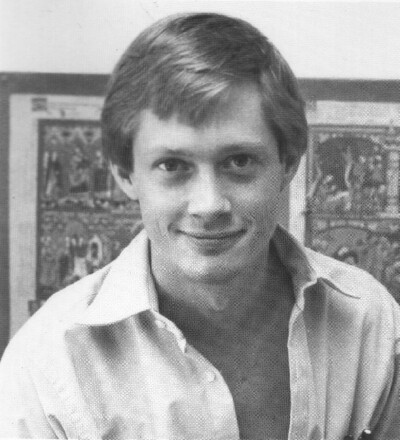
John Eastburn “Jeb” Boswell was born on March 20, 1947, in Boston to a military family. He converted from the Episcopal Church of his upbringing to Roman Catholicism at age 16. Boswell graduated from William and Mary in 1969 and earned a Ph.D. in history from Harvard in 1975. He attended mass daily until his death, even though as an openly gay Christian he disagreed with church teachings on homosexuality. He also helped found Yale’s Lesbian and Gay Studies Center in the late 1980s.
Boswell entered academia at an important time for LGBTQ rights, during the AIDS crisis and the rise of the Christian right in politics. He joined the Yale faculty as assistant professor, was appointed a full professor in 1982 and served as chair of the history department from 1990-92.
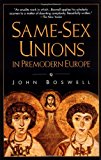
Using some of his last strength as he battled AIDS, Boswell translated many rites of adelphopoiesis (Greek for making brothers) in his 1994 book Same-Sex Unions in Premodern Europe. The book presents evidence that throughout much of medieval Europe both the Catholic and Eastern Orthodox churches blessed same-sex unions in ceremonies that were similar to heterosexual weddings.
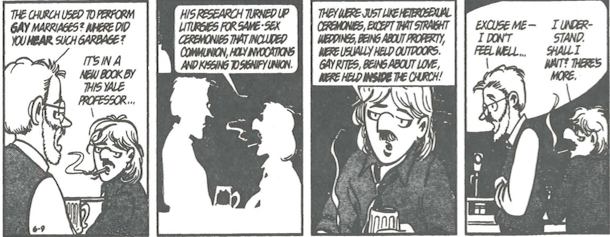
Again Boswell struck a nerve and sparked national controversy. His new book was even featured in the nationally syndicated Doonesbury comic strip, causing many newspapers to stop running the cartoon.
Doonesbury by Gary Trudeau, June 1994
Boswell’s sister Patricia confirmed to Q Spirit that he loved to tell the story of how an anonymous monk sent him a letter to tip him off about the same-sex union ceremonies. She added that it is also possible that he discovered some of the ceremonies by accident while doing research at the Vatican and other European archives.
Boswell can be seen in a 1986 video lecturing on “Jews, Gay People, and Bicycle Riders” at the University of Wisconsin-Madison for the series “Out & About: Celebrating Gay and Lesbian Culture.”
A 25th-anniversary collection analyzing Boswell’s work was published as “The Boswell Thesis: Essays on Christianity, Social Tolerance, and Homosexuality,” edited by Mathew Kuefler. Scholars take many different approaches, looking at Boswell’s career and influence, a Roman emperor’s love letters to another man; suspected sodomy among medieval monks; and genderbending visions of mystics and saints.
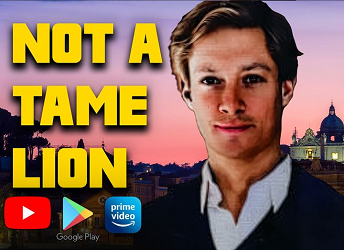
Boswell’s life and impact on LGBTQ acceptance are explored in the 2022 documentary film “Not a Tame Lion.” First-hand accounts from his closest friends, family, students and colleagues shed light on his life, including how he worked feverishly to finish “Same-Sex Unions in Medieval Europe” in the final days before his death from AIDS at age 47 in 1994. It is written and directed by Craig Bettendorf, an openly gay film maker and LGBTQ activist who ministered the Anglican tradition. Bettendorf is the author of the book “A Biblical Defense Guide for Gays, Lesbians and Those Who Love Them.” After winning awards at film festivals in 2022, “Not a Tame Lion” had a rolling release on other streaming platforms.
John Boswell painted his family in medieval style
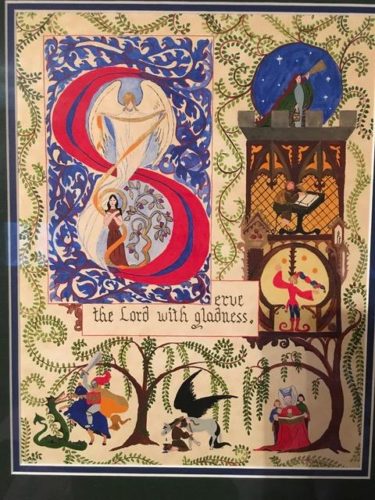
Boswell was age 27 when he painted a medieval-style illumination as a 1974 Christmas present for his mother, Catharine Eastburn Boswell. It was generously provided to Q Spirit in 2020 by his sister, Patricia Boswell, who keeps it hanging in her bedroom. The previously unpublished artwork by John Boswell was released by Qspirit.net for his birthday on March 20, 2020.
“Serve the Lord with Gladness” by John Boswell, 1974 (Courtesy of Patricia Boswell)
The watercolor looks like a page from an illuminated manuscript of the Middle Ages. It depicts each member of his family, including a self-portrait of Boswell as a medieval scribe on the right. A line from his mother’s favorite psalm is inscribed in calligraphy: “Serve the Lord with gladness” (Psalm 100:20).
Boswell painted his parents in the corners on the bottom. His mother is shown reading to her children on the right, while his father, Army colonel Henry Boswell Jr., slays a dragon on the left. Patricia told Q Spirit about how well the image depicts her family:
“Jeb brilliantly captured the essence of each. Dad, the career military officer and man of honor. Mom, who never went to college but educated us as children with her intellect and reading. Henry, who wanted to be a vet but ended up a Navy pilot. Wray, the court jester, who always lightened a tense situation. My portrayal is slightly more mysterious, but fortunately, I can tell you what Jeb himself answered. That Christmas morning, Wray asked if I was some sort of cheerleader. Jeb responded, ‘Pat is searching for truth among the stars.’”
The woman under the angel remains a mystery. “My best guess is that she is Joan of Arc. Jeb had a passion for her when young,” Patricia said.
Visual art was one of many interests for the multi-talented John Boswell. “To my knowledge, which is pretty complete, Jeb did not have a strong interest in displaying art in his home. He tended to hang framed things people gave him. He loved the Prado, but his artistic interest was mostly musical. Jeb did enjoy painting himself when he was younger and painted some quite lovely illuminations…. He was fascinated by angels and often painted them, but I don’t think any survived other than in the illumination I have,” Patricia explained. She added that her brother was also a gifted poet and had begun but not finished many stories before he died.
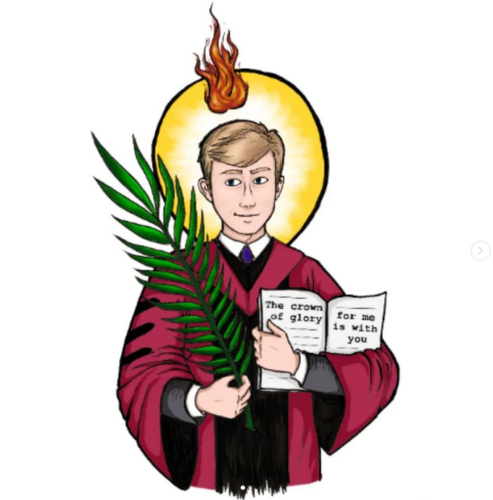
Icon of John Boswell by Faithful Heretic
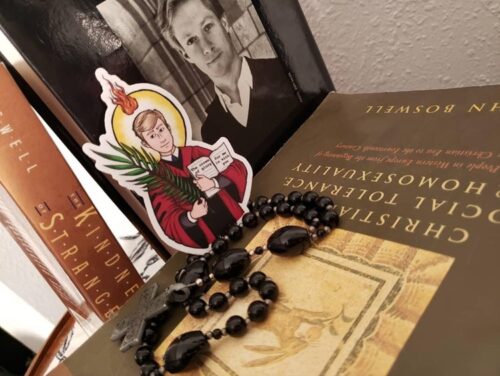
Boswell appears with tongues of flame above his head in an icon by the artist known as Faithful Heretic. Rich in symbolism, the image appears at the top of this post. Fire is associated with the Holy Spirit and the gift of “speaking in tongues,” a reference to Boswell’s extraordinary linguistic ability. He carries a book that says, “The crown of glory for me is with you.” The quote is an expression of same-sex love between paired male saints in “The Passion of Saints Sergius and Bacchus,” a fourth-century hagiography that Boswell translated into English for the first time. “The Venerable John Boswell” wears academic robes and carries a palm branch, a symbol of martyrdom in Christian art.
Faithful Heretic’s website includes a “hagiography” of Boswell, urging churches to commemorate him because he laid the foundation for LGBTQ-affirming ministry. “He must be respected in all of his twinky, flamboyant, brilliant, and life-giving glory. He declared that queer people could know God without shame or self-censorship, and that the Church could be made to repent and welcome us as it once did,” Faithful Heretic wrote.
A temporary home altar honors John Boswell with a rosary adorning his books, photo and a sticker of his icon by Faithful Heretic. The Faithful Heretic Icons Sticker Shop offers waterproof vinyl stickers of various LGBTQ historical figures and saints. Photo by Faithful Heretic.
Raised Mormon, Faithful Heretic is an Episcopalian lay minister and a lifelong student of history, especially medieval history and LGBTQ history.
John Boswell’s memory lives on
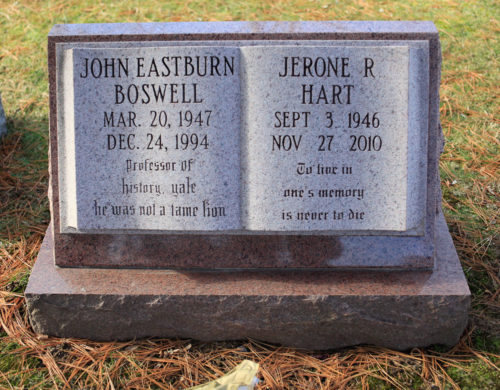
Boswell’s untimely death came at age 47 from AIDS-related illness on Christmas Eve 1994. He is buried beside his longtime partner Jerone Hart (1946-2010) at Grove Street Cemetery in New Haven, Connecticut.
Shared gravestone of John Boswell and his life partner Jerone Hart (photo by Kickstand)
They are pictured together in photos on Boswell’s Findagrave.com page with the caption, “partners in life, for life.” Their shared headstone is shaped to look like a book. Hart’s inscription reads, “To live in one’s memory is never to die.” Boswell’s epitaph says, “He was not a tame lion.” His sister Patricia told Q Spirit that the phrase is a reference to the character Aslan in “The Chronicles of Narnia” by C. S. Lewis, which was one of Boswell’s favorite books.
William and Mary, a university in Williamsburg, Virginia, named a large academic building after Boswell in 2021. The official campus map shows that the many amenities at John E. Boswell Hall include “two all-gender restrooms,” a feature promoted by LGBTQ activists. Jeff Trammell, former rector there and the first openly gay chair of the governing board of a major public university, is quoted in the official announcement: “It brings honor to our 328-year-old institution that we name an academic building for an alumnus who used his William & Mary education to improve the lives of millions of Americans. John Boswell’s scholarship inspired the recognition of same-sex relationships here and around the world. And, personally, it helped make it possible for William & Mary Chancellor Sandra Day O’Connor to marry my husband and me in the U.S. Supreme Court.”
Boswell remains an unofficial saint to the many LGBTQ Christians who find life-giving spiritual value in his historical research that affirms queer people in Christian history.
___ Top image credit: “The Venerable John Boswell” by Faithful Heretic ____ This post is part of the LGBTQ Saints series by Kittredge Cherry. Traditional and alternative saints, people in the Bible, LGBTQ martyrs, authors, theologians, religious leaders, artists, deities and other figures of special interest to lesbian, gay, bisexual and transgender and queer (LGBTQ) people and our allies are covered.
This article was originally published in March 2017, expanded with new material over time, and most recently updated on March 19, 2025.
Kittredge Cherry is a lesbian Christian author who writes regularly about LGBTQ spirituality.She holds degrees in religion, journalism and art history.She was ordained by Metropolitan Community Churches and served as its national ecumenical officer, advocating for LGBTQ rights at the National Council of Churches and World Council of Churches.
Consciousness, spirituality, biography, sexuality, androgyny, futurism, space, the arts, science, astrology, democracy, humor, books, movies and more


 Show map of East New OrleansShow map of LouisianaShow map of the United StatesShow all