
Monthly Archives: April 2025

The Fire Hose of Chaos: Corruption
Zeihan on Geopolitics • Apr 28, 2025 • The Trump administration has introduced a level of chaos that can only result in one thing: corruption. I’m not talking about starting a cryptocurrency or manipulating the stock market, this is deeper.
(Contributed by Hanz Bolen, H.W., M.)
Chupacabra
From Wikipedia, the free encyclopedia
For other uses, see Chupacabra (disambiguation).
| Part of a series on the |
| Paranormal |
|---|
| showMain articles |
| showSkepticism |
| showParapsychology |
| showRelated |
| vte |
The chupacabra or chupacabras (Spanish pronunciation: [tʃupaˈkaβɾas], literally ‘goat-sucker’, from Spanish: chupa, ‘sucks’, and cabras, ‘goats’) is a legendary creature, or cryptid, in the folklore of parts of the Americas. The name comes from the animal’s purported vampirism – the chupacabra is said to attack and drink the blood of livestock, including goats.
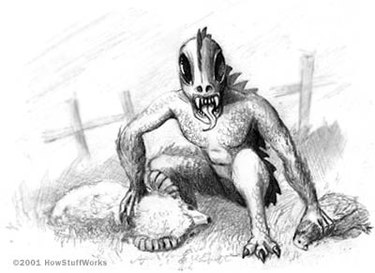
Physical descriptions of the creature vary. In Puerto Rico and in Hispanic America it is generally described as a heavy creature, reptilian and alien-like, roughly the size of a small bear, and with a row of spines reaching from the neck to the base of the tail, while in the Southwestern United States it is depicted as more dog-like.
Initial sightings and accompanying descriptions first occurred in Puerto Rico in 1995. The creature has since been reported as far north as Maine, as far south as Chile, and even outside the Americas in countries like Russia and the Philippines. All of the reports are anecdotal and have been disregarded as uncorroborated or lacking evidence. Sightings in northern Mexico and the Southern United States have been verified as canids afflicted by mange.[1][2]
Name
Chupacabras can be literally translated as ‘goat-sucker’, from chupar (‘to suck’) and cabras (‘goats’). It is known as both chupacabras and chupacabra throughout the Americas, with the former being the original name,[3] and the latter a regularization. The name is attributed to Puerto Rican comedian Silverio Pérez, who coined the label in 1995 while commenting on the attacks as a San Juan radio deejay.[4][5]
History
In 1975, a series of livestock killings in the small town of Moca, Puerto Rico were attributed to el vampiro de Moca (‘the vampire of Moca’).[6] Initially, it was suspected that the killings were committed by a Satanic cult; later more killings were reported around the island, and many farms reported loss of animal life. Each of the animals was reported to have had its body bled dry through a series of small circular incisions.

The first reported attack eventually attributed to the actual chupacabras occurred in March 1995. Eight sheep were discovered dead in Puerto Rico, each with three puncture wounds in the chest area and reportedly completely drained of blood.[7] A few months later, in August, an eyewitness named Madelyne Tolentino reported seeing the creature in the Puerto Rican town of Canóvanas, where as many as 150 farm animals and pets were reportedly killed.[7]
Puerto Rican comedian and entrepreneur Silverio Pérez is credited with coining the term chupacabras soon after the first incidents were reported in the press. Shortly after the first reported incidents in Puerto Rico, other animal deaths were reported in other countries, such as Argentina, Bolivia, Brazil, Chile, Colombia, Dominican Republic, El Salvador, Honduras, Mexico, Nicaragua, Panama, Peru, and the United States.[7]
In 2019 a video recorded by Mundo Ovni showed the results of a supposed attack on chickens in the Seburuquillo sector of Lares, Puerto Rico.[8]
Reputed origin
A five-year investigation by Benjamin Radford, documented in his 2011 book Tracking the Chupacabra, concluded that the description given by the original eyewitness in Puerto Rico, Madelyne Tolentino, was based on the creature Sil in the 1995 science-fiction horror film Species.[1] The alien creature Sil is nearly identical to Tolentino’s chupacabra eyewitness account and she had seen the movie before her report: “It was a creature that looked like the chupacabra, with spines on its back and all… The resemblance to the chupacabra was really impressive”, Tolentino reported.[9] Radford revealed that Tolentino “believed that the creatures and events she saw in Species were happening in reality in Puerto Rico at the time”, and therefore concludes that “the most important chupacabra description cannot be trusted”.[1] This, Radford believes, seriously undermines the credibility of the chupacabra as a real animal.[10]
The reports of blood-sucking by the chupacabra were never confirmed by a necropsy,[1] the only way to conclude that the animal was drained of blood. Dr. David Morales, a Puerto Rican veterinarian with the Department of Agriculture, analyzed 300 reported victims of the chupacabra and found that they had not been bled dry.[1]
Radford divided the chupacabra reports into two categories: the reports from Puerto Rico and Latin America, where animals were attacked and it is supposed their blood was extracted; and the reports in the United States of mammals, mostly dogs and coyotes with mange, that people call “chupacabra” due to their unusual appearance.[11]
In 2010, University of Michigan biologist Barry O’Connor concluded that all the chupacabra reports in the United States were simply coyotes infected with the parasite Sarcoptes scabiei, whose symptoms would explain most of the features of the chupacabra: they would be left with little fur, thickened skin, and a rank odor. O’Connor theorized that the attacks on goats occurred “because these animals are greatly weakened, [so] they’re going to have a hard time hunting. So they may be forced into attacking livestock because it’s easier than running down a rabbit or a deer.”[12][1] Both dogs and coyotes can kill and not consume the prey, either because they are inexperienced, or due to injury or difficulty in killing the prey.[1][13] The prey can survive the attack and die afterwards from internal bleeding or circulatory shock.[1][13] The presence of two holes in the neck, corresponding with the canine teeth, are to be expected since this is the only way that most land carnivores have to catch their prey.[1] There are reports of stray Mexican hairless dogs being mistaken for chupacabras.[14]
Appearance
.jpg)
The most common description of the chupacabra is that of a reptile-like creature, said to have leathery or scaly greenish-gray skin and sharp spines or quills running down its back.[15] It is said to be approximately 3 to 4 feet (0.9 to 1.2 m) high, and stands and hops in a fashion similar to that of a kangaroo.[16] This description was the chief one given to the few Puerto Rican reports in 1995 that claimed to have sighted the creature, with similar reports in parts of Chile and Argentina following.[1]
Another common description of the chupacabra is of a strange breed of wild dog. This form is mostly hairless and has a pronounced spinal ridge, unusually pronounced eye sockets, fangs, and claws. This description started to appear in the early 2000s from reports trailing north from the Yucatán Peninsula, northern Mexico, and then into the United States; becoming the predominant description since.[1] Unlike conventional predators, the chupacabra is said to drain all of the animal’s blood (and sometimes organs) usually through three holes in the shape of a downwards-pointing triangle, but sometimes through only one or two holes.[17]
Plausibility of existence
The chupacabra panic first started in late 1995, Puerto Rico: farmers were mass reporting the mysterious killings of various livestock. In these reports, the farmers recalled two puncture wounds on the animal carcasses.[1] Chupacabra killings were soon associated with a seemingly untouched animal carcass other than puncture wounds which were said to be used to suck the blood out of the victim. Reports of such killings began to spread around and eventually out of the country, reaching areas such as Mexico, Brazil, Chile, and the Southern area of the United States.
Most notably, these areas experience frequent, and extreme dry seasons; in the cases of the Puerto Rican reports of 1995 and the Mexican reports of 1996, both countries were currently experiencing or dealing with the aftermath of severe droughts. Investigations carried out in both countries at this time noted a certain dramatic violence in these killings.[18] These environmental conditions could provide a simple explanation for the livestock killings: wild predators losing their usual prey to the drought, therefore being forced to hunt the livestock of farmers for sustenance. Thus, the same theory can be applied to many of the other ‘chupacabra’ attacks: that the dry weather had created a more competitive environment for native predators, leading them to prey on livestock to survive. Such an idea can also explain the increased violence in the killings; hungry and desperate predators are driven to hunt livestock to avoid starvation, causing an increase in both the number of livestock killings, and the viciousness of each one.
Evidence of such is provided in page 179 of Benjamin Radford‘s book, Tracking the Chupacabra: The Vampire Beast in Fact, Fiction, and Folklore. Radford’s chart highlights ten significant reports of chupacabra attacks, seven of which had a carcass recovered and examined; these autopsies concluded the causes of death as various animal attacks, as displayed though the animal DNA found on the carcasses.[1] Radford provides further evidence in pages 161-162 of his book, displaying animals who are proven to have fallen victim to regular coyote attacks; thus, explaining that it is not unusual for an animal carcass to be left uneaten while only displaying puncture wounds and/or minimal signs of attack.[1]
The plausibility of the chupacabra’s existence is also discredited by the varying descriptions of the creature. Depending on the reported sighting, the creature is described with thick skin or fur, wings or no wings, a long tail or no tail, is bat-like, dog-like, or even alien-like.[1] Evidently, the chupacabra has a wide variety of descriptions; to the point where it is hard to believe that all the sightings are of the same creature. A very likely explanation for this phenomenon is that individuals who had heard of the newly popular chupacabra had the creature’s name fresh in their mind before they happened to see a strange looking animal. They then resort to make sense of their encounter by labelling it as the recently ‘discovered’ monster, instead of a more realistic explanation. For example, some scientists hypothesize that what many believe to be a chupacabra is a wild or domestic dog affected by mange, a disease causing a thick buildup of skin and hair loss.[19]
Related legends
The “Ozark Howler“, a large bear-like animal, is the subject of a similar legend.[20]
The Peuchens of Chile also share similarities in their supposed habits, but instead of being dog-like they are described as winged snakes. This legend may have originated from the vampire bat, an animal endemic to the region.[21]
In the Philippines the Sigbin shares many of the chupacabra’s descriptions.
In 2018 there were reports of suspected chupacabras in Manipur, India. Many domestic animals and poultry were killed in a manner similar to other chupacabra attacks, and several people reported that they had seen creatures. Forensic experts opined that street dogs were responsible for mass killing of domestic animals and poultry after studying the remnants of a corpse.[22]
Do women live longer than men in the US?
(usafacts.org)
Women are expected to outlive men by 5.3 years.Updated March 21, 2025 by the USAFacts team
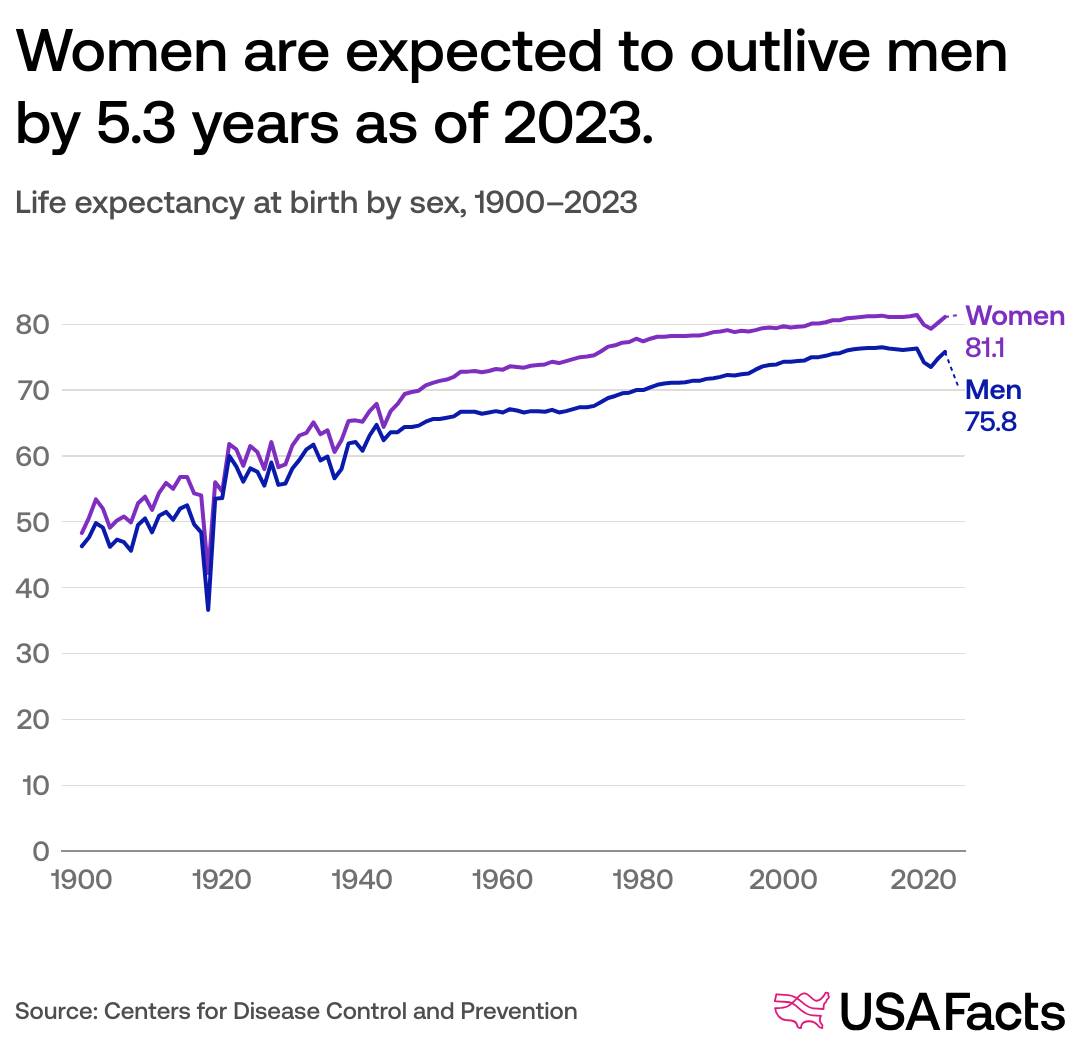
In the United States, women are expected to outlive men by 5.3 years. This longevity gap, which was two years in 1900, grew to nearly eight around 1980 before dropping to its current level.
What are the average lifespans for men and women born in the US?
Women are expected to outlive men by 5.3 years as of 2023.
Life expectancy at birth by sex, 1900–2023
Line chart showing the life expectancy at birth by sex in the U.S. Males have a lower life expectancy, and after gradually rising for decades, life expectancy for both sexes have not fully recovered from a decline seen during the height of the COVID pandemic.
Women
81.1
Men
75.8
Source: Centers for Disease Control and PreventionGet the dataDownload imageDownload SVG
In 2023, the life expectancy for men born in the United States was 75.8. For women, it was 81.1.
Lifespans had been rising across the board in the 20th century — in 1900, the average life expectancy was 46.3 for men and 48.3 for women. That rose throughout the century, apart from a 12-year drop in 1918 during the Spanish Flu pandemic, peaking for men in 2014 (76.3 years) and for women in 2019 (81.4).
When COVID-19 became a leading cause of death in 2020, men lost an average of 2.8 years and women 2.1. The averages have mostly bounced back; men have since recovered 2.3 years and women have recovered 1.8 years.
Subscribe to stay informed about DOGE and federal spending
Interestingly, the longevity gap shrinks among older men and women — a 65-year old man in 2023 was expected to live another 18.2 years, until the age of 83.2, and a woman of the same age could expect another 20.7 years, until 85.7.
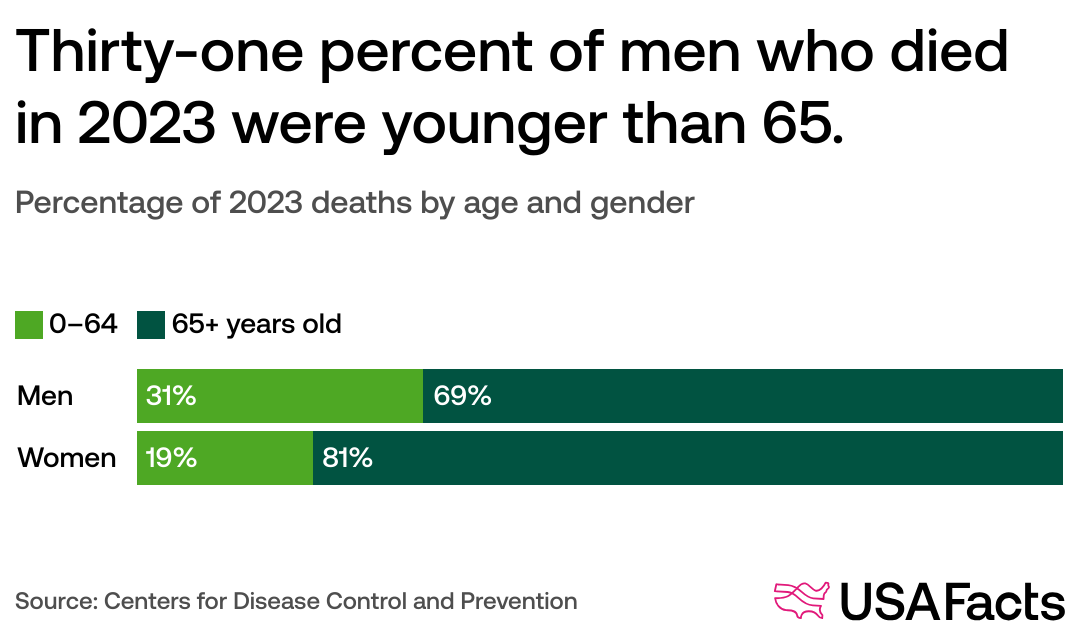
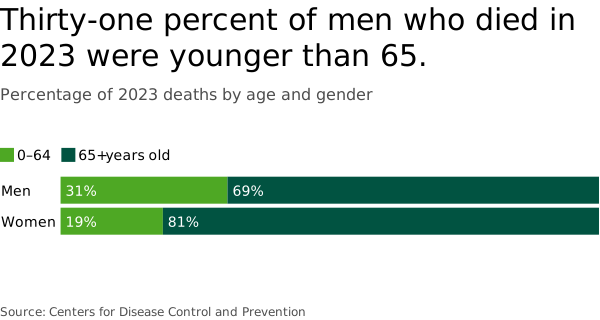
Why this smaller gap? More men die before age 65, dragging men’s life expectancy at birth down. Thirty-one percent of men who died in 2023 were below 65, compared to 19% of women. This may have some to do with how men and women die.
Thirty-one percent of men who died in 2023 were younger than 65.
Percentage of 2023 deaths by age and gender
A bar chart showing the percentage of deaths below and above the age of 65 by gender. More men die before 65.
0–64
65+
years old
Men
31%
69%
Women
19%
81%
Source: Centers for Disease Control and PreventionGet the dataEmbed Download imageDownload SVG
What are the leading causes of death for men and women?
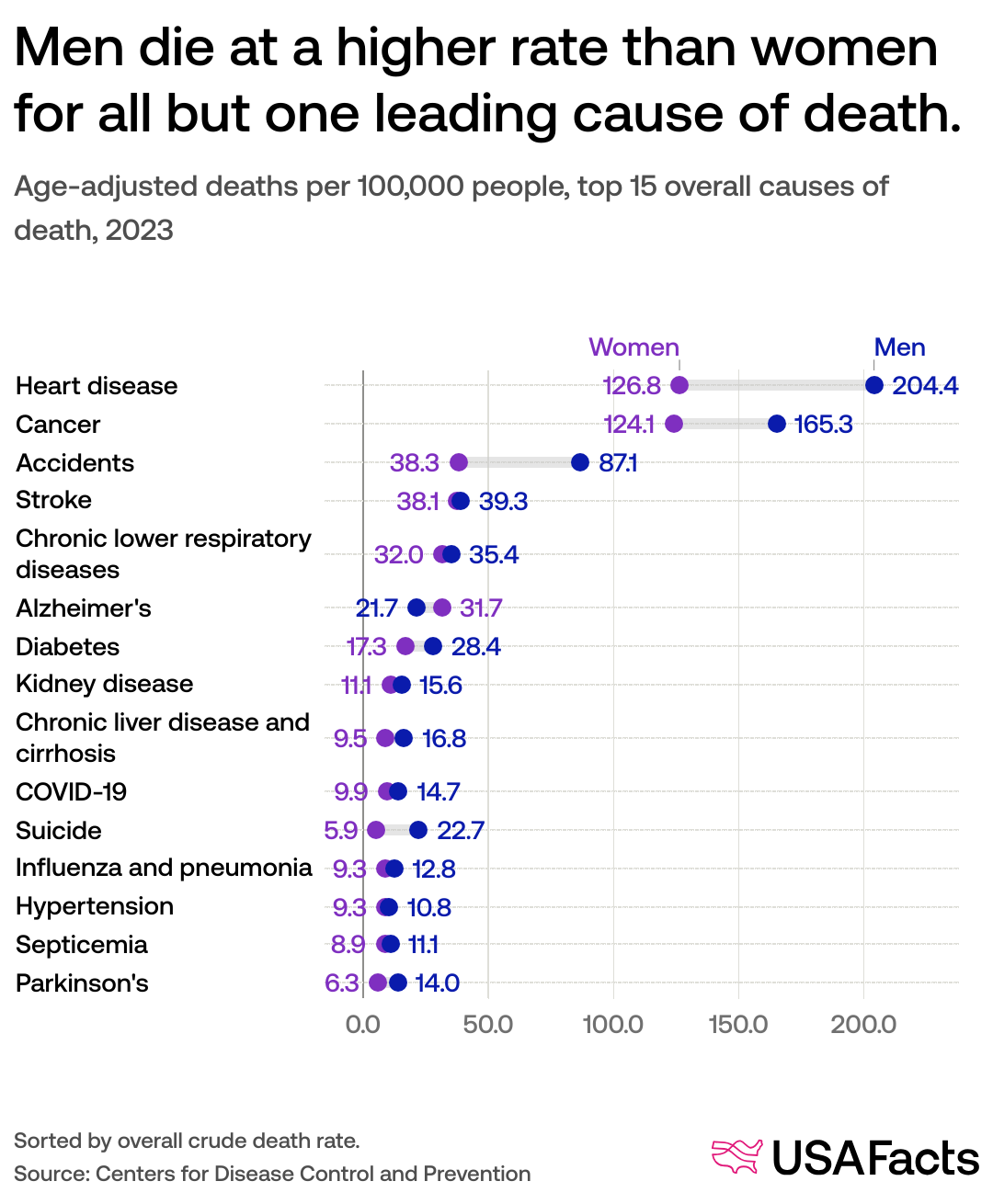
Heart disease, cancer, and accidents were the three leading causes of death in the US in 2023. All three killed men at higher rates than women: 457 of every 100,000 men died from these, compared to 289 women.
Expanding this to look at the 15 overall leading causes of death, only one — Alzheimer’s disease — killed women at a higher rate after adjusting for age. Men were nearly four times as likely as women to die by suicide, and more than twice as likely to die from an accident or from Parkinson’s.
Men die at a higher rate than women for all but one leading cause of death.
Age-adjusted deaths per 100,000 people, top 15 overall causes of death, 2023
A split bar chart of age-adjusted death rates by gender for the top 15 overall causes of death in 2023.0.050.0100.0150.0200.0
Heart disease
126.8
204.4
Cancer
124.1
165.3
Accidents
38.3
87.1
Stroke
38.1
39.3
Chronic lower respiratory diseases
32.0
35.4
Alzheimer’s
31.7
21.7
Diabetes
17.3
28.4
Kidney disease
11.1
15.6
Chronic liver disease and cirrhosis
9.5
16.8
COVID-19
9.9
14.7
Suicide
5.9
22.7
Influenza and pneumonia
9.3
12.8
Hypertension
9.3
10.8
Septicemia
8.9
11.1
Parkinson’s
6.3
14.0
Women|
Men|
Sorted by overall crude death rate.
Source: Centers for Disease Control and PreventionGet the dataEmbed Download imageDownload SVG
Wondering how you fit in? The Social Security Administration’s life expectancy calculator forecasts how much longer a person can expect to live based on birth year and gender.
Learn more about life expectancy by state and get the data directly in your inbox by signing up for our newsletter.
The Kiln and the Quantum of Relationships
By Maria Popova (themarginalian.org)

Anything you give your time to and polish with attention will become a lens on your search for meaning, will lavish you with metaphors that become backdoors into the locked room of your most urgent reckonings.
In my nascent adventures in pottery, I have observed with great fascination how two different glazes, when combined, produce an entirely unpredictable result — something not greater than the sum of its parts but of a wholly different order. In the extreme conditions of the kiln, which can reach the temperature of a red star, chemistry and chance converge to make a third glaze that may turn out to be infinitely more beautiful than either of the two, or disastrous, discolored, hideously cracked with exposed impurities and cratered with burst bubbles.
Consolations from the kiln.
This, of course, is what happens in our most intimate relationships, themselves the product of chemistry and chance. Under the extreme pressures of expectation and the high heat of need, something reacts with something, impurities are exposed and bubbles burst, each person activating dormant potencies in the other, so that a distinct third entity comes alive — the dynamic reality of the relationship — incinerating the notion of the individual self as a set of inherent properties, hinting at the relational nature of reality itself.
A century after the Indian poet and philosopher Rabindranath Tagore observed that “relationship is the fundamental truth of this world of appearance,” physicist Carlo Rovelli traces the scientific path to that same truth in his excellent quantum primer Helgoland (public library), titled after the windswept North Sea island on which the twenty-three-year-old Werner Heisenberg arrived at the idea that became the mathematical blueprint for the staggering cathedral of quantum field theory: that revolutionary description of how one aspect of reality — one object, one entity, one part of nature — manifests itself to any other. Because every description of a thing is a claim about its nature, at the heart of the theory is the claim that interaction is the fundamental reality of the universe, that there are no entities as such — only dynamic manifestations of which we catch an evanescent glimpse and call that flashing image entity.
Rovelli writes:
The world that we know, that relates to us, that interests us, what we call “reality,” is the vast web of interacting entities, of which we are a part, that manifest themselves by interacting with each other.
[…]
The properties of an object are the way in which it acts upon other objects; reality is this web of interactions.
This is why objectifying — the impulse to reduce something or someone to a set of properties — always misses the point of the objectified, and why we always draw closer to reality when we instead “subjectify” the universe, as Ursula K. Le Guin put it in her magnificent meditation on the interplay of poetry and science. The intersubjective — the dynamic reality that arises from the interactions between objects with seemingly fixed properties — is the essence of the quantum world, and it is also the essence of human relationships. Who you become in a particular relationship is not any more you or less you than who you are in your deepest solitude, because there is no you — the self is not the container of your interactions with the rest of the world but the contents.
Observing that the “phantasmal world of quanta is our world,” Rovelli writes:
Card from An Almanac of Birds: 100 Divinations for Uncertain Days, also available as a stand-alone print.
With an eye to quantum entanglement, he articulates what I learned at the kiln:
The great paradox of this subject-object approach to modeling reality is that all of our descriptive models are inherently claims of an outside perspective on it, and yet they all arise from our mental activity, which is inherently interior. In a passage that calls to mind quantum pioneer Erwin Schrödinger’s koan-like insistence that “this life of yours which you are living is not merely a piece of the entire existence, but is in a certain sense the whole,” Rovelli writes:
This fundamental axiom of being is, to me, the first and final proof that the measure of our lives is the light between us.
How to Be More Alive: Artist and Philosopher Rockwell Kent on Breaking the Trance of Near-living
By Maria Popova (themarginalian.org)

The point, of course, is to make yourself alive — to feel the force of being in your sinew and your spirit, to tremble with the beauty and the terror of it all, to breathe lungfuls of life that gasp you awake from the trance of near-living induced by the system of waste and want we call civilization.
Inside the system, these opportunities for raw aliveness are not easily found — they must be sought, seized, and then surrendered to.
At four-thirty in the afternoon of June 17th, 1914, a month before the outbreak of WWI and five years before his reckoning with the creative spirit and the meaning of life on a remote Alaskan island, the artist and philosopher Rockwell Kent (June 21, 1882–March 13, 1971) boarded a small boat headed for Greenland. The crew consisted of him, a Parisian skipper named Cupid, and the young captain, whose father had built the boat and named it Direction after his credo that direction is the most essential thing one must have in life.
The Star-Lighter by Rockwell Kent. (Available as a print and as stationery cards.)
Kent, who had just turned thirty-two and was struggling to make a living as an artist, was confounded to be assigned navigator of the expedition. But he took the duty of direction seriously — along with his drawing paper and inks, he packed a notebook into which he had studiously copied formulae from a spherical geometry textbook and his “beautiful and precious sextant,” the box of which read NATIONAL PHYSICAL LABORATORY CERTIFICATE OF EXAMINATION CLASS A. Along the way, he would come to see in the science of navigation a philosophy for living consonant with the old boat-builder’s credo — after narrowly escaping being crushed by icebergs, Kent would reflect:
Where he wanted to be was the unknown, guided not by an instrument but by the shimmering urge to break free from the chains of habit, to contact something vaster and more alive. He opens N by E (public library) — the exquisite account of his year in Greenland — with that ignition spark of the imagination exhilarated at the beckoning horizon as New York Harbor vanishes behind the stern:

Art by Rockwell Kent from N by E.
A decade later, Georgia O’Keeffe would locate the essence of being an artist in “making your unknown known… and keeping the unknown always beyond you.”
The unknown is in some sense always beyond us because it is always inside us — that is what true solitude reveals, why it can be so clarifying and so terrifying at the same time.
Kent touches this terrifying thrill on his first night swaddled by infinite horizons on every side:
Bowsprit by Rockwell Kent from N by E. (Available as a print and as stationery cards.)
There amid the open sea, where “the solitude is unrelieved,” Kent confronts the most elemental questions of existence — why are we here, how did we get here, what does it mean to be alive, to have purpose, to wield a will against the given of the universe?
[…]
Dream? here is reality so real it nips the bone.
N by E is a ravishing read in its entirety. Couple it with Kent’s later reflection on wilderness, solitude, and creativity drawn from the nine months he spent in Alaska with his young son, then revisit Henry James on how to stop waiting and start living, Hermann Hesse on how to be more alive, and Ellen Bass’s superb ode to waking up from the stupor of near-living.
Sri Nisargadatta Maharaj on dissociating from your mind

.jpg)
Story: Guideposts
| Guideposts |
 The teacher’s dog loved his evening romp with his master. The dog would bound ahead to fetch a stick, then run back, wag his tail, and wait for the next game. On this particular evening, the teacher invited one of his brightest students to join him – an intelligent boy that was troubled by the apparent contradictions in the wisdom texts he studied. The teacher’s dog loved his evening romp with his master. The dog would bound ahead to fetch a stick, then run back, wag his tail, and wait for the next game. On this particular evening, the teacher invited one of his brightest students to join him – an intelligent boy that was troubled by the apparent contradictions in the wisdom texts he studied.“You must understand,” said the teacher, “that words are only guideposts. Never let the words or symbols get in the way of truth. Here, I’ll show you.” With that the teacher called his happy dog. “Fetch me the moon,” he said to his dog and pointed to the full moon .“Where is my dog looking?” asked the teacher. “He’s looking at your finger.” “Exactly. Don’t be like my dog. Don’t confuse the pointing finger with the thing that is being pointed at. All wisdom texts are only guideposts. Every person must work their way through another person’s words to find the truth.” Author Unknown AN OPPORTUNITY FOR DAILY REFLECTION BROUGHT TO YOU BY THE SCHOOL OF PRACTICAL PHILOSOPHY |
Tarot Card for April 28: Works
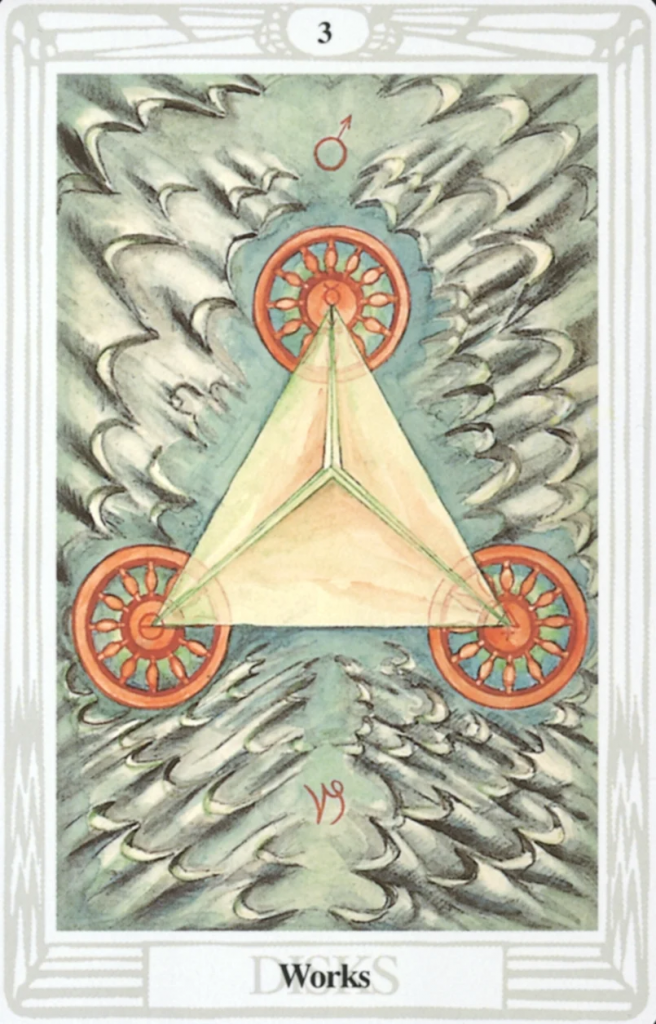
| The Three of Disks The Lord of Works is about concentrated effort in a specific area, which yields unexpected fruits as a reward. When we concentrate our energies and direct them skilfully at a single point, or hoped for end result, we create a stream of force to which most things must eventually surrender.The Three of Disks should be taken as a command to examine all areas of life, until we come across the apparently immovable object – then lean on it with all our might. In so doing, we take advantage of influences beyond ourselves which act as a lever to assist us in our endeavours.Often, the things which we need to focus on during periods like this will be ones where we feel negative, or thwarted, for we stand a much better chance of making good progress. Look for areas where you feel overwhelmed, overworked or inadequate, and then target them all day! You’ll be amazed at what it’s possible to achieve. Affirmation: “My Will flows in a perfect stream of force.” |
(Angelpaths.com)
Spiritual Realities with Donald Keys
New Thinking Allowed with Jeffrey Mishlove • Apr 26, 2025 • Archival Video Recordings This video is a special release from the original Thinking Allowed series that ran on public television from 1986 until 2002. It was recorded in about 1991. It will remain public for only one week. Donald Fraser Keys was the subject of Jeffrey Mishlove’s InPresence 0151 monolog, titled Earth’s Ambassador. In 1971, he founded an organization called Planetary Citizens. He also served as a speech writer for United Nations Secretary General U Thant. He has also been active in the World Federalists Association, and was deeply involved in the esoteric culture of the Arcane School. Here he describes his extensive interactions with alien intelligences associated with UFOs. Now you can watch all of the programs from the original Thinking Allowed Video Collection, hosted by Jeffrey Mishlove. Subscribe to the new Streaming Channel (https://thinkingallowed.vhx.tv/) and watch more than 350 programs now, with more, previously unreleased titles added weekly. Free month of the classic Thinking Allowed streaming channel for New Thinking Allowed subscribers only. Use code THINKFREELY.