Protestors gathered outside an Istanbul courthouse on Saturday where where detained Istanbul Mayor, Ekrem Imamoglu, faces questioning over allegations of corruption and terror links. The arrest of the major opposition politician has sparked consecutive nights of protests across Turkey with hundreds of protestors arrested by police.
Issued on: 22/03/2025 – 10:28 Modified: 22/03/2025
Huge crowds gathered outside Istanbul City Hall for a fourth night of protests over the arrest of Mayor Ekrem Imamoglu, who told police Saturday the allegations against him were “immoral and baseless”.
The demonstrations, which began in Istanbul on Wednesday, have since spread to more than 55 of Turkey‘s 81 provinces, sparking violent clashes with riot police in the country’s worst street protests in more than a decade.
Imamoglu’s arrest came just days before he was to have been formally named as the main opposition CHP’s candidate in the 2028 presidential race.
Following a night in which organisers said 300,000 protesters had rallied in Istanbul, there were similar numbers on Saturday. The boulevard outside the City Hall was a sea of red Turkish flags and angry banners reading: “Dictators are cowards!”
On the fringes of the rally, protesters once again clashed with riot police, who fired tear gas, rubber bullets and pepper spray and also used percussion grenades, AFP correspondents said.
Meanwhile, about 10 kilometres (six miles) away, around 1,000 protesters gathered outside Caglayan courthouse where Imamoglu was being questioned by prosecutors investigating the claims against him, another correspondent said.
Outside, police had set up a tight security cordon with nearly 20 anti-riot vehicles at the ready, as protesters stood nearby, chanting: “Shoulder to shoulder against fascism!”
Earlier Saturday, the 53-year-old mayor was quizzed by police for five hours. He denounced the accusations against him as “immoral and baseless”, he said in a statement released by City Hall.
“This process has not only harmed Turkey’s international reputation but has also shattered the public’s sense of justice and trust in the economy,” he said.
News of his arrest badly hurt the lira and caused chaos on Turkey’s financial markets with benchmark BIST 100 index closing Friday nearly 8.0 percent lower.
“We are here today to stand up for the candidate we voted for,” 30-year-old Aykut Cenk told AFP outside the court, holding a Turkish flag.
“Just as people took the streets to stand up for Erdogan after the July 15 (2016) coup, we are now taking to the streets for Imamoglu,” Cenk said.
“We are not the enemy of the state, but what is happening is unlawful.”
Journalists ‘targeted’
The unrest has spread rapidly despite a protest ban in Turkey’s three largest cities and a warning from Erdogan that the authorities would not tolerate “street terror”.
“For four days, they have been doing everything they can to disturb the peace and divide our people,” railed Erdogan on Saturday.
“The days when politics and justice are guided by street terror are totally in the past,” he said.
Earlier in the evening, Istanbul Governor Davut Gul said the authorities would not allow anyone to enter or leave the city who was “likely to participate in illegal activities”.
Police have arrested 343 people since the start of the protests, the interior ministry said on Friday.
Turkey’s Journalists Union claimed the police had “deliberately targeted” journalists, saying many had been “severely beaten, shot with rubber bullets and had equipment broken”.
Reporters without Borders (RSF) also denounced the “heavy-handed and completely arbitrary” violence against journalists, demanding those responsible be “severely punished”.
Despite Imamoglu’s detention, the CHP has vowed to press ahead with its primary on Sunday at which it would formally nominate him as the party’s presidential candidate.
It has pledged to open voting to anyone, not just party members, in the hope of garnering massive support for the beleaguered mayor, who is widely seen as the only politician capable of challenging Erdogan.
Observers said the government would likely seek to block the vote.
Support sound science and smart stories Help us make scientific knowledge accessible to all Donate today
The quest to send humans to Mars is on: US President Donald Trump talked about it in his inauguration speech this year. Such an epic endeavor could help to answer fundamental questions about the Red Planet, including the biggest question of all: Did Mars once host life — and does it still?
Central to those questions is the status of liquid water — the stuff of life — on the planet. It is now indisputable that there was once water flowing on Mars, but how much, and even why, is a matter of debate. More contentious still is whether liquid water may lurk somewhere on Mars even today.
Planetary scientist Bruce Jakosky
University of Colorado, Boulder
Bruce Jakosky, a planetary scientist at the University of Colorado, Boulder, has studied Mars from its deep interior to its surface for nearly 50 years: He helped with the 1976 Viking mission as an undergraduate student and has been involved with a number of other NASA Mars projects since. Knowable Magazine spoke with him about the hunt for water on Mars, a topic he has written about for the Annual Review of Earth and Planetary Sciences.
This interview has been edited for length and clarity.
How has the thinking about water on Mars changed over time?
Around the turn of the last century, astronomer Percival Lowell did an analysis that suggested there were canals on Mars that must have been created by intelligent beings. He made the front page of the New York Times talking not about whether there were canals and whether there were intelligent beings, but what they might be like, and how might we communicate with them. It was a very different time.
His ideas were never accepted by the astronomy community; it was always thought to be a trick of the eye that connected things and made it look like there were straight lines on Mars. When we finally sent spacecraft there, we didn’t see any features that aligned with his map of canals.
Starting in the 1940s, astronomers were able to make measurements that began to tell us about the actual nature of the Mars environment. When the first spacecraft flew by Mars in 1965, we determined that the atmospheric pressure was only around half a dozen millibars, and the average temperature was 50 degrees Celsius below freezing. That demonstrated that liquid water could not be stable; if I put a bucket of water out there, it would take a while, but it would freeze or evaporate.
Those were the last nails in the coffin for the idea that it could still be a warm, wet planet. But that didn’t kill the prospect of Martian life.
Mars missions have not found alien-built canals. But they have found plenty of other features that look like they were carved by liquid water. Just recently there were headlines saying that images taken by the Curiosity rover in 2022 show ripples from ancient, ice-free lakes; more recently there was news about signs of coastal sediments from an ancient ocean.
The evidence for liquid water around 4.3 billion to 3.5 billion years ago is now absolutely compelling. We’ve seen abundant evidence for ancient lakes within impact craters — I think they number in the hundreds now. The most compelling evidence is in Jezero crater: Where water entered the lake, it deposited a delta, a fan of sediment that had been carried by the water.
We also see evidence for mountaintop glaciers and valley networks that look like river tributary systems. And we see evidence for water having blurped up from within the crust in catastrophic flood channels. They released a lot of water. There are also minerals on Mars that would have needed water to form.
What was it like on Mars back then, 3 billion or 4 billion years ago?
Temperatures must have been warm enough to allow liquid water. But we don’t know exactly how warm. And we don’t know why it was warmer. But other than that, we really have a handle on it (laughs).
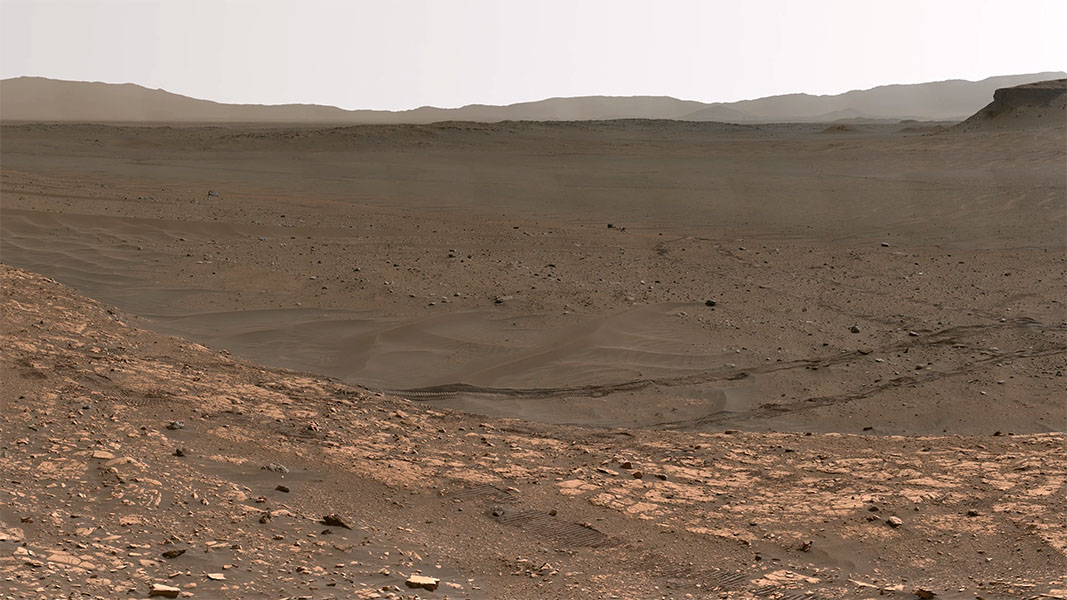
The Jezero Crater was home to an ancient river delta, one of many planetary features that speak of the Red Planet’s watery past. This image was captured by NASA’s Perseverance Mars Rover, which investigated the crater and left its track marks visible on the dusty terrain.CREDIT: NASA / JPL-CALTECH / ASU / MSSS
We certainly need a greenhouse gas to warm a planet, and carbon dioxide is a great greenhouse gas, so we think there must have been more carbon dioxide back then. But the Sun was 30 percent dimmer 4 billion years ago, and in our computer models you can’t put enough carbon dioxide in the atmosphere to raise the temperature enough. So you need another greenhouse gas on top of that to consider in the simulation. We are at the stage of “Let’s pick a gas and ask how much we need, and then ask, ‘Is it possible?’”
Also, the tilt of the Mars polar axis changes over time. What did that do to the climate? We don’t know.
How much water has there been on Mars, in total?
My 2024 paper calculates that if you took all the water that was ever present on Mars and spread it out, you could coat the planet in a uniform layer somewhere between 380 meters to 1,970 meters (0.2 to 1.2 miles) thick. On Earth, for comparison, the same kind of inventory would be a layer 1,400 meters thick. This isn’t a totally fair comparison: For Mars, that’s all the water from all time added up together, it wasn’t all on the surface at the same time. On Earth, most of it is in the ocean still today.
Long ago, Mars was much wetter than it is today. But even at its wettest, the Martian land was probably very dry: In these valley networks with runoff channels, the number of channels per square kilometer is similar to some of the driest areas on Earth, like the Sahara.
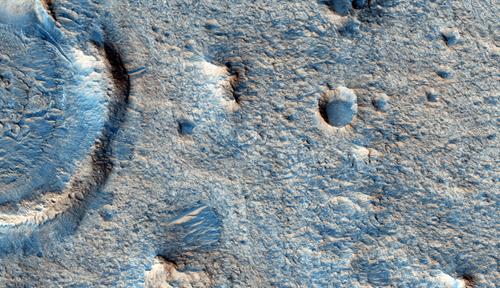
Glacier-like features, where a mass of material appears to have flowed downhill between two ridges, hint at where ice probably accumulated in the past in the mid-latitudes of Mars.CREDIT: NASA / JPL-CALTECH / UNIVERSITY OF ARIZONA
And today — how much water is on Mars now?
There’s a significant amount of water present as ice. At the poles, orbiters have seen ice a few kilometers thick; we can tell it’s water from spectrometers, and we can see the structure from radar. If you spread that ice globally, it would be a layer about 20 to 30 meters thick. There’s also some ice in mid latitudes.
There are trace amounts of water vapor in the atmosphere, orders of magnitude less than on Earth. But it can form clouds that affect the temperature, that affect the climate. There’s a robust water cycle: It can snow, but it’s too cold to rain.
The biggest uncertainty is whether there’s any water present deep within the crust. We think that there should be water there because it would have percolated into the crust from an early wet environment (this happened on Earth, too). We can estimate how much we think might be present there — it might be up to half of the total Martian water inventory. But we don’t know if it’s there.
Where did all the water go?
All the water from the large outflow channels flowed into a spot in the northern lowlands, and this would have formed a large lake — what happened to that is unclear. Did it evaporate, or did it freeze in place and get covered up by dirt and dust? We don’t know.
A lot of the water that was on Mars billions of years ago has been incorporated into minerals. And we calculated that a lot of the ancient water — at least 110 meters thickness if you were to spread it all over the planet — has been lost to space.
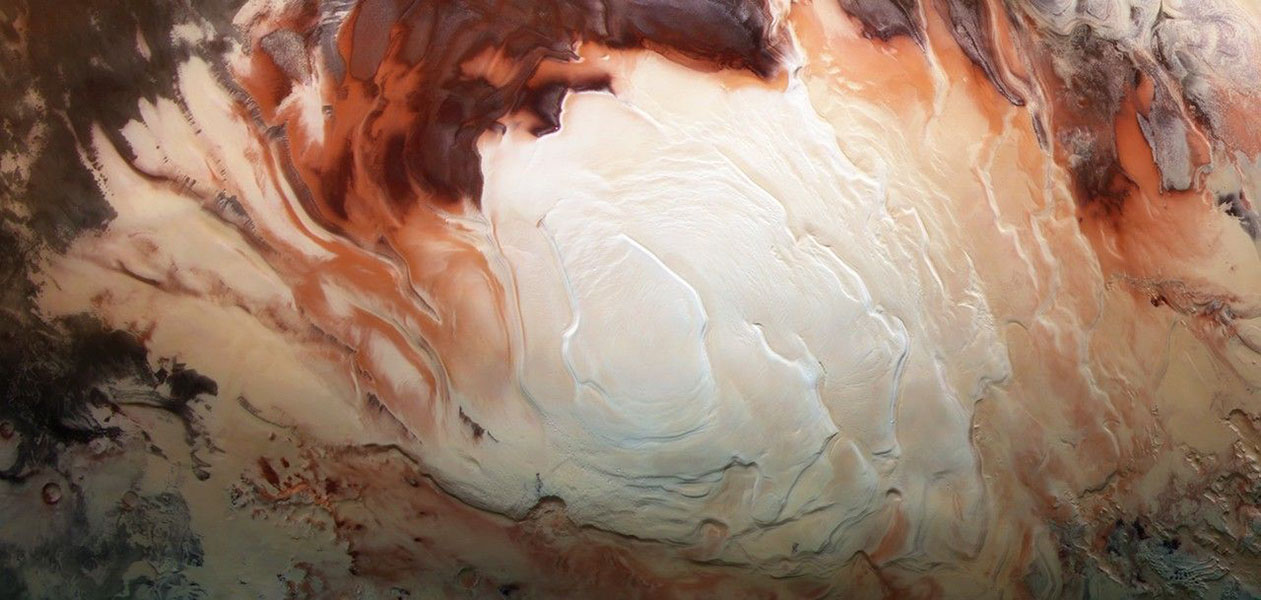
A close-up of Mars’ south pole shows a thick ice cap, thought to be made up of frozen water and frozen carbon dioxide.CREDIT: ESA / DLR / FU BERLIN / BILL DUNFORD
Why was so much water lost to space?
We used to think that the main driving force was that Mars lost its magnetic field and this led to a loss of its atmosphere, which allowed water to be stripped away. We now know it’s a lot more complicated than that. We’re still in the middle of trying to sort this out.
Is there liquid water anywhere on Mars today?
That’s the million-dollar question. In mid to low latitudes, we think there are trace amounts of liquid in the dirt, stabilized by minerals. With the Phoenix lander in the ’90s, we saw droplets of water kicked up by the landing. The amount of this water, though, is lower than is required for any Earth life.
There could be subsurface brines. But given the cold temperatures, it requires a lot of salt, and a very specific composition of salt, to have liquid water stable at the surface. Since we haven’t detected it, we don’t know what that might be like.
There’s a long discussion going back several years on whether they’ve detected layers of liquid water beneath the south polar cap. It comes out of the European radar instrument, and their interpretation was that, a kilometer down, there must be a layer of liquid water. But that has been under much debate, so I’m not willing to accept it yet.
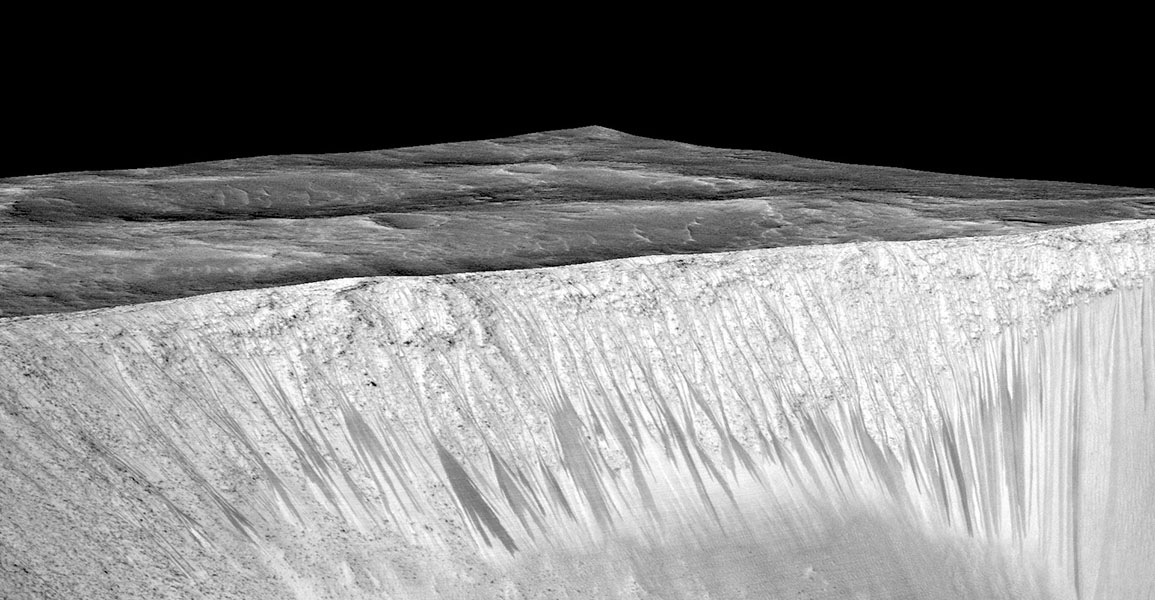
We have also seen features called recurring slope lineae: deposits that look like dark streaks that seem to grow and extend downhill. Orbiters have taken photos before and after their growth. These might be fed by fast-rising groundwater, perhaps, or a little bit of melting ice during summer that lubricates the flow. But a water origin of those features is not accepted yet. It could be dry avalanches. We’ve seen a lot of things on Mars, and on other planets, that have no good analogs on Earth.
Dark streaks called ‘recurring slope lineae’ have been spotted extending down the slope of craters like this one. Originally thought to be formed by flows of briny liquid water, more recent work suggests they may be formed by dry avalanches.CREDIT: NASA / JPL-CALTECH / UNIV. OF ARIZONA
If you wanted to look for liquid water, where would you look, and how?
If I wanted to look for larger amounts of liquid water near the surface, I would look for recent volcanism; we might find hydrothermal vents. We know that volcanism has been active up until geologically recent times, meaning the last few million years. We haven’t seen active volcanism, but that doesn’t mean it’s not there.
In the crust, if you get 2 to 3 kilometers deep, geothermal heating would raise the temperature to above the melting point of ice. It might be sitting in pore spaces microns to millimeters across, but that could still add up to a significant amount of water.
You could do electromagnetic sounding, the way that’s used to detect liquid water on Earth. So, if you put a rover down and had it do a loop and lay out an electrical cable over a kilometer or a couple of kilometers, you might be able to detect deep liquid water. I know people are thinking about it, but there hasn’t been an opportunity to propose a mission like that yet.
There’s evidence for life on Earth going back as far as 4 billion years ago. So, what are the odds that Mars had life back then, too?
That’s the question. Ancient Mars meets the environmental requirements for life: liquid water; access to “biogenic” elements like carbon, hydrogen, oxygen, nitrogen and a dozen others (which are still there today); and a source of energy from chemical reactions. Mars had all that.
What’s my bet? Either there was or there wasn’t, so it must be 50/50 (laughs). I decline to make a guess. Mars meets the requirements. It could have life. The only way we’re going to know is by going there and really looking.
What has the search for life on Mars found so far?
We tried twice with Viking landers in the 1970s. In hindsight, those experiments were ill- conceived. They were basically predicated on the basis of: Let’s take a sample of dirt and add in liquid water and organic nutrients and see if we get chemical reactions indicative of life.
“We’ve seen a lot of things on Mars, and on other planets, that have no good analogs on Earth.”
— BRUCE JAKOSKY
They had hints of positive results but it was complicated, and in the end, the consensus, the majority view, is that it did not detect life.
But today we know that 99.99 percent of microbes can’t be cultured in the lab because we’ve taken them out of their environment, and there’s something that’s missing, we just can’t get them to grow. So, what are the odds that we can go to Mars, throw in a random sample of organic molecules and culture any organisms? I think it’s very unlikely.
The Allen Hills meteorite, collected in Antarctica, came from Mars. In the 1990s, a group at Johnson Space Center put forward the idea that there was evidence within the rock for life. That’s no longer considered compelling or convincing, but we learned a lot about how to look for life.
What would convince you?
You need multiple measurements that all point, through different means, to life being present. So, for ancient life, if we found morphological fossils and organic molecules and isotopic evidence that all suggested life, that would be pretty convincing. For present day life, if we could identify organisms that are really different from terrestrial organisms, then we would know it’s not contamination, that we didn’t accidentally bring it to Mars from Earth, ourselves.
Unlike with the Moon, humanity hasn’t yet brought any samples back from Mars. What’s the plan?
There’s a plan for the Perseverance rover to collect samples and bring them back to study. We’ve sent the rover to a place where we know there was liquid water.
It’s a complicated mission. Perseverance is collecting samples, in tubes about the length of a cigarette and a centimeter wide, and leaving them on the surface in well-marked locations. Then we’ll send a spacecraft that will collect them, put them into a container about the size of a volleyball, put it onto a Mars ascent vehicle and launch it into orbit. Then a different spacecraft will orbit the planet, collect that volleyball and bring it back to Earth, but not until after 2030.
China is also planning what’s called a grab sample, where they land, scoop up something, maybe pick up a rock, put it in a rocket, send it back.
There have been more than 20 successful missions to Mars since 1965, including flybys, orbiters and landers by many nations. You were principal investigator on NASA’s Mars Atmosphere and Volatile Evolution (MAVEN) mission, which has been orbiting Mars since 2014. What has been its main achievement?
MAVEN is the only spacecraft that was devoted to understanding the upper atmosphere and the stripping of gases to space. It was very successful, but we still don’t know everything. Imagine trying to understand the history of the Earth from a handful of missions, without the benefit of hundreds of years of on-the-ground studies.
Stay in the Know Sign up for the Knowable Magazine newsletter today
What are the most exciting upcoming missions to Mars?
There are only two upcoming missions that I’m aware of. NASA’s Escapade — it’s a small orbiting mission — might launch later this year. It will look at the upper atmosphere as a complement to MAVEN.
The second is Rosalind Franklin. It was a joint ESA-Russia collaboration, originally going to be launched in 2020 but then delayed to late 2022. After the Russians invaded Ukraine that year, the European Space Agency withdrew from that collaboration. They took all the Russian hardware off the spacecraft, and they had to push back the launch date to 2028 at the earliest.
It is a lander and rover. The big thing that it’s going to do that hasn’t been done before is it will drill down 2 meters below the surface. At that depth, any organic molecules would be shielded from galactic cosmic rays or solar particles.
Should we send people to Mars?
I think, scientifically, it’s imperative. They can do so much more, so much more quickly than robotic spacecraft.
Science isn’t the only reason. Another reason is national prestige. A third reason is getting people excited about going into STEM (science, technology, engineering and math) careers.
It is doable. But it is really difficult, and it’s not cheap. The minimum numbers that are credible are $100 billion. Elon Musk is talking about being able to send people in four years. I think that ignores a lot of the problems, like life support, keeping people alive for the three years to do a round trip, and making enough fuel to get back. My bet is we are 10 to 15 years away from being able to send people.
Elon Musk has said, let’s abandon the Moon and go straight to Mars. I don’t know what President Trump is going to do.
Nicola Jones is an editor and writer who lives in Pemberton, British Columbia. Read more about her and her work on her blog.
Internet Mystic DataBase • Nov 14, 2024 • Explore the transformative practice of self-observation in the Fourth Way tradition, a method that brings conscious awareness to our thoughts, emotions, and actions. Through disciplined, nonjudgmental observation, you can break free from habitual patterns and reduce automatic reactions. This video dives into the essentials of self-observation, highlighting its role in achieving inner balance, reducing negative emotions, and fostering a unified, conscious self. Gain insights into building an inner observer that enables intentional and purposeful action, leading to greater self-awareness and inner freedom. Based on books such as In Search of the Miraculous, and The Psychology of Man’s Possible Evolution by P.D. Ouspensky, and Beelzebub’s Tales to His Grandson by G.I. Gurdjief.
New Thinkin Mar 20, 2025 Nichol Bradford, MBA, is the CEO & Founder of the Willow Group and the Executive Director and co-founder of the Transformative Technology Lab, Conference, and TT200 List. Prior to becoming a leader in Transformative Technology, Bradford was a senior executive in video games with responsibility for strategy, operations and marketing for major brands that include: Activision Blizzard, Disney, and Vivendi Games — including operating World of Warcraft China. Nichol is a graduate of Singularity University GSP15, has an MBA from Wharton School of Business in Strategy. She is author of a novel, The Sisterhood. Her website is https://www.nicholbradford.com/ In this interview, rebooted from 2019, she describes developments in the emerging industry of transformative technology. She points out that, in the next 25 years, enormous numbers of jobs will be displaced by automation. This challenge, and others, make it essential that people large numbers of people actualize more of their innate potential. Technology can assist in this process — particularly when it is scalable and can be afforded by the millions. She emphasizes a variety of technological advances while emphasizing the importance of ethics, privacy, and data sovereignty. New Thinking Allowed host, Jeffrey Mishlove, PhD, is author of The Roots of Consciousness, Psi Development Systems, and The PK Man. Between 1986 and 2002 he hosted and co-produced the original Thinking Allowed public television series. He is the recipient of the only doctoral diploma in “parapsychology” ever awarded by an accredited university (University of California, Berkeley, 1980). He is also the Grand Prize winner of the 2021 Bigelow Institute essay competition regarding the best evidence for survival of human consciousness after permanent bodily death. He is Co-Director of Parapsychology Education at the California Institute for Human Science. (Recorded on February 18, 2019)
New Thinking Allowed with Jeffrey Mishlove • Mar 21, 2025 This video is a special release from the original Thinking Allowed series that ran on public television from 1986 until 2002. It was recorded in about 1996. It will remain public for only one week. P. M. H. Atwater, a journalist, has written many books on exceptional human experiences, including The Big Book of Near-Death Experiences and Future Memory. Here she explains provides examples of individuals who report visions of the future that are as real and detailed as memories of the past. Now you can watch all of the programs from the original Thinking Allowed Video Collection, hosted by Jeffrey Mishlove. Subscribe to the new Streaming Channel (https://thinkingallowed.vhx.tv/) and watch more than 350 programs now, with more, previously unreleased titles added weekly. Free month of the classic Thinking Allowed streaming channel for New Thinking Allowed subscribers only. Use code THINKFREELY.
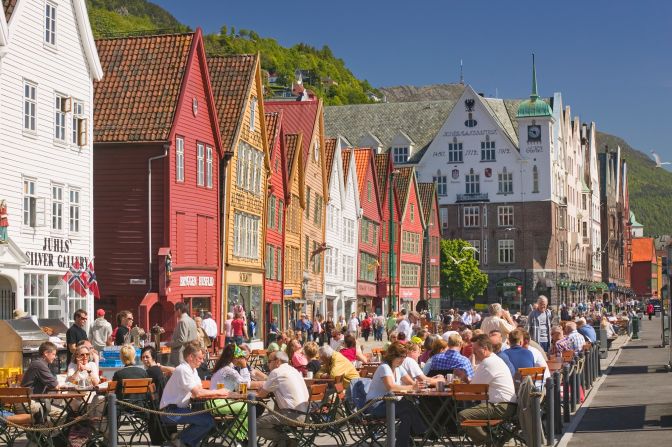
1. Finland is the world’s happiest country for the eighth year in a row, according to the 2025 World Happiness Report. Liuskasaari island is pictured.Mikko Huotari/Visit Finland
World’s happiest countries 2025
1 of 10PrevNextCNN —
The world’s happiest country has managed to keep its No. 1 ranking for eight years running. The picture in the United States isn’t so rosy.
While Finland once again tops the World Happiness Report’s rankings, the United States — at No. 24 — earned its lowest ranking yet in the 2025 report. The 13th edition of the annual report marks the United Nations International Day of Happiness on March 20.
In the United States and parts of Europe, declining happiness and social trust have contributed significantly to the rise of political polarization and votes against “the system,” the report finds.
But in brighter news, global research shows that people are much kinder than we expect.
“People’s fellow citizens are better than they think they are, and to realize that will make you happier, of course, but it’ll also change the way you think about your neighbors,” said John Helliwell, a founding editor of the World Happiness Report.
“And so you’re more inclined to think of a stranger in the street as simply a friend you haven’t met and not somebody who poses a threat to you,” said Helliwell, who is an economics professor emeritus at the University of British Columbia.
There’s “room for improvement,” Helliwell said, in believing that we’re all part of a larger group that looks out for each other. It’s an important source of happiness that we haven’t properly tapped, he said.
The report draws on Gallup World Poll data from people in more than 140 countries.Countries are ranked on happiness based on their average life evaluations over the three preceding years, in this case 2022 to 2024. The report is a partnership of Gallup, the Oxford Wellbeing Research Centre, the UN Sustainable Development Solutions Network and an editorial board.
The survey asks each participant to score their life as a whole and rankings are based on those life evaluations. The report then looks at six key variables to help explain life evaluations: GDP per capita, social support, healthy life expectancy, freedom, generosity and perceptions of corruption.
The happiest countries
Finland, with people gathered here in Helsinki, is ranked the world’s happiest country for the eighth year in a row. Julia Kivel/Visit Finland
When it comes to happiness, the Nordic countries are clearly doing a lot of things right. For the eighth year in a row, Finland is the world’s happiest country, with its neighbors clustered close behind.
“Nordic countries like Finland continue to benefit from universally available and high-quality health, education and social support systems. Inequality of wellbeing is also low,” said Ilana Ron-Levey, managing director at Gallup.
Finland, Denmark, Iceland and Sweden – the top four – remain in the same order as 2024. And Norway is again No. 7.
While social support systems that look out for residents’ welfare are important to Finland’s No. 1 ranking, the people play a role too, according to Helliwell.
“Having a welfare state doesn’t find lost wallets and return them to the owners,” said Helliwell, a longtime lost-wallet researcher, referring to data showing that Nordic nations rank among the top places for the expected and actual return of lost wallets. “Those are individuals caring about the people with whom they live.”
Other factors likely contribute to Finland’s strong performance as well. Helliwell said some Finnish experts point to the unity and trust that came out of the Winter War in 1939-40, also known as the Russo-Finnish War.
“They didn’t win that war, but what they did is they came together and realized even against overwhelming power they could do remarkably well … Sometimes the challenge posed externally can bring you together.”
A less materialistic mindset may also work in Finland’s favor, Helliwell said.
“And these days, to focus on the personal rather than the material is of ever-increasing importance.”
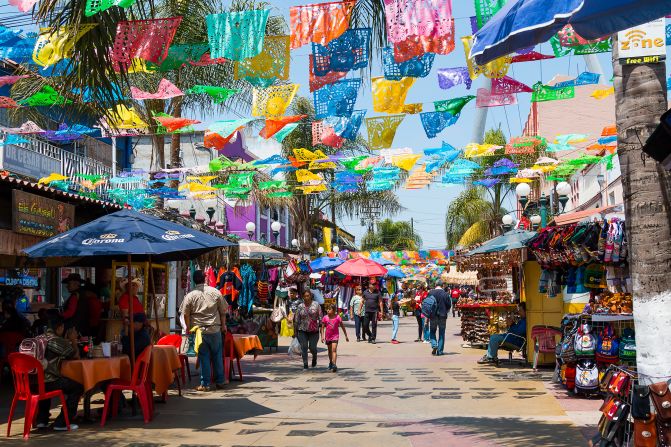
Two Latin American countries — Costa Rica at No. 6 and Mexico at No. 10 — both enter the top 10 for the first time in the 2025 report.
Both countries’ residents have “strong social networks and strong perceptions about the direction of their economy and confidence in leaders and institutions,” Ron-Levey said.
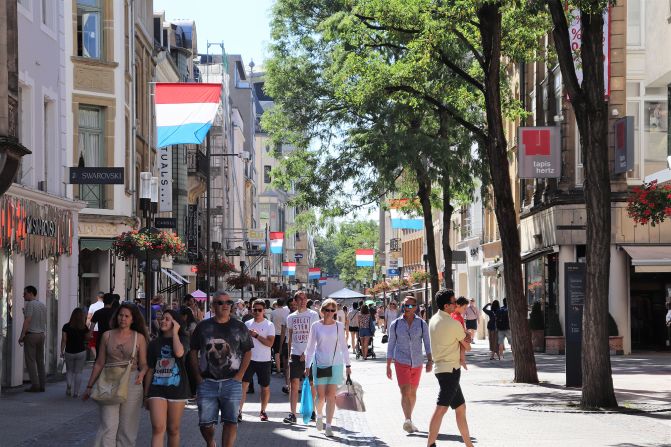
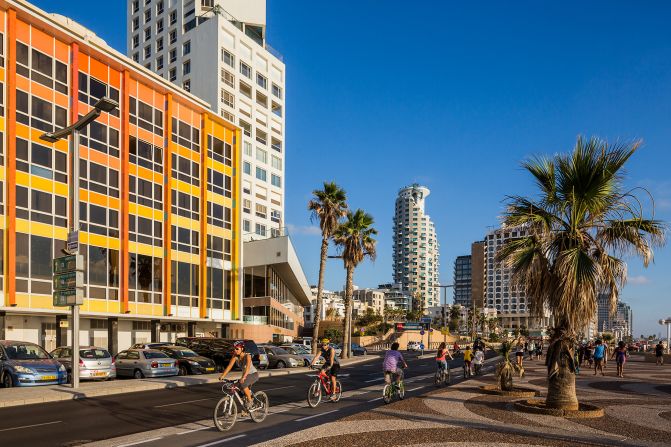
The Netherlands (No. 5), Israel (No. 8) and Luxembourg (No. 9) fill out the top 10.
Lowest ranking yet for the United States
After dropping out of the top 20 for the first time last year, the US ranks No. 24 in the latest World Happiness Report.
“The decline in the U.S. in 2024 was at least partly attributable to Americans younger than age 30 feeling worse about their lives,” said Ron-Levey. “Today’s young people report feeling less supported by friends and family, less free to make life choices and less optimistic about their living standards.”
Last year’s report paid special attention to happiness among different age groups, highlighting declines among the young in numerous countries.
The US isn’t the only English-speaking country with happiness challenges. At No. 23, the United Kingdom reported its lowest average life evaluation since 2017. Canada, which has seen happiness declines over the last decade, remained in the top 20 at No. 18.
While the variables that help explain life evaluations are complex, there is one “balm” that’s within everyone’s reach, Helliwell said.
“Look seriously at the people with whom you are working, with whom you are living, who are on your streets, and put on a rosier set of glasses when you’re dealing with them. And that’ll change your behavior in traffic. It’ll change your behavior in political discussions. It’ll change everything,” Helliwell said.
Talking less and listening more helps with attitude shifts that can lead to more cooperation.
“Negativity is poisonous to happiness,” he said.
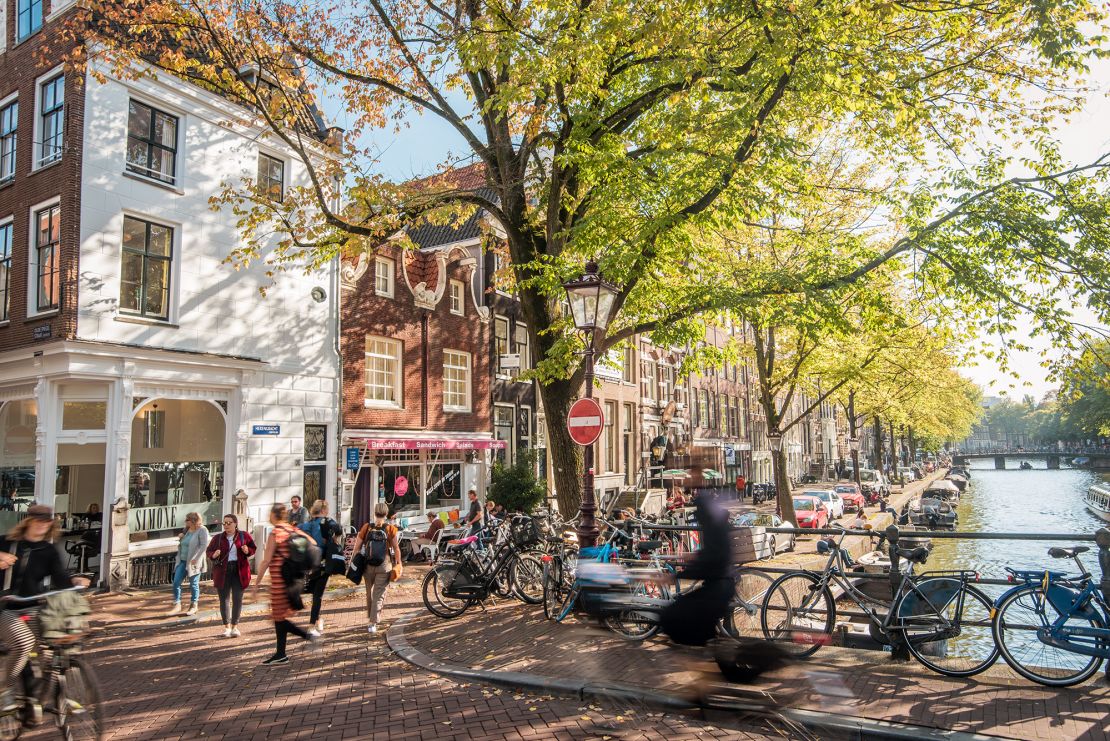
The Netherlands comes in at No. 5 in the 2025 rankings, right after four Nordic nations. Amsterdam is pictured. Koen Smilde/I Am Amsterdam
Afghanistan (No. 147) is once again last on the list. Sierra Leone (No. 146), Lebanon (No. 145), Malawi (No. 144) and Zimbabwe (No. 143) make up the rest of the bottom five for happiness.
Leadership isn’t about a title or position — it’s about generosity, says organizational expert Joe Davis. Drawing on his extensive experience as a people manager, he shares three essential tips for leaders to unlock the potential of their teams by listening generously, embracing vulnerability and leading with humanity — and shows how it’s possible to both earn trust and drive results.
According to P.M.H. Atwater, an investigator into near-death experiences, future memory allows people to “live” life in advance and remember the experience in detail when something triggers that memory. Atwater explains the unifying, and permanent, effect of that experience is a “brain shift” which she believes “may be at the very core of existence itself.”
The Fourth Mind is the first book ever to explore the anatomy, brains, genetics, beliefs and capabilities of the unknown entities the author refers to as “the visitors.” He maintains that they have a set of abilities he describes as a “fourth mind” that include such powers as telepathy, levitation, the ability to move heavy objects without machinery, and many others.
In John J. Prendergast’s decades of experience as a psychotherapist and spiritual teacher, the area of the body that’s most difficult for people to connect with, given our survival fear and trauma, is our physical and energetic ground. This area in the lower belly and at the base of the spine corresponds with the root chakra in the Indian subtle body tradition, the lower dan tien in Taoism, and the hara in Japanese martial arts. While most spiritual traditions focus on opening the mind and the heart, they tend to avoid or undervalue the opening of the ground.
Welcome to a world where participants in psychology experiments respond to pictures they haven’t seen yet… where physicists influence the past behavior of a light beam by measuring its photons now… and where dreamers and writers literally remember their future. This landmark text explores the principles that allow the future to affect the present, and the present to affect the past, without causing paradox.
Extraordinary Human Experiences (EHEs) include the near-death and out-of-body experience, extrasensory perception, synchronicities, reincarnation, spiritual awakenings, effects from psychoactive drugs, altered states of consciousness, and interactions with unidentified aerial phenomena and non-human intelligences, among others. The meaning and implication of EHEs have not been addressed by the scientific community, yet, they have impacted millions who consider them “realer than real,” facilitating the enduring fascination and curiosity of the unexplained and the boundaries of human consciousness.
It’s easy to say you have values — but how can you actually put them into action? Ethicist and rabbi Ira Bedzow helps people wrestle with this big question so they can navigate life with a sense of meaning and direction. He sits down with Shoshana Ungerleider, physician and host of the “TED Health” podcast, to discuss why you may have more than one singular purpose, how to define success on your own terms and the role of community in a fulfilling life.
It’s tonight! It’s the second of the presentation of the Salon Calvin Season. This is Salon Calvin’s presentation of the master storyteller William Shakespeare’s plays.
Storytelling is drawn from a personal odyssey of the author’s own path or the path of the author’s protagonist. It always begs to ask a question or point a finger to an issue or answer that may not be apparent to its audience until it is pointed out. storytelling is one of the most effective ways to connect with people’s hearts and minds.









 Calvin